Feature: Hot on the Trail

0

by Peter Seidman

Late last year, members of the AmeriCorps NCCC (National Civilian Community Corps) spent six weeks planting native plants as part of the wetlands restoration effort at Hamilton, the former airfield in Novato.

The team, comprised of a dozen 18- to 24-year-olds from across the country, planted 11,000 plants. Everyone on the team knew they were helping to create a large and functional seasonal wetland.

Restoring the wetlands at Hamilton is part of a larger plan to restore wetlands around San Francisco and San Pablo bays. Wetlands can provide one of the first lines of defense for shoreline communities facing the challenge of sea-level rise. Restoring wetlands accomplishes a multi-part benefit: It improves the natural environment; it improves the visual impact of the wetlands and shoreline; it keeps tidal surge at bay, to an extent.

And in the case of San Francisco and San Pablo bays, the wetlands restoration project serves as part of the foundation for completing the Bay Trail, which will encircle San Francisco and San Pablo bays with pathways and routes for pedestrians and bicyclists.

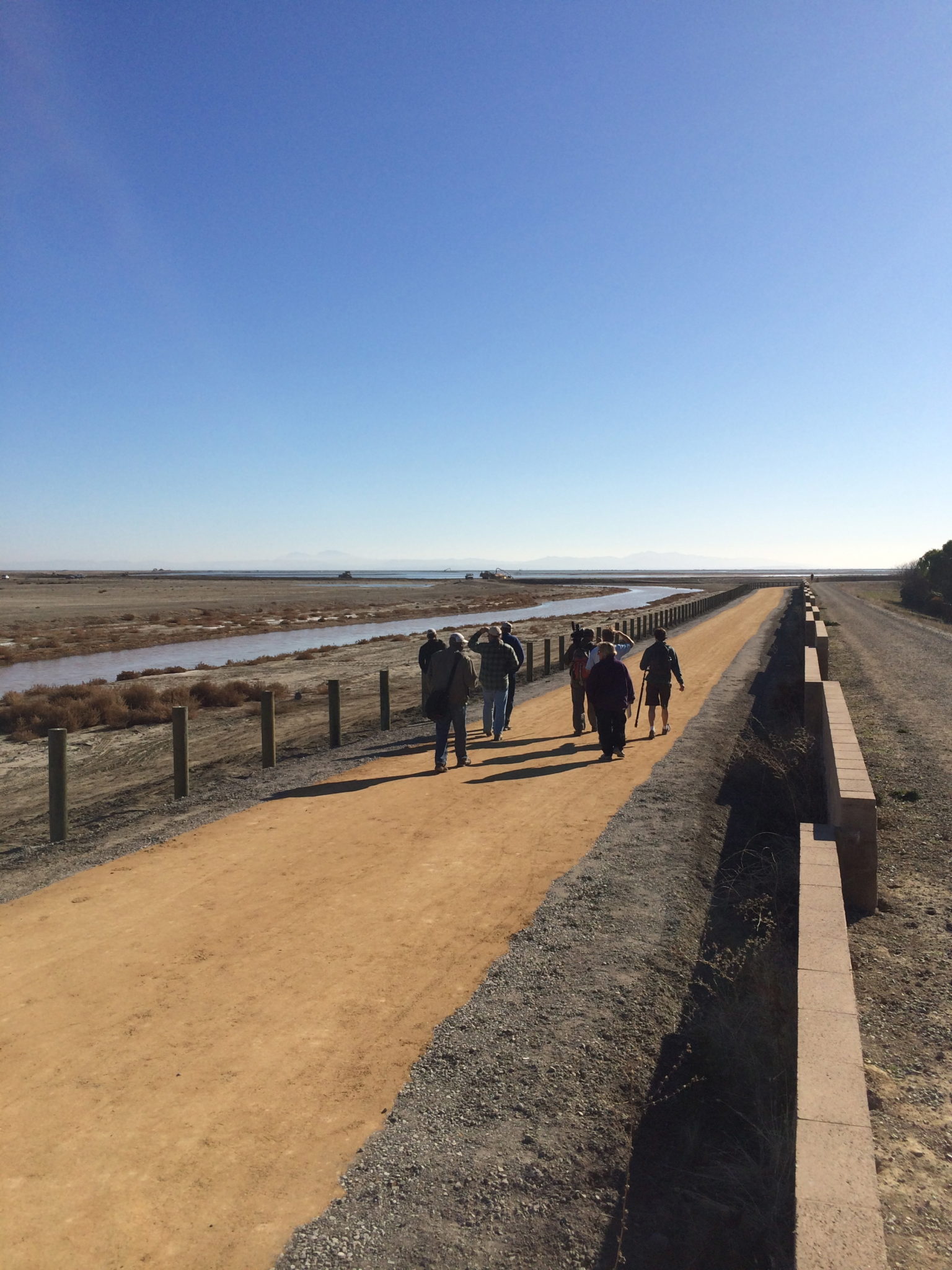
A segment of the Bay Trail includes a two-mile portion at Hamilton. The segment, which officially opened in the summer, offers Bay Trail travelers a look at the former airfield as well as the wetlands restoration and San Pablo Bay. The Hamilton segment also provides a look back in history to a time when the Bay Area—and Marin—played a role in protecting the safety of the nation.

Maureen Gaffney is a Bay Trail planner at the Association of Bay Area Governments (ABAG). Here are her impressions of the trail at Hamilton, along with information about a new audio tour that can be heard on iPhones and Android devices:

“The first time I heard the pitch for the smartphone app that talks while you walk, I was skeptical. In fact I believe the notion was greeted with a small snort and an eye-roll. Who wants to be squinting into their phone on a blissful Bay Trail stroll? The San Francisco Bay Trail is an ambitious plan—a 500-mile walking and cycling path around the entire San Francisco Bay, running through nine counties and 47 cities. With 340 miles in place, the trail was rightly described in the San Francisco Chronicle as “an unofficial national park—right in the midst of the nation’s fifth-biggest urban area.”

“Point” by Canogle is a new smartphone app enabled by GPS that seamlessly provides narrated content as you make your way down the trail. “It’s like having your own pocket storyteller!” says Doug McConnell of Bay Area Backroads fame. Bay Area Backroads was the small-town-feel and much-beloved television show that ran from 1993 to 2009, leading viewers to many hidden gems in the Bay Area. McConnell is now the welcoming voice of the Bay Trail smartphone app. With grant funds from the California State Coastal Conservancy, the San Francisco Bay Trail Project has created curated content for four parts of the trail: Richmond, Alviso, American Canyon and two segments at Hamilton.

The two segments of the Hamilton walking tour give Bay Trail travelers a chance to take in the natural environment as well as the historical significance of Hamilton.

About the Hamilton walk, Gaffney writes, “This former Army Airfield and Air Force base has been transformed radically over the past decade. McConnell weaves the fascinating story of the efforts to restore these 648 acres of thick concrete runways and abandoned structures into something approximating their original status as marsh and wetlands, supporting hundreds of species of fish, fowl and wildlife. Though the levee separating San Francisco Bay from this former airfield was only recently breached, fleets of white pelicans, sandpipers, avocets and a pair of mute swans now grace the landscape. As I took this in, my pocket tour guide [wove] a tale for me. During the Cuban Missile Crisis in 1962, ‘the flight crews at Hamilton Field and the Nike Missiles in the hills of Marin County were on the highest stages of alert … for several perilous weeks.’ As I watched a thousand birds wheel through the sky in front of me, I pictured young airmen sitting in their jets on the tarmac, engines running, ready to take to the skies for a much different purpose.”

The San Francisco Bay Trail Project, which is administered by the ABAG, will be a 500-mile circular route when all connections are complete, but as Gaffney says, it’s never really complete—at least for a while. A large part of the work-in-progress status comes because planners continually seek to realign the trail for a better experience. And as roads and the built environment change (as well as environmental restoration in some areas), the route of the trail accommodates.

But the overall concept remains the same: A trail that follows the circumference of San Francisco and San Pablo bays, providing a rim around the Bay Area. Spoke paths, trails and routes get added to the rim as they become possible, creating a transportation infrastructure for walkers and bike-riders who can enter the system from communities around the bays and then travel along the shoreline.

The Bay Trail is not a mere recreational add-on to the Bay Area’s playful nature and connection to the environment. It’s also meant to be a utilitarian route that can serve as a safe path for children and adults on bikes and on foot. The rules of the path, says Gaffney, are up to the individual communities the path traverses. That has played a role when a bicyclist struck a child on the Mill Valley-Sausalito multi-use segment and talk started about reducing the speed limit from 15 miles per hour to 10 miles per hour.

In addition to providing a recreational outlet for exercise and a utilitarian path to connect travelers to schools and work and transit, the Bay Trail also serves as a link connecting neighborhoods, points of interest and destinations such as beaches, fishing piers, boat launches and more than 130 parks and wildlife preserves totaling 57,000 acres of open space.

Completion of the Bay Trail has come a long way since the project started. It celebrated its 25th anniversary in 2014 with major accomplishments, such as the Hamilton segments, and also some sobering realizations that much still needs to be accomplished.

As of 2013, the state had contributed about $20 million in state bond funding for Bay Trail projects. Bay Trail planners and administrators used that money as leverage—more than $64 million since 1999. The funds generated went toward creating more than 60 miles of new trail construction and what planners call “project specific” planning for more than 130 miles of trail.

In Marin in 2013, dozens of gaps still existed and continue to exist. The gaps include what will one day become 43 more miles of trail, which are estimated to cost about $36 million.

The Bay Trail became inextricably linked, at least in concept and intention, with the Recovery Plan for Tidal Marsh Ecosystems of Northern and Central California.

The plan envisions a recovery effort that will last 50 years. That might seem like a long time, but the shorelines of San Francisco and San Pablo bays have a long way to go to recover from development and environmental pressure that stretches back about 150 years. Only about 8 percent (16,000 acres) remain of ancient marshland that totaled about 190,000 acres along the bay. But when counting the number of acres of tidal marshes, it’s critical to understand the concept of ancient marshes and “modern marshes,” areas that actually increased because of human influence. When the combination of ancient marshes and human-influenced marshes are combined, the number of remaining tidal marsh acreage still is a mere hint of what once ringed the bay.

Of the original tidal marshes in the bay system, about 35,000 were left by 1980.

The Tidal Marsh Recovery Plan seeks to use a variety of tactics. It hinges on volunteer efforts as well as support from various government agencies, from the federal level right down to local jurisdictions. In addition to calling for the creation of new wetlands, the plan also calls for continual research to stay attuned with changing environmental theories. Along the way, as theories alter, the plan can accommodate new thinking. The plan envisions an education component to attract the public—and a trapping program to relocate feral cats and non-native red foxes.

The recovery plan encompasses tidal marshes ranging from Humboldt Bay to Morro Bay, although areas in San Francisco Bay receive special attention. Richardson Bay, Bolinas Lagoon, Tomales Bay and areas in the Point Reyes National Seashore are also included in the recovery plan. All are critical habitats in the Pacific Flyway. The recovery plan is the second largest tidal marsh restoration and protection effort in the country, second only to the restoration of the Florida Everglades.

Many programs and projects are folded into the recovery plan. The state Coastal Conservancy, for example, worked on the major project at Hamilton. That project also incudes an area at Bel Marin Keys. In the South Bay, a massive project to reclaim salt ponds is underway, and restoration of tidal marsh at Crissy Field has achieved success. Those individual projects and many others that ring San Francisco, San Pablo and Suisun bays all represent key links in a chain. The ultimate goal of the South Bay Salt Pond Restoration Project is a contiguous strip of tidal marsh along the entire shoreline in the Bay Area. That’s also a central goal for other segments of the restoration project. In some areas there’s development right up to the bay, but it’s part of the plan to have as much of a strip of tidal marsh as possible. The Bay Trail can sometimes act as a non-motorized-vehicle and pedestrian buffer between restored wetlands and the automated communities inland.

That’s important because unless species can roam in a marsh environment, they become isolated in what amounts to an isolated ecological zoo.

SB 100, authored by then-Senator Bill Lockyer directed that ABAG should create a “ring around the bay.” The bill passed in 1987. Two years later, ABAG adopted a set of policies and alignments for the first incarnation of the Bay Trail.

The first policy in the document states, “In developing the trail alignment, attention was focused on providing a realistic route for trail development, consistent with the need to balance the constraints posed by the different natural and built environments around the bay. Use of the spine and spur trail system provides the means to accomplish this goal.”

On the Bay Trail website, a number of benefits that the Bay Area bestows are listed. The last benefit on the list: “Finally, by linking all nine Bay Area counties and 47 cities, the Bay Trail reminds us of our shared connection to San Francisco Bay and reinforces the Bay Area’s growing sense of regionalism.”

That may inflame those who reject regionalism and regional planning, or at least the acceptance of a sense of regional identity. It also may spark conspiracy theories among those who believe ABAG’s real goal is to homogenize the Bay Area—including Marin.

But using a bit of twist of a saying from a famous Republican conservative, it can be said that a defense of ABAG in the creation of the Bay Trail is no vice.

Sometimes good things do come in big packages.

Contact the writer at pe***@******an.com.
Downtown Streets Team collect 1 million cigarette butts

0

by Janelle Moncada

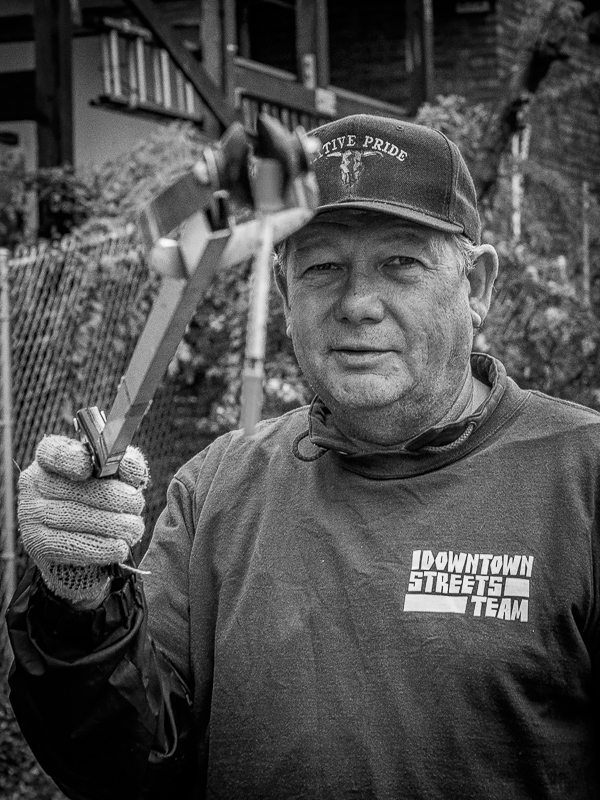
The streets of San Rafael are looking much cleaner thanks to the Downtown Streets Team (DST), an organization that gives homeless and low-income men and women the resources they need in order to help rebuild their lives in exchange for time spent cleaning up downtown San Rafael, as the team has picked up over 1 million cigarette butts in less than a year.

DST contributes most of its time volunteering by picking up litter and removing graffiti.

In 2013, DST joined the San Rafael Clean Coalition and immediately accepted the challenge of eliminating cigarette litter across downtown.

Since early 2014, DST began collecting and sending cigarette butts to TerraCycle, a company that is funded by the Santa Fe Natural Tobacco Company, to be recycled into industrial pallets used to make park benches, railroad ties and more.

According to a press release on Jan. 21, more than 1 million cigarette butts have been collected in the time span of less than one year. According to Andree Jansheski, owner of Bellam Self Storage and Boxes and sponsor of the program, an estimation of “over 10,000 butts are littered every three to four days in San Rafael.”

Despite the constant discarding of cigarette butts, Andrew Henning, DST’s Marin County regional director, is quite proud of what his team has accomplished.

“I honestly never imagined we would collect so many butts so fast,” Henning says. “I am incredibly proud of our team members’ hard work diverting this toxic litter from our creeks and waterways, while also working to show that those who are homeless can be part of the solutions to the challenges our community faces.”

In order to keep the streets clean, San Rafael Clean will be working to install cigarette receptacles in the downtown area sometime this year.

Avanti Awards take place in Mill Valley

0

by Janelle Moncada

Every year, a selection of people who are driven by their passion of music and the arts are acknowledged during the Avanti Awards Dinner and Artist Showcase.

On Jan. 23, four new members of the Avanti Award program were honored at the Mill Valley Community Center. Each were highly recognized and awarded financial assistance for exceptional musical talent.

Following the footsteps of the Brucia legacy since the early 20th century, the Joseph and Frances Brucia Foundation supports gifted artists and their passions by honoring these individuals through the Avanti Award grant program. The grant given by the foundation provides artists with the opportunity to “Go Forth and Seek their Artistic Passion.”

As the lights began to dim, the four new artists, along with two 2014 Avanti Award recipients, each took the stage and showcased his or her musical talent for the audience.

Nolan Ramirez, a senior at the Ruth Asawa San Francisco School of the Arts, is now able to take a step further toward his dream of becoming a classical singer. Ramirez noted that his journey has been challenging, mainly due to financial limitations. His goal is to attend a musical art program that is specific to his field of interest. However, with the help of the grant, Ramirez will now be able to pay for travel expenses as he auditions for music schools across the nation.

For singer-songwriter, Preston Powis, his music is a combination of “cinematic sounds and orchestral, symphonic and operatic elements.” Powis says that his songwriting is based off of experiences that tell the truth. During his performance, the audience was blown away as a pre-recorded video of an orchestral ensemble accompanied his performance. With his Avanti Award, Powis will be able to produce his latest single, “Champion,” which will include an orchestra and studio musicians.

After moving to the U.S. at age 17, Juan Mejia was able to pursue his cellist career as he completed his bachelor and master of music degrees at the San Francisco Conservatory of Music. He is now a “soloist, teacher and cellist of the Triple Wavelength Trio and the Da Jeong Piano Trio.” He is also a part of a few organizations which offer musical training and academic support to young people.

Falling in love with the classical guitar is what led Iren Arutyunyan to her passion. After arriving in the U.S., Arutyunyan won many awards, including most outstanding performer from the Armenian Allied Arts. After receiving her bachelor and master’s degree in music at USC, she began teaching to a diverse group of students. With her Avanti Award, Arutyunyan plans to finish her debut album.

For the 2014 Avanti Award recipients, Olivia Cosio and Rodrigo Castillo have also come a long way post-Avanti Award win. Both are vocalists, who have received recognition from many other foundations since winning their awards.

It is no wonder how each artist was able to impress the audience with their incredible talent. With the money donated by many contributors and sponsors, each person is now able to put more effort into their journey toward fulfilling his or her goals within the music industry.

Style: The lean closet movement

by Katie Rice Jones

The irony is not lost on me that my most chic friend, Liz, is also the one with the least clothing. As far back as our early 20s, and long before it had a proper name, Liz has been unofficially participating in the Lean Closet Movement. For her, making do with less was more than just a way of dressing; it has always been a way of life.

Fast-forward to 2015: the Lean Closet Movement, coined by San Francisco’s lifestyle brand Cuyana, is picking up momentum. While there may be a myriad of reasons for its acceptance, I believe the foremost is a planetary one. These days, thoughtful people aim to reduce their carbon footprint and buying less, of everything, helps ensure this.

However my intimate introduction to the movement was not as noble in cause. It came to me by way of my first pregnancy. Maternity wear can be expensive and I didn’t have the funds to wardrobe my burgeoning bump as a fashion stylist would like. The bigger I grew, the smaller my closet’s options got. Gradually my closet was pared down to only a handful of stylish maternity pieces.

After the birth of Evelyn, I highly anticipated a triumphant return to my closet full of regular clothes. But once I finally got down to my pre-bump size and could wear the stuff, the return lacked luster. In fact, living for nine-plus months with little-to-wear left me changed. For one, I got really good at making less look like more; and two, I now longed for a clutter-free closet. By the time Evelyn was 6 months old, I scaled down my closet substantially by donating those items that were:

  • „ Too small
  • Collecting dust
  • Unflattering
  • Impractical
  • Dated
  • Of a former life or career (ball gowns and suits)
  • Poor quality and cheap construction
  • Not my personal style

With this said, you don’t need a monumental lifestyle change, like a birth, to make a change in your closet. If you, too, long for a clutter-free closet, my advice is to start out slow. Here’s one long-term way to donate large quantities of clothing and limit that nagging feeling that you might wear them again.

  1. Get a large box.
  2. Put those pieces that are habitually unworn in it.
  3. Store the box (somewhere other than in your closet).
  4. Wait 12 months (four seasons).

If you find that you haven’t opened the box within that year, tape it up and donate the entire box to Goodwill. Then, don’t look back.

Katie Rice Jones is the Pacific Sun’s lifestyle editor-at-large, a Marin-based style expert and author of the maternity fashion book titled, Fashion Dues & Duen’ts; a Stylist’s Guide to Fashionably Embracing Your Baby Bump (Know Act Be Books, 2014). Available NOW at Amazon.com. Learn more at FashionDues.com.


Video: A disappearing act

by Richard Gould

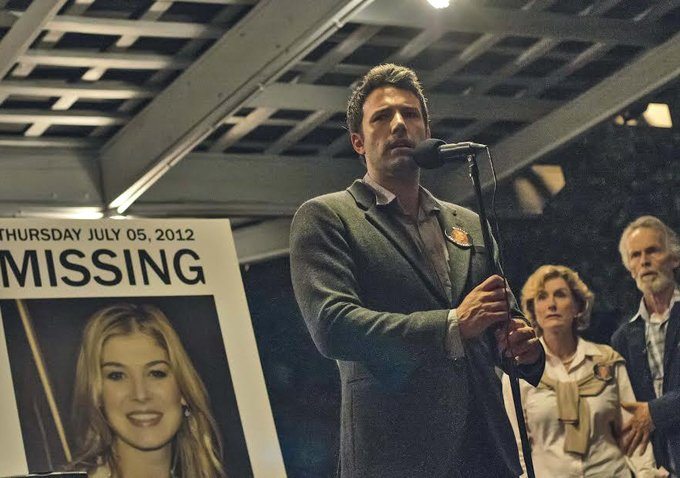
If you’ve made it to late January without learning the surprises GONE GIRL has in store, then you’ve been on full spoiler alert, and congrats. I’ll offer none here except to say that this is David Fincher’s very best film, a thriller that unsettles to its bones, with a spiritual heft that Alfred Hitchcock would instantly spot as his own. Adapted from Gillian Flynn’s best-selling novel of a disappeared wife–suspicion gathers on her husband as the story spreads to smalltown Missouri, then to the cable news circus–the film turns a sardonic gaze on those familiar pantomimes dragged out of friends and family when tragedy morphs into “true crime” for the world’s consumption. But along with this crime’s telegenic press-conferences, hotlines, candlelight vigils and compromising photos gone viral, a ghost of special unease seems to hover over the Dunne household. Hubby Nick at the hurricane’s eye is off-key emotionally and not forthcoming to police, and sorting out the couple’s increasingly suspect home life falls to homicide detective Rhonda Boney (Kim Dickens). Fincher, whose craft and maturity always seemed miles ahead of the post-adolescent stories that brought him fame, seems freed here to tackle some demons much closer to home–right at the breakfast table, in fact. That, along with two indelible performances and a haunting score, makes the film a neo-noir landmark. Can the dings of real life and simple betrayal call up the weapons of social pathology? Ben Affleck and Rosamund Pike star in a stirring tale of love and marriage, taken to its natural conclusion.

The Savior cometh and Comcast does it again

0

by Nikki Silverstein

HERO: Even the agnostic among us should believe that State Assemblymember Marc Levine is the coming of the Savior to Marin. (First or second coming, your choice). Last Tuesday, the San Rafael Democrat introduced urgency legislation (Assembly Bill 157) to speed up restoration of the third lane on the Richmond-San Rafael Bridge. AB 157 will require project design to get underway while the project is going through an environmental review, which could speed up the process by as much as 18 months. “The Richmond-San Rafael Bridge is one of the worst bottlenecks in the North Bay evening commute,” Levine said. “This bridge was built and designed almost 60 years ago to have three lanes in each direction.” Make it happen and Marinites will worship you every night on their way home.

ZERO: After Comcast Zero ran last week, readers inundated us with Comcast tales, some so twisted that Kafka and Heller would have been jealous they didn’t think up the plots. Then, there are stupid stories pointing to Comcast’s incompetence or its corporate philosophy of not giving a hoot. For example, Comcast’s customer service office on Andersen in San Rafael closed at the end of last year. Phone reps were clueless and even the website listed the Andersen address. Eventually, a note was placed on the old office door, which directed customers to the Northgate Mall. Wrong. The new service center is actually located in a strip center down the street from the mall, at 172 Northgate One Center. Bring a book. It’s packed in there.

Music: Finger-pickin’ good

0

by Greg Cahill

You might expect to find insights into guitar-playing on Leo Kottke’s website—after all, Kottke is one of the heirs to American primitive guitar pioneer John Fahey and an inspiration for such next-gen solo-guitar improvisationalists as Kaki King.

Guess again.

What you’ll find is an essay on Kottke’s brief stint as … a trombonist—a tome that captures the artist’s pithy, self-deprecating wit.

“Studying with three teachers in three years, I was a trombone student in Oklahoma until I was about 15 years old,” he writes. “Each weekend at one of their houses I’d wait in the kitchen until the trombonist in the basement would yell up at me to come down—they all taught in their basements.

“I would descend, assemble my horn, sit in a folding chair, park my sheet music on the stand, weather some insult aimed at my embouchure, and play whatever I had not been studying for the last week.

“My teachers—industrious, frugal, starving men—had one thing in common other than my unpreparedness: they’d all installed do-it-yourself showers in those basements. These units stood in some corner, usually my corner, and they’d drip … ploink, ploink.

“There was nothing more ominous than basements with leaking showers in them, and there was no telling when fear began, but my trombone kept those home improvements at bay.

“I was a hero.”

Of course, this sort of humor is to be expected from a musician who in the liner notes to his landmark 1969 album 6- and 12-String Guitar, released on Fahey’s Takoma label, likened his playing to “geese farts on a muggy day.”

The Georgia-born Kottke developed his love for Americana while moving a dozen times as a child. And he developed his precise fingerstyle-guitar-playing while absorbing the country blues of Mississippi John Hurt. Over the years, he’s released a string of critically acclaimed albums, mostly solo guitar, sometimes singing, sometimes not. But there have been exceptions: His 1991 album Great Big Boy, produced by Steve Berlin, who also provided band arrangements, featured guests Lyle Lovett and Margo Timmins of the Cowboy Junkies. On 2005’s Sixty Six Steps, his last album, Kottke teamed up with longtime collaborator and ex-Phish bassist Mike Gordon.

Despite his decade-long hiatus from the recording studio, at 69, Kottke continues to do what he has done for decades, playing the role of traveling troubadour, rambling from city to city with an acoustic guitar and a good reading book, taking to the stage and holding the audience’s rapt attention with wit and steel-string wizardry.

What more can you expect from a guy who holds a Certificate of Significant Achievement in Not Playing the Trombone from the University of Texas at Brownsville with Texas Southmost College?

Ask Greg about his Certificate of Significant Achievement at gc*******@***il.com.

Advice Goddess

 by Amy Alkon

Q: My boyfriend of eight months was with his ex for almost five years. Unfortunately, she passed two years ago. I have sympathy for him, but occasionally he’ll call me by her name, and it’s really upsetting. I feel like she’s haunting his brain, and I don’t know how to do an exorcism. How do I take my rightful place in his life?—Can’t Compete

A: If you’re putting on some skimpy somethings to get your boyfriend in the right mindset in bed, ideally, they aren’t three strategically located “Hello, My Name Is…” stickers.

It’s understandable that you’re feeling bad, but his detours into Wrongnameville probably don’t mean what you suspect they do. Using the wrong name is what memory researchers call a “retrieval error,” describing how an attempt to get some specific item from memory can cause multiple items in the same category to pop up. Basically, your brain sends an elf back into the stacks to get the name to call someone, and he just grabs the first name he spots that’s associated with “girlfriend” and girlfriend-type situations. (Lazy little twerp.) This sort of cognitive error—following a well-worn path (five years of grabbing the late ex’s name)—is more likely when a person is tired or preoccupied. In other words, your boyfriend’s name-swapping may be a sign that he needs to stop multitasking; it doesn’t necessarily mean he’s been taping a cutout of her face over yours in his mind.

There is a solution, and no, it doesn’t involve inventing a time machine so he can go back 20 years and get in the habit of calling all women “babe.” It turns out that a person can get better at retrieving the right name with practice. Cognitive psychologist Gordon Bower explained in Scientific American that the one making the error needs to consistently correct themselves or be corrected and then repeat the right name a few times. It would be best if you correct him teasingly, and perhaps incorporate visual aids like homemade flashcards—ideally of you in various states of undress with your name on them.

Assuming he isn’t trudging around in all black like a Fellini film widow or putting the ex’s urn between you two in bed, it might help to consider how he is when he’s with you: Engaged? Loving? Present? If so, do your best to focus on this—lest you be tempted to go low-blow and tit for tat and start screaming out dead men’s names in bed: “Ooh, Copernicus … Oh, my God, Cicero … I mean, take me, Archimedes!”


Q: My boyfriend just broke up with me but wants to “stay friends” and keep hanging out on those terms. (He says, “My life is much better with you in it.”) I’d like to be friends eventually, but I told him that it’s just too painful and confusing to see him now. He says I’m being dramatic and unreasonable and keeps calling.—Broken

A: This guy’s notion of how a breakup should work is like telling an employee, “Hey, you’re fired, but please feel free to come in a few times a week and do some light janitorial work.”

A breakup is supposed to be an ending, not a “let’s continue as if very little has changed, and I’ll pretend not to notice those big wet mascara stripes down your cheeks.” Research by clinical psychologist David Sbarra confirmed what most of us already know about getting dumped—that contact with your former partner while you’re trying to recover jacks up feelings of love and sadness, setting back your healing. You need time and distance to process and accept the change in your relationship; you can’t just send a memo to your emotions, ordering them to recategorize the guy: “Cut the love. From now on, respond to him like he’s a brick or maybe a lamp.”

It’s wonderful to have a man who insists on standing by you, but not because it’s better for him than respecting your need to go away and lick your wounds. This is not friend behavior. If, despite that, you want him in your life down the road, inform him that for now, you’ve made a “no contact” rule—lasting until you feel ready to see him on different terms. When he (inevitably) tries to break it, politely reiterate it and end the conversation. The sooner he’s out of your daily life the sooner you’ll be open to a new man—dreamy as it would be to spend lazy afternoons at your ex’s place writing him letters of recommendation for prospective girlfriends and Photoshopping your arm out of pictures so he can post them on Tinder.

Theater: Open season

0

by Charles Brousse

Although for many who work in live theater the December holidays are a welcome respite, one group doesn’t share this luxury. These unfortunates have an early January opening to get ready for, forcing them to juggle family, friends and rehearsals as best they can. Here’s a quick rundown on Marin’s first 2015 arrivals.

Landless (AlterTheater): Since the title and much of the content of Larissa FastHorse’s new play is about various kinds of homelessness, it’s more than appropriate that it should have been commissioned, developed and given its world premiere by San Rafael’s AlterTheater, a company that beats the high cost of owning or renting a performance space by utilizing temporarily vacant Fourth Street storefronts.

Based on interviews that FastHorse conducted with neighboring merchants, Landless opens with a folksy monologue by a fictional local businesswoman named Natalie (Emilie Talbot),  in which the area’s characteristics are described in terms that recall the stage manager’s resonant verbal portrait of Grover’s Corners in Thornton Wilder’s Our Town. Curiously, though, the narrative device that Wilder used so effectively to tie everything together is immediately abandoned and the task is left to the play’s central characters, shop owner Elise (Patricia Silver) and her unofficially adopted son and partner, Josiah (Nick Garcia), to tell their story through a series of flashbacks.

Decades earlier, Elise inherited a family-owned general merchandise store. Soon thereafter, Josiah, then a young boy who claimed to be of Native American descent, wandered in saying he was trying to escape his domineering father (versatile Michael J. Asberry in one of several roles). She helped him out and they have worked together ever since. Unfortunately, a combination of declining business and pressure to pay off an ill-advised loan is now forcing her to close down. As the auction of unsold goods draws near, these glimpses into the past reveal the issues that have alternately united and divided them both personally and with their respective communities over the years.

It’s a truly formidable list. In addition to joint financial woes, Josiah has racism and problems with his tribal membership and homosexuality to deal with. Elise’s promotion of a downtown homeless shelter and ambivalence toward projects like a Walmart and an Indian casino raise the hackles of fellow merchants and she becomes increasingly frustrated by being stuck in a glass-windowed “prison” (the shop) of her own making. Given FastHorse’s demonstrated ability to write realistic dialogue, one or two of these conflicts could have been the basis of a compelling story. Lumped together, they create a confusion of overlapping themes, accompanied by abrupt shifts in time and characters that are never satisfactorily resolved by co-directors Jeanette Harrison and Ann Brebner (assisted by dramaturg Duca Knezevic).

*   *   *   *   *

Impressionism (Ross Valley Players): You have to wonder how a theater that in recent years has displayed pretty good judgment in their play selections would suddenly opt for three weak scripts in a row. First came Ken Ludwig’s sophomoric Fox on the Fairway, then a tedious stage adaptation of Jane Austen’s novel Persuasion, and now there is Impressionism, which gussies up a cliched love story (after many trials, two lonely souls eventually end up sitting happily together on a park bench after discovering there is more to life than work) with comparisons to the great early 20th century impressionist painters who discovered that there is more to people, objects and the world in general than what can be seen up close.

Playwright Michael Jacobs, whose background is mainly in family television, offers his pseudo profundities with disturbing nonchalance, leaving director Billie Cox and actors Mary Ann Rodgers (the gallery owner) and Tom Reilly (the photo journalist)—assisted by a hard-working ensemble—with the daunting challenge of making them go down smoothly. When Impressionism had a brief New York run in 2011, almost all the reviews were negative. RVP should have been warned.

Charles can be reached at cb******@*tt.net.  

Feature: Hot on the Trail

by Peter Seidman Late last year, members of the AmeriCorps NCCC (National Civilian Community Corps) spent six weeks planting native plants as part of the wetlands restoration effort at Hamilton, the former airfield in Novato. The team, comprised of a dozen 18- to 24-year-olds from across the country, planted 11,000 plants. Everyone on the team knew they were helping to create...

Downtown Streets Team collect 1 million cigarette butts

by Janelle Moncada The streets of San Rafael are looking much cleaner thanks to the Downtown Streets Team (DST), an organization that gives homeless and low-income men and women the resources they need in order to help rebuild their lives in exchange for time spent cleaning up downtown San Rafael, as the team has picked up over 1 million cigarette...

Avanti Awards take place in Mill Valley

by Janelle Moncada Every year, a selection of people who are driven by their passion of music and the arts are acknowledged during the Avanti Awards Dinner and Artist Showcase. On Jan. 23, four new members of the Avanti Award program were honored at the Mill Valley Community Center. Each were highly recognized and awarded financial assistance for exceptional musical talent. Following...

Style: The lean closet movement

by Katie Rice Jones The irony is not lost on me that my most chic friend, Liz, is also the one with the least clothing. As far back as our early 20s, and long before it had a proper name, Liz has been unofficially participating in the Lean Closet Movement. For her, making do with less was more than just...

Video: A disappearing act

by Richard Gould If you've made it to late January without learning the surprises GONE GIRL has in store, then you've been on full spoiler alert, and congrats. I'll offer none here except to say that this is David Fincher's very best film, a thriller that unsettles to its bones, with a spiritual heft that Alfred Hitchcock would instantly spot...

The Savior cometh and Comcast does it again

hero and zero
by Nikki Silverstein HERO: Even the agnostic among us should believe that State Assemblymember Marc Levine is the coming of the Savior to Marin. (First or second coming, your choice). Last Tuesday, the San Rafael Democrat introduced urgency legislation (Assembly Bill 157) to speed up restoration of the third lane on the Richmond-San Rafael Bridge. AB 157 will require project...

Music: Finger-pickin’ good

by Greg Cahill You might expect to find insights into guitar-playing on Leo Kottke’s website—after all, Kottke is one of the heirs to American primitive guitar pioneer John Fahey and an inspiration for such next-gen solo-guitar improvisationalists as Kaki King. Guess again. What you’ll find is an essay on Kottke’s brief stint as … a trombonist—a tome that captures the artist’s pithy,...

Advice Goddess

advice goddess
 by Amy Alkon Q: My boyfriend of eight months was with his ex for almost five years. Unfortunately, she passed two years ago. I have sympathy for him, but occasionally he’ll call me by her name, and it’s really upsetting. I feel like she’s haunting his brain, and I don’t know how to do an exorcism. How do I take...

Theater: Open season

by Charles Brousse Although for many who work in live theater the December holidays are a welcome respite, one group doesn’t share this luxury. These unfortunates have an early January opening to get ready for, forcing them to juggle family, friends and rehearsals as best they can. Here’s a quick rundown on Marin’s first 2015 arrivals. Landless (AlterTheater): Since the title...
3,002FansLike
3,850FollowersFollow