I was delighted to read Carlo Gardin’s letter [“DMV—a Model of Efficiency Until Illegals Took Over!” Dec. 5] in response to Patricia E. Branton [“What Kind of Man Are You? Call Ahead!” Nov. 28]. Her previous personal attack upon him was both hostile and uninformed regarding the issues of illegal immigration. Carlo is right to continue writing on this issue, to help people break through the political correctness that has all but stifled real debate on this issue.
President Obama has definitely overstepped his constitutional authority with his speech on Nov. 20, in which he shielded approximately 5,000,000 illegal immigrants from deportation. The U.S. Constitution clearly states that only the Congress has the authority to change naturalization law, as stated in Article 1, Section 8, Paragraph 4 of the Constitution. Barack Obama has now definitely committed an impeachable offense. He has made at least three previous changes in immigration law using executive orders: his prosecutorial discretion order, the Dream Act order and the DACA order, Deferred Action for Childhood Arrivals. Every one of these orders was an impeachable offense but his latest is the worst by far.
The Republicans in Congress now face their own dilemma. In public, at least, they are talking as if they will not impeach. Supposedly, they fear the backlash from the Hispanic vote in 2016, when their biggest goal, of course, is to win the White House while retaining control of both houses of Congress. If enough mainstream Americans rigorously attack what Obama has recently done, I wonder if the Republicans would overcome their fears, impeach Obama, and take their chances in 2016.
Are there any other disappointed liberals out there, besides myself, who believe that it is now time for America to launch a new political party? We need a party that will, among other things, follow the Constitution, care for the environment, reduce the military budget and care about the human needs of its own citizens. We need real campaign finance reform, the lack of which, is the underlying, chronic disease that has created continued, massive, illegal immigration into the United States in the first place.
To Steve Heminger, president of the Metropolitan Transportation Commission: I am a resident of Corte Madera, and I’m directly impacted by traffic congestion in my neighborhood due to the backup on the Richmond Bridge during commute hours. Please use some common sense and restore three lanes of vehicular traffic on the bridge in both directions. The Metropolitan Transportation Commission needs to start serving the people who are directly affected by your misguided attempt at social engineering. I challenge you to justify the costs, both economic and health-wise, to this insane position. I invite all members of the MTC to sit in traffic along Sir Francis Drake Boulevard during commute hours for one week. I think you’ll benefit greatly from this experience.
Sorry, Nikki, I’ve got to come to Rex’s defense [“Good Night, Don’t Let the Race Baiters Bite,” Nov. 28]. You would never refer to an “uppity black guy” or a “rich Jew” or a “silly blonde woman” in the same way. You’re being inconsistent in your use of stereotypes, and that is a direct violation of the liberal handbook. Us old white guys are one of the few unprotected classes in the nation, and are thus open game for negative characterizations. My only saving grace is that I don’t give a damn. But you have room to up your game.
The FBI is investigating the Los Angeles Unified School District after questions were raised about its superintendent’s communications with Apple prior to awarding a billion-dollar contract for student iPads. Not disclosing a prior relationship to a vendor could lead to wire or mail fraud charges.
Dick Spotswood, in his Nov. 19 IJ column, revealed that the Marin County Department of Public Works had already inked a contract “with Motorola Solutions in the amount of $1,253,507 to provide an upgraded master site controller” prior to the passage of Measure A, although its proponents “promised open-source competitive bidding for the purchase of the new $46 million (plus $26 million in debt service) 700 MHz radio network.”
Across the country, “government officials have handed (Motorola) noncompetitive contracts, used modifications of years-old contracts to acquire new systems or crafted bid specifications to Motorola’s advantage” according to McClatchy Newspapers.
It seems that the camel’s nose is already in the tent and is being stroked by our government officials.
It is an honor to sponsor the 2014 Heroes of Marin awards. In a county full of residents whose aptitude and determination are testament to what makes Marin such a unique place to call home, we are honored and humbled to celebrate our eight nominees.
This week’s issue highlights our Role Model honoree Emily Sims and our Lifetime Achievement honoree Heidi Kuhn. Here are a few reasons why each hero was nominated for her heroic efforts in Marin and beyond:t is an honor to sponsor the 2014 Heroes of Marin awards. In a county full of residents whose aptitude and determination are testament to what makes Marin such a unique place to call home, we are honored and humbled to celebrate our eight nominees.
Emily Sims graduated cum laude from Golden Gate University in 2002 and magna cum laude with a master of arts from Sonoma State University in 2012. Her thesis, “Social Service and Law Enforcement Responses to Human Trafficking,” has been utilized by West Marin Advocacy, a nonprofit that Emily founded to provide direct service advocacy for survivors of family and community violence and training materials for other nonprofit organizations and public service agencies. Emily had personally experienced domestic violence and sexual exploitation and has chosen to dedicate her initiative and experience to helping others overcome and cope with life during and after abuse. Directly out of college, at age 22, she became a domestic violence intervention advocate with W.O.M.A.N. Inc. at the San Francisco Police Department, working as an advocate with survivors of family violence. Over the next decade, she served as an employee, volunteer and board member at several human service agencies throughout the Bay Area. As a freelance writer she has published essays covering the topics of human sexuality, reproductive health and rights, sexual assault prevention and recovery and adoptive and foster parenting.
Returning to Marin County in 2009, Emily was concerned to find a lack of services for survivors of human trafficking. Drawing from the examples of community task forces in neighboring counties, she proposed the creation of a countywide response to sexual and labor trafficking, with the aim of assisting juvenile and adult survivors. Emily is, quite simply, a role model.
Heidi Kuhn, fifth-generation member of a founding family in Marin and a mother of four, established Roots of Peace in 1997 out of her great respect for her mother and her passionate conviction that the earth should be safe for children. She works courageously to remove landmines, the deadly seeds of war planted in the earth, and replaces these seeds of war with roots of hope and sustenance. Roots of Peace has worked in Croatia, Angola, Bosnia, Iraq, and Israel/West Bank, and current projects continue in Afghanistan and Vietnam.
Roots of Peace reclaims farmland despoiled by landmines, partners with American universities to bring best practices for environmentally appropriate agricultural, and assists and educates the local farmers to raise, market and ship high-value produce, enhancing their income at least threefold. These projects promote sustainable agriculture and education (in addition to training the farmers, Roots of Peace builds or enhances schools for children, and replaces formerly mined soccer fields).
Teaming with her husband Gary, who defines and shepherds the agricultural projects, Kuhn has built a dedicated staff and strong partnerships with the California wine industry and the U.S. and foreign governments.
Mrs. Kuhn’s commitment to this cause has been at great personal sacrifice. She continues to participate and support local groups here in Marin, as her heart lies here, and the beauty of her life in Marin inspires her to “pay it forward” and help make life better for someone less fortunate. She truly is a hero.
It has been a while since I’ve given an update on local restaurants, and since there has been quite a bit of activity in recent months, I thought I’d report on some unexpected closures, exciting openings and events around the county.
A LOSS IN LARKSPUR
Perhaps the most surprising news is the shuttering of both the Tavern at Lark Creek and Yankee Pier in Larkspur. Though the Tavern at Lark Creek never came close to achieving the success of its earlier incarnation (Lark Creek Inn opened 25 years ago) it was still part of a long-running empire that began chef Bradley Ogden’s stratospheric rise to restaurant stardom. And the Lark Creek Restaurant Group’s sister property, Yankee Pier, was truly one of the first restaurants to pull off the difficult task of appealing to both adults and children without compromise. They managed to offer white table cloth-dining with a good wine list in a handsome, casual fish shack-style space, complete with a sandbox. Like I said, no easy feat. It feels like the end of an era. Stay tuned to learn what will be next at these two locations.t has been a while since I’ve given an update on local restaurants, and since there has been quite a bit of activity in recent months, I thought I’d report on some unexpected closures, exciting openings and events around the county.
WAVE GOODBYE TO WIPEOUT
Less surprising is the closure of the Wipeout Bar & Grill, owned by Simco Restaurants in the Bon Air Center in Corte Madera. The family-friendly, surf-themed chain restaurant (there is another one in San Francisco) took over the space occupied by Chevy’s and served pizza and beer amidst multiple TV screens. The prime spot is ideal real estate for a restaurant—let’s hope they raise the bar a little with the next tenant—my visits there were disappointing at best.
MYSTERY ON SIR FRANCIS DRAKE
Ross Valley Kitchen in the Redhill Shopping Center in San Anselmo has also been closed for over a month. Though the food had great promise, it was clear from opening day that running a restaurant was new territory for the well-meaning owner and his staff. Calls to the shopping center business office in Novato have not been returned—so I have no updates on who will take over the space that Easy Street occupied for more years than I can remember.
MORE EQUATOR IN MILL VALLEY
If you live in Marin, you have likely enjoyed Equator Coffee in a restaurant, cafe or surf shop (yep—the coffee is sold out of Proof Lab at Tam Junction). Last month, owners Helen Russell and Brooke McDonnell opened Equator Coffees & Teas at 2 Miller Avenue. Now their many fans can enjoy their celebrated brew along with a waffle or a slice of quiche in the comfort of the new cafe in downtown Mill Valley. The almost 20-year-old San Rafael company now offers a full range of espresso drinks as well as a seasonal shandy, and a few renditions of the Shakerato—a classic brown sugar and cream shaken with espresso out of their own brick and mortar storefront. Housemade blueberry waffles, salads served in jars, quiche and yogurt parfaits are all on the menu at this new addition to downtown Mill Valley. Hours are Mon.-Fri., 6am-8pm and Sat.-Sun. 7am-8pm; www.equatorcoffees.com.
POP-UP PURVEYORS
Pop-up dining! Here is a great way to discover some of our talented Marin chefs, local purveyors, farmers and winemakers all in one place. Graze Local, a series of dinner events integrating our amazing and talented food producers and chefs will be collaborating on Sunday, Dec. 11, in Sausalito at 100 Spinnaker Drive from 6-10pm in the big tent on the waterfront (the wrap of the Sausalito Winterfest event). A few of the restaurants and producers that will be involved in this five-course meal include: Left Bank, Pig in a Pickle, chef Stephen Simmons from Lincoln Park and pastry chef/owner of Sugar Pie Baking Company, Jennifer Hirt. Appetizers will be provided by Cooper’s Public Market and will be paired with Pt. Reyes Farmstead, Gypsy Cheese Company and Rustic Bakery. Wines from Sera Fina Cellars will be served with each course. Tickets are $100 and are available at www.grazelocal.com.
Food insecurity continues to touch the lives of Marinites. The SF-Marin Food Bank reports that it’s distributing 13 percent more food this year than last year. Increasing the number of food pantries and greater reach into the community accounts for some of that increase, according to Paul Ash, executive director at the agency. But the increase also is a sign that more people this year than last year need some help meeting their food needs. Ash estimates that the increased number of people getting a boost from the pantries in Marin mirrors the 13 percent increase in the quantity of food distribution.ood insecurity continues to touch the lives of Marinites.
It’s hard to pin down exact numbers because the SF-Marin Food Bank hasn’t embarked on a comprehensive demographic study of its clients. But from anecdotal evidence, it’s clear that the need for food bank pantries has increased. “It continues to grow in Marin,” says Michelle Garcilazo, the SF-Marin Food Bank’s senior program coordinator for Marin.
The San Francisco Food Bank merged with the Marin Food Bank in 2011. Marin had been “underserved” by the previous incarnation of the food bank program, says Garcilazo. As the new merged entity became established in Marin, it “has become more visible,” Garcilazo adds. Along with its increased visibility, in part by increasing the number of food pantry outlets, the food bank also recognized “the need [of] becoming more visible.”
What Garcilazo refers to is the hidden nature of food insecurity and food need in Marin, a need and an insecurity quite different than in San Francisco. In the city, the food bank sees more homeless and precariously housed clients than in Marin. But that doesn’t mean that the need is inconsequential in Marin. In an affluent county like Marin, food insecurity and the need to visit food pantries often amounts to a hidden need that can carry with it a fair bit of stigma.
From anecdotal information, Ash says, the food bank “knows that a lot of our families have at least one working adult.” Garcilazo agrees: “We are seeing a lot of working families attending our food pantries.” The seemingly safe and affluent lifestyle in the county is resting on an often-precarious financial foundation for families who must meet high housing expenses, transportation costs and still have enough money to feed the family. Garcilazo says that the high cost of living in Marin forces families and individuals “to look at their budgets and see what they can and can’t afford.”
For many families in Marin that means a balancing act that can result in a struggle to meet food expenses. The SF-Marin Food Bank is trying to spread the word that its food pantries are more than an emergency outlet for clients to use in isolated incidents. That’s the impression—or the feeling—that many people have regarding how people should use food pantries. It’s an impression that the food bank works to dispel. “We’re not seeing the same faces at pantries every week,” Garcilazo says. That means that people who could use some extra food on an ongoing basis are reluctant to return. “We’re working to overcome that stigma. That’s a challenge in a county like Marin that’s perceived to be affluent.”
For many Marin families, paying those high housing costs and transportation expenses and other living costs results, Garcilazo says, in “people looking at their paychecks and saying, ‘Hey, I’m doing OK,’ but when it comes time to pay those expenses, people find themselves constantly in a hole.” Coming to the end of the week with insufficient food in the cupboards may seem antithetical to Marin living, but it’s the reality for many families. The SF-Marin Food Bank’s 230 pantries are set up to provide relief from that kind of food insecurity, which can be a crippling psychological burden that affects mental as well as physical health.
Garcilazo says that the need for the food pantries is easily quantifiable by looking at numbers compiled at the First 5 California program, which became reality after voters approved Proposition 10. The program recognizes the importance of health and education in the development of children, especially in their early years. First 5 California estimates that a family of four in Marin, with one child in elementary school and one pre-school-age child, needs $100,000 a year to comfortably meet expenses, including adequate food-healthy living.
The U.S. Census Bureau looked county by county at the number of people at or below 185 percent of the federal poverty level. The number of Marin residents at that income level in 2010 was 43,397, or about 17 percent of the county’s total population. In 2011, the number of residents at or below 185 percent of the federal poverty level had increased to 51,247, or 21 percent. The numbers show a clear indication that the Great Recession hit people hard on the lower rungs of the economic ladder.
According to the SF-Marin Food Bank, the organization estimates, “Marin County in particular has shown a dramatic increase in [food assistance] need. Looked at another way, since the recession hit, the food need in Marin has increased by 54 percent, the food bank estimates.
That 185 percent number is an important benchmark. The SF-Marin Food Bank sponsored a 2010 study with the Stanford Center for the Study of Poverty and Inequality. The study was updated in July 2012. Titled “Coping with Accelerating Food Needs in San Francisco and Marin,” the study notes that when people are at or below 185 percent of the federal poverty level, they are at risk of hunger and face food insecurity. People at that economic level, especially in affluent counties like Marin, routinely miss meals, according to the study.
Even with supplemental food programs from a variety of sources, Marin residents at or below the 185 percent income mark miss seven meals a week, according to the study. Despite benefits from CalFresh (formerly known as food stamps), school lunch programs and other government assistance, low-income and very low-income residents in Marin find that their food budgets just cannot stretch all the way through the week. When the boost to Supplemental Nutrition Assistance Program (SNAP) funding that came as part of the federal stimulus push ended in November of 2013, and when Congress further cut funding for SNAP, it didn’t help families across the country stock their kitchen shelves.
The cuts to SNAP, along with increasing rents, are the two most significant causes in the increased need for food bank assistance in Marin, according to Ash. Last year, the SF-Marin Food Bank distributed more than 5.6 million pounds of food in Marin—enough for about 13,000 meals each day.
And according to the Stanford study that was updated in 2012, “From 2007 to 2010, the number of people in Marin falling under [the 185 percent poverty] threshold increased by 38 percent. At the same time, the percentage of meals that these people can provide for themselves dropped from 45.1 percent of total meals to 38.9 percent of total meals.” The report concludes that nonprofit food providers, including the SF-Marin Food Bank “helped reduce the unmet food need.”
The food bank locates its pantries using a three-part strategy. The first group of pantries is located in schools and provides meal assistance to families and children who qualify for free or reduced-cost lunches. The second group of pantries is just for seniors, part of the SF-Marin Food Bank’s brown bag program. The third group of pantries is for the general public. Those pantries are mostly located in nonprofit agencies. That creates a symbiotic relationship among service agencies.
When people go to a service agency, such as one at the community health campus in San Rafael, they may say they’re struggling to pay rent and need help with healthcare costs. Agency staff can suggest that if clients need help with healthcare, it’s likely they could use some help with food costs, and staff can refer them to a pantry. (Good nutrition is intrinsic to good health, and the food bank reaches out to the community to inform people about nutritional requirements and good diets.)
Garcilazo has a personal story that illustrates the benefits of an intertwined social service net: “I used to work at a school that had a pantry, and in one instance a parent was having a meeting with the school about her children. It happened to be on a Friday, the day of a pantry [at the school]. It turned out the parent had no food in her home. The principal of the school came over and asked us if we had any food. We were able to put together a bag for her.”
About 24 percent of the people the SF-Marin Food Bank serves are children; another 27 percent are seniors, according to Ash, who notes that it’s relatively easy to raise funds and gather donations during the holiday season. The rest of year, it’s not such a simple task. During the holidays, he says, “We have to bank a little bit of money that allows us to operate in February and March and the rest of the year.” The SF-Marin Food Bank has a targeted fundraising drive around Mother’s Day. It also reaches out to specific groups, such as the legal community. That fundraising effort takes place in the late spring. The fundraising after the holidays and throughout the year is aimed at gathering enough resources to carry through to the next holiday season, when, Ash says, “you don’t have to push the reasons” for giving. At the end of the year, tax implications motivate people to make contributions, in addition to the traditional “season of sharing.”
Tax implications also play a role in one of the biggest successes of the food bank. About 14 years ago, it started gathering fresh produce from Central Valley farmers to distribute at pantries. Today, 40 to 60 percent of the food available at the pantries is fresh produce. The SF-Marin Food Bank employs retired workers in the agricultural industry to make the deals that result in a flow of fresh produce to the pantries. The food bank pays between about 7 cents and 15 cents a pound for produce that otherwise would be thrown away or ploughed under. The agricultural industry donators receive a tax break.
The food collected from the farms often is indistinguishable from food on store shelves, Ash says. Sometimes there are minor blemishes. Oranges, for instance, must pass strict USDA standards of size and complexion before they’re allowed on the market. Oranges that are a bit too big or those that have color blemishes get rejected. But the food bank is happy to take them at a deep discount.
Crops such as broccoli and cauliflower are some of the more expensive items on the food bank’s produce shopping list, but even there, the cost to the food bank is almost beyond reasonable. When farmers plant the crops in the Monterey area, for instance, they plan months ahead of the harvest. Market forces can reduce the profit margin for the farm between planting and harvesting. Rather than pay workers to pick and pack the entire crop, farms sometimes plough under a portion of the plants. The SF-Marin Food Bank steps in and pays the cost of harvesting and packing in exchange for a deep discount on the crops. That’s how the pantries can have a variety of fresh produce.
“I think at the end of the day,” Ash says, “farmers don’t like to throw away food. They would rather donate it or sell it for a small fee.”
Contact the writer at pe***@******an.com. To locate a food pantry, call 211.
Courage, like beauty, can be said to be in the eye of the beholder, but the strength of artist Matt Tasley is belied by his tall, slender, slight frame. In fact, the pain he faces isn’t visible at all. Subsequent to being diagnosed with schizophrenia in 2001, Tasley began a 12-step program for recovering alcoholics, and is now 13 years sober.
“It’s kind of a chicken-or-the-egg situation,” Tasley says of the uncertainty surrounding the origins of his mental illness.
In combination with medication, Tasley manages his disease and disorder through oil painting. “It gets me through the ups and downs,” he says. He speaks in tones and shades with broad strokes of meaning—some thicker than others—forming a layered impression. The art of his conversation paints a portrait not of himself, but rather about something of himself. To know him is to understand him, a real piece of work that has to be felt before he can be seen for what he really is.
“I was born an artist,” Tasley says. He was also actually born to an artist—his mother was a photographer who encouraged Tasley from a young age to make art inspired by his childhood visits to WildCare in Albert’s Park. Tasley credits his artistic ability to his mother, his ability to make art to his father—a restaurateur who financially supported his art career—and lastly, Tasley adds, “I owe a lot of my creative talent to my education.”
However, as an undergrad at Maine’s renowned private liberal arts school Bowdoin College, Tasley was initially studying economics and later changed to environmental studies, before eventually settling on art.
“I had loved art since kindergarten, but had only taken one art class in high school,” Tasley says. “I hadn’t been trained before, but I caught on really quick.” Tasley went on to earn a master’s in fine arts from the University of California, Santa Barbara. After graduating, Tasley opened two galleries on Polk and Hayes streets in San Francisco—which have since closed—and currently makes art out of his studio in Greenbrae.
Tasley says he’s never painted while under the influence of drugs, nor while inebriated, likening the painting process to meditation that “brings you peace of mind and serenity.”
“When I make a painting,” Tasley explains, “I’m able to get out of my head of confused thoughts and focus on something for three hours at a time.”
Ironically, much of what Tasley paints are landscapes reimagined in his mind that he recalls from memory. Besides the natural environment, Tasley is also inspired by his favorite artist, Van Gogh, who he simply describes as “a troubled man,” and remembers seeing his artwork for the first time while walking through a museum in Europe.
“His paintings were alive, and evoked a feeling that I could relate to,” Tasley says.
For Tasley, seeing how Impressionist painter Van Gogh found beauty “in the dark times” has influenced his own artistic practice. In summarizing his work, he says, “I like capturing a sense of light.”
Born at Marin General in 1960, Tasley is a Marin native. He lived in Ross for most of his life (attended Branson high school), and was named the artist-in-residence at the Fairfax Pavilion this past year. Currently he resides in West Marin. Among all of the places that Tasley has called home, it is his one-year stay at the Buckelew Program that has perhaps proven to be his most formative.
Founded in 1971, Buckelew was Marin’s first community-based 24-hour facility serving local residents with a mental illness. After transitioning out of Buckelew, Tasley felt compelled to “give back what I received.” As a so-called peer, Tasley teaches free painting classes to Buckelew clients out of his studio—personally transporting students himself—as well as to the Buckelew Program’s Transitional Age Youth (TAY) program.
“It’s very helpful to have some sort of creative passion as a means of recovery,” Tasley says. “That’s why I like sharing my skills through teaching.” It’s Tasley’s continued work at Buckelew that earned him the nomination as the Pacific Sun’s Heroes of Marin Courage award recipient.
With 10 years of volunteer service to his name, which consists of working with Community Action Marin and the Pickleweed Park Community Center, in addition to the Buckelew MarinScapes program, Tasley also sits on the Board of Directors for the National Alliance on Mental Illness. Believing that art as a form of mental health treatment fosters solidarity, Tasley offers the same advice to all aspiring artists: “Go to school and don’t let anyone discourage you.”
“The joy in expressing yourself and creating and sharing with others breaks the stigma and isolation that come along with mental illness and chemical dependency,” Tasley says. The power of art not only forges an alliance between communities, but is also a “useful tool in helping people to better understand themselves and cope with their diagnosis.”
As a living example of how art heals, Tasley represents the resilience of someone who defies what his past expects of him and subsequently, his artwork represents the fortitude of the human spirit. “Keep it simple,” Tasley says, “that’s my life motto.”
Hero FYI
Matt enjoys camping at Samuel P. Taylor State Park.
His hobbies include being in the outdoors, hiking, bicycling and swimming.
His two biggest passions are teaching and making art.
On Friday, Dec. 12 the 1108 Gallery, located on Tamalpais Avenue in downtown San Rafael, will be hosting an opening reception for the exhibition of a retrospective of Tasley’s work. Art sales will support the gallery, which hosts a monthly show of artworks exclusively created by members of the Transitional Age Youth Program of Community Action Marin. Tasley’s work will be on display until the closing reception on Friday, Jan. 2. For more information, visit www.buckelew.org, and you can see more of Matt’s work by searching his name on Flickr.
The farmer rises while the sky is still inky black and the cool misty air is heavy with dew. The morning sun prepares to peer over the coastal hills of Point Reyes Station. Neighbors shuttle their children to soccer games or off to school or simply sleep in. The farmer’s children dutifully waken on their own at 6am. Their instructions on this brisk and busy autumn morning are brief and direct: “Hurry up. Get dressed and find yourself some breakfast.”
Next the farmer ushers Sassy, the pony, out from her stall for some morning grazing, all the while making sure the ranch’s working dogs have water sufficient for the day before collecting 5 gallons of dew runoff from a large nearby barn to water the drought-thirsty flowers edging a bountiful garden. Next, it’s off to the milk barn to check in with the dairy farm employees to see if any health issues have arisen overnight or if any new baby calves were born. On this particular day, the farmer is getting the tractor and truck ready to move the seed and seeder from Point Reyes to Marshall before any tourists begin driving on Highway 1. Fifty-pound sacks of seeds are loaded, as well as flags and the OVERSIZED sign. The truck begins the steady haul with two sleepy kids in the back seat, leading the tractor up the road.
“I usually start with a glass of milk for breakfast as that is all time allows,” says Karen Bianchini Taylor, sixth-generation dairywoman and owner/operator of Bivalve Dairy in Point Reyes Station.
The iconic and celebrated image of the American farmer is that of a weather-worn male wearing dusty overalls in front of a tall red barn with pitchfork in hand, talking about the latest storm, the price of beef and his struggling corn crop. Think “Old MacDonald.” Many of us still hold that image dearly. However, for far too long, Old Mac’s wife has played second fiddle, though she, too, lived and worked a hard life.
But … drum roll, please … we’re ready now for the ladies to rock! Today, strong, capable and fearless farmwomen are beginning to be acknowledged with, or without, the rugged farmer guy by their side. It’s the ladies’ turn to stand in the moonlit shine. In fact, researchers at the University of Iowa estimate that more than 200 million acres of farmland in the United States will change hands by 2027, with women potentially owning a majority of the land.
Well, fasten your seatbelts, my friends, cuz were going old school, baby! I’m talking Neolithic. Back during the Neolithic era, roughly 12,000 years ago, while men were out hunting and protecting, women worked the nearby ‘hood. With babies wrapped in their arms or carried on their backs, they collected seeds and foraged plants, thus ensuring a steady food supply for their village. Today, in the United States alone there are nearly one million female farmers and ranchers. Some of these women choose to be farmers. Others are thrust into farming by having outlived their fathers or husbands. With that, they inherit the stewardship and responsibility of working and managing the land entrusted to their family for generations.
Yesterday’s Farmer Jack is today’s Farmer Jane. Same job, different face.
Christine and Don Scioli of Zan Media in Marin County are presently in production on their documentary entitled, Golden Girls: Cultivating an Amazing Life. The upcoming film will feature farmwomen throughout California and highlight the critically important and underrepresented work they have been doing on their family farms to feed the American public. Their stories will convey the universal themes of the contemporary farmer or rancher: It is a hard, but rewarding life—a life worth celebrating in complete harmony with all living things. Similar to independent family farms, Zan Media is a family-run film operation. The Sciolis have been working together for the past 34 years, and are now joined by daughters Niki and Alexandra helping out the production team. They farm a small piece of land organically in Marin.
“Women are leaving the traditional workforce in record numbers and are heading to farms and ranches all over the world,” Christine Scioli says. “Many of these are not the female farmers of past generations. They are educated professionals who have switched career paths to embrace the growing trend of conscientious, local agribusiness. They are wives, mothers, daughters, artists, authors, lawyers, political leaders and businesswomen. They stand on equal footing with the land as they look to the first quarter of the 21st century as the watershed for responsible agriculture.”
Who are these women who are slowly breaking the grass ceiling in agriculture, a historically male-dominated industry? Some are independent farmers, some have supporting roles, some work off the farm at another job so they can have health insurance for their families, and some have come to farming later, as a second career. They all share a love for their families and a love of the land.
“In past generations it seemed like female farmers weren’t engaged in engineering and economic concerns but in fact, they were; they just didn’t know it,” Don Scioli says. “How to make the family farm profitable with the least amount of toil while simultaneously protecting the soil was always job No. 1. While the new female farmers and the ones from past generations may differ in method, their passion is the same.”
The filmmakers have cast the ideal host for their film: Nicolette Hahn Niman, author of Righteous Porkchop: Finding a Life and Good Food Beyond Factory Farms and Defending Beef: The Case for Sustainable Meat Production. She is an environmental attorney/advocate, wife, mother, writer and morally responsible cattle rancher.
“For me, women have a very special role in agriculture. Increasingly consumers are looking for foods that are raised in a healthy way, that treat animals with respect and that are also safe for the environment,” Hahn Niman says. “There’s a huge role for us to be playing in agriculture. And today there are more and more women running farms so I am excited about the showcasing of women farmers in the Golden Girls film.”
Nicolette Hahn Niman hard at work.
In 2000, Bobby Kennedy, Jr. tapped Hahn Niman to work for Waterkeeper Alliance in New York City. While working on various environmental cases she met conscientious cattle rancher Bill Niman and moved across the country to the ranch he had built in Marin County. They raise grass-fed cows and heritage turkeys with their two children.
“We had heard of Nicolette. We went to Niman Ranch in Bolinas and fell in love with the whole enchilada—and that was that,” Chris Scioli says. “Her knowledge on the core issues is vast; her personal stories of marrying an “older man,” who is Jewish, while she is Christian, moving from New York City to a ranch on the edge of the ocean, becoming a vegetarian cattle rancher and mother of two little boys—it’s all great stuff.”
“Women farmers are our heroes of today,” writes Bay Area author Temra Costa, in her book, Farmer Jane: Women Changing the Way We Eat. “They are becoming the fastest growing number of diversified farmers in the country. They control the majority of household spending. They dominate nonprofits dedicated to shifting the balance from conventional to sustainable foods, and they continue to create innovative businesses that reflect their socio-environmental values.” These visionary farmwomen see the dire urgency and necessity of saving a broken food system. The last century has been characterized by the onslaught of industrialized factory farms. According to the U.S. Department of Agriculture, the number of family farms in the United States has fallen from 6.8 million in 1935 to roughly 2 million today. About a dozen corporations now control most of the food we eat, and, the U.S. is now rated No. 1 globally in childhood obesity. Any correlation? You decide, Sherlock.
Ready to digest some more? Presently, agricultural chemicals account for two-thirds of all water pollution in the U.S. A conservative estimate of pesticide use in American agriculture is 1.2 billion pounds per year. That’s about 4 pounds of chemicals for every American man, woman and child. And, don’t even get me started on G.M.O.’s …
If our food system hadn’t been so robbed of nutrients and polluted with toxic chemicals maybe women wouldn’t have to be so involved. Aren’t we busy enough? OK, just put that on our list of mom crap to get done!
To-do list: Monday morning:
1. Find real food for kid’s lunchbox.
2. Go to work.
3. Rehaul American agriculture (In spare time?)
*****
Originally, the filmmakers were going to create a project that would feature female gardeners. Their working title was Dirt Divas. “We’ve produced two wine-related documentaries: A State of Vine and A Passion for the Vine, and numerous tasting room videos, all of which led us to learn more about vintners and their intimate connection to their terroir,” Chris Scioli says. “The women had very engaging, personal stories and were keen to share them. As we did more research and met more females involved in the bountiful potential of the dirt beneath our feet, we meandered as we saw a larger picture emerge—women as farmers and ranchers, cheese-makers and chefs—all providing a female perspective to the food chain. Fertile land demands to be nurtured, and therefore the most basic connection becomes apparent.”
They were also motivated to create this documentary while working on a different film production at a dinosaur dig on the Standing Rock Sioux Reservation. “We realized we hadn’t seen any crops for hundreds of miles. Next we traveled to several national parks in Utah and Arizona and likewise, no farms or ranches nearby. At the Grand Staircase-Escalante, for example, there are 2.2 million acres of land, largely devoid of food or cattle. By contrast, here in Marin, we live side-by-side with all sorts of fantastic farms of every size and product,” Don Scioli said. “This was the first thing we noticed moving here from suburban Philadelphia, over 30 years ago. In both cases our home-base was about 22 miles from a large city but what a difference in terrain!”
By documenting California’s growing breed of female farmers, the filmmakers hope to highlight the accomplishments of women in agriculture as well as energize the next generation of women working the land. “By infusing photographs of women farmers into the ‘image’ of agriculture, the perception of a farmer will eventually start to change,” says Iowa photographer, Marji Guyler-Alaniz, founder of www.farmher.com. “It’s time for that role to shine. When people see an image or idea regularly, they come to believe that it is the way things actually are. By changing perceptions you break down barriers. More resources become available to these women. More young women will see the positives in pursuing a career in agriculture.”
Marin farmer, Anna Hancock, with a friend.
According to Diane Ullman, associate dean for undergraduate academic programs at UC Davis, 71 percent of this year’s freshman class in the College of Agricultural and Environmental Sciences, is female. Many are interested in sustainability and tend to graduate and run smaller, more specialized farms, selling heirloom tomatoes or grass-fed beef to eco-conscious consumers.
“We all have a role to play in caring for the precious resources on this planet and an opportunity to doing something for the public good,” says Amy Ridout, farm coordinator and cultivator of future of farmers at Indian Valley Organic Farm and Garden in Novato. “Food is one of the basic necessities of life, and it’s a basic human right to have access to healthy food.”
Feel the same way? Have a farmwoman to highlight? Then come on down to the farm! Don and Chris Scioli want you. They’re still in production and seeking Golden Girls to be interviewed. You can contact them at www.goldengirlsfilm.com.
When you speak of “a culture,” it can be the behavior of a given society, or of a group of societies, or of a certain area, or of a certain period of time.—Margaret Mead
The Bay Area has long been a go-to haven for mountain biking enthusiasts.
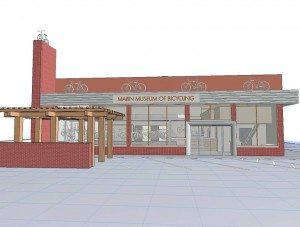
And soon, biking aficionados—or the speckled-faced constituency known as fatheads, klunker riders and bikies—will have a formal way to pay tribute to the beloved outdoor sport. Scheduled to open this fall at an upcycled building at the foot of Mount Tamalpais is the Marin Museum of Bicycling (MMB) and Mountain Bike Hall of Fame, which is being relocated from its longtime home in Crested Butte, Colo.
The MMB, a nonprofit organization that aims to educate the public about the history of bicycling and encourage biking culture, will occupy the former location of Good Earth Natural Foods at 1966 Sir Francis Drake Boulevard in Fairfax—widely regarded as the birthplace of mountain biking. Plans for regular happenings perfect for bicycling fans are in the works and will include lectures, movies and live TV coverage of cycling events in a 12-person screening room. A main hall in the museum that will seat up to 90 people will serve as a meeting place for bicycle clubs and will feature a zone for skills- and shrediquette-training, while long-term plans include a garden, shower and bike wash, among other amenities.
*****
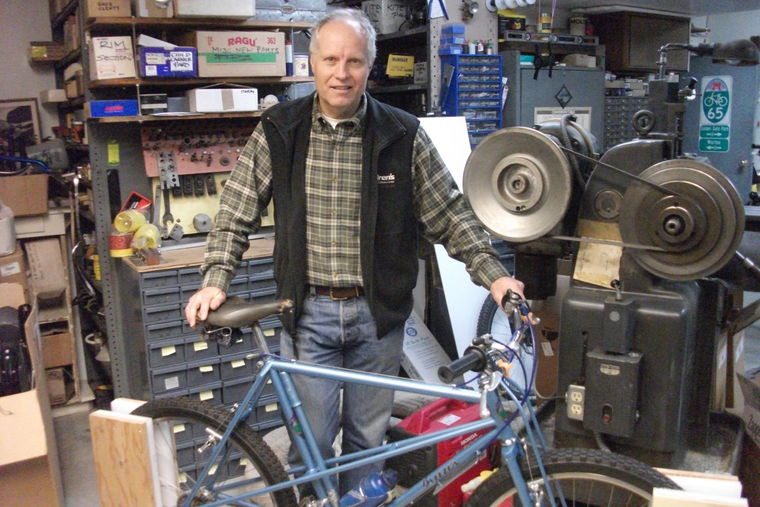
The people behind the MMB range from Don and Kay Cook, who directed the original Mountain Bike Hall of Fame in Crested Butte, Colo., to Joe Breeze, bike builder and historian, to bike pioneers Otis Guy and Marc Vendetti, to Mark Squire, building owner and partner at Good Earth Natural Foods. A community of dedicated bicycle advocates has also been involved.
Larry Galetti, a former Food Villa greengrocer, came of age in San Anselmo during the uncrowded postwar era of the 1980s. Galetti recalls how his extremely hard working (as in seven days a week) stock boy, Al Baylocq, spent a majority of his growing years at the Food Villa. When Galetti was ready to retire, he promised the Villa to Baylocq, who was seeking to partner with others in the opening of Good Earth. When the customer base outgrew the building in 2012, the store moved to the huge lot in the center of Fairfax. Chris Lang, Fairfax commissioner and bike promoter, connected the dots and got Mark Squire together with the MMB team.
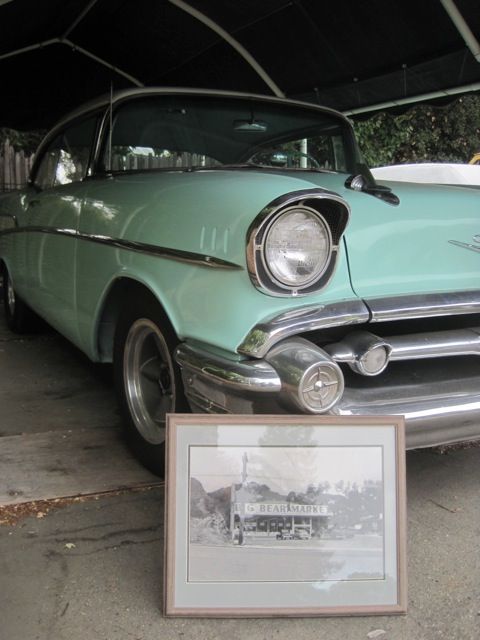
A snapshot of the former Big Bear Market, which was located at the MBB’s future location of 1966 Sir Francis Drake Ave.
With the help of Lang, the MMB team found the former Good Earth location to be promising for the future museum. Morgan Hall, a Fairfax-based architect, wanted to return the building to its midcentury roots by creating a strong, horizontal element and exposing the beautiful bowstring truss construction. Hall partnered with Joe Breeze, a Marin-based bicycling legend in his own right, to collaborate on the building’s spatial elements. He attributes many of the building’s intricacies to Breeze’s attention to detail. “Working with Joe has been a joy,” Hall says. “He has such a good spatial eye, and his tolerances are … well, he works with metal so they’re in the thousandths of an inch. Me, I’m a broad brush-stroke kind of guy.”
To many, the museum’s opening is more than a new addition to what has long been an enthusiastic biking community—it’s a culmination of many events that highlight the Bay Area’s connection between sport, art and the landscape.
In 1998, San Francisco’s Yerba Buena Center for the Arts, in collaboration with the SF Bicycle Coalition, sponsored a broad-scoped art show on bicycle cultures highlighting the history of mountain biking and displaying low rider bikes, art bikes and performance pieces. Many say the exhibit lit a slow fuse for bike culture that’s been sparkling ever since.
Momentum for fostering a biking culture grew from July of 2012 to February of 2013, when thousands of international travelers and bikers enjoyed the SFO Museum’s exhibit, “Repack to Rwanda: The Origins, Evolution and Global Reach of the Mountain Bike.” Often viewed as history in the making, the exhibit helped to unite the bicycle community—while setting a high standard for near-future scholarships and exhibitions.
In 2012, SFO Museum Curator Tim O’Brien realized that there had not yet been an exhibition that focused specifically on the role Marin County frame builders and riders played in bicycle design evolution. Joe Breeze, best known as the designer-builder of the first successful modern mountain bikes, created the first all-new bikes made with rugged frames specifically for mountain biking in the late 1970s.
“We quickly recognized Joe’s critical role in this early history, his steady involvement in the industry, the greater issues surrounding bicycling and his personal connection to so many people whose cooperation we were seeking,” O’Brien says. Having already been invited to contribute to Santa Clara University’s De Saisset Museum, Breeze was ready to commit more time and energy to exhibiting bicycle history.
Determined to avoid succumbing to the pressures many museums face today, O’Brien sought alternatives. “These are unsettled times for museums. The DeYoung and the Asian Art Museum have to push turnstiles,” O’Brien says. “Free from that pressure, our mission is to tell the truth and inspire others to learn more.”
In the spirit of no-waste, O’Brien donated the exhibit’s specially built panels, photographs and other valuable materials to Breeze and the MMB.
Breeze’s love of all-things-bicycling started early in his hometown of Mill Valley. As a child, he was sure that the mountain in his backyard was the “highest mountain in the world.” The magnificent presence of Mount Tamalpais—Marin’s original tourist attraction—and its green slopes has shaped his life indelibly. He roamed not just the county, but much of California by bike, at a time when few people rode bicycles at all.
Breeze was a road-racer on the weekend, but during the week he rode with a posse of free-spirits who sported no race numbers or uniforms. They roamed the yellow hills during long summers, astride clunky relics in search of fun and a little adventure away from the suburbs.
If you told Breeze or one of those denim-and-flannel-clad bikies that someday mountain biking, or the “world’s smallest sport,” would be an Olympic sport, a high school team activity or the inspiration for national transit policies, they would have wondered what planet you came from. While mountain biking started to leave a trail in the sporting industry, the organic food movement was picking up momentum. Good Earth sprouted up in 1969 and set itself apart from regular grocery stores—it was where you shopped if you really cared about what went into your body. Serious coin was spent on food and bicycles, being issues of the most pressing sort.
Always looking at the big picture, Breeze regarded bicycles as capable of influencing politics and, ultimately, saving the planet. In 1994 as the U.S. Army vacated San Francisco’s Presidio District, opening spaces for nonprofit organizations, Breeze and MMB partners envisioned and spearheaded a permanent exhibit to excite the kids of the future about bicycle culture. Breeze imagined a bicycle history corner at the Thoreau Center for Sustainability. He contacted Don and Kay Cook at the Mountain Bike Hall of Fame.
The Mountain Bike Hall of Fame arose from businesspeople brainstorming in the summer of 1988. The Hall of Fame, which inducted mostly California riders at first, had as much to do with tourism as it did with preserving the memory of the sport’s earliest days. In a town of roughly 800 full-time residents, an influx of avid cyclists—especially in the slow season of autumn—means money. Induction ceremonies moved from Colorado to the annual bicycle dealer trade show to accommodate even more attendees. Inevitably, the industry titans who sponsored the Hall of Fame were enshrined; thus the world’s smallest sport became a tributary to the created cult of celebrity.
In the early 90s, around the country, federal funding for non-motorized transportation—mainly identified as the Intermodal Surface Transportation Efficiency Act (ISTEA), among other refreshing acronyms—swelled the coffers of many regional bicycle coalitions. The collective energies of their members resulted in greater numbers of riders on the road, including kids. Dan Freeman, a history teacher at Sir Francis Drake High School, coached Marin’s first high school mountain bike team, and 15 years later all of the high schools in the county have a mountain bike team.
And in 2012, with a space in mind, Breeze had his eye on moving the Hall of Fame and its historical memorabilia out to California. Breeze summoned his old friends Marc Vendetti, a former racer, businessman and philanthropist; Otis Guy, a local fireman, and early mountain biker/builder; Julia Violich, businesswoman and masters category racer and lawyer Keith Hastings to the team. The horde of bikies hammered out details for six months in the summer of 2013. Mark Squire shook hands last year to seal the lease—committing to a project that would house the famed Igler collection (30 bicycles from the beginning to the most recent of the bicycle era) as well as display cases, exhibit windows, bookshelves and, of course, docents and acolytes of the fundraising, culture maven ilk. Contributors to the two-wheeled world are named and honored, their feats described and their artifacts preserved.
*****
Marin County is both the spirit home of the human-powered bicycle and the place where its adherents, despite heroic efforts, had little to no political traction. It is no longer a hidden gem, but a global tourist destination conveniently close to San Francisco.
And decades later beyond our county lines, the world caught the fat tire bug. Global production soared through the 1980s and 1990s as the industry realized: People could have more than one bicycle. This “fad” rescued the flattish-bicycle industry after the 1970s sting-ray and 10-speed boom. Trail prohibitions and inflammatory press coverage generated friction and a sensationalized trail war. A parade of journalists from The New York Times, the L.A. Times and countless European and Japanese bicycle magazines, rolled through impressed by the beautiful terrain and astonished by the grim faces of the bike-loathers. The journalists’ stories noted the incongruousness of “mellow” Marin’s cool regard of cyclists on the trail. But at the time, Marin wasn’t yet your typical tourist destination; and sharing was a new concept.
A new generation of bike-friendly policymakers, 30 years and a global climate shift have silenced the chorus of obstructive land managers and officials, who insisted that mountain bikes were ruining the tranquil outdoor experience. County residents continued to simply ride the bikes, and let the cares of a contentious, traffic-bound county slide off them with every revolution of the bear-trap pedal.
At times collaboration seemed unlikely until common goals, federal funding and expanding enfranchisement brought bicyclists into the negotiating rooms. Three decades later, Marin’s bicycle family has matured with the tincture of time. The Marin County Bicycle Coalition was founded precisely to educate this very mercurial and “skiddish” constituency. Years of lobbying, advocating, showing up and never giving up the mission of safer two-wheel transit paid dividends.
The roads are still jammed with cars and irritable, distracted motorists, but the roads have lanes being shared by thousands upon thousands of both residents and visitors.
The stampede into the county’s greensward can only grow. Farsighted Marinites preserved an impressive amount of public land, and, where once the bicyclists were coolly received, a slight thaw is taking place. Stafford Lake Bike Park—the proposed 17-acre bike park slated to include a single-track loop trail, gravity-fed flow trails with jumps and beams, several pump tracks and north shore style elevated trails—would take pressure off southern Marin fire roads.
Future generations of Marinites will remain young in the saddle. Perhaps, if we are good, there will be some narrow trails opened on Mount Tamalpais. Or all the trails will be open on certain weekdays. Anything is possible.
No car can touch what bicycles deliver on many different levels: the joy, the clean air, the clear head, the strong legs, the healthy lungs and the fascinating, translucent, black Lycra shorts—sorry.
Our love affair with the car is dying, and the romance of modernity’s first love, the bicycle, is gearing back up in its Golden Age.
COMING SOON
The two-wheeler’s cultural center, the Marin Museum of Bicycling, will open before the rainy season this year. As a membership- and fund-driven entity, the MMB will be creating history for the foreseeable future.
NOW READING
Recently released by two professors at MIT is Bicycle Design An Illustrated History by Tony Hadland and Hans-Erhard Lessing. It’s a dense, rich and very readable text made up of 576 pages and 300 accompanying illustrations. Needless to say, most of the Marin inventors like Charlie Cunningham, Joe Breeze, etc. are cited.
Due out in September of 2014 is the memoir Fat Tire Flyer by Charlie Kelly. After a 30-year hiatus, Kelly is back on the trail and ready to recharge his wild biking roots as a much-overlooked biking pioneer.
I was delighted to read Carlo Gardin’s letter in response to Patricia E. Branton . Her previous personal attack upon him was both hostile and uninformed regarding the issues of illegal immigration. Carlo is right to continue writing on this issue, to help people break through the political correctness that has all but stifled real debate on this...
To Steve Heminger, president of the Metropolitan Transportation Commission: I am a resident of Corte Madera, and I’m directly impacted by traffic congestion in my neighborhood due to the backup on the Richmond Bridge during commute hours. Please use some common sense and restore three lanes of vehicular traffic on the bridge in both directions. The Metropolitan Transportation Commission...
Sorry, Nikki, I’ve got to come to Rex’s defense . You would never refer to an “uppity black guy” or a “rich Jew” or a “silly blonde woman” in the same way. You’re being inconsistent in your use of stereotypes, and that is a direct violation of the liberal handbook. Us old white guys are one of the few...
The FBI is investigating the Los Angeles Unified School District after questions were raised about its superintendent’s communications with Apple prior to awarding a billion-dollar contract for student iPads. Not disclosing a prior relationship to a vendor could lead to wire or mail fraud charges.
Dick Spotswood, in his Nov. 19 IJ column, revealed that the Marin County Department of...
It is an honor to sponsor the 2014 Heroes of Marin awards. In a county full of residents whose aptitude and determination are testament to what makes Marin such a unique place to call home, we are honored and humbled to celebrate our eight nominees.
This week’s issue highlights our Role Model honoree Emily Sims and our Lifetime Achievement honoree Heidi...
by Tanya Henry
It has been a while since I’ve given an update on local restaurants, and since there has been quite a bit of activity in recent months, I thought I’d report on some unexpected closures, exciting openings and events around the county.
A LOSS IN LARKSPUR
Perhaps the most surprising news is the shuttering of both the Tavern at Lark Creek...
Food insecurity continues to touch the lives of Marinites. The SF-Marin Food Bank reports that it’s distributing 13 percent more food this year than last year. Increasing the number of food pantries and greater reach into the community accounts for some of that increase, according to Paul Ash, executive director at the agency. But the increase also is a...
Courage, like beauty, can be said to be in the eye of the beholder, but the strength of artist Matt Tasley is belied by his tall, slender, slight frame. In fact, the pain he faces isn’t visible at all. Subsequent to being diagnosed with schizophrenia in 2001, Tasley began a 12-step program for recovering alcoholics, and is now 13...
by Annie Spiegelman, the Dirt Diva
The farmer rises while the sky is still inky black and the cool misty air is heavy with dew. The morning sun prepares to peer over the coastal hills of Point Reyes Station. Neighbors shuttle their children to soccer games or off to school or simply sleep in. The farmer's children dutifully waken on...
by Jacquie Phelan
When you speak of "a culture," it can be the behavior of a given society, or of a group of societies, or of a certain area, or of a certain period of time.—Margaret Mead
The Bay Area has long been a go-to haven for mountain biking enthusiasts.
And soon, biking aficionados—or the speckled-faced constituency known as fatheads, klunker riders...






 A snapshot of the former Big Bear Market, which was located at the MBB’s future location of 1966 Sir Francis Drake Ave.