A recent report from an international health organization has bolstered the argument that a commonly used herbicide should be dropped from use on Marin public lands, say opponents of relying on chemicals to control non-native vegetation.
The debate about whether the county and the county’s largest water district should use the herbicide glyphosate to control plants that easily overrun native vegetation in parks and open space has lasted for decades.
Proponents of using the herbicide (which routinely is called a pesticide) say that it’s the most effective way to control non-native plants, from a cost-benefit basis as well as a practical basis. Land managers in the Marin County Open Space District say that it’s nearly impossible to eradicate non-natives such as broom varieties using mechanical means and hand pulling. The proponents say that applying glyphosate judiciously creates little risk to the environment.
Opponents of using glyphosate say that’s just not true. They point to studies that show a causal relationship between glyphosate and health hazards. Proponents, however, point to studies that show the opposite—that glyphosate is safe.
The issue has bubbled for decades, periodically coming to a boil. The temperature of the debate increased recently when the county planned to apply glyphosate judiciously to control vegetation in the Ring Mountain Preserve between Corte Madera and Tiburon.
The debate over whether to use glyphosate had focused on the Marin Municipal watershed. Protecting the county’s main watershed and reducing fire danger from non-native plants on Mount Tam is one thing, say opponents of chemical control, but using glyphosate in the Ring Mountain Preserve is unacceptable and endangers visitors.
Anti-pesticide proponents are circulating a petition calling on the Board of Supervisors to come out against using the pesticide. At a recent board meeting, Supervisor Katie Rice, who represents the preserve area, said that the county should review its integrated pest management plan. The county is already committed to a reduction of pesticides in parks, but the Open Space District has no such similar mandate, although land managers in the county view using glyphosate as a last resort.
The Marin Municipal Water District (MMWD) has been reviewing its non-native control policies, and the district board is expected to take up the issue soon.
What makes this time different from all other times is a report from the cancer research group of the World Health Organization. In March, the International Agency for Research on Cancer (IARC) said that its most recent investigation of glyphosate data shows that the chemical is a “probable carcinogen.” That’s an increase in the hazard level from the organization’s previous classification of glyphosate as a “possible carcinogen.” That increase adds immediacy to the call to stop using the chemical in Marin.
Almost as soon as the report went public, critics from the chemical industry blasted the research, saying that IARC cherry-picked data contained in previous studies. The controversy continues, but opponents of using glyphosate in Marin say the IARC report should be viewed as just one more nail in the glyphosate coffin.
Glyphosate is the most commonly used herbicide in the world. It’s a Monsanto product that has made billions for the company. Glyphosate is a common application on lawns and driveways and sidewalks and median strips. Monsanto has engineered glyphosate-resistant crop seeds, which allow farmers to use high doses of the chemical to control weeds and increase crop yields. The high doses also result in glyphosate showing up as residue in crops, as well as animals and humans, critics say. Proponents of its use say that the amounts detected pose no potential harm. Opponents beg to differ.
Proponents of using glyphosate say that it can be safely applied topically to plants rather than by spraying, and the topical application is safer. They also say that the chemical has a short half-life. Former Fairfax Mayor and current board member of the Ross Valley Sanitary District Frank Egger disagrees. He’s been a strong glyphosate opponent. “The half-life of glyphosate is much longer than we’ve been led to believe,” he says. “All of the studies that have been done in the past have been industry-run. For years, the Environmental Protection Agency (EPA) has relied on the pesticide industry to determine safety.”
The EPA is at the end of a routine re-evaluation of glyphosate and is expected to release its report soon. The agency delayed issuing a report until it could evaluate the results of the World Health Organization’s report citing the increased cancer hazard of glyphosate. The EPA results could come just as the Marin Municipal Water District begins discussing staff recommendations for vegetation management.
Egger played a major role in rallying Fairfax behind a move to block herbicide use in the watershed, a strategy that district officials say has resulted in the increased spread of non-native vegetation, creating a high fire danger.
Egger and civic activist Bill Rothman played leading roles in the Marin Safe Drinking Water Coalition’s move to convince the district’s board to stop using herbicides in 2005. Egger ran for a spot on the MMWD board in 2008 as a strong anti-pesticide candidate. He was unsuccessful in that bid.
The brooms, Scotch, French and Spanish, have infested the watershed along with other flora such as yellow starthistle and pampas grass. But it’s the brooms that pose the greatest fire threat, as well as damage to the biodiversity of the district’s approximately 22,000 acres of watershed.
The issue of how the district should battle non-natives stretches back to 1994, when a consultant delivered a study to the district that formed the basis for a management plan focused on husbanding the watershed. Then, in 2003, spurred by a continuing increase in fire danger on the watershed, the district adopted an integrated pest management policy aimed at keeping the fuel load suppressed, and at the same time maintaining the ecology of the watershed.
Using a variety of conventional tools, including hand and mechanical removal and controlled burns, the district fought the infesting flora. It also looked at some unconventional methods, including goats that might graze the non-natives. That didn’t work because goats ate every native species they could find before munching on invasive species. The tool that caused the most controversy in the policy was the district’s use of “reduced risk” herbicides. The limited use of those chemicals “in areas away from reservoirs and streams,” was part of the 2003 integrated management policy.
An EPA evaluation found that glyphosate degrades quickly in the soil and does not “migrate” and contaminate water easily, findings that make it a good candidate for use on a watershed. Egger, Rothman and others, however, refute the suppositions.
Larry Bragman currently serves on the MMWD board and is another strong critic of using glyphosate. He also has a unique take on how the district—and the county—should deal with non-native species.
As for the argument that glyphosate degrades to a safe state, Bragman points to New York, where the New York attorney general sued Monsanto “for making that claim,” Bragman says, “and Monsanto lost. They were sued for false advertising.” Proponents of using chemical means to control vegetation also say that it’s far more cost effective to use chemicals along with other methods of control than to take the chemical tool out of the toolbox. “It depends on how broadly you analyze the budget,” Bragman says. “It may save the agency some money. But the actual cost is going to be externalized to the community. There’s no doubt that chemicals save public agencies some money.” But assuming the World Health Organization is correct, he adds, the additional cost of health problems resulting from glyphosate use should be a critical element in a renewed evaluation.
“When conflicting viewpoints exist about husbandry on public property, political and scientific,” Bragman says, “we’ve got to use the precautionary principle. I don’t think we should be rolling the dice with public health.”
In looking at how the district (and by extrapolation other agencies also) should control non-native species, Bragman says, “We need to change the paradigm from eradication to management. Broom, for example, has been around Marin for a long time and has become part of the county’s ecology. I think land management public agencies should embrace a change in perspective. It’s going to take additional investment, but I think it can be done.”
Bragman suggests that managing broom by mechanical means could become a job-creating mechanism. Work “in ecological management needs to be valued,” and can produce local jobs that would add economic benefit to the community.
This week in the Pacific Sun, you’ll find our cover story highlighting local purveyors–from Sausalito to Napa–who make the North Bay what it is. Peter Seidman writes about the heated debate over the herbicide glyphosate, and Tanya Henry talks to the brothers behind the successful Driver’s Market. David Templeton interviews geologist Susan Panttaja about her reaction to the movie ‘San Andreas,’ and San Rafael artist Joel Yau gets excited about this weekend’s Italian Street Painting Marin event. All that and more online and on stands today.
ARIES (March 21 – April 19) Looks like you can finally stop binge-watching The Bachelorette, Aries! You’ve met your match and romance is in the air on June 28. Forget the one rose: If you want this one to stick, shell out the big bucks and go for the dozen. Otherwise, don’t bother canceling your Match.com account.
TAURUS (April 20 – May 20) You’re the hostess with the mostess, Taurus! Bring out the nice china and throw those paper plates away—you’re hosting a get-together with all of your friends and more on June 29. Give into your domestic side—your friends will be over-delighted for a taste of your funfetti cake recipe.
GEMINI (May 21 – June 20) Show you the money, Gemini, er, show the cashier the money. You’ve been on a bit of a spending spree lately. While it may feel like you’re living like a Kardashian—sipping kale juices for breakfast and taking preliminary steps to install a helicopter pad in your backyard, you just don’t have the funds. Don’t spend any money on June 25.
CANCER (June 21 – July 22) Pack your bags, Cancer! It’s time to sell, sell, sell! Selling your home has never been better than on June 24. You have Jupiter on your side—you may have to act quickly. Take a trip to Goodwill and drop off all of the trinkets you’ve horded, er, collected over the past few years. Quit your reminiscing and move on up!
LEO (July 23 – Aug. 22) Surprise, Leo! You’re going skydiving on June 28! Venus and Uranus meet for a weekend full of spontaneity and fun. Leave your cautious self at home, and channel your innate wild lion or lioness. Listen to your inner daredevil, even if it’s saying, “Quit your job and tell your boss how you really feel about her or him.”
VIRGO (Aug. 23 – Sept. 22) With Jon Stewart and Stephen Colbert moving on to new ventures, someone has to be the funnyman (or funnywoman), Virgo! Looks like on June 28, it’s you. You’ve got the sass and charm to make nearly anyone laugh—from client to ex-spouse. It’s prime time to try out your most offensive jokes.
LIBRA (Sept. 23 – Oct. 22) Newsflash: You’re in love, Libra! This weekend is all about romantic surprises. Not to ruin the surprise, but on June 27 your beloved might have something up his or her sleeve. If you planned a dinner date, you might wind up dining on the bay, overlooking the Golden Gate and all of its greatness, or bungee jumping off of it.
SCORPIO (Oct. 23 – Nov. 21) Skip town, Scorpio! Mars enters Cancer, fellow water sign, on June 24—allowing you ample time to travel, relax and focus on a special someone. It’s just the right time to check out a destination you’ve been yearning for—head to Santa Cruz for the weekend and take in the waves (and fog) with your partner.
SAGITTARIUS (Nov. 22 – Dec. 21) Time to get playful, Sagittarius! Maybe head to the park, literally, for a boot camp-style workout or hit the local dive bar scene for some groovin’ tunes and Happy Hour-priced drinks. The county is your oyster this weekend, so go with your gut and live it up!
CAPRICORN (Dec. 22 – Jan. 19) Your schedule should be clearing up very soon, Capricorn! Mars is entering Cancer on June 24—giving you a little extra hint of romance. It seems that you may be taking a few lessons from Pepé Le Pew—romancing at every turn you get. Leaving love notes here, picking up week-old dirty socks there.
AQUARIUS (Jan. 20 – Feb. 18) The sun is out and so are all of your feelings, Aquarius. You can’t hide how you feel for your significant other on June 27. Who would want to, with a smile like that and wit that keeps your side aching. Show him or her how you really feel with a little sentimental surprise on June 28.
PISCES (Feb. 19 – March 20)You keep piling on the projects, Pisces! On June 29, sign on to work with a team, even if the project seems more like an obscure Craigslist red flag posting. It’s bound to bring the bucks, and your bank accounts will thank you.
Wouldn’t it be great if Google or Facebook moved to the North Bay? Well, yes and no. It would certainly create a lot of jobs, but the impact on housing prices and traffic wouldn’t be great. Anyway, such a move isn’t likely to happen and I say that’s just as well.
Folks move to or choose to remain in the North Bay because of the quality of life, open spaces and the slower pace. Silicon Valley, with its crushing traffic, Gold Rush-style development and stratospherically high cost of housing are not things we aspire to. In fact, many bail on Silicon Valley and San Francisco and for those reasons, present company included.
But we still need jobs and economic development. Increasingly, that’s coming from small-scale makers, farmers and artisans, not big corporations. Small and home-based businesses are part of the North Bay experience. Local purveyors, be they farmers, brewers, artisans or apparel-makers, are part of what gives the North Bay its look and feel. And while they don’t have the economic might of a Google, local businesses keep dollars circulating locally, they create local jobs, they reduce reliance on carbon-intensive imports and contribute to the North Bay’s identity.
Last year Sonoma County’s GoLocal Cooperative, a network of local businesses, residents and nonprofits that support local, sustainably minded businesses, produced $5.6 million in sales through its rewards card program. That generated more than $2 million to the North Bay’s economy.
Two-year-old North Bay Made, co-founded by farmer Kelley Rajala and weaver Pam Dale, grew out of GoLocal. The membership-based group is helping to unify small North Bay businesses by acting as their sales and marketing team. With more than 50 makers and markets in its portfolio, the group is really a force of private-sector economic development. But instead of trying to attract new business to the North Bay, North Bay Made is cultivating homegrown makers in the North Bay and stoking the benefits of a homegrown economy.
“We’re just stacking up win-win scenarios,” Rajala says.
In this issue of the Pacific Sun, we’re highlighting several of our favorite local purveyors—they can be found from Sausalito to West Marin to the Sonoma Coast to Napa. The good news is that there are more where these came from.—Stett Holbrook
The Shop
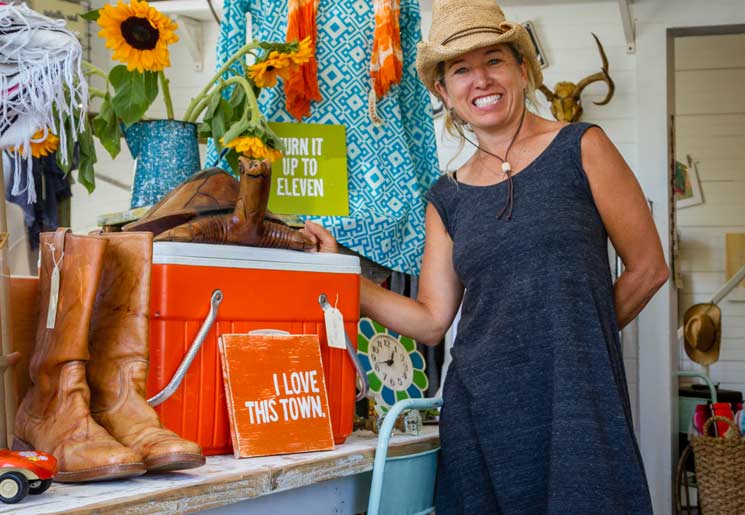
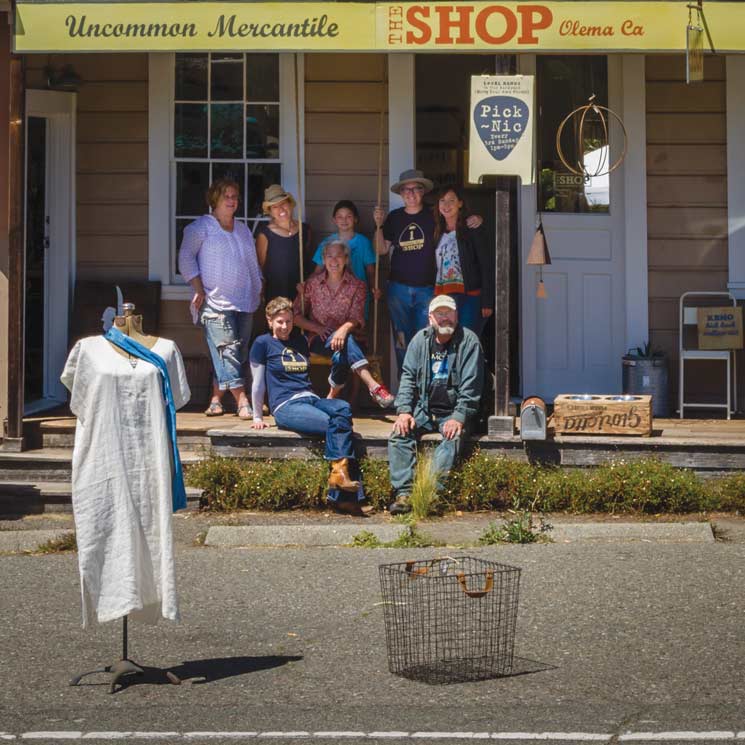
It’s a hot and delightful Thursday in Olema and there’s really no place to be except eased back on the sun-dappled porch of a new way-West Marin outpost of “uncommon mercantile” called, simply, The Shop.
Sit on the porch in a Jane Brooks–designed baseball hat that features the store logo—she’s a co-owner and designer here—as you sip cold-pressed iced coffee out of a milk jar and watch a flow of customers peruse the offerings.
Repurposed as a shop of local goods, vintage wares, “Northern California classics and practical provisions,” the joint is positively bustling today.
Score! A young man of obvious means emerges with a pair of vintage California license plates tucked under his arm. There’s a whole crate of them out back, if you take the time to look.
Take the time—it’s worth it.
The Shop found its genesis in Fairfax several years ago when a quartet of West Marin women artisans took over the former Good Earth parking garage. “We did a pop-up mercantile that lasted two years,” says Brooks, where she, her partner Val Yandell, Liz Lavoie and Michele Schwartz made stuff, gathered stuff and sold stuff.
When the Good Earth building was sold, the women scoped out the Olema property, which last housed an art gallery. An old-time print behind the cash register shows the building—the original Olema post office—as it was way-back-when.
Together, the women set out to curate a retail joint that offered and emphasized a particularized aesthetic. The gist is utility with style, preferably repurposed, salvaged or otherwise gathered from the beach, the woods or some old barn somewhere.
And, where possible, Brooks says the women set out to keep the preciousness factor at a bare minimum. Preferably, none at all. This is, after all, rugged and wild—and quirky—West Marin.
Co-owner and maker at The Shop, Liz Lavoie. Photo by Samir Neffati
The resultant shop is itself a fascinating set-piece of intersecting interests and emphases—wander around awhile and it emerges as a holistic manifestation of a group vision.
It’s a crossroads boutique nestled in the wilderness, with a functional conceit best described as “general purveyor at your service”: The Shop angles to fill the various and sundry-seeking needs of the many whom roll through this tourist turnoff.
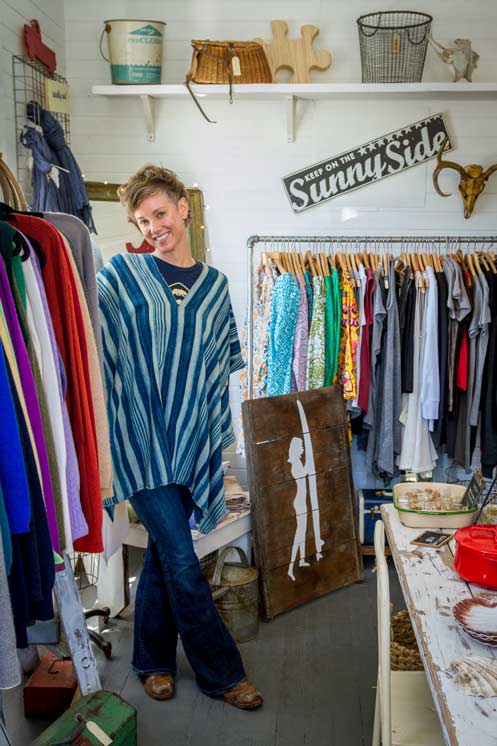
One section of The Shop features lots of kids’ toys, but also Schwartz’s exquisitely soft and luxe cashmere creations, hats, ponchos and scarves repurposed from previous couture incarnations.
Elsewhere, vintage hand tools share shelf space with soft and supple handmade Sundog T-shirts that depict old maps of Mt. Tamalpais and other iconic outposts. There are hand-printed greeting cards from Bolinas’ Sirima Sataman, jewelry from Fairfax’s Sarah Roberston and T-shirts and bags with the shop logo, to go along with that baseball cap.
The vintage-cool offerings take the form of old tools, vintage flannel shirts, paint-dappled coveralls, old fishing reels, old binoculars and camera gear—and a notable collection of old typewriters, which are found in all corners of the store. Schwartz also makes jewelry from old typewriter keys.
The quirky factor finds a voice of sorts in the shelves themselves: The post office survived the infamous 1906 earthquake, but the wall-in shelves wound up on a permanent slant after the fact. Hey, it adds character.
“We don’t put marbles on those shelves,” Brooks says with a laugh. They do, however, offer five-cent pieces of Double Bubble Gum to the kids.
Another anchor product comes from LaVoie: The store is peppered inside and out with simple stencil designs of surfers (and others) rendered on repurposed grape-drying trays; those retail for around $90.
Visitors to The Shop are heartily encouraged to hang around until they’ve uncovered every choice niblet of functional nostalgia, utility and the handmade on display here.
Oh look, a metal box filled with old matchbooks! Jewelry fashioned from beach flotsam and jetsam, cool. Delicious fudge offered in an old fruit jar, yum. Handmade beaded jewelry and leather bracelets from Sister Sue—beautiful.
Brooks tells the story of a recent visitor who was somewhat blown away by the offerings: A 9-year-old walked in and shouted, “I didn’t even know places like this existed! Why didn’t anyone tell me?!”
Tell your friends, tell everyone. Brooks says that the shop aims to find appeal with “people who lost luggage at the airport,” to general-issue tourists, locals looking for art and wares to decorate the yurt and whomever else happens to be blowing in with the wind up and down Highway One.
The utilitarian emphasis is represented in new products on offer, such as those cool and French-made Opinel knives—they can shuck an oyster, open a bottle of wine or dust off some mushrooms lickety-split.
The kind of functional beauty embodied in the knives, says Brooks, “takes away the preciousness factor” that might otherwise run rampant in a boutique-barnyard hybrid such as this.
But it’s the well-curated handmade stuff that drives the aesthetic here.
The store offers consignments for wares that represent “a new kind of craft that is combining good design with an emphasis on the way it is put together—color, texture, quality, style as fun, beautiful, durable products,” says a cheery Brooks.
At the functional end, supple and sturdy Gumshoe Briefcases by Inverness’ Willis Bigelow are a stand-out product.
Then there’s Ray Forbes, also of Inverness, who carves one-of-a-kind, functional mini sailboats that retail starting at around $250.
“He’s an off-the-grid craftsman who makes the most delicate and refined pieces of sculpture—and that take a ton of time to make,” Brooks says.
“We love handmade, we love vintage and we love new stuff,” she adds, “but mostly we just love community. We’re proud to be representing people who are making things.”Y The Shop, 9960 Highway One, Olema; theshop-olema.com—Tom Gogola
lilah b.
It’s only natural that a natural cosmetic brand would come out of Sausalito, where bay views and gorgeous hills give way to thoughts on wellness and bliss. It’s even more natural that the lilah b. products are shaped like pebbles—round and asymmetrical. Open such a white, slick pebble, and inside are silky foundations, bronzers and pops of color that double as cheek and lip tint.
Natural cosmetic lines—no animal testing, no parabens and sulfates—are all the rage these days, far beyond Marin County. Beauty giant Sephora lists more than 20 of them—some are international stars like Josie Maran and bareMinerals, while others are niche and hail from as far as Hungary and South Africa. The saturated market doesn’t scare founder Cheryl Yannotti Foland, whose resume includes more than a decade of consulting on marketing and branding to huge names such as Benefit and Urban Decay.
Ten years ago, as she moved from New York to San Francisco and started working with smaller, independent brands in California, Yannotti Foland aimed to strip down her beauty routine and de-clutter her makeup bag, realizing that “you tend to gravitate to these two, three special products that will give you an amazing look as you’re rushing out the door.”
Not finding what she was looking for on the shelves, Yannotti Foland put her experience to work, pulled some strings, tapped into some professional relationships—and lilah b. was born. The formulations are made and produced in Milan, and the packaging is inspired by Italian beaches. “I wanted the products to look and feel organic and peaceful,” she explains. What’s inside matters, too—lilah b. products swap artificial preservatives and synthetic fragrances for agar and aloe, and Yannotti Foland swears by their “healthy, high-end, high-performance formulations.” You can’t launch a product in California and slip on the healthy selling point.
No animal testing, and no parabens and sulfates are used in the natural cosmetics of lilah b.
As with any well-planned, modern-day venture, solid branding is ever present—lip and cheek colors, ranging from blush pink to look-at-me coral, are named b.sassy, b.darling and so on, playing on the brand’s name, which is borrowed from a “very inspirational friend.” Foundation names explore the theme further, mobilizing somewhat new-age, and some might say, very Californian adjectives—b.natural, b.pure, b.classic. Effortless and fast-talking, Yannotti Foland happily embodies lilah b.’s credo—she splits her time between Sausalito and Napa, and frequently enjoys the health benefits of running, yoga, fresh produce and other Californian perks.
Yet, not unlike Silicon Valley entrepreneurs, she dreams big—lilah b. just launched at a couple of Ron Robinson boutiques in Santa Monica and Los Angeles, and there’s more to come. “I’m very particular about my retailers, their location, audience and what they represent,” Yannotti Foland explains. She is currently in talks with additional retailers in Northern California, as well as on the East Coast, and a top-secret spa collaboration is in the works. At the same time, the products already sell at the company’s online store—the selection is as minimalistic as the package, but new shades and products will appear each season, Yannotti Foland promises. “California is so ahead on everything, from food to beauty,” she says, when asked about the benefits of the local market. Now, there’s home-based packaged glow to match all of those healthy, forward-thinking, local faces.Y Lilah b., 415/729-9974; lilahbeauty.com—Flora Tsapovsky
Clutch Monkey
There’s something very wrong about throwing your leg over a vintage motorcycle wearing a pair of Dockers. It’s not only fashion suicide, it’s not smart. Riding a bike requires a heavy-duty pair of trousers built to withstand hot tail pipes, flying gravel and high-speed asphalt encounters.
Jeans are the pants of choice for most self-respecting bikers, but as Bodega vintage motorcyclist enthusiast Marc Bencivenga discovered, there’s not a lot of heavy-weight denim on the market, especially when you’re 6’3” and 260 pounds of badass biker (note to self: make sure you spell Bencivenga correctly).
“There wasn’t anything out there,” Bencivenga says. “That was the inspiration for Clutch Monkey. There was an unmet need.”
Clutch Monkey makes burly, selvedge denim jeans and vests for bikers and those who appreciate bulletproof denim. Selvedge is heavy, stiff (at first) denim made on shuttle looms that fell out of favor when denim went mainstream in the 1950s. Newer, projectile looms make more denim, faster and cheaper, but from a durability standpoint it’s inferior to selvedge. Selvedge is made in tightly woven strips of heavy fabric that are finished with tightly woven bands down each side, which prevent fraying and unraveling.
Turns out that there is only one mill in the U.S. that makes selvedge to Clutch Monkey’s standards: North Carolina’s Cone Mills. Clutch Monkey also sources its selvedge from Japanese mills that use retooled Draper and Toyota looms.
“The Japanese put out the best selvedge on the planet,” Bencivenga says.
Clutch Monkey jeans and vests are designed in Bodega and sewn in San Francisco’s last denim factory. (The factory is in such high demand that Bencivenga was asked not to divulge its name. Top-secret denim!)
As a revival product, selvedge is often expensive, but Clutch Monkey sells most of its goods via crowd funding campaigns and thereby offers it at near-wholesale prices because a production run only begins with cash from backers on hand. No marketing or sales are required, although they lean heavily on Facebook and Instagram.
“All the marketing comes to us in real dollars,” Bencivenga says. “People pay for what they believe in.”
If you want to handle a pair of Clutch Monkey jeans or a vest for yourself, get on your bad motor scooter and ride to the newly opened Soul Riders in Santa Rosa (404 Mendocino Ave., 707/978-3819), the company’s only retail outlet. Opened by former Brotherhood skate shop owner Kurt Hurley, Soul Riders specializes in Southern California beach culture ware in the form of surf, skate, hot rod fashions and reissues of classic skateboard decks, along with a bin of vintage vinyl in the rear. But Hurley is excited to carry Clutch Monkey denim as the one nod to the North Bay.
“The jeans will outlive you,” he says. Clutch Monkey, clutchmonkey.com—Stett Holbrook
dhbetty
Spokes, cogs, chains, fenders, rims and valves are all used by Christine Culver, owner of dhbetty Bicycle Gems, in creating jewelry from upcycled bicycle parts.
“It’s all about the bicycles,” says the artist, who designs bracelets, earrings, glass pendants and necklaces.
Dhbetty Bicycle Gems was the first business to connect with North Bay Made.
Culver, a long time cyclist, began her passion for the bicycle in her late teens when she started racing professionally. She moved up to Sonoma County to work at a bike shop and continue bike racing.
Culver’s bike love led her to take on a position as executive director of the Bicycle Coalition in Santa Rosa. The group advocates for better bicycle access throughout Sonoma County.
“I got involved as a volunteer, then got myself on the board and created a job for myself,” she says.
While Culver was running the bike organization, she began creating her jewelry.
“The thing that really kicked off this whole doing-the-jewelry-with-the-bicycle-focus is I just wanted a pendant with a bicycle on it, “she says. “Everything I was finding was really chintzy. It started a quest for looking for one and then finally I started making them.”
Bike shops and the Santa Rosa Cycling Club all donate retired bicycle parts for their next lives as jewelry. Culver sells her jewelry at bike-based events, local retailers and the Clif Family Winery in St. Helena.Y dhbetty Bicycle Gems, dhbetty.com—Haley Bollinger
NBC Pottery
Settled in the mountains above St. Helena in the small town of Angwin, husband and wife duo Will and Nikki Callnan create intimately crafted clay works that are redefining everything from plates and vases to sculptures with an emphasis on the rugged beauty inspired by their North Bay surroundings. Under the name NBC Pottery, (named after Nikki Ballere Callnan), the pair specializes in custom-made wares made for private customers, as well as restaurants and wineries throughout the area.
“We’ve been in clay and creating as long as we can remember,” Will Callnan says.
The two met while studying fine art at Sierra Nevada College in Lake Tahoe. Originally from the East Coast, Will says that they decided to stay and work in California because of the natural wonder of the area, and
Handmade bowls by NBC Pottery.
that’s reflected in their one-of-a-kind clay works.
If you’ve ever dined in the Restaurant at Meadowood in St. Helena, you’ve eaten off of their plates. Often resembling organic materials such as bark or mushrooms, the colorful and unique clay highlights chef Christopher Kostow’s singular cuisine.
“They were looking for something different,” Will says. “With each piece, we want to show the qualities of the material.”
The unique, flexible qualities of the clay are also on display. In their vessels, vases and bottles, they mimic the fluid movements of waterfalls and birds taking flight. With a world of influence right outside their home studio, Will, Nikki, their young son Gavin, and newest addition Evie, are happy to host guests for a studio visit. Their custom wares are available for order or commission online as well as directly from their studio location.Y NBC Pottery, 707/965-1007; www.nbcpottery.com—Charlie Swanson
I don’t question the sincerity, dedication and optimism of those described by Stephanie Hiller in her article [“Hot Pockets,” June 10]. One could argue that what they are doing is better than doing nothing but, as Elizabeth Kolbert put it, “… To argue that the current extinction event could be averted if people just cared more and were willing to make more sacrifices is not wrong, exactly; still, it misses the point. It doesn’t much matter whether people care or don’t care … ” There is no real evidence that by joining together and rolling up our shirtsleeves we can regulate/ engineer/ manage our way out of the terracide we are causing.
The statement by the Napa Valley Vintners that, essentially, the jury is still out on the “actual impacts” of climate change and there are still many unknowns, put me in mind of the Buddhist Parable of the Poisoned Arrow. A man wounded with an arrow tipped with poison won’t allow the arrow to be removed until he knows who shot it, whether the shooter was tall, short or medium, whether the bow used to shoot the arrow was a crossbow or a long bow, what kind of arrow was used, etc., etc. While waiting for answers, the lethal toxin from the arrow continues its spread throughout the man’s body, killing him. As Nobel Laureate Sherwood Rowland put it: “What’s the use of having developed a science well enough to make predictions if, in the end, all we’re willing to do is stand around and wait for them to come true?”
We need to get real about how to prepare for a mass extinction event, what Elizabeth Kolbert calls the “morbid topic,” and that starts with massive population reductions. I’m not advocating or hoping for such reductions, knowing that draconian measures will be required to achieve them. I’m simply looking at how we can voluntarily and humanely prevent as much suffering as possible before the time comes when it is the environment that reduces the human population involuntarily.
I understand that one of the missions of an alternative newsweekly is to be the watchdog to make sure that all [are] in on the “up and up” in their respective communities.
So, why no investigation of the Marin History Museum? And, what’s up with the letters to the editor which are signed either with a first name only or with something like “happy reader”? This smacks of planted items by management.
A real credibility problem.
If the letter can’t be attributed, it shouldn’t be printed.
Pacific Sun staff: I agree completely with Donnel’s letter to the editor in [last] week’s issue [“Devoted reader,” June 10]. Please restore the Sundial section to its previous version. It’s a royal pain in the ass to have to look at every venue to see if there’s something I want to see or do. Organize it by the performer, not the venue. I’m loyal to who I want to see, not any particular establishment. And please don’t stop breaking items down by county at the art section, continue it into comedy, dance, events, field trips, food and drink, and lectures, rather than listing items in those sections alphabetically or otherwise haphazardly throwing everything in multiple counties together under a section.
This is a true case of “If it ain’t broke, don’t fix it,” and if you’re looking to improve the Pacific Sun, you really need to fix this section. It worked just fine the way it was. As presently organized, it’s about as user-unfriendly as it gets. Thank you.
I just had a call from May Mar at Northgate Mall informing me that two new handicapped spaces have been installed outside the Chipotle Restaurant at Northgate Mall! I am so pleased by this action because, apparently due to ADA requirements, they actually did have the appropriate number of handicapped spaces in that section of the mall that I had commented on back in [May] [“Exercise might do you good,” Letters, May 1].Now they’ve added two more, going above and beyond what is required!
May had called me immediately after my April 24th email and informed me that they were within ADA compliance at that time and she gave me the phone number for Northgate Security if I ever need assistance when shopping or dining at Northgate Mall with my daughter. She also assured me that with my daughter’s disabled placard we could park in those spaces reserved for food pick-up. She helped raise my awareness about what that placard means in terms of parking in public lots and public spaces and I thank her for that and for her follow-up and for helping make good things happen at Northgate Mall!
Hero: Karen Wilson, executive director of WildCare, brought the organization’s concerns (and those of more than 2,600 petition signers) about the availability of water for the Tule Elk on Tomales Point to Point Reyes National Seashore Park personnel. The meeting focused on the dire situation of elk within the fenced-in Tomales Point Reserve should their water sources once again dry up due to the drought. WildCare urged the park to provide supplemental water, because the 2014 population census of the enclosed elk herd revealed the dramatic decrease of more than 250 animals since 2012. Although we wonder why it took a request and a petition to motivate the National Park Service to act, we’re thrilled that they agreed. WildCare, thank you for continuing to aid and defend Marin’s wildlife.
Zero: When is a 5’2” septuagenarian considered a threat? When two Sausalito cops say so. We observed officers Francisco Padilla and Sean Smagalski when they responded to a call from a hyperreactive woman at the Sausalito Dog Park. She stated that Jerry, 76, threatened her during a discussion about dog behavior. Apparently, she mistook his bright green plastic Chuckit, which he used to throw balls for his dog, as a weapon. Jerry explained the incident to the cops, which incited Padilla to jab his outstretched hand an inch away from the senior’s face while he repeatedly asked whether Jerry felt threatened. Smagalski noted that physical abusers deny beating their wives. The only abusive behavior we saw emanated from the cops. What’s next? Screaming at a 5-year-old?
Got a Hero or a Zero? Please send submissions to ni***************@***oo.com.
by Peter Seidman
A recent report from an international health organization has bolstered the argument that a commonly used herbicide should be dropped from use on Marin public lands, say opponents of relying on chemicals to control non-native vegetation.
The debate about whether the county and the county’s largest water district should use the herbicide glyphosate to control plants that easily...
This week in the Pacific Sun, you'll find our cover story highlighting local purveyors--from Sausalito to Napa--who make the North Bay what it is. Peter Seidman writes about the heated debate over the herbicide glyphosate, and Tanya Henry talks to the brothers behind the successful Driver's Market. David Templeton interviews geologist Susan Panttaja about her reaction to the movie 'San Andreas,'...
by Leona Moon
ARIES (March 21 - April 19) Looks like you can finally stop binge-watching The Bachelorette, Aries! You’ve met your match and romance is in the air on June 28. Forget the one rose: If you want this one to stick, shell out the big bucks and go for the dozen. Otherwise, don’t bother canceling your Match.com account.
TAURUS...
Wouldn’t it be great if Google or Facebook moved to the North Bay? Well, yes and no. It would certainly create a lot of jobs, but the impact on housing prices and traffic wouldn’t be great. Anyway, such a move isn’t likely to happen and I say that’s just as well.
Folks move to or choose to remain in the...
Hot debate
I don’t question the sincerity, dedication and optimism of those described by Stephanie Hiller in her article . One could argue that what they are doing is better than doing nothing but, as Elizabeth Kolbert put it, “… To argue that the current extinction event could be averted if people just cared more and were willing to make...
Who are you?
I understand that one of the missions of an alternative newsweekly is to be the watchdog to make sure that all in on the “up and up” in their respective communities.
So, why no investigation of the Marin History Museum? And, what’s up with the letters to the editor which are signed either with a first name...
User-unfriendly
Pacific Sun staff: I agree completely with Donnel's letter to the editor in week’s issue . Please restore the Sundial section to its previous version. It's a royal pain in the ass to have to look at every venue to see if there's something I want to see or do. Organize it by the performer, not the venue....
Ask and you shall receive
I just had a call from May Mar at Northgate Mall informing me that two new handicapped spaces have been installed outside the Chipotle Restaurant at Northgate Mall! I am so pleased by this action because, apparently due to ADA requirements, they actually did have the appropriate number of handicapped spaces in that section of...
by Nikki Silverstein
Hero: Karen Wilson, executive director of WildCare, brought the organization’s concerns (and those of more than 2,600 petition signers) about the availability of water for the Tule Elk on Tomales Point to Point Reyes National Seashore Park personnel. The meeting focused on the dire situation of elk within the fenced-in Tomales Point Reserve should their water sources...