Q: I’m trying to take a break from dating and work on myself because I keep ending up with really jerky guys. I’m an extrovert—very social and outgoing—and I find it hard to just chill by myself. I get bored and lonely. I want to pick better guys, but I hate being alone on a Saturday night with a phone that doesn’t ring.—Conflicted
A: There’s nothing like that thrill of finally getting a text on some Saturday night—and then realizing that it’s just your grandma playing with her new iPhone.
Trying to embrace solitude sounds so adult and profound and good: “Yes, I’ll just be staying home making popcorn and watching TV with my existential crisis.” But as great as it is that you’re trying to retool your man-picking practices, this home alone thing might not be the best idea for an extrovert—a person who thrives on human contact, along with novelty and excitement. That’s how the psych literature defines an extrovert, but simply put, you’re a party animal—the sort who hurries to join in all the fun, as opposed to an introvert like my boyfriend, who, upon arriving at a party, will ask: “Do we really have to go inside?”
There’s a lot of inconclusive research on introversion and extroversion that’s breathlessly reported as conclusive. However, what seems clear is that extroversion isn’t just a preference; it’s a biologically driven personality trait—a consistent pattern of behavior that appears to come out of your brain’s being far more “sensation-seeking” than an introvert’s. Studies by psychologist Richard Depue and others suggest that extroverts get a “reward system” buzz from socializing that introverts don’t, and then have memories from it pop up like little infomercial pitchmen, urging, “Call now! Go after that buzz again!”
And while introverts’ brains are easily overloaded by stimuli—stuff going on around them—extroverts’ brains are far less sensitive to it, so they tend to need more of it. More people, more hubbub, more new and exciting experiences—to the point where a hot date with the accusatory stare of the cat can tempt an extrovertess to do something arrest-worthy just to shake things up and maybe get grabbed by a man.
In other words, think of your brain as a pet tiger that needs to be fed—with people and excitement. An important point to note is neuroscientist Wolfram Schultz’s finding that unpredictable rewards seem to be the most satisfying for the brain—maybe even three or four times as buzzy as those we see coming. Consider that your attraction may not be to bad guys so much as to the unpredictability and excitement they provide.
You can get your excitement—and the social mosh pit you long for—by spending weekend nights with like-minded friends. Trade off with them on planning the evening’s activity, and surprise one another with what it will be: Repo man ride-along? Cattle rustling? Danger tag (trying to outrun muggers)? Feeding your need for adventure should help you hold out for a man who’s exciting in a new way: In how he does what he says he will and even shows up on time—and not just by telephone from Mexico to tell you how to wire him bail money.
Q: I’m an attractive woman with “bitchy resting face.” Friends tell me to smile more so men will find me more approachable. I do notice that men like the happy, ditsy girls. It’s only in fashion magazines that the “ideal” girls are scowling.—Frownie
A: Of course the girls in fashion magazines are scowling. They’re in wildly uncomfortable shoes, and they haven’t had a hamburger since childhood.
The thing is, happy resting face can come with problems of its own. Social psychologist Antonia Abbey found that men can misread a woman’s mere friendliness “as a sexual come-on.” This seems especially true of smiling—to the point where 12 female Safeway workers filed grievances over the supermarket chain’s “smile-and-make-eye-contact” rule, which had led a number of male customers to believe that these women wanted to bag more than their beer and Cheerios.
So, conversely, yes, you may be missing opportunities with guys who mistake your “I want to have sex with you” scowl for an “I’d like you to go drown yourself” scowl. But really, all you need to do is be conscious of the power of a smile and, when you like a guy, look right at him and turn it on—kind of like flashing your brights. You’re basically putting a sign on the door—“Open for business! Come on in!”—correcting the message sent by your default glare: “Closed for renovations. And there’s a vagrant living in the hallway who may stab you.”
Something innocent and sweet survives in Me and Earl and the Dying Girl to balance out a manipulative, conniving streak so effective that Fox Searchlight paid $12 million for the film at the Sundance Film Festival—the biggest buy in the fest’s history.
Me and Earl is never straight-up TheFault in Our Stars/Love Story backwash, despite the redemption of the troubled hero, the self-loathing, self-described “pasty-faced” protagonist Greg (Thomas Mann). Greg’s mom forces him to hang out with Rachel (Olivia Cooke), a neighbor fighting a losing battle with leukemia. Greg is distracted from his visits of mercy by an annoying crush on Madison (Katherine C. Hughes), the prettiest girl in school.
Meanwhile, African-American sidekick Earl (RJ Cyler) follows the sidekick’s ancient path. He coolly endorses the hero’s decisions, right up until the key moment when he, the sidekick, can reveal the simple, honest emotions that our hero is too complex to understand.
The plot has the traditional young-adult-lit problem of badly delineated actual adults. Greg’s dad (Nick Offerman) and Mr. McCarthy, Greg’s favorite teacher, seem to be the same character. (The latter has tattoos—that’s how you can tell the difference.) It’s a tribute to Molly Shannon’s wry subtleties that she can wring so much emotion out of the one-note role of Rachel’s drunken mom.
The young actors, especially the sweet, sad Cooke, don’t overdo it. Mann brings in a tough, selfish streak that took Michael Cera many movies to discover.
Cinematographer Chung-hoon Chung, of the original Oldboy, films the Pittsburgh locations so well that you think you’ve been someplace exotic when you leave. The Vertigo references don’t seem in vain when you see the precipitous streets, the noble old Victorian houses and a three-story bookshop with steep, bell-tower-like steps.
“I think it’s the Irish in me,” says singer Judy Collins, 76, referring to the sadness that permeates so many of her songs. “You know, that doesn’t go away.”
It’s a mood that suits her fans. The acclaimed song interpreter, who the New York Times has dubbed “the ageless wild angel of pop,” likens the song-selection process to falling in love. “You know when you fall in love what you’re feeling and it just feels right,” she says with a chuckle, speaking on the phone from her apartment on the Upper West Side of Manhattan.
Emerging from the mid-’60s folk revival, Collins scored early hits with Joni Mitchell’s pensive ballad “Both Sides Now” and the anti-slavery hymn “Amazing Grace” before expanding to include pop, art songs and show tunes. She’s closely tied to Stephen Sondheim’s “Send in the Clowns,” the swan song from the Broadway musical A Little Night Music. Her 1975 recording of that melancholy missive earned a Grammy Award for Song of the Year. Sondheim looms large in her career—joined by Don McLean, Collins reprises “Send in the Clowns” on her upcoming album of duets, Strangers Again. Last year, she brought a mostly Sondheim show to San Francisco. Next year, she plans to record an all-Sondheim album.
“The songs I identify with are the ones I’ve made my own—it’s that simple,” says Collins, who sports a still-strong soprano voice. “There’s lots of music in the world, but when you decide to take [a song] into your life, you sort of take over a piece of its landscape. You own it. And I own a lot of that landscape.
“It’s kind of magic, really.”
Collins was one of the first artists to cover the works of Mitchell, Randy Newman and Leonard Cohen. In 2008, Cohen returned the favor, recording one of her originals on a tribute album.
Asked about sustaining a 50-plus year career in the face of a once-debilitating battle with alcoholism and personal tragedy, Collins explains, “I showed up. You know, getting what you want in life, and what you think you need, has to do with showing up. By some fortune, and certainly not my own, because I was a mixed-up kid at the time, I did what I wanted to do and I did what my heart told me to do.
“You do what you’re passionate about … I’ve been passionate about my politics and my music, and those are the things that mean the most to me.”
Judy Collins performs with the Passenger String Quartet on Sunday, July 5 at 3pm at the Marin County Fair, San Rafael. For more information, visit marinfair.org.
June was quite a month for the American Conservatory Theater.
Not since Bill Ball, its flamboyant founder, energized downtown San Francisco with his revolving opening night searchlights and liveried heralds standing on the outside balcony of the Geary Theater sounding trumpet fanfares, has there been so much public attention directed toward what has become a venerable cultural institution. June’s celebratory spirit was owed to the confluence of two events: On the Geary’s vast stage, a brilliant production of Stephen Sondheim’s A Little Night Music drew appreciative crowds; a few blocks away, near the corner of Seventh and Market streets, the company began introducing the public to its long-awaited second space, sleekly remodeled inside the homely concrete skin of the 1917-era Strand Theater.
While the achievement in Night Music is important, the Strand Theater renovation, because of its implications for the future, is far and away the more significant of the two events. Magnificent as it is, the Geary doesn’t offer scheduling flexibility, nor is it suited for the more intimate, smaller cast plays that originate in the off-Broadway, New York circuit that currently supplies material to much of the country’s nonprofit theater sector.
It’s something of an irony, though, that the vehicle chosen to inaugurate the 235-seat Strand Theater—Caryl Churchill’s Love and Information—could have just as easily (with a few high-tech improvements) been produced at the Geary. True, the 12-member cast is never on stage at one time except for the curtain call, but the right lighting for the 57 tiny scenes could have provided the necessary focus, and the giant video screen upstage that periodically filled with faces and numbers would have been right at home at the Geary.
Yes, you read that correctly. Churchill, whose fondness for breaking the rules of dramatic structure is well established, has really done it this time. Fifty-seven “scenelets,” lasting from five seconds to five minutes, most of them two-person encounters, each with a different subject, are presented (as the script specifies) in whatever order the producer chooses. There is no overall story line, no dramatic arc, no character development—no linear progression of any kind. It’s a content free-for-all that includes everything from personal matters, like sex and senile dementia, to reactions to Middle East conflicts. At times, the brevity is so extreme that one is left wondering what it’s all about; at other times, a single word or phrase is sufficient to set a chain of thought in motion, much like the impact of a particularly resonant photo or editorial cartoon.
The problem is that the plethora of actual or potential stories, with their almost instantaneous transitions within the one-hour-and-40-minute performance, doesn’t permit any reaction or feeling to develop before it is replaced. And so we come to Love and Information’s supreme irony. From program notes and interviews, I gather that Churchill’s goal is to draw attention to how “information overload” restricts our involvement in the emotional side of daily life. No doubt. But the ambiguous “love” she proposes as a response seems intellectually flabby, and the fragmented structure of her play only adds to the societal overstimulation that she regrets.
Some readers will note that I have omitted the usual comments on direction, performances and production values—all of which were strong, but overshadowed by the project’s unique characteristics.
NOW PLAYING: Love and Information runs through August 9 at the Strand Theater, 1127 Market Street (between Seventh and Eighth streets), San Francisco. For more information, call 415/749-2228, or visit act-sf.org.
A few months ago I was at a family reunion with many of my highly educated relatives. The conversation turned to the California drought. Many of the participants seemed surprised by the depressing news. I was surprised, too. Not by the drought statistics and the latest water restrictions, but that this group of intellectuals was so surprised that we were in a drought. I didn’t join in the conversation. I just stewed in my bitterness. Didn’t I send them all photos of my front lawn being removed and replaced with drought-tolerant plants 10 years ago, warning them that the weather was changing? Maybe that’s just the American way; don’t fix it till it’s broken beyond repair. Then, freak out.
Or, maybe it’s because they are not gardeners. Gardeners and farmers work side by side with Mother Earth. We hear her voice in our heads. She says that if we continue to waste our natural resources and pollute our environment, we’ll fail to maintain an ecological balance. And that’s when bad things happen: Drought, erosion, floods, climate change. Apparently, she’s not big on forgiveness. His Royal Highness, Prince Charles, in his book The Elements of Organic Gardening, writes, “Our descendants are highly unlikely to thank us if it’s ultimately found that we have indeed been guilty of treating nature merely as a laboratory and not as a vast, integrated, living organism.”
We literally hold our children’s future in our hands. But what if those kids are tired of waiting for us? And what if they hashtag us “#environmentalslackersgohome”? That’s where Conservation Corps North Bay (CCNB) comes in to save the day.
Founded in 1983, Conservation Corps North Bay is the oldest youth conservation corps in the country. Serving Marin and Sonoma counties from facilities in Cotati, Novato and San Rafael, this remarkable environmental nonprofit has helped nearly 10,000 young men and women break the cycle of poverty through education and job skills, while serving the environment and community. Many of these youth have experienced challenges in completing high school. The program leads to completion of a high school diploma through an educational partnership with John Muir Charter School, while also supplying kids with a paid job and skill certifications.
“I’m passionate about what we are doing for the environment and also for the lives we are getting back on track,” says CCNB CEO Marilee Eckert. “It is so amazing to have a job that has such a huge impact on the things that matter most—the future of young lives and the health of the planet.”
Currently, CCNB serves around 400 disadvantaged youth annually. Just what do these teens and young adults do? Oh, so many noble things!
They cultivate real food: The young people learn how to grow edible and ornamental crops at the Indian Valley Organic Garden and Farm, which is managed by CCNB along with its partners College of Marin, UC Cooperative Extension-Marin, Marin Master Gardeners and The Cultural Conservancy. At the farm, they maintain the garden infrastructure and complete local watershed and creek restoration projects.
Thirteen corps members served on CCNB’s farm crew while attending College of Marin, earning AmeriCorps education awards of almost $11,000 to use in furthering their education. Around 2,100 pounds of fresh produce were gleaned and provided to underserved youth and adults; an additional 150 pounds of produce were provided to the Novato Unified School District.
Have you been to the farm? If not, what are you waiting for? It’s beautiful, magical and inspiring! (You, too, will hear Mother Earth whispering in your ear, telling you to turn off your lawn sprinkler and stop watering the sidewalk!)
They learn how to recycle: In partnership with land management agencies, local governments and county businesses, corps members provide recycling services all around the county. You may have seen them at the Marin County Fair over the last few years. The corps crew was led by Jennie Pardi in 2014, and the fair reached a zero-waste diversion rate of 94 percent. Because of the hard work of the young corps members, the Marin County Fair was named the Greenest County Fair on Earth.
Conservation Corps North Bay staff and corps members collected and sorted 4,369 pounds of recycling at 100 recycling bins and Eco-Stations located throughout the fair. Materials included glass, aluminum, high-density polyethylene (HDPE, or plastic #2) polyethylene terephthalate (PET or plastic #1), paper, mixed plastic and cardboard.
They learn about land management: Corps members work with land management agencies and environmental organizations to help build and maintain trails, restore habitats, clear fire breaks and prevent flooding.
The milestone of 2014? They helped maintain 29,936 feet of trails, and installed 1,529 feet of new trails, 252 stairs, three switchbacks, 20 feet of bridges and 1,129 feet of fencing for safe public access to our breathtaking public lands.
OK—I’m now going to make you weep. Grab the (recycled, compostable) box of tissues. Dominick, a corps member, recently wrote a letter thanking donors for supporting him on his path. “This program, if you were unaware, provides young adults with an opportunity to get their high school diploma, help save the environment and most importantly, it lets us know that the world hasn’t given up on us.”
How you can help Conservation Corps North Bay:
Buy fresh, delicious produce and gorgeous plants, seeds or fruit trees from the Indian Valley Organic Farm and Garden. For more information, call 415/883.2211 (ext. 8200) or visit marin/edu.
Visit conservationcorpsnorthbay.org to learn more about the work, and spread the word about it.
Having your own wild shindig? Contact the corps crew (415/454-4554) to see how they can partner with you in your recycling efforts.
4. Become a donor. Take a tour and see the crew in action. Marilee Eckert will personally show you around. Contact her at me*****@********ay.org.
After his executive chef stint at the celebrated Cha Cha Cha restaurants in San Francisco, chef Bill Higgins and wife Debra developed an insatiable craving to open a snappy tapas and sangria bar of their own.
Satisfy this craving, they did—with a feisty restaurant called Whipper Snapper, in San Rafael’s West End Village. Reeling in Latin/Caribbean food enthusiasts like fish to bait since 2009, the husband-and-wife duo has managed to build a devout following in what is a generally quiet side of town.
Colorful as the facade in front is a vibrant interior embellished with contemporary art by Patrick Maloney. Further stimulating is the Latin music playing while the kitchen hustles for the upcoming dinner crowd.
Just past the empty main dining room, life peeks through the shady palm-covered back patio, where tables of two and four are seated elbow to elbow.
Presented with a small lunch menu—featuring specials, tapas, sandwiches and salads, as well as beer, wine and various non-alcoholic beverages, I order the white sangria ($5), served in a tiny glass (near shot size), brimming with sliced apples and oranges. Pleasant and refreshing, yet bev-less after a few sips, I wished for bev-more. Best advice—order a pitcher.
Awakening our tasting palates, we start with the fresh guacamole ($7), nicely textured with bits of avocado, tomato, cilantro and onion, served with a bottomless bowl of homemade yellow corn chips.
As our star dish—the chicken skewers with peanut sauce and jicama ($14)—arrives, we ready ourselves for an explosion of flavors. Love at first bite—four seared skewers served atop a mound of julienne-cut jicama, red and green bell peppers—in a pool of coconut milk-rich, peanut sauce—sends our taste buds adrift.
Next, while my health-conscious guest enjoys his light, nicely prepared blackened Ahi tuna with Cajun spices, lemon aioli and mixed greens ($12), I begin to wonder what’s keeping my “Whip Snap” grilled fish tacos ($15). As it turns out, long forgotten was my order. Disappointed and feeling less hungry at this point, I confer with our server to change my order to something smaller. While I wait, I try the red sangria ($5); a drier, more robust fruit and wine concoction that I find preferable to the sweeter white sangria.
Swooned by the presentation of the spicy Cajun shrimp with cayenne pepper cream sauce ($11.00)—served with a basket of sliced rustic baguette, I dive into the sauce, bread first. Hoping to be swept away, I am overwhelmed instead by the feeling that flavor, as well as half a dozen, prime large shrimp were tragically lost at sea in an abyss of heavy cream. While smoke signals and added zest (acidity) would have made a great rescue effort, these attributes were M.I.A. With a guilty conscience, I abandon what is most of my bread and an unfortunate waste of sauce.
Shortcomings aside, the chicken skewers served as our catch of the day; enough so to sustain my curiosity for next time—when I hopefully find myself whip-snapped by those famous fish tacos.
Whipper Snapper Restaurant and Sangria Bar, 1613 Fourth Street, San Rafael; 415/256-1818;whipsnap.biz/.
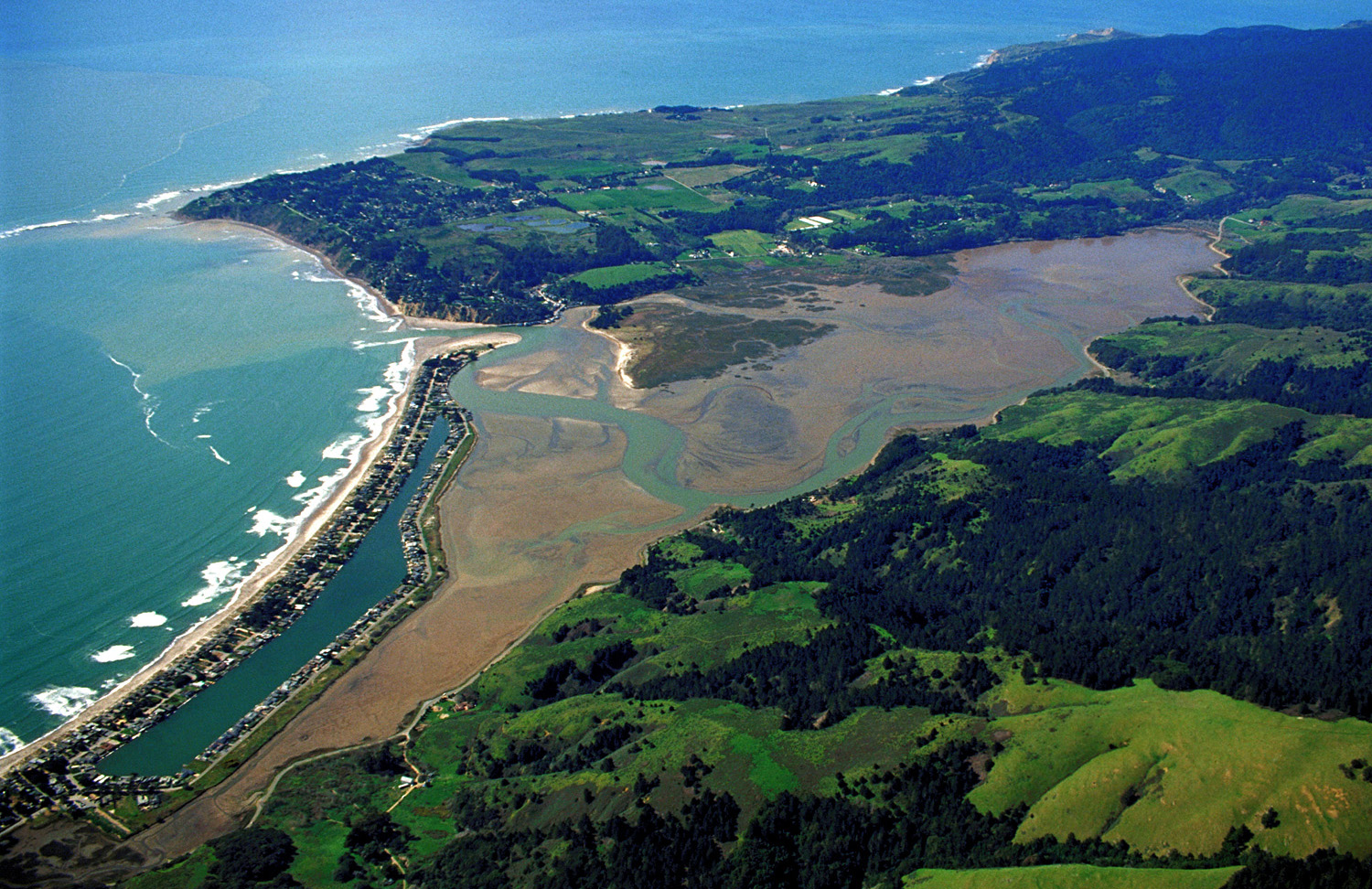
Could sea level rise be a good thing for Bolinas Lagoon? A climactic irony has led to altering previous assumptions about restoring the lagoon.
The irony may prove to be a boon, especially to surfers and other wave-riders at what is arguably the best surf spot in Marin. Other spots may have bigger, more powerful waves, but Bolinas is home to the best longboard and paddleboard venue in the North Bay. For decades, Bolinas has been a family-friendly surf destination for Marin surfers and other water aficionados. It also attracts wave-riders from the rest of the Bay Area—most notably the East Bay.
That popularity triggered a “sign war” in which local surfers continually took down the street sign at what’s called the “Bolinas Wye.” Although the spelling sometimes changes, the importance of that sign to motorists coming from the south and looking for the Bolinas turnoff from Highway One is a big deal. Pass the turnoff without noticing the road to Bolinas and motorists are on their way to points north if they miss the main turnoff just past the Wye. Street crews would erect new signs, but locals would tear them down in an exercise of defiant localism.
It’s been a long time since Bolinas could be called a secret spot. It’s in all of the surf destination literature for the North Bay. On hot summer weekends, crowds deluge the town, and parking becomes a premium. But on chilly mornings, old-time surfers who remember catching waves at Bolinas with eight people out instead of 80 can still get a taste of ocean solitude.
Bolinas offers two distinct surf breaks. “The Patch” is rock reef off the northern section of shoreline. The paddle out can be taxing for beginners. But right in front of the central beach, the waves are made for family play. The southern end of the Bolinas wave emporium is in front of and on either side of the entrance to Bolinas Lagoon.
Tidal action moves water into and out of the lagoon, carrying sediment and gravel that create sandbars, perfect for wave-riding setups and most perfect for summer south swells.
The prospect of the lagoon silting up and transforming to a marsh and then to a grassland was a motivating factor in developing a plan to preserve open water in the lagoon, or at least as open as possible. The push for action came not from surfers, though. It came from environmentalists—and from homeowners. People who spent millions for a house in Seadrift (a private, gated community) with direct access to the lagoon, didn’t relish the body of water transforming. A coalition of disparate stakeholders coalesced to look for possible plans.
The idea of possibly restoring lost tidal flow to the lagoon floated around quietly until 1996, when the Marin County Department of Parks and Open Space agreed with locals and lagoon lovers that the lagoon’s tidal prism was decreasing.
Then the Army Corps of Engineers put a public-service finger in the wind to check whether national public support might exist for remedial action at the lagoon. The Army Corps did what it does best and outlined a plan for a major offensive to secure the tidal prism. The solution stunned locals: Bring in a dredge and suck mud out of the lagoon. Some estimates put the amount of dredging at an astonishing 1.5 million cubic yards.
The stunner to those who love and revere the lagoon were the ecological consequences that such a massive dredging project would trigger. Environmentalists pointed out that dredging the bottom of the lagoon would kill important marine life. And the effects of dredging on the seals using the lagoon to raise their young seemed obvious and negative. A huge dredging project also could have a negative impact on the migratory bird population. It didn’t take too long for the county to put the brakes on the Army Corps.
The strong reaction seemed reasonable. In 1998, the Ramsar Convention recognized the importance of the ecological significance of the 1,100-acre lagoon by designating it as a wetland of international significance, the first designation of its kind for an area on the critical Pacific Flyway. (The Ramsar Convention on Wetlands, signed in 1971, is, in its own words, “an intergovernmental treaty” that created a framework to conserve wetlands.)
Rather than take a sledgehammer approach, locals and other lagoon lovers favored a plan that seeks to take a number of smaller actions over a long time period while watching the effects of the remedial actions. That way the actions will do no harm. And while the smaller actions are underway, circumstances could change and necessitate a change in long-term strategy.
That’s exactly what’s happening.
Coastal ecologist and botanist Peter R. Baye told the Bolinas Lagoon Restoration Design Review Group that sea level rise now has replaced the risk of losing tidal prism because of sedimentation. “The 19th Century historical sediment legacy is relatively unimportant; it was overcompensated by the 1906 earthquake subsidence event,” which dropped the floor of the lagoon, which is a consequence of the San Andreas Fault. “Short-term tidal sedimentation may be conspicuous, but in the long-term (e.g., by mid-21st Century or sooner), high lagoon sedimentation rates will be needed to keep pace with accelerated rates of sea level rise.”
Rather than being a threat, sedimentation now is an ally to maintaining a healthy lagoon.
Earlier this year, county officials approved spending $300,000 to develop a plan to enhance and rrptect the marshland on the north end of the lagoon, at the Bolinas Wye—where locals once staged their nonviolent protests by tearing down the street sign. One of the options includes removing the turn-off road from the south, according to Mary Jane Schramm, spokesperson for the Greater Farallones National Marine Sanctuary. It and the Corps of Engineers, the Golden Gate National Recreation Area, the Point Reyes National Seashore, Marin County parks and the support of local Stinson Beach, Seadrift and Bolinas communities, are participating in the planning and execution of a number of restoration projects.
But it’s sea level rise that will keep the entrance to the lagoon open to tidal prism. To meet the challenge that will come with surging tides and storms, according to Baye, “Accommodation space (room for the lagoon to migrate into lowlands of stream and fault valleys) is a primary concern for long-term health and stability” of the lagoon … . This realignment of the lagoon’s margins is inevitable, and will require reconfiguration of roads, other infrastructure and existing land uses, forced by increased flooding frequency and rising groundwater linked to sea level.”
Buttressing and armoring the shoreline to protect homes is a losing proposition, according to Baye and other experts. But homeowners understandably beg to differ. The scientists caution that armoring shorelines merely moves erosion and sedimentation problems down a shoreline. As part of an initial look at the lagoon, research showed that erosion from the Bolinas bluffs, exacerbated by material shed into the ocean during the 1906 earthquake, accounts for a great deal of the material now in the lagoon, and that process continues. About 80 percent of the sediment in the lagoon comes from the ocean. The other 20 percent comes from local watershed and road runoff. One of the restoration projects involves reducing road runoff.
Schramm says that among the several restoration projects, one now underway focuses on restoring Kent Island, which formed in the north end of the lagoon. The project may not have called attention to itself, and people may not have noticed, but it and other projects have been progressing quietly and steadily. Removing non-native plant species is a high priority in the restoration project. The Marin County Open Space District is the lead agency for the Kent Island project.
Another project involves battling an infestation of green crabs on Seadrift. An eradication program reduced their number from around 89,000 in 2009 to 8,000 in 2012. But, says Schramm, funding dried up in 2013, and as of 2014, there were an astonishing 400,000 green crabs estimated just in Seadrift. Why the population exploded remains a mystery.
The Greater Farallones Marine Sanctuary includes the lagoon. The sanctuary, an expanded Farallones Marine Sanctuary, came into formal being just a few weeks ago. It now stretches all the way to Mendocino.
The numerous lagoon restoration projects continue, but in the end it may be Mother Nature who plays the biggest role in restoring Bolinas Lagoon—for wildlife, for surfers and for other wave-riders, by raising the level of the Pacific Ocean and sending winter storm water to Bolinas.
ARIES (March 21 – April 19) No one likes to go out on a Wednesday, Aries, but you’re going to have to suck it up. Love is in the air on July 1 and has plans for your post-work evening. Hint: It doesn’t involve True Detective reruns and Ben & Jerry’s. Shine your shoes and drink a Red Bull—you’re in for a wild night!
TAURUS (April 20 – May 20) Feel like getting a puppy, Taurus? You might be overcome by a feeling to fill your nest on July 1. There’s no time like the present: If you’re not interested in adding a human to your household, settle for the Chiweenie (Chihuahua-weiner dog). It’ll save you from trading in the two-seater for a minivan.
GEMINI (May 21 – June 20) Time to get emotional, Gemini! July 1 will have you shouting your deepest feelings from the rooftops, thanks to the full moon in Capricorn. It might be sweet nothings that you were planning on whispering into your lover’s ear, or the repressed anger that you’ve been hanging onto since your boss forced you to start wearing a nametag every day.
CANCER (June 21 – July 22) Make it official, Cancer! If you like it then you need to put a ring on it. Otherwise, you might find your dearly beloved the subject of your next #tbt post, with an accompanying caption that ponders what could have been. Suck it up—change your Facebook status and make it official. You’re off the market!
LEO (July 23 – Aug. 22) Calling all romantic Leos! The full moon in Capricorn is paging your inner (and let’s face it—mostly outward) romantic. While you’ll want to spend the day doing something grand with your lover, the Capricorn moon will keep you grounded. For example, you might consider skydiving instead of base-jumping.
VIRGO (Aug. 23 – Sept. 22) Not to get extremely personal, Virgo, but you’re going to have a seriously amazing, er, intimate time this week. Capricorn is your soul sign, and with the full moon pitching a tent on July 1—your love life is about to get more playful and lustful than you could have ever imagined.
LIBRA (Sept. 23 – Oct. 22) Eager to take a trip, Libra? We know. And so does your boss. Leaving your browser open to Expedia.com isn’t always the brightest idea when you decide to step away from your work computer. A little daydreaming never hurt anyone, but take the appropriate steps to plan a trip on July 3—you know, like ask your boss first if it’s OK.
SCORPIO (Oct. 23 – Nov. 21) What are your hopes, dreams and fears, Scorpio? Your partner wants to know! Being a mystery is charming in its own way, but after being together for 11 years, it’s time to share a little more of yourself. Conquer the hardball questions on July 1’s full moon to take it to the next level with your partner.
SAGITTARIUS (Nov. 22 – Dec. 21) You’re so quick, Sagittarius! Quick to fall in love, that is. You could find love standing in line at the supermarket, and beware—that’s where you might find love this full moon. Jupiter meets with Venus in the sky to form a conjunction like no other. Words will be exchanged, spit might swap and you might find yourself tied down for the next 25 years to life.
CAPRICORN (Dec. 22 – Jan. 19) The stars are literally all aligning for you, Capricorn! The moon and Pluto are in your sign on July 1—begging the question: Can you make a mistake? The answer is no! Go with your gut, listen to your inner voice and enjoy the only full moon in your sign in 2015!
AQUARIUS (Jan. 20 – Feb. 18) It’s time to get married, Aquarius! You said that you were waiting until gay marriage was legalized by the Supreme Court, and guess what?! You got your wish last week! Venus—the planet of love—has something up her sleeve, teaming with Jupiter for a sweet week full of taking your relationship to the next level.
PISCES (Feb. 19 – March 20)Warning, Pisces: You’ve got a frenemy in your troupe! Someone close to you might have caught the jealousy bug and isn’t too pleased about the amount of time that you’ve been dedicating to your significant other. It sounds like it’s stemming from a place of hurt, so approach with caution!
Biking is a dream come true in the North Bay. With an abundance of trails in countless open spaces that boast breathtaking views, it’s no wonder that more and more people are opting for two wheels.
Jim Edgar, communications manager at the Marin County Bicycle Coalition, says that these days, a lot more businesses are bike-friendly, and more people are hopping on bikes—not just for trail-riding, but for errands, too. The annual Bike to Work Day in May was a rainy one, but Edgar says that large numbers of riders proved that the weather didn’t dampen spirits.
The coalition offers an array of programs to get people on bikes, but an upcoming “Let’s Ride” series will offer nutrition advice, on top of biking skills. “We try to look to relieve any excuses for people not to be on the bike,” he says.
So read on, and then jump on. Roads and trails await.—Molly Oleson
Jensie Gran Fondo of Marin
Jens Voigt may have retired from pro cycling, but he’s still riding hard on the heels behind Levi Leipheimer. This year, the German cyclist lends his nickname to the inaugural Jensie Gran Fondo of Marin on Oct. 10, trailing Sonoma County’s popular Levi’s Gran Fondo by just one week.
“It’s going to be a great event,” says Jim Elias, executive director of the Marin County Bicycle Coalition (MCBC). “It brings in one of the most iconic cycling personalities of our era.”
Voigt, a resident of Germany who announced his retirement in 2014, loves to ride in Marin, according to Elias. “He’s also quite a personality and a lot of fun,” Elias adds.
Voigt will ride the entire route with participants, and not just at the head of the pack.
“He’s not here to race; he’s here to be an ambassador, to share his wisdom and experience with all the riders,” says Scott Penzarella, a cofounder of the event and owner of Studio Velo in Mill Valley.
A portion of funds raised by entry fees will benefit the MCBC for its bicycle education and advocacy programs, such as Safe Routes to Schools.
Part of the appeal for cycling fans is the opportunity to ride with the famously gregarious Voigt who’s been called “the most fun guy in pro cycling.” Also known for his “attack” style of riding, Voigt placed second after Leipheimer in the 2007 Amgen Tour of California and triumphed in several stages of the Tour de France. Retiring in his “young 40s,” he stuck with it longer than most, says Elias.
Entry fees for the Jensie Gran Fondo, priced from $95 to $749, correspond to routes of increasing length, elevation, service and swag. The 100-mile “Shut Up Legs” route ($195) gets its name from a signature Jensism, and takes riders up to Alpine Dam and around Mount Tamalpais.
The first such event for Marin County, the Jensie Gran Fondo kicks off at Stafford Lake Park in Novato and threads through the hills of West Marin. It’s not a race and it’s not only for hardcore competitors, although riders who finish before 5pm will be timed by electronic chip.
“Some people ride ambitiously,” Elias says, “but for most people, it’s a big cycling celebration.”
While CHP will offer support at major intersections, the mainly rural ride will not close down roads, and participants are encouraged to ride in single file.
All routes lead to a gourmet service stop in Point Reyes Station with local food purveyors, and end at Stafford Lake Park for a festival with music and, of course, a local microbrew to shut up that thirst. thejensiegranfondo.com.—James Knight
Fat tire temple
Curating mountain biking’s roots in the place where it all began
Bicycles predate paved roads, so in a way, mountain biking has always existed.
Yet Marin County is considered the birthplace of the sport, because in the 1970s local riders organized the first mountain bike race on Mt. Tamalpais, the Repack, and designed bikes that would set the path for modern bike design. The four-week-old Marin Museum of Bicycling and Mountain Bike Hall of Fame offers tribute to that history, and to bicycles in general.
The Marin Museum of Bicycling, located in Fairfax. Photo by Angie McClure
“There was only one place where that activity reached a critical mass,” says Connie Breeze, curator of the museum along with her husband, Joe, a Hall of Fame inductee and mountain biking pioneer. Joe Breeze also serves on the museum’s board.
Joe Breeze and fellow pillar of the sport Charlie Kelly helped organize the first Repack race in 1976, a downhill trail on Pine Mountain that Breeze went on to win 10 times. He also welded the first ever mountain bike from new parts, dubbed it the “Breezer,” and won Repack on it the next year.
“This was our off-season fun, exploring the territory we grew up hiking around,” says Joe Breeze, at the time a road racer.
Breezer No. 1, the first bike he made, is in the Smithsonian museum; Breezer No. 2 is on display at the Marin museum. The museum plans on more exhibits, but if Joe Breeze is around, be sure to listen to his stories and check out the Mountain Bike Hall of Fame to read about his achievements in the sport, because he will humbly downplay them on his walk around the museum.
From retrofitted 1940s Schwinn clunkers to sleek, $10,000 carbon fiber bikes with finely tuned suspension, the history of cycling is told through the bikes themselves. To complete the story, a separate exhibit features a rare collection of 19th-century bikes, including the Victorian classic with the giant front tire and another model, with a chainless, shaft-drive design.
All of the bikes in this exhibit are on long-term loan from David Igler, son of prolific bike collector Ralph Igler, whom Joe Breeze met in 1975.
“We were able to cherry-pick to show the stepping stones in the evolution,” says Joe Breeze. “These are really hard to come by.”
The first bike in the exhibit is a French model from 1868 made of forged iron. It’s also the first bicycle with pedals and the first to be commercially produced. The tires look like wagon wheels, yet the design is modern compared to some of the comical and creative designs that followed in the next 10 years.
In 1890, the addition of rubber tires and a chain made riding safer and more efficient, ushering in a decade known as cycling’s golden age. In the 1890s, there were two patent offices in the United States–one for bicycle inventions, one for all other inventions.
Many companies that made bikes in the late 1800s went on to make cars and car parts. “Cycling paved the way for the automobile— literally paved the way,” says Joe Breeze, explaining how roads were initially paved for cyclists, not cars. (The museum recently hosted a lecture by Carlton Reid, author of Roads Were Not Built for Cars.)
The Marin Museum of Bicycling has been in the works for years. Though organizers are still seeking a major donor, the museum opened thanks to volunteer and community support. There are no paid employees. Joe Breeze estimates that he’s put in around 2,000 hours of unpaid work on the museum.
To raise money, the museum sells bricks that range from $250 for a 4-by-8-inch brick to $1,000 for a 1-foot-square brick. The bricks form part of a wall in the shape of Mount Tamalpais in front of the museum—the mountain where it all began.–Nate J. Voge
The Marin Museum of Bicycling and Mountain Bike Hall of Fame is open 11am–5pm, Thursday–Sunday, at 1966 Sir Francis Drake Blvd., Fairfax. $10, adults; $5, students and youth ages 12–17; $3, children ages 6–11; for children under five, free.
Trips for Kids
Nurturing the next generation of cyclists
Marilyn Price admits that, at one time, she was seen as “really odd.” It was the ’70s. She rode her bike everywhere. People were confused, and shot her weird looks.
“But it changed gradually as the years went on,” says Price, who has biked her whole life, but began biking more regularly during her college years, when she became “really concerned” about the environment. Today, she says, the biking infrastructure (especially in Marin) is amazing, and cyclists are now often regarded as “heroes” for saving the planet. “[Cycling] just got more and more accepted.”
Price, 74, a Mill Valley resident and founder of Trips for Kids–an organization that began in the late ’80s out of her home and has served more than 140,000 at-risk youth through biking—turned her passion for biking, a deep care for the environment and her wish to become a social worker into what is now an international organization with more than 90 chapters in the U.S., Canada, Israel and Sierra Leone.
Price’s path was inspired by volunteering at St. Anthony’s and by a bike ride on Mt. Tam.
“One day I was just on the mountain, riding up the railroad grade, and I got to a point where I could see the city, and I thought, ‘Wouldn’t it be neat to bring these kids [from St. Anthony’s] up here?’” Price says, surrounded at her San Rafael headquarters (which also houses the Re-Cyclery, her successful bike thrift store that sprang out of, and partially funds, Trips for Kids) by sun-faded photos of smiley boys and girls on bikes.
Marilyn Price, founder of Trips for Kids. Photo by Molly Oleson
“You know, so that they could have the same experience.”
Words of encouragement from a psychologist in Southern California who was working with kids inspired her to begin bike trips—once a week, and then twice a week, for kids ages 10 to 17. “Lots of good memories,” Price says, noting that she used to transport bikes in the back of her old Volvo.
Last year, Trips for Kids partnered with Marin agencies that included Aim High at Marin Academy, Canal Welcome Center and Alcohol Justice, and took more than 1,300 kids on bike rides to places like China Camp, Golden Gate Park and the Marin Headlands.
Price says that her dream is to expand the bike trips for kids even more. “I would like us someday to be as big as the Boys and Girls Club,” she says with a beaming smile. “You know, that you’ve got bicycling everywhere—or that every Boys and Girls Club chapter has bikes, and is doing biking with kids.”
Kids are often hesitant at first to get on the bike, Price says—“Who are you? What are you about? Why am I here?” is a common reaction. But she says that the bicycle ends up serving as a tool to reach each and every kid.
“And then you get them on the bike, and all of that melts away,” she says. “You get them on the trailhead, and now you’re their friend. The kid, out in nature, the bike—it’s something universal.”—Molly Oleson
Learn more about Trips for Kids at tripsforkids.org.
This week in the Pacific Sun, you’ll find our cover story on bicycling in the North Bay, which includes stories about the upcoming Jensie Gran Fondo of Marin bike race, the new Marin Museum of Bicycling in Fairfax, and Trips for Kids, a local organization that gets at-risk youth on bikes. On top of that, Peter Seidman writes about the effect of surging tides on Bolinas Lagoon restoration, Annie Spiegelman, the Dirt Diva, reports on Conservation Corps North Bay, Charles Brousse reviews ‘Love and Information’ at the sleek new Strand Theater, and Mina Rios tastes tapas and sangria at San Rafael’s Whipper Snapper. And don’t forget that Judy Collins will be at the Marin County Fair this weekend! Greg Cahill talks to her about her music and listening to her heart. All that and more on stands and online today.
by Amy Alkon
Q: I’m trying to take a break from dating and work on myself because I keep ending up with really jerky guys. I’m an extrovert—very social and outgoing—and I find it hard to just chill by myself. I get bored and lonely. I want to pick better guys, but I hate being alone on a Saturday night...
by Richard von Busack
Something innocent and sweet survives in Me and Earl and the Dying Girl to balance out a manipulative, conniving streak so effective that Fox Searchlight paid $12 million for the film at the Sundance Film Festival—the biggest buy in the fest’s history.
Me and Earl is never straight-up The Fault in Our Stars/Love Story backwash, despite the...
by Greg Cahill
“I think it’s the Irish in me,” says singer Judy Collins, 76, referring to the sadness that permeates so many of her songs. “You know, that doesn’t go away.”
It’s a mood that suits her fans. The acclaimed song interpreter, who the New York Times has dubbed “the ageless wild angel of pop,” likens the song-selection process to...
by Charles Brousse
June was quite a month for the American Conservatory Theater.
Not since Bill Ball, its flamboyant founder, energized downtown San Francisco with his revolving opening night searchlights and liveried heralds standing on the outside balcony of the Geary Theater sounding trumpet fanfares, has there been so much public attention directed toward what has become a venerable cultural institution....
by Annie Spiegelman
A few months ago I was at a family reunion with many of my highly educated relatives. The conversation turned to the California drought. Many of the participants seemed surprised by the depressing news. I was surprised, too. Not by the drought statistics and the latest water restrictions, but that this group of intellectuals was so surprised...
by Mina Rios
After his executive chef stint at the celebrated Cha Cha Cha restaurants in San Francisco, chef Bill Higgins and wife Debra developed an insatiable craving to open a snappy tapas and sangria bar of their own.
Satisfy this craving, they did—with a feisty restaurant called Whipper Snapper, in San Rafael’s West End Village. Reeling in Latin/Caribbean food enthusiasts...
by Peter Seidman
Could sea level rise be a good thing for Bolinas Lagoon? A climactic irony has led to altering previous assumptions about restoring the lagoon.
The irony may prove to be a boon, especially to surfers and other wave-riders at what is arguably the best surf spot in Marin. Other spots may have bigger, more powerful waves, but Bolinas...
by Leona Moon
ARIES (March 21 - April 19) No one likes to go out on a Wednesday, Aries, but you’re going to have to suck it up. Love is in the air on July 1 and has plans for your post-work evening. Hint: It doesn’t involve True Detective reruns and Ben & Jerry’s. Shine your shoes and drink a...
Biking is a dream come true in the North Bay. With an abundance of trails in countless open spaces that boast breathtaking views, it’s no wonder that more and more people are opting for two wheels.
Jim Edgar, communications manager at the Marin County Bicycle Coalition, says that these days, a lot more businesses are bike-friendly, and more people are...
This week in the Pacific Sun, you'll find our cover story on bicycling in the North Bay, which includes stories about the upcoming Jensie Gran Fondo of Marin bike race, the new Marin Museum of Bicycling in Fairfax, and Trips for Kids, a local organization that gets at-risk youth on bikes. On top of that, Peter Seidman writes about...