For more trivia questions (and answers!) see Howard Rachelson’s Trivia Café every week in the Pacific Sun.
Answer: Tule elk

For more trivia questions (and answers!) see Howard Rachelson’s Trivia Café every week in the Pacific Sun.
Answer: Tule elk

by Kathleen Willett
Every summer, recreational oyster and shellfish harvesters brace themselves for the period from May until the end of October when red tides prohibit the recreational harvesting of shellfish from coastal waters all along the California coast.
Meanwhile, intrepid kayakers eagerly plan moonless night paddles to view the spectacular marine bioluminescence during the same period. It turns out that the same family of algae is responsible for both phenomena.
Red tides, or Harmful Algal Blooms (HABs, as scientists prefer to call them,) occur when colonies of phytoplankton, a form of algae, “bloom” or begin reproducing so rapidly, the result is millions of cells per gallon of water. As the name implies, the bloom often turns the water red as a result of the pigment present in each algal cell for sunlight capture, which is necessary for cell growth.
Phytoplankton is present in ocean waters throughout the year, but blooms occur only when ocean temperatures and salinity are favorable, usually in the months of May through October on the northern California coast.
But that may be changing.
The Pacific Ocean is a vast body of water with a relatively constant temperature that moderates climate and has provided a stable habitat for marine life for millennia. Could the ocean along the Marin and Sonoma coasts actually be getting warmer as the climate change believers would have us think? And if so, does warmer water have an effect on the red tides?
According to the UC Davis Bodega Marine Laboratory, the seawater along the Sonoma and Marin coasts is getting warmer. The Bodega Ocean Observing Node, or BOON, is a coastal ocean observing system centered at the Bodega Marine Lab. It has been tracking ocean temperatures along our coast for decades.
Ocean temperature at the Bodega Marine Lab in late August, 1988, as reported on the BOON website, was 58.1 degrees Fahrenheit. The temperature has trended upward ever since. At the same location and the same time of year—August 30, 2015—the temperature was 61.8 degrees Fahrenheit.
A 3.7-degree gain is significant and troubling. In warmer waters, algal blooms will begin sooner and persist longer, and with this longer growing season, the blooms may begin to produce biochemicals not previously seen.
Dinoflagellates, the type of single-celled phytoplankton responsible for the amazing bioluminescence that the kayakers hope to see, also produce a biotoxin called saxitoxin, which has been the primary concern during red tide season. Saxitoxin accumulates in filter feeders such as mussels, oysters and other shellfish. Paralytic Shellfish Poisoning (PSP), which can be fatal to humans as well as marine life, is caused by ingestion of saxitoxin.
According to the Alaska Department of Health and Social Services, Division of Public Health, saxitoxin is 1,000 times more potent than cyanide. And PSP toxins are not destroyed by heating or freezing, so cooking contaminated shellfish does not make it safe to eat.
The California Department of Public Health (CDPH) ensures with thorough, regular testing that all commercially available oysters and other shellfish are safe for human consumption year-round. But recreationally harvested oysters and shellfish can be very high-risk.
Historically, PSP was the problem during red tide season. But in 1998, the Marine Mammal Center in Marin County diagnosed the first case of domoic acid poisoning in marine mammals. Sentinels for potentially dangerous environmental changes in the ocean environment, sick and stranded marine mammals warn us of changing ocean conditions.
Domoic acid is a biotoxin produced by diatoms, another type of single-celled algae which blooms as seawater warms. Domoic acid causes Amnesic Shellfish Poisoning (ASP) as it accumulates in shellfish, sardines and anchovies—which may then be eaten by larger marine mammals.
On August 26, 2015, the CDPH issued a warning to consumers in Humboldt and Del Norte counties not to eat bivalve shellfish due to detection of dangerous levels of domoic acid. The same warning is already in place for Santa Cruz, Monterey and Santa Barbara counties. According to Dr. John Largier, Professor of Coastal Oceanography at the Bodega Marine Lab, it is very possible that the same warning may be issued for Marin and Sonoma counties in the next month or so.
“The Mendocino, Sonoma and Marin county coastal waters will become warmer in the next few weeks to a month as our cool ocean upwelling system weakens,” says Dr. Largier, “and it is very likely that the diatoms will then begin to bloom and the same warning will be issued here as well.”
There may also be a third biotoxin, previously not present in significant concentrations on the north coast. Dr. Raphael Kudela, professor of Ocean Sciences at UC Santa Cruz, studies phytoplankton ecology. According to Dr. Kudela, “Okadaic acid, which causes Diarrhetic Shellfish Poisoning (DSH), may become a problem as our coastal waters continue warming and we begin to see more temperature gradient stratification.”
Produced by several species of dinoflagellates, okadaic acid also accumulates in shellfish.
With warmer ocean temperatures, algal blooms will occur earlier and persist longer.
Is it possible that red tides could last all year on the north coast? Will there be a recreational shellfish harvest on the Marin and Sonoma coasts in 20 years—or even in 10 years if ocean temperatures continue to climb?
And then there is the commercial oyster industry here in Tomales Bay. One wonders how the commercial oyster industry—already grappling with the serious onslaught to their industry that ocean acidification presents—will cope with the potential increased temperatures and presence of multiple biotoxins in the coastal ocean environment.
As one climatologist put it, “This may be a dress rehearsal for climate change.”
Emotion in public
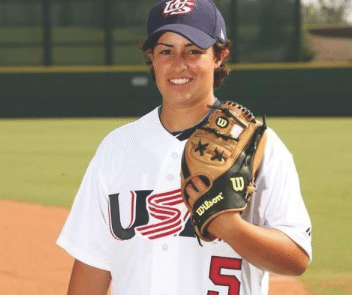
Did Bethany Ojalvo also find it not “amusing” when the Pacifics brought in a woman pitcher recently [Hero & Zero, Aug. 12]? That might have been a first. Might kids take that message even more seriously than a T-shirt slogan? What about the two women who just passed the Army Rangers training–first ever? Would she think them heroic for crying in public? How would they respond to her?
Showing emotion in public does not make one a hero: It’s just what people do.
A Zero is trying to paste one’s biases on the “model for our next generation of men”–or women, or anybody else.
—Mike van Horn, via pacificsun.com

by David Templeton
Perhaps you remember this.
There was once a tiny theater tucked into a corner of the Luther Burbank Center, at the northernmost edge of Santa Rosa. From the way people talk about it today, it’s hard to believe that such a place was ever real. Though the space itself is gone, replaced almost 10 years ago by offices and storage space at the center (since renamed The Wells Fargo Center for the Arts), the shows that were performed at Actors Theater during its mighty reign have lingered on in the memories of North Bay theater fans and artists alike. Some of those productions—Tom Stoppard’s Arcadia, Tony Kushner’s Angels in America, Joan Ackermann’s Off the Map—have fully become the stuff of local theater legend.
“It was an amazing time, and the best artists in the area did great work there,” says Argo Thompson, who joined the company after its foundation, and served as artistic director of Actors Theater from 1997 to 2005. “The goal of the company was to champion small, contemporary theater, with an emphasis on things that had never been produced in the area before. It changed the scene completely, proving that when groundbreaking theater is being done by first-rate artists, people will make the effort to come see it.”
The theater soon earned such a stellar reputation that audiences from around Sonoma, Marin and Napa counties—and even as far away as Berkeley and San Francisco—would make the drive to Santa Rosa to see what was happening at Actors Theater.
Thompson was there when the company—formerly a breakaway from the long-established Santa Rosa Players—rejoined the Players to create 6th Street Playhouse, folding both companies into one under the 6th Street banner. After serving as executive director of 6th Street for three years, a reorganization of management effectively ended Thompson’s participation in the North Bay and Sonoma County theater scene for the next decade.
“With the exception of directing the occasional production of The Santaland Diaries, with David Yen, I have been out of the scene for 10 years,” says Thompson, who served as the executive director of the Marin Arts Council from 2009 to 2011, and has since been working primarily in development and fundraising for various arts-related institutions since, including 142 Throckmorton in Mill Valley and Theatre Bay Area, in San Francisco.
Thompson has finally reentered the scene with Left Edge Theatre, a brand new company in Santa Rosa offering its first season of shows within a few hundred feet of where the original Actors Theater once stood. Beginning with this weekend’s opening of David Lindsay-Abaire’s Good People, Left Edge Theatre has officially landed at Wells Fargo Center, where two resident theater companies, Roustabout Theater and North Bay Stage Company, also operate.
“We have a strong season of four great shows to kick this off,” Thompson says. “Once we make it through this first year, we will see what happens next, but my goal is to establish Left Edge as a professional theater company. The best thing for building an audience for theater is having good theater available. So that, more than anything, is our goal.”
NOW PLAYING: Good People runs on Fridays and Saturdays (with one Sunday matinee) from Sept. 4-19 at the Wells Fargo Center for the Arts, 50 Mark West Springs Rd., Santa Rosa; $30-$40; leftedgetheatre.com; 707/546-3600.
‘The right vibe’
I met Mr. Coyote three times–once randomly on the street in San Francisco–and was blown away by his kindness and generosity in conversation [‘Looking back and moving on,’ April 24]. Not knowing me from Adam, he introduced me to his family including his amazing granddaughter and they were as beautiful and cordial as he is.
I didn’t know about his Buddhist beliefs until seeing him at a recent book signing; but that totally speaks to his gentle way and openness to strangers. He is a brilliant writer and an inspirational human being. I’m sorry to read he no longer resides in Marin. I certainly understand his need to be where he feels the right vibe. Bravo to Peter Coyote for taking his genius to the next level and remaining dedicated to improving the lives of others.
–Diane Harrigan,via pacificsun.com
Woe is us
The fallacy of paying never-ending wage hikes to attract the ‘best talent,’ or ‘comparable’ salaries measured against other agencies, is an outright scam. The Supervisors keep riding this escalator to eventual bankruptcy as if hypnotized by the rarified air of their newly remodeled chambers. Even the new guy, Damon Connolly, seems to have followed into lockstep with the Queens of Excess.
Woe is us until we get three new elected Supervisors, hopefully next June.
—Alex Easton-Brown

by David Templeton
Comedian Greg Proops is not a fan of superhero movies, sequels or remakes—with one or two notable exceptions.
“The Maltese Falcon, by John Huston, is a remake,” he points out. “There have always been sequels and there will always be remakes, but all of these superhero movies just don’t do it for me. I know people love them, and they are mildly entertaining, but my problem with superheroes is that they all have these amazing powers, all of these fantastic things they can do that defy nature—and then at the end they just have a big fistfight. Anybody can have a fistfight. Big deal.”
Proops, best known for his stint on TV’s “Whose Line Is It Anyway?” is the author of The Smartest Book in the World, a reference book adaptation of his popular podcast “The Smartest Man in the World.” Essentially a witty download of Proopian thoughts on history, culture and the state of the world, the podcast—and the highly entertaining book it inspired—is a companion to his other podcast, “Greg Proops Film Club,” a live recording of conversations that Proops has on stage in Los Angeles after screening one of his favorite movies at the Cinefamily theater.
Recently in Northern California on a book tour, Proops enthusiastically accepted my invitation to see and discuss a movie … but then we couldn’t find a film that we both wanted to see happening at a time we were both available to see it.
Then he left the state.
Today, having given up on choosing one particular film to discuss, the Smartest Man in the World and I are on the phone, talking about why it’s so hard to find a good film that isn’t in 3D (“The wax museum [movie], sure, but nothing else,” Proops says), isn’t a remake or sequel or doesn’t feature a superhuman mutant beating the crap out of other superhuman mutants.
“The last movie I saw in a movie theater was Pillow Talk, with Rock Hudson and Doris Day,” Proops says.
No, Proops is not saying that he hasn’t been to a movie since 1959, when Pillow Talk debuted. He screened it as part of his Greg Proops Film Club.
“It’s great to see an old movie on the big screen,” he says. “It’s kind of funny how, even if you’ve seen a film a thousand times on TV, then see them with a bunch of people in a theater, those movies seem new and exciting. Pillow Talk got actual screams of laughter from some people in the audience. People were crying, they were laughing so hard.
“Do you know that movie, David?”
“I’ve seen it on TV,” I admit. “It’s one of those weirdly dated movies that still manages to be funny, partly because it’s so dated.”
“Exactly!” Proops says. “Rock Hudson absolutely tortures Doris Day, who’s his neighbor, with a party line on their phone. Rock Hudson keeps calling her up and pretending to be different people on the party line. It was getting howls, and I was thinking it really wouldn’t hurt to go back and look at some of those great sitcom-style movies from the ’50s and ’60s. They make movies like Bridesmaids and The Hangover III look so unsophisticated and dumb.”
“And yet, in a way, they were the Bridesmaids and Hangovers of their day,” I point out. “These were the movies parents didn’t want their kids to see because they might be a bad influence.”
“It’s true. They had sex in them, or the possibility of sex,” Proops says. “When we showed Pillow Talk in Los Angeles on a Tuesday night, the place was packed with 170 people, and not just old people in their 80s. The people who come are not dusty archivists, pining for the past. They are film fans, and a lot of them were young—and they loved it, because it works. It’s a good movie.”
“And it’s not mean,” I add. “Comedies today have gotten incredibly mean. The remake of Vacation, for one example, heaps so much genuine pain and agony on its characters I don’t see why people can laugh at it for 90 minutes.”
“Oh, I agree,” Proops says. “Cruelty has replaced humor, and I’m not sure when it happened. There’s where I get off the train. I mean, I’ve always liked slapstick, and as a comedian, I try to use as much slapstick in my act as humanly possible, because I think it’s a valuable art form. I mean, it’s a rule of comedy that someone else’s pain is always funny. But there’s only so much we can take.
“I saw it happening on television in a huge way, starting four or five years ago,” he continues. “Every single TV commercial had someone being killed, or getting their hand caught in a machine. When did we become the world of hurt? Is there no room left for anything but cruelty?”
“Can it possibly go any further?” I ask. “Or will there be a return, at some point, to a kind, gentler form of humor?”
“I hope there will be but I really don’t know,” Proops says. “There’s a definite desensitization at work, and it makes me sad. People are nicer than that, I think. I don’t know, maybe I’m naïve. Of course I’m naïve. I choose to be naïve. I think it’s better than being hard and cruel.”
“Would you say that, maybe, gentler forms of humor cease to be effective after years of repetition,” I ask, trying to put my finger on the trend, “so that, to get a laugh, we need to turn up the intensity, and as a result, movies get more and more intense, and humor becomes more and more mean-spirited?”
“No, I wouldn’t say that, exactly,” he responds. “I’d say that Hollywood studios are reinforcing the economy of bullshit that these lousy writers are coming up with. It’s the kind of stuff studios will buy from writers, because they know it sells, so that’s all writers are writing, because they need to work. It’s basically a problem of studios distrusting the intelligence of their audience, and if you don’t give the audience anything else to choose, they will choose the crap.
“And then Hollywood makes more crap, ’cause they think that’s what people want. But guess what? I do a podcast where I talk and blather about whatever is on my mind for 90 minutes, like an old-fashioned radio show . . . and people listen. Lots of people listen. I show old movies in movie theaters once a month, and people come to them, and they enjoy them, and don’t flip out or anything. It excites them, and it’s contagious.
“Because it’s different,” concludes Proops. “And we can only handle so many superhero movies before we demand something else. And I don’t think that’s just me.
“Though maybe it is. I am naïve, after all.”

by Nikki Silverstein
The eagle has landed at the Computer & Technology Resource Center (CTRC) in Bel Marin Keys. Joran Sneath, 15, of Novato, is a Life Scout working to achieve the coveted Eagle Scout status by starting a service project at the CTRC, a nonprofit environmental agency that collects and repairs old computers and then donates them to nonprofit groups and folks with low incomes. “In the 21st century it is almost required to have a computer to apply for a job or even do schoolwork,” Sneath says. Help the future Eagle Scout by donating your used computer. Email jo*********@***oo.com. To learn more about the Computer & Technology Resource Center’s e-waste collection activities and free computer donation program, visit ewastecollective.org.
Hugo Landecker won Zero status by a landslide. Last year, the San Rafael City Council dubbed him citizen of the year, but that moniker is no longer valid. The long-time Gerstle Park resident believes that the homeless want to remain homeless and he wants them to leave town. Drumming up support for a letter-writing campaign to rid San Rafael of the Ritter Center, a nonprofit agency that assists the homeless in our community, Landecker urges the three property owners who lease space to the center to let the leases expire without renewal. He espouses similar vitriol about St. Vincent de Paul Society of Marin. Landecker, close your mouth and put down your poison pen. Try using your time to help homeless people, rather than banish them.

by Annie Spiegelman, the Dirt Diva
Get ready to feast your eyes on peaks of produce whimsically displayed alongside heritage farm animals and classic flowers that will take you back in time to your grandmother’s victory garden. The 2015 National Heirloom Exposition is upon us and it is a true delight for all of the senses. Labeled the world’s purest food fair, this foodie festival—taking place September 8 through 10 in Santa Rosa—assembles talented home gardeners, farmers, pure food enthusiasts, local school groups and global leaders in the food industry for three days of fun, education and plenty of real food tasting.
Just what is an heirloom and why does it merit an expo? Twelve thousand years ago humans discovered agriculture by doing something as simple as saving seeds. A vast variety of seeds were passed down from generation to generation, farmer to farmer, garden-geek to garden-geek. Heirloom seeds are open-pollinated so they can be saved and planted year after year.
Today, there are seeds created in biotech labs and patented by multinational corporations who believe they have the right to own agriculture. Often these genetically modified seeds are treated with pesticides and herbicides. They cannot be saved and replanted from year to year. In the last century, some 30,000 vegetable varieties have become extinct.
Heirloom plants preserve the past, offer greater disease and insect resistance, come in a wide shade of shapes, colors and tastes and have much, much trendier names than today’s hybrids. Check out these heirloom tomato names: Chocolate Stripes, Aunt Ruby’s German Green, Pearly Pink and Radiator Charlie’s Mortgage Lifter. How can we resist those names!?
This ‘World’s Fair’ of the heirloom seed industry began five years ago and is in large part sponsored by Baker Creek Heirloom Seeds. The seed company opened its “Seed Bank” doors in 2008 in Petaluma. Owner, Jere Gettle, a pure food supporter who is known to many as ‘the Indiana Jones of seeds,’ planted his first garden at age 3. Today the company catalogue ships to more than 250,000 gardeners nationally and offers the largest selection of heirloom varieties in the U.S.
Gettle and his team created this not-for-profit event. All funds above cost are donated to school gardening education and other sustainable food programs. On Thursday, September 10, the expo is especially devoted to educational and fun events for children of all ages. This day will be free for children and one adult, and doors will open at 9am instead of 10am.
Ready for a competition? There’s a contest for everyone. Giant pumpkin, best honey, best sunflower, best tomato, favorite pig, fiddler and a chalk art competition featuring drawings of farm life and heirloom produce.
The exposition showcases more than 100 speakers—knowledgeable authors, food activists and environmental speakers coming to share their wisdom on how we can all work to improve our country’s dysfunctional food system, 350 natural food vendors and exhibitors and attracts more than 15,000 visitors.
An impressive lineup of nationally and internationally recognized speakers will include Dr. Vandana Shiva, renowned author, philosopher and environmentalist; Jeremy Seifert, director of the film GMO OMG, which looks at the way GMOs affect our children; Andrew Kimbrell, founder and executive director of Center for Food Safety; Sara Patterson, teenage farmer and entrepreneur who runs Red Acre Farm, a small sustainable family farm near Cedar City in southern Utah; Deborah Koons Garcia, director of the films The Future of Food and Symphony of the Soil; Dave Murphy, founder and executive director of Food Democracy Now!; Steven M. Druker, a public interest attorney who initiated a lawsuit against the FDA that forced it to divulge its files on genetically engineered foods; Jessica Prentice, a professional chef, author, local foods activist and social entrepreneur; Linda Ly, creator of Garden Betty, the lifestyle website devoted to gardening, homesteading and sustainable living; and Zen Honeycutt, founder and director of Moms Across America, a national coalition of unstoppable moms committed to educating themselves—and raising awareness—about GMOs and related pesticides.
Today, powerful U.S. food, biotech and pesticide companies are spending billions of dollars annually opposing any laws to label genetically-adulterated food. Learn about the latest updates on the labeling GMO campaigns gaining momentum across the country. Fifty countries including Japan, Australia, Russia, China and the EU have either banned or labeled GMOs.
“What are these food and agriculture companies so afraid of?” asks Stephen Andrews, environmental scientist and UC Berkeley professor, who attends the Heirloom Exposition each year with his soil science students. “If GMOs are so great and wonderful for us to eat, be upfront about it and declare your GMO greatness on the label. It’s label up, or go crawl back into your plasmid!”
National Heirloom Exposition, Sonoma County Fairgrounds, 1350 Bennett Valley Rd., Santa Rosa; Sept. 8-10; opens at 10am; $15 per adult, kids 17 and under free; theheirloomexpo.com.
by Tanya Henry
One of my first trips to Marin in 1988 entailed a visit to Calico Corners, an East Coast-based fabric and furniture franchise in the Bon Air Shopping Center. With its closing, a different kind of franchise moved in. Bolts of top-quality silks and exquisitely upholstered sofas were replaced with imported Italian ovens, five flat-screen televisions and enough tables and chairs to seat 200 people.
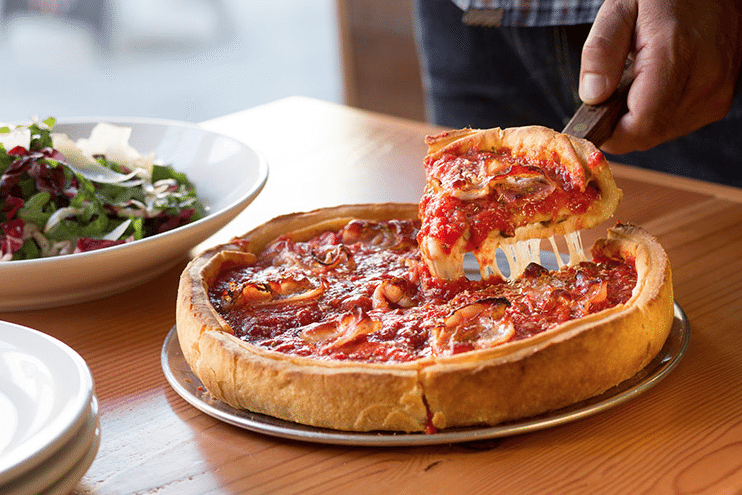
The 16th outpost of Patxi’s Pizza made its Marin debut in early August, and in many ways seems a perfect fit for South Marin’s well-heeled young families and executive types. Patxi’s (pronounced ‘pah-cheese’) comes from one of the two owners, Francisco “Patxi” Azpiroz, who founded the popular pizza chain in 2004. Together, Azpiroz and Bill Freeman have been treating Bay Area folks to their deep-dish, Italian-style thin-crust, and gluten-free pies for more than 10 years.
Completely reimagined by the architect firm DMHA out of Santa Barbara, the stunning space begins with massive front doors featuring foot-long wooden pizza paddles for door handles that open into a dizzying amount of muted beige wood, stone and a decidedly brown color palette. There are plenty of brushed metal chairs, high- and low-top tables and a wrap-around full bar that looks out onto Sir Francis Drake. It’s a lot to take in—the transformation is so utterly extreme and even extends outside to a patio, complete with a fire pit and a handful of umbrellas.
With only a few weeks under their belts, the very earnest and friendly wait staff is doing their best to keep up. Already the large space frequently has a waitlist. The menu features a manageable variety of appetizers, salads and of course various styles of pizza. A 10” deep-dish brimming with BBQ chicken, smoked bacon and jalapenos is a winner. I have previously sampled several of the thin-crust options in San Francisco, including the spinacini topped with spinach, tomatoes and mozzarella and a prosciutto and arugula—none have disappointed. No formal dessert options are offered; however, every table includes a honey bear and diners are encouraged to drizzle honey on any remaining crust for a sweet finish.
Cocktails, beer and wine round out the restaurant’s offerings. As with the food, many are sourced locally with an emphasis on artisan producers and organic when possible.
I have always been impressed with the Bon Air Shopping Center. Unlike other malls it seems to have just the right mix of restaurants, retailers and grocery—and it’s always busy. Patxi’s has landed in a good North Bay location. They seem happy to be here and by the looks of the crowds eager to get in, it’s safe to say that the feeling is mutual.
Patxi’s Pizza, 340 Bon Air Center, Greenbrae; patxispizza.com; 415/526-3889.

FOLLOW US
Copyright © Weeklys All rights reserved.
OUR PUBLICATIONS