Hero & Zero

A scammer ensnared a Marinite in his scheme and added $2,500 to his coffer. Before you say you wouldn’t fall for it, keep in mind these hustlers talk a good game and the elderly in our community are particularly vulnerable.
This swindle began with a person we’ll call Eleanor receiving a phone call from “Sam Fox with the Social Security Administration.” He gave his badge number, asked questions to establish Eleanor’s identity and then transferred her to the fraud division.
A new person weaved a story about the FBI seizing 22 pounds of cocaine from a car registered in Eleanor’s name. In addition, several bank accounts in the same name were being used for money laundering.
The fraudster requested five Google Play gift cards totaling $2,500 to verify the victim’s real bank accounts, with the promise to reimburse the money by the end of the day. Growing suspicious, she informed the caller she didn’t believe him.
Ever the pro at keeping his prey engaged, he texted a letter from Social Security, which detailed criminal charges for drug trafficking and money laundering. Eleanor must stay on the phone and comply with the demands, or risk arrest and jail.
She purchased the gift cards and provided her checking info. Now he asked for $3,000 to verify her savings account. Wary, she googled Sam Fox and his badge number. The scam popped up.
Still fearful of arrest, Eleanor stayed on the line, but she drove to the Marin County sheriff’s office. They instructed her to hang up. Unbelievably, the thief continued to call and even sent a text message indicating a warrant for her arrest had been issued.
Though the grifters performed their parts well, warning signs existed:
The use of gift cards.
Demand to stay on the phone.
The threat of arrest.
If in doubt, hang up and call the police. For those of us with elderly relatives, talk to them about these scams perpetrated by slick callers.
Got a Hero or a Zero? Please send submissions to ni***************@***oo.com. Toss roses, hurl stones with more Heroes and Zeroes at pacificsun.com.

Run Rabbit Run

Break out your decoder rings; the flawed but intriguing Us’s political subtleness is hidden by its straightforward terror. Among other things, Jordan Peele’s followup to Get Out breaks a long drought. Santa Cruz, with its deep cold bay and hoodooed mountains, ought to be California’s Transylvania. Instead, it’s remembered for The Lost Boys, which is just The Goonies wearing plastic vampire fangs. There hasn’t been a good movie made there since Killer Klowns from Outer Space (1988). Now the curse is lifted, even if much of Us is shot in a lake in the San Bernardino Mountains.

There’s a strange ride at the Beach Boardwalk that most visitors fail to notice. In 1986, young Adelaide slips away from her family and wanders into “The Shaman’s Cave.” Passing an old derelict holding up a cardboard sign with a particularly vicious Bible verse (“Jeremiah 11:11”), she enters. An electric owl calls her name. Amid the hall of mirrors and the painted images of redwoods, her identical double awaits.

Somehow she survived. In our present, she (Lupita Nyong’o) is a calm, pretty mom married to a living dad-joke, Gabe Wilson (Winston Duke of Black Panther). Two kids: one a monkey-mask-loving, naughty little boy Jason (Evan Alex), the elder, a disdainful daughter Zora (Shahadi Wright Joseph). They are as tight as the quartet of stick figures on the back window of their SUV.

The “Shaman’s Cave” is still on the beach 30 years later, with a new paint job. It’s Arthurian now instead of Native American. The doorway beckons young Jason.

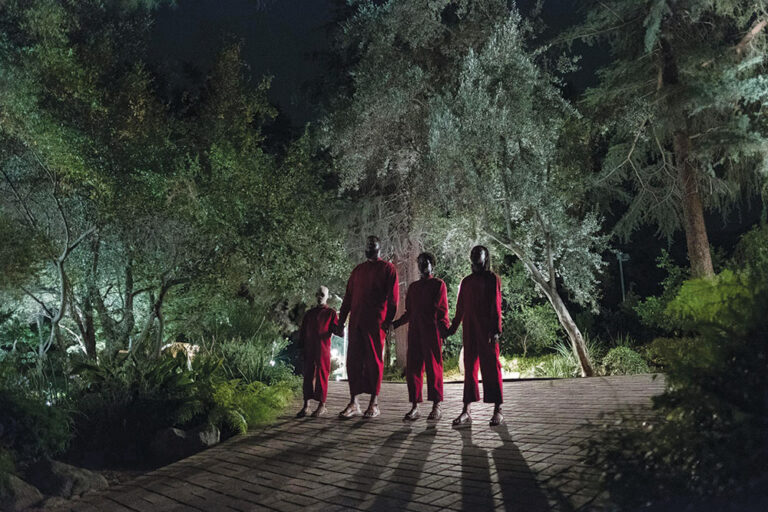
That night as the Wilsons go to bed, the power goes off. Standing in the driveway are four figures in red jumpsuits, smiling maliciously, armed with long sharp scissors. Each wears a driving glove on one hand, Michael Jackson–style, perhaps to keep the blood from making their weapons slip. Jason’s monkeyish double is crouched on all fours. On his face is what the burn-ward doctors call a “TFO mask”—so you’ll know what to ask for next Halloween. At some cost, the family gives their captors the slip. But they’re not the only ones being visited tonight.

Home invasion terror isn’t always elegant, but it’s always effective. Peele is a genial shocker: the comic relief arrives between never-too-horrible mayhem. Before the attack, Gabe lounges in plaid shorts, waiting for his wife in what he hopes is an alluring position. It’s funny and tragic, too, when the cuddly man tries to act badass to scare off the intruders.

The movie’s suggestiveness is in the title, which could be misread as “U.S.”; what will be the fate of a society divided between “influencers” and the influenced? Deeper analysis of Us will be deserved. Nyong’o is constantly startling with her display of terror and maternal wrath. As seen on Us’s sensational poster, Nyong’o is a master of the horror-face, a look described in the theater world as ‘the skull.’

‘Us’ is playing in wide release.

Horoscope

ARIES (March 21-April 19): Kermit the Frog from Sesame Street is the world’s most famous puppet. He has recorded songs, starred in films and TV shows, and written an autobiography. His image has appeared on postage stamps and he has a star on the Hollywood Walk of Fame. Kermit’s beginnings were humble, however. When his creator Jim Henson first assembled him, he consisted of Henson’s mom’s green coat and two halves of a white ping pong ball. I mention this, Aries, because the current astrological omens suggest that you, too, could make a puppet that will one day have great influence. APRIL FOOL! I half-lied. Here’s the whole truth: now isn’t a favorable time to start work on a magnificent puppet. But it is a perfect moment to launch the rough beginnings of a project that’s well-suited for your unique talents.

TAURUS (April 20-May 20): Taurus businessman Chuck Feeney made a huge fortune as the entrepreneur who co-developed duty-free shopping. But at age 87, he lives frugally, having given away $8 billion to philanthropic causes. He doesn’t even own a house or car. In accordance with astrological omens, I invite you to follow his lead in the coming weeks. Be unreasonably generous and exorbitantly helpful. APRIL FOOL! I exaggerated a bit. While it’s true that now is an extra favorable time to bestow blessings on everyone, you shouldn’t go overboard. Make sure your giving is artful, not careless or compulsive.

GEMINI (May 21-June 20): Now is a perfect time to start learning the Inuktitut language spoken by the indigenous people of Eastern Canada. Here are some key phrases to get you underway. 1. UllusiuKattagit inosek: Celebrate your life! 2. Pitsialagigavit, piggogutivagit!: Because you’re doing amazing things, I’m proud of you! 3. Nalligijauvutit: You are loved! 4. Kajusitsiatuinnagit: Keep it up! APRIL FOOL! I lied. Now isn’t really a better time than any other to learn the Inuktitut language. But it is an important time to talk to yourself using phrases like those I mentioned. You need to be extra kind and super positive toward yourself.

CANCER (June 21-July 22): When he was twenty years old, Greek military leader Alexander the Great began to conquer the world. By age 30, he ruled the vast territory between Greece and northwest India. Never shy about extolling his own glory, he named 70 cities after himself. I offer his example as a model for you. Now is a favorable time to name clouds after yourself, as well as groves of trees, stretches of highway, buses, fire hydrants, parking spaces, and rocks. APRIL FOOL. I got a bit carried away. It’s true that now is a good time to assert your authority, extend your clout, and put your unique stamp on every situation. But I don’t recommend that you name entire cities after yourself.

LEO (July 23-Aug. 22): Now is an excellent time to join an exotic religion. How about the Church of the Flying Spaghetti Monster, which believes that true spiritual devotion requires an appreciation of satire? Or how about Discordianism, which worships the goddess of chaos and disorder? Then there’s the United Church of Bacon, whose members exult in the flavor of their favorite food. (Here’s a list of more: tinyurl.com/WeirdReligions.) APRIL FOOL! I wasn’t entirely truthful. It’s accurate to say that now is a great time to reinvigorate and transform your spiritual practice. But it’s better if you figure that out by yourself. There’s no need to get your ideas from a bizarre cult.

VIRGO (Aug. 23-Sept. 22): Studies show that people who love grilled cheese sandwiches engage in more sexual escapades than those who don’t gorge on grilled cheese sandwiches. So I advise you to eat a lot of grilled cheese sandwiches, because then you will have more sex than usual. And that’s important, because you are now in a phase when you will reap huge healing benefits from having as much sex as possible. APRIL FOOL! I lied when I implied that eating more grilled cheese sandwiches would motivate you to have more sex. But I wasn’t lying when I said that you should have more sex than usual. And I wasn’t lying when I said you will reap huge benefits from having as much sex as possible. (P.S. If you don’t have a partner, have sex with your fantasies or yourself.)

LIBRA (Sept. 23-Oct. 22): If you ever spend time at the McMurdo Station in Antarctica, you’ll get a chance to become a member of the 300 Club. To be eligible, you wait till the temperature ouside drops to minus 100 degrees Fahrenheit. When it does, you spend 20 minutes in a sauna heated to 200 degrees. Then you exit into the snow and ice wearing nothing but white rubber boots, and run a few hundred feet to a ceremonial pole and back. In so doing, you expose your naked body to a swing of 300 degrees. According to my astrological analysis, now is an ideal time to pull off this feat. APRIL FOOL! I lied. I’m not really urging you to join the 300 Club. On the other hand, I do think it’s a favorable phase to go to extremes for an authentically good cause.

SCORPIO (Oct. 23-Nov. 21): Scientific research shows that if you arrange to get bitten by thousands of mosquitoes in a relatively short time, you make yourself immune. Forever after, mosquito bites won’t itch you. Now would be an excellent time for you to launch such a project. APRIL FOOL! I lied. I don’t really think you should do that. On the contrary. You should scrupulously avoid irritations and aggravations, especially little ones. Instead, immerse yourself in comfort and ease. Be as free from vexation as you have ever been!

SAGITTARIUS (Nov. 22-Dec. 21): If allowed to do what comes naturally, two rabbits and their immediate descendants will produce 1,300 new rabbits in twelve months’ time. In five years, their offspring would amount to 94 million. I suspect that you will approach this level of fertility in the next four weeks, at least in a metaphorical sense. APRIL FOOL! I stretched the truth a bit. There’s no way you will produce more than a hundred good new ideas and productions and gifts. At the most, you’ll generate a mere 50.

CAPRICORN (Dec. 22-Jan. 19): The weather is warm year-round and the crime rate is low on Pitcairn, a remote South Pacific island that is a 30-hour boat ride away from the nearest airport. The population has been dwindling in recent years, however, which is why the government offers foreigners free land if they choose to relocate. You might want to consider taking advantage of this opportunity. APRIL FOOL! I was exaggerating. It’s true that you could get major health benefits by taking a sabbatical from civilization. But there’s no need to be so drastic about it.

AQUARIUS (Jan. 20-Feb. 18): You don’t have to run faster than the bear that’s chasing you. You just have to run faster than the slowest person the bear is chasing. OK? So don’t worry! APRIL FOOL! What I just said wasn’t your real horoscope. I hope you know me well enough to understand that I would NEVER advise you to save your own ass by betraying or sacrificing someone else. It’s also important to note that the bear I mentioned is entirely metaphorical in nature. So please ignore what I said earlier. However, I do want you to know that there are effective ways to elude the symbolic bear that are also honorable. To discover them, meditate on calming down the beastly bear-like qualities in yourself.

PISCES (Feb. 19-March 20): Now is a favorable time to disguise yourself as a bland nerd with no vivid qualities, or a shy wallflower with no strong opinions, or a polite wimp who prefers to avoid adventure. Please don’t even consider doing anything that’s too interesting or controversial. APRIL FOOL! I lied. The truth is, I hope you’ll do the opposite of what I suggested. I think it’s time to express your deep authentic self with aggressive clarity. Be brave and candid and enterprising.

Go to REALASTROLOGY.COM to check out Rob Brezsny’s Expanded Weekly Audio Horoscopes and Daily Test Message Horoscopes. Audio horoscopes are also available by phone at 1.877.873.4888 or 1.900.950.7700.

Native Beauty

For more than 20 years, award-winning photographers Rob Badger and Nita Winter have been chasing the bloom. That’s the way they describe their work in photographing wildflowers across the Western U.S., an ongoing project that aims to raise awareness about the dangers of climate change on native plants and local ecosystems.

Now, the two Marin City residents present a new exhibit of photography that emphasizes Marin’s vast public lands and scenic array of flora. “Beauty & the Beast: California Wildflowers & Climate Change” runs April 2 to June 1 at the Bay Model Visitor Center in Sausalito and features more than 70 photos of wildflowers taken on the trails of Mt. Tam, Ring Mountain, Point Reyes and other county hotspots as well as locales like the Sierras and Death Valley.

“The point of the project is to use art and text to inspire people to take action. We call it an art to action project,” says Winter.

“Because climate change is affecting ecosystems slowly, what we are showing are the flowers that will be affected by climate change,” says Badger. “We are showing what we have to lose.”

Both East Coast natives, Badger and Winter met while living and working in the Bay Area. Badger’s photography has been focused on nature conservation since the 1980s. Winter’s photography at first was aimed at capturing portraits of underserved communities, though she joined Badger in documenting nature in the early ’90s, when the two moved to Marin.

“We were creating these beautiful images,” says Winter. “But still as activists we wanted to figure out what we could do with them to create change and to create healthier natural communities.”

Ten years back, Seattle-based organization Blue Earth Alliance invited them to create a conservation-themed project, and the idea for “Beauty & the Beast” was born. The exhibition originated at the San Francisco Public Library and currently travels the western states. The Marin chapter of the California Native Plant Society, the Marin Community Foundation and the Marin Municipal Water District are co-sponsoring the upcoming show at the Bay Model.

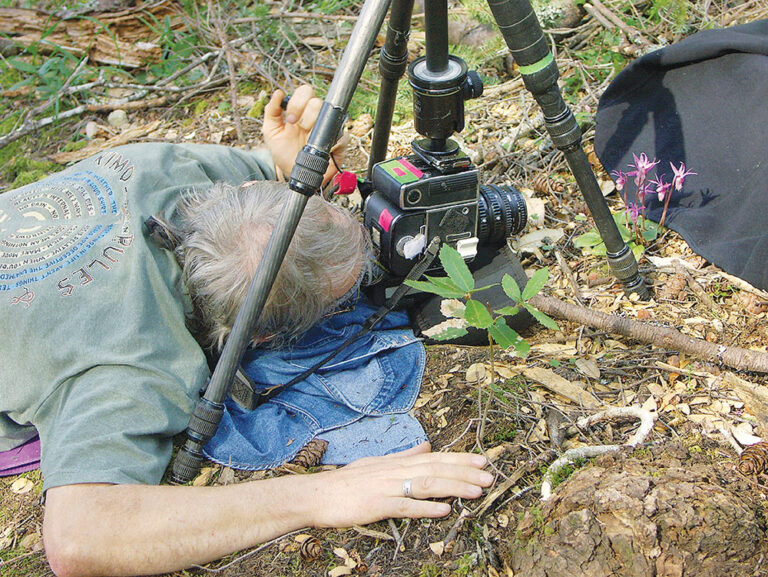
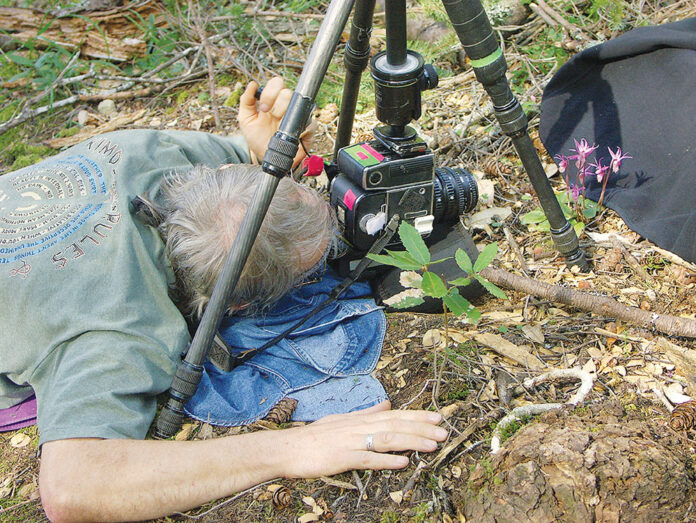
Much more than landscape photography, Badger and Winter take portraits of wildflowers found on the trails, setting up a black or white background, like a mini-studio, that is carefully wrapped around the plant.

“We isolate the plant from a distracting background,” explains Badger. “We want to isolate the beauty of the blossom. It’s a time-consuming process, but we value the individual (plant) and it’s very rewarding to be able to see the beauty, and the diversity of beauty, and to be able to share the beauty of what is on our public lands.”

In conjunction with the exhibit, a schedule of events offer the public a chance to meet the artists at a reception on April 6, shop for native plants on April 13 and take a tour on May 4 of a native plant garden recently installed at the Bay Model. “The garden is a real-time example of what we are promoting,” says Badger. “It’s not just about the flowers, it’s about all the different life forms that depend on these ecosystems.”

‘Beauty & the Beast: California Wildflowers & Climate Change’ runs April 2-June 1 and features an artist reception on Saturday, April 6, at Bay Model Visitor Center, 2100 Bridgeway, Sausalito. Free admission. cnpsmarin.org.

Advice Goddess

Q: I’m a straight single woman nearing 50. My best friends are a lesbian couple. I’m going to get some nonsurgical skin tightening on my face, and they got very judgmental about it: “We think you’re beautiful as you are.” Next, it was “What if it goes wrong?” and “Will you keep getting procedures till you don’t look like you?” I ended up crying and then getting really angry. First of all, it’s my face. Secondly, I don’t think they understand the pressure on straight single women to look young and beautiful. Thirdly, I think my friends should support me in my decisions even if they don’t agree with them. Am I wrong? —Upset

A: I’m 55. Eventually, if a man catcalls me, I’ll go over and give him a dollar.

So I do understand the desire for dermatological intervention. That said, your friends probably feel they have a right (and maybe even a mandate) to tell you what to do—probably because they’re trying to look out for you. The problem is, criticizing people doesn’t make them want to change; it makes them want to clobber the person doing the criticizing. And this seems to be the case whether that person is giving unsolicited advice to a friend or muttering “Dude … seriously on the 24-pack of doughnuts?” to that stout stranger in the supermarket.

This happens because our brain’s threat response system is a little primitive. A central player in it is the amygdala, which makes split-second decisions about whether we’re in danger. Unfortunately, to your amygdala, an attack is an attack—meaning, a verbal attack triggers the same responses as a physical attack. Your adrenaline surges, your heart pumps like crazy, and blood gets shunted away from your reasoning center and to your extremities. This gets you into the perfect state to bolt or punch your attacker in the nose.

Tell your busybody friends it means a lot that they care about you, but that their context—as two nesting lesbians—is not your context as a single straight woman careening toward 50. Set a boundary: Explain that you want their advice on your appearance only if you ask for it. You could also ask them to be supportive of you—even if they aren’t on board with the steps you’re taking—simply on the grounds that you’re trying to improve yourself and go after what you want. It’s nice when your photo on a dating site makes some man reminisce about a classic beauty from his youth—but not when it’s his grandma’s prized Hermes alligator clutch.

Q: I’m a guy, and I’ve noticed that many women (at cafes, etc.) give me flirtatious looks, suggesting they’re interested in me, yet they never approach me. Why don’t they just come over and say hi and get my number and call me or message me? —Annoyed

A: It isn’t hard to get a woman to chase you. Just grab her purse and take off down the street.

However, as a dude, if you’re looking for dates or a relationship, you should plan on doing the chasing rather than the waiting. “Males chase/females choose” evolved to be kind of a thing across species—those in which the females get stuck with the greater share of child production and caretaking (“parental investment,” in anthro terms). As evolutionary scientists Peter K. Jonason and Norman Li explain (in their research on playing hard to get), “the sex that bears the greater obligation to offspring is the more choosy sex (females in most species) and will put the opposite sex (usually males) through ‘tests’ for access.”

Keep in mind that many men will have sex with a woman they aren’t all that interested in simply because she pursues them. (In guy terms: “My wrist is tired. You’ll do.”) In line with this, Jonason and Li’s research finds that women benefit from playing hard to get in a way men do not. A woman who refrains from pursuing a man “may increase her perceived value” in his eyes and motivate him to work harder to pursue her. “In contrast,” they write, “men who limit their availability may pay heavier costs than women will through the loss of potential mating opportunities.” As for what this means for you, waiting for women to ask for your digits and blow up your phone with calls and texts is a fantastic idea—if your mail comes addressed to Chris Hemsworth, 26 Movie Star Avenue.

Look for the Union . . . Edible

Can unions organize cannabis industry workers, some stoned, some sober, others undocumented and still others with college degrees?

It’s tricky.

The upsides: a unionized cannabis industry could help improve wages and working conditions for men and women who labor in North Bay cannabis fields, warehouses and dispensaries. Unions could also assist the industry as a whole by rendering it more transparent, and by insisting on standards that contribute to the health and safety of employers, employees and consumers.

The downsides: a wobbly workforce that’s still laboring underground in many cases and that doesn’t really need the union dues on top of the onerous tax burden that comes with compliance. Not to mention that there’s not one or two, but three unions angling to ramp up their rolls with the North Bay cannabis labor pool.

The International Brotherhood of Teamsters is one of the unions pushing to organize weed workers. Its drivers already transport legal weed throughout the state; now the union is pushing out into the fields and warehouses. At 1.3 million members strong, the IBT is one of the strongest unions in the country and now they’re in the thick of a campaign to organize a California cannabis industry that is moving haltingly from illegality to legality.

The Teamsters have already been engaged in the cannabis culture in this state for decades. Along with the California Growers Association, plus law enforcement and elected officials all across the state, the Teamsters supported and lobbied for Proposition 215, which ushered in the state’s landmark medical marijuana regime in 1996.

The Teamsters also lobbied in favor of Proposition 64, which legalized adult use in 2016 and launched the system of regulation and taxation that’s now in place. Once the legal cannabis industry had employees who delivered and distributed marijuana, it made perfect sense, from the Teamsters perspective, to organize them.

“Helping new industries evolve” is the current Teamster slogan. They’d like to see the cannabis industry evolve by embracing unionization—an effort already underway that’s helped one California pot business organize its workers.

The Teamsters recently helped organize workers at Continuum, a California marijuana distributor that has offices and warehouses in Oakland, Sacramento and Orange County. “We worked closely with the Teamsters,” says Tim Morland, the compliance and policy director at Continuum. “Now all our employees—drivers and warehouse workers—are in the union and make $25 an hour.”

The Teamsters have also stood by their pot-transport workers when they’ve been arrested and detained by law enforcement. The Los Angeles police recently nabbed and held a cannabis delivery man named Richard Rodriguez, a member of Local 853, for 15 hours. The Teamsters found a lawyer who secured the trucker’s release; no charges were filed. “No one has ever offered me that kind of protection,” he told the Teamsters blog. “We need the Teamsters because they have those relationships.”

Closer to home, it’s a challenge to obtain accurate information about where and what the Teamsters are actually doing on the ground in the North Bay on the cannabis front—in part because there’s competition between rival local labor organizations that nobody in the union-advocacy movement wants to talk about, at least on the record.

It’s understandable that the union doesn’t want to tip its hand about its organizing plans and invite sabotage at the hands of “right to work” agitators. And it’s a touchy prospect going in: Some cannabis companies are still very much underground, or straddle a gray border that divides the legal and the illegal. They don’t want or need the publicity of a union shop.

A local Teamsters organizer who insisted on anonymity says of efforts to unionize the industry, “This is just the beginning. A lot of people haven’t followed rules and still don’t follow rules. They’re not the easiest people to work with.”

The United Farm Workers (UFW) and the United Food and Commercial Workers International Union (UFCW), also aim to organize cannabis workers. If you’re a cannabis worker, we want to talk with you,” says UFW national vice president Armando Elenes.

For its part, the UFCW asks that the Teamsters kindly step back. “The UFCW has a Cannabis Workers Rising Campaign,” UFCW spokesman Jeff Ferro says.  “We would hope they [the Teamsters] respect our jurisdiction.”

The competing unions reflect the diversity and scope of a cannabis industry that stretches from fields and warehouses to trucks, kitchens and dispensaries.

Another Teamster spokesperson who requested anonymity says the union is aware of competition from the UFW and UFCW. One difference, she says, is that Teamsters don’t want to be organized-labor militants. “We aim to be an advocate for the industry, not a thorn in its side.”

Organizers note that there’s still some lingering bitterness in California’s Central Valley between the United Farm Workers and the Teamsters, who tried to elbow out Cesar Chavez’s organization in the 1970s. But it was a different Teamsters in the ’70s—in bed with organized crime and with a corrupt ex-convict Jimmy Hoffa as its leader. The union has taken great pains to reform its image and organization since its mid-’70s lowpoint, when Hoffa disappeared and was presumed to be killed by the Mafia. He still hasn’t been found.

It’s a different union today, even if it is headed by James Hoffa Jr.

Kristin Heidelbach heads the Teamsters Cannabis Division. A graduate of Sacramento State University, she commands an office in the state capitol, travels widely, speaks publicly and provides a recognizable name and face to an industry that has historically been reluctant to go public.

Heidelbach worked closely for more than a decade with her mentor, Barry Broad, a Teamsters lawyer from 1985 until his retirement last year. For much of his career, Broad focused exclusively on cannabis issues.

“We joined with members of the cannabis industry to reach consensus on issues and to create the regulatory system that’s now in place,” he says. “We knew it would be a rough transition for the legacy players, but the industry will settle down and become efficient, capitalized and automated like the rest of California agriculture.

“Government officials,” he adds, “had been uncomfortable dealing with people in the underground economy. Once the Teamsters unionized workers, it helped legitimize the industry.”

Broad says cannabis workers have suffered in the black market because they haven’t been paying into or accessing Social Security, unemployment insurance or workers’ compensation.

“There has been a dark side to the cannabis industry,” Broad says. “There’s been use of child labor, which is against the law, and there has been a lot of pot on the market with fungus that’s not fit for human consumption. We’ve helped to clean up the whole industry in more ways than one.”

Heidelbach carries on Broad’s legacy. Over the past three years, she has staked out the Emerald Triangle for organizing pot workers. The Emerald Triangle has for decades  been the heart of the California cannabis industry—though it’s losing ground to Salinas, Monterey and Santa Barbara, where municipalities are eager for tax revenue from the emerging economy.

Broad notes that Humboldt growers, far removed from the regional motherlode of cannabis consumers in San Francisco and San Jose. It’s a long way to drive with a load of legal weed, he says, even for a veteran Teamsters driver.

Last fall, Heidelbach chaired a panel at the Emerald Cup (the annual cannabis county fair, job market and stoner festival) in Santa Rosa that was titled “Tips for Making Money in the Newly Regulated Market.”

“It’s all about survival,” Heidelbach told the audience. That summed up the sentiments of the participants on the panel. None were gleeful about the future of legal weed.

Heidelbach is presently focused on working conditions in the Emerald Triangle and beyond, and not just because Murder Mountain is up on Netflix, highlighting the outlaw culture to the north. Yes, the pot workers are often pleasantly stoned, but many are also unhappy with the long hours, the repetitive work and the demand to turn out product quickly.

“A lot of trimmers and dispensary workers are treated unfairly,” Heidelbach says. “They need representation because they’re often afraid to speak up, lest they lose their jobs. At one place, I was told, ‘We’re good to our workers, but you can’t talk to them. They’re idiots.’”

Along with the condescending tone directed at workers, Heidelbach’s also gotten an indifferent, if not cold, shoulder from big commercial operators in the North Bay. One Sonoma County-based cannabis-industry spokesman who insisted on anonymity says the weed industry is now so squeezed by taxes and regulations it can’t survive further squeezing by the Teamsters.

The new taxes that are part of the Proposition 64 legalization regime have made it nearly impossible for individuals without big financial backing to enter the market.

Earlier this year, Clayton Taylor, a fledgling organizer for the Teamsters—he has an office in Santa Rosa—spoke to a roomful of largely union-indifferent members of the Sonoma Valley Cannabis Enthusiasts (SVCE), an industry group that wants Sonoma Valley weed to be as well-known as Sonoma Valley wine.

Ken Brown, a former Sonoma mayor and a longtime local activist, helped bring Taylor to the SVCE meeting.

“The Teamsters have a right to organize,” Brown says. “[But] if  people don’t want a union, that’s their business.”

For years, Brown’s wife, Jewel Mathieson, has been the heart and soul of the Sonoma Patient Group, the longest-running dispensary in Sonoma County. The Sonoma Patient Group is not represented by any union.

At the SVCE meeting, Taylor distributed a Teamsters flyer that boasted, “We sign what’s called a Labor Peace Agreement which sets the bedrock for the positive relation between employer and the Teamsters.”

That day, no SVCE growers signed up.

“We’re strapped,” one member says. “The union could make life more difficult for us.”

Immigrant trimmers in the cannabis industry are also pretty wary of the uptick in union agitation. Rosa (not her real name) is 25 and from Central America; Santiago (not his real name) is 29 and from South America. She has a passport and a visa; he has no legit papers.

What they make in four months here lasts a year back home. Three years ago, they earned $25 an hour as trimmers. By 2018, the wage had dropped to $15.

Working conditions are onerous—they put in shifts of up to 14 hours, and are under near constant surveillance—but Rosa and Santiago haven’t sought union representation and say they won’t strike or rock the boat. When they don’t like one workplace, they move to another farm or warehouse where the weed bosses are kinder.

Santiago worries about Rosa and rightly so.

“She has trimmed on remote farms where growers hit on her,” he says. “There’s little, if any, protection.”

At CannaCraft, a major cannabis-manufacturing facility in Santa Rosa, CEO Bill Silver expresses pride in the CannaCraft workforce and the company itself. “I was initially drawn to the company because it treats all our employees well.”

Silver, a former professor at Sonoma State University, is a bit more guarded when it comes to the question of a unionized Cannacraft. The company employs around 180 people.

“That’s a sensitive issue,” says Silver. “I don’t want to comment on anything that’s in progress.”

Jonah Raskin is the author of ‘Marijuanaland: Dispatches from an American War.’

Flashback

0

Twenty Years Ago This Week

Best Internet Service Provider

Although we Marinites pride ourselves on setting trends, not following them, when it comes to Internet service providers, we fall in line. Readers overwhelmingly give the first place nod to America Online, the best-known and biggest Internet service. Convenience, ease of use and all the little perks make it the provider of choice for many a Net nut. AOL offers so many services and sites of its own, you can spend hours of online time without ever venturing onto the web.

Matthew Stafford, Deborah Crooks and Carol Inkellis, March 17–23, 1999


Forty Years Ago This Week

We asked a reporter, who had little special knowledge of atomic physics and chemistry, to investigate the general principles of producing a hydrogen weapon.

At no time did he look at any classified information, or secret documents. He did only what any good investigative reporter with a few background courses in chemistry and physics would have done: He educated himself on the pubic services available.

In the process, the reporter discovered the key to another “secret” that we at The Progressive had suspected for many years: that the real purpose of the secrecy laws is to shield the weapons program not from those who might seek to injure America, but from Americans who seek to protect America from itself. The secrecy laws, he found, are effectively used to prevent people outside the weapons program from investigating the complex and profound issues of public health, safety and environmental concern arising from the manufacture of nuclear weapons.

Sam Day, managing editor of ‘The Progressive,’ in a response to an injunction preventing the magazine from publishing an article about the making of an atomic bomb, March 1

Fifty Years Ago This Week

Charles Schulz is known to his friends as Sparky. He lives in a secluded, lushly green, hidden part of Sebastopol. Surrounded by 28 acres of land, he draws “Peanuts” in a quiet, beautifully appointed studio.

First of all, there is the impression that you are talking to a friend: he is easygoing, calm, and confident. There is a quick smile and an honest degree of appreciation if you mention something you like in the comic strip. He has something of the small boy about him: maybe it is the trace of shyness which he isn’t afraid to show. As we left, I felt privileged to have spent the afternoon in such good company. Here’s how it went:

Q: I understand that you and your wife are building a very beautiful ice skating rink in Santa Rosa.

A: Yes. I think, without being egotistical, that we regard this as the world’s most beautiful ice arena, for the kind which is open to the public for general skating. Just the atmosphere of the rink will be different from any that has been constructed . . . the whole thing is going to be kind of extra special.

Where did the name ‘Peanuts’ come from?

It’s a stupid name which was thought up by someone from United Features Syndicate, 18 years ago. I’ve been fighting against it ever since. I think it’s a terrible name.

—Adrianne Marcus, March 20–26, 1969

The Tow Hold

0

A struggling man in West Marin was recently arrested on minor charges and spent a few months serving local time at the Marin County lockup in San Rafael. Before his arrest, the man had been living in his car. When he got out of jail, he was homeless. His car had been tagged and towed, by a company under contract with Marin County, to one of its impound lots—along with all his possessions and identification papers. In a word, this man was screwed.

This is a common enough hard-luck story in the land of sky-high rents: sure, you can live in your car, but you’ve got to move it every three days—or else.

That’s sort of hard to do if you’re poor and in jail.

Now, San Francisco state Assemblyman David Chiu has introduced a bill this week in Sacramento that aims to eliminate poverty-related towing. The bill was inspired by a recent report from the Western Center on Law & Poverty, Towed into Debt, which found that “hundreds of thousands of California drivers have their cars towed every year for non-emergency, non-safety related reasons.”

The three main culprits, according to the Western Center study, are unpaid tickets, expired registrations and parking for more than 72 hours on a public street. The study found that those who can’t afford to pay parking tickets and registration fees “often can’t afford to retrieve their vehicles once administrative fees, storage fees, and unpaid tickets are added together—fee totals often reach $1,500 or more.” If you can’t pay the fee, the state sells your car. If the state sells your car, you can’t get to work. If you can’t get to work, you lose your job. And thus the cycle of poverty continues.

The Western Center study found that every year, the state sells 200,000 government-towed vehicles.

Chiu’s bill, AB 516, would eliminate three types of poverty tows: those where a person has five or more unpaid parking tickets; tows where a registration is six or more months out of date; and tows where a car has been parked on a public street for 72 hours without being moved.

Chiu’s bill has been widely endorsed by anti-poverty and civil-liberties groups, including the American Civil Liberties Union of California.

Chiu expects some pushback from local transit agencies, which are, generally speaking, not in favor of being told what they can or can’t do by the state. But as the Western Study notes, localities are losing money on towing programs that disproportionately impact the lesser-of-means.

A locality will use the tow as leverage to collect a debt, but in many cases, the debt isn’t paid and the car goes to auction, where it’s sold at a fraction of its value. The Western Center study reports that “cities are losing money on tows, especially when the reason for the tow is someone’s inability to pay government fines and fees. Towed vehicles can quickly rack up thousands of dollars in fees and fines that often can’t be paid off by their owner. The fees and fines don’t get collected, the car is sold, and everyone loses.

“For many middle- and low-income Californians, getting towed is more than an expensive inconvenience,” says Chiu. “It can exacerbate an existing untenable financial situation. We should not be taking away a person’s livelihood or shelter simply to try to collect a minimal debt. This legislation will help stop a vicious cycle of penalizing poor people simply for being poor.”


Dank Francis

Ever since Francis Ford Coppola graduated from college back East and settled in California, he’s been ahead of the curve, whether in film or, more recently, viticulture. Last year, he added a cannabis product to his portfolio.

“Wine and cannabis are two ancient and bounteous gifts of Mother Nature, linked by great care, terroir and temperateness,” Coppola tells the Pacific Sun this week, by way of his assistant. (You can’t actually talk to the Godfather, unless he talks to you first.)

“Expertise making one applies to the other. As with growing grapes, location matters,” Copplas says-not-says, and adds that his cannabis is a “true blend of art and science.”

Coppola’s 2018 Growers Series offers a package of three one-ounce marijuana strains: a sativa dominant Sour Diesel; an indica-dominant Blue Zkittlez; and a hybrid called Tanhie.

An associate close to the director says that “cannabis has long played an integral part in his creative process.” Of course, to make his trippy films Coppola had to get high. And he must have been high when Coppola thought making a third Godfather movie was a good idea. Moreover, his wife Eleanor, the associate says, is a “firm believer in CBD.”

Though the website for the 2018 Growers Series depicts a large wine bottle with the name “Coppola,” along with the famed director’s signature, the cannabis is housed inside a small tin in the shape of a wine bottle with an embossed pot leaf. It’s Godfather packaging, totally over the top.

A nifty black-and-white drawstring bag contains rolling papers, a small pipe and a book of matches with the director’s initials. Kathleen Murphy, who handles publicity for Coppola’s cannabis line, says the strains are “not overly potent.” If you wanted a mind-melting Apocalypse Now experience, forget about it.

To market his Growers Series, Coppola created a separate commercial entity called Sana, which is ancient Sanskrit that some claim translates into “marijuana.” The word “chill,” which is broadcast on the Grower’s Series website, suggests that wine and weed are compatible. That’s Coppola’s point.

The cannabis is cultivated organically in the sun by the Humboldt Brothers, CEO Johnny Deim and chief farming officer Brett Todoroff. Both keep a low profile.

“Francis Coppola considers the Emerald Triangle, specifically Humboldt County, as one of the best place in the world to grow cannabis,” Murphy says. “With all of its microclimates, it’s the ultimate playground for the experienced cannabis grower.”

Too bad for you, Marin and Sonoma county growers—the Godfather has opted for greener pastures to the north.—Jonah Raskin

Life During Wartime

After the end of the world, the lights are still bright in Chicago’s Loop; there’s a veneer of normalcy, as long as you’re in the right class and stay in the right places. The top-notch, poorly titled Captive State, by Rupert Wyatt of Rise of the Planet of the Apes, is the first feature film to acutely deliver the mood in the Trump era. This is what a real resistance would be like.

After a shock-and-awe alien invasion, the world’s governments capitulated and instituted a collaborationist regime. Nine years after, the aliens—rebranded as “the Legislators”—run things, strip-mining the earth, drilling, baby, drilling, and sending obstinate humans to some off-world slave-labor colony.

The script by Wyatt and his wife, Erica Beeney, centers around the rebels: nurses, teachers, whores and street criminals. The aliens monitor all broadband, so the resistance uses analog technology: reel-to-reel tapes, carrier pigeons, and secret messages hidden in cigarette papers. We’re lured into the story through a set of lovers in the slums of Pilsner, a Chicago suburb: prostitute “Jane Doe” (Vera Farmiga) has luxuries, a record player and a vase of fresh cut flowers; her trick is the secret policeman William Mulligan (John Goodman).

Wyatt cuts from this sadness to brutal urban guerrilla action. On the graffitied walls are memorials to Rafe (Jonathan Majors), seemingly killed in an insurrection in Wicker Park, flattened by reprisal bombings. His surviving little brother Gabriel (Ashton Sanders, of Moonlight) is pulled into the rebellion.

Captive State isn’t perfection; there’s an inelegant info dump by teletype in the opening: it’s like an arcade game telling you what you’re going to be shooting at. The whippy small camera technique can leave you puzzled; a couple of escapes are exciting in the set-up, but vague in the finale.

The $25 million budget doesn’t permit a new kind of alien. They’re standard-issue buggos, nicknamed “roaches.” We never see their throne room, but we learn that visiting humans must be enveloped in germicide because they can’t stand our smell.

It’s tough to read Captive State as anything but a film on the side of the insurgents, a thriller of colonists and colonizers. Farmiga, a delicate and deeply apt tragic actor, and the magnificent old bull Goodman, with his eloquent grunts of displeasure, make the pair emissaries from a richer, more soulful age of movies. Captive State provides a hopeful end without simple-mindedness. You can read a lot of the fate of fascists into Goodman’s line, “Didn’t you pay attention in history class, Gabriel?”

‘Captive State’ is playing in wide release.

Surfin’ Curds

By late January, it was clear that I was not on track to meet my New Year’s dietary goals, so I cast about for any possible culprit besides my own self-discipline.

My eyes landed on the plate of cheese I’d enjoyed almost nightly with crackers, maybe a little secchi salami, and maybe a little wine. No, not the cheese! Suppose it was the crackers?

“A small amount of fat is better than a slice of bread,” Maureen Cunnie tells me. Cautioning that she is not a nutritionist, but operations manager at Cowgirl Creamery, Cunnie affirms that I’m behind the times if I feel guilty about indulging in their double-cream cheese products because of the bad rap on fat.

“That trend is actually changing very rapidly,” she says. “Cheese is very nutritious, it has fat and protein. If you’re athletic or into working out or doing cross training, you need both that fat and protein to retain muscle.”

I’m getting an idea: why not, instead of gnawing on ribs in some spurious version of the Upper Paleolithic, move the clock forward a few thousand years to the pastoral era?

Pastoralism is more than a pretty picture. For thousands of years pastoral societies in Africa, Asia and Europe have herded goats, sheep, yaks—you name it, it’s got milk, they herd it—and made various fermented products. A rigorous survey of online resources turned up just one mention of pastoralism writ as fad diet, and trademarked, no less: “The Pastoral Life—Home of The Pastoral Diet™ & Movement Plan.”

Unfortunately, the author let the site’s hosting expire shortly thereafter, but from what I remember it goes like this: I can eat plenty of cheese if I mimic the active lifestyle of a wiry herdsman leading his flock around the mountains. And oh yeah, a little goatskin flask of wine is absolutely OK.

That’s it. I’m sold.

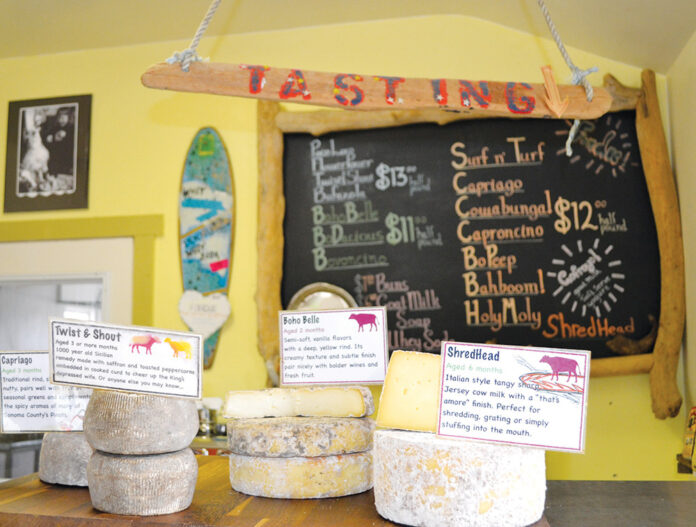
Soon, I’m pushing my herd uphill to greener pastures on Point Reyes-Petaluma Road. Though it’d be a kick to run a bunch of bleating sheep down D Street, my herd is actually two wheels on a steel-frame road bike. My first stop is Marin French Cheese, founded in 1865 when, apropos, a sudden demand for a high-protein egg alternative was filled with the Petite Breakfast Cheese. The hot tip here is to get the discounted off-weighted samples. I catch a round of Schloss that’s still sliceable and move on.

I learn from my friendly cheesemonger at Cowgirl Creamery that their aromatic Red Hawk is only made in Point Reyes Station because it wouldn’t ripen the same in another environment. I opt for Wagon Wheel, which is like a fontina but more rich and buttery.

A detour to Nicasio Valley Cheese nets a rare hunk of aged San Geronimo—fine-textured, less buttery but almost smoky, with a meaty umami quality. Cheesemaking at this creamery, which has Swiss-Italian heritage, can be viewed through a window while one nibbles on samples.

Back in town, I find something besides cheddar and ice cream at Petaluma Creamery—a dry Jack goat cheese that’s flaky and tangy.

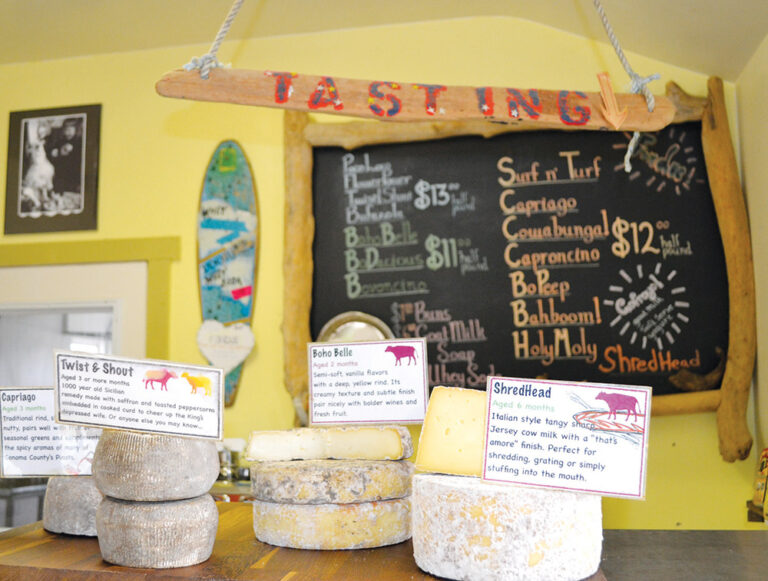
Midway up a treacherous path in the hills of West County—Occidental Road—the tiny shop at Bohemian Creamery is packed with artisan treats like Bo Peep. Now this looks like something an old shepherd pulled out of his rucksack, but it’s creamy under the rustic-looking rind, like Toma.

OK, by month’s end I’ve gained five pounds. But I don’t blame the cheese, the beautiful cheese, and let us not speak of the wine. I blame the weather—seems the shepherd took shelter for much of this rainy February.

See if you can do better at next weekend’s Artisan Cheese Festival, where the curds are mounded high at Sunday’s walk-around tasting. Go ahead, climb every mountain. Need more exercise, do another lap.

California Artisan Cheese Festival, March 23–24. Tickets, $25–$150. Sonoma County Fairgrounds, 1350 Bennett Valley Road, Santa Rosa. 707.545.4200. artisancheesefestival.com.

Hero & Zero

A scammer ensnared a Marinite in his scheme and added $2,500 to his coffer. Before you say you wouldn’t fall for it, keep in mind these hustlers talk a good game and the elderly in our community are particularly vulnerable. This swindle began with a person we’ll call Eleanor receiving a phone call from “Sam Fox with the Social Security...

Run Rabbit Run

Break out your decoder rings; the flawed but intriguing Us’s political subtleness is hidden by its straightforward terror. Among other things, Jordan Peele’s followup to Get Out breaks a long drought. Santa Cruz, with its deep cold bay and hoodooed mountains, ought to be California’s Transylvania. Instead, it’s remembered for The Lost Boys, which is just The Goonies wearing...

Horoscope

ARIES (March 21-April 19): Kermit the Frog from Sesame Street is the world’s most famous puppet. He has recorded songs, starred in films and TV shows, and written an autobiography. His image has appeared on postage stamps and he has a star on the Hollywood Walk of Fame. Kermit’s beginnings were humble, however. When his creator Jim Henson first...

Native Beauty

For more than 20 years, award-winning photographers Rob Badger and Nita Winter have been chasing the bloom. That’s the way they describe their work in photographing wildflowers across the Western U.S., an ongoing project that aims to raise awareness about the dangers of climate change on native plants and local ecosystems. Now, the two Marin City residents present a new...

Advice Goddess

Q: I’m a straight single woman nearing 50. My best friends are a lesbian couple. I’m going to get some nonsurgical skin tightening on my face, and they got very judgmental about it: “We think you’re beautiful as you are.” Next, it was “What if it goes wrong?” and “Will you keep getting procedures till you don’t look like...

Look for the Union . . . Edible

Can unions organize cannabis industry workers, some stoned, some sober, others undocumented and still others with college degrees? It’s tricky. The upsides: a unionized cannabis industry could help improve wages and working conditions for men and women who labor in North Bay cannabis fields, warehouses and dispensaries. Unions could also assist the industry as a whole by rendering it more transparent,...

Flashback

Twenty Years Ago This Week Best Internet Service Provider Although we Marinites pride ourselves on setting trends, not following them, when it comes to Internet service providers, we fall in line. Readers overwhelmingly give the first place nod to America Online, the best-known and biggest Internet service. Convenience, ease of use and all the little perks make it the provider of...

The Tow Hold

A struggling man in West Marin was recently arrested on minor charges and spent a few months serving local time at the Marin County lockup in San Rafael. Before his arrest, the man had been living in his car. When he got out of jail, he was homeless. His car had been tagged and towed, by a company under...

Life During Wartime

After the end of the world, the lights are still bright in Chicago’s Loop; there’s a veneer of normalcy, as long as you’re in the right class and stay in the right places. The top-notch, poorly titled Captive State, by Rupert Wyatt of Rise of the Planet of the Apes, is the first feature film to acutely deliver the...

Surfin’ Curds

By late January, it was clear that I was not on track to meet my New Year’s dietary goals, so I cast about for any possible culprit besides my own self-discipline. My eyes landed on the plate of cheese I’d enjoyed almost nightly with crackers, maybe a little secchi salami, and maybe a little wine. No, not the cheese! Suppose...
3,002FansLike
3,850FollowersFollow