Open Mic: LGBTQIA+ Community Needs Support in Schools

By The LGBTQIA+ Coalition of the North Bay

On March 25, Roseland School District held a board meeting on Zoom that was attended by many students and community members. Attendees were eager to voice their experiences and demand that the district prioritize the needs of its students of color and LGBTQIA+ students.

During public comment, other young people used their time for anti-LGBTQIA+ hate speech and racial slurs. Moderators allowed this to go on for over a minute. Students and parents were triggered. Later, the school board opted to shut down all public comment, preventing many who had waited hours to speak from being heard. 

The RSD board did not record the meeting, so we are writing from our collective memory of what transpired. 

That same week, someone vandalized murals at Brew Coffee and Beer, scribbling out ‘BLM’ and ‘Black Trans Lives Matter’.

White supremacy and hatred toward LGBTQIA+ people are alive in Sonoma County. 

March 31 was Trans Day of Visibility, celebrating the lives and resiliency of transgender people. 

But when hatred is neither addressed nor denounced, visibility is not safe.

We have recently provided LGBTQIA+ cultural awareness presentations to RSD classrooms and counselors. We value those opportunities, but systemic changes are only possible with commitment from those with the most power. We have offered training to district-level faculty, yet our offers have not been met with interest.

In a county with more than 40 school districts, it is difficult to enact change in our education system. We call upon all school district boards of Sonoma County to take proactive steps to keep marginalized students safe and centered in meetings between students and staff.  

The following must happen to ensure students are safe: 

  • That RSD detail a plan for keeping a public record of all board meetings, keeping public comments safe and open and denouncing hate speech and white supremacy
  • That every school district of Sonoma County to publicly illustrate their understanding of the marginalization and threats that make school less safe for students of color, Latinx, and LGBTQIA+ students 
  • That school board members and district-level faculty to invest in LGBTQIA+ cultural humility trainings 

Sincerely,

Concerned members of The LGBTQIA+ Coalition of the North Bay, including representatives from 

  • Aging Gayfully
  • Face 2 Face
  • Lesbian Archives
  • Letter People 
  • LGBTQ Connection
  • LGBTQI Timeline
  • North Bay LGBTQI Families
  • Out in the Vineyard
  • Positive Images LGBTQIA+ Center
  • Queer Resource Center at SRJC
  • Sonoma County Pride 
  • The HUB at SSU
  • TransLatin@s
  • TRANSLIFE Conference 

To have your topical essay considered for publication, write to us at op*****@********un.com.

Letters to the Editor: Older Lives Matter, Too

(The Pacific Sun) listed 385 voting categories for your “Vote! 2021 Best of Marin.”

Specifically, you have 28 categories to vote for under “Family.” In this category family members are listed as children and pets. What about the older folks that created the family to begin with? If you don’t consider elders part of the family category, I suggest a separate category of eldercare.

There is only one category which could specifically be correlated to older people and that is assisted living, which is under Health Care.

I am a fierce advocate for the older population and the very vulnerable elderly in our society. I am amazed and disappointed that 30 years after I began serving the older population, there is little to no value placed on this segment of our population, which is evidenced in your survey categories.

As the CEO and founder of a geriatric care management company, Aging Solutions, Inc., I see the trends toward recognizing which lives matter—and the older folks seem to be forgotten.

Most of the time, because of the work that we do to manage the care for elders, we see the systems writing people off because they’re old. That is evident in the health care systems, and I get it. However, I would like to see the Pacific Sun stand out as supportive and cognizant of the older population and their needs, and the fact that they also matter.

I have been thinking about preparing an awareness campaign at this point. There are many ways to do that, and I’d like to have a conversation about that, if you’re interested. Perhaps the Pacific Sun could think about these issues as well.

Terri Abelar, CEO

agingsolutions.com

Hyperlocal Social Media Network Nextdoor Attracts Buddies and Bullies

Nextdoor, a hyperlocal social media platform, connects you with your neighbors. That sounds friendly enough. Who doesn’t want to know their neighbors’ tips about a great new restaurant or where the wildflowers are currently blooming?

All you must do in return for this neighborly service is scroll by some ads and follow Nextdoor’s rules, including “be respectful, don’t discriminate and discuss important topics in the right way.”

Anyone who took a psych 101 class could tell you how that’s going to work out. Sometimes discussions on Nextdoor breed bad behavior and downright discontent between neighbors. This is not Mister Rogers’ neighborhood.

Bullies abound on social media, and Nextdoor is not immune from their vitriol. It might even be more susceptible to aggressors because people have skin in the game when it comes to their homes and neighborhoods. Emotional issues cause folks to dig in their heels, even when connecting with the guy down the street. Though Nextdoor members aren’t anonymous, people seem to feel freer expressing themselves from behind a computer screen.

Actually, not everyone on Nextdoor is identifiable. The platform requires a user to register under their name and address, yet it apparently doesn’t always confirm the information. Some people manage to register with a fake name and address, usually to antagonize others incognito.

Online provocateurs, whether using their true names or aliases, are called “trolls” in social media parlance. My neighborhood, Sausalito/Mill Valley, recently had a troll who went by Harriet Richards. That could be her real identity, but I couldn’t find any record of such a person in Sausalito. A talented agitator, she—or he—conspicuously joined Nextdoor just after the homeless tent encampment appeared in Sausalito. Harriet mostly harassed and insulted people who posted compassionate comments about the homeless, but folks living on the water also raised her ire.

A prolific poster, Harriet usually made several comments each day. Homeless people are sex offenders and lazy, she said. Positing ideas to get rid of homeless people in Sausalito, she said the city should remove their tents and put boulders on the property to prevent the campers from pitching their tents again. She called the houseboat community a floating trailer park, which is an interesting observation considering houseboats regularly sell for well over a million dollars. Don’t even get her started on the anchor-outs, who she said don’t deserve to live in Marin because they can’t afford it. Anyone with a differing point of view is an idiot, according to Harriet, and she never hesitated to taunt a neighbor.

After others on Nextdoor reported her rudeness, she was suspended from the platform for a few days. When she returned, her conduct remained unchanged, which resulted in users outing her for not using her real identity. Finally, after three months of toxic posts, Nextdoor booted her off permanently.

Nextdoor also kicked Robbie Powelson off the site. Powelson, who lives at the Sausalito homeless encampment, never posted anything to break the site’s rules. His offense is being homeless. According to Nextdoor, if you can’t provide a residential address, you can’t join the conversation.

“Our team is in the process of figuring out how best to support and engage our unhoused neighbors,” Nextdoor Communications Specialist Shannon Toliver wrote in an email. “While we’re unable to share specifics at this time, this is top of mind for us.”

It seems that a 10-year-old social media company that has figured out how to use artificial intelligence (AI) to monitor its members should be able to come up with a way to let a homeless person join the site.

As a privately held company in a relatively new market, Nextdoor is not governed by regulations. It makes its own rules, and at times seems to enforce them indiscriminately. For instance, racial issues appear to be a gray area.

I’ve seen more than one post describing a Black person in the neighborhood as suspicious without substantiating the claim. It may come as a surprise to some residents of upscale neighborhoods that Black people live there, too. So do other BIPOC folks.

In the Tam Valley neighborhood, Yunhee Yoo, an Asian woman, posted in March about her experience walking to a nearby park with her 7-year-old son and dog. 

Two white men approached the mother and son on their walk and verbally assaulted them. The first man repeatedly cursed and referred to them as “you people.”

The second man aimed his iPhone in Yoo’s face. “You don’t belong here. I will call the police,” he yelled.

Yoo said she shared the information to let neighbors know that “racist attacks happen—even in Mill Valley.”

Many neighbors, horrified by the encounter, posted supportive comments to Yoo. Then, poof! The whole post disappeared. Nextdoor corporate removed it.

“It made absolutely no sense to remove it,” Yoo said. “It was so random. So arbitrary. I wrote Nextdoor and asked why. Rebecca [a Nextdoor corporate representative] wrote back, ‘Thank you for reaching out to us. Your post was deleted because of personal disputes, grievances and uncivil content. In the future, please refrain from trying to settle a score.’”

After Yoo’s post was removed, her husband, Axel Redemann, posted about Nextdoor corporate silencing those who have been targeted by hate. Again, neighbors rallied around the couple, this time posting negative comments about Nextdoor. The company responded by promptly closing the discussion.

Eventually, Nextdoor restored Yoo’s post, saying it didn’t violate any rules. An employee posted online that a combination of AI and human error removed it. I wonder whether Nextdoor would have reinstated the post if scores of neighbors hadn’t united around Yoo.

Given the presence of bullies and trolls, not to mention the discriminatory and Big Brother practices of Nextdoor corporate, why does anyone use the site? This week, a lost dog that jumped out of a car in Sausalito was found as a direct result of information posted on the site. Neighbors make helpful recommendations about everything from general contractors to physicians. While people struggle to schedule a Covid vaccination with the current shortage, folks share which drug stores just added more appointments.

Kristina Weber, a landscaper from Sausalito, joined Nextdoor because she received business referrals from it. She even met a few like-minded buddies on the site. However, she has also suffered the consequences of contributing to discussions about controversial issues.

“People gang up, and I have definitely been bullied, but I’ll absolutely stay on and continue to participate,” Weber said. “I’ve had some good experiences and met some amazing people on Nextdoor. Like anything in life, it’s about what you take out of it.”

Spotlight on San Rafael: Take a Spin at Glaze and Confused

San Rafael looks different today than it did 12 months ago.

While Fourth Street remained a fixture for socially-distant outdoor dining throughout 2020, many of San Rafael’s businesses and venues went dark as indoor gatherings were halted in the wake of Covid-19.

Now—with vaccines streaming into the North Bay—San Rafael is reopening, as several local music and arts destinations welcome back visitors for safe and distanced in-person experiences.

For many years, pottery was a hobby for Scott Reilly. The landscape company-owner put a few of his pots and pieces out at his office on Lincoln Avenue in San Rafael, but he never got much traffic with them.

Once the lease was up at Lincoln Avenue, Reilly moved to 846 Fourth St. After settling in, he realized he could turn the storefront into a studio.

Thus, Glaze & Confused Pottery Studio began attracting attention from passersby, who watched Reilly throwing clay on a wheel. Now, the studio is a full-fledged operation with memberships, classes, camps, a professional gallery and more.

“In the first two years, the landscape business supported the pottery, but then the studio started gaining traction right about the time the pandemic hit,” Reilly says.

The studio was able to stay open on a limited basis this past year, with social-distancing in place. Reilly also sold take-home ceramics kits for at-home artists. Even with the restrictions, Reilly says, people gravitated to the studio for an artistic outlet.

This month, Glaze & Confused returns to a full schedule of art-making and exhibiting. Memberships are available for beginning or advanced pottery crafters, and classes are available for hand-building and wheel-throwing. Kids camps will also return this summer.

Glaze & Confused is even expanding into live music on Thursdays and Fridays, when San Rafael’s Dining Under the Lights opens downtown Fourth Street for al fresco food and entertainment. This Friday, April 9, acoustic duo The Breedloves performs 6–9pm. (glazeandconfused.com)

Live music is also slowly, but surely, making its way back to San Rafael’s popular Terrapin Crossroads. While the venue continues to monitor the guidance of city and state health agencies, it also hosts ticketed dining events with live music in its adjoining Beach Park outdoor space.

On April 1, Grateful Dead bassist and venue co-owner Phil Lesh and several musical friends played at the Beach Park. Later this month, roots-rock outfit Midnight North—featuring Phil’s kid Grahame Lesh—will play on Sundays beginning April 18. Tickets to these shows are selling out fast, so act now to save your spot. (terrapincrossroads.net)

Movie mavens are flocking to the Smith Rafael Film Center since it began hosting in-person screenings again last month. Operated by the nonprofit California Film Institute, the theater is home to this year’s DocLands Documentary Film Festival, which will offer virtual screenings as well as a limited number of in-person screenings when it runs May 7–16. DocLands will feature 42 films from 10 countries and host an interactive industry forum to discuss the business and art of nonfiction filmmaking. (doclands.com)

California Sets June 15 Goal for Full Reopening

As the pace of vaccination picks up, California state officials today announced the date they plan to fully reopen the state’s economy: June 15.  

Reopening by then will largely depend on two criteria: Vaccine supply must be sufficient for anyone 16 and older who wants a shot and hospitalization rates must remain low and stable. The mask mandate would remain in place, however.

“It is incumbent upon all of us not to state mission accomplished, not to put down our guard, but to continue with vigilance that got us to where we are today,” Gov. Gavin Newsom said today from San Francisco. 

The move would eliminate the complex web of county-by-county tiers and replace it with a statewide reopening of businesses.

Businesses would open up to full capacity, although individual counties can still opt to have more restrictions depending on their circumstances. Schools would be allowed to reopen to all in-person learning; however, the school districts will maintain control.

“I want kids back in school safely, and on June 15 we anticipate there will be no barriers to getting kids back in person, not just K-12…(also) including institutions of higher education,” Newsom said.

Dr. Mark Ghaly, the state’s health secretary, said he feels comfortable allowing businesses to operate at full capacity in mid-June because the state will continue to track local conditions. 

“What we could see is fully occupied settings, but yet still with masks,” Ghaly said today.

Until at least Oct. 1, events at large settings like convention centers will only be allowed if organizers can show that attendees are either vaccinated or are tested. There is still no plan, however, for large, multi-day events like music festivals to take place, Ghaly said.  

As of Monday, the state had administered more than 20 million vaccines — more than entire countries. That includes 4 million doses in the state’s hardest-hit, disadvantaged communities. This progress allows the state to move forward, and leave behind its colored blueprint that has been determining reopenings by county.

State officials chose the June 15 date because it is eight weeks after April 15, when everyone 16 and older becomes eligible for vaccinations. That gives people three weeks to find an appointment, another three weeks in between their first and second dose and two more weeks after their second dose, which allows them to acquire full protection. 

“It makes sense to me,” said Dr. George Rutherford, an epidemiologist at UC San Francisco. “On the one hand, vaccination is going gangbusters, I think that will give us the out, but we also have to see what happens with the variants, and if people who are vaccinated are getting infected.”

Infections are skyrocketing in some other parts of the country, with some of the outbreaks linked to new variants of the virus. But California has been able to keep its positivity rate under 2% for several weeks now. 

“What we’re asking is for people to hunker down for another two months and when we get there, then it’s Miller time,” Rutherford said. 

Nearly all of California currently is in the orange and red tiers, which allowed businesses to reopen with limited capacity. Only Merced and Inyo counties remain in the most-restricted purple tier after failing today to meet the health metrics required to move to red.

Opinion: Elk Deaths Mount at Point Reyes Seashore

The National Park Service (NPS) has revealed that 152 Tule elk recently died under its watch. Tule elk, a species unique to California, once numbered a half million, but were hunted to near extinction when their territory was appropriated for cattle. Now rare, Tule elk can be seen in one national park—Point Reyes National Seashore.

An 8-foot fence surrounds the so-called Tule Elk Reserve at the Seashore to prevent the native elk from eating grass reserved for domestic cattle. The Seashore elk population has declined from 445 last year to 293. The NPS attributes this to poor forage due to drought. None of the 5,700 cattle in the park reportedly succumbed.

The NPS says the elk die-off is a “natural” event”— a normal “population fluctuation” in response to available resources. But there’s nothing “natural” about fencing in wild animals and denying them the food and water they need to survive. This isn’t an act of God. It’s official National Park Service policy: Provide grass and water for cattle. Let wildlife fend for itself.

Last fall, park visitors and wildlife advocates alerted the NPS that water sources in the elk enclosure had dried up, offering photos of elk carcasses as evidence. The NPS dismissed them, insisting there was water. Some 250 elk—half the confined herd—died during the 2012-2015 drought, also a “natural” event in park parlance.

In response, three nonprofit organizations—Resource Renewal Institute, Center for Biological Diversity and Western Watersheds Project—sued the NPS in 2016. The lawsuit was meant to give the public a voice as to whether ranching belongs at the Seashore and under what conditions. A legal settlement committed the NPS to prepare the first-ever Environmental Impact Statement for ranching in the Seashore and to solicit public comments to its plan. Ninety-one percent of the nearly 7,000 public comments opposed continued ranching.

Nevertheless, NPS persisted.

Beef and dairy ranchers hold 24 leases covering approximately one third of the 71,000-acre park. The NPS considers these commercial operations “cultural resources.” Persuaded by politicians and powerful agricultural interests, the NPS sees to it that ranching at the Seashore continues, regardless of environmental impacts or public opposition.  

The plan that Seashore ranchers lobbied for, county officials endorsed and the Trump Administration fast-tracked guarantees the ranchers 20-year leases, more livestock, crops and new income streams intended to offset the decline in beef and dairy consumption. Wildlife, the environment and park visitors are shortchanged.

For example, the NPS permits dairies to pump water out of park wetlands to supply cattle—no environmental impact analysis necessary. The plan considers digging wells to supply the water demands of additional livestock and crops—no current data exists on groundwater supplies. In January an independent lab found extremely high fecal coliform in waters draining the ranches at the Seashore, some showing as much as 40 times the allowable limit for E. coli. Despite data showing chronic water pollution between 1998 and 2005, the NPS rarely tests the water at the dairy ranches.

The latest park superintendent offers his assurances that the Seashore will be better off once his superiors in Washington sign off on the new plan. Never mind that cattle remain the largest source of greenhouse gases at the Seashore; healthy elk will be shot to ensure enough grass for cattle; and Tule elk behind the fence face a long, dry summer.

Susan Ives is co-founder of Restore Point Reyes Seashore in Mill Valley.

Newsom Gets Covid-19 Vaccine, State Opens Eligibility to Ages 50 and Over

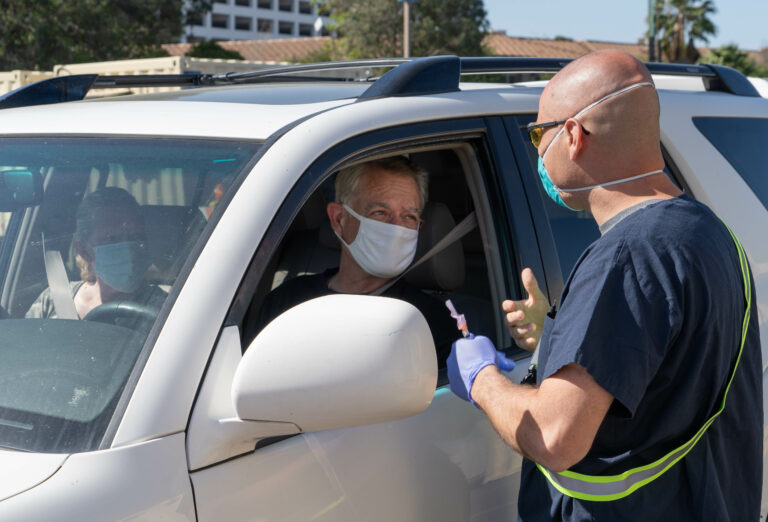
California opened Covid-19 vaccine eligibility to all residents age 50 and older Thursday, the last step before making vaccines available to the state’s entire adult population later this month.

The expansion comes roughly three-and-a-half months after the first doses were shipped to local health departments and administered in the Bay Area and across the state. 

According to state officials, roughly 7.2 million state residents are between age 50 and 64 and some 2.8 million of them have already received at least one dose by fitting into other, previously eligible categories like health care workers, educators and first responders.

The state is set to open vaccine eligibility to all state residents age 16 and older on April 15.

“We have an enormous opportunity in the next six to eight weeks to run the 100-yard dash, not the 90-yard dash,” Newsom said Thursday, acknowledging the concern of proliferating coronavirus variants.

“Let us not dream of regretting,” he said. “We’ve come so far together and we’re this close; 18-plus million vaccine doses have been administered in the state of California.”

Newsom, 53, celebrated the state’s eligibility change by receiving the one-dose vaccine developed by Janssen, the pharmaceutical subsidiary of Johnson & Johnson. He added that his wife, 46-year-old Jennifer Siebel Newsom, will receive the vaccine once she becomes eligible later this month. 

Newsom cautioned that it will take several months to fully vaccinate every California resident seeking to receive a shot, due in part to continuing supply constraints.

State officials expect to receive roughly 2.4 million doses from the federal government next week. However, Newsom said, vaccination sites across the state still have the capacity to administer two times that number of doses per week. 

“We’re confident we can deliver on that as long as the manufactured supply still comes into the state of California,” he said. “That’s the one criteria, that’s the one condition.”

Newsom also said the state is in the process of transferring operations of the mass vaccination sites at the Oakland Coliseum and California State University Los Angeles to Alameda County and the city of Los Angeles, respectively.

Since opening in February, the two sites have been operated by the Federal Emergency Management Agency, the Department of Defense and the state’s Office of Emergency Services and have been administering more than 7,500 doses per day.

“The two FEMA sites, combined, are less than 4 percent of our entire delivery system,” Newsom said. “So it’s not profound in terms of its impact, but it is an impact nonetheless and we try to get every dose we possibly can.”

Newsom encouraged all California residents to make a vaccination appointment as soon as they are eligible, saying it will hasten the state’s burgeoning recovery from the pandemic. Some 18 million vaccinations have already been administered across the state.

“I just encourage everyone 50 and over, do what I just did,” he said. “And I would encourage you, when you’re curious what’s the best vaccine to take, the best vaccine is the next one available.”

Residents who are eligible for the vaccine can visit myturn.ca.gov or call (833) 422-4255 to schedule a vaccination appointment.

Is the Music Over at Mills College?

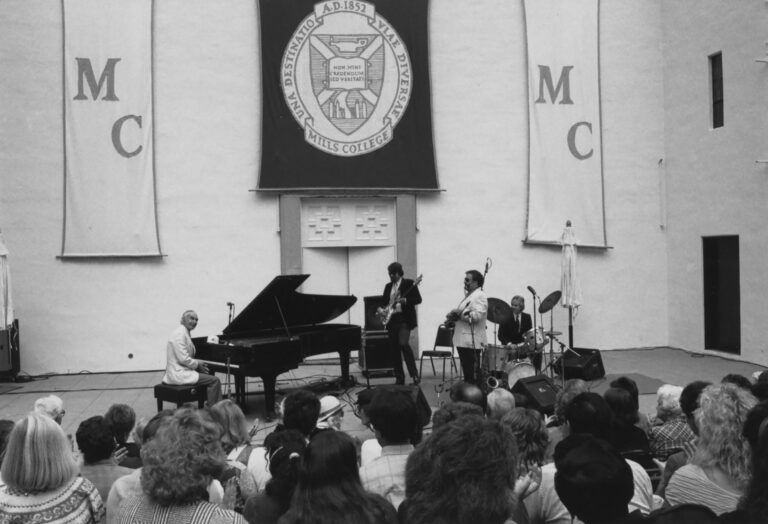
Even the concert hall at Mills College is different.

Looming at the back of the stage is a huge, bright mural of a forest opening onto a deep blue lake. The ceiling is painted in geometric patterns and vivid colors. Frescos of Gregorian chant scores flank the stage.

We are not in sedate, monochromatic Carnegie Hall. No, Littlefield Concert Hall at Mills, in Oakland, is a vibrant, even eccentric place, where it is clear from the surroundings that music outside the mainstream is not simply tolerated, but celebrated. “There was a real atmosphere of comfort and support for whatever it is that you wanted to do,” composer David Rosenboom, who led the music program at Mills in the 1980s, said in an interview.

Now that program and the electronics-focused Center for Contemporary Music, together among the most distinguished havens for experimental work in America over the past century, are facing possible closure. On March 17, the college, founded in 1852, announced that ongoing financial problems, exacerbated by the coronavirus pandemic, would mean the end of its history as a degree-granting institution made up of an undergraduate women’s college and several coeducational graduate programs.

Pending approval by its board of trustees, the school’s final degrees are likely to be conferred in 2023. The statement announcing the proposed closure alluded to plans for a “Mills Institute” on the 135-acre campus, but the focus of such an institute—and whether it would include the arts—is unclear.

For composers and musicians, the potential loss of the Mills program has come as a startling blow, even though the college’s finances have been shaky for years.

“I long feared this might be the worst-case scenario, but I am still devastated by the news,” said harpist and composer Zeena Parkins, who teaches there.

It has been an astonishing run. The school’s faculty over the years has been practically an index of maverick artists, including Darius Milhaud, at Mills for three decades beginning during World War II; Luciano Berio, who came at Milhaud’s invitation; Lou Harrison, who built an American version of the Indonesian gamelan percussion orchestra; “deep listening” pioneer Pauline Oliveros; Robert Ashley, an innovator in opera; Terry Riley, a progenitor of minimalism; influential composer and improviser Anthony Braxton; James Fei, a saxophonist and clarinetist who works with electronic sounds; and Maggi Payne, a longtime director of the Center for Contemporary Music, Mills’ laboratory for electronic work since the 1960s, when Oliveros was its first leader.

Among the alumni are Dave Brubeck, Steve Reich, John Bischoff, William Winant and Laetitia Sonami; several former students ended up returning to teach after graduating.

“What Mills College had was unique,” said Riley, who taught there from 1971 to 1981. “I have never in my travels encountered another institution like it.”

Mills’ defining feature was its sense of community.

Despite all the famous names involved, the overriding impression was that music is not created by lone geniuses, but by people working together.

Fred Frith, whose career has included avant-garde rock and idiosyncratic improvisations and who retired from Mills in 2018 after many years there, said, “Music is essentially a collaborative activity, and if I’m going to teach improvisation or composition without real hands-on involvement, then we’re all going to miss out on something.”

In the first half of the 20th century, when composers like John Cage became associated with the school, Mills developed a reputation for nonconformity.

Performances ran the gamut from traditional instruments to obscure electronics to vacuum cleaners, clock coils and other found objects. Riley recounted an early performance of “In C,” his open-ended classic from 1964, at which the audience was dancing in the aisles. Laetitia Sonami recalled taking singing lessons with master Indian vocalist Pandit Pran Nath, guru to Riley and others.

At that time, the program was practically public access.

“In the 1970s, Mills was still like a community group,” said composer Chris Brown, a former director of the Center for Contemporary Music. “It still had the idea that community members could come and use the studios.”

Robert Ashley, a guiding presence from 1969 to 1981, helped foster that spirit. Though the radically open sensibility faded as the years went by, Mills maintained a commitment to access through frequent performances in and around Oakland, many of them free.

“One of the amazing things about Mills is the rich musical community that it creates through the entire Bay Area,” said composer Sarah Davachi, who graduated in 2012.

As the personal computer revolution was taking hold in nearby Silicon Valley, experiments with home-brew electronics and microcomputers, like those of David Behrman, were common at Mills, where technology had long been at home through the Center for Contemporary Music. Serendipitous moments abounded: As a student in the ’70s, John Bischoff remembers running into David Tudor, renowned as a collaborator with Cage, in the hallway and being asked to assist with recording Tudor’s work “Microphone.” Winant said he found an original instrument built by composer and inveterate inventor Harry Partch hidden under the stage in the concert hall.

“It felt like utopia: an environment where students are encouraged, and given the support they need, to pursue any and all ideas that came to mind, free from the stifling pressures of capitalism,” said Seth Horvitz, an electronic composer known as Rrose.

Students built their own instruments and sound installations, exhilarated by the freedom to do what they wanted. “We commandeered every square inch of the music studio and surrounding areas,” said composer Ben Bracken, “putting up rogue installations in the courtyards, hallways and hidden rooms, inviting friends to perform in inflatable bubbles, screening Kenneth Anger films in the amphitheater with live studio accompaniments, Moog studio late nights that bled into morning.”

But pressures on institutions of higher education around the country, which have intensified in recent decades, did not spare Mills. In 2017, as a cost-cutting measure, it began laying off some tenured faculty. Celebrated composer and multi-instrumentalist Roscoe Mitchell learned his contract was not being renewed—news that was met with an outcry from the experimental music community. (Mitchell’s contract was eventually extended, but he chose to retire.) In 2019, the college sold a rare copy of Shakespeare’s “First Folio” at auction for just under $10 million, and a Mozart manuscript for an undisclosed sum. But the losses continued—and then came the pandemic.

Many musicians said they were concerned about the fate of Mills’ archives.

Maggi Payne said it includes over 2,000 tapes of performances, lectures and interviews, along with scores, letters and synthesizers—and hundreds of percussion instruments owned by Lou Harrison. David Bernstein, who chairs the music department, said the archives would be protected.

“We have been working on this project for quite some time,” he said. “And yes, there are instruments at Mills of significant historical importance. We are very concerned about their fate. Most of all, they should not be stored but used by students interested in exploring new sounds and different musical cultures. And they should also be played by virtuoso performers, as they are now.”

But if Mills’ future is unclear, Mitchell said, its legacy is not. It will live on “much longer than you and I,” he said. “It’s history. It’s not going to go away.”


California Leaders Propose Nation’s First Public Banking Option

Five California legislators are trying to establish the nation’s first public banking option that would offer no-fee, no-penalty bank accounts to all California residents. 

The California Public Banking Option Act, also known as BankCal, seeks to close the widening racial wealth gap by offering financial services at no cost. 

Those services include a no-fee, no-penalty debit account that requires employees to facilitate direct deposit into the account when requested. It also includes automatic bill pay capacity and free ATM access at participating banks—services critical to asset building and wealth generation. 

It would also have infrastructure in place that would allow public benefit payments such as federal stimulus checks to be directly deposited. 

“I’m very excited for the opportunity that BankCal presents to combat some of (those inequities and the racial wealth gap) and to expand essential financial services to all Californians, especially working people,” Assemblymember Ash Kalra, D-San Jose, who co-authored the legislation, said at a news conference on Tuesday. 

Nearly a quarter of Californians are either unbanked or underbanked—meaning they lack a bank account or pay a steep price for basic financial transactions like cashing their paycheck. 

This rate is even higher for Black and Latinx households, where nearly half are unbanked or underbanked—making up 78 percent of the state’s unbanked population, according to the legislation.

The bill also stated that Californian households earning less than $30,000 per year, or just under $15 per hour for a full-time worker, make up 80.7 percent of unbanked people in the state.

A little less than half of California’s disabled population is also unbanked. 

“We know that that 15 bucks an hour means a lot less when that person actually gets a product cash in their hand, and that’s unfair,” lead author of the legislation Assemblymember Miguel Santiago, D- Los Angeles said. “It makes no sense that somebody would earn $15 an hour and after every fee, after every transaction, after everything they do, after overdraft fees, that 15 bucks an hour is even decreased because financial institutions continue to make enormous amounts of profit.”

Those fees could cost an average of 10 percent of an hourly wage worker’s take home pay, Santiago said. 

Sofia Lima, a San Francisco resident who works at McDonald’s and Carl’s Jr. to support her two young daughters said she can attest to that.

“I cash my paychecks at a store half an hour away from home that I have to take a bus to get to,” Lima said in Spanish. “I spend $12 for each check I cash, aside from the cost of travel, and it adds up quickly to having lost over $500 in check cashing over the last couple of years, not including travel.”

She said she has lost even more money from paying for money orders and using public transportation to pay her bills. 

“If I was able to save more of my money, maybe child care would be an option,” Lima said. 

By offering those banking services for free, BankCal would level the playing field, by allowing low- and middle-income residents to save money, build credit, access their money and pay their bills without needing to use “predatory financial services” like same-day loans, money order fees or overdraft fees, Kalra said. 

To be clear, this bill would not create a new bank, rather a statewide retail banking option. 

If passed, the legislation would create a BankCal board, staffed by the State Treasurer’s office, to be the oversight body, ensuring the program reflects the legislation’s priorities. 

It would also have a program administrator who would facilitate partnerships with government agencies and nonprofit organizations as well as a network administrator who would coordinate with financial institutions and debit/credit card networks. 

The banking service would be self-sustaining through the revenues generated from merchant swipe fees from debit card purchases, backers said. 

“It is a direct solution to traditional commercial banks that have been operating with no real incentive to help impacted communities,” Trinity Tran, co-founder and lead organizer of California Public Banking Alliance said. 

BankCal would also eliminate the possibility of overdraft fees by ensuring all payments are made via debit card and not check. 

Tran noted that low-income people are twice as likely to pay overdraft fees, adding that 80 percent of bank fees are paid by only 20 percent of U.S. bank customers. 

Currently, BankCal is not outlined to have the ability to issue loans, but the legislation notes that the board could review and add other services in the future. 

So far, the legislation has garnered a lot of support from progressive organizations and representatives, including Congressman Ro Khanna, D-Santa Clara, who called BankCal “an incredibly innovative,” transformative and moral proposal. 

“It says if you’re a Californian, you’re now going to have a bank account, and it’s not going to cost you anything,” Khanna said. “It is actually giving financial security and financial dignity to so many Californians who don’t have it.” 

The California Public Banking Option Act will be heard before the Assembly Banking and Finance Committee on April 29, 2021.

Pot Shots: Cannabis Under Fire

Just when you thought it was safe to come out of the cannabis closet the Biden administration announced that five White House employees were fired after revealing past marijuana use during background checks. Other White House employees have been suspended or told to work remotely after they fessed up. “Don’t ask, don’t tell” sounds like good advice. Jared Huffman who represents the North Coast, plus 29 other representatives in Congress have protested the Biden action. 

In New Mexico, the state legislature recently declined to pass House Bill 12, that would have made cannabis legal for people over  21. The bill would have expunged the criminal records of people arrested for possession of two ounces or less of marijuana. It also would have allowed those serving time for violation of the marijuana laws to be eligible for a dismissal or reversal of their sentence. 

Closer to home, there was more disturbing news for pot lovers. Marin County residents, Jennifer Durham and Justin Pool, withdrew their application for a delivery service, “Highway 420,” at 205 San Marin Drive in Novato. The couple received conditional approval from the city council, but members of the community raised their voices in opposition and gathered more than 1,000 signatures on a petition that cried out, “Our way and no Highway 420, either.”

The site would have been a mile from San Marin High School. Opponents of the delivery service felt that was too close to kids, and too much of a temptation. Still, as marijuana advocacy groups have shown, there’s no conclusive evidence that cannabis dispensaries and delivery services attract crime and criminals, or that high school students obtain their drug of choice when a dispensary opens its doors, no matter how near to classrooms and playgrounds.

Prejudices die hard. Old bugaboos don’t easily vanish and the war on cannabis isn’t over yet, not by a long shot. Marin teens have long had easy access to weed. Teens with parents who smoke, smoke with their parents. Teens with parents who are opposed to pot, persuade other adults to buy weed for them. Some teens in Marin grow their own in backyards and on remote hillsides.

Keeping teens away from weed is as challenging as keeping teens away from cell phones. Also, as many if not most savvy parents know, telling a teen not to do something, is tantamount to an open invitation to do so, whatever it is. Teens say that adults ought to focus on their own addictions, whether they’re to fast foods, alcohol, and their own vices and devices. Yesterday’s pot foes become tomorrow’s aficionados. Pot partisan and former Bohemian editor, Gretchen Giles, tells me, “Keep the faith. We’re making progress.”

At 79, Jonah Raskin is still a teen at heart.

Open Mic: LGBTQIA+ Community Needs Support in Schools

By The LGBTQIA+ Coalition of the North Bay On March 25, Roseland School District held a board meeting on Zoom that was attended by many students and community members. Attendees were eager to voice their experiences and demand that the district prioritize the needs of its students of color and LGBTQIA+ students. During public comment, other young people used their...

Letters to the Editor: Older Lives Matter, Too

typewriter opinion newspaper
(The Pacific Sun) listed 385 voting categories for your “Vote! 2021 Best of Marin.” Specifically, you have 28 categories to vote for under “Family.” In this category family members are listed as children and pets. What about the older folks that created the family to begin with? If you don’t consider elders part of the family category, I suggest a...

Hyperlocal Social Media Network Nextdoor Attracts Buddies and Bullies

House Marin County, California
Sometimes discussions on Nextdoor breed bad behavior and downright discontent between neighbors. This is not Mister Rogers’ neighborhood.

Spotlight on San Rafael: Take a Spin at Glaze and Confused

San Rafael looks different today than it did 12 months ago. While Fourth Street remained a fixture for socially-distant outdoor dining throughout 2020, many of San Rafael’s businesses and venues went dark as indoor gatherings were halted in the wake of Covid-19. Now—with vaccines streaming into the North Bay—San Rafael is reopening, as several local music and arts destinations welcome back...

California Sets June 15 Goal for Full Reopening

Stanford Medicine California Covid-19
The move would eliminate the complex web of county-by-county tiers and replace it with a statewide reopening of businesses.

Opinion: Elk Deaths Mount at Point Reyes Seashore

Point Reyes National Seashore tule elk drought 2021
The National Park Service has revealed that 152 Tule elk recently died under its watch. Political choices caused their deaths, writes Susan Ives.

Newsom Gets Covid-19 Vaccine, State Opens Eligibility to Ages 50 and Over

Covid-19 vaccine Concord, California
California opened Covid-19 vaccine eligibility to all residents age 50 and older Thursday, the last step before making vaccines available to the state's entire adult population later this month. The expansion comes roughly three-and-a-half months after the first doses were shipped to local health departments and administered in the Bay Area and across the state.  According to state officials, roughly 7.2...

Is the Music Over at Mills College?

Mill College history photo via New York Times
A hotbed of experimental sound for nearly a century, Mills College is preparing to close its doors due to financial struggles.

California Leaders Propose Nation’s First Public Banking Option

ATM fees, California
Legislators are trying to establish the nation's first public banking option that would offer no-fee bank accounts to all California residents.

Pot Shots: Cannabis Under Fire

Just when you thought it was safe to come out of the cannabis closet the Biden administration announced that five White House employees were fired after revealing past marijuana use during background checks. Other White House employees have been suspended or told to work remotely after they fessed up. “Don't ask, don’t tell” sounds like good advice. Jared Huffman who...
3,002FansLike
3,850FollowersFollow