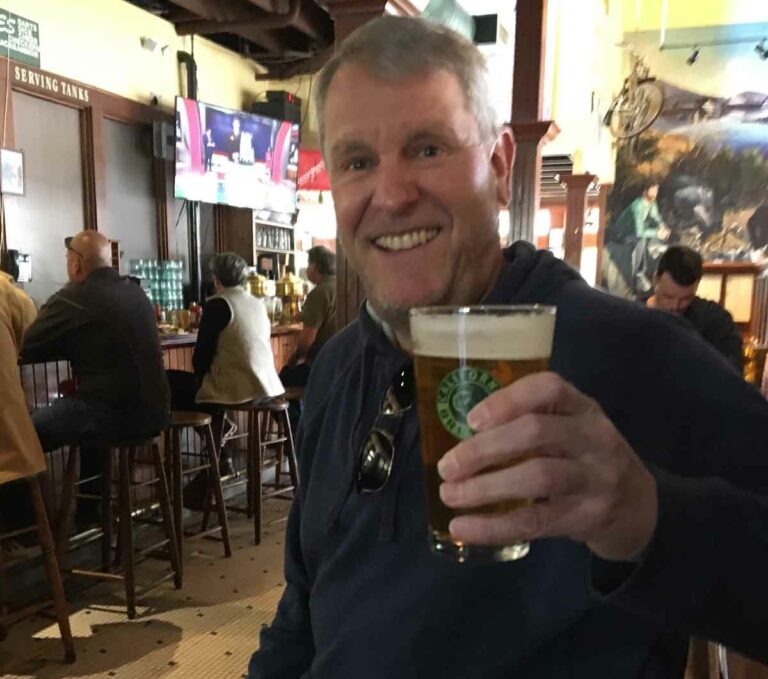
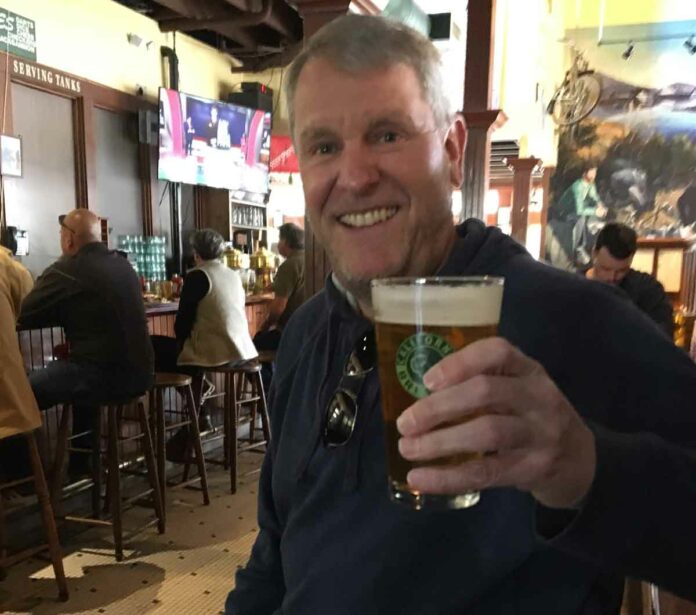
When I heard Marin Brewing Company was closing at the end of this month I was shocked and then saddened that the first brewpub in Marin and one I love will be gone.
This April they would’ve celebrated 33 years in business. The bombshell announcement brought old customers flocking back to enjoy the place they have good memories of.
Until five months ago Will Zenahlik lived in the Bay Area. “I live in Arizona but flew up here. When my friend told me the place is closing at the end of the month I said, ‘we’ve got get up there quick,” Zenahlik said.
Dropping by early afternoon last week I wasn’t surprised to find it busier than usual. Talking with several people I discovered we all had something in common, we’ve been coming there for at least 20 years.
Jim Yoell was there at the start of it. “I was here April 1st, 1989 when they opened. I was a regular for years when I lived in the area, even when I lived in Petaluma.”
Yoell moved to San Jose 13 years ago, but like others, he felt the need to come in one last time.
Likewise, friends Erik Mueller and JC Krause have been coming to the brewpub for 15 and 20 years.
“We’re here as normal, it’s just another day,” laughed Mueller.
Krause reflected on his time there. “It’s sad to see it go. We solved all the world’s problems here,” he said.
There is one problem no one was able to solve, the fallout from the pandemic. Ultimately it was a collection of things that Covid brought on that led to having to close the brewpub.
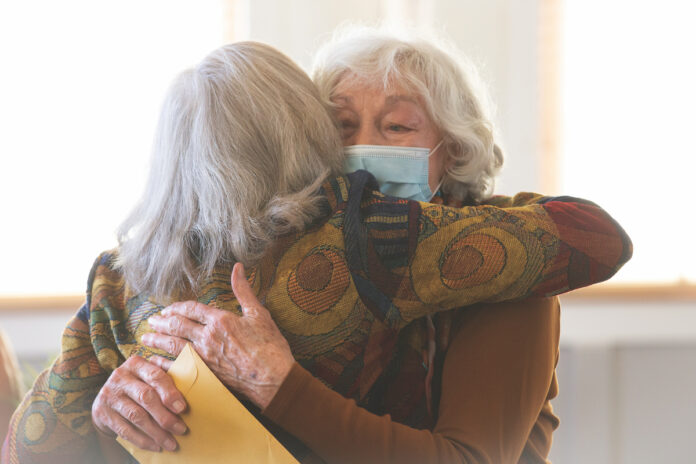
Marin Brewing Company owner Brendan Moylan reflected on the three decades of the Larkspur fixture. “We’ve made some great friendships and it’s certainly a family. It’s kind of tough to see a family breaking up.”
Chris Cox has not only come to Marin Brewing for a long time but also introduced his family to it. “My family and my kids have all kind of grown up coming here and it’s really sad that it’s not going to be here anymore.”
They weren’t the only ones sad about this unexpected news. Moylan has heard from regulars expressing their shock and sadness.
“Marin Brewing Company has a long history for a lot of people. I’ve been getting a lot of emails and a lot of responses on social media. I appreciate all the well wishes and hearing some of the stories,” he said.
Although Marin Brewing Company is closing, his Moylan’s brewpub in Novato will remain open. Starting next month they’ll be open seven days a week.
“Some of the Marin Brewing Company beers will continue to be made. We certainly look forward to having more batches of Mt. Tam [pale ale], 3 Flowers IPA, and San Quentin Breakout Stout in the future. These are all great beers and we’d hate to see them go by the wayside,” Moylan said.
Brewmaster Arne Johnson has made the beers since arriving at the brewpub in 1995. He has brewed about 5000 batches since then. He was happy to see the place busy. “It’s cool to see all these people come out after a couple of years of not seeing anybody.”
Johnson wistfully summed it up his time there. “It’s been a great, long ride. This will be hard to leave behind.”
The brewpub sold out of all their merchandise last week so the only thing people will be taking away now are memories.
Moylan said they’re not closed and said people “can come in and hang out and get one last beer in. I suggest doing just that. We’d love to see you and say hello one more time. Then we can see you up at Moylan’s.”
Rodney Toy’s Vibrant Response to Anti-Asian Racism
The Chinese New Year and the arrival of the Year of the Tiger are just around the corner. Festivities begin on January 25, 2022. They last until February 7, 2022, with food, fireworks, and gifts.
Rodney Toy, 53, a Chinese American artist, plans to celebrate with his family. Toy has a lot to be thankful for: surviving the pandemic, and the opening of his art exhibit in San Francisco, about an hour north of his home in San Jose, where he worked for Apple, Palm, and Forescout Technologies. Toy doesn’t know a lot about his family history, but he knows that when his grandparents arrived in California their last name was changed from Choy to Toy. My mother’s family name was Kvitkow in Russia. It was changed to Quitkin when my grandparents, Aaron and Ida, arrived in Ellis Island more than 100 years ago. Like Toy, I’m the descendant of immigrants. Like him, I’m an artist and like him, I’ve been the target of hate; in my case against Jews.
Two years ago, in the wake of the pandemic, which often kept him confined in his studio—and in the midst of the rising tide of “Asian Hate”— Toy decided no more Mr. Nice Guy. No more “Model Minority,” a stereotype he lampoons in several of his artworks which are at the Canessa Gallery on Montgomery Street in the Financial District, not far from Chinatown, where he was born and where he spent significant time in his childhood.
“Rising Son” is the name of the exhibit which brings together 31 individual pieces, many of them mixed-media collages, with wordplay, some with overt messages, and others abstract and inspired by artists such as Jackson Pollock.
“In 2020, the escalating anti-Asian rhetoric forced me to take a critical look at myself and how I should respond,” Toy told me on a Sunday when Canessa was packed with friends and family members who paid thousands of dollars to acquire his work. Toy added, “I decided to use my art as my megaphone.”
The work in the exhibit is playful, provocative, and colorful and with a mix of the two cultures, Chinese and American, to which he belongs. “Son” is the keyword in the title and an intentional play on the phrase “Rising Sun,” often associated with Asia. Toy calls the piece “an ode” to his parents.
“Choy,” a 30’ x 40’ canvas made with both acrylic and spray paint, was inspired by traditional Chinese calligraphy. “Perfect Pitch” offers a photo of his mother, once a talented performance pianist, along with the hands of Stevie Wonder on a keyboard. His father, who was a school principal, was, he says, his first real hero. He died over 35 years ago but left a lasting impression on his son.
“Caution: Do Not Work” features a strip of yellow tape with the word “CAUTION, in capital letters used to block off a section of seats at the SAP Center, often referred to as the “Shark Tank,” where he often watched ice hockey, not far from his home in San Jose.
“FTP-Z” incorporates photos of his sons, Cameron and Brendan, and was inspired, Toy explains by, “modern streetwear, surf & skateboard graphics.” “Season Pass” includes an image of the artist’s own Audi R8 convertible, and another of the Golden Gate Bridge viewed from Marin.
In the spirit of the writers and artists of the Beat Generation, Toy allows for spontaneity and improvisation. To make the piece, “Pink, Pink Used Ink,” he flicked off the bright lights in his studio and turned it into a dark room where he could use a light-sensitive emulsion. The resulting color scheme—pink, yellow and orange—is psychedelic.
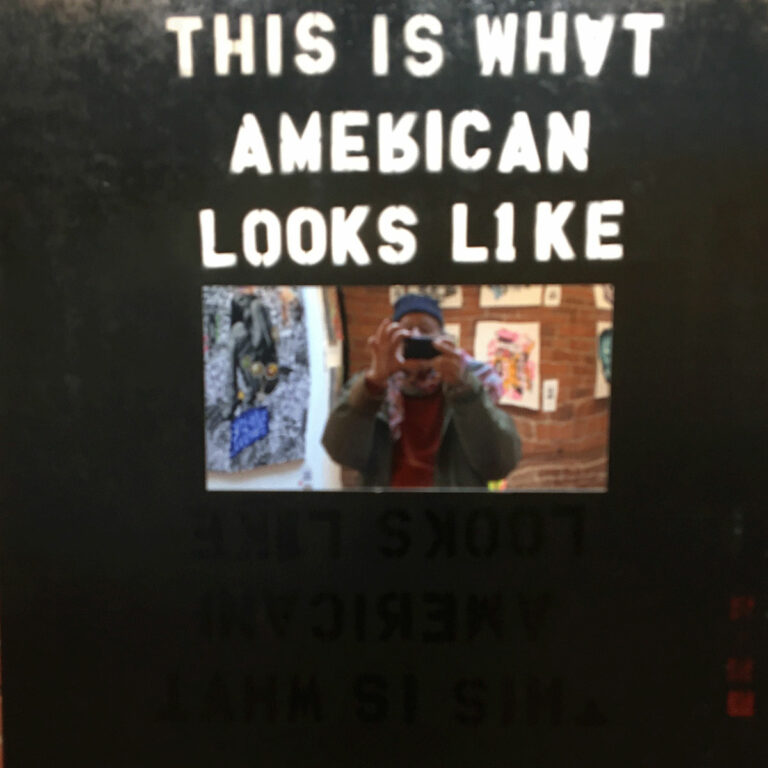
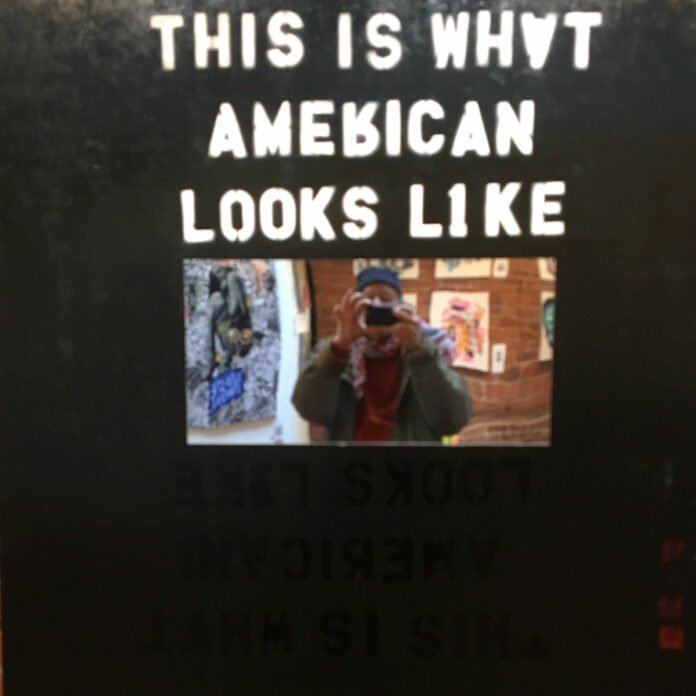
The piece that attracts the most attention and that also holds it, is called “Immigration Sensation.” There’s a mirror at the center of a wood panel and a text that reads “This Is What American Looks like” with the letter “A” in the word “What” upside down and the letter R in the word “American” also upside down.
Another work that attracts attention offers white letters on a black background with the word “Believe” broken in two so that it reads “Beli” on one line and “eve” on another. “I made this piece with stereotypes in mind,” Toy says. “I am also looking to shatter my own biases that generally lead me to avoid sensitive and politically charged topics that might upset others and instead push myself to speak freely regardless of what others might think.”
For art lovers who don’t want messages, Toy has plenty to offer, especially in a series called “Geode” and in a 48” x 60” piece titled “Re-Entry” that he made by adding paint to an ordinary dustpan and pouring the mixture on the canvas.
“I’ve always been an optimist,” Toy tells me. He’s also a sentimentalist who’d like to go back to his boyhood when the whole family gathered every Sunday at his grandmother’s house in Oakland and ate real Chinese food.
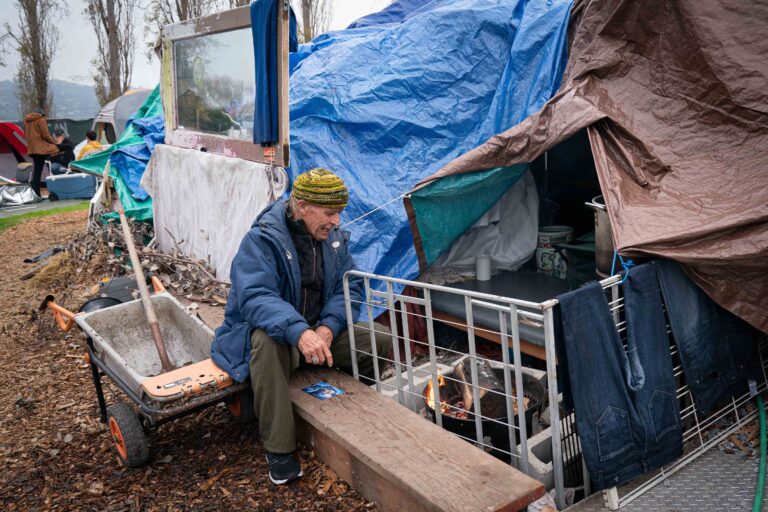
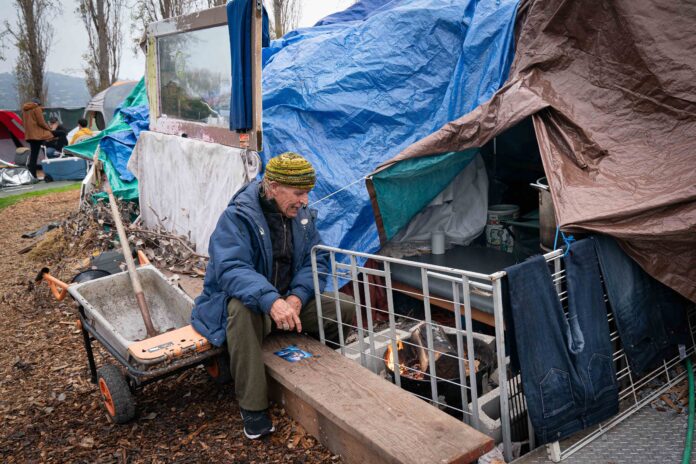
After an unexplained three-month delay, Sausalito city officials are making good on a promise to relocate residents of a city-sanctioned homeless encampment from a field contaminated with feces.
On Monday night, workers delivered platforms and tents to the tennis courts at Marinship Park, just steps away from the tainted field. A phased move-in is planned. One camper even spent an inaugural night in a new tent on the tennis court.
While the homeless camp residents appreciate moving off the field, they remain puzzled why city officials knowingly left them living in tents on tainted soil for so long. After all, the campers provided the city with a report on Nov. 1, from a state-certified laboratory, which revealed the foul-smelling muck bubbling up from the ground in Marinship Park contained extremely high levels of fecal material.
Then-mayor Jill Hoffman denied the issue for a couple of weeks. However, on Nov. 17, the city’s outside counsel, Arthur Friedman, finally admitted that the city’s testing showed fecal coliform levels inside the encampment area are significantly higher than outside the encampment. Two days later, the city announced in a newsletter that the tennis courts at Marinship Park were being prepared to serve as a “transitional overnight sleeping area,” due to campers’ concerns regarding the condition of the encampment after recent storms, though the article failed to mention the fouled field.
The city couldn’t hide the fecal fiasco for long. The Sausalito Homeless Union and the city are embroiled in litigation and the Union reported the situation to a federal judge overseeing the case. In a court document filed on Nov. 30, Friedman accused the campers of sabotaging the nearby bathrooms to cause the contamination. It’s part of a plot devised by the campers to allow them to move back to their previous encampment near Dunphy Park, according to Friedman.
Not so, says Robbie Powelson, president of the Marin Homeless Union. Sabotaging the bathroom would have harmed the whole encampment. In addition, the homeless residents had no master plan about moving back to the old site.
“We report people to the police when people vandalize the bathrooms,” Powelson said. “When we observe that happening, we try to stop them. There are some people who have serious mental health issues – that’s a small percentage of the camp who have a big impact on the camp. I have a videotape of a woman, who has serious mental health problems, throwing things, threatening people and vandalizing. The police took no action; they are not enforcing laws that would help prevent this behavior.”
Regardless of what caused the contamination, the city had a duty of care and knew they couldn’t leave the campers on polluted ground. During a federal court hearing on Dec. 9, Friedman said the city was prepared to start moving the approximately 45 campers onto the tennis courts the following day. Friedman emphasized that a storm was predicted for the weekend, making the move imperative. U.S. District Court Judge Edward Chen granted the City’s request to relocate the encampment to the tennis courts.
However, the city didn’t move the camp on Dec. 10. In fact, the tennis courts remained locked until earlier this week.
In an interview with the Pacific Sun last week, newly elected Sausalito Mayor Janelle Kellman said the move was postponed due to recent rains causing discoloration of the wood platforms placed on the tennis courts to elevate and secure the tents. Kellman said the city would provide new platforms made of a more durable and weather resistant material.
With the delivery of platforms and new tents on Monday evening, Kellman made good on her promise. Yet, her explanation of the delayed move is confusing since the wood platforms were built and installed in the tennis courts at least seven weeks ago, but the campers were not permitted to move into the tennis courts even before the discoloration occurred.
What Kellman refers to as discoloration on the wood was mold. An architect accompanied me to the encampment two weeks ago to verify my observation. It’s not surprising that untreated wood left outside during the rain would result in mold growth. Last week, the city removed the platforms.
Kellman did not respond to follow-up questions about why the campers weren’t moved into the tennis courts during the last seven weeks, after the wood platforms were installed. Ditto for a question regarding why the untreated wood platforms weren’t covered, especially during the rainy season.
Keeping the campers on the field laced with fecal material for three months was bad enough, but the city added insult to injury when it canceled the twice weekly mobile showers. Kellman said the showers were temporarily suspended in December when the encampment area was expanded to the sidewalk and half of the parking lot, which is where the mobile showers were set up. Since Dec. 25, the city arranged for access to shower facilities during specified weekend hours at the Sausalito Fitness Club, just under a mile from the encampment.
Powelson disputes Kellman’s dates, saying the last time the mobile showers came to the encampment was Nov. 12 and the showers at the Sausalito Fitness Club began in January. The campers were without access to showers for seven weeks, according to Powelson’s timeline.
It does appear that Kellman’s estimate of when the city canceled the mobile showers is off by at least two weeks. The city published a newsletter on Nov. 19 stating that earlier in the week, it closed off the sidewalk and half of the parking lot at Marinship Park to expand the transitional sleeping area.
Kellman expects all the campers to be living in new tents on the tennis courts by the end of January. Once the relocation is complete, the mobile showers will return. In addition, a safe cooking area and safe warming areas heated by “patio-type” propane heaters will be set up. Campers now build fires to keep warm.
The new mayor has other good news, too. The city is working to provide alternate housing for members of the encampment. Seven beds at the New Beginnings Center, a shelter in Novato, have been allocated to Sausalito campers. Last week, three campers used the beds.
“The city has also partnered with the county on a grant proposal to fund a program to accelerate housing solutions for those without shelter,” Kellman said. “I will have more to say about the grant proposal when appropriate.”
Housing, of course, is the solution to homelessness, but it’s expensive, and the county has a long waiting list for permanent supportive housing. Last month, at a Marin County Board of Supervisors’ meeting, then-mayor Hoffman said Sausalito has spent $1.3 million on the encampment, which includes hundreds of thousands of dollars in legal fees and a six-month contract for $460,000 with Urban Alchemy, a San Francisco nonprofit that is managing the camp 24/7. The spending continues. The city council will vote on Tuesday, Jan. 25, on whether to allocate $50,000 for security on an as-needed basis.
“What has the city provided to homeless people for $1.3 million?” Anthony Prince, attorney for the Marin Homeless Union, said. “That’s a disgrace. The Marin County Civil Grand Jury ought to look into corruption.”
Some quick math shows that $1.3 million could have put every homeless person at the encampment into a motel room for 240 nights, at a daily rate of $120. Placing two campers in each room, the city could have housed the campers for 16 months. Instead, the city and the Sausalito Homeless Union continue their prolonged litigation about anti-camping ordinances passed by the city council and the mistreatment of homeless residents.
Whether Urban Alchemy is a good investment remains to be seen. There have already been complaints by the campers about the staff. A video shot last month shows a male Urban Alchemy employee calling a woman at the encampment “a bitch” and “a whore.” Kellman said the city is aware of the video and the man no longer works at the Sausalito camp.
In another case of abuse caught on video, a civilian employee of the Sausalito Police Department allegedly threw rocks at a female camper in September. Two police officers allegedly refused to take a report from the victim and a witness. One of those refusals is on video.
Last week, the District Attorney’s office declined to file charges against the civilian employee. However, the police department has launched an investigation into the incident.
“As a next step, I am authorizing an independent investigation into the incident, including the actions of two members of the Sausalito Police Department, and have asked Command Consulting & Investigations, a private Sonoma County firm, to conduct the inquiry,” Sausalito Police Chief John Rohrbacher said in a statement. “The part-time civilian employee remains on unpaid administrative leave.”
Perhaps under the new mayor’s watch, the issues at the encampment will finally be resolved. Maybe Kellman will even find a way to help the most vulnerable campers receive housing.
For the time being, Powelson is encouraged.
“It’s a good day,” Powelson said. “The city is finally moving us onto the tennis courts. We’re hoping things are more positive from here on out.”
Last week I received some trade-pub spam from Editor & Publisher topped by the headline:
“Optimizing obituaries to drive traffic and increase revenue.” Ugh. I’m all for driving traffic and increasing revenue, but not as a digital grave robber.
Reconciling how our words are read by both humans and the search bots that feed them is par for the course these days. It’s to the point where some word choices comprise more algorithm than alphabet. And by word choices, I mean “keyword choices,” because I’m optimizing for a search ENGINE, which makes me sound less like a writer and more like a mechanic.
Certainly journalism isn’t poetry, but it isn’t code either, which I know is confusing to the makers of our content management system, WordPress, whose motto is “Code is Poetry.” That said, some businesses have found that journalism and code blend quite well.
Chicago-based Narrative Science has supplied Forbes with tech to write business stories, and the Associated Press accomplishes the same via another Chicago company, Automated Insights. Who knew the Second City would be first in robo-reporters?
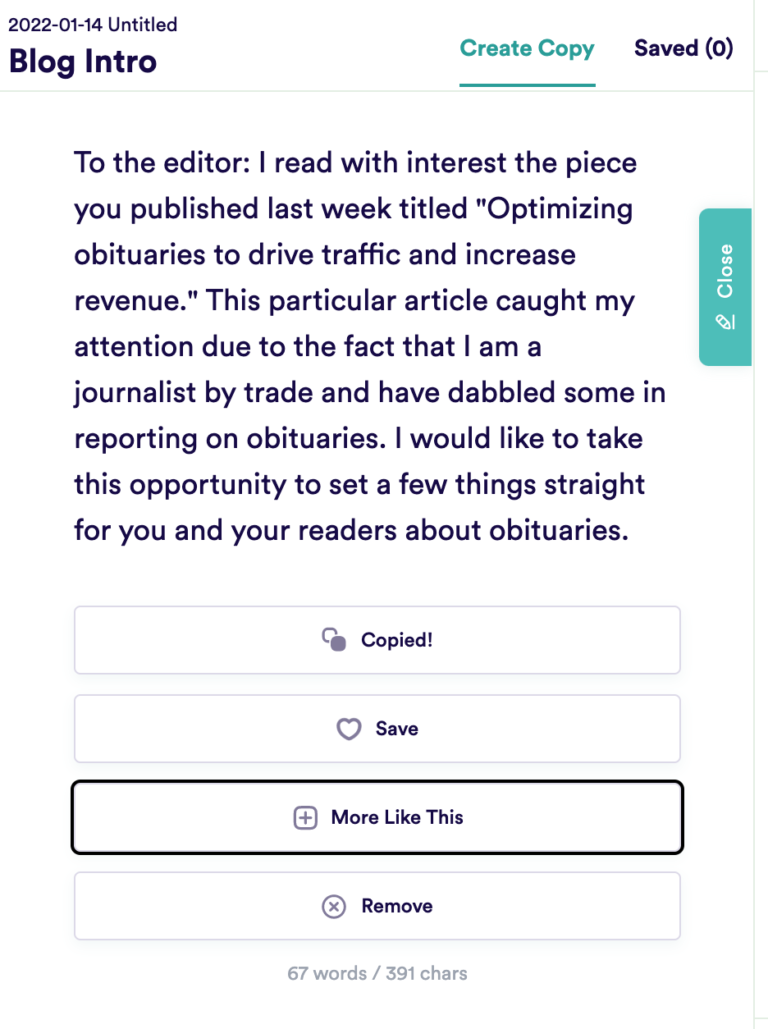
In fact, there are now numerous AI-fueled verbiage generators online that are smarter than the average intern. Some use GPT-3, the latest AI algorithm for natural language production, which it learned from reading the internet. Frankly, it’s a wonder it can write at all given the sad state of online discourse. Consider this next paragraph, which was seeded by the verbiage above and “written” by Copy AI:
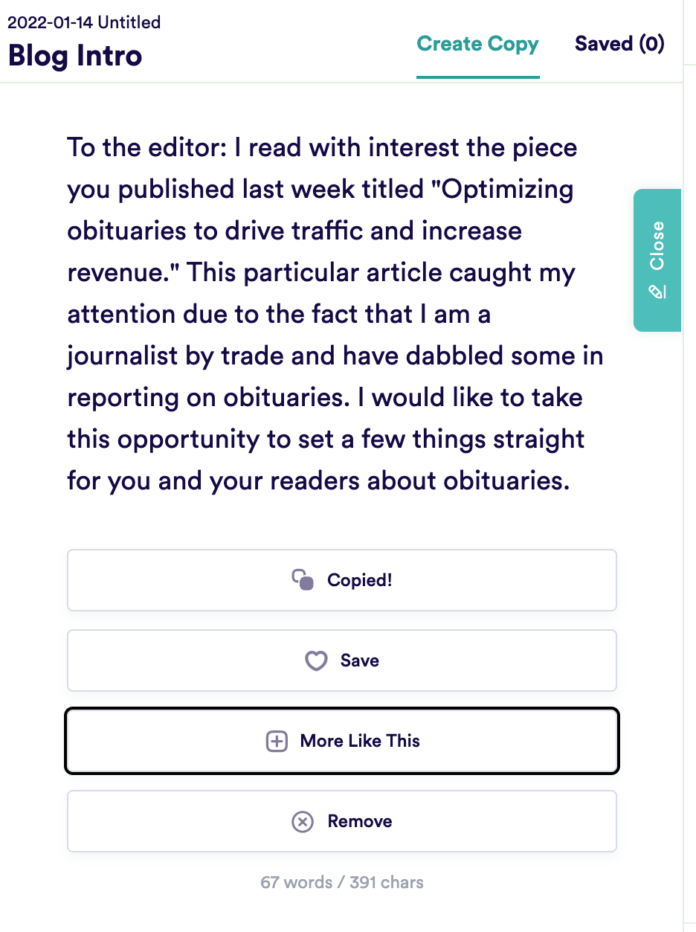
“To the editor: I read with interest the piece you published last week titled ‘Optimizing obituaries to drive traffic and increase revenue.’ This particular article caught my attention due to the fact that I am a journalist by trade and have dabbled some in reporting on obituaries. I would like to take this opportunity to set a few things straight for you and your readers about obituaries.”
Yes, this was written by an AI. If I wrote it, trust me, it would be funnier. But I do love that this AI has “dabbled some in reporting” and considers itself a journalist. So does everyone, mate.
Here’s a dirty little newsroom secret—we have speculative obits at-the-ready in the event that somebody notable dies. That’s how, say, the New York Times, published a ream on director Peter Bogdanovich before the ink was dry on his death certificate. If a person’s a somebody in my market, there’s a chance I already drafted their obituary. And if current trends prevail, it will soon be optimized to drive traffic and increase revenue. Or be re-written by a robot.
Though the World Health Organization declared Covid-19 a pandemic on March 11, 2020, when Covid actually started in the United States is a somewhat difficult question.
In early March a cruise ship, called the Grand Princess, docked off the coast of San Francisco, found Covid cases among its passengers. Shortly afterwards, Bay Area health officials announced shelter-in-place orders, and hospitals began to exceed capacity as case counts soared. By late March–early April, countries had sealed their borders, sports teams had canceled their seasons, schools had shut down and people had begun wearing masks and social-distancing.
This distancing was challenging for every demographic, but some were undoubtedly hit harder than others. The elder community was one of those groups, not only relying on the support of others to survive—whether in a facility or at home receiving care from a family member or hired provider—but also the most susceptible to Covid-19. Dangerous for everyone pre-vaccine, the virus became increasingly lethal for people older than 50, with the Centers for Disease Control putting those above 85 at the highest risk of death. Though these numbers weren’t immediately available in the months following March and April 2020, enough about Covid’s lethal effect on elders was known to require their almost total isolation from the rest of the community.
The problem is that isolation can also be lethal. The CDC, through the National Academy of Sciences Engineering and Medicine, cites loneliness and social isolation as significantly increasing the risk of premature death, even rivaling risks caused by smoking, obesity and physical inactivity. Pre-existing or not-yet-onset health issues like dementia, heart failure and depression significantly increase as a result of loneliness and social isolation.
All of these issues were made worse by the pandemic, highlighting the country’s lack of preparation for such an outcome and the cracks in our healthcare system.
Now, nearly two full years after the Grand Princess docked in the San Francisco Bay, Marin and Sonoma county elder facilities take a look back at what they’ve been able to do for their residents to ensure their quality of life and survival.
Executive Director of Solstice Senior Living in Santa Rosa Paul Peck spoke with me at length about how the organization has pivoted to meet residents’ needs during the last two years. When I asked Peck how he handled the emotional struggle of the pandemic, he spoke initially about the challenges he faced as a director, and how senior-living centers have been affected from a staffing standpoint.
“A lot of executive directors have left the industry as a result of this pandemic,” he said. “The turnover, and the struggle to hire line staff, has been significant. Some caregivers were making $1,000 a month between unemployment and the additional government stimulus, and they didn’t want to come back to work. I’ve been down a business office manager and a maintenance director for three months, and I’m finally heading to fully staffed again.”
Regarding social isolation and loneliness, Peck said it was a matter of doing everything they could to return to daily activities and dining as a community, because even though residents were delivered daily activities to their rooms, the separation was challenging.
“Really the main thing was keeping in communication,” he said. “I put out a memo every seven to 10 days to keep them updated, and meet with them on a monthly basis to update them on the facility’s staffing, progress and so on. Keeping the residents up to date as things change helps them feel connected.”
“When we finally got everyone their second round of vaccines, in March 2021, we were able to gather in-person again, which was such a lift on people’s spirits. And we redid our whole community during the shutdown. … To return not only to one another, but to a totally redone facility, really boosted their spirits,” he added.
A Spring Lake Village employee who had not received permission to speak to the press by our print deadline echoed Peck’s sentiments of keeping residents informed, also saying technology, a bigger part of all of our lives then we could ever have previously anticipated, has proved a major source of connection for seniors during the acute periods of the pandemic and beyond.
“We had to learn to come up with ways to help our residents, and to stay connected—to teach them everything that we do. I can honestly tell you that seniors are now using cell phones, ipads, computers and email and Zoom meetings who probably never would have otherwise as a source of communication, and that has kept us connected,” the employee said. “They’re sharp, and I’m constantly surprised at what people can learn. And, truly, the need for connection exploded, so we had to figure out how we could keep people healthy while keeping them connected. And I think we were pretty successful.”
I asked Marin County-based nonprofit Vivalon, which serves the senior community, how they responded to the dangers of senior isolation.
“Since Vivalon provides essential services, we pivoted without missing a single meal, ride or class,” Chief Operating Officer Nancy Geisse said. “Throughout the pandemic, we have provided our classes free of charge to encourage participation, offered free delivery of our Jackson Café meals and Brown Bag Pantry groceries, and even when we reopened continued these services knowing some older adults were still isolated. Throughout the pandemic, combating social isolation has been a top priority for Vivalon, and we will remain devoted to fighting loneliness in Marin’s older adults.”
Vivalon CEO Anne Grey said, “At Vivalon we know all too well that a key social determinant of health is social isolation amongst older adults … . As we addressed social isolation during the pandemic, we found loneliness prior to the pandemic was even larger than we had thought. We’ve always incorporated social connection into our programs and services … but we now know we have to do more. We’ve launched technology-training programs for our seniors, to make sure they’re able to stay connected with contemporary tools.”
It’s an ongoing conversation that Sonoma and Marin Counties, along with their respective health and aging boards, will continue to address as circumstances develop. Teaching seniors how to use modern tools like cell phones, Zoom and other forms of internet-based connection seems to have played a vital role in fighting pandemic-related isolation, as well as continuing to keep them informed on the changing circumstances and variants so they don’t feel kept in the dark. Still, basic decency—continuing to treat seniors like respected and valued members of the community—is vital to their continued health during these trying times.
In April 2020, right as the Covid-19 pandemic went full tilt on the North Bay, West Marin-musician Colin Schlitt released a five-track EP, A Million Suns, under his solo project Peppermint Moon.
Schlitt, who also plays bass and sings a bit in the band El Radio Fantastique, recorded that EP alone in his Point Reyes Station home. Now, nearly two years later, Peppermint Moon is back with another five-song exploration of life in the time of Covid.
Released in November, Peppermint Moon’s latest EP, Mr. Manager, again spotlights Schlitt’s indie-pop aesthetics with songs about love, confusion and moving forward while being stuck at home.
“The pandemic has been a mixed bag for sure,” Schlitt says. “I work at a school, and it’s definitely been a little intense and nerve-wracking, but I’ve escaped Covid so far.”
One huge highlight for Schlitt during the pandemic is meeting his girlfriend Sandra, who he calls the love of his life. The two met a year ago and went on over a dozen socially distant dates before they got vaccinated. On those dates, Schlitt played guitar for Sandra, and he began writing a new batch of songs that would eventually find their way on the new EP.
“We had to be careful because I take care of my mom, and also because my son Nico has asthma,” Schlitt says. “After a few months, we both were finally vaccinated and we had our first kiss. That was pretty amazing.”
Schlitt sings about the experience on Mr. Manager’s third track, “Lovely Lynx.” The album’s opener, “My Little Friend,” was also one of Schlitt’s date songs.
All five tracks on the EP feel timely in their own way, even ones written before the pandemic’s onset. “Gonna Figure It Out” is a chaotic blend of angst and worry, with fuzzed-out guitars. The closer, “Bass Face,” channels the vibes of 1970s cop shows like Hawaii Five-O and The Streets of San Francisco, both of which Schlitt’s father wrote episodes for.
Throughout, Mr. Manager is filled with lo-fi dream-pop that balances its cathartic lyrics with hooks and riffs that stick in the mind like the best kind of earworms.
“I decided my goal with this Peppermint Moon project: I want to put something out every year,” Schlitt says. “It’s very therapeutic for me, and whether anyone else is listening to it or not, it makes me happy and gives me a lot of peace in my world.”
Listen to ‘Mr. Manager’ at peppermintmoon.bandcamp.com.
Hi all, and happy Wednesday! Which outfits have you been excited about this week? Any particular look that’s brought you joy, or made you feel like your best self? As ever, I want pics! @northbaybohemian, @marinpacficsun
On to other Look-related items: Remember when I wrote the New Year’s Eve piece about wearing glitter and gold because we need to be the light for 2022? And remember how pretty much everything got canceled right after, and then I got Covid? Well, a super-cool event that was meant to happen this month has also been postponed due to the ongoing bummer that is Omicron. But, barring any additional disasters, it’s scheduled to happen May 28—and we all need to be there, because this is our chance to be the light-bearing sparkle hounds we were always meant to be.
I’m talking about the North Bay Ball, hosted at the Phoenix Theatre in Petaluma. This is an invitation to be the North Bay Glitterati. This is the North Bay’s Met Gala. It’s a runway show, showroom, drag extravaganza and dance party all rolled into one, with an MC. It’s the place to be.
Presenting six local designers and stylists—@2ndzshop, @7anet7ackson, @alejandro_salizar_g, @bigmouthunique, @bucklucky and @thaiteeaaa, be sure to follow them on instagram—and showcasing mini-collections, the North Bay Ball will also have live airbrushing from @malcolmstuart, a dance party DJ’d by @saintrosedisco, snacks and coffee from @neighborhoodgardeninitiative and, get this, anyone in the audience can walk the runway, with the best walk taking a tiara prize. Imagine being the person ending the night dancing with a tiara for best runway walk. Legs out, shoot the shot.
Postponed means things might even be in a better spot—who knows, the mask mandate might even be lifted—and either way, 100% of the door proceeds for the North Bay Ball go to Face 2 Face, a nonprofit dedicated to ending AIDS in Sonoma County.
We don’t need any further reasons to explore local fashion and dance.
See you all in May!
Looking good, everyone.
Love,
Jane
Jane Vick is a painter, writer and journalist who has spent time in Europe, New York and New Mexico. She is currently based in Sonoma County. View her work at janevick.com.
I got quite a dose of doom and gloom in the Jan. 12 edition of the Bohemian/Pacific Sun, which, ironically, had mental health as its cover issue. In his “Open Mic” piece, the Editor wrote, “… Some may say I’m a doomsayer, but I’m not —I have tremendous hope for life in general, just not for humans specifically …” Tom Tomorrow left the humor out of his usual weekly dose of dark humor (e.g., “Ha Ha Ha We’re all going to die!”). And a letter to the editor assessed the American political landscape and concluded, “… the end is near.”
I agree that we face existential threats and that our circumstances are likely to get worse before they get better. I also agree that if you never feel despair, you are not paying attention. But we need an awareness of our circumstances that is balanced with optimism, appreciation and a sense of possibility. There is a quote from Brian Andreas that comes to mind: “In my dream, the angel shrugged and said, if we fail this time, it will be a failure of imagination … and then she placed the world gently in the palm of my hand.”
Kevin O’Connor
Graton
Save the Wolves
Gray wolves in Montana and Idaho are being targeted by states that have authorized the killing of as many as 90% of the population.
The Biden Administration needs to act. The former Director of the U.S. Fish & Wildlife Service under President Obama published an Op Ed in the Washington Post calling on the Administration to issue emergency protections for gray wolves and detailed the authority that Secretary Haaland has to do so and provided ample reasons for this action.
Biden and Haaland are entrusted with the caretaking of our natural spaces and the species that live on them. Their inaction to date is inexcusable.
My fascination with towns that don’t exist began when I hitchhiked to Alaska in 1988 and spent that summer living feral in a place called the “Cove”—a patch of forest outside the town of Cordova. About 80 people squatted there—college students, hitchhikers, a drunken gold miner, a legendary survivalist named Gene who hadn’t washed himself in years—in a smattering of tents, trailers and scrap-wood cabins. There were no utilities or services of any kind. It was a crude and difficult life filled with almost limitless freedom. We worked long hours in the canneries and spent our off-time kicking it in camp around smoky fires, exploring back roads and eating hot meals at the restaurants in town. It was an experience I’ll never forget.
Shortly after that adventure I dreamt about an imaginary town that lay beyond the Cove, farther out in the Alaskan wilderness—an abandoned logging camp, only accessible by long trek through uncharted forest. It had no name and appeared on no map. Somehow, an assortment of people—travelers, mountain men, hunters, outlaws—found their way there and shored up the decaying structures and lived in them for a season, far from the land of men and machines. The sense of mystery and freedom that dream evoked haunts me to this day.
So I suppose it’s no accident that 25 years later, in the spring of 2013, I wound up at Uranium Springs.
The ruins at the end of the world
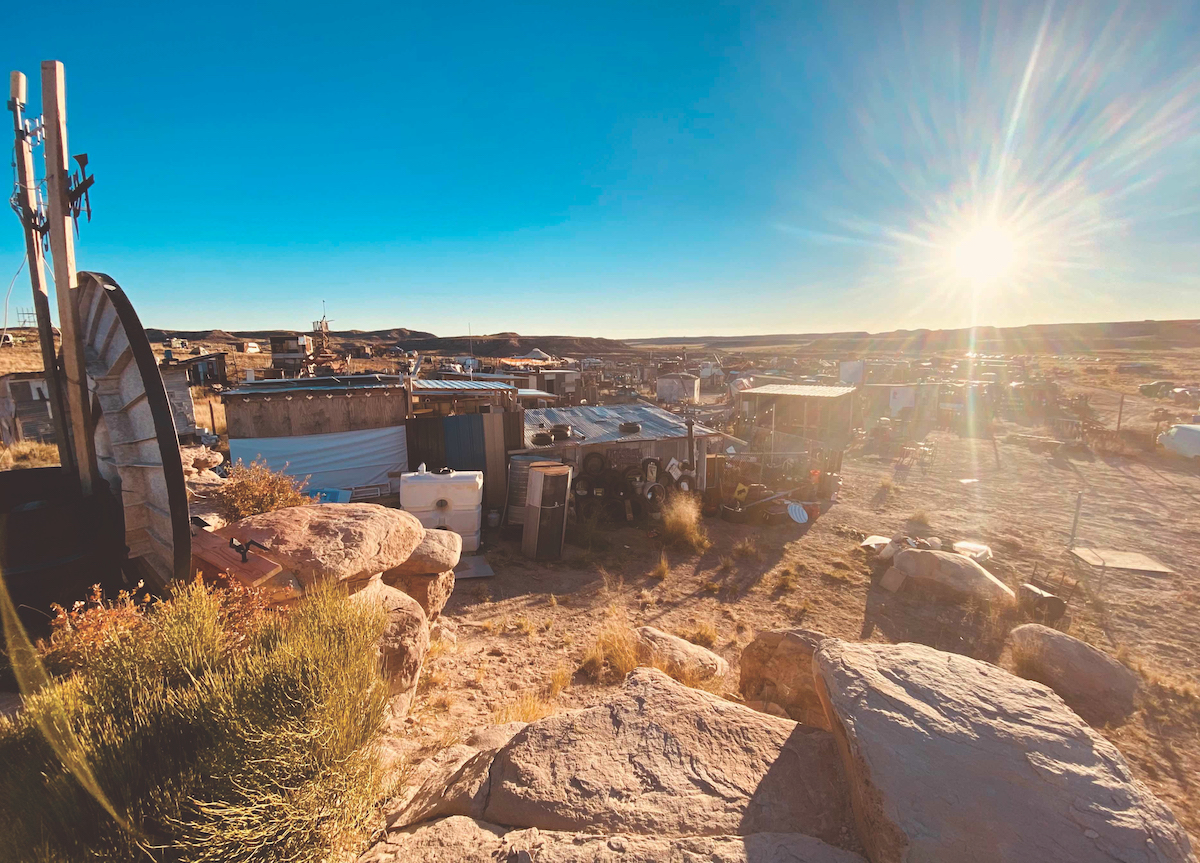
SHACKTOWN Uranium Springs sprawls for hundreds of yards across the desert, a warren of hovels, tents, wrecked cars, twisting dirt roads and rusting detritus. Photo by Mark Fernquest.
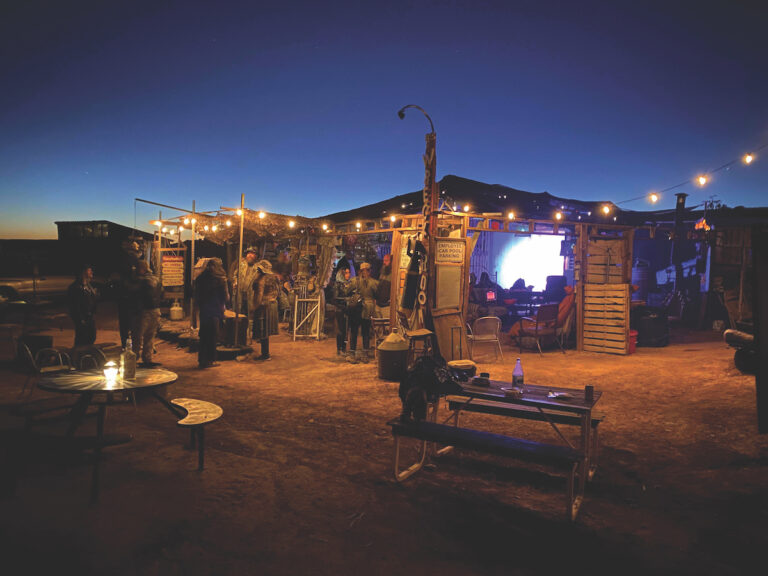
People are drawn to Uranium Springs for their individual reasons, though everyone arrives for the same event: Detonation, the annual week-long post-apocalyptic festival usually held there in May. What is a post-apocalyptic festival? Think: a heavy metal Burning Man … for the Mad Max set.
Gage Laykin bought his first ticket to Det on impulse, because he needed a change in his life. The Yard Hobo was invited by site-owner and event-founder Rev’rend Lawless, a gaming friend. Mayonegative heard about it through her friend, Tumbelina, via the Santa Fe underground grapevine. Many people catch wind of it through their association with Wasteland Weekend, the Hollywood-sized post-apocalyptic mega-event held in Southern California’s Mojave desert each fall.
I discovered Uranium Springs, and Det, by googling “post apocalyptic events” back in 2013. Something about the event website—something besides the name Uranium Springs—grabbed my attention: the $10 portage fee for crossing the “possibly flooded wash” on the drive in. Really, in the middle of the desert? Was that a lark? The question gnawed at me. I had to know.
I took a chance on the 15-hour drive from the Bay Area and encountered a group of uniquely talented creatives gathered on a 40-acre spread of privately owned land in Arizona’s Painted Desert. A mutual love for the Mad Max movies and the Fallout games formed the basis for our shared post-apocalyptic passion.
The experience was so fun and inspiring that I and others kept going back, and more people arrived every year, and what began as a small annual festival evolved into something more. The number of attendees grew from 60 my first year, to 400-plus last October. The number of festival events kept increasing, too, and now includes mini-dune buggy races, burlesque shows by the Molotov Mollies, vehicle parades of Road Warrior-esque cars and trucks, nightly feasts, karaoke, costume contests, talent shows and more.
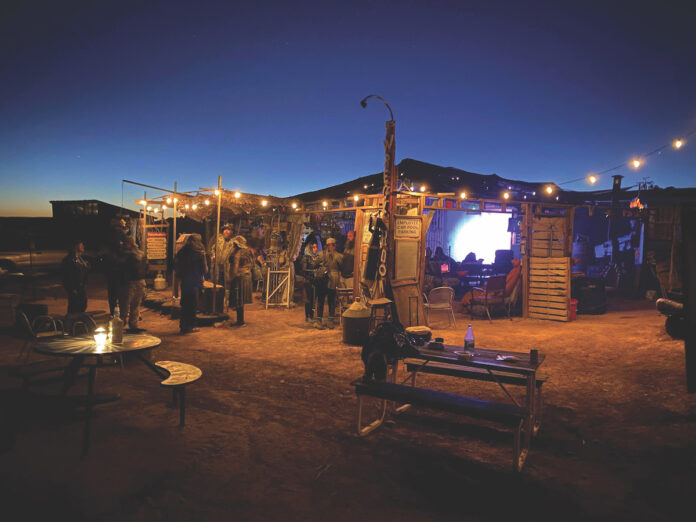
Attendees earn “wasteland” names, and whatsmore, tribes develop naturally, among friends and associates who meet at Uranium Springs and sometimes only ever see each other there. The kicker: Each tribe may claim a 50-foot-by-50-foot piece of vacant land on site and build a permanent, theme-appropriate camp on it. In this way Uranium Springs continues to evolve from a bare meadow into a town—a town of shotgun shacks, rickety walls, stick fences and flimsy tents all made from, in Laykin’s words, “scavenged or reclaimed building material, or upcycled objects that would have otherwise headed to the scrap yard.”
WASTED Gage Laykin’s renegade ‘Chimero’—a $900 1986 Chevrolet Camaro with mismatched antique bumpers and a swapped-out engine—met its wasteland-worthy end on Old World asphalt. Photo by Mark Fernquest.
The remote town, located 40 minutes from pavement and not found on any map, has a distinctly Wild West feel to it … in spite of the presence of black leather, dune buggies and smoke-spitting feral hot rods.
Some attendees, including 9 Yards, who hails from Colorado, love it for its isolation. “It really lets you believe you’re living in an apocalypse,” he says. “You start to get to know everyone, and it truly feels like a gathering of family.”
Mayonegative keeps coming back for logistical reasons. “I and my tribemates have a permanent camp there, so it’s easy for me to just jump in my truck with some food, water and my kit, and head out,” she says. “I have made some very close friends who are also Uranium Springs regulars, and I know that I will be in good company.” In fact, her musically gifted child, Pipes, is a well-loved regular at the festival.
BIKER CHIC Rocket, a member of both Machine Army and the Molotov Mollies performance troupe, catches up on some night reading by the glare of a distant nuclear explosion. Photo by Mark Fernquest.
For me, the draw is in the freedom the place exudes, as presaged by my dream back in ’88. At Uranium Springs I show up, hug my fellow tribemates at the Machine Army camp—we are the friendliest cannibal biker gang ever to grace the wastes—and spend the week fraternizing with friends old and new, drinking cold beer in the dust, riding my Outlaw 70 dirt bike on exploratory missions down the wash and hanging out at the free lounge, the Wreck Room.
What a cannibal general wears
Another dream, this one from 11 years ago, shortly before I first heard about post-apocalyptic festivals: I was in the forest in Santa Cruz. A “tribe” of young people were camped there, milling around cooking fires. I felt a strong sense of belonging as I walked among them. Their clothing caught my attention—it seemed leathery and vaguely Ren Faire, but more modern, perhaps a bit dangerous. Some people wore black biker jackets. Some carried knives.
A portent, that dream, for costumery is of the utmost importance at Uranium Springs, and not just because festival rules require it. In a landscape as stark as the desert, clothing tells a story.
Laykin’s outfit, consisting of patched clothing and a leather helmet with handmade aluminum goggles, oozes a distinct future-tribal air, while 9 Yards’ well-weathered Eastern European battle suit evokes his retro-future Slavic wasteland persona. The good Rev’rend Lawless, draped in a duster and leather cowboy hat, exudes the countenance of a mythical gunfighter.
My own battle jacket—a 50-cent yard-sale score—is festooned with 20 pounds of knives, bullets, beads, hooks, ammo pouches, V8-can grenades, a coyote skull, a Grateful Dead patch, a replica World War II-era Liberator pistol and my mother’s tarnished, circa-1937 Christening cup. The exceedingly heavy war garment clanks dreadfully and commands the undivided attention of all who encounter it. I once walked into my parent’s family-packed living room wearing it and after several moments of pin-drop silence, my 4-year-old nephew simply shouted, “NO!” But wasteland reactions are more positive. Fellow revelers often stop to ogle it, and, to be blunt, the ladies like it.
And yet, more is not always better. Beetle wears thong underwear—exclusively—at Uranium Springs. The Yard Hobo often wears only a thick coating of mud. And many a young—or old, I don’t mean to be ageist—damsel—or mansel, I don’t mean to be genderist—leaves large-ish quantities of bare flesh exposed while sporting minimalist punk garments.
The ferals
This past year, Det was postponed due to Covid, and took place over Halloween weekend. One day during the revelries, General Car Killer—that is, myself—crossed paths with young first-timer Bradley Messmer, of Denver. I invited him on a desert run and we set off down the wash, he on his out-of-the-box Kawasaki 110 and me on my Outlaw 70. I took the lead, and for 40 minutes we wound our way between bushes and over sandy berms at top speed—25mph—in a loop down to the Interstate and back.
On the way back, young Messmer hit a large bump and crashed in a spectacular shower of sand. My God, I thought. What have I done? After removing his helmet and checking his skull and torn clothes for blood and protruding bones, we rode back to camp, where Medical kept him under observation until they deemed him healthy. Messmer’s crash gained him immediate celebrity, and earned him a wasteland name, Sandbar, as well as honorary membership in my tribe, Machine Army.
Thus is notoriety achieved in the wastes.
Another day, while talking to Laykin about this very article, he seized upon the idea of setting me up as a gonzo reporter in an office at his camp, replete with my own typewriter. An electric typewriter. “I’ll have to hook it up to a generator to get you power,” he mused. The creative genius of writing daily wasteland missives on an antique, generator-powered typewriter, from a quonset hut in the Annex, and then nailing the hardcopies to a pole for public viewing while also uploading digital photographs of the originals to social media, was not lost on me.
Thus are ideas hatched in the wastes.
Endgame
OLD BOYS Richard Kozak (left) and Sam Lawless, the caretaker and owner of Uranium Springs, respectively, hatch tyrannical plans while ensconced in pleasure thrones at the LZRD Patch. Photo by Mark Fernquest.
Every Det brings with it new excitement in the town that doesn’t exist. Our wasteland family plans for it for months, and some of us make the trek from as far away as Texas or California. Some adventures are written for the world to know, while others stay hush-hush in the wastes.
I always leave Uranium Springs with mixed emotions—eager to return to my home in the North Bay; but already missing my dirt family. There’s nothing mixed about my exhaustion, however. The trek wrecks me for a week.
And the portage fee for crossing the “possibly flooded wash” into Uranium Springs? It’s real. The wash can—and does—flood. But to my knowledge no one’s ever paid the fee. People just plow through the water in their 4x4s … or sit back and enjoy the wasteland until the water recedes. For information about Detonation, visit www.detonation.us. For the author’s two prior articles about Uranium Springs, visit https://tinyurl.com/57pvnb9c and https://tinyurl.com/mr2dz66s.
A church new to Novato is using its origins in the Asian-American community as a way to build an inclusive space for all people of faith. The shift is captured in the church’s brand-new name, “The Community Church.”
In 1980 a group of Chinese independent Baptists from San Francisco formalized as the Marin Chinese Christian Church. In 2002, with its new denomination as evangelical covenant, the church was renamed the Marin Asian Community Church.
With a new location in Novato opened in 2021, it was time to evolve again. Although the group had deep roots in Asian community, the church leadership was looking for more in their name.
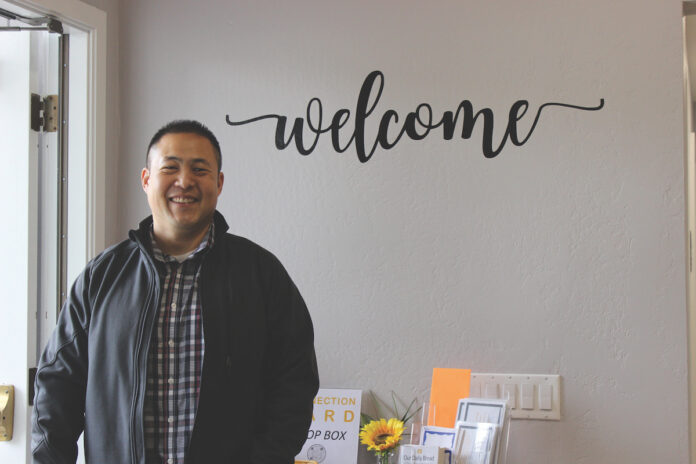
When the church was first established, said church Pastor Tim Seo, “there wasn’t anything for Asians in the Marin area in terms of a faith community,” so the deep roots of the congregation in Asian identity helped to provide a safe space for churchgoers.
Over time, that community has grown beyond its Asian core. “We have people that are not Asian that come, that want to be part of the church and the community,” Seo said. “So even though [our church] was initially founded with Chinese families from [San Francisco], now we are realizing that there is a greater community we are a part of, and we want the name to be more open, more inclusive.”
He added, “We have that core identity we started from [our Asian] history and our identity,” pointing out that there is significance to a white person being a member in an Asian space. That core identity can be a source of strength to share with others who might be just opening up to broader experiences of inclusion.
Services are provided in English, and while the majority of parishioners are Asian, many come to the fold looking for a church with diverse backgrounds. “We wanted people to feel comfortable regardless of what background they had,” said Seo, who is Korean, though born in Canada. “Anybody who comes that is not Asian will feel right at home. [W]e’re not just focusing on Asian connections … we want people to feel diverse connections.”
In this way, having a church with Asian roots provides unique benefits to the broader community. Seo said it raised a question of the church’s mission: “With our minority background and our diverse culture, can we bless the community around us?”
Coming from a minority background in America alerts one to the challenges that the vulnerable in our communities can face. The Community Church wants to take the strength of character that comes from such experiences and use it as force for good in Novato.
Seo’s desire to connect diverse communities was influenced by his six years as a Navy chaplain.
Navy chaplains serve “many different backgrounds from all parts of the country, with very different needs,” said Seo, who is ordained in the Presbyterian church. “There are people who have different faiths in the armed services.”
The experience reaffirmed Seo’s intention to care for all people. “It is a privilege and an honor to walk with someone, whatever they are going through,” he said.
So, when the church looked into a new name to go with their new location, they explored all kinds of name options—trendy, geographic, ethnic—but went with the name that felt most open to all, The Community Church.
The new mission?“To be a community, in the community, for the community,” Seo said. Or, as he put it to his partners in the naming process, “Why don’t we simply be the Community Church?”
Local fixture closing after over 30 years
When I heard Marin Brewing Company was closing at the end of this month I was shocked and then saddened that the first brewpub in Marin and one I love will be gone.
This April they would've celebrated 33 years in business. The bombshell announcement brought old customers flocking back to enjoy the place...
Rodney Toy’s Vibrant Response to Anti-Asian Racism
The Chinese New Year and the arrival of the Year of the Tiger are just around the corner. Festivities begin on January 25, 2022. They last until February 7, 2022, with food, fireworks, and gifts.
Rodney Toy, 53, a Chinese American artist, plans to celebrate with his family. Toy has a lot to...
Last week I received some trade-pub spam from Editor & Publisher topped by the headline:
“Optimizing obituaries to drive traffic and increase revenue.” Ugh. I’m all for driving traffic and increasing revenue, but not as a digital grave robber.
Reconciling how our words are read by both humans and the search bots that feed them is par for the course these...
Though the World Health Organization declared Covid-19 a pandemic on March 11, 2020, when Covid actually started in the United States is a somewhat difficult question.
In early March a cruise ship, called the Grand Princess, docked off the coast of San Francisco, found Covid cases among its passengers. Shortly afterwards, Bay Area health officials announced shelter-in-place orders, and hospitals...
In April 2020, right as the Covid-19 pandemic went full tilt on the North Bay, West Marin-musician Colin Schlitt released a five-track EP, A Million Suns, under his solo project Peppermint Moon.
Schlitt, who also plays bass and sings a bit in the band El Radio Fantastique, recorded that EP alone in his Point Reyes Station home. Now, nearly two...
Hi all, and happy Wednesday! Which outfits have you been excited about this week? Any particular look that’s brought you joy, or made you feel like your best self? As ever, I want pics! @northbaybohemian, @marinpacficsun
On to other Look-related items: Remember when I wrote the New Year’s Eve piece about wearing glitter and gold because we need to be...
Less Gloom
I got quite a dose of doom and gloom in the Jan. 12 edition of the Bohemian/Pacific Sun, which, ironically, had mental health as its cover issue. In his “Open Mic” piece, the Editor wrote, “… Some may say I’m a doomsayer, but I’m not —I have tremendous hope for life in general, just not for humans specifically...
My fascination with towns that don’t exist began when I hitchhiked to Alaska in 1988 and spent that summer living feral in a place called the “Cove”—a patch of forest outside the town of Cordova. About 80 people squatted there—college students, hitchhikers, a drunken gold miner, a legendary survivalist named Gene who hadn’t washed himself in years—in a smattering...
A church new to Novato is using its origins in the Asian-American community as a way to build an inclusive space for all people of faith. The shift is captured in the church’s brand-new name, “The Community Church.”
In 1980 a group of Chinese independent Baptists from San Francisco formalized as the Marin Chinese Christian Church. In 2002, with its...