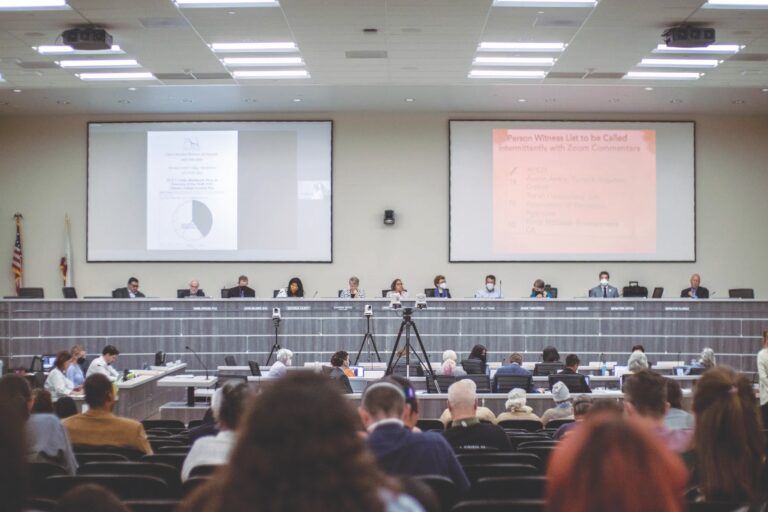
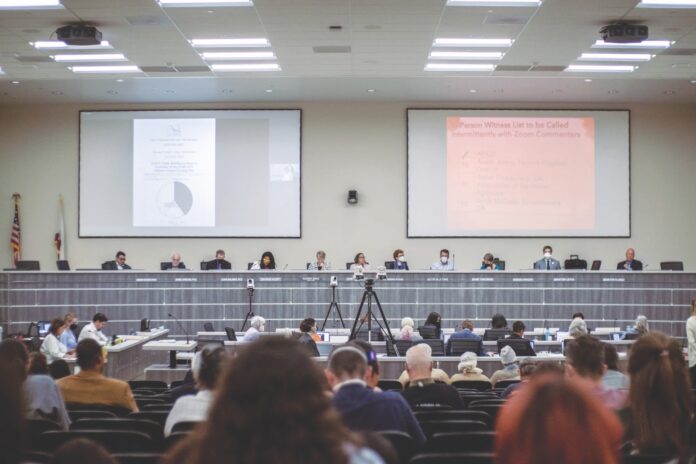
For a July meeting, the Little Hoover Commission—an independent state oversight agency—posted notice that the public could attend in Sacramento, but also in Traverse City, Michigan, or Southampton, New York.
Why the locations scattered across the country? Because some commissioners were taking part in the discussion on aging while on vacation. But California’s open meetings law requires in-person access to members of state bodies during public meetings, wherever they are.
The odd setup is a reflection of a post-pandemic declaration world: While COVID-19 public health rules have relaxed around in-person gatherings, remote work continues, even in state government. And as of July 1, some of the in-person requirements suspended during the pandemic are back in place—including disclosing remote meeting locations and making them accessible to the public.
Enter Senate Bill 544, sponsored by the California Commission on Aging, which seeks to reinstate some of those exemptions until Jan. 1, 2026. The bill—the latest of several in the last few years seeking to ease open meeting rules—passed the Senate in May, and is awaiting an Assembly appropriations committee hearing.
“While the executive order was in place during COVID about public meetings, costs went down 90%. Participation went up from vulnerable populations, and people were able to participate remotely in hearings the way they hadn’t before, and it was trying to continue those benefits,” said state Sen. John Laird, the bill’s author, from Santa Cruz.
The bill seeks to remove requirements to post all teleconference locations, post agendas at each location and make those locations accessible to the public. Instead, boards would only be required to post the physical address for one site, and only one board member or staff member would have to be physically present at that site.
But the bill’s opponents—a rare coalition of good government, press, taxpayer and industry groups—say Californians should be able to address their government officials in person.
“We really believe that having the opportunity to have that face-to-face interaction … is a really core belief for the democratic institutions,” said Laurel Brodzinsky, legislative director for California Common Cause.
Opponents also raise concerns that state boards could save the controversial topics for remote-only meetings, where the public may have less opportunity to weigh in.
“We see this all the time here [in Sacramento]—there is a huge line of members of the public for controversial bills choosing to participate,” said Brittney Barsotti, general counsel for the California News Publishers Association, which opposes the bill unless it’s amended further. “And while it might be disruptive for those of us that work in the Capitol every day, like, that’s the point, right? It’s the ability to organize and have your voice heard, instead of being in an empty room with one poor staffer and a speaker.”
In a concession to those concerns, the bill was amended last week to require that a majority of the members of a board be at the same location for at least half of its meetings.
Ethan Rarick, executive director of the Little Hoover Commission, said it supports the bill based on its own positive experience with remote meetings, but also on its June 2021 report on online meetings, which showed that more than half of the 46 state boards surveyed reported greater attendance by members.
Rarick noted that the Bagley-Keene Act—the law that governs open meetings for state boards and commissions—doesn’t require meetings be livestreamed, which would become a mandate under Laird’s bill.
“The more important point for our commission was that it can also increase the kind of people who are able to serve, and thus kind of increase the diversity and representation,” Rarick said.
Barsotti doesn’t buy that justification from the state boards: “They’re not simply expanding access for the public virtually. What they’re doing is trading it off.”
The Bagley-Keene Open Meeting Act, passed in 1967, says: “The people of this state do not yield their sovereignty to the agencies which serve them … The people insist on remaining informed so that they may retain control over the instruments they have created.”
Staying informed means a state body—any multi-member body that is created by statute or required by law to conduct meetings—is required to post public notices about when they’re meeting, prepare agendas and accept public testimony.
But balancing openness with efficiency can be frustrating, according to the state itself.
A handbook by the Attorney General’s office, updated in 2004, notes that the “unnatural communication patterns brought about by compliance with its rules” is an intentional choice to ensure the public has a seat at the table. “Simply put, some efficiency is sacrificed for the benefits of greater public participation in government,” the handbook says.
But Laird said the state learned a lot during the pandemic on ways to increase public participation while protecting people’s health.
“While it’s very important to have a majority of people there in person, we’ve been given some options that increase participation and protect people,” he said. “ And we should leverage those into a public process that really allows people to participate and has a majority of people there all the time in person.”
Still, some of the bill’s provisions remain to be worked out, such as no longer requiring disclosure and access to some remote locations, specifically private homes. Supporters argue that change is necessary to protect the privacy and safety of state board members, particularly those in “vulnerable groups” who may be targeted for “harm or harassment,” according to the bill analysis.
Brodzinsky of California Common Cause said she understands the privacy concerns, but aside from emergencies or health issues, doesn’t think it’s appropriate for members who choose to serve on boards and are accountable to the public to participate in meetings from home.
Common Cause, as well as the California Newspaper Publishers Association, also raised concerns that current language only requires an audio option, and not video.
It’s not just the expected opponents who are raising concerns.
In a July opposition letter, the Glass Packaging Institute, the California Manufacturers and Technology Association, the California Association of Winegrape Growers and other business groups wrote that remote participation eliminates eye contact, discourages debate, and stifles pre- and post-meeting discussions.
Laird said he heard the concerns from an August hearing “loudly and clearly,” and is considering amendments, such as on-camera participation and quorum requirements.
While the legislature is scheduled to adjourn Sept. 14, the senator still hopes to get it passed this session due to what he calls the ongoing need to allow people with disabilities or those with trouble traveling to serve on commissions or boards.
“We are still in the middle of COVID. And so I think that we still have to figure out a way that people that are compromised have a way to participate, and that is something that can’t be put off ’til next year,” he said.
Common Cause says its concern isn’t just with this bill, but with a “dangerous trend” of legislation the last two years that seeks to roll back public access.
Last year, a similar bill by former Assemblymember Bill Quirk that would have allowed meetings to be held entirely by teleconference died in committee. But Assembly Bill 2449 passed, extending until 2026 pandemic-era exemptions to teleconferencing rules for local governments.
This year, at least seven bills have been proposed that would expand the use of teleconferencing for public meetings, three of which have moved forward.