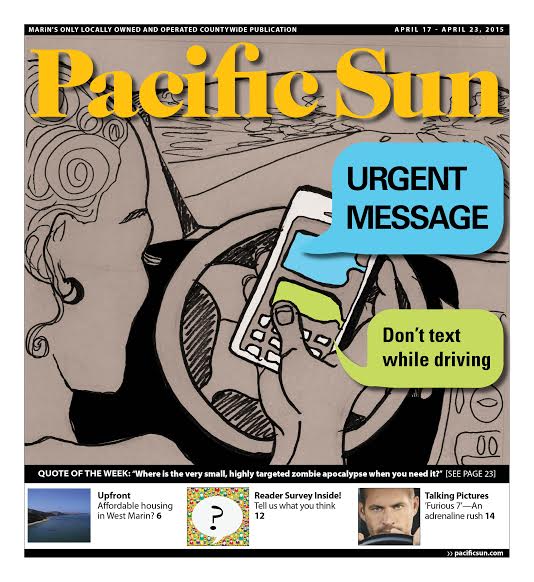
This week in the Pacific Sun

0

In this week’s issue of the Pacific Sun, Alyson Geller writes about the dangers of texting while driving, and explores what a Marin high school is doing to encourage students to put their phones down. David Templeton talks to Lino Ramos, of Sonoma Raceway, about ‘Furious 7’ and the need for speed, Tanya Henry reminds us that Slide Ranch’s Spring Fling is just around the corner and Peter Seidman writes about what could be an affordable housing oasis in West Marin. And if you missed it in last week’s issue: We’ve printed our 2015 Reader Survey again, and welcome your feeback. Be sure to fill it out and mail it in (or fill it out online) by April 23, and include your name and address for a chance to win a free dinner for two. All that and more is waiting for you online and on stands today.

Talking Pictures: The need for speed

0

“Drifting is not about speed,” explains Lino Ramos, of Sonoma Raceway, where he founded the popular weekly “Wednesday Night Drift” program. “Drifting,” he says, “is all about technique. It’s about taking a car out of control, and still controlling it.”

Sitting at his desk at the raceway—where his office is perched atop a high hill overlooking the facility’s 1600 acres—Ramos calls up a video on a computer and swivels the screen around for me to see. He’s found footage of a car engaging in the technique called “drifting,” in which the driver intentionally oversteers the car, causing a noticeable loss of traction in the rear end of the vehicle.

“It looks pretty cool, doesn’t it,” Ramos says, appreciatively. “It’s even more fun to do it.”

For most of us, of course, watching is as close as we’ll get to drifting, and for several million people across the world, the best way to watch professional drivers losing partial control of their cars while maintaining enough control not to die, is by watching one of the seven movies in the phenomenal Fast & Furious series.

The most recent entry, Furious 7—which Ramos and I have met up here at Sonoma Raceway to discuss—has already made more than three-quarters of a billion dollars, and that’s in just three weeks.

“Drifting is just one of the things the drivers do in the movie,” Ramos says, “but I definitely think it’s the popularity of the Fast & Furious movies that have made drifting so popular over the last few years.”

Ramos has worked at Sonoma Raceway—formerly Infineon Raceway—for 22 years, ever since he was 16 years old, doing basic laborer work around the massive site. It was Sears Point Raceway back then, and as the facility has changed hands a time or two, Ramos has worked his way up to his current position as Director of

Facilities, managing the entire property, supervising 24 employees, overseeing everything from changing over the track configuration from one kind of event to another, all the way to setting up for massive Nascar Cup competitions.

With the 4-year-old Wednesday Night Drift program, Ramos has been able to indulge his love of the sport that makes a car look as if it’s ice skating across a track—simultaneously thrilling and magical, and a little bit scary.

Which pretty much describes Furious 7.

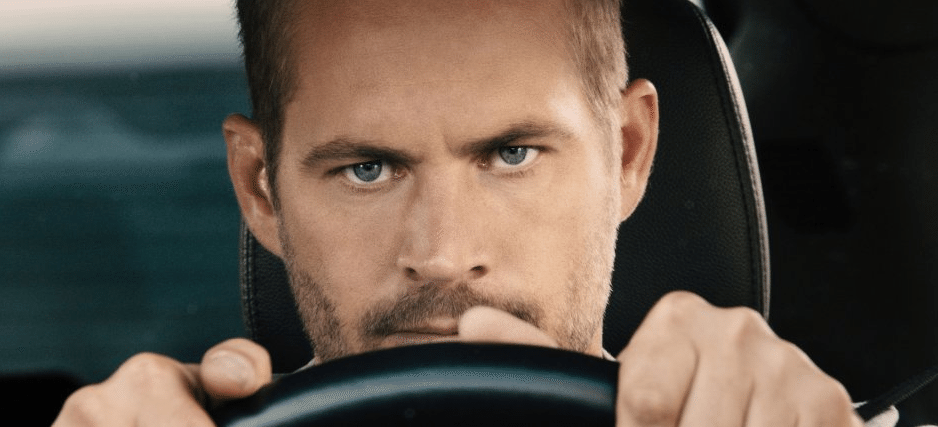
The film—completed, tragically enough, after star Paul Walker died in a car crash in 2013—takes the original concept of the first film, about a cop infiltrating a gang of car thieves, and makes it a cross between a James Bond movie and American Graffiti, with a lot more fistfights than the latter and much cooler cars than the former. In the film, featuring Vin Diesel, Michelle Rodriguez and Dwayne Johnson, cars do a lot more than just drive. They drop from airplanes, parachute to the ground and land on curving mountain roads. They play chicken at 100 miles an hour. They fly out through the windows of a 100-story skyscraper, sail through the air and crash through the window of a second skyscraper, and then a third. They careen from a parking garage and sideswipe a helicopter, somehow dropping off a package before plummeting to the ground.

“It’s a lot of fun,” Ramos admits. “As a guy who loves cars, it’s great to see drivers do all this crazy stuff. But I kind of miss the first movies, where it was all about drag racing with your friends. Working on cars together.

Having fun seeing how fast your car can go. A lot of the stuff they do in the movies now, you couldn’t really do. That stunt with the skyscrapers? That’s not even possible.”

Asked if he thinks these movies have encouraged people to take more chances while driving, Ramos agrees that that’s probably the case.

“And that’s why I go to a lot of car shows and car events,” he says. “I go out and I tell people about what we’re doing here, where you can come out and drive fast and do all kinds of fun things that aren’t legal, or safe, to do on the street.”

In a strange way, Paul Walker’s death illustrates the danger of driving recklessly, underscoring the need to separate what trained drivers do in movies and what the rest of us can do on an open road.

“It’s so unfortunate,” Ramos says. “Paul Walker’s death could have been avoided in so many ways. But unfortunately, you can’t turn the clock back. I really don’t think Paul Walker was the kind of guy to be doing anything reckless out on the streets. He wasn’t even the one driving. It was his friend, the owner of the Porsche. Lots of times, people with expensive cars want to show off how cool their car is, or how fast it can go. It makes it so easy for something to go wrong. And things can go wring fast, just like, ‘Click!’—Everything’s going in the other direction.”

Another way Ramos believes that the Fast & Furious movies have had an influence is that the number of women who’ve been taking up drifting and other car-driving skills has been growing. In the Furious films,

Michelle Rodriguez can do pretty much anything the guys can do behind a wheel, or under the hood.

“It’s pretty cool to see a woman come out here and start working on her car,” Ramos says. “And then she gets behind the wheel and goes out drifting with the other drivers. It’s happening more and more, and I think some of that is because of these movies. A woman sees Fast & Furious and she thinks, ‘I could do that!’

“Cars are fun to be around,” he continues. “Cars are fun to work on, and fun to drive and it doesn’t matter whether you are a guy or a girl. You can get hooked pretty easily.”
Ramos leads me out to the parking lot, where his own 1989 Mustang is waiting. He’s made a number of adjustments of his own.

“When you drive it on the street, every time you shift, you can hear the blow-off, and you can feel that there’s the power there under the hood, if you ever wanted to use it,” he says. “I wouldn’t do it, but if I was on the highway, and a Corvette pulled up next to me, I know that I could punch it and leave that Corvette behind in just a few seconds. That’s a cool feeling. It’s a very special feeling, knowing you are sitting in a car that could go really, really fast if it had to.”

Ask David if he’s ever gotten a speeding ticket at ta*****@*******nk.net.

Video: Scenes on the mind

0

by Richard Gould

Inception, with its turgid stretches and pages of expository dialogue, thrilled audiences with a time trip they had never been on before–and nudged me to a wider awareness of the moment in a way no other film has. INTERSTELLAR ratchets up the science and accompanying techno-babble threefold, albeit with a Jet Propulsion Laboratory (JPL) assist – pretty much no one in it has an interior moment – but you forgive Nolan, aware throughout that he’s turning the vast machinery of effects and blockbusterdom back to what’s most deeply felt and personal to us. Matthew McConaughey plays retired astronaut Cooper, lured away from his farm by mysterious forces to a secret NASA compound intent on rescuing Earth from the environmental catastrophe overtaking it. To be a part of the galactic mission means an almost certain severing from his 10-year-old-daughter and everything that’s dear to him – at best, relativity might bring him back when she’s reached his age – not to mention the Hail Mary pass that is suspended animation and passage through a gravitational wormhole. An hour on the surface of a target planet, if they reach it, would amount to seven earth years. The talk here is endless, and in the end Nolan might be a maker of scenes, not movies – but considering the permanent residence two or three of them will take up in your consciousness after watching this film, that might be the highest form of compliment.

Hero and Zero: A fire hero and a reason for justice

by Nikki Silverstein

HERO: After a woman allegedly set a Mill Valley house on fire last Sunday morning, she was confronted by a neighbor. The alleged arsonist doused the neighbor with lighter fluid and was ready to use her lighter to set the victim ablaze. At that moment, an off-duty fireman grabbed the suspect and stopped her cold. Marin County Fire Captain Graham Groneman was driving past the scene on his way to get coffee, observed the pandemonium and jumped into action. He’s a true hero, and it’s not the first time either. In 2013, the American Red Cross honored him as a Marin County Hero for rescuing two children from underneath a small capsized boat in the surf off Dillon Beach. We remain in awe of Captain Groneman.

ZERO: While a South Carolina town files murder charges against a cop who shot and killed a black motorist, Marin County offers a job to a former sheriff’s deputy who was fired after he shot and wounded a black motorist in Marin City. The Personnel Commission, in a 3-2 vote, reversed Sheriff Robert Doyle’s decision to terminate Evan Kubota, though the trigger-happy deputy fired 16 rounds at an unarmed man in a car. At least the reinstatement includes a demotion, which prevents the bad apple from carrying a gun at work. There’s an opening on the Personnel Commission and we encourage sane Marinites to apply. The group needs another voice of reason to tip the scales of justice in the right direction. Call 415/473-7331 for information.

Got a Hero or a Zero? Please send submissions to ni***************@***oo.com.

Upfront: Under threat

by Peter Seidman

Ever since the 1800s, Richardson’s Bay has been a safe anchorage for vessels ducking out of the weather of San Francisco Bay. Whaling ships anchored there, as did ships plying the trading routes of the West Coast. Today, this safe anchorage is under threat, burdened by its very value as a safe harbor, as well as inadequate enforcement of illegally moored vessels and vessel owners who dump derelict boats.

The bay’s history is marked by the jostling of often-disparate interests. That jostling has at times erupted into outright open confrontations between boats anchored in the bay and law enforcement representatives seeking to clear out the anchorage of illegal boats. But through the years, the so-called anchor-outs also have become a part of the county – an intrinsic element of the waterfront as legitimate as any other along the shoreline.

But things are getting out of hand, in large part because anchorages around the bay are closing and vessel owners are coming to Richardson’s Bay as a last refuge. Unfortunately, vessel owners are also abandoning derelict boats at an increasing rate. The agency in charge of administering the anchorage, Richardson’s Bay Regional Agency (RBRA), has become incapable of keeping up with the number of abandoned vessels.

That issue is one of the reasons for a recent workshop that the agency held to begin mapping out a plan to deal with the issues facing the bay. In addition to the increasing number of abandoned vessels, the environmental quality of the water and its flora and fauna are issues of concern.

Along with trying to create a plan to take Richardson’s Bay – a federally designated anchorage – into the future in good shape, the agency and those who support creating an overall plan for the bay also acknowledge that a key element to be addressed is the people who have come to call it home. To a large extent, tackling the issues surrounding the permanent, or semi-permanent anchor-outs, deals with interrelated issues of the homeless. People living on the bay have vessels that they call home, but some of them also face food insecurity, health issues and the threat of their vessels breaking moorings during winter storms.

Arriving at a comprehensive plan to deal with the issues of the bay will involve listening to and meeting the needs of several different communities, says Ben Berto, clerk to the RBRA board. The first step in that listening process took place at the workshop at the Bay Model.

When it comes to the issue of a homeless population seeking a haven on the water of Richardson’s Bay, the issues today echo the issues that have existed for decades. In modern history, during the 1960s and 1970s, the Sausalito waterfront was home to an eclectic bunch. Alan Watts lived on a houseboat, although it was far from a low-ticket anchor-out. The bay was home to a variety of art-inspired craft, giving Sausalito a reputation as having a quaint waterfront. Residents who lived up in the Sausalito hills valued the views from their panoramic windows.

The ultimate expression of the art-meets-waterfront-mid-century gestalt was embodied in a derelict dry dock beached on the bay side of the channel off of Sausalito, and left to decay. Students from the San Francisco Art Institute looked at the sides of the massive dry dock, which was maybe two stories tall, and ascertained that it would make an excellent outdoor gallery. No one knew who actually did the deed, but reproductions of Gauguin paintings went up on the Sausalito side of the dry dock.

The dry dock definitely increased the quaintness quotient of the bay, but it also represented a serious safety hazard. It was removed eventually. The hazards it posed are some of the same hazards that exist today in the bay. No single vessel abandoned in the bay is nearly as large as the dry dock, but the sheer number of abandoned vessels is overwhelming the BRBA, which is responsible for removing them.

Vessels like the dry dock and the patched-together “art boats” are cute and quaint “only until you see the first sheen on the water from a hazmat spill,” Berto says. “Then you have to decide whether the quaint vessel is worth environmental damage and safety issues.” Berto notes that winter storms generally pack winds from the south blowing into the bay. That means that vessels inadequately moored tend to blow to the Belvedere and Tiburon shorelines. He recalls a contractor on the shore who tried to intercept a loose vessel and was killed.

Adequately mooring vessels is the kind of nuts and bolts issue that mariners can understand and administrators can oversee using objective measures of success. The more amorphous and difficult issues involved with meeting the needs of people present different and much more complex challenges.

That was the situation when former Supervisor Charles McGlashan tried to tackle the challenges of anchor-outs on the bay. It was circa 2009, a few decades after the situation over illegal live-aboards flared into what was called The Houseboat Wars, had calmed. Only about 40 boats were live-aboards then, but the Bay Conservation and Development Commission (BCDC) wanted them gone.

McGlashan proposed a plan to create a mooring field with about 100 to 120 mooring buoys. Boats could hook onto the buoys instead of dropping anchor and harming the marine environment. McGlashan was proud of his plan, but BCDC stopped him cold. BCDC said the mooring field might be a good idea, but first the county had to remove the 40 live-aboards. The law allows boaters to stay for 72 hours in the bay. The county sheriff said that if the county forced the live-aboards to move, they could simply up-anchor and move and drop anchor again for another 72 hours – all legal.

McGlashan continued to push his plan, but his efforts failed to achieve a successful result at BCDC. The mooring field, he said, would provide safe harbor for the live-aboards and the county would know who and where they were moored. No new live-aboards would be allowed in his plan, and their numbers would gradually decline.

The live-aboards are low-income residents, McGlashan said, and forcing them off the bay would push them onto the street as additions to the homeless population. “I find that inappropriate from a moral standpoint,” he said.

The issues haven’t changed much. But the numbers have. Other anchorages around the bay have closed, putting pressure on Richardson’s Bay. Today it is one of the last remaining anchorages on San Francisco Bay. “Redwood City cleared its sloughs of anchored vessels in 1997,” according to a Richardson’s Bay Regional Agency statement. “The closure of Alviso Slough followed, then Clipper Cove at Treasure Island, the delta shore of Contra Costa County and most recently, the Oakland Estuary in 2013.”

In a 2008 survey, the RBRA counted 98 vessels anchored in the bay. Between 2008 and 2014, the agency “abated 484 derelict or abandoned vessels,” according to their statement. In 2014 there were 205 vessels anchored on Richardson’s Bay, “a 209-percent increase over 2008.”

The increased number of vessels – and the cost associated with removing derelict boats, as well as cleaning out debris – are making the job of the RBRA unsustainable. The workshop was the first step in gathering members of the various communities on and around the bay to discuss issues and options. It’s a daunting challenge, especially given the relatively small budget of the agency, which had a budget of $467,548 in fiscal year 2014-15. The agency runs “a pretty tight” ship, according to Marin County Supervisor Kate Sears, who serves as chair of RBRA’s board. The agency is a joint-powers body comprising five members representing jurisdictions around Richardson’s Bay. From 2014 to 2015, the state contributed $200,000 to the total budget of the agency. The rest came from member dues.

In addition to the increasing number of abandoned vessels on the bay, the agency is faced with another challenge: The state is reducing the amount of funding that it sends to the agency. Between 2008 and 2014, the state increased its funding from $120,000 to $180,000 a year for the disposal of vessels. But starting in 2016, the state will reduce its contribution to $120,000. And that comes as the number of abandoned vessels keeps increasing.

Dealing with the realities of abandoned vessels and reduced funding comes along with the challenges of continuing protection of the environment on and under the bay. It’s an important link in the West Coast flyway and a key in the health of fish-populations. And recognizing the importance of living conditions and opportunities for anchor-outs must be an essential element in a plan for the bay, say Sears and Berto.

To manage the anchorage, we need to pay attention to a variety of users,” Sears says. The job of managing the anchorage is particularly difficult for the agency because it lacks teeth to enforce the prohibition against vessels remaining at anchor illegally after 72 hours.

A captain of a vessel can request permission from the harbor administrator to anchor for 72 hours. Anchoring longer than that time period is forbidden without obtaining additional permission. But there’s a fly in the ointment: The RBRA currently has no procedure in place to secure additional permission for anchoring longer than 72 hours. That means that, technically, every vessel on the bay staying longer than 72 hours is on the bay illegally.

It’s very frustrating,” Sears says. The enabling legislation for the agency sets the policy, but no enforcement process goes along with the policy. The agency formed in 1985, after tensions on the waterfront had ebbed and flowed for decades. The agency was – and is – an attempt to bring some regulation to a kind of “Wild West” on the water. In the words of Berto, “Our agency to date has not been in a position to administer a permit program. We hope that as part of a comprehensive management program that we will be able to sort out the length-of-stay question and concern.”

Berto notes that the agency “wants to welcome visiting boaters, who “make the San Francisco Bay a fabulous place to visit.” But, he adds, “Staying [longer than 72 hours] violates any number of state and federal regulations.” The policy regarding length of stay versus the non-enforcement issue is just one part of a larger seascape of administrative issues on Richardson Bay. The federally designated anchorage has no upper limit to the number of vessels that may anchor within its boundaries off of Sausalito.

The task of administering the anchorage is completely in local hands. “We are aware of the situation [with vessels overstaying],” Berto says, “but we are not enforcing it. It is a completely haphazard, unorganized anchorage.” A sympathetic ear but a rejection of financial support from BCDC and other agencies that might provide funds to help the RBRA cope with the challenges it faces doesn’t make it any easier.

The workshop was designed to open a dialogue to collect comments and suggestions about what the various Richardson’s Bay communities would like to see. The agency board will meet May 7 to discuss the workshop results. Interested members of all of the communities can access workshop information and meeting agendas at the agency’s website at rbra.ca.gov/index.htm. Anyone interested can also get on the agency’s mailing list.

The task for the agency is so large and the issues are so encompassing, that it might be reasonable to tackle issues in bite-size pieces, Sears says, to deal with smaller things and make some incremental, initial progress. One of those things could be providing debris boxes or garbage receptacles for people coming in from their boats on the bay.

Contact the writer at pe***@******an.com.

Pacific Sun Reader’s Survey

Participating in our 2015 Reader Survey is your chance to give us your best feedback. Completed Reader Surveys will be entered in a raffle to score a dinner for two at a downtown San Rafael restaurant. Sweet!

In case you need a refresher on what you can find in the Pacific Sun, click here for a rundown of what we currently feature from week to week.

Please complete the survey by Thursday, April 23. Thank you!

[gravityform id=11 title=false description=false ajax=true]

2015 Reader Survey: A call for feedback

The Best of Marin fairy tale has ended, but that doesn’t mean that life can’t go on. We thought that this would be an ideal time to take a step back and assess what we are doing here at the Pacific Sun, how we’re doing it and how we can make the paper better. We want to know who our readers are, what you like and don’t like, and involve you in decisions about changes to your favorite alternative weekly newspaper. We haven’t asked for your feedback in a formal format for years, and we think that that’s a crime! Participating in our 2015 Reader Survey is your chance to give us your best feedback. Our editor, Molly Oleson, will personally review each and every form mailed in, dropped off in person or completed online.

What’s in it for me, you ask? Well, besides bragging rights that you contributed to a new and improved newspaper, we’re having a Reader Survey raffle for those of you who take the time to tell us what you think. The winner of the raffle will score a dinner for two at a downtown San Rafael restaurant. Sweet!

In case you need a refresher on what you can find in the Pacific Sun, below is a rundown of what we currently feature from week to week. (Regular readers will know that some columns occur more frequently than others.)

Please drop off the form provided in our print edition, postmark, or complete the survey online by Thursday, April 23. Surveys can be mailed to: Molly Oleson, Pacific Sun, 835 Fourth St., Suite D, San Rafael, CA, 94901.

Thank you, and we look forward to hearing from you!

The rundown on current content in the Pacific Sun:

Advice Goddess: Amy Alkon takes no prisoners and gets straight to the point with her wise and witty advice for the lovelorn. In other words: When she tells you what to do—just do it!

Dirt Diva: Get down on your knees and dig it—advice and tips from Dirt Diva Annie Spiegelman are sure to get you and your inner gardener blooming.

Features: Perspectives and profiles—from musicians to moguls. Real-world stories—sometimes passionate, sometimes poignant, but always to-the-point. We’re not a daily, so you can count on us for in-depth and off-the-beaten-path stories.

Food & Drink: Keeping up with current trends and events, Tanya Henry satisfies your hunger and thirst for all things food and drink happening around the bay—and beyond.

Hero & Zero: Who are the good guys out there, and who are the bad guys? That’s what Nikki Silverstein likes to get to the bottom of.

Horoscope: Sassy Leona Moon doesn’t pull any punches when she consults her crystal ball and tells it like it is every week for each and every astrological sign.

Letters to the Editor: We really do want to know what you think. That’s why we present this open forum for feedback to our readers.

Movies: Our Movies page, which includes concise summaries by Matthew Stafford about flicks, along with local movie times, gives you the skinny on the films that everyone is talking about, and lets you know where you can find them.

Music: What’s new and what’s old, what’s cool and what’s even cooler—that’s what you get from Greg Cahill’s music column.

Single in the Suburbs: Is a woman without a man like a fish without a bicycle? See what Nikki Silverstein thinks as she reveals the trials and tribulations of living single in Marin.

Style: From the art of cleaning out your closet to what to wear to a holiday party, Katie Rice Jones is a woman in the know about the proper dos and don’ts regarding style.

Sundial: This is the place to turn to for all of the happening events in Marin and beyond. The Sundial section offers listings of live music, comedy, theater, art, film events and more, so that you can stay entertained every day of the week.

Talking Pictures: To see, or not to see? Movie critic David Templeton (and his ever-changing movie date) will answer this for you. The narratives are always entertaining, and often delightfully surprising.

That TV Guy: Even if you don’t  “like to watch,” That TV Guy Rick Polito will make you “like to read” about current TV shows with his hilarious takes on what’s currently on the tube.

Theater: Theater critic Charles Brousse channels his inner drama king and reports on all things thespian for your reading pleasure.

Trivia Cafè: Brain twisters and teasers will sharpen your mind when you try to unravel Howard Rachelson’s trivia facts via clever puzzles and plays on words.

Upfront: Keeping you apprised of important issues, hot topics and debates facing Marin County is what Peter Seidman was born to do.

Video: Couch potatoes delight in finding out the good, the bad and the ugly in video reviews from Richard Gould.

Fill out the survey here, and remember to include your contact info. for a chance to win a free dinner for two!

Trivia: Start with the name of a West Coast university, change one letter, and you get the name of a lake in Marin County.

For more trivia questions (and answers!) see Howard Rachelson’s Trivia Café every week in the Pacific Sun.

Answer: Stanford University/Stafford Lake. Thanks for the question to Jay Hamilton-Roth from Mill Valley.

Letter: ‘The A4B attitude reeks of entitlement …’

Fact checking plea

The Access 4 Bikes (A4B) ad (Pacific Sun, April 3) from our local bike lobby needs some serious fact checking. They describe Marin as the only place where there is a hiker-biker conflict. Just a quick look at Google: “Hiker-biker conflicts” turns up scores of credible articles addressing this issue all around the world.

Access 4 Bikes feels that all bikers are being falsely characterized as dangerous thrill-seekers without regard for other users of the trails. Most of my hiking friends have seen notable improvement in their biking interactions but have focused on those bikers who don’t respect the current guidelines and thereby endanger others on the trails. In the last few years there have been multiple documented biker, hiker or equestrian interactions that led to serious injuries. For A4B to say that “none of these charges are based in fact” is simply not true. A recent Open Space public workshop demonstrated that the A4B bikers will not be happy until they have access to all trails that hikers can currently use.

The A4B attitude reeks of entitlement. Their goal of having a “more inclusive trail network” is not always compatible with safer and more enjoyable trail use for non-bikers. I hope the public and managers of open space will be mindful of the inherent tendency to bike at speeds that are unsafe and disrespectful to others on the trail. A4B needs to acknowledge that most single track trails are not appropriate for biking. Until they do, conflicts will undoubtedly continue.

 Gerald Freedman, MD, Mill Valley

Letter: ‘Glad that Simon’s not my neighbor …”

A toot of the horn

Nadia Silvershine’s letter of support for Dr. James Simon assumes facts not in evidence. While I don’t agree with the reprehensible and aggressive behavior by both parties in this road rage incident, Simon was not an innocent victim forced to defend himself. As Osenton waited at a green light, Simon chose to impatiently drive around Osenton’s car. Why not a quick toot of the horn to encourage Osenton to pay attention? Would it have been the end of the world if Simon had to wait through another cycle at the stoplight? After Osenton showed his hostility by following closely behind Simon, a dangerous game began, with both men participating. Simon kept braking, which antagonized an already enraged driver. That’s an aggressive, not a defensive, move.

Silvershine writes that Osenton was going to beat Simon or even murder him. What? There is absolutely no evidence suggesting that Osenton was going to physically assault Simon. Simon, on the other hand, had ample time to go into his home, call 911 and prepare to shoot his gun if Osenton broke into the home. Instead, Simon left the safety of his garage and home and went outside to confront Osenton and shot him twice. I agree that Osenton’s reaction to being cut off was over-the-top, as was Simon’s reaction to being tailgated. They both fueled the fire, but ultimately, it was Simon who took the most aggressive and violent stance. He deserves to be held accountable. None of this even takes into account that he has 50 guns at home. I’m certainly glad that Simon’s not my neighbor.

Nikki Silverstein

This week in the Pacific Sun

In this week's issue of the Pacific Sun, Alyson Geller writes about the dangers of texting while driving, and explores what a Marin high school is doing to encourage students to put their phones down. David Templeton talks to Lino Ramos, of Sonoma Raceway, about 'Furious 7' and the need for speed, Tanya Henry reminds us that Slide Ranch's...

Talking Pictures: The need for speed

“Drifting is not about speed,” explains Lino Ramos, of Sonoma Raceway, where he founded the popular weekly “Wednesday Night Drift” program. “Drifting,” he says, “is all about technique. It’s about taking a car out of control, and still controlling it.” Sitting at his desk at the raceway—where his office is perched atop a high hill overlooking the facility’s 1600 acres—Ramos...

Video: Scenes on the mind

by Richard Gould Inception, with its turgid stretches and pages of expository dialogue, thrilled audiences with a time trip they had never been on before--and nudged me to a wider awareness of the moment in a way no other film has. INTERSTELLAR ratchets up the science and accompanying techno-babble threefold, albeit with a Jet Propulsion Laboratory (JPL) assist - pretty...

Hero and Zero: A fire hero and a reason for justice

hero and zero
by Nikki Silverstein HERO: After a woman allegedly set a Mill Valley house on fire last Sunday morning, she was confronted by a neighbor. The alleged arsonist doused the neighbor with lighter fluid and was ready to use her lighter to set the victim ablaze. At that moment, an off-duty fireman grabbed the suspect and stopped her cold. Marin County...

Upfront: Under threat

by Peter Seidman Ever since the 1800s, Richardson’s Bay has been a safe anchorage for vessels ducking out of the weather of San Francisco Bay. Whaling ships anchored there, as did ships plying the trading routes of the West Coast. Today, this safe anchorage is under threat, burdened by its very value as a safe harbor, as well as inadequate...

Pacific Sun Reader’s Survey

Participating in our 2015 Reader Survey is your chance to give us your best feedback. Completed Reader Surveys will be entered in a raffle to score a dinner for two at a downtown San Rafael restaurant. Sweet! In case you need a refresher on what you can find in the Pacific Sun, click here for a rundown of what we currently feature from week to...

2015 Reader Survey: A call for feedback

The Best of Marin fairy tale has ended, but that doesn’t mean that life can’t go on. We thought that this would be an ideal time to take a step back and assess what we are doing here at the Pacific Sun, how we’re doing it and how we can make the paper better. We want to know who...

Trivia: Start with the name of a West Coast university, change one letter, and you get the name of a lake in Marin County.

For more trivia questions (and answers!) see Howard Rachelson’s Trivia Café every week in the Pacific Sun. Answer: Stanford University/Stafford Lake. Thanks for the question to Jay Hamilton-Roth from Mill Valley.

Letter: ‘The A4B attitude reeks of entitlement …’

Fact checking plea The Access 4 Bikes (A4B) ad (Pacific Sun, April 3) from our local bike lobby needs some serious fact checking. They describe Marin as the only place where there is a hiker-biker conflict. Just a quick look at Google: “Hiker-biker conflicts” turns up scores of credible articles addressing this issue all around the world. Access 4 Bikes feels...

Letter: ‘Glad that Simon’s not my neighbor …”

A toot of the horn Nadia Silvershine’s letter of support for Dr. James Simon assumes facts not in evidence. While I don’t agree with the reprehensible and aggressive behavior by both parties in this road rage incident, Simon was not an innocent victim forced to defend himself. As Osenton waited at a green light, Simon chose to impatiently drive around...
3,002FansLike
3,850FollowersFollow