San Francisco songwriter Andy Cabic is the man behind the city’s long-running folk ensemble Vetiver, forming the band in 2002. Over the course of five albums, Cabic took Vetiver from psychedelic freak rock roots to dusty folk melodies to ambient soundscapes. This year, with the band’s sixth LP, Complete Strangers, Vetiver is switching it up again.
Vetiver shows off the new sounds on August 21, playing with opener Sandy’s at Terrapin Crossroads in San Rafael.
Born in Virginia and schooled in North Carolina, Cabic first came to the Bay Area in 1998 and fell in with other emerging artists like Devendra Banhart and Joanna Newsom.
When I spoke to Cabic last fall, as he was taking off for a short tour with Banhart, he was reluctant to talk about the then forthcoming record, saying, “I’m a little too close to it still to give much description, but it continues what I was going for with the last record.”
That last record, The Errant Charm, was released four years ago. It was a subtle and softly explorative collection of ambient jams, and Cabic’s continuation of that exploration takes the leisurely folk sound to new sonic locales as Cabic musically transforms his melodies into a variety of worldly tunes.
Some songs on Complete Strangers, like “Current Carry” are infused with bongo beats and sunny ukulele strings for a tropical sensation. Other songs, like the hypnotic “Stranger Still,” incorporate drum machine-produced blips and beats, sounding more like an Icelandic electronica project than a rock band.
Then there is the Parisian lounge pop of “Time Flies By,” a song that’s sure to be a part of director Wes Anderson’s next kitschy flick. And for anyone who misses the old Vetiver, Cabic submits an emotional country ballad, “The Last Hurrah,” which sounds just like Steve Earle in his prime.
These far-reaching expressions are a bold turn of sound for Cabic, who’s always been a master of creating effortless melody. Yet, with all these exotic influences, it’s clear that trying to predict what Cabic is going to pull out of the hat is a futile effort.
It’s also clear that the last four years have been well spent for Cabic musically, expanding his palette and utilizing Complete Strangers as a canvas on which to paint with many different brushstrokes.
Vetiver performs on Friday, August 21 at Terrapin Crossroads, 100 Yacht Club Dr., San Rafael; 8pm; $20; 415/524-2773.
“It happened like lightning.” That’s how Rita Abrams, former kindergarten teacher at the Strawberry Point School, describes how the little song that she wrote in 1969 about Mill Valley—“a place that’s got a hold on me”—became the tune that “captivated so many people … all around the country and all around the world.”
As the story goes, in ’69, “Miss Abrams,” as she was known, was a 26-year-old teacher who had arrived in California, looking for a job after teaching in East Boston. Mill Valley was just a name on a map—until an interview (that she almost skipped) at the Strawberry Point School.
“I drove down Miller Avenue, and I was just overwhelmed by the feeling and the beauty of that town,” Abrams says wistfully over the phone, describing the paradise that became her new home. “By the time I got to my interview, I was already in love with the town.”
On Christmas Day, Abrams suddenly had a feeling that Mill Valley needed a song. She penned love-letter-like lyrics that celebrated the town’s mountain, creeks, trees and smiling people, with the idea that she would sing the song with her students.
Cut to the scene where Erik Jacobsen—a producer for Warner Brothers who was, at the time, working to produce the Norman Greenbaum hit “Spirit in the Sky”—played, for a group of men in suits in L.A., the “Mill Valley” tape that Miss Abrams and her students had recorded.
“First he played ‘Spirit in the Sky,’” Abrams says proudly, “and he said there was a polite smattering of applause. And then he played ‘Mill Valley’ and he said, ‘they jumped to their feet, and they gave it a standing ovation!’”
Rita Abrams, who continues to sing and perform, went on to produce other songs with the children after the “Mill Valley Song” made it big. Photo courtesy of Rita Abrams.
Ten days later, the sweet song about “a little place where life feels very fine and free” was playing around the world. The calls to the Strawberry Point School were nonstop. Letters flooded Abrams’ mailbox. There was a video of the teacher and her students shot by aspiring filmmaker Francis Ford Coppola, a photo by Annie Leibovitz for Rolling Stone, a spread in LIFE magazine and countless public appearances.
This Sunday, August 23 at the Throckmorton Theatre, Abrams will, for the first time, host a community event to celebrate the 45th anniversary of the song. She’ll be joined on stage by around 12 of the third-graders—now in their 50s—who she recorded the song with in 1970.
“It just seemed really appropriate with the anniversary of the song and the impact that it’s had, to have people come together,” says Throckmorton founder and executive director Lucy Mercer, who describes Abrams as someone with core enthusiasm who draws people close to her.
The song, carefree and from a simpler time, Mercer says, made people relate to one another. “That feeling, I think, continues to reverberate today.”
“It was really kind of about smalltown America,” says 53-year-old Cindi Koehn, who will be one of the former third-graders at the event. “It’s just amazing that this little song about our hometown transformed so many people, and that they’re still listening to it.”
Abrams says that she still receives letters, many of which will be read aloud at the celebration. One particular one, years ago, was from a man who was writing from the trenches of the Gulf War.
“I have been scared out of my wits,” the letter read, “And I want you to know that your little song has saved me.”
It sounds dramatic, Abrams says, but she sees it as remarkable. “Whenever I feel the most frightened,” he wrote, “I hear your little song going around in my head, and it calms me.”
The innocent song describes a place that has changed drastically over the years. But the connection to it, Mercer says, hasn’t diminished. “They come back to feel it,” she says of Abrams, the students, the community and all those who relate to the song. “That sense of being a part of something.
“The reassurance that you have the connection … that it’s still there,” she continues. “Those are the moments we all look for in life.”
Celebrate 45 years of the ‘Mill Valley Song’ with Miss Abrams, former students of the Strawberry Point School and special guests Terry McGovern and Celeste Perry. Sunday, August 23; 7pm; $20; Throckmorton Theatre; 142 Throckmorton Ave., Mill Valley. For more information, visit throckmortontheatre.org or call 415/383-9600.
This week in the Pacific Sun, you’ll find our cover story, by David Templeton, about docents being entrusted with sharing the history of North Bay landmarks. Tom Gogola reports on the parking snafu around the Tomales Bay Oyster Company, and Molly Oleson writes about the 45th anniversary of the ‘Mill Valley Song.’ Charles Brousse reviews MSC’s production of ‘Don Quixote,’ and Tanya Henry interviews Surinder “Pal” Sroa about his Indian restaurants and commitment to the community. All that and more on stands and online today!
“This, ladies and gentlemen, is what the courthouse used to look like.”
An assemblage of nine people—some local, a few from “out of town”—all lean together toward an aged photograph of a big stone building, the former Marin County courthouse, which once towered over downtown San Rafael. On a slowly warming Wednesday in May, as a fog-filtered light squeezes in through the windows of the Marin County Civic Center (MCCC) cafeteria, this small group of tour-takers directs its collective attention toward the photo to which Ted Kreines is pointing.
Bespectacled, baseball-capped and clutching a wooden yardstick, Kreines is standing at one end of the cafeteria, just inside the MCCC’s tiny “bookstore”—think of a walk-in closet with books, postcards and a few archival photos behind a glass case—and in his official capacity as one of the MCCC’s small army of trained docents, he tells the story behind the photograph.
“The courthouse represented a form of architectural presence that was once associated with courthouses and civic centers all over the country,” Kreines says. “The building is ‘exalted!’ It says, ‘Look at me! I am up here! You are down there! Acknowledge my superiority!’ That was not the same kind of thing Frank Lloyd Wright had in mind when he was asked to consider designing the new Marin County Civic Center. He was more interested in horizontal architecture, where the people and their public servants were on a level playing field.”
In less than seven minutes, Kreines spins the colorful tale of how a small group of Marin County leaders enticed the world-renowned Wright, at the end of his life and legendary career, to take on the task of designing a brand new civic center in Marin, a building that would serve as a symbol of democracy, while also standing as one of the most striking and inventive buildings in the world.
Then, his story completed, the official tour begins.
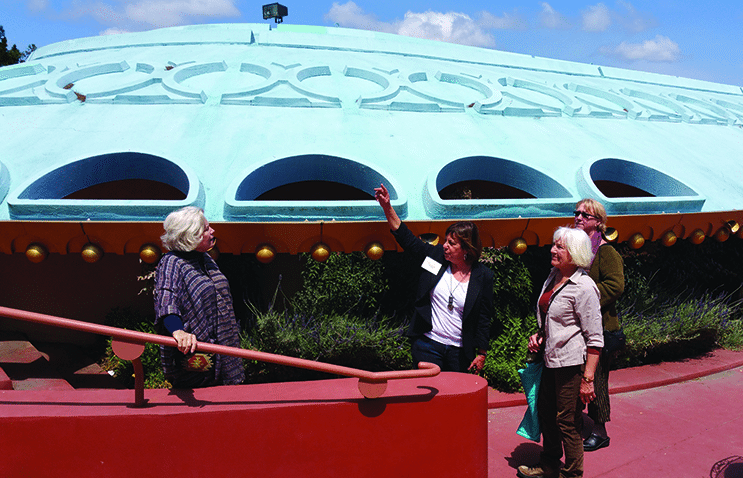
Over the next fast 75 minutes, Kreines leads the group on a fact-filled romp through the sprawling building that Wright envisioned, up and down escalators, in and out of the supervisors’ chambers, all through the insides and part of the outsides of the MCCC. Pausing frequently to point out one detail or another, Kreines is a fountain of tidbits and factoids, dropping names from local history—the “Cracker Barrel Gang,” Vera Schultz, William Fusselman—as deftly as he answers questions about the purpose of the tower jutting up over the center, the materials used to construct the roof and the specific color of paint that adorns the golden orbs decorating various structures throughout the facility.
Kreines, who describes himself as “mostly retired,” is one of many trained docents who lead tours at the MCCC. In a gradually expanding program under the supervision of Libby Garrison, the county’s Department of Cultural Services Marketing and Communications Director, volunteer docents have become the backbone of a program that, depending on the season, can serve hundreds of visitors a month.
According to Garrison, the interest in the MCCC as a unique historical landmark is growing, partly for its connection to Frank Lloyd Wright, and partly for its connection to the futuristic cult movie Gattaca, in which the building was on prominent display—inside, outside and on the sleek, sloping roof where a climactic chase scene took place. A good docent, then, is not just someone willing to devote a day or two every so often to talk to strangers, but someone willing to become slightly obsessed about the building, museum, mountain, coastline, woods, animals, birds, bugs or strange collection of memorabilia they are entrusted with telling visitors about in one way or another.
The word ‘docent’ is borrowed from the Latin word ‘docere,’ which means ‘to teach.’ In parts of Europe, a docent is a member of the teaching staff ranked just below a professor, but in America, the term has widely come to describe any person who acts as a guide or interpreter, usually in a museum, art gallery, zoo or other educational environment. With so many such organizations in the North Bay, there are thousands of opportunities close-at-hand for people like Kreines to serve as docents. These opportunities fit an array of skill sets and comfort levels. Some are purely informational, along the lines of what happens during a tour of the MCCC, the Petaluma Public Wetlands or the Space Station Museum in Novato, while others are more hands-on.
Some docents primarily focus on adult visitors, particularly with historical and art-themed institutions like the Hamilton Field History Museum and the Marin History Museum in Novato, Art Works Downtown in San
Docents like Dennis Conway (left) are trained to pass on information about the history of important places. Photo courtesy of Marin Center.
Rafael and Marin Society of Artists at the Marin Art and Garden Center in Ross. Many times, docent programs in the area put a particular focus on working with schools and children. Novato’s Marin Museum of the American Indian, Santa Rosa’s Laguna de Santa Rosa nature preserve and the (very hands-on) Bay Area Children’s Museum, in Sausalito, are just three of hundreds of institutions offering such docent opportunities in the area.
Whether a potential volunteer is more comfortable indoors or outdoors, or prefers leading tours to getting messy with hands-on activities that include contact with animals, Indian crafts, ocean waves and mechanical gizmos, there is an amazing assortment of volunteer docent programs in the North Bay, from the Golden Gate up to the wilds of Sonoma and beyond.
And the good thing is, most programs are always looking for new docent volunteers eager to learn the ropes.
“Many of our volunteers are retired, many of them were scientists or teachers, but we have all kinds of professional people, many still working,” explains John Petersen, executive director of Audubon Canyon Ranch, a nonprofit that manages and cares for a number of protected nature preserves in the North Bay, and has a thriving program of nearly 800 volunteers—many of them docents. “All of our docents,” Petersen says, “are people who are interested in, and care about conservation and the environment, are curious about nature and the world and want to spend some spare time sharing their knowledge and experience. They are largely responsible for our many school programs, which bring about 3,000 students out to our Marin locations, and if we include our Sonoma programs, out at the Bouverie Preserve, we work with a total of about 6,500 school kids every year.”
Some of the docents first meet students in the classroom, but there’s nothing like getting the kids out into the woods for some face-to-face nature time, and Audubon’s corps of trained docents are the guides who make the experience informative, safe and sometimes, life-changing.
This morning, at the annual meeting of the Martin Griffin Preserve Docent Council, (held at the Martin Griffin Preserve in West Marin), about 50 experienced guides have gathered to make decisions, hear plans for the upcoming year and to spend a little time swapping stories about how being a docent has changed their own lives.
“This group of people is famous for their potlucks,” Gwen Heistand, a resident biologist with the Audubon Canyon Ranch (ACR), and the one who trains the docents, says with a laugh. Sure enough, the table at the back of the room—in an impressive old farmhouse that came with the property when it was acquired by ACR—is quickly filling up with casserole dishes and cheese plates.
“In terms of this particular preserve, in terms of active hiking docents, we have about 80 docents right now,” says Heistand, “but it sometimes can grow up to 140 or so. But the thing that’s really cool is, yes, we have docents who go hiking with the kids, but we also have docents who work with our whole natural history library, or administer the school programs. Those are things that are done by docents who no longer go out hiking with the students.”
The specific training required to become a docent varies wildly from program to program. At ACR, docents must complete 23 weeks of natural history training before being qualified to lead students out on the trail. The training is heavily weighted toward science and the specific ecology, history, flora and fauna of the preserve the docent will be working at.
“During those 23 weeks,” Heistand continues, “people naturally gravitate toward those things that spark their interest and enthusiasm the most. We don’t have a prescribed curriculum when they go out on the trail. The program is designed to work with the strengths of the people that are in the program, and allows them to pass on the things they are most passionate about.”
The next training program begins this September, at the Bouverie Preserve near the town of Sonoma. The next Marin County training begins a year from now.
“A good docent program,” adds Dr. Martin Griffin, “is about teaching education to adults, who, in this case, then pass on what they’ve learned to children. And if the docent is especially good, the kids don’t know they’re learning anything. They just think they’re having a good time!”
Griffin, who founded the Audubon Canyon Ranch in the ’60s as part of a movement to protect the Marin and Sonoma coasts from developers, is a lifelong conservationist and public health activist. Where he stands now is part of a vast heron habitat, which would have been destroyed had the area not been saved and turned into a nature preserve. It’s a story that Martin tells in his book Saving the Marin-Sonoma Coast. Many of the docents in the room today have shared that same story with busloads of children from around the Bay Area.
“These are some of the best docents we’ve ever had,” says Martin, nodding to folks filling up the room. “Some of them have been with us a long time—and every year, they learn more, and then, of course, they have more to share with the children. A good docent isn’t just a good teacher. A good docent is always learning.”
A key requirement for being a docent, it seems, is that willingness to always be learning, and a genuine sense of enthusiasm for whatever nature preserve, historical collection or landmark building they choose to share with visitors.
Which brings us back, full circle, to Ted Kreines, who is pointing out a circle or two at Frank Lloyd Wright’s famous building in San Rafael.
“A lot of people think circles is what this place is all about,” he says, “and if you look around, you’re going to see a lot of circles and globes, and the use of round returns to everything, and that this was part of Frank Lloyd Wright’s intention because circles stand for democracy. I’m not sure that holds, but I do believe Frank Lloyd Wright was very interested in exploring different types of geometric shapes. I’m still doing my own research on that, and maybe I’ll have a stronger opinion at some point in the future.”
The sense of affection Kreines shows for the MCCC is palpable, calling attention to a certain side effect of being a docent that many volunteers don’t expect when they initially decide to donate a day or two a month showing people around their local museum or park. That side effect?
Love.
“Oh, I have been in love with the Civic Center for a while now,” Kreines says with a laugh, as he concludes the tour and takes final questions. “It’s just such a pleasure to be here, and to learn about this place and share what I learn with others.”
Which reminds him of one more important fact.
“A lot of people don’t know this, but the United Nations has named 1,007 places in the world as UNESCO World Heritage sites,” he says with a broad, proud smile, “and only 22 of them are in the United States. So we are very excited to have just learned that we—the Marin County Civic Center—have been nominated to become a World Heritage site, which is a pretty exciting prospect.
“If this happens,” he adds, quickly correcting himself—“when this happens, I should say, we expect to have even more visitors, from all over the world—so we will need more docents, because we plan to be prepared for all those people.”
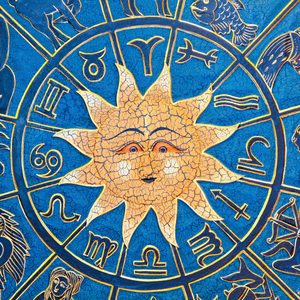
Aries (March 21 – April 19) Gearing up for that big interview, Aries? Your career will be the center of attention on August 25. Spend some time reviewing your résumé and updating your list of references. Spending the extra $1.75 on luxury paper for your CV is worth the change—if you really want the job, that is.
Taurus (April 20 – May 20) Get out there, Taurus! Your house of true love is ready for some attention. The more you mingle, the likelier it is that you’ll run across a potential dearly beloved who hits almost all the marks on your checklist. Leave the judgment at home, plus or minus five days around August 25. Meeting someone at a dive bar isn’t the end of the world—after all, what are you doing there?
Gemini (May 21 – June 20) Stay in, Gemini! Your friends might wonder if you’ve slipped into a deep depression, but just assure them that everybody needs to channel their inner homebody once in awhile. You’ll be turning down party invitations left and right. If you need extra motivation to stay home, it’s kitten season—go get one!
Cancer (June 21 – July 22) Carve out some time for a good ol’ family vacation, Cancer! There’s nothing like renting an RV and traveling across the country with some of your favorite people to fight with—we’re talking parents, cousins, aunts, uncles and kids. No one should be left out of this family bonding trip—pack your bags on August 21.
Leo (July 23 – Aug. 22) Money in the bank, Leo! Your finances are starting to make their way into the clear. Say goodbye to the red—and hello to an extra chunk of change that will land in your bank account around August 25. Don’t jet set to the casinos just yet; the cash will come from a freelance project that you’ve most likely forgotten about, not from a round of Craps or Texas Hold’em.
Virgo (Aug. 23 – Sept. 22) Make a list and check it twice, Virgo! Jupiter meets your sign on August 26, so what does that mean for you? You’ve got all week to write down your personal and professional hopes and desires. Want a new mattress? Write it down. Want a new partner? Jot it down. Whatever you’ve been hankering for is just around the corner celestially.
Libra (Sept. 23 – Oct. 22) Sign on the dotted line, Libra! Whether you’re selling your house, opening a checking account or adopting a pet—you’ve got a commitment to make. Don’t worry—Jupiter is on your side with your signature. Go with your gut and quit worrying about the fine print. You’ve done all the research you can!
Scorpio (Oct. 23 – Nov. 21) Take a risk, Scorpio! Invest in Alphabet—go skydiving—head to the casino! Moral of the story: Listen to whatever your daring heart desires. Spoiler alert: Nothing can go wrong on August 25, so live it up. Feel free to bring along friends for the ride, but keep in mind that this extra dose of luck is pretty much exclusive to Scorpios.
Sagittarius (Nov. 22 – Dec. 21) And the award goes to … Sagittarius! Your hard work has paid off—and the stars heard you whistling while you were working, as did your boss. (More like heard you humming “Uptown Funk” while you were working, but you get the point.) A new position or promotion is headed to your résumé. Wear your best outfit to work on August 24.
Capricorn (Dec. 22 – Jan. 19) Take a break, Capricorn! It’s time for a little vacation. Work has been full of, well, too much work. While the thought of a vacation might sound more like a distant dream—this will not be a mirage you are experiencing on August 25. The countdown begins and so do your endless mimosas.
Aquarius (Jan. 20 – Feb. 18) Did you hire a personal banker, Aquarius? It’s starting to show! Whatever adjustments you’ve made to your budget—leaving the Two Buck Chuck and chocolate bars behind at Trader Joe’s—is paying off. A new sense of fiscal responsibility has overtaken you! Enjoy the ride and your hefty savings account.
Pisces (Feb. 19 – March 20) An emotional breakthrough is headed straight for you, Pisces! We’re talking your significant other here. Think big: Your partner might start doing his or her own laundry and the dishes without any nagging. Could you even imagine?! You can thank Jupiter for that one.
A book that really impressed me as a child was Dr. Seuss’s If I Ran the Zoo.
If I were a Marin County Supervisor, I would work to:
Institute TERM LIMITS;
Institute and adhere to COIN;
Block Pensions for Politicians;
Eliminate the SLUSH FUND;
Establish a ‘Son of 13’: Since we are such a rich county, we take in too much money from residential property taxes without refraining from spending every last cent. I want to give back the annual 2 percent tax hike on Assessed Property Evaluations each year to the taxpayers;
Cut Supervisors’ aides from 10 to 5 and promote the use of INTERNS to do that work;
Cut back the use of CONSULTANTS in favor of using county staff;
Institute a ‘Fire Department Measured Response’: Don’t automatically send out fire engines and fire crews on Paramedic Calls.
I feel that Marin is already ‘built out.’ The carrying capacity of our roads has been exceeded, the same with our bridges. The housing market defines who gets to live here. It may not be fair, but it is the system we went along with and agreed to live by. Race is a red herring. Additional ‘affordable housing’ should come from 2nd units, not Win Cup type hives whose placement along the 101 corridor would be dictated by developers and regional agencies.
Our limited water supply should stop new development dead. One look at 580 should kill any notion of an ‘urban hub’ being developed at San Quentin. We need to fight for a legislative dismantling of the regional agencies and a beneficial disposal of their assets. The French king Philip’s seizure of the Knights Templar treasures and properties when that group became too powerful and threatened the throne comes to mind. Though we probably don’t have to resort to burning them alive at the stake.
Vaccinations have ruined the health of humanity! We were so much better off before we strayed away from time-tested and proven effective medical treatments such as bleeding and the proper use of leeches.
While we should be thrilled a Russian mogul has put up big euros to search for extraterrestrial life, a reality check might be in order. This planet has been alive for a few hundred millions of years, if any observer from afar was to look. Only in the past few thousands of those years has any significant impact been made on this blue rock by its highest evolved life form. In an instant, in a continuum scientists can see evidence of stretching back billions of years into the past. Good luck seeking evidence of life in all that vastness of time and space. And if something was found—would it not be of a spark of life, extinct light-years ago?
Which brings to mind an MTC request, sent out to transit advocates earlier this year, asking what they envision the Bay Area to look like in 2040, when 2 million more humans live here, working at 1.1 million more jobs. Sounds like ruination for a livable environment, as we have known it.
Sure wish some big euros were put towards figuring what might be a population this planet can sustain. A critical dilemma, yet what is being done? How long is this instant of intelligent life on our planet going to last, folks?
by Charlie Swanson
San Francisco songwriter Andy Cabic is the man behind the city’s long-running folk ensemble Vetiver, forming the band in 2002. Over the course of five albums, Cabic took Vetiver from psychedelic freak rock roots to dusty folk melodies to ambient soundscapes. This year, with the band’s sixth LP, Complete Strangers, Vetiver is switching it up again.
Vetiver shows...
For more trivia questions (and answers!) see Howard Rachelson’s Trivia Café every week in the Pacific Sun.
Answer: Dirty Dancing, Ghost and To Wong Foo, Thanks for Everything, Julie Newmar (photo shown)
By Molly Oleson
“It happened like lightning.” That’s how Rita Abrams, former kindergarten teacher at the Strawberry Point School, describes how the little song that she wrote in 1969 about Mill Valley—“a place that’s got a hold on me”—became the tune that “captivated so many people … all around the country and all around the world.”
As the story goes, in...
This week in the Pacific Sun, you'll find our cover story, by David Templeton, about docents being entrusted with sharing the history of North Bay landmarks. Tom Gogola reports on the parking snafu around the Tomales Bay Oyster Company, and Molly Oleson writes about the 45th anniversary of the 'Mill Valley Song.' Charles Brousse reviews MSC's production of 'Don Quixote,'...
by David Templeton
“This, ladies and gentlemen, is what the courthouse used to look like.”
An assemblage of nine people—some local, a few from “out of town”—all lean together toward an aged photograph of a big stone building, the former Marin County courthouse, which once towered over downtown San Rafael. On a slowly warming Wednesday in May, as a fog-filtered light...
by Leona Moon
Aries (March 21 - April 19) Gearing up for that big interview, Aries? Your career will be the center of attention on August 25. Spend some time reviewing your résumé and updating your list of references. Spending the extra $1.75 on luxury paper for your CV is worth the change—if you really want the job, that is.
Taurus...
If I ran the zoo
A book that really impressed me as a child was Dr. Seuss's If I Ran the Zoo.
If I were a Marin County Supervisor, I would work to:
Institute TERM LIMITS;
Institute and adhere to COIN;
Block Pensions for Politicians;
Eliminate the SLUSH FUND;
Establish a 'Son of 13': Since we are such a rich...
Better off
Vaccinations have ruined the health of humanity! We were so much better off before we strayed away from time-tested and proven effective medical treatments such as bleeding and the proper use of leeches.
—D. Schultz
Reality check
While we should be thrilled a Russian mogul has put up big euros to search for extraterrestrial life, a reality check might be in order. This planet has been alive for a few hundred millions of years, if any observer from afar was to look. Only in the past few thousands of those years has any significant impact...