To cry or not to cry? That is the question we’re asking. More specifically, is there crying in baseball? We’re on the fence and seek your input to identify the Hero and the Zero in this tale about America’s favorite pastime. First up is New York Mets shortstop Wilmer Flores. He wept during a recent game when he heard that he was being traded, and his tears made headlines around the country. San Rafael resident Bethany Ojalvo applauds the player for his willingness to “be real and show his feelings.” In fact, Ojalvo believes that he’s a Hero and a model for our next generation of men. Batting second is the San Rafael Pacifics baseball club. Along with Prandi Property Management, the Pacifics gave away T-shirts to the first 250 fans at a recent game. Fun, right? Well, we’re not sure, because the free tees were emblazoned with the message, “No Crying in Baseball.” Mike Shapiro, President and General Manager of the Pacifics, says that they were honoring the classic line from the 1992 film A League of Their Own, and they weren’t taking it too seriously. Ojalvo didn’t find it amusing. “Kids take these simple messages seriously and I think it’s the last thing young boys need to hear,” she says. Do you see our dilemma here? Is Flores a Hero for showing his emotions in public? Should we call out the Pacifics for not being more thoughtful? Send us your comments and together we’ll find out who wins.
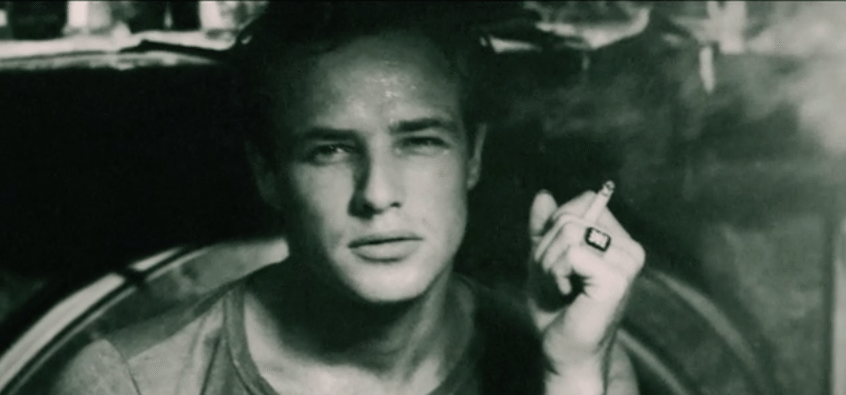
Marlon Brando once said, “An actor’s a guy who, if you ain’t talking about him, ain’t listening.”
Compiled from a basket of cassette tapes Brando made as personal therapy, Stevan Riley’s Listen to Me Marlon gives us the night thoughts of the greatest American actor of the 20th century. The visuals are a combination of news footage, interviews and impressionist camera views of the Southern California compound where Brando hid from the world. Also supplementing the narration is an early 3-D animated sampling of Brando’s head as he speaks, a leftover from some digital experiment made years ago.
Brando had a battering father and a sensitive mother who was, he claims, the town drunk. His own children’s lives were colored with tragedy. One son, Christian, killed the boyfriend of his half-sister, who later hanged herself. Brando’s contempt for the demands of his profession added to his strain—he hated being thought of as a “mechanical doll.”
The deadly paternal rumble of Don Corleone in The Godfather or the slurred, psychedelic muttering of Colonel Kurtz in Apocalypse Now were Brando’s strange gifts to the world. He brought an utterly masculine attack to Last Tango in Paris, and feline, mincing diction to Mutiny on the Bounty and Superman. In odd parts, he’d sweeten up this feminine side, just to shock the machos.
As he tells it to himself, Brando’s success seems a blur, compared to places that seemed real to him, such as the American West and Tahiti. Brando was a vessel for elements so corrosive (gangster, mutineer, street tough, pervert) that it’s not surprising that there was some cracking.
We still have Brando’s influence to thank for how fine screen acting is today. To be an actor, you don’t have to be well-born or well-read; it’s the gift for observation and intuition and fearlessness that matter. What Brando had, and what young actors are still trying to grasp, was both aloofness and need.
‘Listen to Me Marlon’ is playing at the Christopher B. Smith Rafael Film Center, 1118 Fourth St., San Rafael; 415/454-5813.
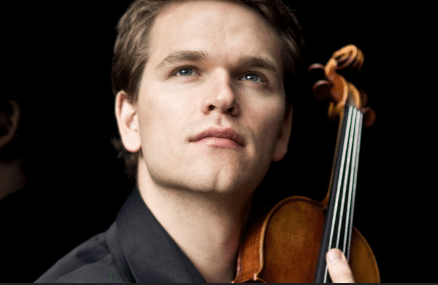
Jazz and classical music might seem like a strange combination to some, but if you listen to it, the result is quite provocative. And Mads Tolling, a classically trained violinist who has earned international recognition for his work as a jazz/classical/rock fusion performer, is currently at the forefront of this innovative and ever-expanding genre.
“I think in classical and jazz, as opposed to a lot of other styles, you are really taking the instrument and playing it to the extreme—as far as what’s possible technically,” Tolling, 35, says by phone. “Certainly there is very much of a different aesthetic when it comes to the written note—in jazz you are supposed to mess with that and in classical the written note is kind of gospel and you don’t mess with it—so in that way they are different, but I think that’s kind of the fascination between the two sides.”
Tolling, who moved from his native Denmark to study at Boston’s Berklee College of Music, began playing violin at age 6; after hearing Miles Davis at 15, he was hooked on jazz. Listening to jazz violinists like Stéphane Grappelli and Svend Asmussen inspired Tolling’s direction, and he grabbed the attention of jazz violinist Jean-Luc Ponty.
Tolling has since worked and recorded with an impressive roster of jazz musicians, including the groundbreaking jazz fusion group Turtle Island Quartet, which earned two Grammy Awards in ’06 and ’08 for Best Classical Crossover album.
These days, Tolling performs with his own group—The Mads Tolling Quartet—and with another version of it, the Mads Men, which puts a new spin on ’60s TV show and movie theme songs. “It was a great period of time in music history when everything changed—music kind of became art and it moved to another place,” Tolling says of the Mad Men era.
The musician, who says that many people have a hard time connecting with jazz, feels that crossover music can help them understand it better.
“[Jazz is] a bit too cerebral for them and it’s a little bit intimidating, too, because they don’t understand what’s going on, and I think some of these tunes provide the right kind of vehicle for an exchange to go on with the audience that would otherwise be a little tougher to have.”
The Mads Tolling Quartet performs Friday, August 14 at the Marin Country Mart’s Friday Night Jazz Concerts; 2257 Larkspur Landing Circle, Larkspur; 6-9pm; free. For more information, call 415/461-5700, or visit marincountrymart.com/calendar.
Whispered just loud enough to be heard over the end-credit music now blaring merrily from the vicinity of the movie theater screen, my 20-something son Andy succinctly puts his indelible stamp of approval on Paper Towns, the latest film adaptation of a book by Young Adult (YA) novelist John Green. The movie, an enjoyably offbeat love story, of sorts, involves a nerdy high school senior named Quentin (Nat Wolff), who hits the road with a robust van-full of friends, to follow clues possibly left behind by the hero’s mysterious love object, Margo (Cara Delevingne), who might not actually have intended Quentin to pursue her when she suddenly dropped out of school and skipped town.
The film was good. Very good, actually.
Personally, I have observed that YA novels are yielding some of the best and freshest literature of the current age. Furthermore, the movies made from these books (everything from Suzanne Collins’ The Hunger Games to last year’s The Fault in Our Stars, also by John Green) are often, but not always, filled with impressively accurate depictions of teenagers, be they young cancer survivors in love, hormonal combatants in a futuristic gladiator spectacle, or a poor geeky guy in love with a girl who may or may not be the love of his life but who has awesome eyebrows.
Andy agrees.
Not about the eyebrows, a subject on which he expressed no opinion. But he does agree that YA novels often make the best movies. Actually, Andy’s views do not figure into this column beyond his original statement, which handed me a great opening line with which to launch a series of my own personal thoughts on the allure of “teen road movies,” which, come to think of it, there actually aren’t very many.
Beyond Paper Towns, I can think of only two others—The Sure Thing, a 1985 comedy starring John Cusack, and the 1979 Diane Lane debut A Little Romance. Like Paper Towns, The Sure Thing follows a teenager driving cross-country in a quest for a girl, though in the Cusack film, he just wants to get laid. In Paper Towns, the quest is all about true love, and the lengths to which our hero goes to find it, with the help of some charmingly faithful friends who are eager to help their lovesick buddy win the heart of the mysterious runaway with a penchant for leaving cryptic clues.
In A Little Romance, two 13-year-olds in Paris—one American, the other French—travel by car, train and gondola in order to kiss beneath the Bridge of Sighs in Venice, believing local legends saying that any two people who kiss under the bridge at sunset will love each other forever.
I haven’t thought of that movie in years, but I remember the first time I saw it because I saw it with a girl named Pinky.
More on her later.
In these films, the protagonist is often inspired by fictional stories of romance and adventure, inspired to their quest for love because … well, that’s what fictional guys do. Since seeing Paper Towns with Andy—a somewhat hilarious father-son bonding experience, given that the theater was otherwise packed with females, most of them teens, and only one other male, who appeared to be a on first date—I have been thinking about the films that inspired my own beliefs about love and life, back when I was a senior in high school.
One such film was American Graffiti—which might qualify as a road movie, given that so much of it takes place in cars—a movie about the early ’60s that was released in the early ’70s, but managed to capture the strange blend of innocence and cynicism that teens often feel when hovering on the precipice of adulthood.
Like the heroes of the aforementioned films, Richard Dreyfuss’ Curt is on a quest to find a particular girl, the elusive Blonde in the White T-Bird. After spying her driving down the street one long night, frustrated with the choices his life seems to be offering him, Curt falls instantly in love, convinced that the girl in the T-Bird holds the answers he’s found nowhere else.
I see a pattern here.
SPOILER ALERT! In all of the films mentioned above, the nerdy guy never actually ends up with the girl. Or not for long, anyway. In most of those films, the most the hero gets is one kiss; then it’s goodbye, sorry, you’re not my type—but in a good way. And in American Graffiti, Curt never manages to do more than talk to the Blonde in the White T-Bird for two minutes on a pay phone.
I identified with Curt, having become similarly smitten with the aforementioned Pinky. She drove a Toyota, not a T-Bird. We lived in a Los Angeles suburb, not Modesto. My clumsy but highly creative pursuit of her was assisted, just like in Paper Towns, by a band of friends with nothing else to do. In high YA fashion, they helped me send Pinky on a Lord of the Rings-style treasure hunt that concluded with me rescuing her, knight-in-shining-armor-style, from a band of sword-fighting orcs and Ringwraiths.
Talk about being inspired by fiction.
That story, for what it’s worth, was the basis of my 2012 play Pinky, which I have recently learned is set to be staged in Marin County in the fall of 2016.
But where was I? Oh, right. Fiction. The thing is, as a one-time teen myself, I can see that my ideas of the world were partially derived from whatever I saw in front of me—and I saw a whole lot of movies. In half of them, true love always wins out. In the others, love crashes and burns in a flaming ball of teenage angst and bad timing.
Like in Zeffirelli’s 1968 Romeo and Juliet.
I saw that one at a drive-in movie when I was 8.
From Romeo and Juliet I learned that Olivia Hussey was the most beautiful girl in the world, and that love, even when it crashes and burns, is more or less worth the trouble—because it’s love.
Which, more-or-less, is what Quentin and his friends finally learn in Paper Towns, even if the happy ending they eventually arrive at requires a somewhat different definition of “happy” than the one they all learned at the movies.
Cowgirl Creamery doesn’t really need an introduction. The Petaluma-based staple already has solid representation in San Francisco’s Ferry Building Marketplace, and weekend getaway routes are unimaginable without a decadent stop at the Point Reyes Station shop and creamery in Tomales Bay Foods. As of June 27 and until November 7, cheese-buying tourists and supportive locals can spend more than a few minutes at the busy Marin location, thanks to a new, Saturdays-only breakfast menu. Cheese is a central breakfast ingredient, so this makes perfect sense.
On a typical cloudy Point Reyes Station morning, this felt like an exciting addition to the creamery’s Cowgirl Cantina, which now opens an hour earlier on Saturday, at 9am sharp. An hour into the service, the kitchen was already running out of items—it certainly hit the right spot with the sleepy weekenders. The reason for the limited-edition appeal is the active months of the weekend Point Reyes Station Farmers’ Market—the Creamery clearly wants to support the buzz and the movement around the organic happenings.
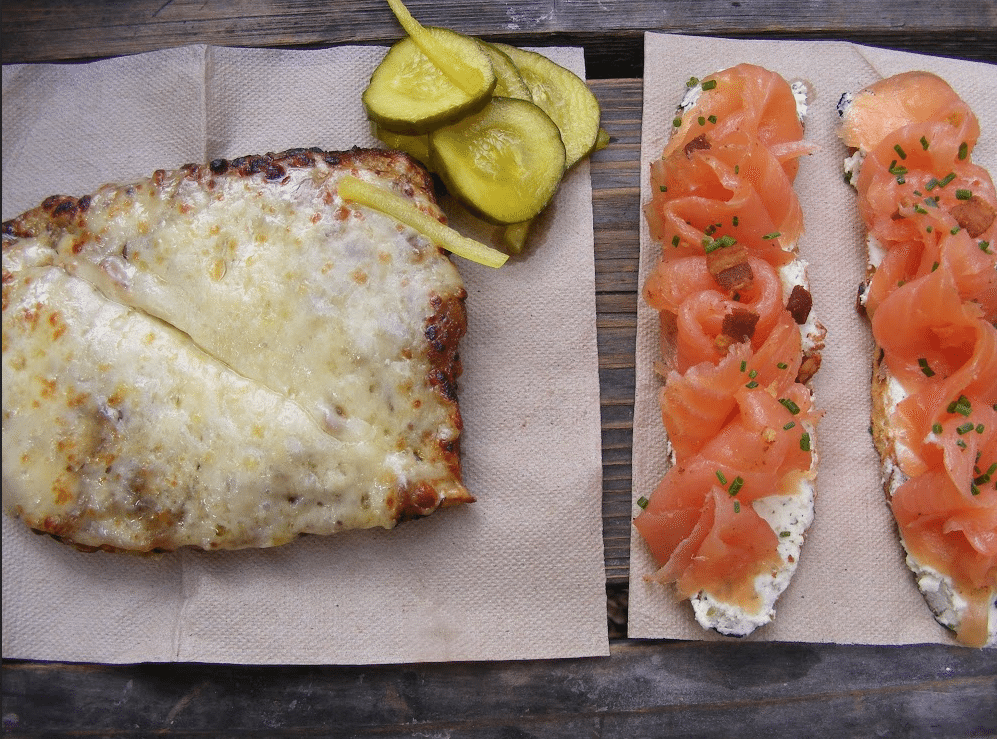
The menu is short and sweet—or rather savory—and all items are made with Cowgirl’s excellent cheeses. Skipping the heavier Eggs and Grits and the banal Granola Yogurt duo, we started with a cold snack: Smoked Salmon Bite with Cowgirl Fromage Blanc ($7.95). The two ‘bites’ turned out to be crispy, buttery toast points, covered with small mountains of tangy, soft creamy cheese and topped with bits of cured salmon. If the IKEA salmon bagel underwent a Northern California gourmet upgrade, this would be it—a classic, elegant morning treat.
We also managed to order the very last Baked Egg Sandwich with Sautéed Mushrooms, Gruyere and Herbs ($7.25, which was another upscale take on a well-known combo). The creamery’s Gruyere is smoky and nuanced, and the mingling with mushrooms and thyme only flattered its deep flavor, resulting in a comforting, almost sweet ciabatta heaven. As for the egg, it wasn’t as wet as I normally like it, but I’m sure runny-egg-haters will be very pleased.
The best of the lot was a sleeper item, humbly hiding under a golden crust of melted cheese. The menu read, ‘Cheese toasties: open-faced grilled cheese with Cabot Cheddar, Caramelized Onions and Maple Mustard ($7.95).’ One bite and we were hopelessly hooked—the gooey, rich onion and the sharp cheddar are a perfect match, and the spicy mustard gave the whole thing an unexpected, exotic twist. It was utterly delicious, and, thanks to the reasonable size, there was no food coma ahead.
The delicate, scented Lavender Crème Fraîche Scone ($3.95) was packed to go, and later eaten, with great pleasure, on the highway. Unlike occasional fellow scones, it didn’t crumble to make a mess and had a soft, cookie-like texture. It wasn’t too sweet either, and I can easily imagine it in a pairing with rich Brie or some kind of blue cheese.
In this cheesy joy, only one thing was missing—plates. The breakfast items, for some reason, were packed in recyclable carton to-go boxes, and although we ate on the patio, a slightly less picnic-like setting could be nice. Sure, the Creamery people are used to hordes of folks buying their goods to nibble on later, but the breakfast is worth lingering.
Learn more about Cowgirl Creamery at cowgirlcreamery.com.
Solar-power adopters are at the cutting edge of climate-change activism on the home front. In Sonoma County, they’re gaining in numbers, and now homeowners have a new (if costly) opportunity to maximize their clean-energy investment, with the Tesla Powerwall battery.
The Palo Alto–based electric-vehicle giant unveiled the Powerpack for commercial use and the Powerwall for residential consumers earlier this year, and the pre-orders immediately flowed in. The batteries store excess energy generated from rooftop solar; the power they store, Tesla claims, can be used to keep the lights on during a power outage and to regulate energy that flows back into the grid.
The residential version of the Powerwall has dominated renewable-energy news, especially in electric-vehicle circles (EVs are even cleaner—and more economical—when powered with your own solar energy). The hip prestige of the Tesla name, the sleek design and hint of independence from the grid all work together to make the Powerwall look sexy and utilitarian. It all sounds great, but is it what you need in a battery?
Not necessarily, says Joseph Marino, who owns the solar-battery business DC Power Systems in Healdsburg. Reliability is the more important issue when it comes to batteries, says Marino, who adds that the standard “forklift”-type batteries that dominate the market still fit the bill. Those batteries are also 100 percent recyclable, whereas lithium-battery recycling is still in its infancy; the Powerwall uses lithium batteries. Yet some kind of battery is the only solution for storage until there’s a greener way found to conserve excess energy generated by solar panels and get it to market.
Sonoma County gets greener by the day, and, indeed, the county was one of 16 communities recognized last December by the White House for its climate-protection leadership. That’s in no small measure due to the creation of Sonoma Clean Power, a big step for the county as it heads in the direction of a power marketplace dominated by clean energy, some of it locally sourced. The utility puts an emphasis on solar power as part of an evolving energy mix that also includes geothermal power produced locally.
The problem, says Sonoma Clean Power CEO Geof Syphers, is that “solar and wind do not make energy around the clock. These new technologies offer part of the answer. Battery storage combined with interruptible electric-vehicle charging will be necessary as we scale up our use of renewables.”
Sebastopol resident Alan Soule agrees. He has a rooftop solar system and owns two Tesla electric vehicles. “It just makes sense to put in solar when you have an electric vehicle, so you can make your own fuel,” says Soule. He pre-ordered a 10 kilowatt-hour (kWh) Powerwall when Tesla announced the new product. “It’s worth it to be able to use energy if the grid goes down.”
The Powerwall takes up less space and looks sexier than standard batteries, but it also costs four times as much as most batteries now in use. The Tesla
7 kWh Powerwall runs $3,000; the 10 kWh version is $3,500. That does not include the installation or cost of the hybrid inverter needed to use the battery on a grid-tied solar-energy system. (Most solar users are tied in to the PG&E grid.)
Whether the battery will justify its cost for the occasional outage is another matter. During a June shareholders meeting, Tesla CEO Elon Musk admitted that the emergency-storage benefit for grid-tied solar customers would only appeal to a small number of residents. For the most part, it’s cheaper (if less eco-conscious) to use a gas generator for infrequent outages.
But can the Powerwall help off-grid solar-power users “save for a rainy day?” That depends. In order to be independent of the grid without experiencing power interruptions, a household must overproduce energy and store it for nighttime use and overcast days.
That could be problematic, depending on the size of a resident’s solar-power system and the duration of a stretch of gray days, when not much energy is being created or stored. There’s no point in having battery capacity to store energy if you can’t produce the energy in the first place.
Soule, in the meantime, has his eye on so-called micro-grids, which is a way for Sonoma County solar-power users to leverage solar-wrought savings across the community. Micro-grids are small co-ops in which residential solar-power users in a neighborhood feed excess power to a central switch, which the residents control.
Micro-grids may or may not be coming to a progressive community near you. In the meantime, solar-powered citizens don’t necessarily have to run out and buy a Tesla Powerwall. It has the Tesla name and it looks cool, but many in the renewable-energy industry are saying that, while Musk is a great marketer and packager, he didn’t necessarily build a better mousetrap with this product.
Q: My new boyfriend travels a lot for work. Before he left on this trip, he gave me his weird onesie lounging garment. It’s this disturbing “As Seen On TV” thing called a Forever Lazy. It’s like a fleece blanket, but with legs, a hood and a … um … back flap for easy bathroom access. I was hesitant about taking it, but he said, “Take it! It’s so comfy! It’s the bomb!” Of course, I don’t wear this weird thing, but it smells just like him. I’ve found myself cuddling up with it and sniffing it. Like, a lot. And it’s not just about missing him; it’s about the smell. I feel like a serial killer! What is wrong with me?!—I’m Weird
A: Welcome to the decline of civilization playing out in a single garment. If a grown man who wears one of these things says something like, “Let me slip into something more comfortable,” you’ve got to think, “What, the womb?”
What seems weird to me is that you’re able to have sex with a man who wears a giant romper. What doesn’t seem weird is your sniffing Mr. Baby’s onesie. This suggests that you two might be a pretty good match, at least genetically—which isn’t to say your genes and his have lots in common. Studies by Swiss biologist Claus Wedekind and others have found that women seem to prefer the body odor of men whose genes aredissimilarto theirs. Which sounds so hot: “Hey, baby, I love how genetically dissimilar you smell in the morning.”
It’s a set of immune system genes that matter. They’re called the Major Histocompatibility Complex, or MHC. “Histocompatibility” is a mouthful, yes, but it’s really just the Greek word for tissue—“histo”—bumming a ride on “compatibility.” Molecules of MHC are basically immune system security guards that sound the alarm on incompatible stuff in our bodies—icky infectious microorganisms that don’t belong in our “tissue” (really, our cells). If you and a genetically similar man have kids, your combined MHC genes will only be able to recognize a very similar, limited set of trespassers. But with a genetically dissimilar man, the immune systems of any kids you have will have a much larger force of security guards, able to recognize a much broader group of icky invaders.
Regarding your onesie sniffing, the most interesting, relevant finding on MHC is by experimental psychologist Christine Garver-Apgar and evolutionary psychologist Steven Gangestad. Instead of just testing individuals as previous studies did, they tested couples. They found that as the proportion of MHC genes that couples shared increased, women were less turned on by their partner, cheated with more men, and were more attracted to men other than their partner, especially during their most fertile time of the month.
In other words, it’s a very good thing that you’re into how this guy smells—so much so that you can overlook the fact that he’s a grown man who wears a onesie made from some fabric cousin of the airline blanket. Here’s to your living fleecily ever after with your new man. But should this not work out, remember that smell is important, and look for a man who also smells good to you—maybe even one who isn’t afraid of hard work, like the agonizing chore of pulling on both sweatpants and a sweatshirt.
Q: I’m an in-shape, intelligent, funny 35-year-old guy with a good job. I went on a date with a beautiful woman. We had a terrific time—wonderful conversation over a nice dinner. When I asked her out again, she said she thinks I am a “super-nice guy” but she just wasn’t feeling the “chemistry.” Well, it was only one date. Can chemistry grow? I’d like to see her again. I’m convinced I could sweep her off her feet if given the chance.—Ambitious
A: You didn’t get the job. Picketing the office isn’t going to change that.
Not feeling the “chemistry” is polite code for, “I’m not physically attracted to you” (or, in really dire cases, “I’d chew through rope to avoid having sex with you.”) Unfortunately, there’s no sweeping a woman off her lack of chemistry with you, though you might sweep a lesser woman off her integrity by inviting her out for a slew of free dinners. Over time, you might even charm the woman into loving you—kind of like she loves her grandma. But keep in mind that biological anthropologist Helen Fisher and other researchers find that physical attraction comes out of a person’s look, smell and manner. In other words, persisting when a woman lets you know she isn’t attracted to you is ultimately a big ol’ losing proposition. (You can try harder, but you can’t, say, try taller.)
Worship the goddess–or sacrifice her at the altar at ad*******@*ol.com.
Some artists’ work is immediately recognizable—“That must be a Picasso” or, “That’s Dali,” or “Look—a Banksy.”
Marin woodcut artist Tom Killion would reject such comparisons with a self-deprecating laugh, but for many, he is one such artist—you know a Killion when you see it. And with a big and beautiful new book out showcasing much of his best work, we can now see a lot more.
Killion grew up in Mill Valley. He “never took any art classes” and is largely self-taught. His earliest woodcuts date from the ’60s, when he was a teenager making holiday cards for his family or working on similar projects. After much education and world travel, he settled in Inverness, where his woodblock printmaking studio is a productive source of the many colorful prints that have graced numerous books and countless walls and exhibits.
In not much more than the past decade, he has become especially renowned for a trilogy of large coffee table books that he has produced with iconic and Pulitzer Prize-winning poet Gary Snyder, melding his art, Snyder’s poetry and essays to portray certain regions in a graphic and literary manner never accomplished before. Killion first collaborated with Snyder on their book The High Sierra of California in 2002; in 2009, they produced Tamalpais Walking: Poetry, History, and Prints.
The third such collaborative work might well be the best yet. California’s Wild Edge: The Coast in Poetry, Prints, and History is, like the previous two, first a showcase for Killion’s striking, colorful and interpretive pieces, produced over four decades and portraying beautiful locales along the vast California coast. It also contains Gary Snyder’s poetic prose, always welcome in any form to a wide readership, and carefully selected work from a stellar roster of California poets both living and gone, including Robinson Jeffers and Marin’s Joanne Kyger, Robert Hass and Jane Hirshfield, among other departed poetic local legends such as Kenneth Rexroth, Lew Welch and Jack Kerouac. The work of J. Smeaton Chase and Jaime de Angelo—wonderful if underexposed California writers—is also spotlighted. Chase rode his horse all the way up the coast more than a century ago, and de Angelo, a doctor and anthropologist who settled in Big Sur, wrote wonderful poetry inspired by deep Native American contacts.
But especially prominent in this book is the re-emergence in print of Killion’s original vocation as historian, in the form of a detailed yet sweeping history of the discovery of the coast by Spanish explorers, the oral traditions of Native American coastal dwellers and much more. It’s an illuminating, user-friendly narrative that even those who think they know coastal history will learn from, and that anyone can easily enjoy along with the images and poems.
Gary Snyder, 85, is a longtime California history buff as well, as his revered poetry has long evidenced. He’s spent a lot of time on the coast, too, from his early days in the 1950s Bay Area to now, even though he has long lived in the Sierra foothills. At a recent, large and sold-out dinner event in Point Reyes Station to “launch” this new book, he reflected not only on his own lifetime of loving the coast, but went much further back—and forward—in time.
“We actually live on the eastern edge of the Pacific Ocean,” Snyder noted. “The western coast of the United States is physically inhospitable compared to many others—it’s not surprising that it has taken so long for a real poetic consciousness to take hold there. It’s foggy and windy and chilly much of the time. Tom really knows what it took for early ships to find a decent place to berth—many of them sailed right by the Golden Gate in the fog. And in fact we are still learning our way around this part of the world. Human culture here is still fairly new, only 500-600 years old. There’s also no doubt that Chinese and Japanese fishing boats made it over here before the Westerners, and many probably never made it back. Our poems in this new book are really still the beginning—I’d like to see what they will be writing in 1,000 years.”
Snyder, born in San Francisco and a Mill Valley resident in the 1950s and 1960s, also recalls his own early forays to the Marin coast—”When I was living in Berkeley in the 1950s, I found that I could ride my bike to Richmond, put myself on the old ferry to Marin, and ride up and over Mount Tamalpais. When I was teaching grad students, drinking in a bar at night afterwards, I would sometimes say, ‘Let’s go out to Point Reyes!’ I needed a ride, you know. And usually somebody would go for it and we’d end up getting into the cold water, and then around a fire on the beach, as often as I could. And luckily I survived.” And in the new book, he adds, “One of the things that baffles me a bit, is how was it I decided way back then that it was OK to go naked on a beach, even when there were other people there fully clothed that I didn’t even know?”
A longtime homesteading resident of the Sierra foothills and poet of nature, Snyder has done very few collaborative books or other projects. But Killion’s woodblocks immediately won him over. “I had first met Tom in the 1960s I think, and he had given me a gift of his early book 28 Views of Mount Tamalpais,” Snyder
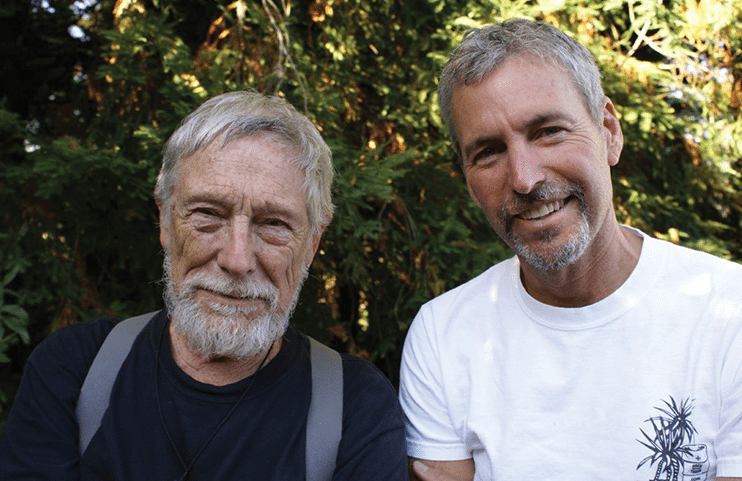
Gary Snyder (left) and Tom Killion have collaborated on three books together. In June, they spoke to a sold-out crowd in Point Reyes Station. Photo by Katsunori Yamazato
says. “He’d become a passionate print artist fairly early on. After some years he got hold of me to do a book on the high Sierra, which was a wonderful project. And we’ve kept at it.” When reminded of his own status as a literary icon—a poetic signpost to countless readers, first immortalized—very inaccurately, he insists—in Jack Kerouac’s The Dharma Bums, he shrugs, demurs and says of working with Killion, “Really, the honor is all mine.”
This trilogy of landmark books are published by Berkeley’s Heyday Books, a longtime nonprofit printer of works focused on anything to do with California. Founder Malcolm Margolin is a hero to many western writers and readers, and is himself a longtime fan of both Killion and Snyder. “When I first met Tom, he brought with him what might very well have been the most beautiful book I’ve ever seen, his hand-printed, luxurious edition of High Sierra of California,” Margolin recalls. “It was a limited edition—something on the order of 100 or so copies—printed on paper so sensuous I couldn’t stop myself from running my hand over it and turning the pages for the joy of feeling these heavy pages settle into one another. These pages were interleafed with translucent rice paper that had patterns embedded in them. The printing, the binding, the size: It was stunning. He wanted to know if Heyday would do a trade edition. This may have been the most terrifying moment in my 40 years of publishing. He had brought us something of great, even transcendent beauty, and we were going to make it uglier.”
Obviously Margolin and Heyday did not make the book “uglier.” Margolin explains why: “I’m struck by the huge amount of time that goes into any one of Tom’s fully-rendered, multi-colored woodblock compositions—as much as 300 hours of what seems to me to be the most exacting, even tedious work imaginable. The miracle of these compositions is that the result of these efforts, rather than anything that looks overworked, are depictions of a world utterly alive, as fresh and vibrant as the earth on the first day of creation. He could have cut corners and gotten away with a lot less. His generosity of spirit is reflected in his rejoicing in the beauty and abundance of the world and his appreciation of the work of other artists. He brings out the best in everything and everyone he touches.”
The artist himself, long a West Marin resident with his family, is an engaging and youthful man who does not seem to seek the limelight but who, once he gets going, becomes eager to share his thoughts and work. He says that his new book is an attempt to “find the song of the California coast.”
Steve Heilig: Is this new book a new version of your early one, 1979’s ‘The Coast of California’?
Tom Killion: Well, yes and no. It has a lot of the pictures from that book but many, many more done since then. That book started as a hand-printed book with just a few images and my own poetry. It went through more editions and each time got a little more colorful with new prints. And then this time, after doing the first couple of books with Gary Snyder for Heyday books, Malcolm Margolin there said, “Let’s do another; what do you think you could put together in just a couple of years?” And I thought about it and told him I’d like to do another version of my coast book. And he just kind of mumbled into his beard about the poetry—and I don’t feel too good about that poetry either; it was, you know, kind of adolescent. So I said I knew Gary had some good stuff about the coast, and that I’d like to include some Robinson Jeffers and some other coastal poets.
Did you pick the poets and poems or have help?
Well, once we agreed this could be a good project, Malcolm sent out a query to all his literary friends about who they might pick for the best California coastal poetry. And they all came back saying Robinson Jeffers is the man. So I kinda concentrated on Jeffers, and went up to Gary’s place in the summers of 2013 and 2014, just sitting out under the ramada in the heat with him, just talking about this poetry. I learned so much from that and got ideas for poems to include, so while Gary himself doesn’t feature as prominently in this book as the previous two, he is still a big presence in it. And I worked on new prints specifically for this book over the past couple years, and I think some of those came out really nice—‘Muir Beach,’ ‘Tennessee Cove,’ and some little ones of areas I hadn’t explored that much before. This is probably the last one of this series, although I am going to work on a “treescapes of California” book for the next 10 years, and Gary of course has many poems about trees—his early book Myths and Texts, for just one example, is full of them.
And your own text in this new book, rather than adolescent poetry, is very different—you exhumed your inner historian for a full historical survey.
Yeah, that’s one of my other hats I used to wear—I was a history professor, focused on African history, but I did other work, too. At SF State I taught in the late 1990s classes on California and San Francisco history and culture. And I got some of my ideas about poems from teaching, and went off on two particular tangents that are in this book—Jaime de Angulo and J. Smeaton Chase, as well as the original journals of Juan Crespi, which were just translated and published in the early 2000s. Everybody knew about the Portola expedition through the rewritten and redacted older versions, with lots of interesting stuff cut out, such as their first encounters with coastal Native Americans.
This is the third volume in your series with Gary Snyder. How did you first wind up meeting and working with him?
Like many people of my generation, he was a hero of my teenage years. And I got to know him through some mutual friends in Mill Valley, and was first able to visit him in the Sierras when I was 21, and brought my first, handmade book along. I wanted his sage wisdom about his take on a big walkabout journey around the world I was planning. He just said, “Take along plenty of Kaopectate”—an old remedy for diarrhea!
Good advice. So, you grew up in Mill Valley, and went to UC Santa Cruz and were on the path to becoming a certified historian, but then got diverted into becoming an artist.
Yes, I did. After Santa Cruz I went to Stanford for a Ph.D. in African History—on a full financial ride, I like to say, as Stanford sounds hoity-toity but they actually paid me to do it. Then I went off and worked for a couple years in Africa in a refugee camp, and got very interested in Eritrean history, and wound up going with the Eritrean rebels and was with them when they won the big battle that got them independence from Ethiopia. After all that I got a teaching job back east at Bowdoin College, and then a Fulbright Fellowship to go back and teach in Eritrea for a year. By then I was married with a 1-year-old son, and we wanted to come back to California and I got a part-time lecturing job at SF State and started to do more art. Then Gary and I started in on the High Sierra book project in the mid-1990s and I had to get really serious, and this turned into a wonderful hand-printed folio book at first. That led to Malcolm Margolin getting interested in it and wanting to publish it.
The color prints you do seem very labor-intensive. What goes into them?
The big multi-colored prints can take upwards of 300 hours. The majority of that time is spent carving the wood block. I do a sketch out in the field, and then carve the first or key block, which becomes almost like a template as it has all the detail of the sketch, and the outline of where the different colors are going to go. I print that block onto acetate and use that to reverse the image onto as many color blocks as I’m going to need—sometimes I do as many as 15 or 20 different colors for one of these prints. I don’t have to have that many blocks though as I can print one block a lighter color, and then a darker color, carving away each time
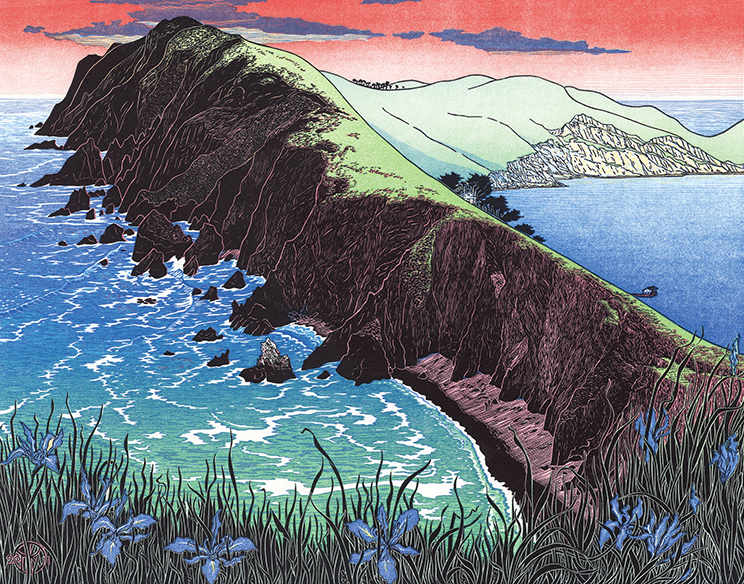
‘Coast Camp,’ by Tom Killion, is the artist’s latest print, and just one of countless works of his native Marin.
so that the blocks get destroyed in the process. Each block reduction print takes a whole day of printing, so as many colors as there are in the print means it takes that many days of printing. So I can end up spending three or four months on a big—color print. Actually one of the most elaborate prints I ever did is the opening diptych or two-page spread of this new book, called ‘Carmel Bay.’ It’s sort of a view from Robinson Jeffers’ Tor House as it might have been in 1915 when he was first starting to build his stone tower on Carmel Point, facing Point Lobos. It has 32 layers of colors and took me much of 2014 to do that one, along with writing the text.
Can you estimate how many images you’ve done?
In my life? You know, I’ve never added it up. I used to say 500, but it’s certainly 600 by now, including my smaller jobs.
The older, black-and-white ones must have taken much less time, right?
Oh yeah, but the funny thing is, when I was first starting, as a teenager, they could take longer, as I was much slower at carving. I wouldn’t want to have tackled these big multi-color ones until I was quite fast at it. I did it the right way, by chance.
Some of your prints are so detailed—you start with a sketch but do you take photos, too?
Rarely, and I don’t really use them when I do. Sometimes I get some ideas about color or mood from a photo I’ve taken at the same time I am sketching but usually I make a lot of the coloring up from notes I write with the sketches. I have done things from watercolors but they don’t turn out as good as ones where I have pencil or ballpoint pen sketches, because it’s the lines that really make the key block. The notes are also about time of day, and shadows, and such, and I make up the colors from there—that’s why they’re a little wild sometimes.
Well that would be part of the real art of it, right?
Yes, and it’s kind of the traditional Japanese way of dealing with color prints—they didn’t have photographs in Hokusai’s day, and I’ve said, If Hokusai didn’t do it, I don’t do it. That’s kind of bull, but it is also why I don’t use photographs.
So the Japanese woodblock artists were a prime influence?
Certainly in the beginning that was my big interest. But the truth is I am much more interested in the Japanese stuff now than I was back then, as I was using linoleum and didn’t have all the Japanese carving tools I do now and couldn’t afford the really good Japanese heavy paper. Now I do use Japanese tools, paper and wood. But I still use a little hand-cranked printing press when I put the ink on with rubber rollers, and it’s oil-based ink, mostly from Europe.
Your work all depicts the great outdoors, and obviously you love nature and wide open spaces. But it would seem that this career has kept you indoors, producing prints, much more than you might otherwise have done.
Yes, people have always thought of me as Mr. Outdoors, but the only time I get out there is when I go backpacking on vacation or something. Because it is very time-consuming to make the prints, and I also have a lot of time researching and writing to do these books. There was a lot of material made available to me, about places like Big Sur and so forth, that was never used before in writing about California history, so there is original information in this new book.
As you said, you focused much on Robinson Jeffers’ poetry. Was there really anything new to say about him?
I found him fascinating to study; there’s a tremendous sort of fan club in the Tor House Foundation, and scholars still devoted to him. And I was happy to find how well-respected he is now among people I respect. One thing you find is that every Californian of note has read Jeffers, and many have to write some kind of take on him—some pro, some less so. Some of his poems are just fantastic—”He hit the old nail on the head,” as Gary says.
Jeffers’ reputation truly has been an up and down one; he was reviled during WWII when people thought he sided with America’s enemies.
Yeah … people misunderstood him. They thought he was a fascist, too, when really he was trying to get inside the head of some of the Nazis and such, and some people misconstrued that as sympathy for them.
Your book is about the whole California coast but you really focus more on the north. Is that just since it is so much better up here?
Umm, [laughs], yes, well, I put in a sentence about why that is—it’s just not my coast down there. It’s beautiful in places, no denying that. But it’s mostly so urbanized, and a lot of the poetry I could find was urban too, and I guess I just wasn’t that interested in that. I like the wild, and that’s why I called the book ‘California’s Wild Edge.’
I had not heard of the Sonoma Coast being referred to, as in your book, as the “doghole” coast.
You know, I’m really interested in that, as that is part of my own family’s history. My great grandparents came to the Eureka area in the early 1860s and were part of the logging there, and I lived up in Fort Bragg for a year and worked on a fishing boat—a dangerous job I quit pretty quick, as I was too worried about losing my right hand, I guess. But what a forbidden, impossible coast to try to take big resources from. But that’s what they did, from a wall of cliffs with a few openings in little coves they called ‘dogholes.’ They took huge lumber down the cliffs to the boats using these crazy iron rigs, some of which you can still see. I loved exploring that area when I was young, riding up and down Highway 1 on a motorcycle, and even by bicycle.
Here’s my toughest question for you: What are your three favorite spots of all on the Marin and Sonoma Coast?
Well, the short answer is … I’m not gonna tell you. But people already know these places, and most are portrayed in the book. The very end of Point Reyes is just wonderful, and it’s so well-traveled now you have to take a bus out there during a lot of the year. It’s spectacular. And around Muir Beach, the whole stretch between there and Stinson. Wildcat Beach, Alamere Falls and Double Point. On the Sonoma Coast, I think the way the mountains rise to the north of the Russian River north of Jenner is amazing, and the best place to see that of course is Goat Rock. Salmon Creek by Bodega Bay, and Fort Ross—I camped with both my kids there as part of a school trip and it was great. Basically, if there’s a print of it in the book, that means I really like it!
I recently did a Pacific Sun interview with Peter Coyote, who has lived in Mill Valley for decades and is now leaving due to both crowding and attitudes. You’re a Marin native, and while West Marin hasn’t changed nearly as much—thanks to some foresighted people—you must have seen some changes too?
There certainly are more people, and, as Coyote lamented, more traffic. Listen, we grew up here in a golden age, and it’s over. Nobody wants it to end yet, but there is just no way our world can support so many humans. We’re preserving some things, but change is coming, and it’s driven by overpopulation—one thing people still don’t want to talk about. We’re still in these crazy debates about abortion and sex education and saving every human life no matter what. As Gary says, we’re not really domesticated, we’re still a wild species, who if left to it, will create as many progeny as we want. People who are conscious of this have less children, but wild animals actually do better than us in controlling population for their environment.
But most people here certainly don’t want to leave if they can help it.
Things are still nicer here than most places, that’s for sure. And we can complain about how Marin has changed, but the people who did such an incredible job of preserving this place also made it so that, of course, the rich people who want to live here can live here. And some come with their own ideas of entitlement and their own obsessions, and those change a community. I just feel so blessed that by total chance I wound up growing up and living here. I worked in refugee camps and I couldn’t change anything—I never thought I could—and just learned from people there. So much of the world is just unbelievably hard to live in, urban shanty towns are growing all over much of the world. But still I never feel guilty about being here and just say, gosh, I was one of the lucky ones and I guess I just try to give back in some way, to celebrate it and remind people how much beauty there is. That’s about it.
See more of Killion’s work at tomkillion.com, and read more about his new book at heydeybooks.com.
This week in the Pacific Sun, you’ll find our cover story, by Steve Heilig, on Marin-based artist Tom Killion. Heilig interviews Killion about his process in creating his well-known Japanese-style woodcuts, and about the new book that he’s collaborated on with Pulitzer Prize-winning poet Gary Snyder. Ann Hutchinson asks if the latest “It” gadget from Tesla lives up to the hype, and David Templeton writes about teenagers on quests for love. On top of that, there’s a Marlon Brando documentary playing at the Rafael, and Mads Tolling, a musician who fuses jazz and classical, will be performing soon at the Marin Country Mart. All that and more on stands and online today!
Aries (March 21 – April 19) True love is in the sky, Aries! The new moon in fellow fire sign Leo on August 14 will have you getting down on one knee and making it known who your dearly beloved is. It’s the day to sign up for Match.com, linger a little longer at a local dive bar or text the hottie who works in the office building next to you.
Taurus (April 20 – May 20) Tired of paying double the rent that all of your friends are paying, Taurus? The stars have some helpful hints this month that comes with the new moon on August 14. Break your lease and find a new spot! It’s likely that your new surroundings will lead to some excellent housewarming parties and might even introduce you to some better-looking and more emotionally available neighbors.
Gemini (May 21 – June 20) Call 1-800-GOT-JUNK?, Gemini! It’s time to clear out the clutter: Emotional and physical. After all, your spare bedroom is full of “As Seen On TV” trinkets. Grab a few garbage bags on August 14, call up your best friends and make a dent selling some of your useless belongings on eBay. You never know who will want that Robin Thicke dartboard.
Cancer (June 21 – July 22) Craving cash, Cancer? The new moon on August 14 is here to help. It’s time to sell your baseball card or Beanie Baby collection. You’re sitting on a gold mine, but you can’t seem to pay your rent. Do the responsible thing and let go of your childhood obsession that also happens to double as an extremely rare collectible item. You’ll thank the stars—or at least your landlord will.
Leo (July 23 – August 22) Your wish is the new moon’s command, Leo! The new moon on August 14 is in your sign! What does that mean, fiery one? Set a list of intentions, check it twice and manifest it! Anything you scribble down on a napkin, notebook or in your iPhone will be your main focus for the next six months. Careful what you wish for—that girl or boy next door might turn out to be more of a nightmare than significant other material.
Virgo (August 23 – Sept. 22) Rest up, Virgo! If you didn’t get the memo: Jupiter, the planet of luck, is making a 13-month tour in your sign as of August 12. So, in order to get up to speed, you’re going to need to rest. Take it slow while you can—you’ve got a lot of potential around the corner. New loves, new jobs, new apartments—heck, even new pets.
Libra (Sept. 23 – Oct. 22) You’re so popular, Libra! You’re not an octopus—there’s only one of you to go around. The new moon on August 14 will be pulling you in a million directions—your book club, chess club, housing association committee and BFF will all want a piece of you. Your best bet is faking an illness. We hear strep throat will be going around sometime next week—give that one a try to make it more believable.
Scorpio (Oct. 23 – Nov. 21) Check your email, Scorpio! Your inbox is full of messages from your boss. Your next meeting, on or around August 14, will prompt the discussion for a raise. Put your game face on and practice some charming one-liners for your boss. Money is in your future!
Sagittarius (Nov. 22 – Dec. 21) Get out of town, Sagittarius! A last-minute trip never looked so good. Hop in your car and drive as far away from the 101 as possible. New scenery will open up a new perspective on a home-related issue that’s been causing you some grief.
Capricorn (Dec. 22 – Jan. 19) Your settlement is on its way, Capricorn! If you’ve been waiting for a court case to finish up, or for your financial aid to go through—the new moon on August 14 will bring you to the bank. Do your best not to splurge on a new pair of sunglasses or patio furniture—it’s time to channel your frugal side!
Aquarius (Jan. 20 – Feb. 18) Can’t stop staring at your reflection, Aquarius? Is that really you? That’s what your friends are wondering. You’re about to embark on a journey of self-discovery. The new moon on August 14 will have you questioning your path’s progress and manifesting destinations you’d like to reach. Buy some incense and sage on August 13 to prepare.
Pisces (Feb. 19 – March 20) Feeling ill, Pisces? If an undisclosed health concern has you down and you’re starting to feel like Joni Mitchell, make an appointment with a new doctor on August 14. The new moon will offer resolutions and treatments that didn’t seem possible prior to the lunar revelations.
by Nikki Silverstein
To cry or not to cry? That is the question we’re asking. More specifically, is there crying in baseball? We’re on the fence and seek your input to identify the Hero and the Zero in this tale about America’s favorite pastime. First up is New York Mets shortstop Wilmer Flores. He wept during a recent game when he...
by Richard von Busack
Marlon Brando once said, “An actor’s a guy who, if you ain’t talking about him, ain’t listening.”
Compiled from a basket of cassette tapes Brando made as personal therapy, Stevan Riley’s Listen to Me Marlon gives us the night thoughts of the greatest American actor of the 20th century. The visuals are a combination of news footage,...
by Lily O'Brien
Jazz and classical music might seem like a strange combination to some, but if you listen to it, the result is quite provocative. And Mads Tolling, a classically trained violinist who has earned international recognition for his work as a jazz/classical/rock fusion performer, is currently at the forefront of this innovative and ever-expanding genre.
“I think in classical...
by David Templeton
“Best! Teen! Road movie! Ever!”
Whispered just loud enough to be heard over the end-credit music now blaring merrily from the vicinity of the movie theater screen, my 20-something son Andy succinctly puts his indelible stamp of approval on Paper Towns, the latest film adaptation of a book by Young Adult (YA) novelist John Green. The movie, an...
by Flora Tsapovsky
Cowgirl Creamery doesn’t really need an introduction. The Petaluma-based staple already has solid representation in San Francisco’s Ferry Building Marketplace, and weekend getaway routes are unimaginable without a decadent stop at the Point Reyes Station shop and creamery in Tomales Bay Foods. As of June 27 and until November 7, cheese-buying tourists and supportive locals can spend...
by Ann Hutchinson
Solar-power adopters are at the cutting edge of climate-change activism on the home front. In Sonoma County, they’re gaining in numbers, and now homeowners have a new (if costly) opportunity to maximize their clean-energy investment, with the Tesla Powerwall battery.
The Palo Alto–based electric-vehicle giant unveiled the Powerpack for commercial use and the Powerwall for residential consumers earlier...
by Amy Alkon
Q: My new boyfriend travels a lot for work. Before he left on this trip, he gave me his weird onesie lounging garment. It’s this disturbing “As Seen On TV” thing called a Forever Lazy. It’s like a fleece blanket, but with legs, a hood and a … um … back flap for easy bathroom access. I...
by Steve Heilig
Some artists’ work is immediately recognizable—“That must be a Picasso” or, “That's Dali,” or “Look—a Banksy.”
Marin woodcut artist Tom Killion would reject such comparisons with a self-deprecating laugh, but for many, he is one such artist—you know a Killion when you see it. And with a big and beautiful new book out showcasing much of his best...
This week in the Pacific Sun, you'll find our cover story, by Steve Heilig, on Marin-based artist Tom Killion. Heilig interviews Killion about his process in creating his well-known Japanese-style woodcuts, and about the new book that he's collaborated on with Pulitzer Prize-winning poet Gary Snyder. Ann Hutchinson asks if the latest "It" gadget from Tesla lives up to...
by Leona Moon
Aries (March 21 - April 19) True love is in the sky, Aries! The new moon in fellow fire sign Leo on August 14 will have you getting down on one knee and making it known who your dearly beloved is. It’s the day to sign up for Match.com, linger a little longer at a local dive...