For more trivia questions (and answers!) see Howard Rachelson’s Trivia Café every week in the Pacific Sun.
Answer: Heart’s Desire Beach

For more trivia questions (and answers!) see Howard Rachelson’s Trivia Café every week in the Pacific Sun.
Answer: Heart’s Desire Beach
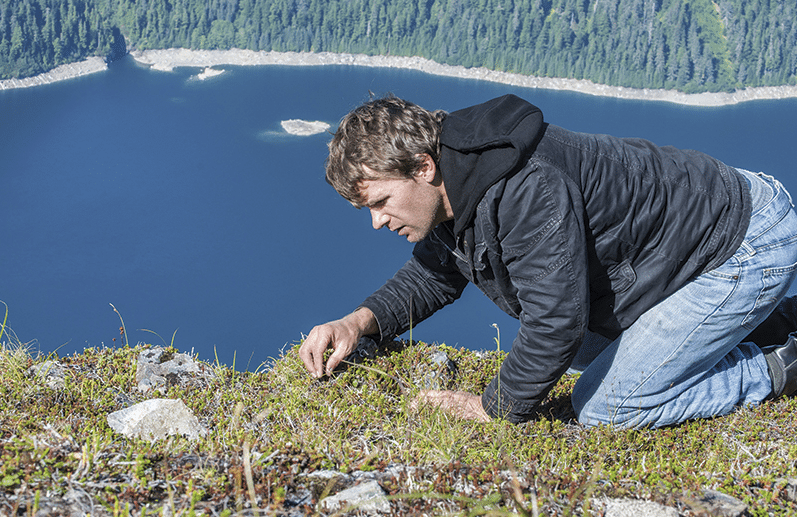
Non-sustainable practice
Foraging. Earth can support maybe a million Homo sapiens.
Gardening. Earth can support maybe 100,000,000 people.
Farming. Earth can support a few billion.
Agribiz. Earth can support 10 billion plus.
Which do you want?
Foraging is an elitist, non-sustainable practice.
—Mike van horn, via pacificsun.com (in response to ‘All natural,’ Food & Drink, July 29)

Rain and fog
The contribution of fog to groundwater has been confirmed in Point Reyes; I helped collect fog drip samples there for isotope analysis.
A stable isotopic study of fog: the Point Reyes Peninsula, California, U.S.A.–Neil Ingraham and Bob Matthews, UC Davis.
Rain and fog were collected at four locations for almost two years for stable isotopic analysis, on the Point Reyes Peninsula on the north coast of California. The fog water ranged from −18 to −7%o in δD, and −3.1 to −1.7%o in δ18O.
The rain was isotopically more depleted, and ranged from −41 to −33%o in δD, and −7.0 − 5.8%o in δ18O. Six groundwater samples were also collected on the Point Reyes Peninsula for stable isotopic analysis. These samples ranged from −32 to −29%o in δD and −5.8 to −5.2%o in δ18O, and are ∼10%o more enriched in δD than the rain.
A geographic variation in the δD of fog on the Point Reyes Peninsula is explained by the loss of ∼5% of the condensing atmospheric vapor in the form of fog drip. This explanation, coupled with the observed stable isotopic composition of groundwater, may indicate that a small portion of fog-drip water infiltrates and recharges the groundwater system. The stable isotopic ratios of California coastal fogs, collected on the Point Reyes Peninsula, were compared to those of mountain fogs collected in northern Kenya. Coastal fogs, collected in California, plot below the MWL and are consistently depleted in D and 18O with respect to SMOW.
These coastal fogs are the result of an early-stage condensate representing a single-stage evaporation over the open ocean/condensation cycle at the coast. The mountain fogs, collected in northern Kenya, plot above the MWL, are consistently more enriched in deuterium than SMOW, and are thought to contain water that has been evapotranspired and recycled upwind.
Available from:researchgate.net/publication/250749498_A_stable_isotopic_study_of_fog_the_Point_Reyes_Peninsula_California_U.S.A [accessed Jul 24, 2015].
—Tom Mohr, via pacificsun.com (in response to ‘Mist opportunity,’ July 22)
Transitioning
Caitlyn Jenner says, “Transitioning was EASY compared to trying to find a decent MOISTURIZER!”
—Craig Whatley, via handwritten note taped to office door
In last week’s review of RVP’s ‘The Pirates of Penzance’ [‘The Magic Formula,’ July 29], we accidentally wrote that actress Christina Jaqua, who plays Ruth, was Frederic’s love interest in the play. Jaqua does indeed play Ruth, but Ruth is Frederic’s nurse. Joni DeGabriele plays Mabel, who is Frederic’s love interest. We regret the error.

by Nikki Silverstein
Hero: As Barbara Nelson of Sausalito sat on a bench at the Marin Center Lagoon Park in San Rafael, she noticed people flagrantly ignored a sign with the instruction “Do Not Feed the Wildlife.” When a camp director came by with a flock of children carrying bags of white bread, she discreetly mentioned the policy to him. “I’ve been feeding birds here since I was a kid,” he said and went back to doing so. Nelson gave it another try by pointing out the sign. It was a learning and teaching moment for the camp director. He had his campers read the sign and explained that they could no longer feed the birds the human food, because it isn’t good for the wildlife. To Nelson’s delight, he thanked her. Mensch.
Zero: How do we guilt you, Hit and Run Lady, to step up and take responsibility for your zero actions? If you don’t recognize yourself yet, we’ll review what you did. A young woman, who waits tables to put herself through college, was driving in front of you and signaled a left turn near Enterprise Rent-A-Car in San Rafael. On the two-lane road, you impatiently zoomed around her car on the left side, which caused a collision with significant damage to the woman’s car. Then you shouted at the hard-working college gal and fled. Unfortunately, the student didn’t get your license plate number. We hope that you’re feeling overwhelming remorse and will do the right thing. In lieu of that, are there any witnesses out there?
Got a Hero or a Zero? Please send submissions to ni***************@***oo.com.

by Richard von Busack
Tom Cruise’s Ethan Hunt is described by his boss Alec Baldwin as “the living manifestation of destiny” in Mission: Impossible—Rogue Nation. Cruise seems like an unusually lightweight agent of destiny. But he and director Christopher McQuarrie respect the principle that an action-movie hero should never falter in revealing character through action.
With disavowal on one side and betrayal on the other, Hunt, and what’s left of the Impossible Mission Force (IMF), seek a highly untrustworthy secret agent, Ilsa Faust, whom Hunt first encounters while being trussed up like St. Sebastian. (As played by the Swedish actress Rebecca Ferguson, Faust almost deserves a series of her own.)
Hunt gets help from his steady friend Benji (Simon Pegg), computer expert and comedy relief. (Benji grouses: “Join the IMF and see the world. Through a monitor. In a closet.”) The IMF’s ultimate target, which is not a rogue nation, is a SPECTRE-like criminal organization run by a frowning intelligencer named Lane (Sean Harris). Harris hasn’t been this frightening since he was the head thug in the Michael Caine movie Harry Brown.
The action never stops in this pinnacle of the series. Especially exciting is a motorcycle race of supreme wickedness, which has Hunt leaning so far into his ride that his knees are almost ground by the asphalt. Even in the film’s moments of rest and exposition, a strong tempo can be felt, though we do get a satisfying use of space alternating with the action, such as the first close-up of Ferguson’s Faust, seen through the hole in a Chinese wooden screen.
Hunt is called “an arsonist playing fireman,” which isn’t an unfair description of the spying community. Lane’s own underestimation of Hunt: Our hero is “a gambler”—an excellent metaphor for this hazardous game.

by Charlie Swanson
The term “living legend” rarely describes someone as well as it describes guitarist Ernest Ranglin. His innovative sound and style swept his home nation of Jamaica in the 1950s, and have made him a worldwide icon of modern music.
At 83 years old, Ranglin is still highly active, making records, touring the country and performing this week for the first time at Terrapin Crossroads.
Born in Manchester, Jamaica, in 1932, and raised in a musical family, Ranglin, at a young age, began developing a style that mixed traditional calypso and the jazz he picked up from longtime friend and musician Monty Alexander. Ranglin got his start as a session musician before moving on to composing, and eventually he became the music director at various Jamaican record labels.
In working with Jamaican producers like Lee “Scratch” Perry, Ranglin would change the face of Jamaican music and define the guitar style of ska and reggae in the 1960s, specifically the signature upward stroke that creates the sound.
Now in Jamaica’s Music Hall of Fame, Ranglin has played alongside iconic figures like Bob Marley, Jimmy Cliff and Thelonious Monk.
When Ranglin was booked to play the High Sierra Music Festival in 2011, producer Tony Mindel assembled backing band Avila, with an ensemble of talented players, to join Ranglin on the live performance. Avila is now a permanent fixture in Ranglin’s repertoire.
Today, the band is eight members strong, including drummer Ian “Inx” Herman (Hamsa Lila, Paul Simon), bassist Yossi Fine (David Bowie, Lou Reed) and keyboardist Jonathan Korty (Vinyl), along with a cavalry of horns and vocalists.
Aside from his burgeoning festival and live appearances, Ranglin’s notoriety has shot through the roof in the last few years, thanks to his steady output of new records that continue to explore the textures of reggae rhythms and Caribbean melodies.
Ranglin’s 30th studio release was Bless Up, in 2014. It’s an album full of blissful grooves and warm atmospheres, recorded live at In the Pocket, the Sonoma County recording studio that hosts other living legends like Tom Waits.
And this year, Ranglin released a new album—Ernest Ranglin At Side Door Records—for which he traveled to Toronto to record with drummer and Side Door Records owner Everton Paul. With 31 albums under his belt, Ranglin has truly played and recorded in every corner of the world, from sunny Jamaica to frigid Canada.
Ernest Ranglin makes his Terrapin Crossroads debut with Avila and Stu Allen on Thursday, August 6 at 8pm; 100 Yacht Club Dr., San Rafael; $28; 415/524-2773; terrapincrossroads.net.

by Annie Spiegelman, the Dirt Diva
About 10 years ago, I ripped out our front lawn and replaced it with natives and drought-tolerant plants. At first, my suburban neighbors thought this was totally wacko and un-American, but every summer, like clockwork, just about the time our flood insurance bill arrives in the mail on a stifling, dry morning, another crestfallen neighbor stops by to ask how they, too, can get rid of their turf. I recommend two books to them. One is American Green: The Obsessive Quest for the Perfect Lawn by environmental historian Ted Steinberg. The other is Lawn Gone: Low-Maintenance, Sustainable, Attractive Alternatives for your Yard by Pam Penick.
With great insight and wit, American Green chronicles the American homeowners’ precarious and bizarre obsession with their lawns. Today, lawn care is big business; in America alone, we’re spending an estimated $40 billion a year. How did we get hooked? In the 1950s, companies such as DuPont, who were already selling pesticide treatments for nine out of 10 acres of American cropland, needed to find a new receptive audience besides the farmers. Enter the naive suburban homeowner.
“If every homeowner made just four applications a year, lawns could be a $2.8 billion market!” a manager chimed. So they got to work persuading gullible suburbanites from the rainy East Coast to the dry desert of California that it was ‘un-Christian not to have a neatly manicured green lawn.’ Down came the victory gardens, citrus groves and chicken coops that gave families and communities fresh food and free fertilizer during the war years, and out rolled mass-produced, thirsty and high-maintenance turf all across America.
Today, according to the Union of Concerned Scientists, one gas-powered mower, used for one hour, emits as much pollution as eight new cars driven at 55 mph for the same time. In addition, nearly 80 million pounds of pesticide-active ingredients are used on U.S. lawns annually.
In Lawn Gone, garden author Pam Penick shares an array of possible lawn alternatives such as never-mow grasses (fountain grass, feather grass or sedge), or ground covering plants that aren’t too thirsty or kvetchy in the summer heat (senecio, jasmine, lamb’s ear, thyme and sedum).
She also details a few options on how to remove your lawn or a part of your lawn such as digging it up, tilling it, using a power-operated sod-cutter, solarizing or sheet-mulching. All of the above will work—however, I’m a fan of sheet-mulching since I am tired and don’t feel like digging so much. With this technique, you will have to be patient because the process takes a few months as the old grass decomposes. By adding a few layers of organic material on top of the old lawn, you’ll be improving the texture, structure and nutrient value of the soil below without adding any chemical fertilizers. All of the microorganisms living in the compost and underground will slowly make your soil sing. You will automatically become one of Mother Earth’s star students!
Simple Steps to Sheet-Mulch Your Beloved Turf:
It’s best to wait till the fall so that organic matter is decaying for about two seasons and the winter rains do all of your watering for you. By early spring you’ll be able to plant. So, this summer, start thinking about the design of your new area without grass. (Below are some resources to help you dream up your new planting area.)
Step 1: Trust and Trample
Chop down any tall weeds. Don’t pull them out of the ground, as this will wake up all of the weed seeds hiding in your lawn. Simply step on them or chop them to the ground and leave them there to decompose naturally. Remove any large woody materials, as well.
Mow the lawn and leave grass clippings on the lawn. Mark any sprinkler heads with small flags. You won’t be using this form of irrigation anymore and you may want to remove them later or simply shut them off.
Step 2: Add a Concentrated Layer of Compost
Add several inches of enriched compost, aged horse manure, worm castings or all of the above to the top of the turf. These are high in nitrogen and will shake up the microbial life underground. If your soil is hard clay, you may want to add some gypsum at this time. Thoroughly soak the area with water.
Step 3: Add a Weed Barrier
This barrier will prevent germination of the troublemaker weed seeds and their cohorts by taking them to the dark side. You’ll want to make sure that they never see the light of day again—literally. The weeds and grass will die and become food for earthworms and their cohorts. This weed barrier will eventually decompose.
You have a few options for your weed barrier: Newspapers, cardboard, burlap bags or gypsum board.
Most gardeners choose newspapers or cardboard. (Cardboard will take longer to break down.) Lay out four to six sheets of newspapers, or single layers of cardboard along the entire area, making sure each piece is overlapping with the next. Do not leave any soil exposed to light. Water the area again.
Step 4: The Final Layer
This layer mimics the top layer of the forest. Add a 3 to 6-inch layer of mulch such as leaves, wood chips or straw. Water weekly with a hose if no rain is expected.
Come spring, you can plant directly into your sheet-mulch, as it should be fully decomposed. There will be no reason to turn the soil here since you hired the earthworms to do the work for you already. Isn’t nature grand?! After planting flowers or crops, you may want to add a new top-layer of mulch to keep plants cool in the summer and warm in the winter.
Additional Resources for More Get-off-the-Lawn Ideas:
*Designing with Succulents by Debra Lee Baldwin
*Reimagining the California Lawn by Carol Bornstein, David Fross and Bart O’Brien
*Eco-Lawn plant mix at Wildflower Farm: wildflowerfarm.com
*Marin Master Gardener’s Water Wise Plant List: ucanr.edu/sites/MarinMG/Plant_Guide/
*High Country Gardens—various seed mixes and groundcovers: highcountrygardens.com
*Great ideas and photos of life without turf: lawnreform.org
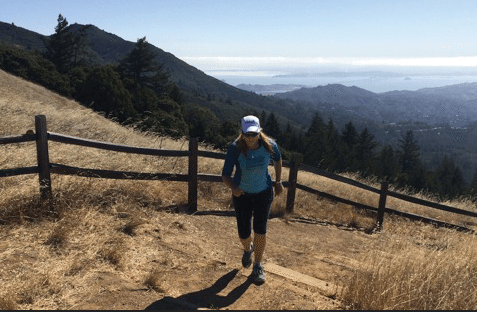
by Joanne Williams
Catching up with Joan Steidinger—teacher, lecturer and consultant, and a psychologist in private practice in Marin and San Francisco—requires marathon stamina. Dr. Joan, as she is known, was at Mt. Hood in July preparing to run another 50K race, part of a regimen she maintains that fueled her 2014 book, Sisterhood in Sports: How Female Athletes Collaborate and Compete. She came in first in her age group (60-69), although she suffered a cracked rib and bruises. “I fell at mile five but continued, although finished about an hour short of what I had expected,” she says.
An ultra-runner, marathoner and ultra-distance cyclist, Steidinger, 60, of Mill Valley, has a Ph.D. in professional psychology and is certified by the Association of Applied Sports Psychology as a consultant in sports psychology. But that doesn’t mean that she’s immune to injury. In fact, Steidinger began distance-running to help her take up the pedals again after a serious bicycle accident. “I began to rethink my life, my goals,” she says. “I started to interview high-level competitive women athletes to see how they managed to overcome physical injuries and mental letdowns.
Steidinger says that she had already been counseling women athletes and families and realized that parents had a lot of influence on their daughters. “At that time,” she says, “many parents believed certain sports were more ‘appropriate’ for women than others.” Steidinger recalls that when she was in high school, where she played competitive badminton and tennis, her own parents resisted her participation in distance-running. In researching Sisterhood in Sports, which she spent around 10 years working on, Steidinger also found that young women athletes depend on parental support.
After interviewing more than 150 professional and amateur athletes—marathoners, mountain bikers, skiers, golfers, tennis players—Steidinger discovered that women athletes use talking as a primary form of communication and support. “Unlike men, competitive women tend to befriend one another during stress, to intuit, express empathy, worry and to seek fun in sports. These are our strengths grounded in both our minds and bodies,” she says, “and there are dozens of studies showing how our brains and hormones operate quite differently from men’s.
“The tight bond that exists among women’s sports teams became evident to me during the U.S. win in the 1996 U.S. Olympic team,” Steidinger says, of the soccer team that made history. “It was evident among Kristine Lilly, Judy Foudy, Brandi Chastain, Joy Fawcett and Mia Hamm—a bond that exists today among many women, including the 2015 World Cup winners.”
In July’s World Cup final between the U.S. and Japan, U.S. star midfielder Carli Lloyd’s teammates swarmed around her in recognizable female fashion after her famous hat trick—three goals in one game, which led to the U.S. snagging the Cup.
“Social connections appear to be critical to female athletes’ success,” Steidinger says, “and language is the glue that connects females to one another.” It all has to do with the female brain, which places significance on friendships, empathy, intuition, positive peer-group collaboration, camaraderie and just plain having fun. “Studies show that females have different needs than male athletes—different neurotransmitters in the male and female brain account for different behaviors between them. Oxytocin, for instance, is found in much higher levels in the female brain than the male brain and directly influences female behavior.
“Female athletes require ongoing and regular spoken communication in order to feel connected,” Steidinger found, “and studies show females are more social and verbal in their communication than men are. Women are hardwired to engage through language and that is critical to their success.”
This ‘style debate’ came to the fore for Steidinger a few years ago while she was a guest speaker at a master’s level sports management class at Georgia State. Guys don’t talk about their feelings the way women do, one of the male students said.
And while yelling at a male team player might help him improve, it does nothing to help a female do better in her sport, according to many women who spoke to Steidinger on coaching styles. Sisterhood in Sports cites many studies and programs to validate her claims. She credits pioneering female athletes such as Billie Jean King and Rosie Casals, who laid the foundation for strong female competitors, and the passage of Title IX in 1972, which supports equality in women’s sports.
Steidinger has biked the Double Century, run the Quad Dipsea, hiked Mt. Kilimanjaro and will soon run the Athens Classic Marathon in Greece. She’s scheduled to speak at the Twin Cities Marathon in Minneapolis-St. Paul in October; her topic: What Makes Female Athletes’ Style Unique.
In the meantime, the motivational speaker and counselor to female sports teams, coaches and individual athletes near and far, will continue to inspire. “In my workshops I focus on building confidence in youth and women,” Steidinger says. “Success grows from confidence.”
Learn more about Dr. Joan at powerzonephd.com.

FOLLOW US
Copyright © Weeklys All rights reserved.
OUR PUBLICATIONS