By now we’ve all heard the story: Trophy-hunting dentist from Minneapolis shoots beloved lion in Zimbabwe, becomes most hated man in America overnight. He takes to the Internet to say he’s sorry, sort of, but it was all legal—or so he thought.
As the Cecil the Lion story has unfolded, it turns out that Dr. Walker Palmer illegally shot a black bear in Wisconsin in 2006, and almost went to prison for it. According to the New York Times, he recently paid California for the privilege of killing a tule elk. Ted Nugent came to his defense, as Palmer, facing extradition, went into hiding.
The Cecil controversy has highlighted the ethics of killing big-game animals strictly for the trophy value.
“There is trophy hunting [in California],” says Tracy Coppola, Washington, D.C.–based director of the Humane Society of the United States’ wildlife abuse campaign. She notes that trophy hunters don’t generally hunt bears that have a history of close contact with humans (such as the ones you see around garbage cans).
“California is a leader in ‘fair chase’ hunting,” she says, and that has led to a reduction in the number of bears killed annually in recent years.
California Department of Fish and Wildlife (CDFW) spokesman Clark Blanchard says the Cecil outrage hasn’t made its way to his agency. “The CDFW communications office has not received any calls from the public regarding this issue,” he says.
The black bear hunting season starts on August 15 in California and runs through the end of the year, or until 1,700 bears are killed.
Blanchard pushed back against the notion that California bear hunters are in it mostly for the trophy.
“There is no data or other evidence to support the claim that ‘most bear hunters in California are shooting purely for the trophy,’” writes Blanchard in response to questions sent to him last week.
Blanchard noted that California’s bear hunting laws limit the season and methods of killing bears, and prohibit hunting with bait. To coax Cecil from his sanctuary, his killer strapped a dead animal to a jeep and lured him to his eventual death.
Additionally, the state prohibits “wasting the carcass of any game bird or mammal,” Blanchard says. And the sale or purchase of dead bears taken for recreational purposes is also off limits.
The state also issues “depredation permits” that allow people to kill bears where they have become a so-called nuisance.
Coppola says that California should be celebrated for banning practices like hounding, trapping and baiting bears. The state has also banned bear hunting in the spring, when the animals are both particularly vulnerable (they’re hungry and food is in short supply) and desirable (their meat is reportedly at its sweetest).
State law banned the practice of using hounds to hunt bears in 2012. Some dogs were equipped with GPS collars to make for easier tracking. But the law was quickly subjected to repeal by Tea Party favorite and former state Assemblyman Tim Donnelly, who ran for governor last year.
Donnelly’s overturn push was supported by the organization California Houndsman for Conservation (CHC), which continues to oppose the law. Lori Jacobs, president of CHC, says that she’d just as soon not shoot a bear that’s been hounded up a tree. Like the Motörhead song of the same title, sometimes the chase is better than the catch.
“I am not a trophy hunter,” Jacobs says, “and I never have been a trophy hunter. The animals my family takes are for meat. That’s why we hunt.”
Hunter groups like the CHC expressed concern that the hound hunting ban would lead to grisly human-bear interactions of the Werner Herzog variety. That has not materialized; the only reported incident in California in the past few years occurred last October, when a Humboldt County man, who had a heart attack, died and then got eaten by a black bear.
But Jacobs says there’s been an “increase in the number of bear sightings and bear problems” since the bill passed. And she notes that the practice of hound hunting gives discretion to the hunter. “You don’t have to kill the animal. You can leave the animal.”
The hound dog ban, Coppola says, has pushed down the number of black bears shot each year. According to her, 1,768 black bears were shot in California in 2002. A year after the ban was enacted, the number dropped to 1,002.
“It’s pretty significant,” she says, “and has a lot to do with getting rid of these egregious practices.”
Would-be trophy hunters are also stymied by the fact that if you kill a black bear in California, you’re not going to mount the head above the fireplace. The agency requires that the heads be sent to them for analysis.
Blanchard says “the vast majority of hunters in California [hunt] to provide themselves and their families with a lean, organic, hormone-free food source.”
Believe it or not, he adds, “bear meat can make excellent table fare.” He even provided a link for some recipes.
The black bear population, he says, is on the rise, and the beasts are being seen in places “where they were not seen 50 years ago,” including Sonoma County. Blanchard says there are between 25,000 and 30,000 black bears in the state across about 52,000 square miles.
Much of the outrage over Cecil’s death is emotional and driven by a sickening spectacle: Lure a majestic beast from its sanctuary, wound it with an arrow, chase it for 40 hours, shoot it and then chop off its head to cover up the dirty deed. The lion had a tracking device strapped to its neck.
Zimbabwe is not, however, California, and Governor Jerry Brown doesn’t eat trophy meat, as far as we know, unlike the lion-eating president of that African nation.
Jacobs is withholding judgment. “As far as the Cecil thing goes, not enough has been uncovered yet for me to take a side.”
Jacob’s organization generally supports state conservation efforts. The group’s website says “the authority to establish regulations necessary to conserve our state’s wildlife should remain with those schooled and trained to use sound logic, scientific reasoning and proven wildlife management principles; not emotion, ignorance or personal agendas.”
Yet California’s state flag features a bear, a grizzly, that’s extinct in the state because of overhunting. Blanchard, however, says that “regulated sport hunting has never caused any wildlife species to become endangered or extinct. In fact, legal hunting plays a very important role in wildlife management and habitat conservation.”
Hunters pay taxes and other fees for the privilege of shooting bears. Blanchard says that the state Wildlife Restoration Fund collects the taxes and fees, “and apportions them to state natural resource agencies for conservation and education, which includes habitat restoration, wildlife research and more. Together, hunters and anglers may very well be the most important source of conservation funding in the United States. “The real question is, where would California’s bear population be without conservation efforts made possible by the contributions of legal hunters?”
This week in the Pacific Sun, you’ll find our cover story, by Tom Gogola, about the end of an era at Lawson’s Landing. On top of that, in the wake of the outcry about the death of Cecil the Lion, we present a story on hunting the black bear in California. Joanne Williams interviews Joan Steidinger, ultra-runner and psychologist, about what she found while researching her book, Sisterhood in Sports, and the Dirt Diva tells us all to rip out our lawns. Tanya Henry talks to the founder of Marin Kombucha about his fermentation process and plans for the future, and Charlie Swanson reminds us that living legend Ernie Ranglin will be playing at Terrapin this week. All that and more on stands and online today.
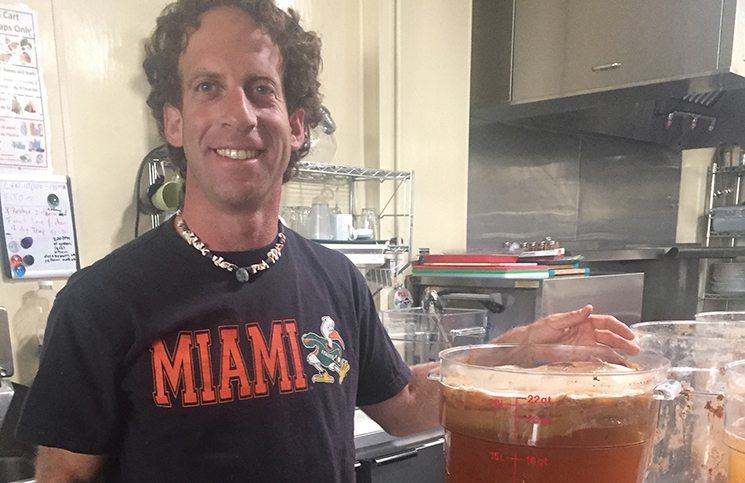
“I am a pH freak,” contends Brian Igersheim, who started selling his handcrafted 16-ounce brown glass bottles of Marin Kombucha in March of this year. “The right pH and high-quality tea is everything.”
After spending more than five years in the islands overseeing quality control for the Maui Gold Pineapple Company, Igersheim moved to Corte Madera and put his chemistry and biology background to good use with his small-batch kombucha operation. Working with Fermin Alvarez at the Food Business Incubator Program offered through the Renaissance Entrepreneurship Center in San Rafael, Igersheim rolled out three signature flavors: Original Oak, Pinot Sage and Apple Juniper.
“I use only high-quality, organic ingredients,” explains Igersheim, who sources his teas locally from the husband-and-wife team behind Silk Road Teas in San Rafael. The water, a critical component in brewing 200 gallons a week, is pure, reverse osmosis.
Before Igersheim moved his enterprise beyond his home kitchen, he tried to learn from other producers, but found most to be proprietary and unwilling to share their knowledge. “I’m all about transparency—I will happily give my exact recipe to anyone who wants it,” Igersheim says. His goal is to eventually have a space large enough for customers to hang out in and enjoy his non-alcoholic brew in a communal and open setting.
Igersheim’s brews are unique in that he keeps the pH levels at 3 (most on the shelves are in the 2.5 and lower range). A quick chemistry lesson: Pure water has a neutral pH of 7—pH values lower than 7 are acidic, and pH values higher than 7 are alkaline. Though decidedly tart, Marin Kombucha’s unique oak-aged treatment and original non-fruity flavors add smooth notes to the brews, making them more food-friendly and accessible than many.
Not surprisingly, Igersheim has outgrown the commercial kitchen at Renaissance and will soon move to a larger space where he and his small team can continue to grow more ‘mothers’—or SCOBY (Symbiotic Culture Of Bacteria and Yeasts) for raw, active and continuous fermentation. For now, the tasty brews can be enjoyed on tap from five-gallon kegs at local spots like Woodlands Café, Sweetwater and True North Pub & Grill, among others. Select Marin retailers also carry the attractively labeled 16-ounce bottles. Learn more at marinkombucha.com.
Q: I had an affair with a married man, and we fell madly in love, and he left his wife for me. We’ve been happily married for many years, but recently, I found out that he’s still in contact with his ex-wife. I got suspicious, bought a voice-activated recorder and tapped our landline. Lo and behold, they’re having hot phone sex while I’m visiting my elderly mother on Sundays! I can’t believe he would disrespect me like this! Especially after all we’ve done (like moving across the country to get away from his psycho ex). I really love him, so I’m wondering whether I should confront him or just seethe in silence (because I know he won’t go back to her). And honestly, I’m not even sure phone sex is really cheating.—Shocked
A: OK then. You’ll just be having a nice big scoop of “What Comes Around Goes Around.” Cup or cone? Nuts? Sprinkles?
As for your shock at his behavior—“I can’t believe he would disrespect me like this!”—it’s not like you two met while working at the ethics factory. People who cheat with you are cheaters, meaning that they can probably be counted on to cheat on you. We all know this. Yet there you are, not only suspending disbelief but driving it out to the desert and burying it in a shallow grave.
You’re doing this not because you’re dumb but because you’re succumbing to a mental shortcut called “optimism bias”—a belief, fueled by ego and wishful thinking, that bad things likely to happen to other people will pass over you like a flock of birds, not leaving so much as a souvenir dropping in your hair. Optimism bias is maintained with denial—like your questioning whether phone sex is “really cheating.” Um, if some behavior by your partner, done openly, is likely to cause you to burst into heaving sobs, chances are he’s crossing the line: “Be right there, dear! Just talking dirty to my ex-wife.”
As for your notion that you could just seethe in silence, wonderful idea—except for how, as resentment builds, “head in the sand” starts to feel like “head in the blender.” To stop giving in to optimism bias, give yourself a crack upside the head with how things actually are. Yes, you need to admit that your husband is cheating on you. Once you have your meet-and-greet with reality, let him know that you’re onto him and then sit down together to see what you have and whether it’s fixable (and not just by making your elderly mom take the bus to your house so you can stand guard by the phone).
To figure things out, spend 12 hours straight in a hotel room together. Yes, really. No books, TV, phone calls, naps or walks outside. You can sit silently—or talk about anything regarding one or both of you. The late therapist Nathaniel Branden, who came up with this idea, called it an “experiment in intimacy.” Branden explained that when all avenues of escape are closed off, a couple can experience real breakthroughs in communication. As opposed to what you’ve been experiencing—real breakthroughs in communication devices: “Yeah, we have a very happy relationsh- … hold on, Katrina … sorry; that was just the tracking thingie telling me my husband’s going south on Oak.”
Q: I’m dating this guy. We aren’t committed, but I’d like us to be. Recently, he’s been mentioning chicks who want to sleep with him whom he shut down. I appreciate his honesty, but I guess I’m wondering why he’s telling me this stuff at all.—Earful
A: There’s being open and honest, and then there’s bragging about your sexual options, which is the mark of a man-toddler: “Mommy, Mommy, look at the sex fort I’m making!”
The guy’s spirit animal appears to be the trash can with the swinging lip. He either wants you to like him more or he is warning you that you like him too much. Time will tell. Meanwhile, just sitting there blinking as he rattles on about his harem-in-waiting doesn’t make you seem cool and easygoing; it makes you seem cool with disrespect.
In other words, you actually need to say no to knowing. This doesn’t take some long, icky speech. Just a slightly singsongy “Overshare!” And if he doesn’t quite get it, maybe add, “Fascinating … but unless I’ll be needing a penicillin nightcap, TMI.” Assuming he listens and stops and is generally attentive to your feelings, you probably shouldn’t fixate on this. Even the sweetest guy may say things he doesn’t quite think through—to the point where a girl’s sometimes got to ask for tech support: “Hi … sorry, but I couldn’t find this in your FAQs. How do I log out of your penis’s news ticker?”
It’s a sunny Saturday morning in July at Lawson’s Landing at Dillon Beach, achingly beautiful and breezy, as Bob Bedsworth ambles down a sandy path, a bright red five-gallon bucket of spent horseneck clamshells in hand.
He has just finished giving a shucking lesson to one of his grandkids from the back deck of his trailer at the campsite. It’s a scene that’s likely been repeated hundreds, thousands of times at this popular campground.
Bedsworth is retired U.S. Air Force, has a home in Elk Grove and spends five months a year in his trailer at Lawson’s Landing, from May through September. He’s been coming here for 34 years. But those days are coming to an end, as Lawson’s faces an uncertain future.
Bedsworth owns one of the 200-odd semi-permanent camper-trailers perched along the edge of Tomales Bay. They’ll all be gone by this time next year. That move is a key piece of a long-in-the-making deal struck in 2011 between Lawson’s Landing and the California Coastal Commission to keep Lawson’s open.
But ask Lawson’s owners and they’ll tell you that, because of financial and regulatory challenges, staying open is by no means assured.
Bedsworth recalls the clamming, the abalone diving and the general good times he’s had over the decades he’s been coming to this rather remote and freewheeling campground, where the cattle once ran free on an adjoining ranch also owned by the Lawson family.
“Where else can you find a place on the bay that’s reasonably priced and where you can bring the kids, the grandkids,” says Bedsworth. “I’ll miss that.”
Under new rules designed to save the endangered red-legged frogs, famous Tomales dunes and snowy plovers, Lawson’s will have to abide by state laws that restrict people from coastal camping for more than two straight weeks at a time.
The idea is to give other people a shot at camping at the location and to protect sensitive habitat. But once those camper-trailers are gone, Lawson’s owners say they will have to provide access to a more well-heeled crowd of luxe campers as part of its plan to stay afloat. And that may not be enough, the owners fear.
Bedsworth peers over the top of his rectangular sunglasses and says with a soft smile, “I’d just as soon it not happen. I think it’s stupid.”
He heads off to dump his bucket of clamshells into the sun-dappled bay.
CLAMS AND FREE AIR-CONDITIONING
Lawson’s Landing has been a family business in northwestern-most Marin County since the late 1950s. The family has owned the land, which until recently comprised some 1,000 acres, since the 1920s. The camping scene has historically been dominated by blue collar and middle-class folks from the Sacramento Valley.
“They come for the free air-conditioning,” says Lawson’s Landing co-owner Carl “Willy” Vogler.
The campground first came into the crosshairs of Marin County environmentalists in 1962. None of the moving parts that had kept the revenue flowing to Lawson’s—a sand quarry (now defunct), the cattle ranch (still operating), the camping—had operated with a use permit from the county.
The boat livery is still operating, which is a rare sight at marinas these days because of liability concerns. You can rent an aluminum boat (the motor’s extra) and head out to the bay for the day. There’s also a boat-repair shop attached to the fishing and retail operation.
The family has been trying to get use permits since before the advent of the Marin County Local Coastal Plan in 1980, but to no avail, say Lawson family members. “We’ve been working with, and sometimes against, the agencies, trying to get things permitted,” Vogler says.
The coastal plan is essentially the local reflection of mandates contained in the state Coastal Act of 1976 that created the California Coastal Commission.
The campground’s footprint has shrunk from 100 to about 20 acres, and you can feel that the squeeze is on. There are a few abandoned public restrooms that tell of the downsizing. Tent campers are now slotted into small patches of grass, and everyone seems to be right on top of one another.
The owners returned 465 acres of campsites back to wetlands as part of an ongoing settlement arrangement with the coastal commission (a “consent cease and desist”), and in exchange were given the green light to grow out the tent camping in less sensitive areas. That hasn’t happened yet.
“There’s work to be done,” says Vogler. “It will take tractors and time,” and the latter is in short supply in the summer.
The 465 acres comprised the most eco-sensitive parts of the Lawson’s holdings, and they put the acreage into a permanent conservation easement with the federal Natural Resource Conservation Service for $5 million.
Meanwhile, the family hasn’t been able to move on the part of the redevelopment plan that would allow them to put in new camping areas in other parts of their land.
The Lawsons now say that a much-anticipated coastal commission scientific survey (which, they stress, they were not required to do) has been so long in coming that it’s handcuffed them from making the necessary changes that would keep them in business.
The survey is a necessary precondition for the family to start dealing with critically needed wastewater infrastructure. New bathrooms and shower facilities are part of the deal, among other upgrades.
The family says it can see a viable business on the other side of this complex and multi-million dollar transition—but getting from here to there without going out of business in the process? That’s another story.
“I’m extremely nervous,” says Vogler. “This is supposed to remain a place for low-cost coastal access, and I want to keep it that way.”
While he sees a business after the transition, “it’s paying off the other stuff to get there that is the terrifying part. The trick is to make the income meet the out-go.”
Marin County Supervisor Steve Kinsey is more optimistic.
“I believe that Lawson’s Landing has several more generations of opportunity for visitors to come,” says Kinsey, who has a dual role here in his additional capacity as a commissioner with the California Coastal Commission. Kinsey notes that the family has a “very viable coastal development permit that they can work with.”
Kinsey was, however, surprised to hear the extent of the worry expressed by Vogler and co-owner Mike Lawson over staying in business.
“I personally think they should be talking to me if they think it is that serious,” he says. “The last thing we want to do is to eliminate the largest coastal camping opportunity in Northern California. That’s not the intention, and there would be ways that it could possibly be addressed. I am determined to help them not go out of business.”
Kinsey says that he had been an early proponent of seeing the “historic trailers prevail,” but agrees with the ruling consensus that those folks had to share the wealth with other campers.
Catherine Caufield is the former executive director of the West Marin Environmental Action Committee, a nonprofit that was a major driving force for the changes afoot at Lawson’s. She agrees that the slow roll on the scientific study has created “a bit of a bottleneck, because it just took time to do a good job.”
Caufield credits the family with the changes that they have made to address the environmental concerns her organization highlighted. “I believe that Mike [Lawson] and Willy want to do the right thing,” she says, “and we’re always there to encourage them just a little bit more.”
Meanwhile, the clock is ticking on the camper-trailers, which have provided a backbone of rental income to the owners for decades. The 2011 deal gave those trailer owners a five-year window to get out. That’s a hard deadline, and it’s coming on July 13, 2016.
The coastal commission has two general mandates: Keep the coast clear of excessive development that would negatively impact the environment; and ensure that the California coastline is accessible to everyone, and especially those of lesser means.
Lawson’s and Marin County struck a deal to keep the business going in 2008. The West Marin Environmental Action Committee challenged that agreement, and that’s when the issue jumped from the county’s in-box to the coastal commission.
“The coastal commission was supposed to shut us down,” Vogler recalls. They entered into a “consent cease and desist” with the agency as part of the agreement to remove the trailers. “They chose not to enforce the ‘cease’ part as long as we kept moving down the road, making the improvements,” he says.
“What the coastal commission did—right, wrong or indifferent—was they offered a compromise that PO’d the environmentalists, the NIMBY people and us. I’d call it a good compromise where people wind up basically being equally unhappy. Everybody was more or less disappointed with it.”
HARD TIMES?
“This was supposed to be a fast-track deal,” says Mike Lawson. “The five-year period is coming to an end, and we have no way of replacing our business in a quick, business-like time frame with something else. Either the coastal commission is going to allow us to keep the business afloat for another year or two, or we are going to be facing some really hard times. When the trailers go away, we have to replace that revenue, but we can’t replace that with low-cost, overnight camping.”
Lawson says that survivability may now hinge on a new wastewater system that’s part of the purview of the coastal commission study currently underway. The family, he says, had submitted a preliminary proposal to the commission and Marin County to get a proper use permit for the proposed build-out, and it was approved—but only preliminarily.
“We think we have a strong argument for redeveloping a formerly developed area, but we’re still waiting to hear from the scientific review panel,” says Lawson.
One idea under exploration would put the land into the purview of the California Coastal Conservancy. In that scenario, the state agency would partner with the Lawsons, loan them the money to stay afloat and then collect the loan back at a low interest rate.
“But money is getting hard to find,” Lawson says. “Our planner is trying to work with some of those people and get something done here.”
GONE FISHING
To say that it’s a bustling day at Lawson’s Landing is to say that people have been mildly interested in the recent goings-on on Pluto.
A familiar scene at Lawson’s Landing. Photo by Michael Amsler
And we’re in a far-off place in the Marin County galaxy here, in the northern reaches where Tomales Bay spills out into the Pacific Ocean by way of Bodega Bay. Today, the place is positively bopping with mid-summer recreation, and it’s a hoot to behold.
On this particular Saturday morning, Tomales Bay is coming right off an ultra-low “clam tide,” and the clam diggers were out there all morning. Vogler says some of those clam diggers are a little less welcome than others. Lawson’s has been victimized by its own popularity.
“We started to attract other clientele from the Bay Area that didn’t have any concern for conservation for saving some for next year,” says Vogler.
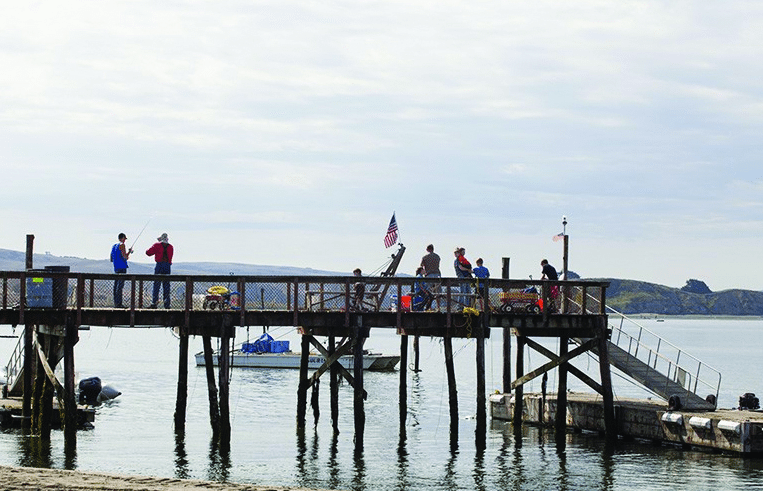
A couple of front-loaders stand at the ready to “splash” boats from their trailers into the bay. The fishing pier that sticks out into Tomales Bay is loaded with crabbers and fishers; there are buckets full of red crabs, and people jigging little fry for use as live bait. A lone dude with a surf-fishing rig sits in a beach chair way out on a long sand spit at the edge of the bay, waiting for a bite.
As if on cue, a woman points into the bay to a spot that had earlier been loaded with clammers. Gesticulating wildly and yelling at no one in particular, she exclaims, “Is the game warden around today? Can you please save some for our grandchildren?”
The woman then strikes up a conversation with an elderly woman in a big floppy sun hat seated on a bench. They begin shouting things at and past each other about having relatives who arrived at Ellis Island, back when, you know, immigration was immigration.
“Trump was absolutely right!” one of them exclaims.
“They want Sharia law in Sacramento, there’s going to be a problem!” exclaims the other.
Well . . . umm . . . errr . . .
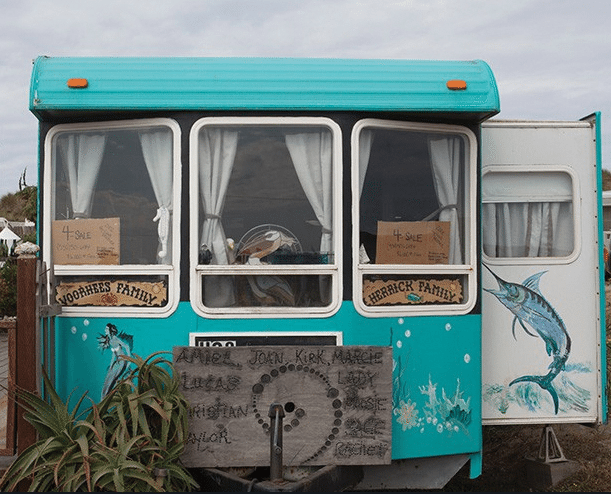
How about we take a stroll among those cool trailers! While it’s still going, the trailer community offers a fascinating glimpse into a particular variety of coastal Americana. There are numerous varieties, but the tin-can aluminum rectangles that jut out at rakish angles—those are all over the place and stand out; they are the characteristic Spartan Trailer design from the 1940s and ’50s, when America again took to recreational pursuits after the Great Depression and an even greater world war. The overall feel of the joint is exquisitely ramshackle, but not down-at-the-heel.
Lawson’s Landing is akin to the all-but-vanished American drive-in movie theater, a last vestige of a bygone era centered on leisure and motion—and geared toward working and middle-class families.
And there’s no question that the trailer owners are holding out for that last briny breeze, the end of the endless summer in these salt-encrusted and well-worn domiciles. So far it appears that nobody’s yet left the premises.
Meanwhile, there are decades of accrued character and memories to contemplate and enjoy: glass Japanese mooring balls in the windows of a few trailers, signage with proud declarations that this is our summer home. As a sign of things to come, there are “For Sale” signs everywhere. There’s also a bunch of golf carts, a “Grateful Dead Way” street sign, variously constructed deckage and driftwood bric-a-brac, a living museum of accumulated flotsam and jetsam.
The rent is cheap–$400 to $500 a month–and the view is world-class, looking across to the untrammeled Point Reyes National Seashore wilderness area.
Jerry Knedel is cleaning his boat near his trailer after a morning fishing trip, and he pulls a couple of dripping lingcod and a salmon from his fish box and tosses them to a friend. Knedel and family have been coming here for 56 years, and he speaks of possible scenarios where a hotel like the Ritz-Carlton buys up the land from the Lawson’s, builds a fancy resort, and just like that, it’s all over for the working man. Knedel just can’t see how Lawson’s can swing this state-mandated transition.
The family says it plans to use the freed-up space for non-permanent trailers, which Knedel describes as “1 percent campers,” big rigs in need of multiple hookups, which the Lawsons will install once the long-term trailers are gone.
Knedel says, and Lawson confirms, that the rents have gone up in large measure to help the Lawsons pay their lawyers and consultants. He recalls that the rent was $19 a month when his family started coming here.
“The spikes in rent,” Knedel says, “were the result of lawsuits to oppose Marin County, the coastal commission and the Marin County supervisors who have drummed up multiple bogus offenses” to drive the business to a brink of unsustainability.
But the halibut bite’s been good, he adds.
Meanwhile, Vogler is in his office in the fishing station, chock-a-block with maps and memorabilia, and there’s a toddler rocking away in one of those egg-shaped thingamabobs. Vogler’s kids are out front tending the retail shack—get your bait, get your ice cream bars here, sit on the bench out in front and take it all in, xenophobic outbursts and all.
As he describes the various twists and turns along the way to a final deal with the state, a Lawson’s worker comes in and tells him that a boater has had a problem—his prop was fouled by a fallen marker that was used to indicate a nearby sandbar.
The exchange gives a rich insight into how to properly run a family business that’s geared toward families. “Give him a new prop,” says Vogler, arms akimbo as he laughs, “but he’s not getting another one after this!”
END OF AN ERA
Mike Pfeifle and Robert Roth are friends from Lodi who’ve just returned from a spearfishing adventure out in Tomales Bay. Their quarry was halibut, and Roth says he speared a nice one that morning—but nothing on the order of the 32-pounder he once lanced here.
The men are hanging around in front of a rare sight along the seawall and trailer area: an abandoned trailer that’s all torn up inside, no doors or windows, totally junked-out.
Pfeifle owns a trailer over on lot A-13 and Roth, with a hearty chuckle, describes himself as his freeloading friend. Roth says he brought two granola bars with him from Lodi but hadn’t yet eaten them: there’s a lot of communal food-sharing going on among the trailer owners.
Roth says he’s been coming here for 30 years but has had a permanent camper here only for the last eight. Roth is a bus dispatcher back home; Pfeifle works in hazardous waste, he says.
Pfeifle says he’s gotten used to the idea that an era is coming to an end, and he’ll keep coming out here even after his trailer’s gone. He’ll keep spearing and gigging halibut, and diving for abalone, and he’ll keep telling the story around the campfire about that time the great white shark showed up.
He’s going to hold out through the year. “I’m pulling mine out in January,” Pfeifle says, still wearing the wetsuit from the morning spearfishing trip. “It’s been on the horizon,” he says. “I’ve gotten used to the idea.”
Roth leans against the abandoned trailer and revels in what he calls the great appeal of Lawson’s Landing. “The beauty here is the pride that people have in these salted, sometimes rusted trailers,” he says, “the uniqueness that you continually see here.” He speaks of the blending of people, the unforced multiculturalism, and says the resort functions as a sort of “great equalizer,” where people of all races and persuasions gather.
There are potluck dinners after everyone’s come back from their fishing trips, he says. “It’s all about the tribal experience, the coming together after the fish hunting. That’s going away, and that is unfortunate for the next generation.”
Aries (March 21 – April 19) Been thinking that two is better than one recently, Aries? It’s perfect timing because you or yours is pregnant! While the news may come as a surprise, Jupiter’s been taking baby steps (pun intended) toward bringing a bundle of joy to your family. Take a trip to Goodwill on August 11 to snag a crib.
Taurus (April 20 – May 20) Red alert, Taurus! Jupiter is changing up its path—the joyful planet will bid adieu to dear Leo and enter Virgo, your fifth house of passion and creativity for the next 13 months. Grab a blank canvas and your watercolors—it’s time to make some art—or DIY shelves, or rice crispy treats with Kylie Jenner lips. Either way, get your creative on!
Gemini (May 21 – June 20) Time to get a little emotional, Gemini! Thank your mama for what she gave ya! Jupiter is headed straight for your fourth house of home, family and security. Ditch the cheese plates, wine and The Bachelorette girls’ nights—it’s time to turn inward and do some serious reflection on personal growth. Are you going in the right direction?
Cancer (June 21 – July 22) Finally employed, Cancer? Looks like Lady Luck and planet of luck, Jupiter, have employment in the stars for you! Last year was a bumpy ride, but with Jupiter entering Virgo on August 11, it’s all about to look up. Your communication is off the charts—no more need to stress about people not understanding you and your intentions. Enjoy your promotion in a new field!
Leo (July 23 – Aug. 22) It’s time to say farewell, Leo! Don’t worry—You’ll see Jupiter again in 12 years. In the meantime, welcome Virgo’s stay in the joyous planet and a shifted focus on money and security. Pick one of your passions you worked so hard to hone during Leo’s stay in Jupiter and turn that passion into pay! Go after a freelance gig in said discipline on August 11.
Virgo (Aug. 23 – Sept. 22) All eyes on you, Virgo! Jupiter, the planet of luck and all things delicious, is headed for a 13-month stay in your sign on August 11. This is the first time in 12 years that Jupiter has been in your sign—so it calls for a significant reinvention. Say goodbye to a possibly painful 2015, and welcome the best of the best. Anything you desire is within arm’s reach.
Libra (Sept. 23 – Oct. 22) You’re dying, Libra! Dying to have some time alone—and oh it will come on August 11 when Jupiter lands in Virgo—your 12th house of rest and endings. Pack up your porcelain dinner set and bring your down comforter out of storage. Prepare for months of nights in with cozy blankets, some beloved family and friends and Netflix.
Scorpio (Oct. 23 – Nov. 21) Tired of your friends, Scorpio? Jupiter enters Virgo on August 11, welcoming a time for networking and developing new friendships. Technology will play a role, so make sure that your LinkedIn profile is up to date and your Facebook profile picture is appropriate. We all know you know how to have fun; no need to flaunt your beer-induced escapades on social media.
Sagittarius (Nov. 22 – Dec. 21) You had a lot of a good thing, Sagittarius! And now, it’s time to hone in on your desired focus and shoot for the moon. You’re up for a little public recognition on August 11—prepare to star in your very first press release, or be honored in a viral Facebook post. Whatever it is, it’s your time to shine and focus—and most likely give a public speech.
Capricorn (Dec. 22 – Jan. 19) Get ready for the good times, Capricorn! Jupiter pit-stops in Virgo on Aug. 11 for a 13-month tour, which will help to lighten your load. The next few months will be a road to new discoveries, as you say goodbye to a tough 2015. You may have focused on moving forward after tying up loose ends with a relationship or job. Good news: 2015 is all about letting the good times roll!
Aquarius (Jan. 20 – Feb. 18) Don’t panic, Aquarius! You’re a free spirit, sure, but Jupiter is entering Virgo and you’re getting married! It’s headed straight for your eighth house of soul-merging and shared resources. If you can’t handle the heat, you’ll have to get out of the bedroom—it’s getting seriously passionate, and ‘commitment’ is your middle name. Link up your bank accounts on August 11.
Pisces (Feb. 19 – March 20)What’s that sound, Pisces? The sound of wedding bells! Jupiter moves into Virgo on August 11, welcoming a whole new focus: Partnerships! You’re either ready to settle down with ‘the one,’ or sign a contract with a dream business partner. Whichever direction you’re pulled in—two’s company, good company!
Thank you so much for your candid letter [Letters, July 15] in defense of your investment portfolio. How awful of the proletariat classes to put into question the nature of your blind but well-intentioned investments and cast a shadow of a doubt on your good-natured profit motive.
“That said, the comments made about Colony American Homes and other investors in single family homes for rent are totally false and inflammatory. The investments are removing distressed inventory from the market, which has been depressing home prices. Many of these homes being purchased were foreclosed years ago, and had become a blight on neighborhoods.”
Forgive us Mr. Blum for daring to cast a pall over the good name of CAH and the fine work which your “passive” investing makes possible for humanity. Please forgive us for not being thankful enough for what you and your admirable fellow capitalists do to help remove the blight from our neighborhoods! Thank goodness these investments in Colony American Homes (and other schemes like it) focus on helping the hard-working families who would otherwise have to contend with a housing market in which prices are “depressed.” Instead we have the immense good fortune, thanks to you and your oligarch friends, of not being able to afford rents or take out mortgages on the artificially pumped-up prices of the speculative Bay Area real estate market!
“Instead, the investors rebuild communities and provide jobs. And they allow families who cannot buy or prefer not to, to stay in the communities they want. The average renter stays for five years.”
God bless the virtuous Captains of Enterprise and High Priests of Wall Street who, through their benevolence and care for the commoners, invest in good causes—like securities and derivatives and real estate—which profit not only the tycoons and multi-millionaires but the whole community as well (though obviously not in the same proportions; roughly 99 percent to 1 percent, shall we say?).
I truly appreciate the kindness and thoughtfulness of people like Mr. Blum, who show such empathy and deep understanding of ordinary individuals’ and families’ plights.
“Finally, the homes being purchased by CAH and other investors are typically all-cash investments so they are not crowding out other buyers; most homes purchased are not even on the open market.”
Finally, Mr. Blum’s statement à la Robert Durst, that investors put up “all-cash investments,” ergo “other buyers—presumably meaning those of us who have to qualify for a bank mortgage—are not crowded out, is splendidly impressive reasoning. Moreover, Mr. Blum informs us that most of the homes CAH, and other corporately owned real estate investment and management firms like Blackstone/Invitation Homes and Waypoint Homes acquire, never even make it to the “open market.” Is there some black market we don’t know about where this is happening? Oh, yes, that would be the Insider’s Trading Market conveniently located next to the NYSE there on Wall Street.
So thank you Mr. Blum for your outspoken and guileless explanation of the situation. And, quite frankly, thanks for giving us “non-investors” an insider’s glimpse of how the oligarch thinks. For it is said in the billionaire’s investment bible somewhere that “Might makes Right,” while Laws 1 and 4 in the Ten Commandments of Wealth Building respectively state: “Thou shalt put thyself before all others” and “Thou shalt not question.”
People, please remember to be respectful of your superiors’ wealth and power.
—Ivan Besack, San Rafael (read the full letter on pacificsun.com)
In one sense I strongly agree with, while in another sense I respectfully disagree with the “Zero” assessment of the Dixie School District in San Rafael [Hero and Zero, July 22].
I definitely agree in the strongest terms with the need for our societies to continue to discriminate against racism and other forms of personal and institutional bias in every way possible. If District officials are intentionally obfuscating the origin of the name of the District (or just plain wrong) they should be reprimanded and censored in the strongest terms, and (unless they are just plain wrong) should probably be dismissed from the District or forced to resign by the community. My hope, expectation, and presumption is that neither of these is the case.
But if as indicated in the Zero column and as apparently suggested by District officials the true origin of the name is in fact a local Miwok family name, an entirely different story is created. In this case the District may want to clarify the official name publicly to include the given (first) name of the person from which the District name derives.
The real story could be difficult to discover. Evidence presented in the column; that “ … the District was named during the time frame of the Civil War … ” seems troubling. I’m not an expert on history but I’m surprised if there were any public school districts created in that period; if that part of the story is true perhaps the District was created by a local church.
Either way, from what I think I know about California history it seems unlikely a public entity or a church in 1863 would name a school district after a Native American. Nonetheless a notion that the District might have been named in 1863 in solidarity with Confederate States but that the origin of the name was obfuscated over time to be “politically correct” seems especially confusing.
As members of a global society we need to discriminate issues such as this carefully because to do otherwise reduces not only those we wish to protect and respect but ourselves and our global society as well. I am certainly encouraged that as members of society we are asking these questions and are willing to come to difficult conclusions.
The Supervisors should not criticize the Citizens for Sustainable Pension Plans for essentially doing the work that we pay the Supes and the County staff to do. The citizens group is made up of knowledgeable professionals who are volunteering their time and their resources to try to get Marin County back on a stable economic footing after years of abuse. They do not have the soft cushion of $100,000 plus salaries and the dubious perks that energize the Supes in their antic wild ride with taxpayer dollars.
County Supervisor is a part-time job with a full-time salary. It is outrageous that we let the Supes pay themselves a fat pension once they leave office: something they ought to do much more frequently. Getting entrenched at the Civic Center is just too easy. Term limits are the only thing that will stop them from hanging out and glorying in their own reflection well beyond their sell-by date.
A recent U.S. Supreme Court fair-housing decision and new U.S. Department of Housing and Urban Development (HUD) rules are either a significant step forward to promoting diverse communities or examples of government overreach aimed at destroying suburbia, depending on the observer.
Although the assertion that the feds and the high court are aiming big Washington guns at counties like Marin in an effort to dismantle single-family enclaves may rest at the wild end of a conspiracy spectrum, the court decision and the HUD rules unquestionably signal a “get serious” approach to fair housing that could have significant impacts on counties like Marin.
The court upheld a key part of the 1968 Fair Housing Act called “disparate impact,” a kind of indirect discrimination. If a landlord says that all of the units in a complex must have just one person per bedroom and the landlord doesn’t mention any prohibition against any protected class covered by the Fair Housing Act but the action effectively excludes families with children, that’s disparate impact discrimination, and it’s illegal. The court case that went to the Supreme Court sought to negate disparate impact.
“The Supreme Court decision is an absolute victory for fair housing,” says Caroline Peattie, executive director at the nonprofit Fair Housing of Marin. “It expands housing opportunities to people across the country. Where you live has everything to do with the opportunities you have available to you. The decision underlines that fact by supporting what already was the premise of the Fair Housing Act—that everyone should have the opportunity to live in the housing of their choice free of discrimination.”
The court released its decision in late June. Shortly after, HUD announced new rules relating to fair housing. The rules could have a significant impact on cities and counties. The rules underscore the Fair Housing Act that has been in place since 1968 but that has been a bit fuzzy. To clarify the situation, HUD now says, communities must analyze zoning and housing patterns to determine whether patterns exist that effectively discriminate and report findings to HUD. The rules go a step further and stipulate that communities must show HUD they have taken a proactive stance and taken actions and embraced policies aimed at reducing discrimination.
In the past, HUD took a relatively hands-off approach and allowed communities to investigate their housing patterns using a variety of data sources. Each community could use its own methods. Now, however, communities will be asked to develop a housing picture using similar data. Jurisdictions can use data HUD provides. Along with that kind of standardization, HUD will take a stricter look at the results. At stake are certain federal grants.
The Supreme Court decision and the HUD rules “are coming at the same issue of equal housing opportunities from different angles and in some ways coming into sync with each other,” Peattie says.
Opponents of fair housing cite these mechanisms as examples of excess government regulation and charge that the real goal is to aim anti-discrimination rules and regulations at eviscerating communities like Marin that have a preponderance of single-family homes.
The disparate impact court ruling and the new HUD rules clarify and strengthen the fair housing legislation. They enact no new regulations not included in the original Fair Housing Act.
That’s unlikely to mollify opponents of Plan Bay Area, a state-mandated transportation, land-use and housing plan that will support a growing economy, and other programs aimed at regional planning. While Plan Bay Area covers nine local counties, the new HUD rules cover the entire country. Hence the conspiracy theories.
Predominantly white Marin is a county in which only about 2 percent of its population is African-American, according to U.S. Census data. People of Hispanic and Latino origin make up about 15 percent of the population.
In 2009, HUD initiated a review of Marin to determine whether the county was meeting fair housing goals. Part of the county’s response to HUD involved updating a document called Analysis of Impediments To Fair Housing Choice, which identified barriers to fair housing. The county, with the help of Fair Housing of Marin, drafted an updated Analysis of Impediments, which the Board of Supervisors approved. It included an analysis and an implementation plan.
Key findings in the investigation revealed some common knowledge: Marin City and the Canal area in San Rafael are home to a high percentage of minorities. Most communities in the rest of the county have a relatively low percentage of minorities. Why the disparity exists is of equal importance to the fact that it does exist. If zoning and planning decisions relegate a protected class to certain neighborhoods, that’s housing discrimination. But if market forces create a county in which housing prices are beyond the reach of protected classes, that in and of itself doesn’t amount to discrimination.
Opponents of housing actions like the HUD rules and the court decision say that groundwork is being laid that will result in lawsuits forcing communities to provide increased affordable housing to protected classes. They say that Marin is the next stop in the federal government’s crusade to remake the suburbs. The first stop, they assert, was Westchester County, New York.
It was in that county, often called a kind of “East Coast Marin,” that the Anti-Discrimination Center filed suit. The legal action led to a settlement in which the county agreed to build 750 units of “affordable and fair” housing and accompany the building with a marketing move.
The pushback in Marin against higher-density affordable housing has the effect of limiting affordable units in the county. But the county, its cities and interested residents are engaged in looking at ways to provide affordable units without resorting to multi-story complexes. That situation separates Marin from Westchester.
Peattie notes that lower-income populations never have been a protected class under the Fair Housing Act. A lack of affordable housing still could be one element that contributes to a disparate impact. But the prospect of HUD-related lawsuits filed against local jurisdictions because they’re not approving and building housing along the Highway 101 corridor is a possibility, though the bar will be set rather high. “You would have to show how not [building development in the corridor] would in a very specific way impact protected classes,” Peattie says.
The new HUD rules clarify how the agency will help local jurisdictions create fair housing assessments and the data HUD will provide. The rules do not set out a plan to decimate single-family homes in suburbs, says Peattie.
No part of the new HUD rules or the court decision stipulates anything about restricting single-family homes. Fair housing mandates, however, prohibit counties and cities from enacting zoning regulations across their entire jurisdictions that allow only single-family housing.
The new rules, rather than charting Armageddon for the suburbs, recognize that HUD is ready to, in Peattie’s words, “step up to the plate,” and acknowledge that fair housing obligations have been in place since 1968 “and now we want to make sure that you fulfill them.”
Housing advocates recognize that Marin residents opposed to increasing the stock of affordable housing will continue to pressure politicians who sit between the feds and the electorate. Threats of recalls and campaigns to defeat reelection bids have become more common and more commonly based on housing issues.
There are ways to increase affordable housing without building monolithic projects. A county like Marin, with a pool of talented designers and architects, could become a showplace for innovative development sensitive to the environment. There is a middle ground.
“I understand that people want to preserve the beauty of Marin County,” Peattie says. “I am one of those people. There are ways that we can use land in this county in a way to address some of these issues. I want to retain the beauty of Marin. But I also want all the wonderful things, the richness that comes with a diverse community. I mean diverse in every way, not just in race and national origin but the whole kit and caboodle: Different incomes, different ethnicities, different values. That’s what I would love to see in the county I live in.”
by Tom Gogola
By now we’ve all heard the story: Trophy-hunting dentist from Minneapolis shoots beloved lion in Zimbabwe, becomes most hated man in America overnight. He takes to the Internet to say he’s sorry, sort of, but it was all legal—or so he thought.
As the Cecil the Lion story has unfolded, it turns out that Dr. Walker Palmer illegally...
This week in the Pacific Sun, you'll find our cover story, by Tom Gogola, about the end of an era at Lawson's Landing. On top of that, in the wake of the outcry about the death of Cecil the Lion, we present a story on hunting the black bear in California. Joanne Williams interviews Joan Steidinger, ultra-runner and psychologist,...
by Tanya Henry
“I am a pH freak,” contends Brian Igersheim, who started selling his handcrafted 16-ounce brown glass bottles of Marin Kombucha in March of this year. “The right pH and high-quality tea is everything.”
After spending more than five years in the islands overseeing quality control for the Maui Gold Pineapple Company, Igersheim moved to Corte Madera and put...
by Amy Alkon
Q: I had an affair with a married man, and we fell madly in love, and he left his wife for me. We’ve been happily married for many years, but recently, I found out that he’s still in contact with his ex-wife. I got suspicious, bought a voice-activated recorder and tapped our landline. Lo and behold, they’re...
by Tom Gogola
It's a sunny Saturday morning in July at Lawson’s Landing at Dillon Beach, achingly beautiful and breezy, as Bob Bedsworth ambles down a sandy path, a bright red five-gallon bucket of spent horseneck clamshells in hand.
He has just finished giving a shucking lesson to one of his grandkids from the back deck of his trailer at the...
by Leona Moon
Aries (March 21 - April 19) Been thinking that two is better than one recently, Aries? It’s perfect timing because you or yours is pregnant! While the news may come as a surprise, Jupiter’s been taking baby steps (pun intended) toward bringing a bundle of joy to your family. Take a trip to Goodwill on August 11...
Wealth and power
Dear Mr. Blum,
Thank you so much for your candid letter in defense of your investment portfolio. How awful of the proletariat classes to put into question the nature of your blind but well-intentioned investments and cast a shadow of a doubt on your good-natured profit motive.
“That said, the comments made about Colony American Homes and other...
The real story
In one sense I strongly agree with, while in another sense I respectfully disagree with the “Zero” assessment of the Dixie School District in San Rafael .
I definitely agree in the strongest terms with the need for our societies to continue to discriminate against racism and other forms of personal and institutional bias in every way possible....
A fat pension
The Supervisors should not criticize the Citizens for Sustainable Pension Plans for essentially doing the work that we pay the Supes and the County staff to do. The citizens group is made up of knowledgeable professionals who are volunteering their time and their resources to try to get Marin County back on a stable economic footing after...
by Peter Seidman
A recent U.S. Supreme Court fair-housing decision and new U.S. Department of Housing and Urban Development (HUD) rules are either a significant step forward to promoting diverse communities or examples of government overreach aimed at destroying suburbia, depending on the observer.
Although the assertion that the feds and the high court are aiming big Washington guns at counties...