For more trivia questions (and answers!) see Howard Rachelson’s Trivia Café every week in thePacific Sun.
Answer: Chickens. Not the most intelligent of animals, chickens will pluck out the eyes of others at feeding time.

For more trivia questions (and answers!) see Howard Rachelson’s Trivia Café every week in thePacific Sun.
Answer: Chickens. Not the most intelligent of animals, chickens will pluck out the eyes of others at feeding time.
by Charles Brousse
Old prejudices, like old habits, are hard to change—so it comes as a big surprise when a single incident alters solidly established beliefs.
Over the years, I’ve seen a number of operettas written by the famous 19th century English team of librettist W.S. Gilbert and composer Arthur Sullivan. They include The Mikado, H.M.S. Pinafore, Iolanthe, and the subject of this review, The Pirates of Penzance (twice). With each viewing, my resistance to the G&S formula of silly plots, dated jokes, cartoonish characters and shrilly rendered patter songs grew, to the point that when the moment came to attend Ross Valley Players’ production of Pirates, I wondered if I was capable of giving it a fair appraisal.
It would not be an understatement to say that RVP’s rendering of this chestnut was a revelation. A few minutes into the show, I realized that, by luck or by design (I’m inclined to the latter), the artists involved in this local community theater effort found the vital ingredients that had largely been overlooked in the professional productions I had witnessed. And the really wondrous part was that it was taking place on the homely little stage of RVP’s Barn Theatre at a tiny fraction of the professionals’ cost.
So, what was the magic formula? Three words: Tempo, clarity, warmth. Stage director James Dunn and music director Paul Smith share the credit for liberating Pirates from a tradition that pursued laughs by keeping songs and dialogue moving at breakneck speed, accompanied by an ample helping of physical schtick. Under this approach, the importance of the score is greatly reduced and the show becomes a kind of wacky cartoon that happens to last (for the non-committed) a couple of tedious hours.
Dunn and Smith turn the equation backwards. Slowing everything down a notch results in improved diction during both solo and ensemble numbers, allowing the audience to engage more readily. It also has the unexpected effect of revealing the attractiveness of Sullivan’s melodies, which are too frequently dismissed as parodies. The result is that for the first time ever in my experience with G&S, the production clearly links Sullivan to the grand tradition of European comic opera begun by Mozart, Donizetti and Rossini.
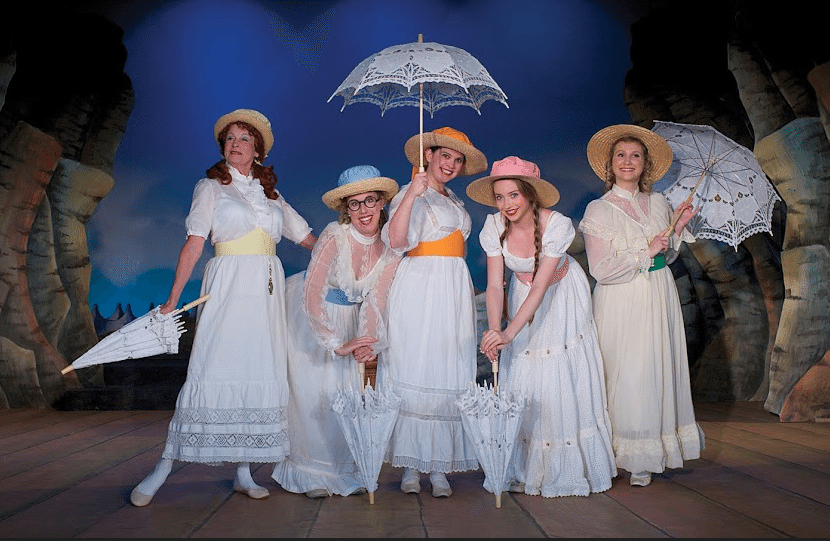
Finally, we come to that elusive ingredient which I have called ‘warmth.’ Too often, the performers—whipped along by metronome-driven directors—have seemed mechanical. This is definitely not the case at RVP. Joni DiGabriele’s Mabel, the love interest of young Frederic (Cordell Wesselink), whose rebellion against his pirate comrades is the play’s main plotline, has a gorgeous, round-edged soprano to go along with her physical beauty. Her sisters (Kathryn McGeorge, Chloe Hunwick and Arden Kilzer), dressed in virginal white, join with her in several appealing ensembles. Their doting but rather addled father is played in fine style by Norman A. Hall. Phillip Percy Williams is a jolly Pirate King and both the Police and Pirate’s choruses provide some entertaining full-throated nonsense. With a cast of 22 and a large production team, it isn’t possible to mention everyone, but they all contributed to the evening’s success.
One further observation: I doubt that this transformative version of Pirates could have occurred without the participation of Paul Smith, whose operatic background at the College of Marin, musical sensitivity and golden touch as the show’s piano accompanist gave fresh luster to what easily could have been just another production of a tired warhorse. Even if I never see another one like it, this will have been a lasting gift.Y
NOW PLAYING: The Pirates of Penzance runs through August 16 at The Barn Theatre, Marin Art and Garden Center, 30 Sir Francis Drake Blvd., Ross. For more information, call 415/456-9555, or visit rossvalleyplayers.com.

by David Templeton
“The problem with faith-based films is they kind of don’t play fair.”
This remark comes not from a film critic, or social activist, or anti-religious pundit, but from a teenage girl with blonde hair, engaged in a conversation about film at the Christopher B. Smith Rafael Film Center.
Last week, I was talking to a bunch of kids as part of the California Film Institute’s (CFI) annual Summerfilm youth program, a presentation of CFI’s ongoing educational efforts.
Each year, I talk to the students—usually between 15 and 30 teens recruited from around Marin County—sharing inside information about being a film writer, and the history of criticism as an art form.
Eventually the kids always ask me to list my favorite or least favorite films, or to explain why I might take issue with some particular genre of film. Last Thursday morning, in answer to that last question, I admitted that I find slasher films—particularly of the Saw and Hostel variety—along with faith-based films like God’s Not Dead and Christian Mingle, are not to my taste, primarily because they are so focused on a narrow audience desperate to see images and messages that move them, that they often settle for a kind of artless mediocrity.
I did list a title or two in each genre that I believed were exceptions to that rule, and as I was finishing, the aforementioned young woman, sitting in the second row, raised her hand to tell me her opinion of God’s Not Dead, a 2013 film in which an atheist college professor (played by outspoken Christian actor Kevin Sorbo, of Hercules fame) challenges his students to prove that God is not, as he insists, dead.
“My problem with the movie,” she says, “is that it cheats. It’s not fair, because it makes all the believers seem wonderful, and the non-believers seem like really bad, awful people. That’s not the way it is in the world. So it makes its case, but it makes it based on a lie.”
Somebody hire this girl, because she’s a film critic waiting to happen.
After the workshop, I got to thinking about this exchange, and started asking myself a few questions. She’s right, that many faith-based films use broadly sketched stereotypes to represent non-believers, but of course, mainstream movies have been turning believers into comic foils and stereotypical villains for as long as there have been movies.
Eventually, I remembered one movie that worked miracles in turning all of these stereotypes back on each other: Robert Zemeckis’ 1997 science fiction brainteaser Contact.
When the film—starring Jodie Foster in one of her best performances—first came out, I took Dr. Eugenie Scott to see it, and now, with these thoughts fresh in my mind, I went and pulled out the recording I made of our conversation.
Scott is a physical anthropologist with a resumé full of distinguished teaching appointments, and at that time was the executive director of the National Center for Science Education (NCSE), a nonprofit watchdog group headquartered in the East Bay. Since 1981, the NCSE has monitored creation/evolution skirmishes in public schools. Scott, who now serves the NCSE on an advisory level, was a 1991 recipient of the Public Education in Science Award, given out by the Committee for the Scientific Investigation of Claims of the Paranormal.
She is, by all definitions of the word, a non-believer.
And that label is part of what made me want to revisit the conversation.
“You know what I think?” Scott asked, early in the discussion. “I think we non-believers need to find a term other than ‘spiritual’ to describe many of our profound experiences. I wish we could find a word that means awe and wonder and excitement and love, without the supernatural twist that ‘spiritual’ has.”
We spent a bit of time dissecting Contact, a remarkably powerful drama based on the 1984 novel by the late scientist Carl Sagan. The film concerns a worldwide clash of values and ideas, mainly between science and religion, that occurs after radio signals from space are detected and identified as an invitation from an alien race. Foster plays the scientist who discovers the message, a practical woman and dedicated seeker of answers, whose intense empiricism becomes an issue when she volunteers to be the first emissary to the solar system from which the signals originated.
In one key scene, Foster is asked by an international selection committee if she is a ‘spiritual person,’ by which they mean, does she believe in God? She doesn’t, and, squirming uncomfortably, it is clear that she doesn’t like the ambiguity of the word spiritual.
“It must have been terribly awkward,” Dr. Scott continued in her analysis of the scene. “I can certainly identify with her. How do I talk about something that is non-material yet is also non-supernatural? How do I talk about the awe that descends on me when I go to the top of a mountain? Or when I hear the Queen of the Night’s aria from The Magic Flute, and the hair goes up on the back of my neck?
“I don’t think those feelings are supernatural, but they’re not exactly material either. So I wish I could come up with a term—one that wasn’t clunky—to express that. ‘Non-material non-supernaturalist’ doesn’t exactly fall trippingly from the tongue, now does it?”
In movies like Contact and God’s Not Dead, whenever a character identifies himself or herself as an atheist or a believer in God, you can see the hackles rising on the characters who hold a different view.
Scott, for what it’s worth, suggested during the conversation that she prefers “agnostic” to “atheist,” as she is first and foremost a scientist.
“I would agree with good old Thomas Henry Huxley,” she continued, “who said, ‘The only reasonable attitude for a scientist to take would be agnosticism, because you really cannot know if God exists, so you shouldn’t be an atheist.’
“For a scientist, ‘I don’t know’ is a perfectly acceptable answer,” she added. “You don’t accept the first explanation that comes along. Somebody shows up and says, ‘Aunt Rosie can find water with a forked stick. She’s found it five times in the last 10 years.’
“OK. Is there another explanation? To me the best thing we can do in our society—in terms of teaching people to think—is to get children trained immediately to say, ‘Is there a better explanation?’ And of these explanations, which is the better supported when I go to nature and look for the support?”
I recalled another remark Scott made, but had to skip to the end of the tape to find it. But I did, and my thanks to the young woman in the second row whose remarks sent me in search of it.
“I saw a bumper sticker the other day,” Scott said. “It read, ‘Thank God for Evolution.’ I can appreciate that. I wish we had more people with that kind of sense of humor. It would make my job a whole lot easier.”

by Charlie Swanson
Though the name conjures up an image of two unlikely enemies locked in eternal combat, Insects vs Robots aren’t a band of fighters; they’re a band of lovers, eliciting a joyful communal vibe wherever they show up with their exciting freak folk art rock.
As the band embarks on a West Coast summer tour, they play 19 Broadway Club in Fairfax on Thursday, July 30, and Terrapin Crossroads in San Rafael next week, on Aug 6.
Speaking from the band’s hometown, Venice, Calif., bassist and founding member Jeff Smith recounts the band’s metamorphosis over their last eight years together.
“We all met either on the beach, the boardwalk, backyard jam sessions, coffee shops; and started jamming in an old band mate’s garage,” explains Smith. “We’ve had a natural evolution that’s gone through many different sounds and creative phases, but its all been one continuing journey.”
As their popularity and notoriety expanded in Southern California, the group branched out to an electrifying world fusion sound that encompasses instruments ranging from violin, charango, harp, banjo, harmonium, megaphone and sitar.
“We started off much more punk and metal-influenced,” Smith says. “Now it’s quite different, but still in the same spirit. As we’ve gotten to know each other and as our musical influences have evolved (the band) has grown with us.”
Insects vs Robots’ current roster of Smith, Micah Nelson, Tony Peluso, Milo Gonzalez and Nikita Sorokin have a reputation these days of getting the L.A. crowds to really move on the dance floor, a unique feature in the city’s “too cool” scene of hipsters; though Smith credits Venice’s anomalous and positive vibe for letting the group flourish and connect to audiences.
Each year, they take their act out on the road, and the band plans on using this tour to unveil a host of new material that they’ve recently recorded for a new album this past spring. “We’re the kind of band that gets tired of our own material pretty quickly, in that we want to write new stuff and evolve,” Smith says.
Insects vs Robots is also the kind of band that lets their songs naturally take shape for months or even years, says Smith. “I was actually thinking when we come back from the road we should record all the songs again,” he adds, only half joking. “The nature of our writing process, which is a lot of improvisation and finding new ideas; that happens when you’re in the moment performing. The more you do it in front of an audience, the more comes out of it.”
Insects vs Robots perform on Thursday, July 30 at 19 Broadway Club, Fairfax; 9pm; free; 415/459-1091, and on Thursday, Aug. 6 at Terrapin Crossroads, San Rafael; 415/524-2773.

by Nikki Silverstein
Hero: There is much ado about something in Inverness this summer. An overlooked outdoor amphitheater, overgrown with weeds and brush, is receiving a much needed makeover, just in time to host a production of Much Ado About Nothing. Although the 50-year-old amphitheater, located at St. Columba’s Episcopal Church, was once home to frequent operas and concerts, it went to seed in 70s. When actress Sharron Drake, of West Marin, discovered the historic venue, she set the stage for its comeback. She coordinated work parties to clear the vegetation and rebuild the theater and created a Kickstarter campaign that raised almost $6,500. Much Ado About Nothing runs from August 29 through September 7. Bravo to Sharron Drake and her cast of merry helpers.
Zero: Who is the biggest zero among thugs? The moron who pointed a semi-automatic gun at a woman pushing her child in a stroller. The armed robbery occurred last Friday morning on the Shoreline Park Pathway, between the Target store and Shoreline Park in San Rafael. The loser forced the mother to stop and extract her wallet from her bag. That wasn’t easy enough for the guy, because he hit her on the side of her neck before he grabbed the wallet and ran. Boy, he must have a small, uh, mind. If you have information about this white brute, 25 to 30 years old, medium build, clean-shaven, with short brown hair and skull tattoos on his left arm, call the San Rafael Police Department at 415/485-3000.
by Tanya Henry
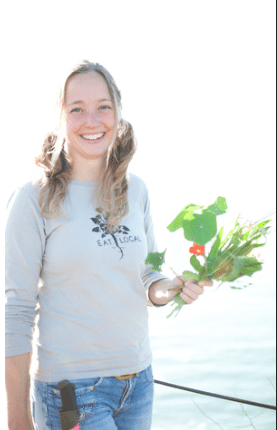
“We never called it foraging,” says Mia Andler, who describes growing up in Finland and eating plants and berries that she would find while exploring. “We just ate food from the forest.” When she moved to the United States 20 years ago, she was surprised to learn that few people did the same.
The Lagunitas resident teaches children a range of wilderness classes that include tracking, nature awareness and survival skills through her Vilda camps (named after a Finnish boat from her childhood—Vildanden, which translates to Wild Duck).
The soft-spoken naturalist moved from Tahoe to Marin In 2005 and enrolled in a naturalist training program called Kamana, taught by Jon Young at the Regenerative Design Institute in Bolinas. She describes the experience as life-changing, and it was there that she learned to produce her own food in and outside the garden.
What once appeared to her as a wall of green is now familiar, she says, and she has even learned to predict what types of plants will grow in any particular spot throughout the Bay Area.
Through her work with Sustainable Fairfax, Andler explains how she accidentally began teaching adults about foraging. “I offered a wild-food walk and over 40 people showed up!” She has been leading at least one walk a month ever since. With a deep commitment to sustainability, Andler is concerned that with the growing popularity of foraging, some might over-pick or harvest too much—not allowing plants to grow back and complete their natural cycle.
“The only way we are going to value plants is through education,” says Andler, who has co-authored a book titled, The Bay Area Forager: Your Guide to the Edible Wild Plants of the San Francisco Bay Area. Dedicated to the plants that feed us, the book features chapters that include a photograph of a specific plant, where it can be found, what it looks like and when it’s available. In addition, a recipe is provided along with a paragraph about sustainability and ways in which readers can be sure the plant or tree will continue to flourish after fruit or leaves are picked.
Andler has another book in the works that will focus on edible and useful gardens that don’t require a lot of “inputs.” She wants to show folks how to bring foraging to their homes, and offer tools for readers to create usable and purposeful gardens. For now, Andler will continue teaching her mindful brand of nature awareness. She hopes that folks will consider their interconnectedness to the land and only eat what they find on the trail—leaving some behind for others.
by Richard von Busack
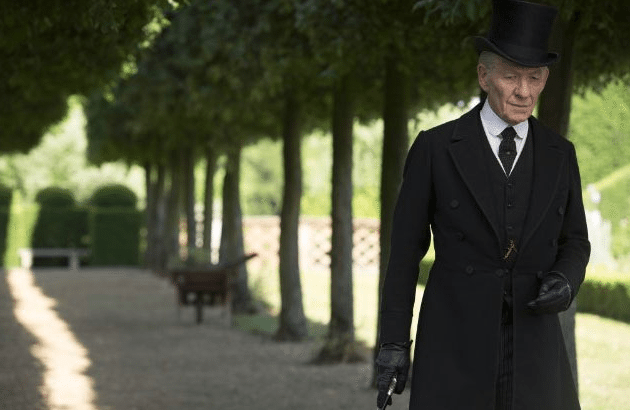
When you see Sherlock Holmes’ name, you expect adventure and danger, not a memory piece, which is why there’s something disconcerting about Mr. Holmes. In director Bill Condon’s new film, the beloved detective faces his ultimate adversary, old age, and it’s one struggle he cannot win.
Based on the novel A Slight Trick of the Mind by Mitch Cullin, Mr. Holmes is a reunion for Condon and Ian McKellen, who last worked together on 1998’s Gods and Monsters. Set in 1947, Mr. Holmes tells of Sherlock’s retirement in the country as a beekeeper. He’s tended by an impatient cook, Mrs. Munro (Laura Linney), and her brainy, fatherless son, Roger (Milo Parker).
Holmes has just returned from an arduous trip to Japan with some foul root called “prickly ash” that may fight the coming of senility. He focuses his waning abilities on solving two final cases. One is the question of what is killing his bees. The second is the account by his last client of events that happened three decades earlier—a story fictionalized and given a happy ending by Dr. Watson. Holmes cannot recall the real outcome, despite certain sharp memories of a lady’s gray glove and the trilling of a glass harmonica.
McKellen is 76 and appears very hale in flashbacks to the 1920s, where we see him swinging his walking stick with brio. These scenes alternate with shots of the detective looking blank and ape-like as the vacancy of mind strikes him. This is an acute, bravely unsentimental portrait of decay that’s as tough to watch as it is impossible to turn away from.
Mr. Holmes is a touching and elegant film with a deep, pellucid poignancy softened by Carter Burwell’s soundtrack. There’s nothing pandering about McKellen’s foxy yet affecting performances, both as the sage in his 60s, who fails to see a clue in plain sight, and the 90-year-old recluse with a crumbling mind.

by Amy Alkon
Q: I just broke up with my girlfriend of seven months. We fought constantly, but the sex was amazing. Reviewing my relationships, it seems I have the best sex in the volatile ones—those where we argue all the time and really don’t get along. I’m wondering whether there’s a connection between anger and sex.—Just Curious
A: Sex can be a form of peacekeeping, since your girlfriend can’t be screaming that you loaded the dishwasher wrong if she’s screaming, “OHGOD! OHGOD! OHGOD!”
But is there a thin line between longing and longing to throttle someone? Justin Garcia, an evolutionary biologist at The Kinsey Institute, told me that “in general, relationship satisfaction and sexual satisfaction seem to correlate.” In other words, when your love life is in the toilet, your sex life is quick to join it for a swim.
That said, Garcia says there’s some evidence for a “subgroup of people who can have very volatile relationships but very passionate sexual lives together.” This seems to have something to do with the body’s response to stress. (Researchers call this stress response “arousal”—which is cute, because it’s erotic on the level of having a condominium placed on your chest.)
Sex researcher Cindy Meston and evolutionary psychologist David Buss explain in Why Women Have Sex that a stressful situation activates a “fight or flight” reaction in the sympathetic nervous system, making your heart race and your blood pressure zoom, and leading your brain to release norepinephrine, a brain chemical that, molecularly, is the first cousin of speed.
This helps explain why prolonged activation of the sympathetic nervous system—as in, prolonged stress or anxiety with no physical outlet—can be physically unbearable. Many who regularly experience this sort of stress-athon take anti-anxiety drugs like Xanax to calm down. But in Meston’s research on female arousal, some women found sex to be a substitute chill pill (and, depending on the partner, far less tedious than climbing six tall buildings on the StairMaster). Some women even reported that stress makes them feel turned on. Which makes stress sound like it has its sexy points—that is, unless you’re a man, because sympathetic nervous system over-arousal is the body’s little erection-killer.
Seeing as this doesn’t seem to be a problem for you, when you’re in one of those boringly healthy relationships, sure, you could pick fights and hope that this leads to more exciting sex and not less sex, no sex, or no more girlfriend. Or … you could opt for a more positively energizing activity, like paintball, Super Soaker tag, or an intense pillow fight. Aerobic exercise and competition both boost testosterone—a libido picker-upper in both men and women. They also increase energy and arousal—and probably more so if you add a little playful goading and teasing to the mix. But, as Meston and Buss point out, what you should definitely avoid is the advice of many self-help books to “romance” a woman with soothing music, a bubble bath or a massage. Remember, you’re trying to get a woman in the mood, not put her in a coma: “Oh, baby, you make me so—wait … are you snoring?”
Q: My boyfriend of six months lives an hour away. We’ve had weekend overnights, but now he wants to come visit for an entire week. I’m super-excited but—don’t laugh—worried about his seeing me in my shower cap. (My hair takes 45 minutes to blow-dry, so I wash it only once a week.) My ex-husband used to make fun of me for wearing it, telling me how unsexy and stupid-looking it was. How do I introduce my boyfriend to this thing?—Embarrassed
A: Introducing your boyfriend to your plastic shower hat? Easy: “Hi, meet the end of your erections.”
Consider that there are lots of hot sex scenes in movies that take place in showers. Note that no woman in any of them is wearing a shower cap. This is not an accident or omission on the part of countless movie directors. Male sexuality evolved to be visually driven—and no, not by the sort of visuals that scare a man into thinking that he’s walked in on Aunt Bea. (And—nice try, shower cap manufacturers! Calling it “Bath Diva” or making it in an animal print doesn’t change that.)
Yeah, I know, it’s what’s on the inside that counts—but not if a guy doesn’t want to have sex with what’s on the outside. And by the way, it’s hard enough to find a romantic partner attractive over time. Do you really want to give your boyfriend a visual obstacle course? Instead, be open about your deepest hopes, fears and dreams—right before you lock yourself in the bathroom with the elasticized stepsister of the plastic grocery sack.
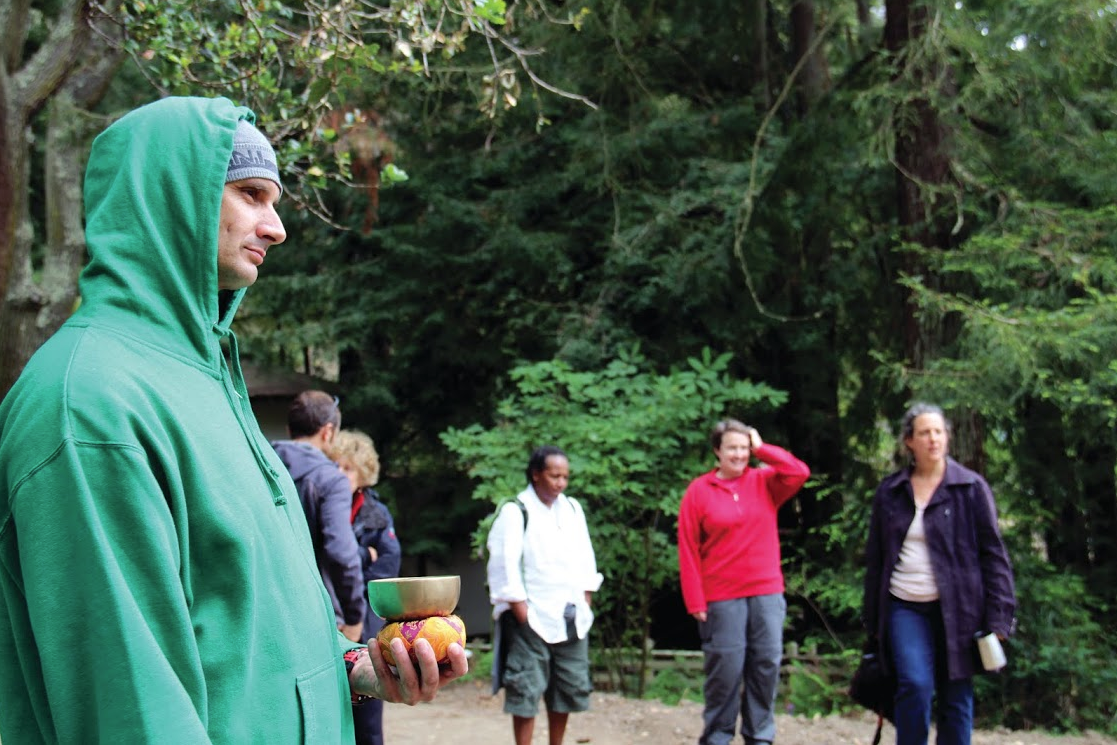
This week in the Pacific Sun, you’ll find our cover story, by Molly Oleson, on veterans finding inner peace through a mindfulness practice offered by the nonprofit Honoring the Path of the Warrior. Peter Seidman writes about a recent U.S. Supreme Court fair-housing decision, and Tanya Henry profiles local naturalist Mia 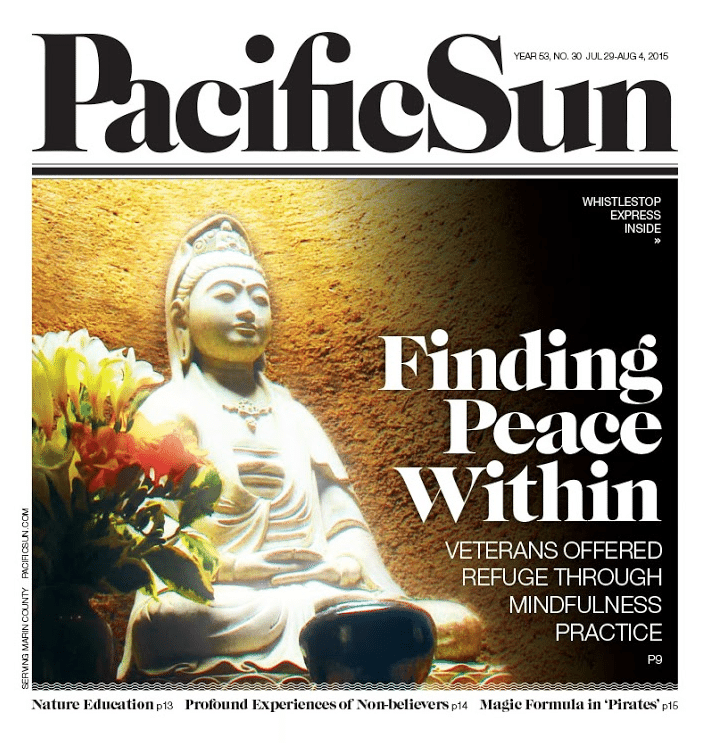 Andler. David Templeton gets more than he bargained for out of a talk at the Christopher B. Smith Rafael Film Center, and Charles Brousse reviews RVP’s ‘The Pirates of Penzance.” All that and more on stands and online today!

Story and photos by Molly Oleson
When it comes time for Aaron Tozier to share with the group how nature has helped him heal, he admits that he doesn’t get out much. “I tend to isolate myself a lot,” says the 6’4’’ 39-year-old U.S. Army infantry veteran who served from 2003 to 2009, including time in Iraq from 2005 to 2006. “I tend to sit around and feel sorry for myself.”
Today, a foggy morning in April, is not one of those days. He sits with other veterans and supporters of vets in a circle formation in a yurt nestled in a grove of tall eucalyptus trees at the Green Gulch Farm Zen Center near Muir Beach. A wood-burning stove provides warmth. The chirping and wood-pecking of birds fills the silence between words.
They’ve come for a one-day retreat for veterans who have served since 1990—offered by Honoring the Path of the Warrior (HPW), a nonprofit organization sponsored by the San Francisco Zen Center.
The theme of the day is “the healing power of nature,” and one by one, the participants share their stories.
One veteran remembers the bamboo plant that helped her through her long deployment. “I knew that as long as it was alive, I could be alive,” she says.
Another veteran talks of spending hours below the deck of a ship during her six years in the Navy, and describes the calmness she felt when she came above deck. “Man, if the ocean can be still, why can’t I?”, she would ask herself.
Honoring the Path of the Warrior was founded in 2008 by Lee Klinger Lesser, who has been leading workshops in sensory awareness for more than 30 years, and Chris Fortin, a spiritual counselor and psychotherapist. Both women facilitate the retreats, drawing on their experiences with people of different ages and backgrounds. Right before the U.S. went into Iraq, both protested the war.
“Here we were going into Iraq—and now these were people who were the age of my children,” Lesser says. “And I started thinking about—what would happen to my children if they were sent into war, and what would I wish for them when they were coming home? And I realized that I would wish for my kids some very safe, very safe, secure place where people knew how to hold a space to meet suffering. Because I couldn’t imagine you could live through a situation in war and not meet suffering.”
Lesser says that there were many things about the war that she could not change. But she knew that she had something to offer: Sensory awareness, a mindfulness practice that had been a refuge for her from a young age.
“It’s a practice where you can literally come to your senses,” she says. “You can come into your own body, instead of feeling like this is something you ignore.”
We hold trauma in our bodies, she says, and the tightness and the experiences of our bodies have a lot to teach us. Through sensory awareness, we can find a sense of connectedness, calmness and a sense of ease to know that things can change.
“You get located in the present moment when you’re connected to your breath, to your sensations,” she says. “And that’s really helpful when your mind is spinning out and you’re caught in memory. And so you can just keep coming back to being right here, and feeling what’s needed and how you respond.”
Whether the tools would be of interest to veterans, Lesser says that she had no idea. “But I trusted that if they were of interest, they would be helpful.”
Only one vet showed up to the first event that Lesser and Fortin offered. Over time, more and more found them, and helped them know how sharing the mindfulness practices could be accessible and meaningful to veterans. The words honor and warrior came up over and over again. Deep wounds—memories carried alone—were shared in intimate spaces.
“I’m learning all the time,” Fortin says of leading HPW. “My sense is that it is an active process, because returning vets are in an active process of trying to find meaning and grounding in what they carry for all of us.”
Mindfulness, it has been proven, has been effective in reducing stress, anxiety, depression, isolation and other difficult emotions that veterans struggle with.
A veteran who was involved in the beginning told Lesser, “You never feel more alive than when you’re at war.” The statement, Lesser says, was stunning, sad and uncomfortable. But she says that she also understood it. “Because there’s a kind of intensity and vitality and awakeness, because everything depends on it,” she says. “And actually, that’s kind of the essence of practice that you should be alert because this moment matters.”
Lesser, who once lived at Tassajara Zen Buddhist Monastery and now describes the intensity of need for sensory awareness among vets, recalls formal chants that were practiced right before days off: You should practice as though your head is on fire. You should practice as though you were a fish in a puddle of water.
“I feel like so many veterans are coming back, and their heads are on fire,” she says. “And they’re looking so much for some kind of comfort and refuge and source of healing. So there’s that kind of ripeness for soaking in practice.”
A Place of Healing
Fortin, along with her husband Bruce Fortin, a psychotherapist and mediator in private practice, take turns
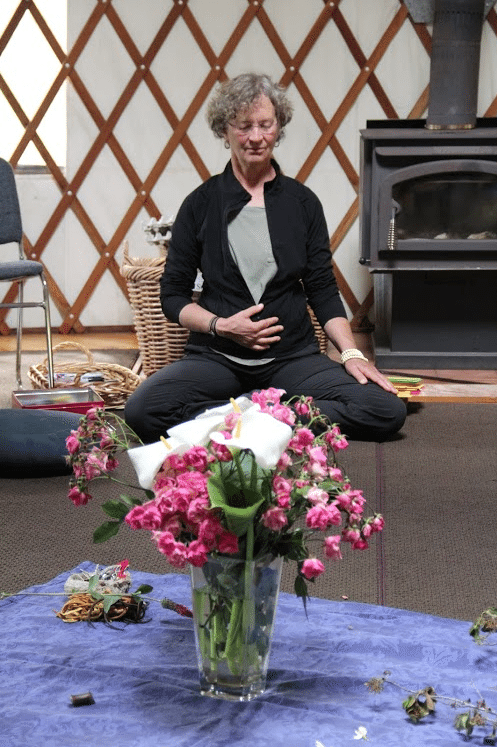
leading the day’s mindfulness exercises with calmness and grace. Green Gulch is a special place for them—it’s where they got married, and where their son was born.
Honoring the Path of the Warrior, Chris says, aims to create a safe space in which to be held and witnessed. There’s never a push to make people feel something. “There’s just a place to let yourself feel what’s there to be felt,” she says. “Gently. Over time.”
The Fortins alternate taking the lead, introducing vets to Qigong—an ancient Chinese practice that integrates postures, breathing techniques and focused intention—walking meditation and breathing exercises. “Practice letting thoughts go,” Bruce instructs, as the veterans close their eyes.
He tells them that they can use visualization and breathing to call in energy and let it sweep through their bodies. “Let that healing energy come in, and let your heart receive it.”
“Moments of grace” can happen when the mind begins to quiet, he says. It’s painful to study ourselves sometimes, he acknowledges. “Be open to how the universe comes forward to support you.”
The group stands up to do a meditation exercise that involves walking around the room. “Every time your foot touches the ground,” Bruce says, “see if you can feel the energy—you’re giving energy and you’re receiving energy. As soon as you aren’t aware of your feet, it usually means the mind has kicked in.”
Most times, he says, we can’t receive energy because we’re in the past, or the future, or we’re worrying about something.
“The world has all the magic you need right here in this moment,” he tells them. “All you have to do is be open to it.”
An exercise stirs up difficult memories for one of the vets, and she shares her feelings, head down, with the group.
“That last visualization was painful,” she says. “It brought a memory up—some grief I’m trying to avoid right now.” Bringing her knees up to hug, she begins to cry. Chris scoots over from her round cushion on the floor and places a supportive hand on the woman’s orange-and gray-striped sock. “But that’s probably why I’m here.”
Military Culture
“You have to have a specific mentality to sustain that lifestyle,” Jasmine says of being in the military. The 28-year-old Daly City native spent four years as a mechanical engineer aboard the USS Nimitz, the Navy’s oldest aircraft carrier. It was dangerous, she says, but she didn’t have time to think about that. “It’s very difficult to explain to people who haven’t been immersed in it.”
Jasmine, who recently moved to the Bay Area from Southern California, attended the Green Gulch retreat on the recommendation of Veterans Affairs in San Francisco. She had heard about meditation before, but she hadn’t practiced it. “I joined out of curiosity,” she says. What she found was an opportunity to slow down.
“There’s a mentality in the military where you have to carry things with you,” she says. “And keep on going. It fosters the idea of not taking time for yourself. Keep pushing towards the mission, keep pushing towards the goal.”
The retreat taught her that it’s important—and OK—to breathe. Since Green Gulch, Jasmine has participated in another HPW retreat—a five-day stay for women vets at Tassajara. “It was a huge turning point in my life,” she says of the rejuvenating experience.
“Some things I didn’t even know were there, were shared,” she says. “If the space is open, it opens your mind up to things you’ve filed away.”
Dyan Ferguson, a South African immigrant who joined the National Guard right out of high school in 1985 and who now works for HPW, shares some of Jasmine’s sentiments about the military.
“The day I left the military, I wanted nothing to do with it ever again,” Ferguson says, noting that while in it, she lived with her bags packed by the door, and a sense that her name was high on the list to go to the Persian Gulf or Bosnia. “You just live with this pressure,” she says. “They want you to think—they sort of teach you to think—that everything you do could have some life or death consequence.”

It’s hard to let that go when you leave the military, she says, when you don’t need to carry it anymore. Some people don’t want to let it go—they miss it when they leave, she says.
But for Ferguson, one of the most amazing things about the military was the strong sense of belonging that she felt.
Although she says it took years to “unravel” the internal conflicts that she had about her time there, she was grateful for the sense of community, and for the commitment to service—something that has deeply inspired Chris and Lesser.
It’s a bond over a shared experience that HPW vets understand. The ongoing mindfulness practice builds a strong sense of community. And it’s a community, Lesser says, in which many veterans are proud of their service, and grateful for it.
“There’s a sense of continuity and refuge that people can really depend on,” Chris says.
And mindfulness has a cumulative effect, Ferguson says. “The more you practice, the more effective it becomes.”
Bridging the Gap
Chris tells the vets at the beginning of the day how HPW started from the idea of trying to find some way to smooth the transition from military to civilian life.
“We both knew how much our practices had helped us transform and ground our own hearts and minds and bodies,” she tells them, of she and Lesser wanting to share with veterans.
Chris tells them that her father was a veteran of World War II, who was awarded the Bronze Star. He never talked about his time in the war, she says, but she could feel it. “I knew he was carrying something,” she says. And then she thanks them. “You’ve all helped me understand my own life and know him better.”
People can sit isolated in their lives, Lesser says, and not be touched by what veterans are left to carry. There’s a gaping space between military and civilian life, where stereotypes and assumptions live. People will sometimes approach veterans and ask them what the worst thing they saw was, and if they had killed anybody.
“I mean, just such a disconnect from what we’ve asked of human beings,” Lesser says. “And we’ve sent folks over there, and then we’re leaving them as though it’s their problem when they come back. And to me, that’s pretty disgraceful.”
Lesser hopes to share an understanding, appreciation and respect for what veterans are living. “We should all be carrying what they’re left with,” she says.
Every Moment is a Moment
Tozier says that joining the military was probably the best decision that he’s ever made in his life. It taught him discipline, structure, integrity—all of the things he says that he was lacking at the time.
“I went there with my eyes wide open,” he says of Iraq. “I knew what I was getting into. But it has affected me. It has affected me a lot.”
When he returned from combat in 2009, Tozier coped with coming back by drinking. When he realized that alcohol wasn’t working to ease his pain, he checked himself into a 90-day program with Veterans Affairs for PTSD and alcohol abuse.

“Today, I choose to deal with life with healthier activities,” he says, noting that he joined HPW on a river rafting trip three years ago, and has since been a part of at least 10 of the veteran retreats. His first experience with meditation, the rafting trip opened him up to something that he was once skeptical of.
“I am the last person I would ever expect to say, ‘I do meditation,’” Tozier, a self-described adrenaline junkie, says. “I’m just a macho kind of guy. Infantry. You don’t talk about your feelings; you don’t show emotion.”
The first time that Tozier saw people express sadness in the military, he says, was when his good friend, 26 years old and a father, was killed in combat. “That shook everybody up,” he says. But he doesn’t remember anybody talking about it. “It was more … I could see people crying. Just emotion.”
He remembers that there were civilian people there for them, if they wanted to talk. He didn’t. “I just wanted to be left alone,” he says.
About a month ago, Tozier got together with some fellow veterans for a 10-year anniversary. He saw his late friend’s widow and the daughter who lost her father. “It hadn’t really hit me that he’s gone,” he says, choking back tears, “until I saw his beautiful little girl.”
“It’s OK,” he says, his voice cracking, of expressing sadness. “It’s good for me.”
Tozier has learned, over time and with practice, to let himself feel things; to be mindful of the present.
“I have a tendency to get stuck in the past or to worry about the future,” he says. “Sometimes being in the present sucks. I’m full of anxiety, fear … my mind is going crazy.”
Honoring the Path of the Warrior, Tozier says, has taught him to concentrate on his breath to find freedom in the moment. “They’ve taught me that everything is OK in this moment,” he says of Lee and Chris, emphasizing the huge impact they’ve had on his life. “You can’t change the past. You can work on the past and try to deal with the experiences that affected your life in a negative way.”
When anxiety creeps in, he says that he reminds himself that “every moment is a moment.”
Tozier, who was awarded the Purple Heart from wounds received during combat, says that just being there at Green Gulch resonated the most for him. “It’s kind of like a different world down there,” he says. “It’s peaceful; it’s safe.”
He talks about lying down in the grass and looking up at the trees. “There’s no other place that I feel comfortable lying down like that, except in my room.”
The Paradigm
“I always tell people, ‘You’re never going to be the same.’” Lesser says that a chaplain who had been in the military for decades and deployed to many combat zones, once came to an event and said that.
“And that was really important when he said that,” she says. “You are never going to take these experiences out of you and be the same as you were before. But to find how you live with them and how you use what you have lived through to create more peace and connection in our world and more healing for other veterans—that’s very meaningful.”
Tozier participated in an HPW training to become a veteran leader at retreats because he felt like he had a lot to offer other vets, especially those coming in with skepticism of meditation and mindfulness, as he had. “If they’re open-minded enough, then it can help them as much as it’s helped me.”
Honoring the Path of the Warrior has plans to expand to other communities that have a desire to help veterans. Lesser and Chris hope to provide tools that veterans can use for the rest of their lives, and that they have a place to rest, to feel welcomed and seen as whole. “Our paradigm has always been to meet each person where they are, with acceptance. Unconditional acceptance, and regard and love,” Chris says.
Dyan says that if she hadn’t come across HPW, she might never have been around veterans ever again. “You know, because I rejected that so strongly when I left, it’s been great to be able to come back to it, and experience the good in it—which is that camaraderie and that fellowship and that loyalty and integrity of my fellow veterans,” she says. “That’s been really fun to just kind of reclaim that part of the experience–leave the rest behind.”
Leaving it Behind
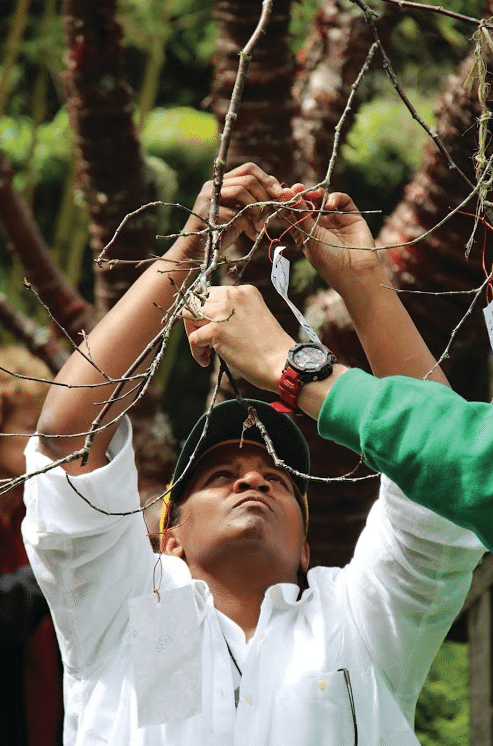
In one of the last exercises, the vets walk to the gardens and stop frequently along the path to observe and to breathe. Before leaving the yurt, Chris says, “See what opening yourself up to nature teaches you about yourself.”
To a tree, they tie handwritten messages that read, Let go of expectations, level, judgment.
Walk toward fear, beside or behind, not blocking the way.
Happiness is a choice.
Light. Kindness. Loving. Laughing. Living.
As the pieces of paper flap in the wind, the vets head back to the yurt. They place flower petals, tree branches and other offerings from nature on a blanket in the middle of the room.
The last exercise of the day is about reflecting on what they’ve learned. They split off into groups of two and three.
“I’ve never been a war person,” one vet admits to her partner in a soft voice—almost a whisper. “And I’ve got a lot of war years in me.”
She wears a necklace with a round pendant on which ‘Pace’—Italian for ‘Peace’—is engraved. She describes bouts of substance abuse and homelessness, where she chose to live in her truck because she liked the safety and the freedom that came with it.
“It’s hard,” she says. “I almost didn’t make it here today out of shame.”
She’s glad she did. Meditation, she says, is the one thing that keeps her sane. There’s a relief that comes with shedding the “cloak of anxiety.”
The woman she is paired with—who is not a veteran herself, but who was deeply affected by war when she was in the Peace Corps—looks her straight in the eyes. “You’re glowing,” she tells her.
“Thank you—I’m trying,” the vet says, nodding. Her smile is bigger than it’s been all day. “This feels like coming home.”
Meet staff and veterans from Honoring the Path of the Warrior at the French Garden restaurant in Sebastopol on August 2 from 1-2:30pm, or contact dy**@*************th.org about upcoming one-day events on Saturday, August 15 at Green Gulch Farm. Learn more at honoringthepath.org.

FOLLOW US
Copyright © Weeklys All rights reserved.
OUR PUBLICATIONS