Letter: ‘For all of us to enjoy’

Too bad

Too bad the coastal commission (which taxpayers support) has put a tradition for many families out of business [‘Sea change,’ August 5]. Unfortunately we all can’t afford to buy million dollar properties in California to enjoy the coast that is supposed to be there for all of us to enjoy! My family has enjoyed Lawson’s Landing for 40 plus years and now it is all being taken away! Shame on you Marin Co. and the Coastal commission!

Jan, via pacificsun.com

Letter: ‘Few people understand hunting … ‘

‘I want to thank you’

Dear Mr. Gogola,

I want to thank you for being balanced in your writing, ‘Open Season’ [August 5]. You were up front regarding the hunting laws in California. Few people understand hunting as a form of conservation; nor does the general public know about [how] the funds gathered from the purchase of licenses, tags, and hunting/ fishing paraphernalia directly impact the habitat restoration, wildlife research and hunter safety education programs.  

My husband and I instruct hunter education classes for the California Department of Wildlife. We emphasize both conservation and safety in our classes. Following the laws and making ethical choices out in the field is very important. When the season is open for a particular quarry, it doesn’t mean that you’re successful every time either.

California is not the only state to have “fair chase” laws. Each state does differ, but the different types of restrictions suit the needs for each region. To learn more, take a hunter’s education class.  

Thank you for taking the time to read my note.

Sincerely,

Janet P. Gookin

Letter: A life worth living

The secret to life

Somebody asked me last night if there was a secret to life and, if so, if I knew what it was. Strange conversation on the way home …

Anyways, I got to thinking about what it is that makes a life worth living and I came to a conclusion: A Life Worth Living Is About Knowing What You Live For. For some people it’s creating each individual note in a piece of music. For others it is about enjoying each and every facet of the savory taste of their favorite dish.

For others still it’s about family and sharing every special and magical moment with your loved ones while making memories and building legacies together. There isn’t any one specific or concrete solution that constitutes what it is that makes a life worth living. Simply know what it is you live for and allow your soul to embrace the very essence of your passions. There it is. The Secret To Life is that there isn’t a secret.

Scott

Letter: What do you advise?

Wealthy elites

Seems to me like all these technologies you describe are targeted at wealthy elites–the kind that Marin and Sonoma counties are full of [‘Charging ahead,’ August 12]. What do you advise those who must choose between these “green” technologies and putting their kids (or themselves) through school?

Mike Van Horn, via pacificsun.com

Advice Goddess

by Amy Alkon

Q: I’m a 20-year-old woman, and for three months last year, I dated a 21-year-old guy. Suddenly, out of the blue, he stopped returning my calls. I spent about a month trying to find out what had happened, but he wouldn’t respond to texts or email, either. Well, last week, I ran into him, and he said he’d just gotten really busy with school. He wants to date again, and I really cared about him, so I’m tempted.—Please Talk Me Out Of It

A: “Really busy with school,” huh? When … 150 years ago, when there were no phones in the one-room schoolhouse in Little House on the Prairie?

There’s playing hard to get, and then there’s being impossible to locate. The first is a canny strategy; the second is casual cruelty in action. In this case, after three months of dating, a breakup phone call (in lieu of face-to-face) would have been semi-appropriate. A text would have been better than nothing. A telegram would at least have had historical flair. Yet, there you were, repeatedly trying to track him down and getting the reception most of us give random collect calls from “guests” in the long-term bed-and-breakfasts known as federal prisons.

As for your toying with the absolutely absurd notion of dating him again, your slacker of a brain is partly to blame. Admittedly, our brains require a lot of energy to operate, so they like to take energy-saving shortcuts whenever they can. They do this with what I call “think-packs”—the brain’s version of those Lunchables combo boxes—prepackaged thinking sets that allow us to act automatically (without thinking through every last little detail). These come in handy when, for example, we’re dining and we can just pick up a fork and use it; we don’t have to wonder what a fork is and whether we use the pointy bits to stab the food or the person next to us.

But in psychologically complicated situations, these mental shortcuts can get us in trouble. Take the state that social psychologist Leon Festinger named “cognitive dissonance”—our simultaneously holding contradictory beliefs, such as, “He’s not that into me!” and, “He’d make a great boyfriend!” Well, the inconsistency makes us very uncomfortable, so our mind wants to smooth it out pronto. So, easy peasy, no problemo—it typically just up and erases whichever belief goes most poorly with our ego. Unfortunately, reality isn’t so simply dispensed with, and before long, “He’s not that into me!” is back and, “He’d make a great boyfriend!” is face-down in the storm drain behind the dive bar.

A way to avoid reality erasing is by getting in the habit of “metacognition”—basically, thinking about your thinking. The guy who came up with the term, developmental psychologist John Flavell, called it “a kind of quality control.” In this case, you unpack your thinking about this guy: “He’d make a great boyfriend!” and your wanting to believe that things could be different. Lay those out on the bed next to the facts—how he behaved—because what you do reflects who you are and what you’re likely to do in the future. In other words, what you can trust about this guy is that you can’t trust him to show even the most minimal concern for your feelings—not with even so much as a poop emoji goodbye.

Q: I’m a 28-year-old guy, newly single after the end of my relationship from college, and all of my dates have been busts. I ask girls out, and they say yes, but I must be doing something wrong on first dates, because I can’t seem to score a second one. Like, ever. They go out with me once, and goodbye. I’m a gentleman, enthusiastic, complimentary, affectionate. What could be the problem?—Puzzled

A: There’s a chance that you’re overdoing it in the Enthusiastic! Complimentary! Affectionate! department. (It’s good to keep a woman guessing a little, but not, “Am I on a date, or is this guy trying to enroll me in a pyramid scheme?”)

Consider “the principle of least interest,” sociologist Willard Waller’s term for how, in any relationship, the person who shows the least interest has the most power. Conversely, the person who comes on with all the subtle nonchalance of a “Cash For Gold!” sign-spinner—especially before they even know the other person—has the aura of a needy suck-up.

Try something: Cool it on your next five dates. This doesn’t mean acting catatonic. It just means waiting to see whether a woman actually is exciting and worth getting to know—as opposed to being excited by her mere presence: “Wow—to be out with a real woman! I usually just have candlelit dinners with a pillow with a wig on it!”

Film: Coming of age

0

by Richard von Busack

For the evocative, if sweetened, adaptation of Phoebe Gloeckner’s semi-autobiographical novel Diary of a Teenage Girl, director Marielle Heller cast British actress Bel Powley. Powley, 23, plays Gloeckner’s 15-year-old heroine Minnie Goetz. Rounded and fragile, with big yearning eyes, she looks childishly rambunctious as she stands on a hassock or bounces on a bed to admire the details of her room.

Minnie’s first lover is her mother’s boyfriend, Monroe (Alexander Skarsgard), a perfect representative of this certain time and place (San Francisco in the 1970s), when the fanciest men were not expected to do all that much, either in the realm of work or love. The first-person point of view belongs to Minnie, even as all the power in her first sexual relationship is held by Monroe.

It’s scandalous material, but Heller takes the sensationalism out of this not untypical memoir. In interviews, Gloeckner—a memoirist and cartoonist of great merit—has kept busy explaining why the scandal isn’t in the statutory rape; the real shame, she stresses, is in the way the liaison broke up the trust between daughter and mother.

Minnie’s very ’70s, laissez faire mom, Charlotte, is played by Kristin Wiig, and her performance proves again why she’s one of the most important actresses working today. When the cat is finally out of the bag, Charlotte interprets this betrayal in terms of a mother’s traditional outraged decency, demanding that the scoundrel marry her daughter.

Anyone who dawdled through that dangerous time of the 1970s, especially as a teenager, will see a reflection of their own experiences. They’ll remember things they swore they’d never forget, and somehow did.

Food & Drink: Commitment to community

by Tanya Henry

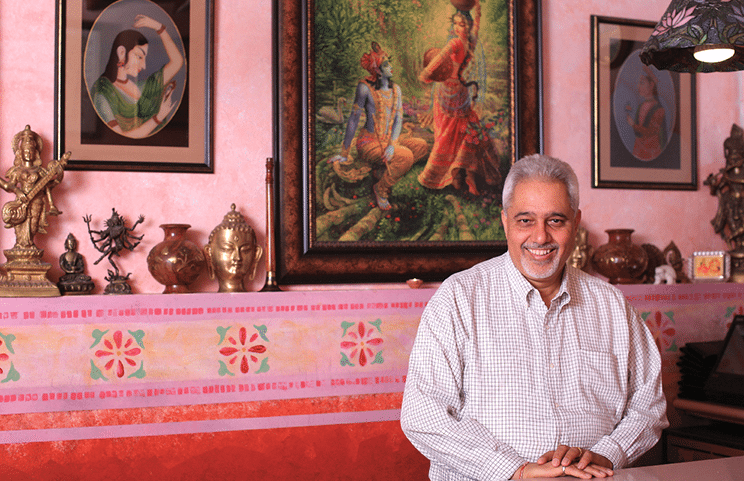
“I like to give—it’s good for the karma,” says the man who has been feeding Marin residents his northern Punjabi-style Indian cuisine since 1998. Novato resident and restaurateur Surinder “Pal” Sroa currently oversees three restaurants and a store in the North Bay and has a couple more in the works in Hercules and San Francisco.

For many folks who live in Fairfax, Café Lotus is the go-to spot for tasty chicken tikka masala, vindaloo, tandoori and piping hot naan. Their mango lassis are kid-pleasers, and the Navarro wines by the glass are popular with parents. A regular at this tiny spot ever since it opened more than seven years ago, I’ve watched the owners progressively incorporate organic ingredients, offer gluten-free items and bring in biodynamically farmed wines.

“We are going in a different direction,” explains Sroa, who says that his wife Linda of 33 years has long encouraged him to serve organic and sustainably sourced food. Getting green-certified was a recent achievement for Sroa, and perhaps most important of all is his commitment to the community. “We work with the organization ExtraFood.org and I don’t give them my leftovers—they get the best we have just like everyone else,” says Sroa, who has worked with the Novato School District to provide school lunches, and frequently donates food where it is needed.

While Sroa is from the northern Punjab region of India, his Lotus Chaat & Spices (café and store) offers southern Indian dishes that include dosa and bowls of sambar. The flavors are different here—lighter and tangier than at Café Lotus, and lentils and chopped onions appear in most dishes. The open space has more than 15 tables and a large outdoor eating area. Shelves of dried imported Indian spices and frozen pre-made meals fill the aisles.

Sroa credits his family with much of their success. His son manages the Fairfax café, while his nephew Amba has worked at the flagship restaurant, Lotus Cuisine of India on Fourth Street in San Rafael, since it opened in 1998. “My son Jyoti is my biggest competition,” Sroa jokes.

Sroa makes the rounds between all of the restaurants, but is currently spending much of his time in San Francisco—he hopes to open his next café at 20th and Mission streets this year. Though Café Lotus in Fairfax is my personal favorite, Sroa, with his delicious food, mindful practices and strong commitment to giving back, succeeds in nourishing his customers and community wherever he goes.

Café Lotus, 1912 Sir Francis Drake Blvd., Fairfax. Learn more at cafelotusfairfax.com.

Hero and Zero: Props, CHP and Boo, AT & T

by Nikki Silverstein

Hero: Remember what terrible drivers we were during our teen years? Those risky maneuvers and lack of judgment causing near misses? If you made it through those early driving years unscathed, bravo, because not everyone was so lucky. The leading cause of death among American 15-to-20-year-olds is car collisions. The California Highway Patrol (CHP) in Marin is taking a proactive stance to help prevent accidents by offering a free “Start Smart” class. The goal is to help young drivers and parents understand the responsibilities associated with driving and how poor choices behind the wheel can change the lives of everyone involved. The class will be held at the CHP office in Corte Madera on Wednesday, August 26 at 7pm. RSVP by calling 415/924-1100. Thanks, CHP.

Zero: Though AT&T promises to “Remobilize Your World,” that only seems to work if you remain immobile. Dr. Ann Troy, a well-loved Marin pediatrician, closed her office in May to join a Terra Linda practice in June. Patients were notified of the move; however, some didn’t receive the letter. As a backup measure, Dr. Troy arranged with AT&T that callers to her old number would hear a message giving the new number. Instead, the communications company cut off service and callers heard, “This number has been disconnected.” It took five weeks of repeated calls to AT&T and the threat of a lawsuit to remedy the problem. Frustrating process. Let’s all take a deep breath, exhale and write down Dr. Troy’s new number: 415/479-8642.

Theater: Comic effect

1

by Charles Brousse

Seldom, if ever, do critics sitting in the darkened audience writing unreadable notes to themselves, get a chance to become part of the evening’s entertainment. It happened to me last week in Dominican University’s Forest Meadows Amphitheatre, where Marin Shakespeare Company (MSC) is presenting the second of its 2015 summer festival productions, a new theatrical version of Miguel de Cervantes’ famous early 17th century novel, El Ingenioso Hidalgo Don Quijote de la Mancha, now simply re-titled Don Quixote.

Seated with my companion, third row center, I was scribbling comments when I heard the audience burst into laughter. Ron Campbell, the actor playing the Spanish Don had leaped from the stage, clambered over the intervening rows and was about to take a seat beside me. With a flick of the wrist, he launched my press envelope into the darkness, snatched the note paper from my hands, wrote on it, handed it back and returned to the stage. When I looked at what he had written, it read, “Ron Campbell is great!”

Now, it’s true that over the years I’ve chided MSC for continually sending actors into the audience, where they take a bite out of someone’s sandwich, drink another’s wine, or sit in an unwitting ticket-buyer’s lap. It’s a repetitive shtick, and the comic effect wears off after you’ve seen it a few times. That it happened to me doesn’t make it more defensible, but the crowd’s laughter was genuine and the episode provided me with the theme for this review—namely, that Ron Campbell is indeed GREAT (emphasis mine), and those who value fine acting should hustle out to Forest Meadows during the play’s final weeks to see for themselves.

Campbell’s forte is clowning, but it’s not the American clown. No fat suit, chalky skin, bulbous red nose and spontaneous pratfalls. His is the more subtle European style that establishes a character through posture, movement, facial expressions and mime. Don Quixote, the mentally confused would-be knight errant who wanders the arid wastes of Central Spain’s La Mancha district on a broomstick horse with a watering can for a head, is looking for heroic deeds that will win the favor of his imaginary “Lady.” Dulcinea (actually the daughter of a village pig farmer), is the perfect vehicle for this approach.

Of course, Campbell is not the whole show. Director Lesley Schisgall Currier moves the action along smoothly, although—with a running time of two hours plus—the adaptation by Canadian writers Peter Anderson and Colin Heath (this is its U.S. premiere) might have benefited from some trimming, especially in the more wordy second act. John R. Lewis is a solid Sancho Panza, the Don’s faithful (though skeptical) “squire.” Cassidy Brown and Rick Eldridge are fun to watch as a kind of village chorus, and the remainder of the ensemble holds its own. David Poznanter’s half-masks create a commedia atmosphere that suits the production style, and Billie Cox’s flamenco-flavored music adds an authentic touch.

In sum, even in the midst of our drought, MSC’s Don Quixote is worth a visit to the even drier plains of La Mancha—but watch out if you sit third row center with note paper in your hands. You might have a visitor!

NOW PLAYING: Don Quixote runs through August 30 at the Forest Meadows Amphitheatre, Dominican University, San Rafael. For more information, call 415/499-4488, or visit marin shakespeare.org.

Upfront: Highway to shell

0

by Tom Gogola

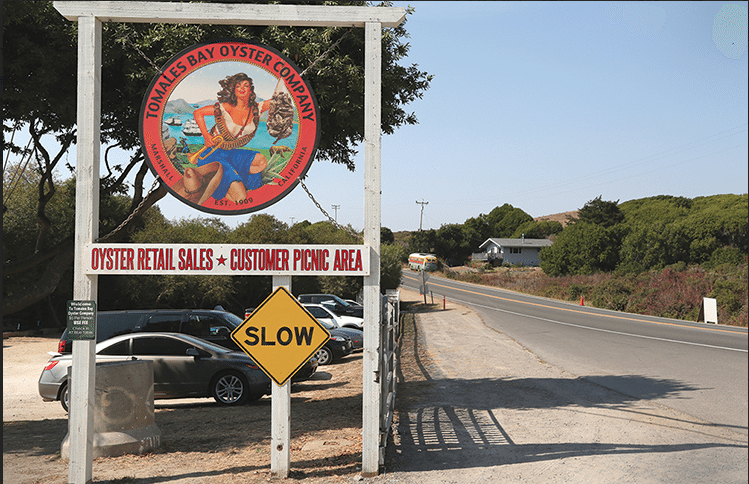
Anyone who’s ever driven up scenic Highway 1 through Marshall on a weekend knows this: The parking scene at the Tomales Bay Oyster Company (TBOC) is chaotic.

Cars are everywhere along the road, some swinging U-turns as they try to park, people toting coolers in the road—and just a few young, for-hire parking assistants on hand to try and manage an increasingly unmanageable scene.

Nobody denies that it’s an accident waiting to happen, least of all Tod Friend, the majority owner of the popular bayside picnicking destination, where the oysters flow freely (but not for free) and visitors are mightily encouraged to carpool, given a traffic picture that often finds dozens of cars lined up along the highway.

“People are always trying to do U-ies, the speed limit is 55—it is a little bit snarly,” says Friend. “It really hasn’t played out that there’s these terrible consequences, but someone can get hit, and we know that.” Friend stresses that there’s been a “total of three collisions” associated with the snarly parking scene.

The retail and commercial oyster-harvesting operation is going through changes it hopes will help it expand business, even as it works to make the highway safer for all who would drive it.

“They have troubles at land and at sea,” says Marin County Supervisor Steve Kinsey, who also sits on the California Coastal Commission (CCC). At the land-bound county level, Kinsey says that the business’ use permit “does not permit anywhere near the level of activity that they undertake on that site.”

The coastal commission and lawyers for the oyster company are meanwhile in litigation over TBOC’s coastal development permits and whether it should be able to reclaim portions of bayside oyster grounds it once owned. The gist of their argument, says Friend, is that TBOC predated the emergence of the California Coastal Commission and may not be “subject to a permit with the CC.” G’luck with that.

The troubles at TBOC began in 2012, says Friend, when the facility hosted a theater event. “It came to pass that there was a complaint filed against us for having a little theater conducted here on a summer evening,” he says.

The Marin County use permit for TBOC dates back to 1987, says Friend, and stipulates a few conditions that the operation has outgrown as its popularity has increased.

The permit allowed for the retail operation to run Friday through Sunday; the operation could hire a maximum of eight employees, and only one full-time resident was allowed on the property.

Yet by 2012, Friend says, “we were operating seven days a week, and we were not supposed to be doing that. We have more employees. So the county wanted to start from scratch, they wanted to take it from the top. We said, ‘Fine, we’d like to do that.’”

Friend says TBOC has tried numerous times to sort out the traffic problem. First, the company tried to take over an underused nearby parking lot owned by the state. The state said no-go.

For a while, they parked cars on a parcel owned by the federal government. The feds put the kibosh on that parking lot.

Friend then rented out the West Marin School parking lot, in Point Reyes Station, between Memorial Day and Labor Day, and provided a shuttle.

“None of that worked,” says Friend. Finally, the company purchased a 26-acre lot across the highway from the main oyster shack and hopes to use it for parking—but that’s by no means guaranteed.

“We sought out some idea from the county that they’d give some permission, give us the thumbs-up—so we bought it, and it’s the centerpiece of our proposal with the county.”

Problem is, the 26 acres are zoned as an “agricultural protection parcel.” Kinsey says the county recently sent Friend a letter that indicated TBOC “is not going to build large parking lots in the ag zones.”

The Marin County Planning Commission will take up the parking plan on September 17.

“The 26 acres pretty much speaks to the parking issue,” says a hopeful Friend.

Kinsey notes that he’s a big fan of the West Marin oyster economy and wants to help sort out TBOC’s intersection of growing pains: “We want to support oysters, oyster growing and oyster entertainment.”

And why shouldn’t he? Oysters represent a huge draw for the county. Friend says that the recent closing of Drakes Bay Oyster Company has naturally meant a spillover crowd to his business—that’s 50,000 Drakes Bay visitors a year whose options for al fresco oysters, he says, are now Tomales Bay Oyster Company or Hog Island (and, we’d add, the Marshall Store).

Friend notes that the biggest groups to visit TBOC are Asian-American weekenders, and he’s worked mightily to manage the traffic they bring with them. “Half of our customers are Asian-Americans from the East Bay,” says Friend. “Nobody in the world loves shellfish like the Asian and the Latino populations. The people who are the least avid about the oysters are the Caucasians, but they come out for the picnicking.”

The oyster company enacted a reservation system, says Friend, “to try and control the traffic and the parking.” But that didn’t work, even though Friend says reservations came with “a long discussion from us about how you had to come by a bus or a van.”

Instead, the reservation system only encouraged more cars to the site. “It didn’t help with the number of cars,” says Friend. “It went the other way. So we’ve gone away from reservations. Now it’s first-come, first serve. But we tell the big parties: You have to come by bus.”

The parking snafu, says Friend, sees up to 100 cars parked along the road on the weekend. “That has been the subject of some complaint and concern in Marshall,” says Friend.

Kinsey says he’s surprised at the absence of California Highway Patrol (CHP) officers at TBOC to direct traffic or write tickets.

“It shocks me that CHP hasn’t been more formidable,” says Kinsey. He adds that it’s not like the officers aren’t writing tickets already. “I hear from single-family homeowners in Marshall who get nailed by CHP for backing into the roadway from their homes.”

Friend says that the CHP does come to the facility, but only on “a couple of occasions” to write tickets.

CHP Public Information Officer Andrew Barclay says part of the law enforcement problem is TBOC’s location at the far-northwestern edge of Marin County. Unless there’s a call for service or a specific complaint, Marin-based state police don’t make it out there too often. That’s especially so on the weekends when, says Barclay, there’s only one or two CHP officers on patrol in all of West Marin—and an increasing number of collisions to contend with. Still, says Barclay, “we are aware of the parking problem up in that area. It’s on our radar . . . but we don’t have the resources to station one officer at the TBOC.”

In any event, the CHP officers who do head to TBOC are more likely to enjoy the scene than write tickets, says Friend. “We’ve got CHP guys who come without their uniforms, and come for a picnic,” says Friend.

No problem there, says Barclay, so long as everyone understands that those officers are off-duty. “What officers do in their spare time, that’s their business.”

Letter: ‘For all of us to enjoy’

Too bad Too bad the coastal commission (which taxpayers support) has put a tradition for many families out of business . Unfortunately we all can’t afford to buy million dollar properties in California to enjoy the coast that is supposed to be there for all of us to enjoy! My family has enjoyed Lawson’s Landing for 40 plus years and...

Letter: ‘Few people understand hunting … ‘

‘I want to thank you’ Dear Mr. Gogola, I want to thank you for being balanced in your writing, ‘Open Season’ . You were up front regarding the hunting laws in California. Few people understand hunting as a form of conservation; nor does the general public know about the funds gathered from the purchase of licenses, tags, and hunting/...

Letter: A life worth living

The secret to life Somebody asked me last night if there was a secret to life and, if so, if I knew what it was. Strange conversation on the way home … Anyways, I got to thinking about what it is that makes a life worth living and I came to a conclusion: A Life Worth Living Is About Knowing...

Letter: What do you advise?

Wealthy elites Seems to me like all these technologies you describe are targeted at wealthy elites–the kind that Marin and Sonoma counties are full of . What do you advise those who must choose between these “green” technologies and putting their kids (or themselves) through school? —Mike Van Horn, via pacificsun.com

Advice Goddess

advice goddess
by Amy Alkon Q: I’m a 20-year-old woman, and for three months last year, I dated a 21-year-old guy. Suddenly, out of the blue, he stopped returning my calls. I spent about a month trying to find out what had happened, but he wouldn’t respond to texts or email, either. Well, last week, I ran into him, and he said...

Film: Coming of age

by Richard von Busack For the evocative, if sweetened, adaptation of Phoebe Gloeckner’s semi-autobiographical novel Diary of a Teenage Girl, director Marielle Heller cast British actress Bel Powley. Powley, 23, plays Gloeckner’s 15-year-old heroine Minnie Goetz. Rounded and fragile, with big yearning eyes, she looks childishly rambunctious as she stands on a hassock or bounces on a bed to admire...

Food & Drink: Commitment to community

by Tanya Henry “I like to give—it’s good for the karma,” says the man who has been feeding Marin residents his northern Punjabi-style Indian cuisine since 1998. Novato resident and restaurateur Surinder “Pal” Sroa currently oversees three restaurants and a store in the North Bay and has a couple more in the works in Hercules and San Francisco. For many folks...

Hero and Zero: Props, CHP and Boo, AT & T

hero and zero
by Nikki Silverstein Hero: Remember what terrible drivers we were during our teen years? Those risky maneuvers and lack of judgment causing near misses? If you made it through those early driving years unscathed, bravo, because not everyone was so lucky. The leading cause of death among American 15-to-20-year-olds is car collisions. The California Highway Patrol (CHP) in Marin is...

Theater: Comic effect

by Charles Brousse Seldom, if ever, do critics sitting in the darkened audience writing unreadable notes to themselves, get a chance to become part of the evening’s entertainment. It happened to me last week in Dominican University’s Forest Meadows Amphitheatre, where Marin Shakespeare Company (MSC) is presenting the second of its 2015 summer festival productions, a new theatrical version of...

Upfront: Highway to shell

by Tom Gogola Anyone who’s ever driven up scenic Highway 1 through Marshall on a weekend knows this: The parking scene at the Tomales Bay Oyster Company (TBOC) is chaotic. Cars are everywhere along the road, some swinging U-turns as they try to park, people toting coolers in the road—and just a few young, for-hire parking assistants on hand to try...
3,002FansLike
3,850FollowersFollow