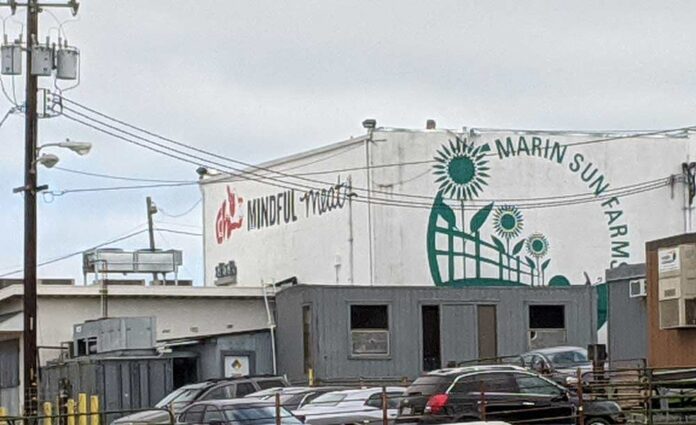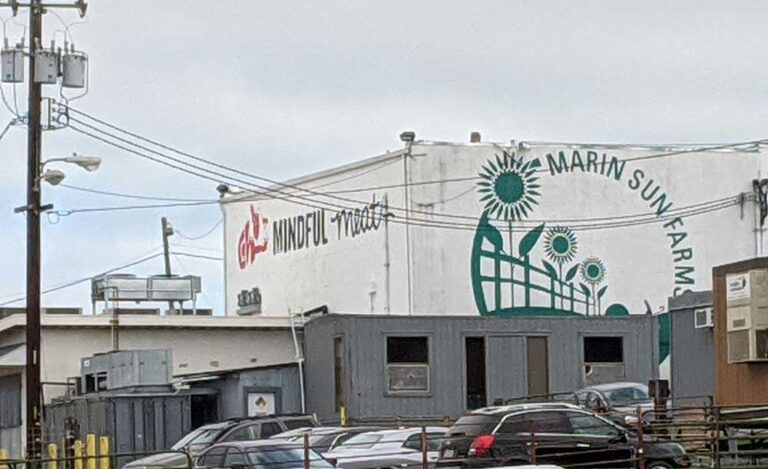
Slaughterhouse-2.0

North Bay ranchers face a new challenge after the owner of the region’s last slaughterhouse announced last year that it will no longer process meat from small, independent producers.

The news comes five years after a Marin County rancher, backed with investment from a Silicon Valley businessman, saved the slaughterhouse from closing.

In February 2014, the United States Department of Agriculture (USDA) announced a recall of 8.7 million pounds of meat processed at a Petaluma slaughterhouse owned and operated by Rancho Feeding Corporation over the previous year. 

“[Rancho] processed diseased and unsound animals and carried out these activities without the benefit or full benefit of federal inspection,” a USDA press release from the time states.

The news hit the local food community hard. After decades of consolidation within the meat-processing industry, Rancho operated the last USDA-approved slaughterhouse in the Bay Area, a wealthy region full of health-food fanatics.

In a March 1, 2014 New York Times opinion piece, Nicolette Hahn Niman, the co-owner of Niman Ranch, explained some of the inter-related problems facing the industry. 

“From 1979 to 2009, California went from having 70 slaughterhouses to 23,” Niman wrote. “Because it is more complicated and costly to do so, nearly all large facilities refuse to work with smaller farms. This makes slaughtering the most serious bottleneck in the sustainable food chain.”

Shortly after the USDA’s recall announcement, David Evans, the owner of Marin Sun Farms, swooped in to save the slaughterhouse from closure. According to press coverage from the time, Marin Sun Farms received financial backing from Ali Partovi, a Silicon Valley investor who had taken an interest in local agriculture several years earlier.

In April 2011, Patrovi wrote an article for TechCrunch laying out his thoughts on the organic food industry titled “Food Is The New Frontier In Green Tech.”

“Like energy, food and agriculture are big, slow, and highly regulated sectors,” Partovi wrote. “But also like renewable energy, there might be opportunities for innovation and profit in ‘renewable food,’ fueled by consumer preference today and by shifts in policy tomorrow.”

Between 1990 and 2009, the organic-food market in the U.S. grew from $1 billion to $25 billion, Partovi noted in the article.

“The biggest obstacle impeding Marin Sun Farms’ growth today is inadequate capital,” Partovi wrote. “It cannot secure land, water, and animals fast enough to meet the growing demand. This dynamic reminds me of the early days of [the online shoe sales company] Zappos, when Tony Hsieh was desperately seeking capital to secure shoes fast enough to meet the growing demand.”

For almost five years, Marin Sun Farms continued to serve small producers as promised. But last fall, Evans informed independent producers that the slaughterhouse would no longer be able to serve them. 

In November, Claire Herminjard, Evans’ wife and business partner, told the Petaluma Argus-Courier that the cannabis industry has caused the company’s labor costs to increase.

Sarah Silva, farm manager at Petaluma’s Green Star Farms, which produces eggs, chickens, pigs, lambs and more, says Marin Sun Farms’ announcement reinvigorated a conversation about finding an alternative solution for small-scale, USDA-approved meat processing.

“This might be a blessing in disguise,” she told the Bohemian.

Get Boont

The little wine weekend formerly known as the International Alsace Varietals Festival is back from its “gap year.” And, if chardonnay’s your thing, the rechristened Winter White Wine Festival is better than ever.

Held in February, down a long and twisty drive from the rest of Wine Country and celebrating a bunch of misfit grapes, the Anderson Valley Winegrowers Association hatched this unlikely event as a counterpoint to the growing success of their pinot noir. The varietal stars of this sideshow are gewürztraminer, riesling and pinot gris—white, aromatic wines traditional to the Alsace region of France. They’re a big part of the valley’s heritage, but they’re being rooted out by the red king of burgundy.

“You can’t have a festival with six producers,” says Joe Webb, winemaker at Foursight Wines. So, the winegrowers changed the rules to include all white wines—chardonnay, viognier, ribolla gialla.

Now, Foursight can join their neighbors and show off their estate-grown 2018 Charles Vineyard Sauvignon Blanc ($27), which should pique the interest of Loire buffs with its stone-dust and stone-fruit aromas, with a twist of lime.

Up the street, new-kid-in-town Bee Hunter Wine balances their pinot-noir menu with a leesy, grapefruity sauvignon blanc, but also a slightly fizzy 2015 Wiley Vineyards Riesling ($24) that cofounder Ali Nemo says is a particularly big hit among the wine-bar trendsters of San Francisco.

Frizzante or not, most riesling in the valley is dry, not sweet. That’s still big news for most visitors, says Natacha Durandet of Phillips Hill Winery. They come in with old “Blue Nun” wine stereotypes from the 1970s, but after tasting the juicy-but-subdued 2018 Anderson Valley Riesling ($26), say, “Wow, this is not sweet; this is nice.”

Early birds get the scoop on riesling Saturday morning, when John Winthrop Haeger, author of Riesling Rediscovered: Bold, Bright, and Dry, leads a panel discussion and wine flight on the question, “Why Riesling?”

“Some wine-grape varieties have relatively uncomplicated stories and there is consensus about their attributes,” Haeger explains. “For better or worse, this is not true of riesling. Its history and attributes are longer stories. The panelists will be asked how those longer stories affect riesling’s image, popularity, marketability and economic viability.”

Newfound riesling fiends will be pleased that the Grand Tasting still brings in notable producers from places afar, including Germany, Finger Lakes, Central Coast and Oregon.

Winter White Wine Festival is Saturday and Sunday, Feb. 22–23, at the Mendocino County Fairgrounds, 14400 Hwy. 128, Boonville. 9:15am to 3pm. Tasting, $95; seminar, $50. www.avwines.com.

Pushback Time

Call them Sonoma County’s best-known marijuana-istas. Erich Pearson, Alexa Wall, Erin Gore, Ron Ferraro and Dennis Hunter are among the most outspoken activists in an industry that long encouraged its members to be faceless and nameless, stay under the radar and keep out of jail.

These five industry movers and shakers have put aside their differences and come together to create the Cannabis Business Association of Sonoma County (CBASC), an organization that aims to bolster an industry hard-hit by local regulations and undermined by county officials who want Sonoma to be known for grapes and wine and not for weed. Anyone in the hemp industry or the cannabiz can join.

Now, it’s pushback time. When asked why she and her cannabis comrades joined forces and now serve as CBASC’s Board of Directors, Wall—the CEO at Luma California and the Cofounder of Moonflower Delivery—says, “Rising tides lift all boats!”

In part, CBASC (www.cbasc.org) is an act of desperation. It’s now or never for the struggling Sonoma County cannabis industry. Naysayers think it’s already too late to save cannabis here, though Pearson, Wall and Company haven’t given up hope.

“We’ve all agreed to tackle the county’s failed cannabis program,” Wall says.

Pearson, CEO of SPARC, adds, “We will make Sonoma County the example of sensible cannabis regulation.”

Gore, the CEO at Garden Society, feels it’s essential for CBASC to “educate the policymakers” and for the organization to become a model of “trust and transparency.”

Ferraro, the CEO at Elyon, captures the mood of the moment when he says, “this is a scary time to be a cannabis professional; many in our industry are failing just as they begin.”

Hunter, the cofounder and CEO of CannaCraft, says, “Unless the county moves quickly to address the flaws in the program, we can expect to see a migration back to the illicit market.” 

Hey, Hunter, that’s already happened, as you surely know.

Joe Rogoway, the pro-bono legal counsel for CBASC, emphasizes the all-important need to “amend the county’s ordinance and align local regulations with state law.”

 Jonah Raskin is the author of “Dark Day, Dark Night: A Marijuana Murder Mystery.”

#DeleteFacebook

0

I’ve been recovering from a recent bout of digital marketing. I don’t want to go into where or how I got it, just that it’s left me itchy in that way that creative types get because we needed the money. This sounds more venereal than intended, but then, courting a certain virality was part of the gig. 

The scratch for this itch? Maybe some old school Internetting. Hmm. Remember when blogs were a thing? Did it. Email newsletters? Clicked “here” to unsubscribe. I’ve been off and on the podcast ride enough to admit it the siren song was really just loving the sound of my own voice all along.

I’m also hastening an end to my tenuous relationship with social media. I ceded my Twitter account to Russian robots months ago and now I’m contemplating further social media decouplings. TikTok? Don’t get it, don’t care. Instagram? I can barely live my own life let alone curate it to look better than yours

I long ago converted my Facebook profile into a “page,” which is the social media equivalent of Kal-El giving up his superpowers in Superman II — sure, you can become mortal but then you can’t really do anything and you can’t get your powers back unless you find that magic glow stick (and that, my friends, was last seen at a SOMA warehouse in the 90s).

Thereafter, Facebook has merely served me as a “distribution vector,” as “infrequent electronic letter”-writer and thinker Craig Mod aptly describes his similar use of social media. Perhaps I’ll hire a Russian bot to post for me rather than going all-in on #deletefacebook, which requires an AI to figure out how to do it anyway.

This is the general thinking: If I’m going to scream into a hole on the Internet, I should own it and my personal data with it. That way, I can more effectively market to myself and turn a vicious circle of posting to ZERO readers into a virtuous cycle of affirming the work of Number Fucking ONE.

Also — I’m just gonna say no to SEO. Now Google can’t find me and stalk me with ads for every search term I’ve ever entered. I recently dropped the E when searching for Moleskine notebooks and have been pursued by blister protection products since.

And no more digital sharecropping for the likes of @Jack and Zuck and probably Putin. I could never muster the algorithmic mojo to viably surface on their platforms anyway. In this infowar, I’m not interested in being a hostage. So, I’m going to tend my own online Victory Garden and make it fertile ground — even if that means it’s only full of my own manure.

Daedalus Howell lives at daedalushowell.com.

Still Our Friend

0

The North Bay’s Logan Whitehurst was many things. He was a son, a brother, a multi-instrumental musician, a wildly creative singer-songwriter, a bandmate and an indie-rock inspiration to many. But more than anything, Whitehurst—who died from brain cancer in 2006 at the age of 29—was “Your Friend, Logan.”

Those three words were how Whitehurst signed all his correspondences, and they’ve inspired young filmmaker Conner Nyberg and producer Matlock Zumsteg to collaborate on making a documentary, Your Friend Logan: The 4-Track Mind of Logan Whitehurst, which is currently raising funds through a Kickstarter online campaign that ends on Feb. 29.

“I met Logan in, it must have been 1998,” Zumsteg says. “He gave me a copy of his first album Outsmartin’ The Popos on cassette tape. I listened to it and I was amazed. It was like I had met Weird Al or something. His music is so full of fun and whimsy.”

Zumsteg, who is a sketch and improv comedian with the Natural Disasters, became fast friends with Whitehurst.

“He was somebody that I really admired,” says Zumsteg.

Musically, Whitehurst was best known as the drummer for Petaluma-based bands the Velvet Teen and Little Tin Frog, and his solo project Logan Whitehurst & The Junior Science Club, in which he recorded and played every track and instrument.

Outside the North Bay, Whitehurst’s fans include radio-legend Dr. Demento, who called Whitehurst’s 2003 album, Goodbye My 4-Track, “the Sgt. Peppers of comedy music albums.”

At the time of his death, Whitehurst was on the verge of breaking out, and for years Zumsteg has wanted to find a way to get the word out on Whitehurst’s music.

Cut to Greenville, South Carolina, where a young Conner Nyberg discovered Whitehurst’s music online by chance in 2013 and became obsessed with his songs about happy noodles and robot cats.

Now 20 years old and about to enter film school, Nyberg knew—even at age 13—that he wanted to find out more about Whitehurst by making a documentary. In doing research, Nyberg met Zumsteg, and the rest is history.

Nyberg plans to interview dozens of people who knew Whitehurst best and incorporate original animations and rare archive material to create an intimate and celebratory film.

“This seems like a great opportunity to share Logan and his story,” Zumsteg says. “What Logan left behind is so beautiful.”

‘Your Friend Logan’ is accepting donations on Kickstarter.com through Feb. 29.

Ride SMART and vote yes on Measure I

My family has lived in Sonoma and Marin Counties for over 100 years. We commute daily, within and across county lines, or to our jobs in San Francisco. We understand that a “No” vote on Measure I—a vote against the SMART train—directly punishes the thousands of riders who have regained some sanity by not being in the car three hours a day.  

Teachers and students who get to school on time without the stress of getting caught in traffic are of particular interest to me as an employer, but also nurses, lawyers, technicians, people who care for our elders, Marin Subaru employees . . . I could go on, but everyone knows someone who has directly or indirectly benefited from the train. If you think you don’t, you’re not paying attention to the workforce that our region depends on.

I have wondered why a rich land developer would commit a million dollars to kill the train. Are they truly worried about all of our tax burden as they claim? I mean, even if they were concerned about the additional cost of a new Range Rover, we’re talking $250. 

No, I believe that opposing public transportation and extending a tax to support it is actually the latest incarnation of red-lining. If political will ever prevails and affordable housing is required to be located near transit lanes, developers who depend on scarcity of real estate inventory and megamansions for their profits and wealth would be highly motivated to eliminate the trigger—the train. 

I want no part of this attitude and behavior in the counties I’ve lived and worked in all my life. We are already facing unprecedented tragedies, such as wildfires, that are directly attributable to climate change. Will we willfully snub the SMART solution to both challenges—adequate housing and green transportation—to save a quarter on every $100 we spend? 

I would rather be able to say to my grandchildren, “I did something. I rode SMART. I voted YES on Measure I.”

Elizabeth Schott

Sebastopol

Hero & Zero

Hero

Become a hero by downloading PulsePoint, a life-saving app now available in Marin. If a cardiac emergency occurs in a public place, the app contacts nearby CPR-trained people who can perform cardiopulmonary resuscitation until first responders arrive.

PulsePoint saved Al Hart’s life last June. The Fairfax man collapsed on a run in Pleasanton. A friend flagged down a motorist, who called 911 and started CPR. The emergency call automatically activated PulsePoint, which alerted CPR-trained people near Hart’s location.

First, two brothers driving by stopped and took over CPR. A few minutes later, lifeguards from a nearby pool arrived with a defibrillator. Paramedics then reached the scene and continued life support while transporting Hart to a local hospital.

Hart fully recovered, thanks to the PulsePoint alert.

The free PulsePoint app, available on the App Store and Google Play, is fully endorsed and paid for by the Marin County Fire Chiefs Association. Download it today.

Zero

Manicurists were conversing with each other in Vietnamese, their native tongue, at a nail salon in Mill Valley last Saturday. A customer was less than thrilled with their discussion.

“I don’t like you speaking in your own language,” she said.

She said they should speak English; she was concerned they were speaking about her. (All this occurred while one of the employees was scrubbing her feet.)

Hey, racist lady, they probably were talking about you. Or maybe they’re simply more comfortable speaking in their first language.

Another patron, perturbed by the situation, spoke up.

“That’s offensive,” she said.

The intolerant woman reiterated she feared they were talking about her.

“In that case, you must be very insecure,” said the other customer.

Yes, indeed. An insecure bigot. We hope in the future she skips the salon and gives herself a pedicure while speaking English.

email: ni***************@***oo.com

Hero & Zero

Hero

Become a hero by downloading PulsePoint, a life-saving app now available in Marin. If a cardiac emergency occurs in a public place, the app contacts nearby CPR-trained people who can perform cardiopulmonary resuscitation until first responders arrive.

PulsePoint saved Al Hart’s life last June. The Fairfax man collapsed on a run in Pleasanton. A friend flagged down a motorist, who called 911 and started CPR. The emergency call automatically activated PulsePoint, which alerted CPR-trained people near Hart’s location.

First, two brothers driving by stopped and took over CPR. A few minutes later, lifeguards from a nearby pool arrived with a defibrillator. Paramedics then reached the scene and continued life support while transporting Hart to a local hospital.

Hart fully recovered, thanks to the PulsePoint alert.

The free PulsePoint app, available on the App Store and Google Play, is fully endorsed and paid for by the Marin County Fire Chiefs Association. Download it today.

Zero

Manicurists were conversing with each other in Vietnamese, their native tongue, at a nail salon in Mill Valley last Saturday. A customer was less than thrilled with their discussion.

“I don’t like you speaking in your own language,” she said.

She said they should speak English; she was concerned they were speaking about her. (All this occurred while one of the employees was scrubbing her feet.)

Hey, racist lady, they probably were talking about you. Or maybe they’re simply more comfortable speaking in their first language.

Another patron, perturbed by the situation, spoke up.

“That’s offensive,” she said.

The intolerant woman reiterated she feared they were talking about her.

“In that case, you must be very insecure,” said the other customer.

Yes, indeed. An insecure bigot. We hope in the future she skips the salon and gives herself a pedicure while speaking English.

email: ni***************@***oo.com

Flashback

0

50

Years Ago

After 38 days of stalemate the strike at the Independent-Journal discovered on Saturday – Valentine’s day – a perilous new detour around the impasse. Demonstration and riot.

It was no Chicago or Berkeley, but for a town unaccustomed to passionate outburst it was frightening enough. As many as 17 were injured, most of them police and NorCal security cops inside the I-J building. There were a dozen arrests. Every window on the first floor of the newspaper plant was smashed, paint was splashed on the walls, a truck was burned.

…There weren’t two forces in confrontation at A and Julia on Saturday but three: the police, the union men, and the young street radicals.

…[Union activist Jack] Goldberger saw the cops as a legitimate force to contend with (and also maybe to some day organize in that old Teamster dream). The street kids saw them as a visible extension of a hated structure. “What struck me was the way they didn’t seem to care about the I-J,” said one observer. “They acted like the police WERE the I-J. Beat the police and they’d beaten the paper.”

… the paper’s unwillingness to submit the dispute to arbitration causes concern among organized labor everywhere.

“This is a crucial strike,” says the ITU’s [George] Duncan somberly. “If we lose this one, we’re apt to lose a lot more. It would mean that one whole segment of the labor movement is going backwards for the first time.”

⁠—Don Stanley, 2/18/70 

40

Years Ago

Looking tired and a bit confused, the first shift of Southeast Asian refugees reached Hamilton Air Force Base last Sunday. About 550 refugees were first processed at Travis Air Force Base in Fairfield and then bussed to Hamilton for an overnight stay before proceeding to permanent homes that sponsors have arranged for them. Another 560 refugees, primarily from the Mong (mountain) tribes in Laos, arrived at Hamilton on Tuesday. The U.S. State Department expects about 120,000 immigrants to make such stopovers at Hamilton this year. A spokesman for the International Committee for European Migration, which is administering the Hamilton reugee

Center, says volunteers as well as donations of food and clothing are needed. If you have help to offer, call 883-1287.

—Newsgram, 2/15/80

30

Years Ago

Marin and Sonoma gun dealers, instructors and shooting range owners say more women than ever before are taking an interest in handguns. In some local training courses, women account for 70 percent of the students. In fact, the female gun market has grown dramatically in recent years.

…It’s a small wonder gun manufacturers are targeting women buyers. The Florida-based FIE Corporation entered the female arms race last year with the “Titan Tigress,” a gold-plated .25 caliber handgun with gold lame carrying purse and a faux ivory handle inscribed with a red rose. At the Connecticut-based Charter Arms Corporation, handgun sales to women have risen steadily in the past three years and now account for 40 percent of all purchases.

⁠—Greg Cahill, 2/16/90  

20

Years Ago

Do you realize there is still NINE MORE MONTHS left until the presidential race is over? A person could get pregnant and have a baby in that time⁠—especially a woman. Nine more months of name-calling, negative ads and each candidate trying to portray himself as more of an outsider than his opponents. We’re already sick of them all⁠—except John McCain, who we’ll be sick of as soon as voters realise he’s spent years in the Senate, is chairman of a committee and actually has those two dreaded words: Washington experience. If it’s one thing we can’t stand in our presidential candidates, it’s job training.

⁠—Stan Sinberg, 2/16/00

⁠—Compiled by Alex T. Randolph

Flammable Romance

The two-woman, huntress-gets-captured-by-the-game romance Portrait of a Lady on Fire offers a lot, particularly ravishing color that makes the actresses look like Fragonard paintings, with the spirit of the French revolution waiting in the wings to give the story some yeast. Also seen in director Céline Sciamma’s film is that French precision in defining feelings that makes an encyclopedia of the passions.

Sometime in the latter half of the 1700s, painter Marianne (Noémie Merlant) arrives at an island off Brittany in a rowboat in a rough sea. She shows her spirit right away. When her box of canvases falls overboard she jumps in after them, shoes and all. Marianne learned the trade from her artist father, and is on this island to paint Heloise (Adèle Haenel), the daughter of a countess.

But the daughter refuses to pose. They will send the portrait to a potential husband in Milan who wants a good look at this convent-raised girl, and Heloise doesn’t want to be auctioned off. Heloise also seethes because her elder sister fell or jumped from a seaside cliff, under circumstances that become cloudier the more they’re explained.

The seduction between artist and model is slow and tantalizing, since Marianne must covertly sketch the girl without being discovered. Heloise is a tough subject even when she holds still. It’s a task to get past her look of crossness and the creases of sorrow under her eyes. As the portrait progresses, it becomes a painting in which the love between painter and model is unignorable.

Subplots add cross-currents. Sophie (Luàna Bajrami) is a maid who must terminate her pregnancy in the old way—through teas of bitter herbs, and a visit to an old woman who specializes in just such things. The three women—painter, model and maid—sit side by side unpacking Ovid’s version of Orpheus and Eurydice.

On the whole, Sciamma masters the waxing and waning of moods. There’s a rowdy game of slapjack; later Heloise poses with a mirror over her naked loins so that Marianne can see herself reflected, the better to draw a self-portrait.

One takes away Heloise’s tousled hair and rich, bedroom half-smile, and tends to overlook Sciamma’s trouble settling on an ending. There is creeping anachronism here in the style of the paintings themselves, in an irresolute bit about magic mushrooms.

The especially picky could consider the way the gentry of the era looked at marriage. In 1700s Italy, there would be no reason Heloise couldn’t have a female companion, since her husband would most certainly be out with a companion of his own.

‘Portrait of a Lady on Fire’ opens on Feb. 21 at Smith Rafael Film Center in San Rafael.

Slaughterhouse-2.0

North Bay ranchers face a new challenge after the owner of the region’s last slaughterhouse announced last year that it will no longer process meat from small, independent producers. The news comes five years after a Marin County rancher, backed with investment from a Silicon Valley businessman, saved the slaughterhouse from closing. In February 2014, the United States Department of Agriculture...

Get Boont

The little wine weekend formerly known as the International Alsace Varietals Festival is back from its “gap year.” And, if chardonnay’s your thing, the rechristened Winter White Wine Festival is better than ever. Held in February, down a long and twisty drive from the rest of Wine Country and celebrating a bunch of misfit grapes, the Anderson Valley Winegrowers Association...

Pushback Time

Call them Sonoma County’s best-known marijuana-istas. Erich Pearson, Alexa Wall, Erin Gore, Ron Ferraro and Dennis Hunter are among the most outspoken activists in an industry that long encouraged its members to be faceless and nameless, stay under the radar and keep out of jail. These five industry movers and shakers have put aside their differences and come together to...

#DeleteFacebook

I’ve been recovering from a recent bout of digital marketing. I don’t want to go into where or how I got it, just that it’s left me itchy in that way that creative types get because we needed the money. This sounds more venereal than intended, but then, courting a certain virality was part of the gig.  The scratch for...

Still Our Friend

The North Bay’s Logan Whitehurst was many things. He was a son, a brother, a multi-instrumental musician, a wildly creative singer-songwriter, a bandmate and an indie-rock inspiration to many. But more than anything, Whitehurst—who died from brain cancer in 2006 at the age of 29—was “Your Friend, Logan.” Those three words were how Whitehurst signed all his correspondences, and they’ve...

Ride SMART and vote yes on Measure I

My family has lived in Sonoma and Marin Counties for over 100 years. We commute daily, within and across county lines, or to our jobs in San Francisco. We understand that a “No” vote on Measure I—a vote against the SMART train—directly punishes the thousands of riders who have regained some sanity by not being in the car three...

Hero & Zero

Hero Become a hero by downloading PulsePoint, a life-saving app now available in Marin. If a cardiac emergency occurs in a public place, the app contacts nearby CPR-trained people who can perform cardiopulmonary resuscitation until first responders arrive. PulsePoint saved Al Hart’s life last June. The Fairfax man collapsed on a run in Pleasanton. A friend flagged down a motorist, who...

Hero & Zero

Hero Become a hero by downloading PulsePoint, a life-saving app now available in Marin. If a cardiac emergency occurs in a public place, the app contacts nearby CPR-trained people who can perform cardiopulmonary resuscitation until first responders arrive. PulsePoint saved Al Hart’s life last June. The Fairfax man collapsed on a run in Pleasanton. A friend flagged down a motorist, who...

Flashback

50 Years Ago After 38 days of stalemate the strike at the Independent-Journal discovered on Saturday – Valentine’s day – a perilous new detour around the impasse. Demonstration and riot. It was no Chicago or Berkeley, but for a town unaccustomed to passionate outburst it was frightening enough. As many as 17 were injured, most of them police and NorCal security cops...

Flammable Romance

The two-woman, huntress-gets-captured-by-the-game romance Portrait of a Lady on Fire offers a lot, particularly ravishing color that makes the actresses look like Fragonard paintings, with the spirit of the French revolution waiting in the wings to give the story some yeast. Also seen in director Céline Sciamma’s film is that French precision in defining feelings that makes an encyclopedia...
3,002FansLike
3,850FollowersFollow