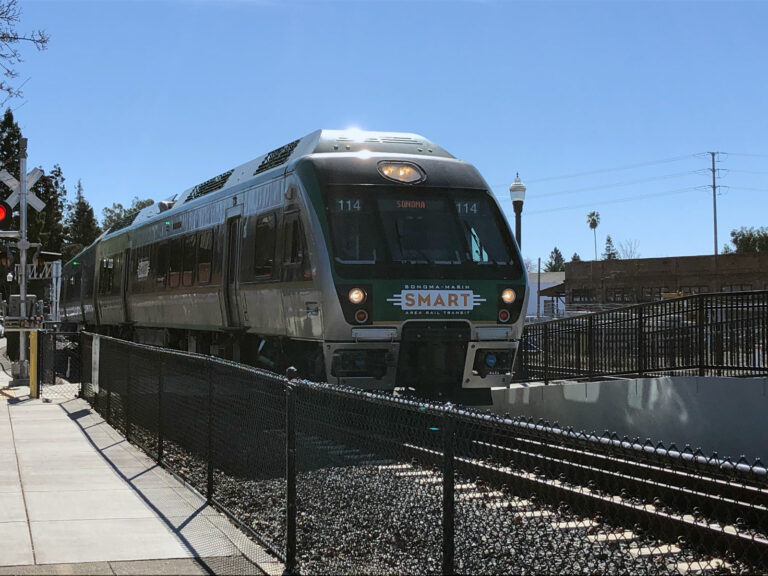
SMART Board Will Receive Budget Report Today

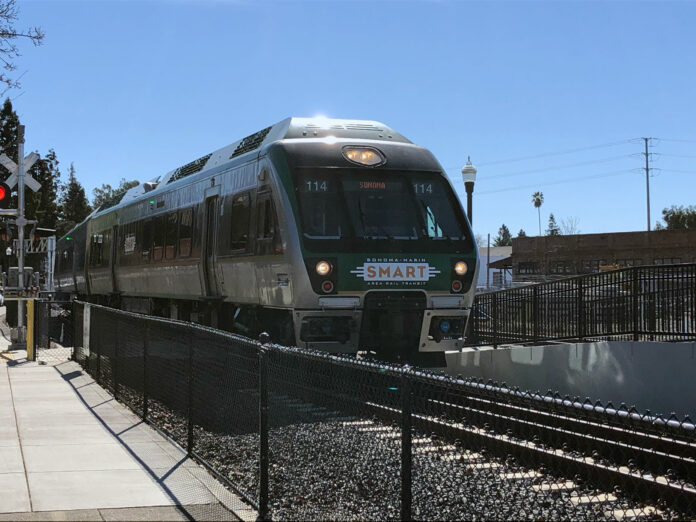
This afternoon, the board which controls the North Bay’s only commuter train service will hear a staff report on just how badly the transit agency’s finances have been impacted by the Covid-19 pandemic. 

Even before the pandemic drastically reduced the Sonoma-Marin Area Rail Transit agency’s ridership, the transit agency was facing a somewhat uncertain future.

In early March, voters in Marin and Sonoma counties rejected Measure I, a ballot item that would have extended the sunset date of the agency’s quarter cent sales tax from 2029 to 2059. 

Supporters of the measure said that approving the extension well in advance of the end of the current tax’s lifespan would allow SMART to refinance its debts and repurpose the money to bolster train service.

But, after an insanely well-financed campaign for and against Measure I, skeptics of SMART won out. Measure I’s backers failed to win the two-thirds support the measure needed.

Since then, a worldwide pandemic has lowered transit ridership across the country and SMART is expecting a drop in ridership and sales tax revenues in the coming years.

At their meeting today, SMART’s board will hear an update on the agency’s budget projections for the current and coming fiscal year.

The meeting will be streamed on Zoom beginning at 1:30 pm. The agenda and information about how to view the meeting are available here.

Marin Seeks Federal Funds For Covid-19 Response

0

Marin County is joining other North Bay governments in lobbying state and federal lawmakers and agencies for additional financial assistance in order to deal with the costs of the Covid-19 pandemic.

The federal Coronavirus Aid, Relief and Economic Security (CARES) Act set aside $15.3 billion for aid to local governments in California. However, because cities and counties with fewer than 500,000 are exempt from the program, Marin, Napa and Sonoma counties have not received any federal relief through the program.

The county is currently projecting a budget shortfall of between $7 and $11 million for the coming fiscal year, due to Covid-19-related expenditures alone, according to a press release. Without federal assistance, the shortfall, which will be worsened by expected revenue losses, is expected to grow to over $50 million by 2024.

“While we have had tremendous success locally and regionally in ‘flattening the curve,’ it has also been at tremendous local cost,” said Katie Rice, the president of the Marin County Board of Supervisors. “Early and unprecedented effort has saved many lives, but the County has shouldered an unsustainable burden with its mandate to protect the health of the public at large.”

Bret Uppendahl, Marin County’s budget manager, said at an April 28 Board meeting that he will have more clarity about the scale of the county’s budget problems after Governor Gavin Newsom’s administration releases its May budget revision in mid-May.

Rep. Huffman’s New Legislation Opposes Fossil-Fuel Bailout

0

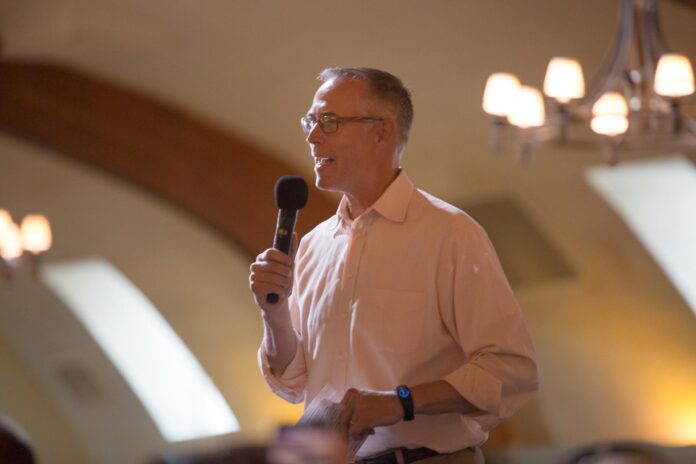
North Coast Congressman Jared Huffman has introduced legislation intended to bar fossil-fuel companies from receiving relief funding from the $500 billion federal CARES Act stimulus bill.

Huffman and other Democratic lawmakers introduced the legislation, known as the ReWIND Act—the Resources for Workforce Investments, not Drilling Act—on May 5.

The bill comes after the Trump Administration announced the president’s intent to steer CARES Act funds to the struggling oil and gas industries. 

The ReWIND Act would make “sure [that CARES Act funds] are not used to pay off bad debt taken on by fossil fuel corporations before the public health crisis,” according to a statement released by Huffman’s office.

“The relief allocated by Congress in the CARES Act is intended to benefit families and small businesses, not bail out oil and gas companies that were failing long before the coronavirus pandemic hit,” Huffman said in a statement. 

Among other things, the ReWIND Act would prevent banks using certain CARES Act programs from issuing loans to oil companies, and institute a moratorium on new federal fuel leases until the end of the Covid-19 pandemic.

Marin County Launches COVID-19 Data Dashboard

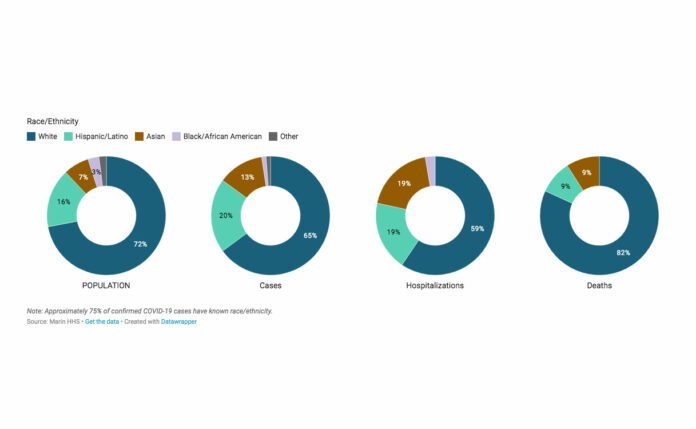
In an effort to provide Marin County residents with a daily snapshot of the coronavirus pandemic’s size and impact, the county’s public health department has released a new website featuring maps, graphs and charts tracking the county’s coronavirus caseload.

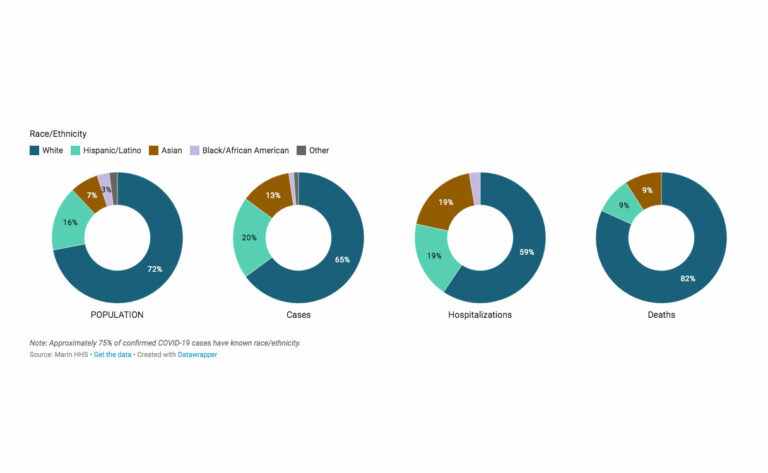
The website includes cumulative information about the current number of cases in the county, a map of cases by location and the virus’s impact on different sections of the community—separated by age, gender and race/ethnicity. No personal or identifiable data is included in any of the published information. 

“Lately there has been a lot of interest in the breakdown of cases by ethnicity,” said Bethany Dominik, a public health epidemiologist who worked on the platform. “This site is also going to help researchers who are collecting statistics to track the trends. One person who contacted us was putting an app together and wanted the raw data. We’re glad to be able to share it.”

The website—www.coronavirus.marinhhs.org/surveillance—will be updated every day by approximately 5pm. Some of the data is available for download in spreadsheet format.

Sonoma-Marin Fair Canceled Amid Pandemic

After some uncertainty, the organizer of the Sonoma-Marin Fair canceled plans for this June’s annual event.

The 4th District Agricultural Association Board of Directors decided to cancel the event during a May 1 emergency virtual meeting due to local regulations barring mass gatherings during the coronavirus pandemic. 

“We hoped that as the shelter in place deadline of May 3rd approached, we would be able to move forward with our fair. We explored all the options, but we understand that this is the right decision for the safety and well-being of our community,” Allison Keaney, the Sonoma-Marin Fair’s CEO, said in a statement released after the meeting.

The fair offers a combination of agricultural attractions and musical performances. Perhaps the fair’s best-known competition is the annual World’s Ugliest Dog Contest.

Organizers are planning to hold a Virtual Fair between June 24 and June 28. The details of the event have not been announced. More information is available at www.sonoma-marinfair.org.

O’Hanlon Gallery Hosts Online Exhibit of ‘Humankind In Crisis’

Throughout time, artists have visually responded to the world around them and reflected the times they live in with their art.

In this new era of sheltering-in-place, Marin’s nonprofit O’Hanlon Center for the Arts is shining a light on the Covid-19 pandemic as seen through the eyes 80 local artists in the new online exhibit, “Humankind in Crisis.”

The show is now up on O’Hanlon’s website, with works ranging from paintings, photography, collage, sculpture and more that speak to the artists’ emotional and life-altering experiences.

On Tuesday, May 5, O’Hanlon also hosts a Virtual Roundtable discussion over Zoom at 4pm. Join the Zoom meeting here.

Postponed Doclands Fest Talks to Filmmakers from Home

0

Doclands Documentary Film Festival, hosted by the California Film Institute, brings compelling true-life films to Marin each spring; though this year’s festival is postponed due to the Covid-19 pandemic.

For now, film lovers can enjoy the upcoming DocTalk From Home, an online showcase featuring the films and filmmakers that were meant to be in the fest. The virtual event features conversations with filmmakers and trailers of their films, and the audience will have a chance to get in on the live Q&A hosted by Variety senior features writer Andrew Barker.

Films and filmmakers included in the showcase are Time directed by Garrett Bradley; John Lewis: Good Trouble directed by Dawn Porter; Dick Johnson Is Dead directed by Kirsten Johnson; Gather directed by Sanjay Rawal; Public Trust directed by David Garrett Byars; The Social Dilemma directed by Jeff Orlowski; and Socialism: An American Story directed by Yael Bridge.

Tune in on Sunday, May 3, at 4pm. Registration required. doclands.com/showcase.

Groups push for housing solutions

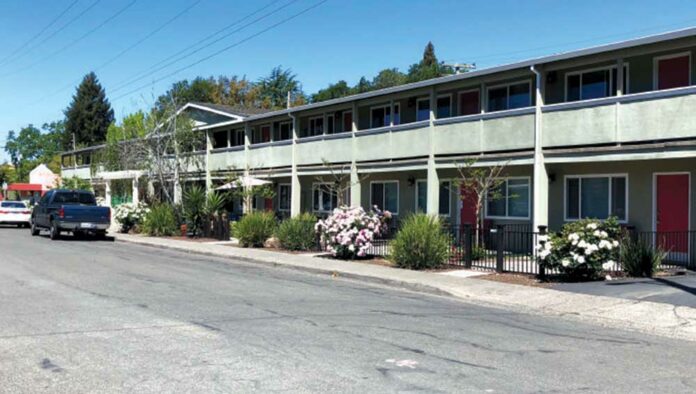
As the second month of coronavirus shelter-in-place orders come to an end and calls for a May 1 rent strike continue to circulate, the number of renters struggling to make ends meet is becoming clear. If no action is taken, millions of missed rental payments could trigger a series of devastating economic impacts.

As many as 2.3 million renter households in California may have at least one member of their household lose income due to the coronavirus, according to an analysis released by the UC Berkeley Terner Center on April 24.Those millions of potentially impacted households—approximately 40 percent of the state’s total 5.8 million renter households—pay nearly $4 billion in rent each month.

In Santa Rosa and Petaluma alone, 24,300 renter households—roughly 34 percent of the total 71,900 renter households in the two cities—may lose one household income each to the coronavirus. The total rent of those impacted households could be as much as $42 million per month, according to the survey. In Napa County, roughly 44 percent of the 17,000 renting households will likely be rejected, according to the same data set.

That equates to approximately $12 million of potentially-missed payments each month.

The Terner Center data set does not offer similar data for any Marin County cities.

Prior to the crisis, 1.1 million Californians were already considered “rent burdened,” meaning they spent more than one third of their income on rent each month. The Terner Center study predicts an additional 1.1 million households could become rent burdened due to the coronavirus pandemic.“

The current crisis only exacerbates the vulnerability these cost-burdened households were already facing, putting them at greater risk of housing instability,” the Terner Center study states.

Although the federal government has increased Unemployment Insurance (UI) benby $600 per week, much of that money may end up going to rent. Due to the high cost of housing in California, renters will still pay a ant portion of their bento their landlord, even if they do qualify for the highest level of UI benaccording to the UC Berkeley analysis.

With rent averaging $1,580 per month, a family quafor the lowest amount of benwill spend 65 percent of their monthly check on rent. If they qualify for the highest level of benthey will spend 38 percent of the check on rent, an expense level which will still leave them rent-burdened.

There are also those who do not qualify for any unemployment benOn April 15, Gov. Gavin Newsom announced the state will distribute a one-time payment of between $500 and $1,000 for undocumented Californians who do not qualify for unemployment benefit. That money will go quickly.

Patchwork

In March, local, state and federal lawmakers and agencies created a patchwork of partial protections for renters and landlords but, weeks later, the holes in that system are becoming apparent.

Marin, Napa and Sonoma counties each have different ordinances, but the strongest protection in California came in the form of an April 6 order from the State Judicial Council, the board that governs the state’s courts system. That order bars all courts from processing eviction and foreclosure cases until 90 days after the crisis.

Still, there are many unanswered questions, says Ronit Rubin, the executive director of Legal Aid of Sonoma County.

One of Rubin’s primary concerns is that, under the current orders, tenants will still be required to make up all of their missed rent payments after the orders are lifted. If tenants are unable to pay the back-rent after the Judicial Council’s order is lifted 90 days after the crisis, landlords could begin pushing ahead with eviction proceedings based on the tenant’s inability to pay back rent. That could lead to a wave of evictions across the state, likely hampering the economic recovery by worsening workers’ ability to return to work after the crisis.

“If we open businesses back up but half of their prior are now gone or destabilized because they don’t have a place to live, how does that affect the businesses’ ability to gear back up and have again?” Rubinsays. “I don’t think that makes reopening particularly easy.”

Landlord groups in turn argue that, if tenants miss their payments en masse, landlords will miss their mortgage payments.

The looming question is: What will happen if hundreds of thousands of tenants are unable to make up their missed rent payments due to long-term unemployment? In recent weeks, both landlords and tenants have turned to lawmakers for a solution.

Proposals

So far, local governments have largely stayed away from offering direct assistance to renters. Due to the mounting costs of missed rent payments and local governments’ own economic struggles, it seems unlikely that local governments will be able match millions of dollars in missed rent payments each month, even if they want to. A few possible solutions are being shopped at the state and federal levels.

According to an April 17 California Apartment Association (CAA) press release, State Senator Lena Gonzalez plans to amend Senate Bill 1410, a preexisting housing bill, to create a temporary state program to pay landlords for some missed rental payments. Similar to current, local North Bay protections, the temporary COVID-19 Emergency Rental Assistance Program would require renters to demonstrate “an inability to pay rent due to COVID-19 or a government response to the COVID-19 pandemic” in order to qualify for the program, according to the CAA release. Details of the proposal have not yet been released.

At the federal level, Minnesota congresswoman Ilhan Omar introduced legislation to cancel rent and mortgage payments—including missed payments in April—for millions of people across the country.

Omar’s legislation, the Rent and Mortgage Cancellation Act, would establish a fund for landlords and mortgage holders to cover losses from the cancelled payments and set aside funds for local governments and nonprofits to purchase private rental properties.

“We must take major action to protect the health and economic security of the most vulnerable, including the millions of Americans currently at risk of housing instability and homelessness,” Rep. Omar said in a press release.

Galleries grapple with stay-at-home reality

If a painting hangs on a gallery wall, but no one is around to see it, is it still art?

As the North Bay shelter-in-place passes the 40-day mark, many galleries and organizations that depend on social gatherings to share and sell art struggle to answer the question of how to keep the art alive when they are forced to keep the doors shut.

“It’s different for every gallery I’m sure, but most galleries are in the same boat in terms that they’ve lost almost all opportunity to sell art,” says Paul Mahder, founder and director of the Paul Mahder Gallery in Healdsburg.

In the last month, many in-person businesses have had to turn to an online-only mode, and art galleries are no exception. Mahder says he is fortunate in that he was already in the process of creating an online gallery for the thousands of pieces of original work he sells for more than 40 artists.

The entire gallery is now available online at paulmahdergallery.com, and Mahder notes there’s been some action on the site, in part because he is doing something else that he never thought he would do; offering a sale.

“This is a particularly unusual moment,” he says.

As the North Bay enters its high season of tourism-related business, Mahder believes the pandemic means it will be a while before people feel comfortable gathering in public.

“Even when things do turn around, how long is it going to be for people to actually start coming back?” Mahder asks. “It’s not a matter of relaxing the restrictions, but when people can feel that they can get back in the marketplace—that could be a year or more.”

For Mahder and other art curators and gallery owners, the fluidity of the pandemic’s timeline is the most stressful aspect of the ordeal, especially for galleries that often arrange exhibits up to a year or more in advance.

“The feeling of uncertainty that’s hanging over everyone’s heads, that’s hard,” says Shelley Rugg, coordinator of Gallery Route One in Point Reyes Station. “Not knowing when this is going to end, we don’t really have any way to schedule an exhibition, because we don’t know when people are going to be able to enter our space again.”

Gallery Route One was about to open its annual “Artist Members Show” when Marin County’s stay-at-home orders went into effect. Instead, it put the art online at galleryrouteone.org, where the “Spring 2020” exhibit now shows work by 18 artists.

The GRO website also features an online shop where art from the “Spring 2020” exhibit and other works can be purchased. And the nonprofit organization put its Artists in Schools program online, as well as an Art Projects at Home page, where the public can download instructions on how to make various art works and enjoy a Point Reyes Coloring Book and other activities.

The gallery is now looking ahead to its annual “Box Show,” its most popular fundraising event each year, currently scheduled to open with a reception on August 1. The exhibit features boxes transformed into art by local artists, and the show includes a silent auction in which, Rugg says, hordes of attendees usually use pen-and-paper to bid on work throughout the show’s run.

“It’s likely none of that can happen,” Rugg says. “We have to think about how to transform what we are used to doing—what we know how to do—into a whole new form. It’s very challenging.”

In Novato, the Marin Museum of Contemporary Art is also busy rescheduling and adapting to the internet in order to share art in the form of virtual art tours and videos, and the museum is taking the time to team up with Marin-based nonprofit ExtraFood for the #Mask­er_piece Challenge.

“We’re trying to do our part to not be so concerned with our own finances, but to look to people who are really hurting,” says MarinMOCA executive director Nancy Rehkopf. “We know that due to unemployment and isolation, there are a lot of people out there who need meal support who didn’t use to.”

To that end, MarinMOCA’s member artists are creating artful face coverings, using well-known art works for inspiration. For every #Mask_erpiece posted on social media and marinmoca.org, a group of MarinMOCA’s donors contributes $5, for a total of $5,000 planned to go to ExtraFood’s efforts to keep Marin fed during the pandemic. The masks will also be available to sell to those who want to help with donations.

“It lets everybody do what they are best at,” Rehkopf says. “Our artists can continue to create and people with empathy can donate and it all goes to ExtraFood.”

The challenge MarinMOCA’s member-artists face is where to create, as more than 60 artists with working studios in four buildings on MarinMOCA’s campus have not been able to use their studios.

“They are coming up with creative ways to work from home, but it’s definitely affecting their livelihood and their ability to enter shows and get their artwork out there, so it’s a tough time,” Rehkopf says.

MarinMOCA has updated its Facebook and other social-media pages with member artist profiles and art to help keep them visible to the public. Rehkopf adds that MarinMOCA’s educational programs are also transitioning to an online format.

Other art events in the North Bay moving to an online format include the Virtual Marin Open Studios (marinopenstudios.org) replacing the self-guided studio tours in May; the Town of Fairfax Online Art Show (fairfaxartwalk.com) replacing the Fairfax Art Walk and the Sebastopol Center for the Arts Virtual Open Studios (sonomacountyarttrails.org) replacing Art at the Source and the Sonoma County Art Trails in September.

In Napa County, the planned Arts in April month of events hosted by the county’s official arts agency, Arts Council Napa Valley, is also moving online with events like the Yountville Art, Sip & Stroll going digital (see “Culture Crush,” pg 12).

“We’re seeing many of our arts organizations trying to pivot,” says Arts Council Napa Valley CEO Chris DeNatale.

While some groups, such as St. Helena–based Nimbus Arts, create online classes, art challenges and even art kits to go, others in Napa County face a more serious situation.

The Napa Valley Museum closed during a popular art exhibit by actress and activist Lucy Liu. In response to the COVID-19 pandemic, the di Rosa Center for Contemporary Arts has also decided to close the campus for the remainder of 2020.

To help these struggling arts organizations, Arts Council Napa Valley is opening a disaster relief fund to provide grants to artists and organizations. Applications to the fund will be accepted starting May 4, with a total of $40,000 planned for distribution to individuals, arts nonprofits and Napa County schools and educators that have experienced economic loss due to cancellation of performances, shows or fundraisers.

“It’s been so hard to access the CARES Act [the federal coronavirus economic relief plan] at this point for smaller organizations,” DeNatale says. “So we are trying to find ways to put money in our organizations’ pocket without having to be so tedious.”

Arts Council Napa Valley will also participate in Giving Tuesday, a May 5 statewide call to action to support nonprofit organizations, in which every dollar raised will be added to the relief fund, and the council has also assembled a Covid-19 resource center at artscouncilnapavalley.org with a list of state, county and community services to support artists dealing with economic loss.

In addition to exhibitors and organizations, individual artists are also taking the stay-at-home matter into their own hands with online shows and specials. Two of the first to do so in the North Bay were artist friends Bill Shelley and Chris Beards, who resurrected their former Blasted Art Gallery in Santa Rosa as an online exhibit space.

“Bill and I are both working artists; we had reached our objective with the brick-and-mortar Blasted Art Gallery [in 2019] and wanted to get back to our work,” Beards says. “We kept our presence on Facebook (facebook.com/blastedartgallery) and then this coronavirus came and we came up with the idea of restarting the gallery online to bring people together and create community, which is isolated at the moment.”

“We wanted to give artists who work regularly and who were no longer able to show anywhere a virtual place,” Shelley says. “And to also reach out to people who don’t show on a regular basis and give them an incentive to do something special for the exhibit.”

Blasted Art Gallery’s online show, “Sonoma County: Flattening the Curve” includes nearly 90 pieces of work from over 40 artists, in all manner of styles and mediums.

Hundreds of online participants attended the exhibit’s online opening on April 17, filling up the message boards and posting on the page.

“I have a friend who commented to me that she doesn’t go to galleries, but she did attend the opening on Facebook,” Beards says. “She said she felt included, and that felt like a real win. It felt like a community at the opening.”

“We are all experimenting with how you show art online,” Beards says. “I don’t know that a virtual show is a substitute for seeing the art in person. So, I’m hoping that our galleries and museums remain vibrant, and yet we can have this additional online format that will allow more people to see more work.”

A Star is Bored

0

Why wait for the inevitable deluge of COVID-19-themed horror films when you can script your own? Every filmaker worth a roll of gaffer’s tape is plotting their pandemic feature right now—don’t be left out like you were during the Great Burning Man Documentary Deluge of the early aughts. Stay home, lock the doors and start your screenplay with our free Instant Pandemic Plot Thickener system.

How does it work? Like this: If your house was haunted, wouldn’t you just leave? Normally, yes, but the pandemic plugs this age-old plot hole by promising a slow, painful death if you go outside. Boom—you’re trapped! And … the wifi is down! If that’s not frightening enough, use the following screenwriting prompt to add more chills: In the dead of night, your partner whispers in your ear “I think there’s someone in the house …”Remember, this is a movie, not reality. In reality, everyone is so utterly bored with each others’ company that you’d welcome the intruder with open arms and a bottle of wine. But in the horror-show version of your quarantined life, the moment has to be bone-chilling. Choose one of the following: 1. Someone is surreptitiously living in your attic, a crawlspace, or the secret room that is discovered when the blueprints are examined in a dramatic second-act revelation.2. YOU are surreptitiously living in the attic to avoid your family.

Now add one of the following tried-and-true tropes:

1. A malevolent spirit inhabits one of your child’s toys, preferably a doll, especially the kind with eyes that suddenly open for no reason.

2. Your kid has an “imaginary friend”—with an Edwardian-era name like Gwilym—that they “talk to” through the closet.

Pick one, then get jealous that the kid has someone to talk to who isn’t related to them. Start talking to Gwilym yourself. Write down what you say. Presto—your screenplay is practically writing itself!

At some point in your script, write a character who works in a spiritual capacity (a priest, exorcist, bartender, etc.) and have them attempt to purge the evil spirit through a Zoom call. At a crucial moment, have your screen freeze and then run to every room in the house with your laptop trying to get a better connection. When you finally find a signal and resume your video call in the darkened bathroom, have the kid wander in and turn on the light … revealing—Ahhh!—you’re just talking to yourself in the mirror! You’ve lost your mind—but you’ve found screenwriting gold!

SMART Board Will Receive Budget Report Today

This afternoon, the board which controls the North Bay’s only commuter train service will hear a staff report on just how badly the transit agency’s finances have been impacted by the Covid-19 pandemic.  Even before the pandemic drastically reduced the Sonoma-Marin Area Rail Transit agency’s ridership, the transit agency was facing a somewhat uncertain future. In early March, voters in...

Marin Seeks Federal Funds For Covid-19 Response

Marin County is joining other North Bay governments in lobbying state and federal lawmakers and agencies for additional financial assistance in order to deal with the costs of the Covid-19 pandemic. The federal Coronavirus Aid, Relief and Economic Security (CARES) Act set aside $15.3 billion for aid to local governments in California. However, because cities and counties with fewer than...

Rep. Huffman’s New Legislation Opposes Fossil-Fuel Bailout

North Coast Congressman Jared Huffman has introduced legislation intended to bar fossil-fuel companies from receiving relief funding from the $500 billion federal CARES Act stimulus bill. Huffman and other Democratic lawmakers introduced the legislation, known as the ReWIND Act—the Resources for Workforce Investments, not Drilling Act—on May 5. The bill comes after the Trump Administration announced the president’s intent to steer...

Marin County Launches COVID-19 Data Dashboard

In an effort to provide Marin County residents with a daily snapshot of the coronavirus pandemic’s size and impact, the county’s public health department has released a new website featuring maps, graphs and charts tracking the county’s coronavirus caseload. The website includes cumulative information about the current number of cases in the county, a map of cases by location and...

Sonoma-Marin Fair Canceled Amid Pandemic

After some uncertainty, the organizer of the Sonoma-Marin Fair canceled plans for this June’s annual event. The 4th District Agricultural Association Board of Directors decided to cancel the event during a May 1 emergency virtual meeting due to local regulations barring mass gatherings during the coronavirus pandemic.  “We hoped that as the shelter in place deadline of May 3rd approached, we would...

O’Hanlon Gallery Hosts Online Exhibit of ‘Humankind In Crisis’

Throughout time, artists have visually responded to the world around them and reflected the times they live in with their art. In this new era of sheltering-in-place, Marin's nonprofit O'Hanlon Center for the Arts is shining a light on the Covid-19 pandemic as seen through the eyes 80 local artists in the new online exhibit, "Humankind in Crisis." The show...

Postponed Doclands Fest Talks to Filmmakers from Home

Doclands Documentary Film Festival, hosted by the California Film Institute, brings compelling true-life films to Marin each spring; though this year’s festival is postponed due to the Covid-19 pandemic. For now, film lovers can enjoy the upcoming DocTalk From Home, an online showcase featuring the films and filmmakers that were meant to be in the fest. The virtual event...

Groups push for housing solutions

Santa Rosa apartment housing
As the second month of coronavirus shelter-in-place orders come to an end and calls for a May 1 rent strike continue to circulate, the number of renters struggling to make ends meet is becoming clear. If no action is taken, millions of missed rental payments could trigger a series of devastating economic impacts. As many as 2.3 million renter households in California may have at...

Galleries grapple with stay-at-home reality

If a painting hangs on a gallery wall, but no one is around to see it, is it still art? As the North Bay shelter-in-place passes the 40-day mark, many galleries and organizations that depend on social gatherings to share and sell art struggle to answer the question of how to keep the art alive when they are forced to...

A Star is Bored

Why wait for the inevitable deluge of COVID-19-themed horror films when you can script your own? Every filmaker worth a roll of gaffer’s tape is plotting their pandemic feature right now—don’t be left out like you were during the Great Burning Man Documentary Deluge of the early aughts. Stay home, lock the doors and start your screenplay with our...
3,002FansLike
3,850FollowersFollow