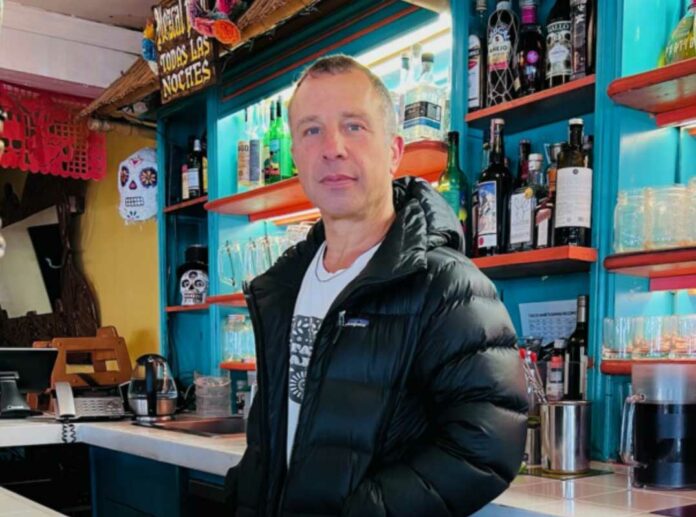
Taco Jane’s has been my family’s go-to Mexican restaurant since moving to Marin, and not just because their patio is especially suited for drinking margaritas on sunny days. Matthew “Matteo” Boussina opened the place in 1998, and they are celebrating 25 years in business this month. The following is an interview with Boussina:
What do you do?
I own and run Taco Jane’s Restaurant & Bar in downtown San Anselmo. It’s named after my mother, Jane.
Where do you live?
I live in Fairfax, not a bad commute.
How long have you lived in Marin?
I’ve been in Marin most of my life, 40 or so years.
Where can we find you when not at work?
Trail running or mountain biking on Mt.Tamalpais, and when I get the chance, I love the old school vibe and liveliness of Marin Joe’s in Corte Madera.
If you had to convince someone how awesome Marin was, where would you take them?
First thing, I would take them up in a sea plane from Sausalito for a bird’s-eye view of the Bay Area and that thrill of landing back on the water. West Marin and Point Reyes are hard to beat, just exploring all around. And of course a stop at Taco Jane’s for at least one watermelon margarita and an order of “Matteo cakes.”
What is one thing Marin is missing?
Hmm, that’s a good question… Persian food. Oh and a larger venue for live music and the performing arts. Whenever we get the chance, we have live music, but it’s a more intimate vibe.
What’s one bit of advice you’d share with your fellow Marinites?
That your true treasure and wealth is that of where you are standing, and that your best investment is yourself.
If you could invite anyone to a special dinner, who would they be?
Thomas Jefferson, Freddie Mercury, Howard Schultz and of course Thom Yorke.
What is some advice you wish you knew 20 years ago?
That everything is going to be OK.
What is something that in 20 years from now will seem cringeworthy?
I certainly hope it will be social media.
Big question. What is one thing you’d do to change the world?
Wow, that’s a stumper. Bring back the virtues of our forefathers, perhaps, and send the rest camping.
Visit Taco Jane’s Instagram page (@tacojanes) to find out what anniversary specials Boussina has cooking this month, and make sure to say hola, since he’s almost always there.
Nish Nadaraja was on the founding team at Yelp, serves on the San Anselmo Arts Commission and attempts to play pickleball at Fairfax’s Cañon Club.
Prioritizing wellness and learning to balance mind, body and spirit is a lifelong journey—one full of twists, turns and unexpected elephant-sized potholes along the way.
For the past 20 years, New Living Expo has provided a space for like-minded individuals interested in the pursuit of holistic health and wellness, to gather, share wisdom and celebrate together in the collective human experience. This year, New Living Expo is coming to Marin and is set to take place on April 14, 15 and 16 at the Marin Center in San Rafael.
The founder of New Living Expo, Ken Kaufman, is excited to bring his passion project so close to his home in Novato, where he has lived for the past 35 years. Kaufman’s interest in health and wellness, which led to him beginning the New Life Expo, took place during his formative years growing up in Los Angeles—specifically beginning when he traded a garbage bag full of mint he had gathered for a book at a health food store.
“I got a book called Herbs and Things, and it awoke something inside of me,” said Kaufman. “I got really into the healing arts, got my massage license, and that’s what led me to become the owner of [New Living Expo]. The expo has been my baby ever since, and hosting it here in Marin is so exciting; it feels like I’m bringing it back home.”
New Living Expo is a three-day event offering a wide array of experiences, such as the free and open-to-the-public outdoor Mind, Body and Spirit Village. There, guests may sample exotic teas from across the globe in the crystal tea garden, practice yoga and movement classes such as Tai Chi and Chi Gong at the yoga pavilion and appreciate visual arts on display along the art walk. Attendees will also have the opportunity to partake in various natural food selections at the food court and visit the meditation center and healing arts pavilion.
“Everyone walks away with a wealth of information and new connections,” said Kaufman. “A lot of people tell me they met their soulmate at the expo and got married—it happens so often I’m thinking we should start a wedding chapel segment at the expo!”
Those interested in a more involved expo experience may purchase a day pass for just $23. This general admission ticket grants attendees access to exhibits, lectures, panels and more. Additional admission fees apply to certain paid workshops and special events. The speaker lineup for New Life Expo’s 20th anniversary is stacked high with noteworthy and knowledgeable figures from all across the spectrum of health and wellness.
John Grey, best known as the author of the bestselling book, Men Are from Mars, Women Are from Venus, is a longstanding repeat guest at New Life Expo and will be in attendance for the 20th anniversary. His workshop, The Secrets of Lasting & Great Sex, will take place on April 15 from 11am to 12:30pm.
“I’m so excited [the expo] is in Marin this year,” said Gray. “This event is just a wonderful experience, and it always attracts a really amazing collection of people. It’s like having appetizers for mind, body, spirit and love—appetizers for things that can change your life for the better.”
“I was invited many many years ago to speak at the expo and have spoken at it eight or nine times since,” continued Gray. “I’m very open to new ideas—I mean, I was a celibate monk before I became a relationship and sexuality expert.”
Influential astrologer, activist and host of KPFA’s The Visionary Activist Show, Caroline Casey is set to make an appearance at the expo as well. Her special event, Bodhisattva Coyote*Bre’r Rabbit-Rumi Guide to being a good Citi-zen Trickster, will take place on Saturday from 2 to 4pm.
“I like guiding people—it’s part of what I’ll be doing at the expo,” explained Casey. “I think, in all of our lives, every affinity and quirky thing is a clue to be wondered about and honored. I was born into a political family in DC, but was always interested in things like faeries and astrology. Looking back, in 8th grade I wrote a report on psychedelic mushrooms, and when I saw Time’s article about LSD, it sent me forth on a whole path. And then I was 17, doing mushrooms and LSD and reading Carl Jung.”
“I also lived with an actual coyote for 20 years,” continued Casey. “I learned a lot about reciprocity in nature through the experience.”
Another guest of honor for the 20th anniversary of New Living Expo is the president of the Northern California Recycling Association and Bay Area Local, Jessica Jane Robinson. Once crowned Miss Alameda, Robinson is also an actress and activist who uses her platform to promote zero waste. Known also by her pro-environmental superhero persona, Resilience, she will give her zero waste presentation at 7pm on Friday.
“When I first got started doing what I do, zero waste wasn’t as much of a thing,” explained Robinson. “Now it’s becoming trendy, which is good because people are gaining awareness. But, instead of a trend, zero waste needs to be a part of our culture.”
Robinson has also attended the expo in previous years and is excited to join the festivities again. For the uninitiated, she describes the expo as being a place of “crystals, healing, wellness, innovation, usefulness, new technologies and information — people should come if they’re interested in personal growth, in holistic medicine and healing, and those who are interested in community.”
Other speakers include (but are not limited to): Deborah Graham, Shekinah Ma and Sanandaji Twinray, Gail Thackray, Kimberly Meredith, Eben Alexander, Emmanuel Dagher and Matt Kahn.
Alongside the workshops and lectures, highlights include Friday’s free screening from 6 to 8pm of Gratitude Revealed, a film directed by Louie Schwartzberg (a well-known director, producer and cinematographer who readers may recognize for his film, Fantastic Fungi). Additionally, a free-to-attend dance party will take place on Saturday night from 7:30 to 9:30.
“Usually, a lot of people come to the expo looking for answers,” concluded Kaufman. “If they’re stuck in relationships, feeling depressed or need a different view on life and need access to some positivity that’s out there. People have been cooped up for so long with COVID, and they need to come out and network and gather as a community.”
The 20th annual New Living Expo will take place on April 14, 15 and 16 at the Marin Center in San Rafael. Friday’s hours span from 2 to 8pm, Saturday from 10am to 8pm and Sunday from 11am to 7pm. Parking is free. For more information or to reserve tickets, visit the website at newlivingexpo.com, send an email to Ke*@***********po.com or call 415.382.8300.
This story was co-published with MindSite News, a nonprofit digital news site focused on mental health reporting.
On a late afternoon in December, a 22-year-old youth advocate named Rachel is addressing a jury of her peers on Zoom in Marin County, California. Her client: a teen named Leonel, who was caught with two boys after shooting BB guns from a garage.
The boys said they were shooting bottles in the driveway, but several BBs hit a neighboring home and passing vehicles, causing damage and broken windows, according to a police report. No one was arrested but police cited Leonel and his friends for vandalism.
A virtual room full of teens and young adults listens intently as Rachel talks about how Leonel is changing his life in the aftermath of the incident.
“As you will hear today, Leonel has made some important changes in his life,” she tells the peer team members, who act as jurors and will question the teen about those changes. She instructs them as jurors to focus their questions not on what he did wrong, but on what he’s doing right. (We are identifying Leonel and other youth court participants by their first names to protect their privacy.)
“We’re not here to punish or stigmatize,” Don Carney, Youth Transforming Justice’s founder and executive director, tells the peer team members. “Every young person is so much more than the dumbest thing they’ve gotten caught for by some authority figure.”
He urges the young participants to remove judgment as they encourage a sense of safety and consider Leonel’s friendships, interests, and strengths.
Don Carney, founder and executive director of Youth Transforming Justice, and Antonio Zavala, the peer court’s programs director, gave a talk about the school-to-prison pipeline at Sonoma State University on April 3, 2023. Photo by Brittany Nielsen.
The mission of the program and others like it is to counter a trend that became common in the late 1980s of suspending or expelling public school students, especially students of color. Advocacy groups like the ACLU argue that this approach increases absence and alienation from school and increases the risk of arrest and entry into the criminal justice system, fueling the so-called school-to-prison pipeline.
Because more than two-thirds of youth involved in the juvenile justice system have experienced trauma from abuse in their homes or violence in their communities, Peer Solutions combines restorative justice techniques with practices that help youth to feel safe even when facing school disciplinary procedures or criminal charges.
BACK AT THE PEER SOLUTIONS SESSION, THE “JURORS” HONE IN ON ANOTHER FACET OF TEEN COURTS—ACCOUNTABILITY.
Proceedings used to take place at the Superior Court of California in Marin County before they went virtual during COVID lockdowns. The decision to keep them online stems from an encounter Carney had with an undocumented teenager faced with the choice of school suspension or Youth Court. Surprisingly, he chose school suspension.
“When people like me go near Superior Courts, we tend to disappear and get sent back,” he told Carney. With that, “a lightbulb went off” for Carney as he realized how much fear an actual courthouse can inspire.
The online program is also more accessible for its participants since transportation to the court is no longer an issue., Like the in-person court, it revolves around accountability. To fulfill its terms, respondents must volunteer with an organization that meets their interests, participate in future gatherings of the court, and take a 12-hour course. The classes teach them how to steer away from drugs and alcohol, how to be a first responder to a peer who has overdosed, and how to manage an encounter with police in ways most likely to protect their rights and their lives.
This is where the youth really start to trust the program and the staff, Carney says. “We teach them how to talk to an officer in a respectful manner and continue to exercise their civil rights.”
The program also instructs youth on ways to stay grounded if they encounter officers so they don’t feel the need to run.
“First thing, make sure they can see your hands,” Carney says. “As you’re holding your hands up, take three deep cleansing breaths to clear your mind and try to stay still.”
Since its inception in 2004, Peer Solutions says it has diverted 1,300 teens from the traditional juvenile justice system. The vast majority—95%—complete their agreed-upon court tasks, and among those who do, there’s only a 7% rate of recidivism.. Close to 70% of youth who take part are Latino, including a small number of teens who fled from Guatemala as unaccompanied minors. As today’s youth court session begins, Leonel, the “respondent,” is asked by the de facto judge and “facilitator,” retired attorney Marita Daly, to give his version of what happened. Then comes a volley of questions from the peer team and responses from Leonel:
How has the relationship with the people you were caught with changed?
I no longer have relationships with that group of friends. I stopped talking to them.
How do you feel about what you did?
I feel guilty for being there…
What goal do you have right now?
Just to get out of school and start working.
Leonel adds that he plans to become a landscaper, and the questions from the “peer team” soon take a different turn.
Teen Court Effectiveness
A randomized-controlled study of 12 middle schools and high schools that used youth courts, compared with 12 schools that didn’t, found that suspensions declined more than twice as much in the schools that started using them. Use of the courts was also “significantly associated with positive changes in school satisfaction” and (seemed also to lead to a reduction in the number of students saying they had friends who were considered “delinquent”), according to the study, published in 2020 in the Journal of School Violence.
The schools with teen courts also saw a 47% drop in bullying versus a 22% decrease in schools without the courts. The authors concluded that the school-based teen courts “have the potential to positively impact youth development.”
But overall, there’s been relatively little research on the effectiveness of teen courts. A 2023 review by the Rand Corporation, “Promising Services for Justice Involved Youth,” included seven youth-court programs. The 2020 study mentioned above had positive results. So did two others that found youth in youth-court programs were less likely to re-offend than those in other diversion programs and had relatively low arrest rates (20% in a year). Yet another found that a teen court was associated with increased substance use and delinquent behavior among boys and no effect on girls. “Overall, there were mixed results on teen courts’ abilities to reduce recidivism and other outcomes,” the Rand report authors concluded.
Back at the Peer Solutions session the “jurors” hone in on another facet of teen courts—accountability
How did the incident affect you?
I didn’t have any problems with the police [before this happened]. Now I have problems. I have probation. I have a time I have to be home.
Rachel, the advocate, jumps in:
What would you do differently if a similar situation happened?
I’d leave the place, leave the area – not hang out with them.
Heydi Taay, 17, is now a paid intern with the program and has participated as a “juror.” She understands how nervous youth going through the court can feel, having once appeared at a hearing after stealing another student’s ear pods. She especially identifies with the challenges of youth whose parents lost their jobs during the pandemic.
“They were really hurting that they weren’t able to help their parents,” says Taay. “It really touched me personally, because my parents too had lost their jobs then, and they were having a hard time paying for rent and food.”
That dynamic is a driving force of the Peer Solutions program, says Meghan Greenwood, a counselor for San Rafael City Schools. She has observed the peer court in action and later ran one at a local middle school.
What impressed her most “is that they include the students who have been through it as part of the jury,” Greenwood says. They “understand what it’s like to sit in that kind of hot seat. So there’s a lot of empathy.”
That’s a key element for Eric Olson, director of Marin County’s Juvenile Services Division. “One of my biggest concerns with juveniles is, do they have the capacity for empathy?” The Peer Solutions program, he maintains, is key in developing that.
But the program isn’t just about cultivating empathy; the peer-to-peer element also helps build connections.
“This is a very powerful motivator for adolescents, that sense of being connected to one’s community,” says Keith Cruise, director of clinical training in the Department of Psychology at Fordham University in New York.
Another program tenet is that all youth need a trusted adult in their lives. Having one, according to a recent study, is a protective factor that helps offset the harm a child may experience from adversity in the home or community. Carney insists that every referred youth gets asked if they have such a relationship.
“We now know that resilience is really based on having that trusted adult that you’re willing to take advice from,” Carney says.
Leonel had these trusted adults—his parents—but not every teen does. When they don’t, it often falls to Antonio Zavala, the youth court’s 33-year-old director of programs, to try to fill the void.
A Mexican immigrant, Zavala knows firsthand how the lack of such a presence can impact a teen’s life. When he was 10, his mother decided to escape from Zavala’s abusive, alcoholic father and return to Mexico with him and his two siblings. His father refused to let her take Antonio.
“That drove a spear through my mom’s heart, and I ended up having to stay with this man whom I had grown to hate,” he says. By his teen years, Zavala had grown into someone “who was not going to run to his room, scared of what my father was going to do to me.”
He served time in juvenile detention, got kicked out of schools, and was sent to the school of last resort for kids who were troublemakers.
“By that time, I had already been pushed into gangs, I had already found my tribe and there was a lot of violence that I was committing outside of the home,” he says.
Amidst the chaos and violence, Zavala encountered an adult who earned his trust. It was Carney. He organized outings for Zavala and a group of other teens on probation, all of whom, Zavala says, “had come to internalize that we were failures.” Carney took them out to meals and to play basketball and racquetball.
“He kind of told us although these schools maybe don’t want you, although you’re on probation, you’re human and you still matter,” Zavala says.
Through the program, a trauma therapist worked with Zavala during lunchtime, trying to coax him out of the armor he had forged between himself and the outside world.
“She had the ability to get me to talk about an experience that I just went through and get me to really focus on my reaction to it,” he says. “It helped me better understand who I was and do it in a way that felt safe and comfortable.”
Growing up in homes filled with chaos from violence or unpredictable stress can put a child’s brain into a constant state of high alert, ready for fight or flight, Carney told the Peer Solutions gathering.
“When you grow up in those circumstances, it’s a survival asset to know when to fight back, when to disappear,” he says. But, in school or other settings, there’s a downside: “You really quickly get labeled defiant, disruptive and noncompliant…You tend to believe it and internalize it and start acting it out.”
Activities like yoga help young people in the program tamp down their stress and build connections with other youth. It also counts toward community service hours.
On a recent Saturday, yoga teacher Rayner Needleman walked six participants through a series of breathing exercises, yoga poses, and stretches, then had them pair off. One participant, Sonia, said it helped her relax.
“I really liked that we were in a small circle with others,” she said through an interpreter. “When I try to do any form of physical activity, it’s hard because I’m by myself and it’s hard to find the motivation.”
Peer Solutions program participants in a paired yoga exercise in Needleman’s class. Photo by Laurie Udesky
Sonia is almost 16 and loves algebra and mathematics. She came to the United States on her own from Guatemala two years ago. She wasn’t comfortable talking about the reasons for her flight, but she had to leave and now lives with a maternal aunt and uncle. She choked back tears when asked what she misses about her parents, whom she speaks to virtually.
“I liked going for walks with them, just hanging out, going shopping,” she says. “I felt like they really took care of me.”
Smoking in the bathroom landed her a referral to the program and overwhelmed her with fear and worry—until she met her peers and staff. Because of what she endured back home and on her journey to the U.S., the staff worked with her one-on-one rather than asking her to face a roomful of peers.
She also was assigned to work at a food bank, where she learned “to give back to others,” she said. “Seeing people so appreciative of what we’re doing when they receive the food makes me really happy and gives me a sense of purpose.”
Back at the Zoom session, the peer team returns from a break-out room and outlines the restorative plan that Leonel has already agreed to: He will participate in three rounds of jury duty with the peer team and 20 hours of community service in landscaping. He also will pay $500 in restitution for damage to the cars and the neighbor’s house.
Leonel was given three months to fulfill his plan and participate in Youth Transforming Justice’s harm reduction course. “Next time I see you in this setting, I hope to see you as a peer team member,” says Marita Daly, who acted as a judge. “Good luck to you, and remember, you’re a valued member of the community.”
Joining a nationwide rise in labor action, workers at Petaluma’s beloved Copperfield’s Books store are attempting to unionize.
On Saturday, March 11, members of the Copperfield’s Books Petaluma Union gathered under the downtown store’s awning to announce the campaign to a few dozen supporters.
A series of speakers highlighted their main concerns, including low wages, minimal paid time off, inadequate healthcare benefits and a lack of clarity about how workers should respond when customers are racist, homophobic or transphobic to employees. Union members stressed that they want to help preserve Copperfield’s as a community resource.
“I love Copperfield’s. My coworkers love Copperfield’s. We just want them to love us back,” one worker said to the crowd.
Robert Glover, a seven-year Copperfield’s employee, who introduced the idea of joining theIndustrial Workers of the World (IWW) to his colleagues, hopes that unionizing will help the store retain experienced employees with knowledge of customers’ interests and preferences.
“One of the big reasons for unionizing for me was creating a stable environment. I had seen so many good people with decades of industry knowledge leave Copperfield’s because they could no longer afford to work there, because the pay was too low for the area,” Glover said.
Currently most workers are paid the minimum wage, $17.06 per hour in Petaluma, Glover said.
A full-time worker at that rate would make $34,120 a year, qualifying them for low-income, subsidized housing.
Even employees with decades of experience are paid only slightly more. Ellen Skagerberg, a 32-year employee, said she is paid $18 per hour. Ultimately, the lack of meaningful raises may have contributed to solidarity among workers.
“People who were there for six weeks, six months or six years, we’re all making minimum wage, and the six-year people were training the six-week people,” Skagerberg said.
Glover said that the union has support from almost all of the 21 part- and full-time employees at the Petaluma store. The union is not currently interested in organizing any of Copperfield’s eight other stores spread through Sonoma, Marin and Napa counties, according to Glover.
Three days before the public event, two workers from the Petaluma store delivered a letter to management at Copperfield’s headquarters in Sebastopol, requesting that the company voluntarily recognize the union. The company’s owners have declined to do so.
In an emailed response to questions last week, Cooperfield’s co-owner, Paul Jaffe, stated that a formal election with the National Labor Relations Board will give “everyone time to get more clarity on the issue and then have an election where everyone can feel safe in expressing their choice… under no duress or micro aggression.” Since the union announced its campaign, the company has begun a series of conversations with workers at multiple locations, including the Petaluma store, according to Jaffe.
Jaffe acknowledged many of the union’s concerns, but argued the company is constrained in what it can do.
“I do agree the issue of wages that haven’t kept up with rising costs is one that needs to be addressed, not only for Copperfield’s Books, but for most businesses these days,” Jaffe stated.
“There are longer term employees that have not had their wages raised proportionally, and I believe this to be one of the main issues for some of the staff in Petaluma and Copperfield’s Books as a company. I agree with them and do feel that ownership at Copperfield’s could have done a better job of addressing their needs. But at the same time, we are a unique small business with some of the smallest margins of any business, that also has to compete directly with the likes of Amazon and Barnes & Noble, and we have limits to the amount of raises we can give to all our people,” he continued.
Jaffe added that Copperfield’s has been family-run for 42 years and claimed that management has always been open to listening to concerns, even if they can’t always fix the issues raised immediately. Jaffe expressed regret that none of the “disaffected employees at the Petaluma store” reached out with their concerns before launching their union campaign so that some “misconceptions could have been discussed and perhaps cleared.”
Citing the stresses that the COVID-19 pandemic and inflation have caused over the past few years, Jaffe concluded “this is not an excuse, and we can always try and do better, but the ownership of Copperfield’s feels that the timing of this union effort is not the best or most efficient way for our business to operate….but we will leave that decision to the employees and honor the outcome.”
Union Movement
Copperfield’s workers are not alone in organizing. In California, the list of recently-unionized stores includes Moe’s Books in Berkeley, Bookshop Santa Cruz and Book Soup in Los Angeles. Workers at a few other stores, including Powell’s Books in Portland, OR, and Green Apple Books in San Francisco, have been unionized for decades.
In an interview, Glover said that workers had informally discussed unionizing for years, but working conditions during the pandemic and learning about the IWW’s Moe’s Books union effort ultimately inspired the campaign.
The union’s mascot, Coppycat, is a callback to the IWW’s black mascot, Sabocat. Photo courtesy of Copperfield’s Books Petaluma Union.
“The people I made contact with at the IWW were also book people, so they knew what we were going through and they understood our complaints completely,” Glover said.
Skagerberg, 63, highlighted the role of her younger co-workers in powering the union campaign. While many older Copperfield’s workers had resigned themselves to subsidizing their bookstore wages with a spouse’s income and healthcare benefits or simply leaving the company for a more lucrative industry once the pay became unsustainable, she’s noticed younger employees tend to look out for each other.
“They’re always checking in with each other; they’re all kind to each other. They’ll say, ‘If you’re overwhelmed, ask somebody else for help. You don’t have to do it all,’” Skagerberg said. “It’s a very connected generation.”
The generational dynamic is present across the nationwide surge in labor activity, according to John Logan, a labor history professor at San Francisco State University, who has been following the Starbucks union campaign closely.
Over the past several decades, service and retail jobs have become a larger portion of the American economy. Now, workers at retail stores, nonprofits, museums, bookstores and other similar businesses are unionizing at an increased rate.
“If you look at the kinds of workers who are most involved in union organizing campaigns right now, they tend to be sort of younger workers, often workers with college degrees or some college education, who are nonetheless working often in low wage service sector jobs,” Logan said.
Catherine Simon recently opened the Garvey|Simon Gallery in downtown San Anselmo. I’ve gotten to know her via my volunteer work with the San Anselmo Arts Commission and just because she’s a pretty rad lady. The following is an interview with Simon:
What do you do?
That is a loaded question. I own and run an art business and gallery with my sister—Garvey|Simon in downtown San Anselmo—and I coach women through MILK (Mothers I Love Knowing) in health and creativity. And of course, currently also raising and enjoying my four radical kids.
Where do you live?
Sleepy Hollow FTW!
How long have you lived in Marin?
15 years.
Where can we find you when not at work?
On the trails… running, biking, hiking…peeing (truth!).
At the MarinMoca in Novato, checking out one of their latest exhibitions.
Eating brunch at Miracle Mile Cafe in San Rafael with the kiddos.
If you had to convince someone how awesome Marin was, where would you take
them?
A pre-dawn trail run to watch the sunrise on top of the mountain.
Super-delicious tacos at Mas Masa.
Sunset paddle out at Stinson Beach.
Late night music at The Sweetwater in Mill Valley.
What is one thing Marin is missing?
Diversity—in all the ways. Shout out to Paul Austin and Tenisha Tate at PlayMarin! And Critical Friends for being a catalyst for change.
What’s one bit of advice you’d share with your fellow Marinites?
Take your life, but not yourself, seriously. Remember to soak up this incredible place we live… take in the sunrise, look at the moon… be good to people, laugh and treat everyone as your equal.
If you could invite anyone to a special dinner, who would they be?
Joan Brown, Judy Chicago, Andrew Huberman, Tig Notaro, David Goggins, Jason Bateman, Will Ferrell, Gabor Mate, Dave Chappelle, Ram Dass.
What is some advice you wish you knew 20 years ago?
Follow your gut; don’t be afraid to say no… the world is conspiring in your favor!
What is something that in 20 years from now will seem cringeworthy?
Fucking YouTube channels of people reacting to other videos, or at least that Preston guy playing Minecraft… God, I hope so anyway.
Big question. What is one thing you’d do to change the world?
Incentivize communal living.
Visit Garvey|Simon Gallery in San Anselmo and follow along at @garveysimon on Instagram.
Nish Nadaraja was on the founding team at Yelp, serves on the San Anselmo Arts Commission and attempts to play pickleball at Fairfax’s Cañon Club.
It seems like these days, everyone is finding classified documents in places they shouldn’t be: their homes, their offices, their storage lockers, their garages, their guitar cases, between the cracks of their couches, under some withered celery in the vegetable drawer … OK, we’re exaggerating—but it is getting ridiculous.
While the pundits continue to speculate whether former President Donald Trump, former Vice President Mike Pence and President Joe Biden put national security at risk by hoarding these secrets, that ultimately might not be the biggest problem.
What we know for sure is that these episodes illustrate overlapping problems for government transparency. It reveals an epidemic of over-aggressive classification of documents that could easily be made public. It means that an untold number of documents that belong to the public went missing—even though we may not get to see them for at least 25 years, when the law requires a mandatory declassification review.
And then there’s the big, troubling transparency question: If these officials pocketed national secrets, what other troves of non-secret but nonetheless important documents did they hold on to, potentially frustrating the public’s ability to ever see them?
It doesn’t do much good to file a Freedom of Information Act request for records that have mysteriously disappeared.
Misbehavior like this is why we created The Foilies, our annual tongue-in-cheek “awards” for agencies and officials that thwart the public’s right to government information or otherwise respond outrageously to requests for documents and records. Each year, the Electronic Frontier Foundation and MuckRock News, in partnership with the Association of Alternative Newsmedia, publish this list of ne’er-do-wells to celebrate Sunshine Week (March 12-18)—an annual event to raise the profile of the democratic concept of government transparency.
It may be many years before the public learns what secret and not-so-secret documents weren’t turned over by past administrations to the National Archives. But when we do, we’ll be sure to nominate them for the top prizes. In the meantime, we have no shortage of redaction rascals and right-to-know knaves, from agencies assessing astronomical fees to obtain documents to officials who overtly obstruct openness to protect corporate interests. Read on and get to know the 2023 who’s-who of government opacity.
(I’m Not Your) Steppin’ Stone to Transparency Award: Federal Bureau of Investigation
We are all lucky that the FBI is always on the lookout for “left wing innovations of a political nature,” especially those nasty “subliminal messages.” That’s why, in 1967, it sent an informant to a Monkees concert, who reported on the band’s anti-war sentiment to add to the FBI’s growing file on them.
Micky Dolenz, the band’s sole surviving member, is suing for that file under FOIA. As his complaint points out, the FBI spied on many musicians of that era, including Jimi Hendrix and John Lennon.
Dolenz sued after the FBI failed to produce the file beyond the heavily redacted portion that it already published online. The FBI has since provided five more redacted pages, Dolenz’s attorney tells us. Hopefully, this will shed more light on the FBI’s heroic war against Beatles, Monkees and other subversive members of the animal kingdom.
The Redactions Don’t Gitmo Surreal Award: The U.S. Southern Command
The U.S. facility at Guantanamo Bay regularly serves up both insults and injuries. A number of people still held there have been subjected to torture and other inhumane treatment at U.S. “black sites”; many are imprisoned indefinitely; and the Pentagon considers detainees’ artwork to be property of the U.S. government. The whole thing is a bit surreal, but U.S. Southern Command (SOUTHCOM) has more techniques for turning up the dial.
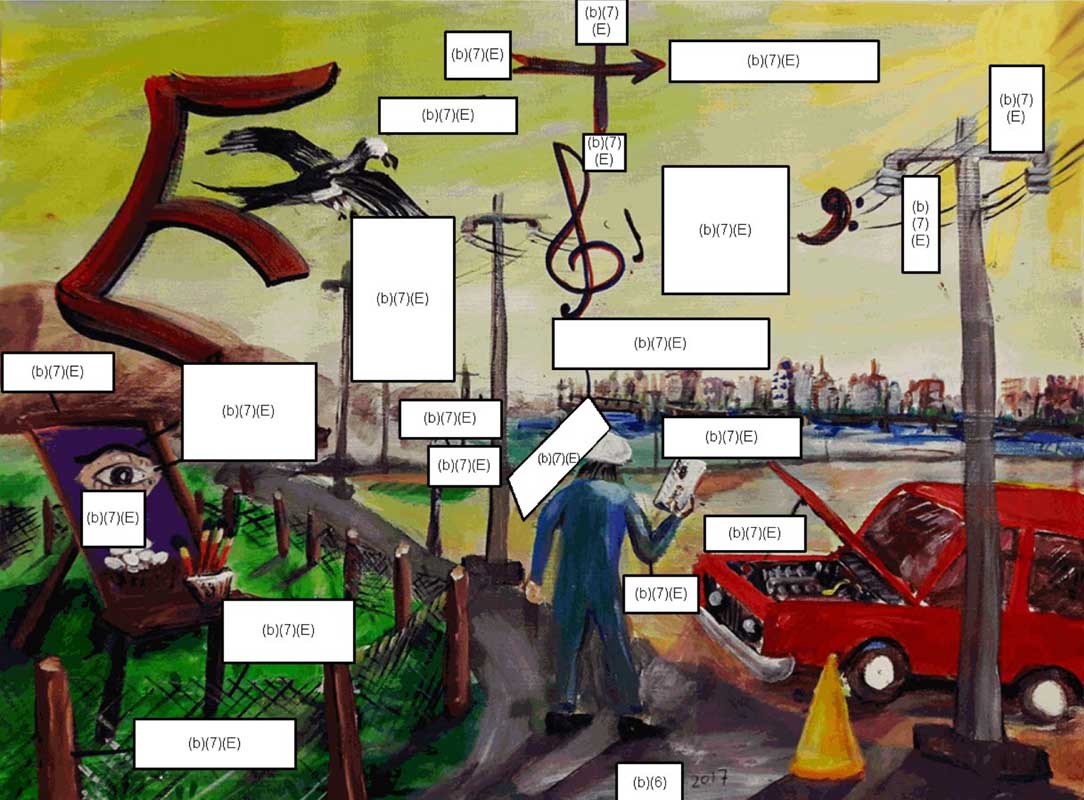
Bloomberg reporter Jason Leopold submitted a FOIA request in 2017 for artwork created by those detained at Guantanamo Bay. SOUTHCOM finally fulfilled the request last spring, and it took its own creative liberties with the release.
To the hundreds of pages of colorful paintings and drawings created by Gitmo prisoners, the military added hundreds of little white redactions. FOIA requires redactions to be very particular and to specifically cite applicable exemptions. It seems there were plenty of very particular elements with which the agency took issue, claiming that amidst trees of leaves and other scenes were materials that were ineligible for release due to personal privacy concerns and the risk that they would betray law enforcement techniques. When prisoners’ art could potentially disclose military secrets, we’re well through the looking glass.
“Gitmo, after 20-plus years, is not only a black box of secrecy,” Leopold said, “but it has its own Orwellian rules when it comes to transparency.”
We Can Neither Confirm Nor Deny the Existence of This Award: National Security Agency
Sometimes agencies will respond to your FOIA request with a stack of documents. Other times, they will reject the request out of hand. But some agencies choose a third route: They tell you they can neither confirm nor deny whether the information exists, because the subject matter is classified, or because a positive or negative response would expose the agency’s hand in whatever intelligence or investigation game they’re playing.
This so-called “Glomar response” is derived from a Cold War-era case, when the CIA refused to confirm or deny to the Los Angeles Times whether it had information about the USNS Hughes Glomar Explorer, a CIA ship that was used to try to salvage a sunken Soviet spy sub.
“The Reporters Committee for Freedom of the Press is studying the prevalence of so-called ‘Glomar’ responses to FOIA requests across the federal government,” RCFP senior staff attorney Adam Marshall told us. “As part of that project, it has submitted FOIA requests (what else) to every federal agency regarding their Glomar volume over a five-year period.”
So far, RCFP has learned that the U.S. Commodity Futures Trading Commission sent four Glomars; the U.S. Department of Energy Office of the Inspector General sent 14; and the U.S. Department of Health and Human Services Office of the Inspector General sent 102.
The NSA came back with an astounding 2,721 Glomar responses over the five-year period. As Marshall noted on Twitter, in fiscal year 2021 alone, Glomars accounted for at least 41% of all the FOIA requests the NSA processed. And so we honor the NSA for being so transparent about its lack of transparency.
TOP SECRET The ‘Glomar response’ takes its name from the USNS Hughes Glomar Explorer, a spy vessel, the existence of which the CIA would neither ‘confirm nor deny.’
The Leave No Coffee Mug Unturned Award: General Escobedo, Mexico
When an agency receives a records request, an official is supposed to conduct a thorough search, not poke around half-heartedly before generating a boilerplate rejection letter. What’s rare is for an agency to send a photo essay documenting their fruitless hunt for records.
That’s exactly how the city of General Escobedo in Nuevo León, Mexico responded to a public records request that the EFF filed for documents related to a predictive policing law under Mexico’s national transparency law. The “Inexistencia de Información” letter they sent included a moment-by-moment photo series of their journey, proving they looked really hard, but couldn’t find any records.
First, the photos showed they were outside the city’s security secretariat building. Then they were standing at the door to the police investigative analysis unit. Then they were sitting at a computer, looking at files, with a few screengrabs. Then they were looking in a filing cabinet.
The next photo almost caused us to do a spit-take: They were looking in the drawer where they keep their coffee mugs—just in case there was a print-out jammed between the tea bags and the stevia. See, they looked everywhere.
Except … those screengrabs on the computer they breezed past were exactly the kind of documents we wanted. EFF appealed the case before the state’s transparency board, which eventually forced Escobedo to release a slideshow and receipts showing the city had wasted more than 4 million pesos on the Sistema de Predicción de Delitos (SPRED) project.
THOROUGH Officials in General Escobedo, Mexico looked for records on predictive policing in a coffee cabinet.
The Wishy-Washy Access Award: Alphabet and The Dalles, OR
The Western United States has been caught in a 20-year megadrought, but when The Oregonian/OregonLive sought records on water usage from the city of The Dalles, the news organization found itself on the wrong side of a lawsuit. The city claimed the data was a trade secret, and filed suit on behalf of Google parent company Alphabet to block the release of records.
Alphabet, like other major tech companies, has increasingly invested in massive data centers that slurp up vast quantities of water to cool off their hardware. How much water, however, was a mystery, and one of pressing concern for locals. One resident told The Associated Press she had seen her well water continue to drop year after year. “At the end of the day, if there’s not enough water, who’s going to win?” she asked. After a 13-month fight, there was something to savor: The city dropped its fight. Alphabet even tried to spin it as a PR win and declared itself a champion of transparency.
“It is one example of the importance of transparency, which we are aiming to increase … which includes site-level water usage numbers for all our U.S. data center sites, including The Dalles,” a spokesperson said at the time.
ALPHABET’S WATER The Dalles, OR initially put Google’s interest
over the public’s in a records battle.
The Outrageous FOIA Fee of the Year Award: Rochester Community Schools District
This year’s winner for most ludicrous fee assessment takes us to a suburb north of Detroit, where parents were met with a hefty price tag for trying to find out whether the school district was spying on them.
As reported by WXYZ, the parents were part of a Facebook group where they discussed their dissatisfaction with the district’s approach to remote learning. After a local parent sued the district, claiming she was fired because a district official had complained to her employer about her criticism of the district’s COVID-19 policies, these parents began filing public records requests to see if the district was monitoring their social media.
When one parent asked for records to know whether their name was included in any social media monitoring, the district said that to comply with the request, staff would have to search every email ever sent by an employee—a total of 12,115,251 emails. The district told the parent to be prepared to be liable for a whopping $18,641,345 fee, with $9,320,673.73 due in advance. That’s a lot of bake sales.
The Digital Divide Award: U.S. Office of Personnel Management
Producing a copy of an intranet homepage should be a pretty easy task for an agency: Open up your browser in the morning; click “Save As”; and, boom—kick back after a job well done. You don’t even need to talk to your colleagues! But after five years of inexplicable transparency purgatory, a lead government information specialist at the U.S. Office of Personnel Management responded curtly to one such request with the following:
“The FOIA does not require agencies to create a record. The records you seek would require the creation of records. Therefore, OPM is unable to provide you any records.” Even odder, the agency’s FOIA log for last year notes the request, but writes that it was closed with “no records,” rather than being rejected. Keep that in mind when calibrating the reliability of FOIA annual reports and other official transparency statistics.
Happily, we can report that other agencies are more digitally adept when responding to these types of requests, even if they do have a maddening tendency to print out the pages and mail them rather than just sending the actual digital files. We can only hope that the Office of Personnel Management manages to get some better-equipped personnel when it comes to understanding that simply copying bits is one of the least-creative acts a computer—or FOIA officer —can do, and they should take these requests as a gift rather than a challenge.
SURREAL U.S. Southern Command redacted scans of artwork created by people detained at Guantanamo Bay.
The Bulk Data for Me but Not for Thee Award: Los Angeles Police Department
Police departments have an uncanny knack for being able to fund cutting-edge (if horribly broken) technology to watch the public while only mustering ’90s-era (also horribly broken) technology to help the public watch them back. This appears to be the case in Los Angeles, where the forthrightly named Stop LAPD Spying Coalition found that it was being monitored by the LAPD.
Like any good public watchdog, it filed a records request, in this case for emails that mentioned “Stop LAPD Spying” or “stoplapdspying.” We will make a concession that this is a potentially broad search. It’s not always easy for agencies to search across all departmental emails; sometimes emails are stored in different systems, and so on.
LAPD didn’t seem to have an issue with conducting the search, but, rather, they just had found too much material when they did: “The query resulted in a file(s) that exceeds the maximum gigabyte that our system would allow to export; therefore, we are unable to search for and identify emails responsive to your request.”
LAPD then asked the requester to narrow their request. For better or worse, the reality of public records is that it’s often a negotiation, but if an agency is going to compile more than a gigabyte of emails on an organization dedicated to curbing surveillance, the least the agency can do is have the capability to sift through and export that material. The agency’s response—put bluntly, we talk about you too much to tell you how much we’ve talked about you—would be flattering if it wasn’t both creepy and aggravating.
I Wanted to Clarify That My A** Is Covered Award: White House
Backroom dealers sometimes struggle to keep their deals in the backroom, especially when they inadvertently reveal them in emails that are presumptively public records. That’s when they follow up by saying, “I wanted to clarify that the email I sent was pre-decisional and privileged information,” hoping these magic words will exempt the email from disclosure should anyone file a records request.
On June 23, 2022, a White House staffer revealed to the Kentucky governor’s office that President Joe Biden planned to nominate Chad Meredith as a federal judge the next day. Days later, the White House official then tried to use the follow-up “clarification” email as cover. But the Louisville Courier-Journal got the story, and the Kentucky governor’s office released the emails confirming the nomination plans, despite the weak follow-up email trying to claw them back into secrecy.
The president ultimately scrapped Meredith’s nomination entirely after pro-choice advocates criticized Biden’s apparent backroom trading on judicial nominations with Senate Minority Leader Mitch McConnell. Meredith had defended Kentucky’s anti-abortion laws under the previous Republican governor.
The whole ordeal, which was overshadowed by the Supreme Court overruling Roe v. Wade on the very day Meredith would have been nominated, shows the ridiculous ways officials will try to keep public records secret.
The Transparently Proud of Destroying Public Records Awards: Michael Gableman
The effort to investigate unsubstantiated 2020 election fraud claims in Wisconsin sped past comedy, plowed through farce and fell into ludicrous land. The driver of this ridiculous journey: Michael Gableman, a former Wisconsin Supreme Court justice who was hired by Wisconsin State Assembly Speaker Robin Vos to investigate alleged election fraud.
The probe itself, however, has generated plenty of violations of state public records laws. Gableman’s inquiry is the subject of at least four public records lawsuits. And in the process of responding to public records requests about his election inquiry, Gableman has admitted to routinely deleting records and deactivating an email account he used while working on the probe.
After receiving a records request from American Oversight, someone deleted Gableman’s personal email account, the former justice testified during a hearing in one of the suits. And when questioned about whether he knew who deleted records responsive to a public records request, Gableman was refreshingly honest.
“Did I delete documents? Yes, I did,” he said.
In Gableman’s defense, he believed deleting the records was proper, because in his view, the destroyed records were not part of his election investigation. The problem is that no one can trust Gableman’s judgment, because there is no paper trail to confirm that the records were, in fact, irrelevant to his work. Gableman’s lack of an auditable paper trail to check his work stands in stark contrast to the auditable results of the 2020 Wisconsin election.
For his records destruction and general frustration of the public’s right of access, courts have awarded plaintiffs $163,000 in attorney’s fees and costs in one case, and $98,000 in another.
The Ancient Art of Dodging Accountability Award: Cyber Ninjas
Wisconsin isn’t the only state where we’re recognizing an election “audit” contractor’s misbehavior.
After the audit of the 2020 presidential election in Maricopa County, AZ—which ultimately reaffirmed Biden’s victory—State Senate President Karen Fann tried to save face by claiming that the reason the project spiraled out of control was because the election system was hard to audit, and not because auditing firm Cyber Ninjas might’ve been inexperienced and tilting at windmills. That’s kind of like saying it’s the homework’s fault that the dog ate it.
“As our efforts have clearly shown, elections processes here in Arizona are not designed to be easily audited, unlike every other government process accountable to citizens,” Fann wrote in a statement. “… (W)e look forward to implementing improvements to add ease, authentication, transparency, and accountability to our elections processes in the coming legislative session.”
The Cyber Ninjas’ own work, however, was anything but authenticatable, transparent and accountable, as the group tried to evade legitimate public records requests at nearly every turn.
The nonprofit American Oversight and The Arizona Republic newspaper had to take Cyber Ninjas to court in mid-2021 to demand access to audit records. The firm routinely refused to hand over documents, including communications, despite a court order, leading a judge in 2022 to sanction Cyber Ninjas’ founders $50,000 per day.
“I think the variety of creative positions Cyber Ninjas has taken to avoid compliance with this order speaks for itself,” Superior Court Judge John Hannah said. Cyber Ninjas began handing over records last year, revealing connections between the firm and various election conspiracy theorists and lawyers tied to Trump’s campaign and his efforts to overturn the election.
According to The Arizona Republic, Cyber Ninjas’ fines surpassed $10 million, and the firm closed up shop—and yet they still haven’t learned their lesson. The firm continues to withhold and improperly redact text messages and other correspondence. For example, Cyber Ninjas has withheld communications between CEO Doug Logan and prominent election denier Phil Waldron, claiming the messages are covered by legal privilege. This is clearly the FOIA equivalent of a torinoko, the legendary ninja smoke grenade, since Waldron is not a lawyer at all, and definitely not Logan’s lawyer.
The Transparency Tax Award: Mendocino County
The Foilies regularly recounts outrageous public records fees that seem clearly aimed at discouraging specific records requests. But those are usually one-off efforts aimed at specific requests. This award to officials in Mendocino County, California, is based on their creation of a fee system that appears designed to discourage everyone from requesting public records.
The ordinance lets officials charge you $20 per hour to look for records if you fail to “describe a specifically identifiable record.” So, if you asked for the sheriff’s “Policy 410.30,” you wouldn’t get charged, but if you asked for “all directives, policies and orders related to body-worn cameras,” you might have to pony up hard cash. Even worse, the ordinance says that if you ask for emails or other types of records that “may” include information that needs to be redacted or withheld, the county would charge you $50 or $150 per hour, depending on whether an attorney needs to be involved.
In other words, the ordinance punishes the public for not knowing exactly how the county organizes and stores its records, or what records might contain sensitive information. If you have an encyclopedic knowledge of the county’s systems and how to request records, you may not be charged any search fees. But if you are a normal person who just wants to find out what’s happening in the county, you are probably going to be charged a huge search fee.
Mendocino County’s ordinance is on shaky legal ground. The California Public Records Act does not give state and local government agencies the authority to assess their own search fees, review fees or even fees to redact records. The law only allows agencies to charge the public what it costs to make copies of the records they seek.
But aside from being potentially unlawful, Mendocino County’s fee ordinance is an affront to its residents. It treats all records requests as hostile, resource-wasting inquiries rather than a central mission of any public agency committed to transparency.
The Burn After Reading Award: Immigration and Customs Enforcement
Though it might be surprising, sometimes an agency will fulfill your request—and realize afterward they’d like to hit the undo button. Generally, however, the First Amendment protects your right to keep the records and publish them, even when the government could have originally withheld them.
That’s what happened to the well-known, oft-feared FOIA warrior and journalist Jason Leopold after Immigration and Customs Enforcement (ICE) used the wrong highlighter when they responded to his request for information on Department of Homeland Security (DHS) activity in Portland, OR, in the wake of George Floyd’s murder during the summer of 2020.
Leopold asked ICE for communication and documents from the DHS about the training and placement of DHS personnel in Portland that summer and received a “DHS Component Actions Report” in response. Among the information on the report that ICE later claimed was sensitive enough to warrant a gimme-back: the exact numbers of helmets, crowd-control shields and pepper-spray projectiles that the DHS loaned to the United States Park Police, the police force of the National Park Service.
The Misfire in All Directions Award: Irvington Township
Sometimes you just have to marvel at the hubris of an agency that would prefer to pick unwinnable fights rather than just open up its books.
Irvington Township, NJ started one such berserk rampage in 2021 when it filed a lawsuit against a retired teacher who had gotten in the habit of regularly asking for information about local government operations. The suit claimed her requests were “unduly burdensome, time consuming and expensive” and that the octogenarian had “bullied and annoyed” township administrators.
Then, in a misguided attempt to avoid negative attention, the town sent cease-and-desist letters to NBC reporters who were covering the lawsuit, also accusing them of harassment. Less than a week after the reporters published their story, Irvington Township withdrew the suit.
But it didn’t end there. Curious about how much the lawsuit had cost and who had authorized it, Adam Steinbaugh, an attorney for the Foundation for Individual Rights and Expression (FIRE), filed his own records requests. Irvington Township failed to respond to the request, and Steinbaugh filed a complaint with the New Jersey Government Records Council.
At that point, Irvington Township claimed that Steinbaugh, being from out of state, had no right to the records (false!) and deserved to be referred to law enforcement and criminally prosecuted (no!). Not only were Irvington Township’s arguments frivolous; they backfired: Saber-rattling about vexatious lawsuits against a free speech lawyer is like threatening them with a good time.
The Foilies (CC BY) were compiled by the Electronic Frontier Foundation (director of investigations Dave Maass, senior staff attorney Aaron Mackey, Frank Stanton fellow Mukund Rathi and investigative researcher Beryl Lipton) and MuckRock (co-founder Michael Morisy, data reporter Dillon Bergin and investigations editor Derek Kravitz), with further review and editing by Shawn Musgrave. Illustrations are by EFF designer Caitlyn Crites. The Foilies are published in partnership with the Association of Alternative Newsmedia.
ARIES (March 21-April 19): Aries-born René Descartes (1596–1650) was instrumental in developing modern science and philosophy. His famous motto, “I think, therefore I am,” is an assertion that the analytical component of intelligence is primary and foremost. And yet, few history books mention the supernatural intervention that was pivotal in his evolution as a supreme rationalist. On the night of Nov. 10, 1619, he had three mystical dreams that changed his life, revealing the contours of the quest to discern the “miraculous science” that would occupy him for the next 30 years. I suspect you are in store for a comparable experience or two, Aries. Brilliant ideas and marvelous solutions to your dilemmas will visit you as you bask in unusual and magical states of awareness.
TAURUS (April 20-May 20): The dirty work is becoming milder and easier. It’s still a bit dirty, but is growing progressively less grungy and more rewarding. The command to “adjust, adjust and adjust some more, you beast of burden” is giving way to “refine, refine and refine some more, you beautiful animal.” At this pivotal moment, it’s crucial to remain consummately conscientious. If you stay in close touch with your shadowy side, it will never commandeer more than 10% of your total personality. In other words, a bit of healthy distrust for your own motives will keep you trustworthy. (PS: Groaning and grousing, if done in righteous and constructive causes, will continue to be good therapy for now.)
GEMINI (May 21-June 20): “‘Tis the good reader that makes the good book,” wrote Gemini philosopher Ralph Waldo Emerson. “In every book, he finds passages which seem confidences or asides hidden from all else and unmistakably meant for his ear.” In the coming weeks, a similar principle will apply to everything you encounter, Gemini—not just books. You will find rich meaning and entertainment wherever you go. From seemingly ordinary experiences, you’ll notice and pluck clues that will be wildly useful for you personally. For inspiration, read this quote from author Sam Keen: “Enter each day with the expectation that the happenings of the day may contain a clandestine message addressed to you personally. Expect omens, epiphanies, casual blessings, and teachers who unknowingly speak to your condition.”
CANCER (June 21-July 22): Traditional astrologers don’t regard the planet Mars as being a natural ally of you Crabs. But I suspect you will enjoy an invigorating relationship with the red planet during the next six weeks. For best results, tap into its rigorous vigor in the following ways: 1. Gather new wisdom about how to fight tenderly and fiercely for what’s yours. 2. Refine and energize your ambitions so they become more ingenious and beautiful. 3. Find out more about how to provide your physical body with exactly what it needs to be strong and lively on an ongoing basis. 4. Mediate on how to activate a boost in your willpower.
LEO (July 23-Aug. 22): I won’t ask you to start heading back toward your comfort zone yet, Leo. I’d love to see you keep wandering out in the frontiers for a while longer. It’s healthy and wise to be extra fanciful, improvisatory and imaginative. The more rigorous and daring your experiments, the better. Possible bonus: If you are willing to question at least some of your fixed opinions and dogmatic beliefs, you could very well outgrow the part of the Old You that has finished its mission.
VIRGO (Aug. 23-Sept. 22): The Supreme Deity with the most power may not be Jehovah or Allah or Brahman or Jesus’ Dad. There’s a good chance it’s actually Mammon, the god of money. The devoted worship that humans offer to Mammon far surpasses the loyalty offered to all the other gods combined. His values and commandments rule civilization. I bring this to your attention, Virgo, because now is an excellent time for you to deliver extra intense prayers to Mammon. From what I can determine, this formidable Lord of Lords is far more likely to favor you than usual. (PS: I’m only half-kidding. I really do believe your financial luck will be at a peak in the coming weeks.)
LIBRA (Sept. 23-Oct. 22): It’s an excellent time to give up depleted, used-up obsessions so you have plenty of room and energy to embrace fresh, succulent passions. I hope you will take advantage of the cosmic help that’s available as you try this fun experiment. You will get in touch with previously untapped resources as you wind down your attachments to old pleasures that have dissipated. You will activate dormant reserves of energy as you phase out connections that take more than they give.
SCORPIO (Oct. 23-Nov. 21): “The best revenge is not to be like your enemy,” said ancient Roman philosopher Marcus Aurelius. I’m tempted to advise every Scorpio to get a tattoo of that motto. That way, you will forever keep in mind this excellent advice. As fun as it may initially feel to retaliate against those who have crossed you, it rarely generates redemptive grace or glorious rebirth, which are key Scorpio birthrights. I believe these thoughts should be prime meditations for you in the coming weeks.
SAGITTARIUS (Nov. 22-Dec. 21): Sometimes love can be boring. We may become overly accustomed to feeling affection and tenderness for a special person or animal. What blazed like a fiery fountain in the early stages of our attraction might have subsided into a routine sensation of mild fondness. But here’s the good news, Sagittarius: Even if you have been ensconced in bland sweetness, I suspect you will soon transition into a phase of enhanced zeal. Are you ready to be immersed in a luscious lusty bloom of heartful yearning and adventure?
CAPRICORN (Dec. 22-Jan. 19): What shall we call this latest chapter of your life story? How about “Stealthy Triumph Over Lonely Fear” or maybe “Creating Rapport With the Holy Darkness.” Other choices might be “As Far Down Into the Wild Rich Depths That I Dare to Go” or “My Roots Are Stronger and Deeper Than I Ever Imagined.” Congratulations on this quiet but amazing work you’ve been attending to. Some other possible descriptors: “I Didn’t Have to Slay the Dragon Because I Figured Out How to Harness It” or “The Unexpected Wealth I Discovered Amidst the Confusing Chaos.”
AQUARIUS (Jan. 20-Feb. 18): It’s sway-swirl-swivel time for you, Aquarius—a phase when you will be wise to gyrate and rollick and zigzag. This is a bouncy, shimmering interlude that will hopefully clean and clear your mind as it provides you with an abundance of reasons to utter “whee!” and “yahoo!” and “hooray!” My advice: Don’t expect the straight-and-narrow version of anything. Be sure you get more than minimal doses of twirling and swooping and cavorting. Your brain needs to be teased and tickled, and your heart requires regular encounters with improvised fun.
PISCES (Feb. 19-March 20): When I was growing up in suburban America, way back in the 20th century, many adults told me that I was wrong and bad to grow my hair really long. Really! It’s hard to believe now, but I endured ongoing assaults of criticism, ridicule and threats because of how I shaped my physical appearance. Teachers, relatives, baseball coaches, neighbors, strangers in the grocery store—literally hundreds of people—warned me that sporting a big head of hair would cause the whole world to be prejudiced against me and sabotage my success. Decades later, I can safely say that all those critics were resoundingly wrong. My hair is still long, has always been so, and my ability to live the life I love has not been obstructed by it in the least. Telling you this story is my way of encouraging you to keep being who you really are, even in the face of people telling you that’s not who you really are. The astrological omens say it’s time for you to take a stand.
Willie Waldman loves you two times, baby—check into his two-night stand, featuring John Avilla on bass, Tony Austin on drums and Emcee Radioactive on vocals, 8pm, Friday, April 14 and Saturday, April 15. $20.
The Flamingo Resort
2777 4th St., Santa Rosa. vintagespacesr.com.
It’s that time of the month again—LUSH, an LGBTQ+ and friends dance party with DJ Die Wies. 9pm, Friday, April 14. 21+. $10.
Green Music Center
1801 East Cotati Ave., Rohnert Park. gmc.sonoma.edu.
32 Sounds: A Film by Sam Green is an immersive documentary and sensory experience featuring original music by JD Samson of the band Le Tigre, with a binaural sound mix (headphones provided) and live narration by the filmmaker. 7:30pm, Saturday, April 8. Tickets are $25–$75
Hopmonk Tavern Sebastopol
224 Vintage Way, Novato. hopmonk.com.
There are no strings attached to this gratis gig from the Josh Brough String Band, which will explore folk, Americana, country and bluegrass at 6pm, Tuesday, April 11. Free.
Uptown Theatre Napa
1350 3rd St., Napa. uptowntheatrenapa.com
John Oates is one half of the best-selling duo of all time (here’s a hint: it’s not Simon & Garfunkel). The original man with a mustache plays at 8pm, Sunday, April 16. Tickets $50-$70.
The Phoenix Theater
201 Washington St., Petaluma. Thephoenixtheater.com.
Only the best-named bands play here: Gas Money, Wild Metanoia, Plum and Juniper.
8pm, Friday, April 7. $10
Peri’s Tavern
29 Broadway, Fairfax. peristavern.com.
Get wrecked and/or strange with the Wreckless Strangers when they play this beloved West Marin enclave. 9pm, Friday, April 7. $10-$13.
Tom Tomorrow draws public figures in “This Modern World” so true to life that we all instantly recognize them, as well as portraying the dangerous silliness of Republicrats accurately week after week. I bet if he portrayed himself in a panel, we would recognize him.
Barry Barnett
Santa Rosa
Some Assembly Required
Regarding the article on Assemblymember Damon Connolly (March 22)—More for welfare while they continue to pollute our environment. Shame! We are paying ag to put the land back to where it was originally before they ruined it, which they cannot successfully do. It is just big money getting more out of our pockets and destroying our resources.
Mark White
Portland
Dog Days
Regarding “Dog Crisis” (March 15)—The worst part about most impulse buying American dog owners is that they never make the effort to train a dog—just tragic. This was easily seen when people adored dogs like popcorn during the pandemic. Then all these untrained dogs are back at shelters.
The best option for most people is to consider a dog like a car expense—if you do not have lots of money and ample space and time to spend training/caring for it, just don’t get a dog. It is a tragic American mentality to just scoop up pets, then leave them at shelters when it gets to be too inconvenient.
Margo Wixsom
Inverness
We Love to Hear From You
Send your letters to the editor to le*****@******an.com or le*****@********un.com.
We’ve heard of “Art in the Park,” but what about “parking your art?” As part of an upcoming May show, “Auto-Mobility: Cars and Culture in Sonoma County,” the Petaluma Arts Center announces a “call for art,” open to all Sonoma County resident artists to express their creativity and love of the automobile (with themes of “community and cultural identity” encouraged). Deadline is April 16. For more information and details for submission, visit bit.ly/pac-car-show.
Napa
Roped In
All four basic food groups of the soul (wine, art, food and music) will be fed at a “Velvet Rope Social Club Pinot Night,” at which Art House Wines will offer a sneak preview of their unreleased 2021 Pinot Gris, a favorite of several Napa Valley restaurants (the wine, as well as a pinot noir, will be paired with light bites by “Chef Ron”). Contributing to the ambiance of the evening are paintings by artist John Bonick and the work of photographer Dona Kopol Bonick, as well as the musical stylings of Sanho the Indian The event runs from 6 to 10pm on Friday, April 21 at the Mia Carta Wine Lounge, 1209 First St. in downtown Napa. For more information, visit arthousewines.com. Free.
Mill Valley
Loretta Lives
Stars of the Bay Area country music scene come together to pay tribute to country music legend Loretta Lynn, whose career spanned six decades before her death last October. Fans of the “Coal Miner’s Daughter” can expect to hear hits and deep cuts from Lynn’s ouvre performed by Laura Benitez, Cindy Emch and Margaret Belton, among many others, all backed by Crying Time, “a stalwart of the Bay Area’s vibrant country music scene.” The tribute begins at 7:30pm, Sunday, April 16, at Sweetwater Music Hall, 19 Corte Madera Ave., Mill Valley. Tickets start at $20.
Santa Rosa
Becoming Story
Award-winning local author and community leader Greg Sarris will return to Santa Rosa Junior College (SRJC) to read from his recent memoir, Becoming Story, a Journey Among Seasons, Places, Trees and Ancestors. Weaving reminiscences from childhood to present-day, Sarris explores the forces that shaped his childhood and his path to becoming a professional storyteller and tribal leader. A book signing in the lobby follows the presentation (books will be available for purchase in the Studio Theatre Lobby). The reading commences at 9am, Thursday, April 13 at the Burbank Studio Theater at Santa Rosa Junior College, 1501 Mendocino Ave. A livestream will be viewable at nac.santarosa.edu.
Taco Jane’s has been my family’s go-to Mexican restaurant since moving to Marin, and not just because their patio is especially suited for drinking margaritas on sunny days. Matthew “Matteo” Boussina opened the place in 1998, and they are celebrating 25 years in business this month. The following is an interview with Boussina:
What do you do?
I own and...
3-day event frontlines wellness
Prioritizing wellness and learning to balance mind, body and spirit is a lifelong journey—one full of twists, turns and unexpected elephant-sized potholes along the way.
For the past 20 years, New Living Expo has provided a space for like-minded individuals interested in the pursuit of holistic health and wellness, to gather, share wisdom and celebrate together in...
Keeps youth accountable, removes shame and stigma
This story was co-published with MindSite News, a nonprofit digital news site focused on mental health reporting.
On a late afternoon in December, a 22-year-old youth advocate named Rachel is addressing a jury of her peers on Zoom in Marin County, California. Her client: a teen named Leonel, who was caught with two boys after shooting BB guns from...
Joining a nationwide rise in labor action, workers at Petaluma’s beloved Copperfield’s Books store are attempting to unionize.
On Saturday, March 11, members of the Copperfield’s Books Petaluma Union gathered under the downtown store’s awning to announce the campaign to a few dozen supporters.
A series of speakers highlighted their main concerns, including low wages, minimal paid time off, inadequate healthcare...
Catherine Simon recently opened the Garvey|Simon Gallery in downtown San Anselmo. I’ve gotten to know her via my volunteer work with the San Anselmo Arts Commission and just because she’s a pretty rad lady. The following is an interview with Simon:
What do you do?
That is a loaded question. I own and run an art business and gallery with...
Recognizing the worst in government transparency
It seems like these days, everyone is finding classified documents in places they shouldn't be: their homes, their offices, their storage lockers, their garages, their guitar cases, between the cracks of their couches, under some withered celery in the vegetable drawer … OK, we're exaggerating—but it is getting ridiculous.
While the pundits continue to speculate...
ARIES (March 21-April 19): Aries-born René Descartes (1596–1650) was instrumental in developing modern science and philosophy. His famous motto, "I think, therefore I am," is an assertion that the analytical component of intelligence is primary and foremost. And yet, few history books mention the supernatural intervention that was pivotal in his evolution as a supreme rationalist. On the night...
Elephant in the Room
177 Healdsburg Ave., Healdsburg. Elephantintheroompub.com.
Willie Waldman loves you two times, baby—check into his two-night stand, featuring John Avilla on bass, Tony Austin on drums and Emcee Radioactive on vocals, 8pm, Friday, April 14 and Saturday, April 15. $20.
The Flamingo Resort
2777 4th St., Santa Rosa. vintagespacesr.com.
It’s that time of the month again—LUSH, an LGBTQ+ and friends dance...
Drawn From Life
Tom Tomorrow draws public figures in “This Modern World” so true to life that we all instantly recognize them, as well as portraying the dangerous silliness of Republicrats accurately week after week. I bet if he portrayed himself in a panel, we would recognize him.
Barry Barnett
Santa Rosa
Some Assembly Required
Regarding the article on Assemblymember Damon Connolly (March 22)—More...
Petaluma
Car Meets Canvas
We’ve heard of “Art in the Park,” but what about “parking your art?” As part of an upcoming May show, “Auto-Mobility: Cars and Culture in Sonoma County,” the Petaluma Arts Center announces a “call for art,” open to all Sonoma County resident artists to express their creativity and love of the automobile (with themes of “community and...