Leland Dennick’s Open Mic essay (“Conscious Confusion,” Sept. 6) brought to mind a concept that may or may not have been introduced decades ago by the writing partner of corporate guru and Ivy Leaguer Tom Peters, Stanford business school lecturer Robert Waterman. The two wrote In Search of Excellence to spread the word on what they thought the best companies were doing to stay on top of their respective industries. They sold a lot of books.
The idea Waterman presented, if memory serves, was “expertise blindness,” which happens to someone who thinks he’s so smart that he ignores anything contrary to his own observations, even when he’s plainly out of touch. The Buddhists call it believing your own bullshit. There is a lot of that going around.
Craig J. Corsini
San Rafael
Spirit of the Law
Let’s talk about the “insurrection clause” of the Constitution. Lawyers and judges can argue “the letter of the law” until blue in the face as to whether this provision disqualifies Donald Trump from holding office again.
But how about “the spirit of the law”? The spirit of the law looks at what the law is really trying to get at. Do you think our highly moral Founding Fathers would qualify Trump for a second term of office, even if they had no idea about the outcome of his four criminal trials?
In other words, if they only knew what we know today? Various newspaper watchdogs and fact checkers cataloged over 30,000 distortions, exaggerations, half-truths and outright lies over the course of his four-year administration. Does Trump meet even the minimum standard expected for the lowest position of political leadership in America, let alone the highest? You tell me.
When Kelechi Ubozoh needed a fresh start and a safe place to land and recuperate after dealing with trauma and a suicide attempt, she sought refuge in California a little over a decade ago. “The Mental Health Services Act, also known as Prop 63, changed my life. It’s the reason I moved to California,” Ubozoh says. “It funded peer and community-based innovative solutions. I found radical ways to look at healing that were culturally responsive. I found my people.”
The MHSA, which passed in 2004, serves as a lifeline for people like Ubozoh, who are both beneficiaries of and providers of community-based peer mental health support. Funded by a 1% income tax to those with annual incomes of more than $1 million, it provides a spectrum of services including prevention, early intervention and training for effectively supporting the continuum of public behavioral health.
Now, as Sacramento lawmakers aspire to push through Senate Bill 326—a bill purporting to modernize the MHSA by redirecting funding to prioritize a subsection of California’s growing unhoused population dealing with mental health and substance abuse issues by building 10,000 new beds in treatment centers and facilities—Ubozoh is part of a growing group that fears California will no longer live up to its reputation as a safe haven.
Parties on all sides seem to agree that the intention behind the $4.68 billion bond measures SB326 and AB531—proposed by Gov. Gavin Newsom, Sen. Susan Talamantes Eggman and Assemblymember Jacqui Irwin to build 10,000 new beds in California treatment centers and facilities to help unhoused Californians impacted by severe mental health and substance use issues—is positive.
But the sentiment among opponents is that SB326 is a shortsighted band-aid approach to a complex problem that threatens to unravel the peer and community-run programs keeping many Californians afloat, by focusing only on a subsection. And the numbers just don’t add up. Here’s why: California is home to the vast majority of unhoused people in the United States, with estimates ranging from 115,000-170,000 people. It’s also home to 1,243,000 adults with serious mental illnesses, 396,000 youth between the ages of 12-17 struggling with depression and as many as one in six youth between the ages of 6-17 struggling with a mental health disorder.
Ubozoh, one of dozens of opponents who showed up at one of the informational hearings in August, spoke during the hearing, but says that simply wasn’t enough. “There is a difference between a listening session where policymakers listen to the concerns of stakeholders and co-creation of policies,” Ubozoh says.
“Unlike the Mental Health Services Act, which had the active participation of all stakeholders—particularly mental health clients and their families in its development—SB326 was drafted without meaningful involvement of mental health consumers. ‘Nothing about us without us’ is a disability rights and mental health consumer-movement slogan that means no policy changes should be decided without the direct participation of members of the group that will be affected. This policy has been all about us without us, and has had no representation from unhoused communities,” she continues.
Tiffany Elliot, a project manager with Painted Brain, a peer-run organization providing community-based solutions through arts, advocacy and enterprise, is also involved with the Medi-Cal Peer Support Specialist Training program, which empowers people who have been impacted by mental and health challenges, trauma and interpersonal violence to support peers after completing an extensive, multiple-module program. As a person who lives with PTSD and physical disabilities and who has benefited from the peer-run program and now works within it, Elliot has many concerns about SB326, starting with the pacing.
“When I made my public comment, I questioned the rush,” Elliot says. “This isn’t a crisis that came up yesterday. The crisis with homelessness has been going on in California for a long time. There is room to get the voices of people impacted by homelessness, those affected by mental health challenges and those who’ve experienced 51/50s or 52/50s—involuntary mental health hospitalizations. Get those voices heard, especially by people with disabilities, people who are Black, Indigenous, people of color, people with disabilities. Our anthem in the peer movement is: ‘Nothing about us without us.’”
Elliot says that even if it’s complicated, there needs to be an individualized way of addressing mental health. “Programs like the Care Act, part of Care Court, aren’t looking to conserve people forever,” she says. “If someone who doesn’t want to take medication is forced to take it, as soon as they’re out of the program, they are going to turn away—not only from the medication but from the mental health care system in general.”
Elliot shared a breakdown of how funding under SB326 might change things. This bill raises the administrative cost from 5%, which it currently is under the Mental Health Care Act, to 10%. Of the remaining funds, 35% will be earmarked for the housing initiatives, which she says lacks specificity. The remaining funding will be used to help with mental health and co-occurring substance challenges.
With nearly 1.5 million Californians struggling with severe mental health challenges and likely many more with more moderate forms, Elliot says organizations will be placed in an impossible predicament. “A lot of these nonprofits are led by people of color,” she says. “This one is. Black Men Speak is another organization that came to the capital. There are so many amazing organizations whose funding will be in jeopardy. There’s not going to be much funding left over to support community agencies provided by non-county sources. We’ll be tasked with doing 125% of the work with 65% of the funding.”
Julia Ford has experienced addiction, homelessness and recovery. Even before Ford began her own recovery program, she connected with the Healthy Babies Project, a program started by Majeedah Rahman, a former Black Panther, to help mothers struggling with addiction get the resources and support they needed to care for their children. Although Ford’s four children are now in their 30s and 40s, she still speaks highly of that organization for giving her a different outcome. She was living in a bus, courting the idea of recovery, when she was arrested.
“I went to a place called Shepherd’s Gate, where I had to work a 12-step program and scrape all the way to the bottom of my trauma that brought me all the way to when I was 17 years old, when I was sexually assaulted,” Ford says. Although gearing up on her own to get back on her feet with the help of a program, an Alameda court judge mandated she do it. “I had forgotten all of that. I was working the program at Shepherd’s Gate, getting better and saying, ‘I brought myself here.’ When I went back to court, the judge didn’t even recognize me. He told me he didn’t recognize me, and he closed out my case.”
Twenty-five years later, Ford is still going strong. She might not have a formal peer certification, but she offers advice and referrals to the spaces that changed her life and the lives of her children. She’s not opposed to court care, but she’s a huge proponent of self agency. “I think intervention can be helpful,” she says. “If people have 30 days with access to food, water and shelter, [which] allow[s] them to have a clear brain, many people would choose to be sober if they’re able to work the program, and be honest with themselves and deal with their adverse childhood experiences.”
That said, Ford recalls not having anyone to lean on after she was victimized as a 17-year-old child. She now wonders how her outcome might have been different if she’d had access to a community resource after that happened. “My mom was loving, but I didn’t know how to tell her that someone tampered with me,” she says. “I didn’t want to tell my brother because he would’ve wanted to harm the person who harmed me. So I kept it to myself and didn’t deal with it until the recovery program.”
Although Ubozoh and Elliot have never met Ford, her story represents the dichotomy of the state of mental health in California, and likely the nation as a whole. From this vantage point, it’s plausible that if the 17-year-old Ford had a safe community space to turn to, she might have healed instead of using substances in the first place. “If we don’t have culturally informed and accessible resources and interventions for support that meet people where they’re at,” Ubozoh says, “we’ll have more crisis situations, and the problem[s] will be even bigger.”
Gin has been a go-to spirit among the British for a long time. Though the Dutch came up with its precursor, gin as we know it today, is actually a British invention.
The Dutch invented a whisky-like, amber-colored alcoholic drink which they named jenever, while the British drink, shortened to gin, was a clear spirit.
In the 18th century (mostly between 1720 and 1751), London went mad for gin. Called the “Gin Craze,” it was when extremely cheap, unlicensed gin was available everywhere in London, and its rampant consumption outright killed and ruined a good portion of the population—particularly the poor. One must remember that available water was too unhealthy to drink at those times, so other substances containing germ-destroying alcohol were preferred and consumed.
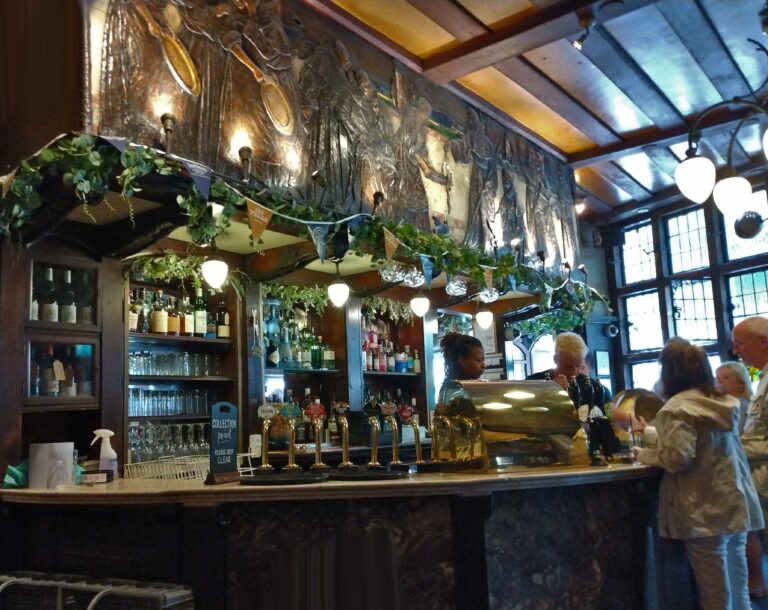
Eventually, the government passed the Gin Act of 1751, which made it illegal to sell unlicensed gin, and brought most “bathtub,” i.e., homemade gin, under control. The 1751 act forced the alcohol industry into enacting higher standards for gin and outlawed small producers. By the 19th century, the Gin Craze was under control, and new “gin palaces” built out of glittering glass, ornate dark woods, brass and artistic carvings began popping up. Gin was back in London, and many of these gorgeous old haunts can still be visited today.
What Exactly Is London Dry Gin?
“There’s a long list of regulations about what does and does not constitute a London Dry Gin, but in a nutshell, these are the most important parts,” said Jake Burger, master distiller for The Ginstitute, located on Portobello Road in the trendy Notting Hill section of London.
Continued Burger, “We must start with a neutral spirit (i.e., column distilled), which has been taken pretty much as close to complete purity as conventional distillation technology allows, and it must be of ‘agricultural origin.’ We can only flavor that by redistilling it in the presence of natural botanicals—essentially any part of any plant—we cannot use extracts/flavorings/synthetic flavors. The Ginstitute is not only a classroom for gin education; it’s a hopping bar too.”
Burger went on to state, “The predominant flavor must be juniper berries. After the botanical distillation, the only things we are permitted to add are more distilled alcohol of the same quality (unflavored) and water.”
Additionally, London Dry Gins don’t have to be made in London. There are many fine examples of London Dry Gin on the market today, produced in the UK and beyond. One may try Sipsmith, the London City Distillery, Ford’s plus classics like Tanqueray, Beefeater, Bombay Sapphire. These are all fine London Dry Gins. Incidentally, gin drinks in London are customarily served in large, Copa de Balon glasses. They’re festive and fun.
BE STILL MY HEART The Ginstitute’s general manager Phil Gabriel (left) and master distiller Jake Burger pose with a gin still.
London sports many wonderful bars, hotels and other spots to enjoy an excellent gin & tonic, such as the Ginstitute, Duke’s Bar, Viaduct Tavern and The Franklin Hotel. A company called Imagine Experiences offers great tours of venerable gin haunts in London: imaginexperiences.com/the-gin-craze-experience-2.
For a very special gin experience, one may try going to Highclere Castle, located about an hour west of London. It’s an amazing, historic place to visit. Besides being the actual castle/grand manor house used in the hit PBS Show, Downton Abbey, it’s home to one of the smoothest, premium gins available: Highclere Castle Gin.
“Premium Gin is one of the fastest growing spirit sectors in the U.S. Some estimates have it growing at nearly 35% per year. However, in the U.S. it’s still a relatively small category, accounting for roughly 6% of spirit sales,” said Adam von Gootkin, co-founder and CEO for Highclere Castle Spirits. “We are projecting 25,000 cases this year and nearly double that for 2024.” Besides enjoying at the castle itself, this gin is available in upscale retailers throughout northern California. Lord and Lady Carnarvon are the brand’s other co-founders, and live on the Highclere Castle property.
And Tonic
Another important recent—and related development to the modern “Gin Craze” is the sales of artisanal tonic waters in the drinks marketplace. In fact, on the tonic side, things have also changed drastically. For years, tonic water was relegated to the commonplace, high fructose tonics readily available, such as Canada Dry, Schweppes and Seagram’s.
Nothing against those brands, but around 2010 or so, artisanal foods and drinks were gaining in popularity as consumers were seeking out more authentic products to eat and drink. So, it was only natural that this artisanal revolution came to tonic waters. After all, half or more than half of a good gin & tonic is made from … tonic.
So why wouldn’t discriminating imbibers opt for high quality tonics in their drinks? Most of these products today come in small 6.7-ounce bottle sizes, good for two drinks or one large G & T. (Big bottles go flat too soon anyway.) The largest company in this category is Fever Tree which produces a number of excellent products. But other, smaller companies also offer fine tonic waters worth trying. These include Jack Rudy, Top Note, Q and Navy Hill, among others. They are more expensive, but worth it.
“Premium tonic waters are made with more than generic quinine and flavor, and can combine with just about any exceptionally crafted spirits, like vodka, rum, even pisco, and of course gin, which tonic is best known to mix with,” said Mary Pellettieri, co-founder of Milwaukee based Top Note Tonic. “No matter the spirit, premium tonic water makes a simple highball drink more complex because it plays the perfect combination of sweet, sour, salt and bitter, crafting a complex arrangement with every sip.”
Gin, and tonic, respectively, have hit the big time, and there’s no going back. Premium products help elevate the flavors, so one’s drink will really stand out. When trying some, don’t forget to ask for the big glass.
Bob Ecker is a Northern California based writer and wine judge.
The easiest way to maximize vacation time is to spend it locally, and Sonoma County is full of options for this kind of getaway, including the close-to-home but remote-feeling Vintners Resort in Santa Rosa.
It’s perfect for a wide range of special events, from a quick romantic getaway or a personal retreat, to a catered vineyard wedding convenient for out-of-town and local guests alike, a family reunion or conference.
Dream Amongst the Vines
Vintners is the first luxury resort on a working vineyard, and is also home to John Ash and Co., one of the very first farm-to-table restaurants in Sonoma County. Besides the vineyard, the 92-acre estate has extensive flower and culinary gardens, fig and olive orchards, all contributing to the restaurant and the resort’s unique farm-to-spa treatment offerings.
This local getaway showcases everything about Sonoma Wine Country that other travelers come from far away to enjoy, including the thoughtful, spacious rooms with breezy balconies offering expansive vineyard views. Some rooms even feature luxurious bathtubs large enough for honeymooners, and there’s coffee and wine in the room for when one just wants to stay in.
When ready to emerge from the relaxing rooms, there are many ways guests can enjoy personal time at the resort or engage with fellow travelers. First and foremost, of course, are wine tasting and fine dining, and then there are the large-scale chessboard and swimming on the pool grounds for outdoor fun.
Consider delighting in a leisurely late-morning brunch at the on-site River Vine Café, then go for a swim, head to the spa for a treatment or even venture out into the country for a little antique shopping that could never normally be done here during the bustle of day-to-day life. The advantage is that the places one discovers can easily be returned to again and again since they’re local.
Back at the Vintners Resort, the Front Room Bar and Lounge makes for a fine happy hour. With some luck, while awaiting dinner reservations, there might also be a complimentary wine tasting. On a recent late afternoon, Scherrer Winery was showcasing its splendid old- and mature-vine varietals in the lobby sitting area.
Dinner at the John Ash & Co. restaurant could be the highlight of any stay in Sonoma County and all the more convenient when its a mere stroll away. Widely known as the first Sonoma County restaurant to introduce the idea of cooking with seasonal, locally sourced food, the restaurant is also known for its expert pairing of regional wines with its stellar cuisine.
The namesake restaurant of James Beard Award-winning chef and author John Ash (a.k.a., the “Father of Wine Country Cuisine”), the restaurateur opened the establishment in 1980 to instant critical acclaim. A passionate supporter of sustainable food practices, Ash served on the board of the Chefs Collaborative, as well as Seafood Watch, an initiative of the Monterey Bay Aquarium.
Passing the Toque
Today, executive chef Thomas Schmidt continues the tradition of quality at John Ash and Co. His broad knowledge of wine informs the creation of meals that are creative accompaniments to the restaurant’s extensive, award-winning wine list.
Indeed, the restaurant’s seasonal offerings are not only created from the bounty of local farms and purveyors, but also from sustainable and organic produce from the resort’s own gardens, overseen by culinary gardener Chris Connell.
The restaurant is relaxing, with a vineyard view, outdoor banquet table, indoor or outdoor seating, and Mediterranean accents. The rural environs of the establishment are transportive, while embracing contemporary “foodie” culture.
This combination is amplified by a recent addition to the culinary team, chef de cuisine Dylan Ghadiri, who joined executive chef Tom Schmidt and his team at the restaurant this summer.
“Dylan is a talented chef with an enviable depth of experience at some of the most legendary Bay Area establishments,” said Vintners Resort general manager Brian Sommer. “Our inspiring cuisine has helped to shape the culinary movement over the past several decades—placing the Vintners Resort on the global stage and establishing us as a major culinary destination. We’re thrilled to bring Dylan’s expertise and energy to our tightly-knit culinary team.”
Ghadiri brings with him more than 10 years of culinary experience in Healdsburg, Geyserville, Marin and San Francisco, at restaurants and wineries including the Francis Ford Coppola Winery in Geyserville, Sonoma.
“As a Marin and Sonoma County native, Josh Ash & Co. has always been on my radar as a dream job,” said Ghadiri. “The possibilities are endless—and I look forward to collaborating with the team to showcase Sonoma’s world-class cuisine to our guests.”
Table Time
For the table, enjoy an artisan charcuterie and cheese board, which features house made chorizo, a rich bresaola, a country paté, cheeses from the Valley Ford creamery and the Bohemian Creamery, nuts, pickled vegetables, mustard, and a selection of flatbreads and crackers.
CHOPS Dylan Ghadiri joined John Ash & Co. as chef de cuisine this past summer.
Then begin the meal with local Hog Island oysters and an estate heirloom tomato and burrata salad. This can be paired with one of the many locally produced white wines for a tasting experience that will start a meal off right. In fact, one may ask the server to recommend a wine that pairs with each course for a real wine country farm-to-table experience.
Entrees range from the vegetarian Bellwether Farms ricotta cavatelli pasta with estate basil and cherry tomatoes, sweet corn cream and smoked butter, to the black angus beef filet steak with whipped potatoes and sauteed spinach. Or one may try the herb-crusted pork, pan-seared scallops, salmon or Rocky chicken breast.
And remember to save room for dessert and, for that matter, a dessert wine. Pastry chef Desiré Blanc creates seasonal offerings that change often during the year.
Who doesn’t love a dinner out? But the best part? When vacation is over, it isn’t really over, because it’s only a few minutes away.
Vintners Resort is located at 4350 Barnes Rd., Santa Rosa. 800-421-2584. vintnersresort.com.
In airing this family classic of a neurotic New Yorker who dates a high school girl after a messy divorce before stealing the mistress of his best friend, the Lark Theater shows that their drive-in revival is not a neighborhood summer series outdoor theater. Too often screenings of Shrek and Cars 2 seem to clog up summer’s community outdoor screens. At the Lark Drive-In, patrons can bet on quality, sometimes challenging cinema from the comfort of their ’51 Hudson Hornet, or whatever they drive these days. 7:45pm,Friday, Sept. 15. LarkDrive-In at the Village at Corte Madera, 1557 Redwood Hwy. Arrive 45 minutes before the show. Advance ticket sales only. There is no box office on-site. larktheater.net.
Petaluma
The Hills Are Live
The iconic musical movie, TheSound of Music, kicks off the 2023/24 season at Cinnabar. The adult and youth actors bring to life the story and the music of this Broadway hit by Rodgers and Hammerstein. Pro tip: Try waitlisting for the sold-out days, as tickets do come up at this jewel of a theater nestled in the hills. Two casts perform the eternal singalongs. Newly added dates: Sept. 29 and 30, and Oct. 1. Fridays, Saturdays and Sundays through Oct. 1. Cinnabar Theater,3333 Petaluma Blvd. North, Petaluma. $60 tickets online at cinnabartheater.org/show/sound-of-music.
Vallejo
Beers and Thrills
For those who enjoy the risk of a good puke, check out Oktoberfest at Six Flags Discovery Kingdom. German themes abound, from extensive menu to Instagrammable photo ops. Highlights include the Beer Keg Tapping Ceremony and the Pretzel Eating Contest. Games, bratwurst, spaetzle, large beers, and yes, lots of whirling rides. Live entertainment from 12:30 to 4:30pm. Keg Tapping at 1:15pm. Festival games at 2:30pm and 3:30pm. 11am-6pm on select dates between Sept. 9-Oct. 29. Six Flags Discovery Kingdom, 1001 Fairgrounds Dr. SW, Vallejo.
Glen Ellen
Enchanted Summer
An Enchanted Evening, a production of Transcendence Theater Company at Beltane Ranch in Glen Ellen, is a collection of tributes to Broadway through song and dance. “This is my favorite show of the year, where we get to play the best of Broadway with some of the best talent from across the country,” said the play’s director, Brad Surosky. The venue is open-air, and the stars will be out for this multi-run. 5pm picnic, 7:30pm showtime, Thursday, Friday, Sunday, through Sept. 17. Tickets for ‘An Enchanted Evening’ start at $35. Visit BestNightEver.org
ARIES (March 21-April 19): Aries photographer Wynn Bullock had a simple, effective way of dealing with his problems and suffering. He said, “Whenever I have found myself stuck in the ways I relate to things, I return to nature. It is my principal teacher, and I try to open my whole being to what it has to say.” I highly recommend you experiment with his approach in the coming weeks. You are primed to develop a more intimate bond with the flora and fauna in your locale. Mysterious shifts now unfolding in your deep psyche are making it likely you can discover new sources of soulful nourishment in natural places—even those you’re familiar with. Now is the best time ever to hug trees, spy omens in the clouds, converse with ravens, dance in the mud and make love in the grass.
TAURUS (April 20-May 20): Creativity expert Roger von Oech says businesspeople tend to be less successful as they mature because they become fixated on solving problems rather than recognizing opportunities. Of course, it’s possible to do both—untangle problems and be alert for opportunities—and I’d love you to do that in the coming weeks. Whether or not you’re a businessperson, don’t let your skill at decoding riddles distract you from tuning into the new possibilities that will come floating into view.
GEMINI (May 21-June 20): Gemini author Fernando Pessoa wrote books and articles under 75 aliases. He was an essayist, literary critic, translator, publisher, philosopher and one of the great poets of the Portuguese language. A consummate chameleon, he constantly contradicted himself and changed his mind. Whenever I read him, I’m highly entertained but sometimes unsure of what the hell he means. He once wrote, “I am no one. I don’t know how to feel, how to think, how to love. I am a character in an unwritten novel.” And yet Pessoa expressed himself with great verve and had a wide array of interests. I propose you look to him as an inspirational role model in the coming weeks, Gemini. Be as intriguingly paradoxical as you dare. Have fun being unfathomable. Celebrate your kaleidoscopic nature.
CANCER (June 21-July 22): “Rather than love, than money, than fame, give me truth.” Cancerian author Henry David Thoreau said that. I don’t necessarily agree. Many of us might prefer love to truth. Plus, there’s the inconvenient fact that if we don’t have enough money to meet our basic needs, it’s hard to make truth a priority. The good news is that I don’t believe you will have to make a tough choice between love and truth anytime soon. You can have them both! There may also be more money available than usual. And if so, you won’t have to forgo love and truth to get it.
LEO (July 23-Aug. 22): Before she got married, Leo musician Tori Amos told the men she dated, “You have to accept that I like ice cream. I know it shows up on my hips, but if you can’t accept that, then leave. Go away. It is non-negotiable.” I endorse her approach for your use in the coming weeks. It’s always crucial to avoid apologizing for who you really are, but it’s especially critical in the coming weeks. And the good news is that you now have the power to become even more resolute in this commitment. You can dramatically bolster your capacity to love and celebrate your authentic self exactly as you are.
VIRGO (Aug. 23-Sept. 22): The Virgo writer Caskie Stinnett lived on Hamloaf, a small island off the coast of Maine. He exulted in the fact that it looked “the same as it did a thousand years ago.” Many of the stories he published in newspapers featured this cherished home ground. But he also wandered all over the world and wrote about those experiences. “I travel a lot,” he said. “I hate having my life disrupted by routine.” You Virgos will make me happy in the coming weeks if you cultivate a similar duality: deepening and refining your love for your home and locale, even as you refuse to let your life be disrupted by routine.
LIBRA (Sept. 23-Oct. 22): My hitchhiking adventures are finished. They were fun while I was young, but I don’t foresee myself ever again trying to snag a free ride from a stranger in a passing car. Here’s a key lesson I learned from hitchhiking: Position myself in a place that’s near a good spot for a car to stop. Make it easy for a potential benefactor to offer me a ride. Let’s apply this principle to your life, Libra. I advise you to eliminate any obstacles that could interfere with you getting what you want. Make it easy for potential benefactors to be generous and kind. Help them see precisely what it is you need.
SCORPIO (Oct. 23-Nov. 21): In your history of togetherness, how lucky and skillful have you been in synergizing love and friendship? Have the people you adored also been good buddies? Have you enjoyed excellent sex with people you like and respect? According to my analysis of the astrological omens, these will be crucial themes in the coming months. I hope you will rise to new heights and penetrate to new depths of affectionate lust, spicy companionship and playful sensuality. The coming weeks will be a good time to get this extravaganza underway.
SAGITTARIUS (Nov. 22-Dec. 21): Is it ever morally permissible to be greedily needy? Are there ever times when we deserve total freedom to feel and express our voracious longings? I say yes. I believe we should all enjoy periodic phases of indulgence—chapters of our lives when we have the right, even the sacred duty, to tune into the full range of our quest for fulfillment. In my astrological estimation, Sagittarius, you are beginning such a time now. Please enjoy it to the max! Here’s a tip: For best results, never impose your primal urges on anyone; never manipulate allies into giving you what you yearn for. Instead, let your longings be beautiful, radiant, magnetic beacons that attract potential collaborators.
CAPRICORN (Dec. 22-Jan. 19): Here’s a Malagasy proverb: “Our love is like the misty rain that falls softly but floods the river.” Do you want that kind of love, Capricorn? Or do you imagine that a more boisterous version would be more interesting—like a tempestuous downpour that turns the river into a torrential surge? Personally, I encourage you to opt for the misty rain model. In the long run, you will be glad for its gentle, manageable overflow.
AQUARIUS (Jan. 20-Feb. 18): According to the Bible’s book of Matthew, Jesus thought it was difficult for wealthy people to get into heaven. If they wanted to improve their chances, he said they should sell their possessions and give to the poor. So Jesus might not agree with my current oracle for you. I’m here to tell you that every now and then, cultivating spiritual riches dovetails well with pursuing material riches. And now is such a time for you, Aquarius. Can you generate money by seeking enlightenment or doing God’s work? Might your increased wealth enable you to better serve people in need? Should you plan a pilgrimage to a sacred sanctuary that will inspire you to raise your income? Consider all the above, and dream up other possibilities, too.
PISCES (Feb. 19-March 20): Piscean author Art Kleiner teaches the art of writing to non-writers. He says this: 1. Tell your listeners the image you want them to see first. 2. Give them one paragraph that encapsulates your most important points. 3. Ask yourself, “What tune do you want your audience to be humming when they leave?” 4. Provide a paragraph that sums up all the audience needs to know but is not interesting enough to put at the beginning. I am offering you Kleiner’s ideas, Pisces, to feed your power to tell interesting stories. Now is an excellent time to take inventory of how you communicate and make any enhancements that will boost your impact and influence. Why not aspire to be as entertaining as possible?
The 9th annual Peace Fest is just around the corner, and the entire Marin County community is invited to gather to celebrate the global and local movements of all things peace. Music, food and general festivities await anyone who attends this year’s Peace Fest.
The Peace in the Valley Festival is set to take place in San Geronimo on Sept. 23. This all-day event promises a plethora of peaceful, positive energies and experiences and a much-needed reminder that there are still people, here and across the world, who are committed to a planet for peace rather than power.
“A community is a group that shares a common unity, even if it’s just where they live,” explained Ted Wright, a Marin local and founder of the Peace Fest. “And peace is something that we have inside all of us.”
The first Peace Fest took place nine years ago when Wright decided it was high time he gave his local community a taste of tranquility. He came up with the idea for a Marin-based peace festival while watching the Peace Channel, a television station with a mission to counteract the disproportionately wide distribution of non-peaceful news by showcasing the various ongoing movements of peace worldwide.
Said Wright, “I saw there is a global peace movement, even though it isn’t promoted by media so much, and I thought it was such a wellspring of hope and thought that our community needed a wellspring of their own.”
Wright took his idea to the San Geronimo Valley Community Center, and they accepted his proposal for peace (a peace festival, that is). And so, the Marin County community’s very own celebration of unity, harmony and tranquility was born.
“Over the years, I’ve come to think of [the San Geronimo Valley Community Center] as a world-class community center,” said Wright. “They have such a variety of assistance, instruction and entertainment available, as well as a fantastic volunteer base and dedicated staff—they do a lot on a very little budget, and I lucked out that I found a group.”
This year’s Peace Fest promises a series of ongoing experiences throughout the day. It includes the “Peace through Art” exhibits from Teamworks Art Mentoring Program and inmates at San Quentin State Prison; the “Peace through Vision” VR exploration of “Sanctuaries of Silence” and Ram Dass’ talk, “On Love and Death”; the “Peace through Teaching” program that introduces Peace Education Programs (PEP) through the Prem Rawat Foundation; and the “Peace through Film” screening on themes of peace, change and social justice. The Peace Fest also offers a wide array of workshops and performances.
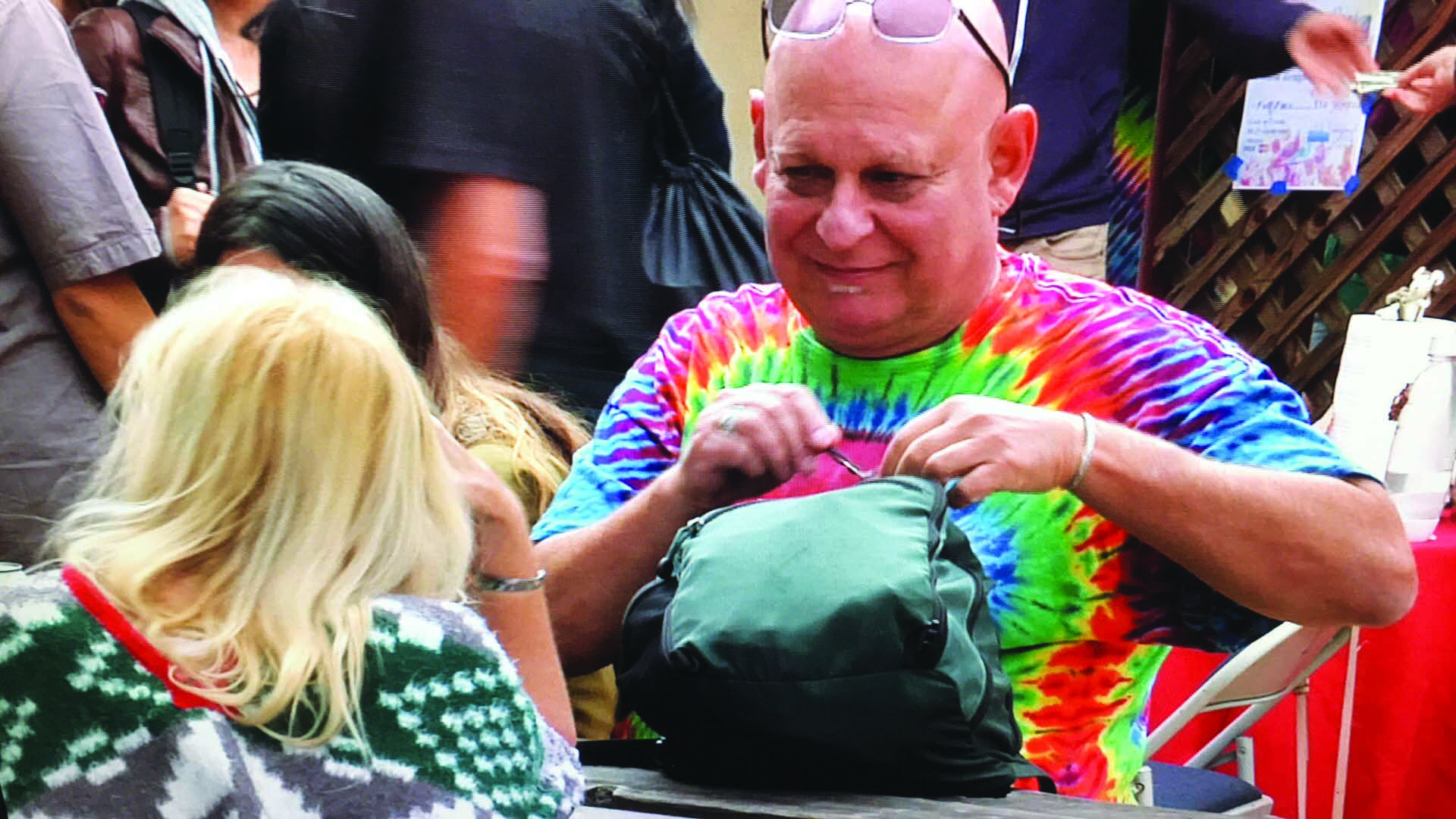
TO DYE FOR A reveler at a previous Peace Fest is garbed in appropriate festival attire.
These events begin at 9am with a guided yoga and meditation peace offering workshop, “Peace through Meditation,” by Patty Brockley. At 10am, Peace Fest attendees can experience Nicole Reyes’ sound bath experience, “Peace through Sound.” This exercise in audible tranquility is set to be followed at 11am by a nonviolent communication workshop called “Making Peace through Conflict,” which will be hosted by Martine Algier, a certified trainer on the topic.
At noon, Peace Fest guests will be offered “Peace through Sustenance,” a lunch from the Reviver Las Culturas Program, accompanied by a “Peace through Song” performance from none other than Ted Wright and Friends.
After lunch, the entertainment and possible enlightenment continue with a 1pm “Peace through Laughter” performance by Swami Beyondananda. As the pièce de résistance of this year’s Peace Fest, the musical festivities will continue at 2pm with a “Peace through Music” performance from performers including Vernon Black Ice and Fantuzzi.
Apart from offering a place to celebrate peace in peace, the San Geronimo Valley Community Center and Peace Fest organizers also partner with the Lagunitas School District to help spread the early education of self-love and worth to the community’s children. The mission of Wright and his associates is to help the youngest and most vulnerable members of the community to feel more intrinsic worth and, in doing so, grow to have a healthy and developed sense of inner peace.
“One of the burns I really was feeling in the early days of our festival, and more intensely in recent years, is the need to fill the missing link in our public education and probably private schools as well,” explained Wright. “Our education is so in the model of the post-war industrial education, and I think about all the thousands of hours I spent in a school and how none of them were spent teaching me about me.”
Wright continued to explain that the current system of schooling can, unfortunately, lead children to base their worth on external values and their ability to achieve rather generic goals, such as good grades, acceptable clothing, the friends they make, the extracurriculars they participate in, college acceptance (or lack thereof) and so on.
“Students find value through things that are happening externally, but receive no education about their innate value, and that is a gigantic missing link,” added Wright.
This missing link can be as simple as early lessons in mindfulness, meditation and affirmations or simply explaining to the next generation that their worth in this world is not based on the grades they get or the clothes they wear.
“We didn’t have this rate of teen suicide when I was in high school, and it really represents an erosion of hope in our kids,” said Wright. “By teaching peace, it can help [the children] to feel empowered and alive, just because they’re human and they exist—and teaching peaceful practices, well, it’s not a stretch now for schools to do anymore, especially when they see that places all over the country and world are already doing them.”
The annual Peace Fest is held, in part, to participate in and honor the United Nations International Day of Peace. The festival will take place from 9am to 3pm on Sept. 23 at the San Geronimo Valley Community Presbyterian Church, 6001 Sir Francis Drake Blvd.
The Peace Fest is held through the San Geronimo Valley Community Center, which Wright called “the bastion of peace in the valley” for their hard work supporting the local citizens and community before, during and after the COVID-19 pandemic.
Admission to the festival is free for all and includes many peaceful people, workshops, experiences and activities to engage with. For more information about the Peace Fest or to contact its organizers, visit SGVCC.org or call 415.488.8888.
On Aug. 31, Davis Wright Tremaine LLP filed a lawsuit against the National Park Service in California Northern District Court in San Francisco on behalf of freelance journalist Peter Byrne.
The complaint alleges that the National Park Service is violating the Freedom of Information Act by refusing to disclose public records that may reveal decades of federal mismanagement of Point Reyes National Seashore and ongoing environmental concerns.
Since 2020, the North Bay Bohemian and Pacific Sun have published a half dozen investigative reports by Byrne detailing how the Park Service has harmed the endemic ecologies of Point Reyes by leasing a third of the parkland to the environmentally destructive dairy and beef ranching industry. The science and historicity revealed by the reports are influential in informing activities in environmentalist circles, and have garnered attention in local and national press.
Byrne’s ongoing reporting on Point Reyes is supported by the Washington D.C. based Fund for Investigative Journalism and Reporters Committee for Freedom of the Press and has been recognized with several journalism awards.
These investigative stories on the environmental and archeological disaster at Point Reyes are sourced by public records obtained at the county, state and federal levels. The lawsuit declares that the United States Department of Interior, of which the National Park Service is a division, is improperly withholding public records; and that the agency is overly redacting (censoring) some of the records it has provided to Byrne. The lawsuit protests that on the Point Reyes National Seashore website, the National Park Service wrongly accuses Byrne of publishing factual inaccuracies in what appears to be an attempt to avoid disclosing evidence of governmental malfeasance.
The opening of the lawsuit reads like a blurb for a John Grisham novel, if he wrote about matters as seemingly mundane as FOIA: “In December of 2020, Plaintiff authored an article, Apocalypse Cow: The Future of Life at Point Reyes National Park… The article was highly critical of the 250-page Environmental Impact Statement on Point Reyes that was released earlier that year by the National Park Service. The NPS was so sensitive to criticism of its work that it went so far as to post ‘corrections’ to Plaintiff’s Apocalypse Cow article on the agency’s website, which remain to this day.” After the Park Service posted its response online, the editors of the North Bay Bohemian and Pacific Sun investigated the claim that there were factual errors, and there are none.
The complaint continues, “Ever since Plaintiff’s Apocalypse Cow article was published, Plaintiff has consistently experienced unlawful barriers to obtaining public records from Defendants. Defendants have strung along, or stymied, his attempts to obtain what they are statutorily obligated to provide: public records. The public records that Plaintiff seeks—improperly withheld by Defendants—would shed light on credible, first-hand reports of a plethora of inter-related ecological, environmental, and archaeological issues, including: prioritization of commercial dairy and cattle ranching interests above statutorily mandated public-interest duties of Defendants; commercial dairy farms and cattle ranches neglecting septic systems on said farms and ranches, resulting in polluted water; polluted water harming elephant seals; enclosure of tule elk into an unsustainable environment for the benefit of dairy farms and cattle ranches, resulting in preventable deaths of these elk; and cattle trampling and destroying indigenous archaeological sites.”
The lawsuit describes the categories of records improperly withheld by the Park Service, and asks for a judge to order full disclosure.
Federal financial disclosure statements of Park Superintendent Craig Kenkel;
Annual budgets for the operation of Point Reyes National Seashore;
Park Service correspondence with the Federated Indians of the Graton Rancheria, the Seashore’s co-manager;
Park Service correspondence with Rep. Jared Huffman, who is a strong supporter of keeping federally subsidized industrial agriculture in the Seashore in perpetuity, despite the ecological damage attributed to ongoing dairy and cattle ranching in the park by the National Park Service’s own investigations;
Bids and contracts and disbursements awarded under government mandate to a small business for work cleaning up rancher generated toxic waste that was in actuality performed by a company that was not an eligible small business;
“All reports, memoranda, email or other forms of internal and external written communications regarding the health of elephant seals at Point Reyes National Seashore from September 2022 to the present which are reported by the PRNS co- manager to ‘sicken and die’ from Seashore waters polluted with agricultural run- off, including but not limited to correspondence between the NPS, Rep. Jared Huffman, Federated Indians of the Graton Rancheria, California Coast Commission, Marine Mammal Center.”
Records related to the preservation of, or failure to preserve, Indigenous archeology sites.
Davis Wright Tremaine LLP is a major force in all mediums of media law, representing many national companies. Firm partner Thomas R. Burke regularly litigates high profile public records cases.
Regarding Byrne’s complaint, Burke commented, “The public cannot provide meaningful oversight into the management of this national treasure unless and until the National Park Service begins to comply with the Freedom of Information Act. This lawsuit will force compliance.”
Thank you Nikki Silverstein and the Pacific Sun for your continued coverage of important issues in our community. It’s hard to believe that this horrible abuse of power (“Cause for Conflict,” Aug. 30) happened 13 months ago, leaving a community member brutally beaten and severely injured for drinking beer after work.
As the criminal case finally comes to court against the two former officers, it feels important for our community to show in solidarity and with love to support justice and accountability.
Heidi
Via PacificSun.com
This Needs to Stop
Pacific Sun and Nikki Silverstein continue to lead in reporting the facts about what BIPOC (Black, Indigenous, People of Color) residents who live in Marin experience (“Cause for Conflict,” Aug. 30).
Through this exposure, we’re seeing some (not transformative yet) accountability and transparency happen, in my opinion, with the (hopeful) prosecution of these two former Sausalito (Brandon Nail) and San Rafael (Nail and Daisy Mazariegos) police officers, officers living in a culture of policing that abuses and discriminates against residents of color.
This needs to stop now, and Nikki, along with the Pacific Sun, model to community readers the courage it takes from within to spotlight and report the facts about unjust actions by Marin’s police culture and company “business as usual” protocols. Thank you, Nikki!
Tara Evans
Via PacificSun.com
We welcome your letters to the editor via le*****@******an.com and le*****@********un.com.
Humboldt-based journalist and activist Greg King has spent his life connected to redwood forests.
Born and raised in Guerneville near Sonoma County’s few remaining redwood groves, King went on to write about redwood logging in the 1980s as a young reporter for The Paper, an alternative weekly which later became the North Bay Bohemian. Outraged by what he saw, King left his reporting job to become an activist, involved in a number of direct actions, including tree sits, aimed at preventing lumber companies from cutting some of the last remaining old growth redwoods.
King and fellow activists had some success with direct action, but, on numerous occasions, faced violent responses from lumber workers and their allies. His career in direct action ended with a nearly-successful attempt to hang a banner emblazoned with the phrase “SAVE THIS PLANET” and other admonitions from the top of the Golden Gate Bridge. A month later, in May 1990, two fellow redwood activists, Judi Bari and Darryl Cherney, were injured by a car bomb in Oakland.
The identity of the bomber has never been discovered, though activists suspect law enforcement may have been involved. (The Oakland Police and FBI tried to pin blame on Bari and Cherney, pursuing the theory that the pair were eco-terrorists knowingly carrying the bomb. Bari’s estate and Cherney won a record-setting $4.4 million legal settlement in 2002, after a jury agreed the agencies had violated the pair’s civil rights in their investigation.)
Last week, this reporter interviewed King about his new book, The Ghost Forest: Racists, Radicals, and Real Estate in the California Redwoods. Published in June, the 450-page book weaves together King’s early life and activism, with a detailed history of the timber barons who most profited from the rapid felling of magnificent redwood trees between the 1850s and the end of the 20th century.
Two activists in Headwaters Forest on March 1, 1990, preparing to access a new, illegal logging road into the grove. Photo by Greg King.
Before the logging began, redwood forests covered two-million acres of the West Coast. Today, only 4% of that original forest stands. King also focuses on the role of the Save the Redwoods League. Founded in 1918, the nonprofit is still around 105 years later, with a fine do-gooder reputation largely intact.
In The Ghost Forest, however, King argues that the League, whose founders had numerous personal investments in redwood or industries which used redwood lumber, endeavored to slow a growing redwood protection movement. The League, then, was an early example of “greenwashing,” an industry front group used to downplay or obfuscate the negative environmental impacts of an industry’s actions. League activities covered in the book include proposing smaller conservation projects than would have been possible, actively lobbying against other groups’ more ambitious conservation proposals and paying timber companies well above market rate for their properties.
Asked for comment on the book, a spokesperson for the League provided a one-page, pre-written statement. It notes that environmental policy and “conservation ethics” were still in their infancy in the early 20th century when some, but not all, of the events covered in the book occurred and alleges that some of King’s claims are “purely speculative.” The statement does not identify any specific errors in the book, which King based on League documents stored at UC Berkeley’s Bancroft Library, other archival sources and interviews.
In an email responding to the statement, King wrote, “‘Purely speculative’ is an extraordinary claim because my examination of the League is clearly based on very specific documents that I note in the text… I would welcome an opportunity to publicly discuss the book and its conclusions with any individual, or set of individuals, of the League’s choosing.”
A illegal logging road cut into the Headwaters Forest in 1990, which public officials dubbed a “wildlife study trail.” Photo by Greg King
The following conversation has been edited for length and clarity.
Will Carruthers: One of the things that I didn’t appreciate before reading The Ghost Forest is what a crucial role redwood lumber played in the development of California as we know it today. Can you talk about what some of the things redwood lumber was used for?
Greg King: Commercial redwood logging didn’t begin until the 1850s early on in the Oakland Hills. At that time, it was used for really rudimentary purposes, including railroad ties and housing. Starting in the 1870s or so, the qualities of the redwoods—the lack of resin and the antimicrobial qualities—were starting to be discovered, and industrialists, through especially beginning in the 1880s and 1890s, began to understand that the redwood lumber could be used for industrial purposes, whose ease of use and cost and availability far outstripped any other material, including iron.
It was discovered in the early 20th century that redwood made the best wood for transporting water and sewage and holding cyanide solution [used in gold mining]. The only thing better was cast iron, which was cost prohibitive, and it was impossible to stitch cast iron pipes, in those days, across miles of rugged mountain terrain.
We think of redwood going into houses, but that wasn’t its superpower. The redwood use in stave pipes [specially cut lumber held together by metal bands] stands out for me as the most transformative application. That’s because the West grew according to availability of water, not only for cities, but for the massive agricultural expansion throughout the West.
You have the stave pipes being used for water delivery to municipalities and agriculture, which were two of the biggest growth industries at that time. But what became the most important use was in electric power. No other wood could be used to make these stave pipes—the biggest stave pipe was 16 feet in diameter—delivering enormous amounts of water to turbines. That production of power, the availability of that much power and the ability of redwood to provide it when nothing else could, really allowed Western industry to boom and cities to grow.
I can’t emphasize this enough: Virtually all industries that used electric power in the early 20th century, in the West, utilized power that was produced using redwood stave pipes. No other wood could do that.
WC: What other parts of the book seem to have resonated with readers the most?
GK: Without question, the Save the Redwoods League history is the most talked about element of the book. And, again, it’s shocking and surprising. And it shocked and surprised even me. And of course, for that reason, it was incredibly exciting to research. And then, as we were just talking about, you know, the stave pipes and the industrial uses of redwood. Virtually no one understood that. I didn’t, and I’ve been looking at this for decades. It really took some very deep digging.
The way that I got to that was through examination of the individuals who ran the League. And so I saw that the founding director was this guy with a Pulp Fiction name of Wiggington Creed. And I’m like, ‘Okay, well, who’s Wiggington Creed? Some, you know, beneficent rich guy who wants to help redwoods and takes over in 1920 as a director and writes the League’s bylaws and articles of incorporation. He’s probably a nice guy.’
And then I see that he’s like one of the biggest redwood barons in the world, and he married into the Hooper family and that C.A. Hooper, one of four baron brothers, developed the redwood stave pipes, and I’m like, ‘What the hell’s the stave pipe?’ And so I got into that, and everything continued to unfold.
There just isn’t any refutation of this. One of the greatest purveyors and consumers of redwood in the world, this man Wiggington Creed, wrote the league’s articles of incorporation and bylaws and ran the organization with others until he died in 1927.
King will appear at a book event hosted by the Stewards of the Coast and Redwoods and Russian River Books & Letters at 5pm on Wednesday, Sept. 27 at the Forest Theater in Guerneville’s Armstrong Woods.
Expertise Blindness
Leland Dennick’s Open Mic essay (“Conscious Confusion,” Sept. 6) brought to mind a concept that may or may not have been introduced decades ago by the writing partner of corporate guru and Ivy Leaguer Tom Peters, Stanford business school lecturer Robert Waterman. The two wrote In Search of Excellence to spread the word on what they thought the...
When Kelechi Ubozoh needed a fresh start and a safe place to land and recuperate after dealing with trauma and a suicide attempt, she sought refuge in California a little over a decade ago. “The Mental Health Services Act, also known as Prop 63, changed my life. It’s the reason I moved to California,” Ubozoh says. “It funded peer...
Our writer goes to London for the real deal
Gin has been a go-to spirit among the British for a long time. Though the Dutch came up with its precursor, gin as we know it today, is actually a British invention.
The Dutch invented a whisky-like, amber-colored alcoholic drink which they named jenever, while the British drink, shortened to gin, was...
The easiest way to maximize vacation time is to spend it locally, and Sonoma County is full of options for this kind of getaway, including the close-to-home but remote-feeling Vintners Resort in Santa Rosa.
It’s perfect for a wide range of special events, from a quick romantic getaway or a personal retreat, to a catered vineyard wedding convenient for out-of-town...
Corte Madera
‘Manhattan’
In airing this family classic of a neurotic New Yorker who dates a high school girl after a messy divorce before stealing the mistress of his best friend, the Lark Theater shows that their drive-in revival is not a neighborhood summer series outdoor theater. Too often screenings of Shrek and Cars 2 seem to clog up summer’s community...
ARIES (March 21-April 19): Aries photographer Wynn Bullock had a simple, effective way of dealing with his problems and suffering. He said, “Whenever I have found myself stuck in the ways I relate to things, I return to nature. It is my principal teacher, and I try to open my whole being to what it has to say.” I...
The 9th annual Peace Fest is just around the corner, and the entire Marin County community is invited to gather to celebrate the global and local movements of all things peace. Music, food and general festivities await anyone who attends this year’s Peace Fest.
The Peace in the Valley Festival is set to take place in San Geronimo on Sept....
On Aug. 31, Davis Wright Tremaine LLP filed a lawsuit against the National Park Service in California Northern District Court in San Francisco on behalf of freelance journalist Peter Byrne.
The complaint alleges that the National Park Service is violating the Freedom of Information Act by refusing to disclose public records that may reveal decades of federal mismanagement of Point...
Abuse of Power
Thank you Nikki Silverstein and the Pacific Sun for your continued coverage of important issues in our community. It’s hard to believe that this horrible abuse of power (“Cause for Conflict,” Aug. 30) happened 13 months ago, leaving a community member brutally beaten and severely injured for drinking beer after work.
As the criminal case finally comes to...
Humboldt-based journalist and activist Greg King has spent his life connected to redwood forests.
Born and raised in Guerneville near Sonoma County’s few remaining redwood groves, King went on to write about redwood logging in the 1980s as a young reporter for The Paper, an alternative weekly which later became the North Bay Bohemian. Outraged by what he saw, King...