
Part of my job as a reporter involves chronicling what I see and hear.
In some ways, it’s similar to what legal observers do when documenting Immigration and Customs Enforcement activity. So, when I joined a group of Marin residents who were undergoing legal observer training, I figured I knew the basics.
I was wrong.
After the first training video played, I realized the difficulty of this work. And the stakes are high.
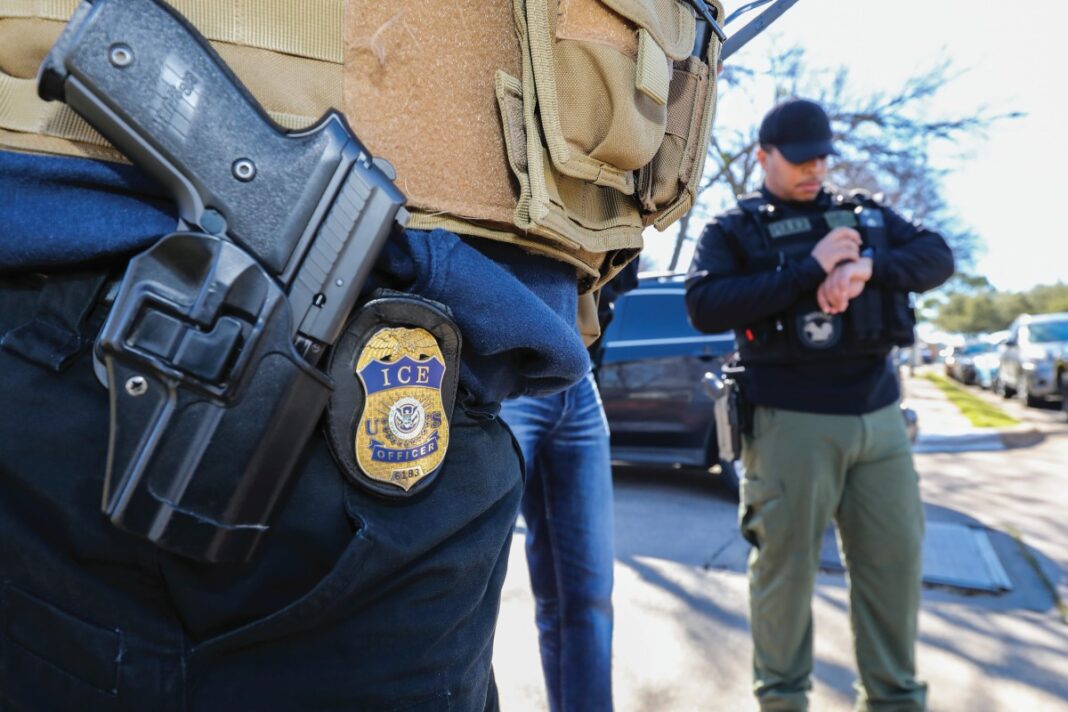
Law enforcement actions happen fast. In one video of an actual ICE detention, multiple vehicles, most unmarked, were at the scene. Some officers wore plain clothes. They handcuffed a person and whisked him away.
Legal observers are expected to document the details, including the make and model of vehicles, license plate numbers, officer descriptions and whether weapons were displayed or property seized. Before the detained person disappears into the system, they must ask them for the phone number of a family member or friend.
And then there’s the big question: Is it even ICE?
Local law enforcement vehicles can look like the vehicles that ICE uses. Officers may not be clearly identifiable. In fact, the Marin County Sheriff’s Office has a team that county residents have mistaken for ICE.
“They’re called the SIU, Specialized Investigative Unit, and they work in an undercover capacity,” Marin County Sheriff Jamie Scardina told me in a recent interview. “They do narcotic purchases. They do undercover surveillance. They do warrant apprehensions. They do whatever the county needs.”
Uncertainty is one reason that the Marin Rapid Response Network, part of the Marin Multicultural Center, offers a three-hour training for legal observers. The workshop prepares volunteers for the quick pace of highly charged situations that they could encounter while documenting ICE activity.
Lisa Bennett, director of the nonprofit and our group’s trainer, explained that obtaining viable evidence could aid in legal defense cases, litigation intended to hold law enforcement accountable and public statements.
ICE activity in the county has increased recently, with eight people detained in May. In the 16 months prior to March, ICE had detained an average of one to two individuals per month. Legal observers from the Marin Rapid Response Network witnessed and documented several of these ICE actions.
When the network’s hotline receives a report of possible ICE activity, dispatchers notify the nearest legal observers. They text back, “OTW,” shorthand for “on the way,” before heading to the scene.
Once there, observers fill five key roles. Some take photographs and videos. Others communicate with dispatchers, gather witness information and act as community liaisons for family members and bystanders trying to understand what is happening.
Bennett noted that observers have legal rights. While lawfully on public property, they may photograph and record law enforcement actions, as long as they don’t interfere. Officers can’t confiscate phones or delete photographs and videos.
But legal rights don’t always prevent issues.
“Officers sometimes lie,” Bennett told our training class, describing scenarios where law enforcement incorrectly states that observers must leave the scene.
She walked us through the concept of “minimal compliance,” focusing on the difference between what an officer may order us to do and what is legally required.
“The fact that you’re there will change the way they behave,” Bennett said.
During role-playing exercises, I slipped on a pink apron identifying me as a Marin Rapid Response Network legal observer, and I attempted to document a mock ICE incident. It was challenging.
Officers barked commands while bystanders began asking questions and raising their voices. In the confusion, I couldn’t remember how to ask the detained individual a crucial question in Spanish: “Who should I call?”
“A quién llamar?” I repeated over and over before the next exercise.
By the end of the training, participants said they felt better equipped to become legal observers, though acknowledging the complexity of the role. Bennett agreed, saying the work can be emotional and even traumatizing.
Yet the legal observers’ documentation is just the beginning for the Marin Rapid Response Network. After ICE detains a person, the network’s staff and volunteers help connect them and their families with legal assistance, financial support and community resources.
The need for legal observers continues to rise, and Bennett believes ICE will further ramp up activity in Marin. Still, she said, the organization’s 1,000 trained volunteers remain ready.
As the training session concluded, Bennett reminded participants of the organization’s motto: “Power, not panic.”
To register for the Marin Rapid Response Network’s legal observer training, go to multiculturalmarin.org/mrrn.









This reporter is yet another that obviously displays a Democrat Party bias, but tries to cloak it in an air of reasonability. To the contrary, what she writes is hardly reasonable. It is the same pablum produced by the people who think deporting illegals is bad, men can have babies and atmospheric carbon dioxide is a big problem. This reporter supports the most insidious and diabolical agendas designed to mangle and destroy the human spirit. This reporter WORKS for the New World Order, but she’s so confused about her role here on this planet that she thinks that she’s opposing it. The reporter who wrote this story is not doing good work. The reporter who wrote this article works for the devil himself and the garbage she produces will be remembered in infamy.