
There are roads that wind all over West Marin, and many ultimately lead to former military installations. Fort Baker, Fort Cronkite and Fort Barry are all there, as are Battery Spencer and Battery Townsley, all designed to defend the Golden Gate from hostile military action.
And on any given day, one could drive by SF-88—another decommissioned military site in Fort Barry—and never notice anything more than what appears to be a large parking lot with a few odd outbuildings surrounded by a chain-link fence. There are certainly more interesting military buildings just a quarter mile further up the hill where Point Bonita is located, along with its sweeping panoramic views of both the Golden Gate Bridge and the city of San Francisco.
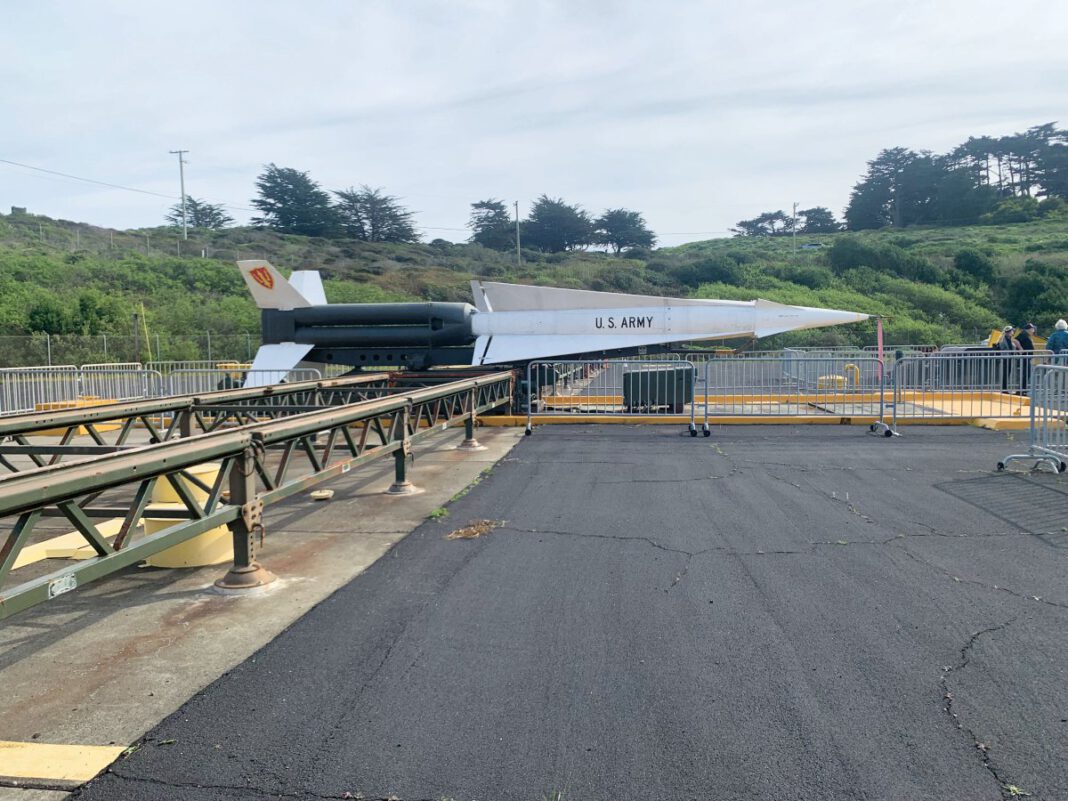
But if one’s timing is just right, there will be something rather alarming on that tarmac at SF-88. If it just happens to be the first Saturday of the month, between noon and 3pm there will be a 41-foot-long dart-shaped Nike Hercules missile sitting on its raised launch pad. It looks like any nuclear missile out of any stock Cold War Hollywood Armageddon film, be it Dr. Strangelove or Fail Safe or Seven Days in May. And that’s exactly what it is. But what is it doing there?
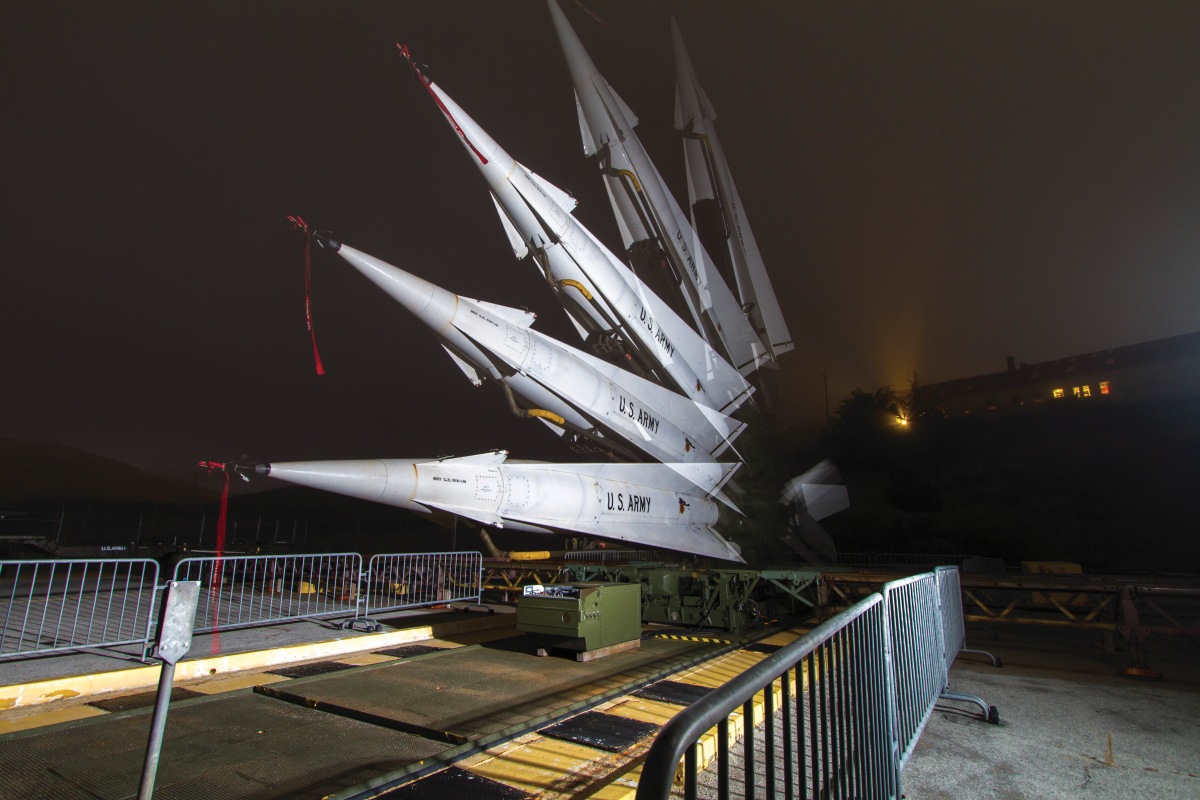
SF-88 is a restored former Nike Missile site, now a museum, run by the National Park Service as part of the Golden Gate National Recreation Area. It is open once a month for free tours. The tours are guided by volunteer docents, many of whom served at Nike sites both locally and around the United States. The highly informative tour includes the underground missile magazine and an operating missile elevator launch platform. There are several Nike museum sites in the United States, but SF-88 is the most fully restored site and the only one that has an operational missile elevator.
I first took the tour a few years back, and after the docent mentioned nuclear warheads several times, I raised my hand and asked the obvious question.
“Wait, are you saying that these here were nuclear missiles?”
He smiled and then nodded his head.
Nike Ajax, the first adaptation of the Project Nike missile defense system, was a conventionally armed line of sight radar directed anti-aircraft missile. Nike Hercules, its successor, was an area specific radar guided missile armed with low yield nuclear warheads. And those are primarily the missiles on display at SF-88 (all of the missiles there are “dummies,” including the one Nike Ajax, in a shed topside). However, once having nuclear armed missiles in Marin County was only the first shocking realization.
The docent then mentioned that the maximum range of the Hercules was 114 miles, being most effective in the 75-mile range.
“Excuse me,” I said, interrupting again. “Do you mean to say that we were going to launch nuclear bombs into the atmosphere and explode them 75 miles that way?” I asked, pointing in the direction of the Farallon Islands (which are 30 miles off the coast).
The docent smiled again. “We weren’t going to launch them that way,” he responded, pointing down the nose of the missile toward the ocean. “We were going to launch them that way,” he continued, pointing down the fins in the exact opposite direction, northeast towards Sacramento.
“Why on earth would we do that?” I asked.
Because Soviet bombers travelling from bases in the former USSR would have flown the shortest route, flying up over Canada (just like domestic flights to Europe or to Asia do) and then down. A mass attack of Soviet bombers wouldn’t approach from the sea; it would come from the direction in which the docent had pointed.
Which meant that part of our defensive plan was to launch and explode 35 or more, 1 to 60 kiloton nuclear bombs into the atmosphere over West Sacramento, to defend ourselves. And a good many of those bombs were located in Marin County.
“Do people know this?” I asked.
“You do,” he said. “Now.”
The United States was the first and only country to use an atomic bomb in wartime, ending World War II with the bombings of Hiroshima and Nagasaki. That nuclear monopoly didn’t last long, ending just four years later on Aug. 29, 1949, when the former Soviet Union detonated its own nuclear device.
Since then, there has been a determined effort to limit the potential of a Soviet (and later Russian) nuclear attack on the continental United States.
The very first of these attempts was the Project Nike missile defense system (named after the Greek goddess of victory), a $1.16 billion ($13 trillion in 2026 dollars) last ditch missile defense system against Russian bombers, first tested in 1951. The first iteration, Nike Ajax (named after the second most powerful Greek hero at the battle of Troy) was already relatively obsolete upon the day of its delivery. Nike Ajax’s first test target was a World War II era B-17 Flying Fortress converted to a drone, an aircraft that was considered obsolete even by the end of World War II.
They say one always plans to fight the last war, and in the case of airplanes that was surely true, because those propeller planes would be no match for the jet airplanes of the 1950s, nor for the jet powered rockets that later followed. And the U.S. military realized this. When the United States deployed the first ever supersonic bomber, in November of 1956, it had a top speed of Mach 2 (roughly 1325 mph), nearly five times the speed of a B-17. Three years later, the first Soviet supersonic bomber entered service with a top speed of Mach 1.42 (938 mph).
Post World War II, things were progressing at the speed of sound. And so even as they were testing Nike Ajax, the U.S. military began developing Nike Hercules. Due to the evolving threat, Hercules was armed with an area specific low yield nuclear bomb designed to hopefully take out several bombers and their support aircraft all at once. And it was designed to use the nearly 200 Nike bases that the military had already built throughout the United States at an additional cost, just for the missiles, and adjusted for inflation, of at least $700 billion. Only the military and the government didn’t really explain the switch to the American public.
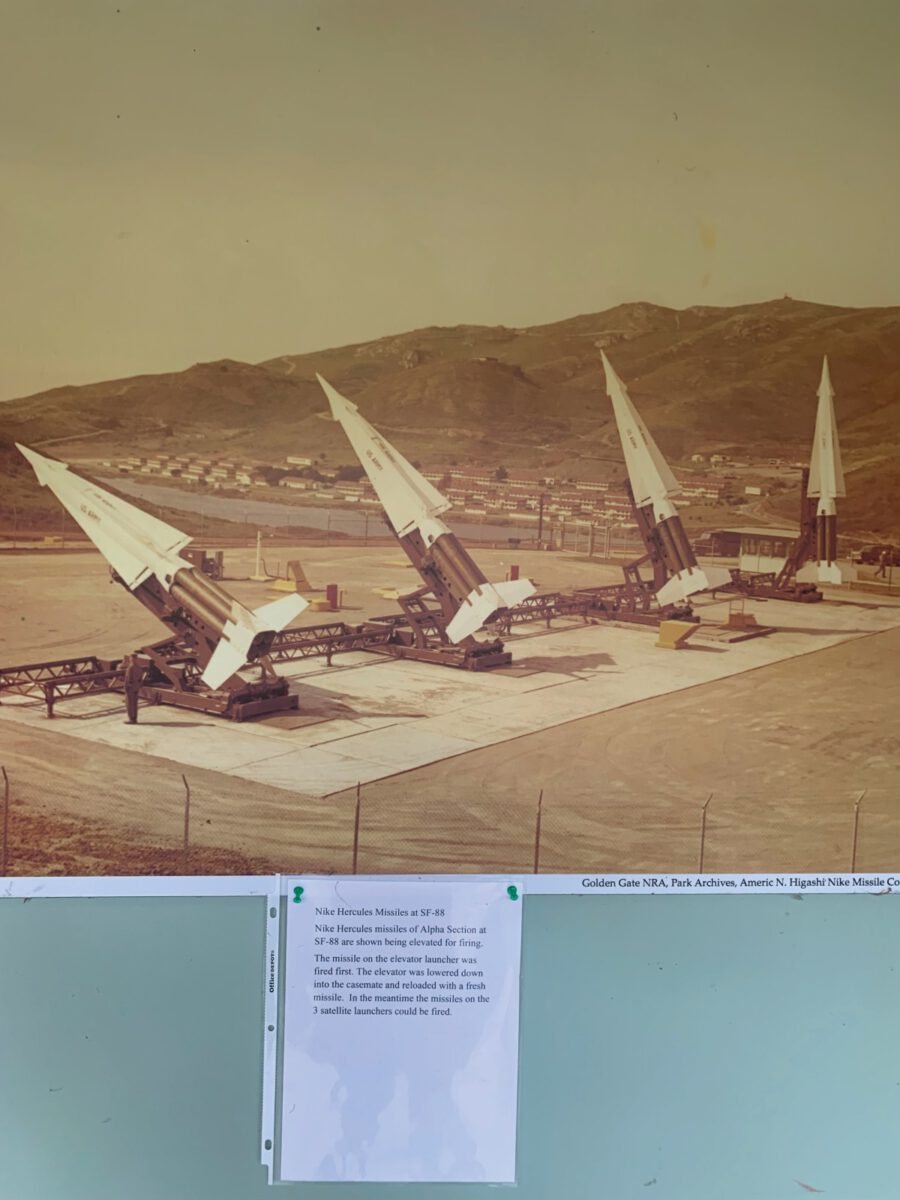
Marin County originally had four Nike Ajax sites, two in Fort Barry: SF-88 and its sister site SF-87, across the valley from each other (SF-87 was where the Marine Mammal Center sits today); another one in San Rafael (SF-93); and one on Angel Island (SF-91). In 1962, the three on mainland Marin were converted to Nike Hercules, and the one on Angel Island was decommissioned.
Altogether there were 13 Nike sites in the Bay Area (with one only recently disclosed by the military in the East Bay). First operational in 1955, SF-88 was the so-called “show off” battery site, as explained in the 2010 book, The Last Missile Site, by Stephen Haller and John Martini. SF-88 was heavily photographed, and tours were even given to the media. Located through a one-way tunnel on a secure military installation certainly gives one an aura of security.
But reading that book or looking at the National Park website (or really reading any website about Nike, including the Wikipedia entry), one is struck by the fact that the nuclear aspect of those missiles is pretty well minimized. Terms like “low yield” nuclear warheads and “anti-aircraft” often help to disguise the fact that even a low yield nuclear bomb has three times the power of the one used on Hiroshima, and that there were up to 20 of them between the two sites in Fort Barry alone.
Even on the tours of SF-88, some of the docents only obliquely mention this fact. It’s not an overt omission, but if one doesn’t ask, they sometimes won’t tell, and if one doesn’t really listen, they also might not hear.
“Everyone always wants to know about the rockets,” one of the volunteers (who wanted to remain anonymous) told me. “But nobody ever asks what was in the tip,” he added.
The actual mission of Project Nike is often somewhat obscured in print. Even The Last Missile Site (published under the auspices of the National Park Service) plays a little loose with the information. Its original title as a pamphlet by the same authors—and using much of the same information—was “What we have, we shall defend,” and that gives us a little hint of the inherent bias. Therein Nike, and specifically Nike Hercules, is consistently referred to as a “last ditch defense” in the event of nuclear war.
Only that isn’t exactly true.
Part of the problem with the U.S. military’s nuclear history is how fast and loose it played with the new technology and the information surrounding it. Even the bombings of Hiroshima and Nagasaki produced some surprises. One of these was radiation sickness. As documented in John Hersey’s highly acclaimed book, Hiroshima, first published in 1946, and then updated in 1985, the military was completely unaware of radioactive fallout and its residual effect on human beings.
Today, one can watch online videos of the first hydrogen bomb tests at Bikini Atoll in the late 1940s, and it’s rather shocking to see people either watching them in person, or fully crewed naval ships being engulfed by the eject from the explosions. We now know that it’s not just the blast of a nuclear device that is dangerous but also its lingering radioactive effects.
Which is why the National Library of Medicine (a government website) says this: “Nuclear air bursts form ionizing radiation, such as y-rays and neutrons. The ionizing activity can alter molecules within the cells of our bodies, causing cancer and death.”
And by 1962, the U.S. military (and government) were well aware of this, even as they were building 100 more Nike Hercules missile bases just outside of civilian centers all around the United States (300 in total), ostensibly, to protect us all from a nuclear attack.
This story continues next week with ‘Project Nike: Cold Warriors.’






It got even scarier by the late 60s with the successor system, the Pershing missile a so-called “theater” balistic missile with much more powerful warheads. It was deigned for attacking targets on the ground in the USSR and eastern Europe. I was in a Pershing uniit in 1972-73 until I became a conscientious objector and was discharged honorably after a long difficult process. That system and the Soviet counterpart were dismantled by treaty in the 80s. The time from launch to target was so short that the most effective attack would have been to be the first to launch.
Thank you for the article. I was a Nike Hercules missile crewman in Germany in the 1970s, so will be sure to take the tour on our next visit to Marin.