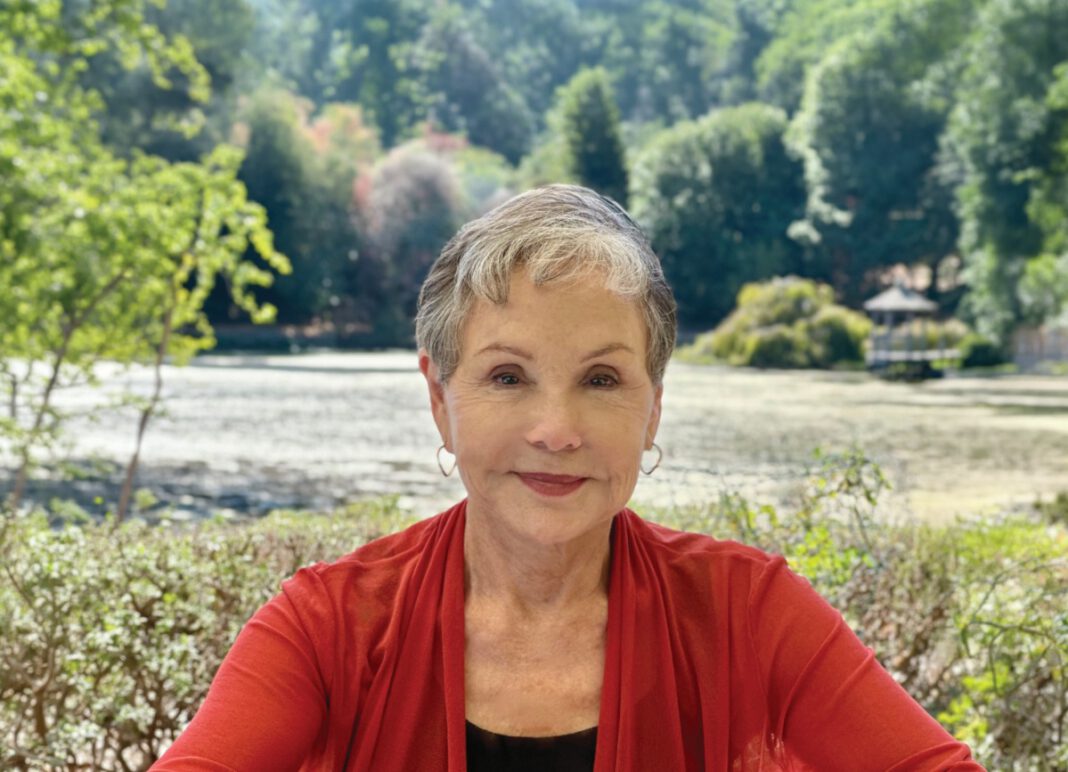
Artist and writer Ayris Hatton hopes her new book gives readers a chance to take a breath. In her new collection, Dreaming Wide Awake, she presents her poetry and short stories with her own original art. Organized by season, it is a meditation on the small beauties that pass us by, and a practice in making space for them.
The Bay Area has featured prominently in Hatton’s imagination since she was young. On a family vacation from her Southern California home as a child, she remembers eating at Sam’s Anchor Cafe in Tiburon, overlooking the water. “I was smitten,” she says. Hatton was the only one in her family to head north, enrolling at UC Berkeley. While a student there, she remembers cutting class and driving over the Golden Gate Bridge and into Marin County with her boyfriend.
“I said to him—and I remember this so distinctly—I want to live here someday,” Hatton recalls. She pauses, then laughs: “Who knew, right?”
She has since lived in many parts of Marin and the North Bay over the course of many decades, including San Rafael, San Anselmo, Kentfield, and now Tiburon, where she rents a cottage. She splits her time between there and a small ranch in Sebastopol, which is home to her painting studio. Living in this area, she never wants for inspiration, she says; the natural beauty continues to feed her work.
“Sometimes, things just stop me,” Hatton says. “They’re just so gorgeous, the light on the water or whatever it may be.”
When she feels creatively stuck, the fix is simple. “I just take a drive and find a beautiful spot,” she explains. “And if it’s moving and I want to paint it, it’s for the taking.”
Hatton began thinking about compiling her work into a book about five years ago. With a deep archive of art and writing, it was a big project to curate, organize and pair her poetry, prose and paintings. She sorted it into four seasonal sections and, on and off over those five years, arranged and rearranged until Dreaming Wide Awake began to take shape.
Working with a publisher for the first time, Hatton was thrust into the world of modern bookmaking. It was a crash course in learning new technologies, as the entire process was conducted remotely, and she never met any of her collaborators in person. Even so, she formed a close working relationship with her formatter, who is based in Romania. It was fulfilling, but nonetheless, it was work.
“I realized I really had to stay on it. It was tenacity, focus, discipline,” Hatton says of keeping the project moving forward. It was also important to know when to stop. “I really had to be cautious because I think you can go back and kind of take away the freshness,” she notes. She drew on the following advice from a fellow writer: “A friend of mine who’s a very good writer said, you never ever finish editing. At some point you just say, ‘OK, we’re stopping now.’”
In addition to preserving the freshness, she also wanted each piece to be digestible. By keeping them short, Hatton wanted to create something a reader can pick up and take in one vignette at a time, as a short meditation on the beauty in the quotidian. “We’re just in this environment like a fish in water,” she says, “so we don’t often see it.”
Her hope for readers goes beyond the book itself. “When you do something creative, you make anything, it doesn’t matter, woodwork, music, anything,” she says, “it feels like somehow that complements our ability to be present to things and to see things in life that we often miss and that are truly miraculous.”