Hero & Zero

Hero
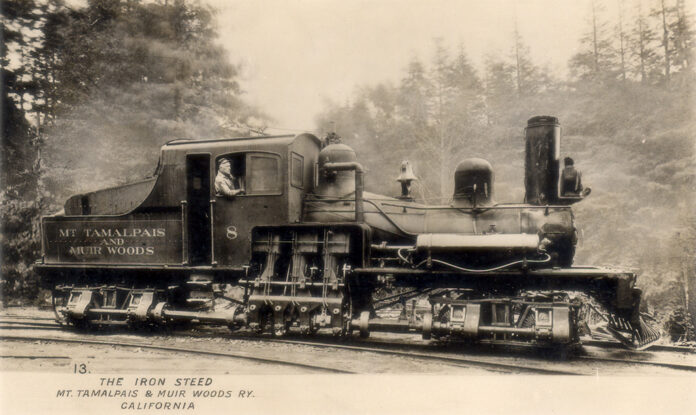
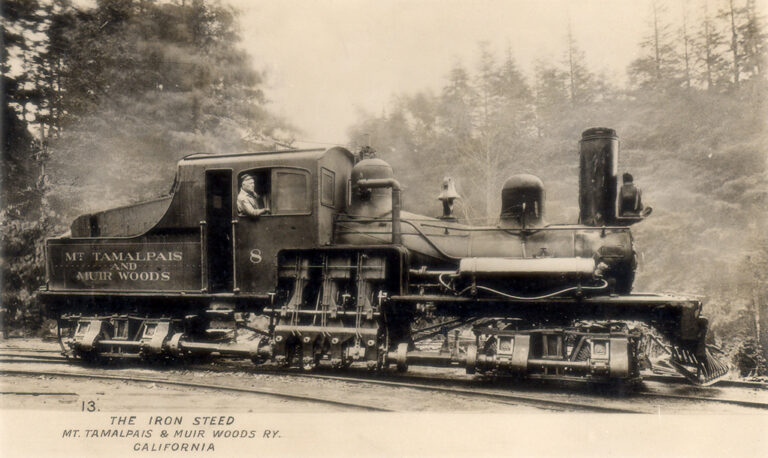
The “Crookedest Railroad in the World” opened in 1896 and transported tourists from downtown Mill Valley to the Tamalpais Tavern on top of Mt. Tam for almost 35 years. The eight miles of track wound around 281 curves and offered stunning vistas of San Francisco. In 1920, a new steam locomotive, Heisler Engine No. 9, manufactured in Pennsylvania, joined the railroad. Business waned after the advent of roads for automobiles, and No. 9 was sold. It changed hands several times and ended up on display outside the Pacific Lumber Company in Humboldt County. The historic locomotive went to auction last year and a Marin group called Friends of No. 9 placed the winning bid of $56,240. The deadline to move the engine is looming, and the Friends need some Heroes to step up and make donations. Send funds earmarked for No. 9 to the Mill Valley Historical Society, 375 Throckmorton Ave., Mill Valley, CA 94941.
Zero
Hallie and her leashed dog were on their morning walk on the Dan Abraham Trail in San Rafael, and she stopped for a chat with a woman. The trio took up about half of the trail. Unbeknownst to Hallie, the Tamalpa Runners, a Marin County running club, was holding its monthly race on the same pathway. When a male racer approached and asked her to get her dog off the trail, she began to pull her stubborn dog away from him. “Come on,” the runner said. “It’s not hard.” To prove his point, he kicked the pooch to the side. A man, who had enough room to sprint by a friendly dog, kicked her—hard. The culprit was a senior wearing a teal T-shirt and a white cap. Tamalpa Runners had a sign at a trailhead advising people of the race, but there was no notice where Hallie entered. Share the trails or buy your own piece of open space.
Got a Hero or a Zero? Please send submissions to ni***************@***oo.com. Toss roses, hurl stones with more Heroes and Zeroes at pacificsun.com.
 

Hero & Zero

Hero

The “Crookedest Railroad in the World” opened in 1896 and transported tourists from downtown Mill Valley to the Tamalpais Tavern on top of Mt. Tam for almost 35 years. The eight miles of track wound around 281 curves and offered stunning vistas of San Francisco. In 1920, a new steam locomotive, Heisler Engine No. 9, manufactured in Pennsylvania, joined the railroad. Business waned after the advent of roads for automobiles, and No. 9 was sold. It changed hands several times and ended up on display outside the Pacific Lumber Company in Humboldt County. The historic locomotive went to auction last year and a Marin group called Friends of No. 9 placed the winning bid of $56,240. The deadline to move the engine is looming, and the Friends need some Heroes to step up and make donations. Send funds earmarked for No. 9 to the Mill Valley Historical Society, 375 Throckmorton Ave., Mill Valley, CA 94941.

Zero

Hallie and her leashed dog were on their morning walk on the Dan Abraham Trail in San Rafael, and she stopped for a chat with a woman. The trio took up about half of the trail. Unbeknownst to Hallie, the Tamalpa Runners, a Marin County running club, was holding its monthly race on the same pathway. When a male racer approached and asked her to get her dog off the trail, she began to pull her stubborn dog away from him. “Come on,” the runner said. “It’s not hard.” To prove his point, he kicked the pooch to the side. A man, who had enough room to sprint by a friendly dog, kicked her—hard. The culprit was a senior wearing a teal T-shirt and a white cap. Tamalpa Runners had a sign at a trailhead advising people of the race, but there was no notice where Hallie entered. Share the trails or buy your own piece of open space.

Got a Hero or a Zero? Please send submissions to ni***************@***oo.com. Toss roses, hurl stones with more Heroes and Zeroes at pacificsun.com.


Stockholm Syndrome

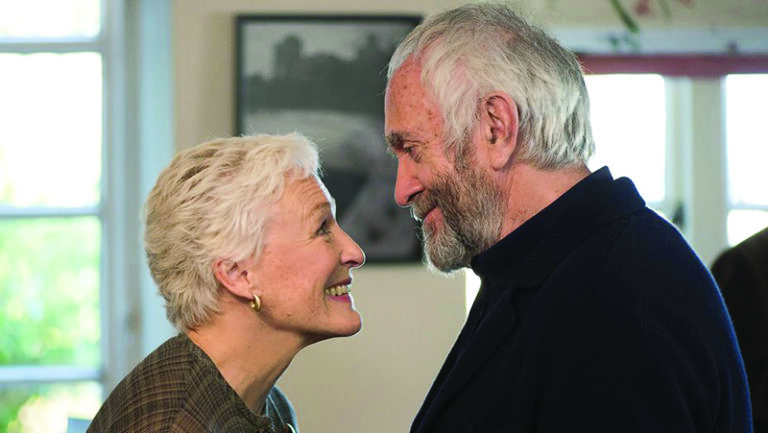
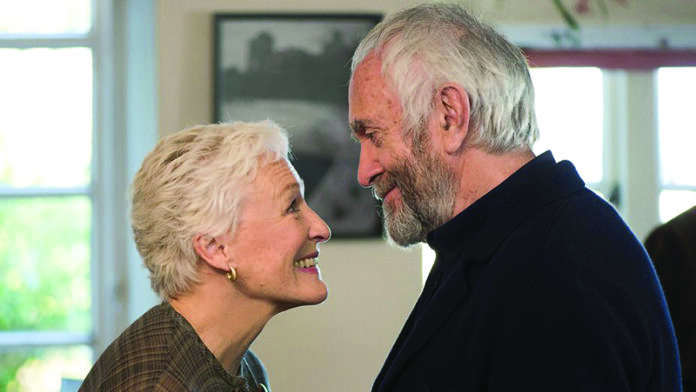
The fantasy sold in The Wife, based on Meg Wolitzer’s novel of the same name, is of winning the Nobel Prize for literature, and at first that’s fun. An old literary lion, Joe Castleman (Jonathan Pryce), and his wife, Joan (Glenn Close), are sleepless as they await the early morning phone call. Soon comes the comically Scandinavian-accented news, and both are jumping on the bed in happiness.

Once in Stockholm, Joan starts displaying passive resistance to the ceremony, the hobbing and the nobbing, the bowing and drinking, and we’re sent into a nest of flashbacks about the way she choked her dreams and subsumed everything to the man she married—even bearing his terrible secret.

Director Björn Runge’s scolding tone suits our age of the exposure of dick-wielding artists in all fields. And it’s very good to have Glenn Close back. She’s poised as she simultaneously flirts with and fends off a literary parasite named Bone, played by Christian Slater.

Pryce is distinguished actor, but the Norman Mailer/Saul Bellow type is beyond his ken. Moreover, Harry Lloyd’s version of the author in 1950s flashbacks doesn’t match the old man he becomes.

Pryce’s Castleman displays quirky habits when he’s out philandering, like personally autographing walnuts and reciting the last paragraph of James Joyce’s “The Dead.” But The Wife doesn’t seem informed about the literary life, as when tries to lure Joan into a Stockholm bar by saying that it was the kind of place where Strindberg would drink. Is Strindberg the name to drop when you’re trying to charm a literate married woman?

What keeps the film from rising above an insufferable soap is the masochistic insistence that all men are crushers—and that it’s impossible for them to be otherwise.

‘The Wife’ opens Friday, Aug. 31, at the Christopher B. Smith Rafael Film Center, 1118 Fourth St., San Rafael. 415.454.5813.


Local Gem

There’s so much more to Mediterranean food than is usually expressed stateside.

The region offers everything from undiscovered Turkish delights to slowly trending Israeli dishes. Petaluma’s new restaurant Pearl is attempting to bring the lesser known stars of the cuisine to the table with a focus the on eastern Mediterranean—Turkey, Israel, Syria and beyond—with a sprinkle of Moroccan and French influences.

Behind the menu are Brian Leitner and Annette Yang, who previously owned Nettie’s Crab Shack in San Francisco and, most recently, Le Vieux in Portland, Ore. The two began experimenting with Mediterranean cuisine one country at a time; France one month, Morocco another. Leitner, a Chez Panisse alum, unites them all. The menu changes occasionally, according to seasonality and availability, and some ingredients stand out, not often seen on local menus around the Bay Area.

Take the stuffed sardine ($10), for example. Expert home cooks across the Mediterranean have been stuffing the tiny fish for centuries, but rare is the Bay Area chef willing to take on the meticulous task. At Pearl, the single fish arrives topped with cherry tomatoes and cilantro, hiding a herbaceous tabbouleh salad inside. The fish has a bright sea flavor and delicate texture, highlighted by the tabbouleh’s chunkiness. It’s a bold, fun appetizer that made me wish stuffed sardines would, one day, reach crudo-level popularity.

The charred okra (another seldom-seen ingredient) with preserved lemon ($10) is spot-on. Okra is a tricky little vegetable, and one extra minute in the heat can turn it to mush. Pearl’s is crunchy and fresh. The wood-roasted beets ($10) are the third appetizer we try. In this dish, too, the textures are remarkable, from the velvety-rich beet to the snappy beans and the light dressing.

Even in a restaurant fielding a wild mix of influences and inspirations, some things are better left true to their origins. The shakshuka ($18), an Israeli staple, is one such dish. This vibrant, tomato-heavy stew is meant to simmer on the stove or in the oven until its raw eggs and sauce become one. In Pearl’s version, served with a side of pita ($2) and containing the addition of chickpeas and griddled halloumi cheese, the eggs are perched on top. Playful as the interpretation might be, it undermines the shakshuka’s messy, hearty appeal and denies
it the collision of flavors it’s famous for.

The dessert to right this wrong is the dreamy Moroccan rice pudding ($8). With a bite to its texture, the pudding is made from Madagascar pink rice and topped with rhubarb compote and almond flakes. It’s delicate and fragrant, refreshing and comforting. I’ve never seen this rice before, on a menu or at a supermarket. Leitner’s clearly showcasing another star ingredient. Is the pudding Mediterranean? Moroccan? Local? When something tastes this good, who cares.

Pearl, 500 First St., Petaluma. 707.559.5187.


Cluster’s Pluck


At a time when craft brewers are chasing the latest trends in new, trademarked hop varieties to juice up their juicy IPAs, some in the North Bay are digging up a relic
of a bygone day for their brews—literally, they are digging up the roots of decades-old hop plants that have gone feral near the banks of the Russian River.

Cluster is an old American hop variety that was widely grown in California both before and after Prohibition, and all but vanished from Northern California in the 1950s. Today, Cluster has about as much cachet as Michelob Light. But the bad rap is undeserved, says Windsor hop grower Mike Giovannoni, who found a few hardy survivors growing alongside wild grapevines in the corner of a vineyard he farms.

“Back then,” Giovannoni says of the glory days of bland American beer, “hops were used more for bittering than aroma and flavor, like they are today. Brewing styles have changed, but I feel that Cluster has a bad reputation based on old brewing styles and descriptions based on those old beers.”

One cool thing about Cluster, according to Mike Stevenson, who grows Cluster sourced from the Mt. Shasta area at his Warm Spring Wind Hop Farm, is that it’s got great genetics: having survived untended for 60 to 100 years, it may now be this region’s most robust hop variety. “The flavors and aromas are speaking to the adaptability of the plant in those different areas,” says Stevenson, who likes the tropical fruit, piña colada, passion fruit aromatics that his Shasta hops exhibit. “Totally different from the California Cluster that Paul has in his yard from Russian River.”

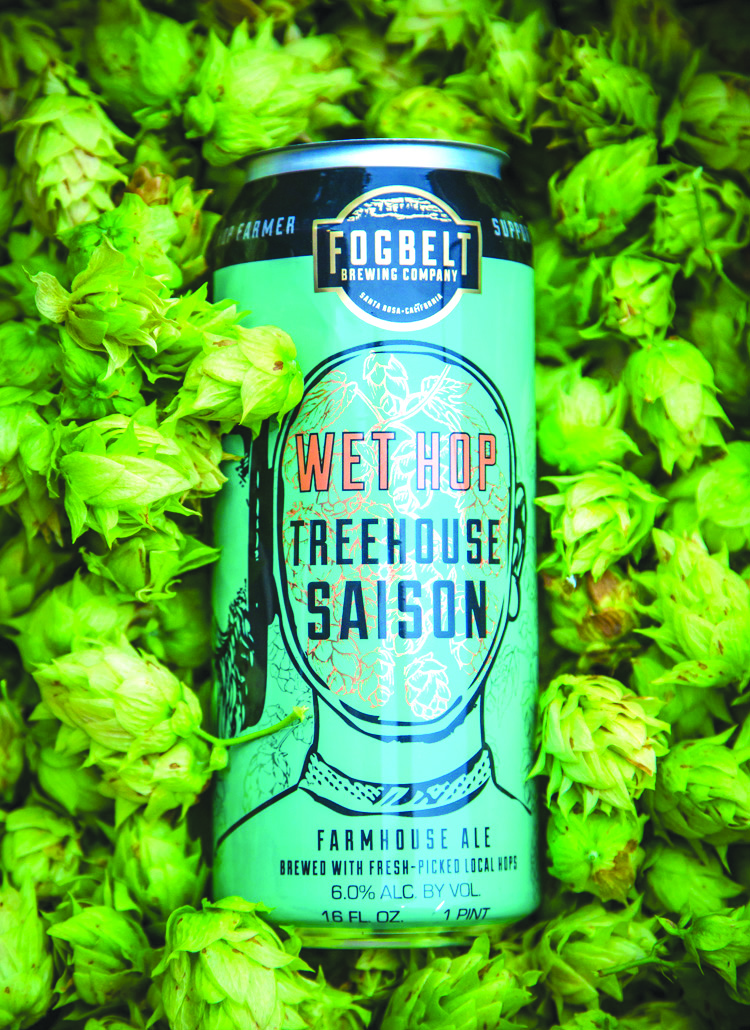
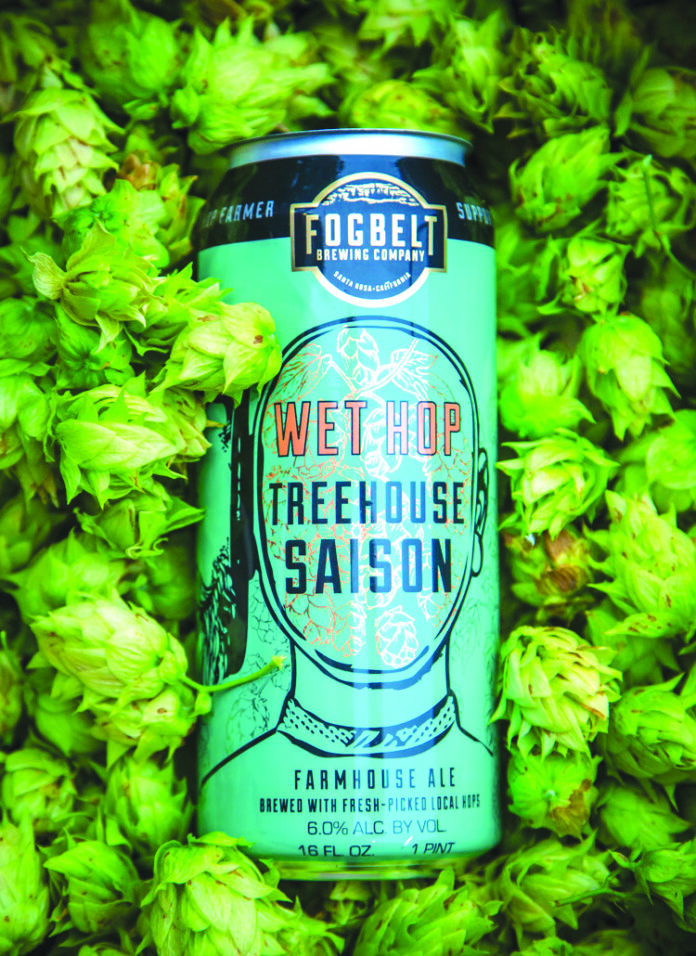
That’s brewer Paul Hawley, who’s releasing a trio of freshly brewed beers, including a farmhouse saison-style brew wet-hopped with Cluster, at Fogbelt Brewing’s third annual Wet Hop Festival. Adding to the spiciness of the saison, says Hawley, “the heritage California Cluster shows aromas and flavors of honeydew melon, papaya and mango.”

Hop season doesn’t get any fresher than at the Windsor Historical Society museum’s eighth annual Hop Harvest & Heritage Day, where president Steve Lehmann invites budding hop heads to pick their own from the 15 prickly plants he grows on the museum grounds from roots collected from three Russian River Valley ranches. Spectators, including folks who remember the hop harvests of days gone by, are welcome.

“Some old timers come by to ridicule my hop-picking technique,” says Lehmann, “in the nicest way.”

Fogbelt Brewing Company, 1305 Cleveland Ave., Santa Rosa. Wet Hop Festival, Sunday, Sept. 2, noon–8pm. 707.978.3400. Windsor Historical Society, 9225 Foxwood Drive, Windsor. Hop picking starts at noon, Saturday, Sept. 8. Lunch and beer, $15. 707.838.4563.


Real Astrology

ARIES (March 21–April 19) In Alice’s Adventures in Wonderland, our heroine encounters a talking caterpillar as he smokes a hookah on top of a tall mushroom. “Who are you?” he asks her. Alice is honest: “I know who I was when I got up this morning, but I think I must have been changed several times since then.” She says this with uneasiness. In the last few hours, she has twice been shrunken down to a tiny size and twice grown as big as a giant. All these transformations have unnerved her. In contrast to Alice, I’m hoping you’ll have a positive attitude about your upcoming shifts and mutations, Aries. From what I can tell, your journey through the Season of Metamorphosis should be mostly fun and educational.

TAURUS (April 20–May 20) Juan Villarino has hitchhiked over 2,350 times in 90 countries. His free rides have carried him over 100,000 miles. He has kept detailed records, so he’s able to say with confidence that Iraq is the best place to catch a lift. Average wait time there is seven minutes. Jordan and Romania are good, too, with 9- and 12-minute waits, respectively. In telling you about his success, I don’t mean to suggest that now is a favorable time to hitchhike. But I do want you to know that the coming weeks will be prime time to solicit favors, garner gifts and make yourself available for metaphorical equivalents of free rides. You’re extra magnetic and attractive. How could anyone could resist providing you with the blessings you need and deserve?

GEMINI (May 21–June 20)  One of the big stories of 2018 concerns your effort to escape from a star-crossed trick of fate—to fix a long-running tweak that has subtly undermined your lust for life. How successful will you be in this heroic quest? That will hinge in part on your faith in the new power you’ve been developing. Another factor that will determine the outcome is your ability to identify and gain access to a resource that is virtually magical even though it appears nondescript. I bring this to your attention, Gemini, because I suspect that a key plot twist in this story will soon unfold.

CANCER (June 21–July 22)  Potential new allies are seeking entrance to your domain. Existing allies aspire to be closer to you. I’m worried you may be a bit overwhelmed; that you might not exercise sufficient discrimination. I therefore urge you to ask yourself these questions about each candidate. 1. Does this person understand what it means to respect your boundaries? 2. What are his or her motivations for wanting contact with you? 3. Do you truly value and need the gifts each person has to give you? 4. Everyone in the world has a dark side. Can you intuit the nature of each person’s dark side? Is it tolerable? Is it interesting?

LEO (July 23–August 22)  While a young man, the future Roman leader Julius Caesar was kidnapped by Sicilian pirates. They proposed a ransom of 620 kilograms of silver. Caesar was incensed at the small size of the ransom—he believed he was worth more—and demanded that his captors raise the sum to 1,550 kilograms. I’d love to see you unleash that kind of bravado in the coming weeks, Leo—preferably without getting yourself kidnapped. In my opinion, it’s crucial that you know how valuable you are, and make sure everyone else knows, as well.

VIRGO (August 23–September 22)  Romanian philosopher Emil Cioran loved the music of Johann Sebastian Bach. “Without Bach, God would be a complete second-rate figure,” he testified, adding, “Bach’s music is the only argument proving the creation of the universe cannot be regarded as a complete failure.” I invite you to emulate Cioran’s passionate clarity, Virgo. From an astrological perspective, now is an excellent time to identify people and things that consistently invigorate your excitement about your destiny. Maybe you have just one shining exemplar, like Cioran, or maybe you have more. Home in on the phenomena that in your mind embody the glory of creation.

LIBRA (September 23–October 22)  I foresee the withering of a hope or the disappearance of a prop or the loss of leverage. This ending may initially make you feel melancholy, but I bet it will ultimately prove beneficent—and maybe lead you to resources that were previously unavailable. Here are rituals you could perform that may help you catalyze the specific kind of relief and release you need: 1. Wander around a graveyard and sing songs you love. 2. Tie one end of a string around your ankle and the other end around an object that symbolizes an influence you want to banish from your life. Then cut the string and bury the object. 3. Say this 10 times: “The end makes the beginning possible.”

SCORPIO (October 23–November 21)  “If a man treats a life artistically, his brain is his heart,” wrote Oscar Wilde. I’ll translate that into a more complete version: “If a person of any gender treats life artistically, their brain is their heart.” This truth will be especially applicable for you in the coming weeks. You’ll be wise to treat your life artistically. You’ll thrive by using your heart as your brain. So I advise you to wield your intelligence with love. Understand that your most incisive insights will come when you’re feeling empathy and seeking intimacy. As you crystallize clear visions about the future, make sure they are generously suffused with ideas about how you and your people can enhance your joie de vivre.

SAGITTARIUS (November 22–December 21)  “My tastes are simple,” testified Sagittarian politician Winston Churchill. “I am easily satisfied with the best.” I propose that we make that your motto for now. While it may not be a sound idea to demand only the finest of everything all the time, I think it will be wise for you to do so during the next three weeks. You will have a mandate to resist trifles and insist on excellence. Luckily, this should motivate you to raise your own standards and expect the very best from yourself.

CAPRICORN (December 22–January 19)  Russian playwright Anton Chekhov articulated a principle he felt was essential to telling a good story: If you say early in your tale that there’s a rifle hanging on the wall, that rifle must eventually be used. “If it’s not going to be fired, it shouldn’t be hanging there,” declared Chekhov. We might wish that real life unfolded with such clear dramatic purpose. To have our future so well-foreshadowed would make it easier to plan our actions. But that’s not often the case. Many elements pop up in our personal stories that ultimately serve no purpose. Except now, that is, for you Capricorns. I suspect that in the next six weeks, plot twists will be telegraphed in advance.

AQUARIUS (January 20–February 18)  Would it be fun to roast marshmallows on long sticks over scorching volcanic vents? I suppose. Would it be safe? No! Aside from the possibility that you could get burned, the sulfuric acid in the vapors would make the cooked marshmallows taste terrible and might cause them to explode. So I advise you to refrain from adventures like that. On the other hand, I will love it if you cultivate a playful spirit as you contemplate serious decisions. I’m in favor of you keeping a blithe attitude as you navigate your way through tricky maneuvers. I hope you’ll be jaunty in the midst of rumbling commotions.

PISCES (February 19–March 20)  People will be thinking about you more than usual, and with greater intensity. Allies and acquaintances will be revising their opinions and understandings about you, mostly in favorable ways, although not always. Loved ones and not-so-loved ones will also be reworking their images of you, coming to altered conclusions about what you mean to them and what your purpose is. Given these developments, I suggest that you be proactive about expressing your best intentions and displaying your finest attributes.


Advice Goddess

Q: I met somebody online, and we have a real connection, but he is agoraphobic and hasn’t really left his bedroom for 10 years. I have a job and a life, so it’s hard to keep up with his barrage of messages. However, it seems unfair to bail on dating him just because he has this condition. What causes agoraphobia? Is it treatable?—Wondering

A: It can be really romantic to spend the entire weekend in bed with a man—but only when you don’t have to spend every other day of the month there, too.

The term “agoraphobia” starts with “agora,” the word for the ancient Greek version of a ginormous open-air shopping mall and outdoor auditorium. However, agoraphobia is not simply a fear of big open spaces. Agoraphobics also fear (and avoid) unfamiliar environments and situations that leave them feeling as though their safety is beyond their control—like being in a crowd of strangers with little room to move. (To an agoraphobic, a free pass to Coachella is like a coupon for a free hour of electric shocks at a CIA black site.)

Additionally, the “my duvet is my continent!” lifestyle (in severe cases of agoraphobia) can develop out of a fear of having these dreaded situations trigger a panic attack. Evolutionary psychologist and psychiatrist Randolph Nesse explains that panic, a form of fear, appears to be an “adaptive” reaction—meaning that it evolved to protect us—driving us to flee from “life-threatening danger.” It does this by kicking off a “coordinated pattern” of changes in the body, emotions and behavior.

In the body, panic causes your adrenaline to surge, ramping up your energy. Your lung capacity increases and your blood flow gets redirected—away from your brain and to your arms and legs, so you can kickbox somebody into submission or (if you got a D in ninja school) run for your life. Mentally, panic turns you “Aaah! Lemme outta here!”–centric. As Nesse explains it, “The mind becomes focused on finding escape routes. If none are obvious, anxiety rises quickly,” and there’s an “overwhelming” motivation to seek shelter in protective places and be near protective people (like “trusted relatives”).

If you’re staring down a lion or an angry mob, this response will help you survive. And Nesse notes that “mild ‘normal’ agoraphobia seems” to be a reaction akin to “fear of leaving the home range in territorial animals, a situation fraught with danger in the wild.” However, extreme agoraphobia, says Nesse—like that experienced by your friend—seems to be an over-functioning of a survival mechanism, an excessive response leading to the avoidance of not just meaningful danger but the stuff of normal day-to-day life.

But there is hope for agoraphobics. Clinical psychologist Michelle Craske reports that the mind and body can often be successfully retrained through a form of cognitive behavioral therapy. It’s called exposure therapy, and it involves a therapist gradually and repeatedly exposing a patient to something they’re irrationally afraid of (like spiders, social rejection or leaving their bedroom). These experiences can eventually lead patients to see that their fear is unfounded and, in time, to react more rationally, both consciously and in subconscious physical reactions. So, for example, going to the grocery store would eventually give rise to the bodily reactions of any other tedious to-do list item, as opposed to the adrenalized reactions that go with being chased down the cereal aisle by a guy with a bloody axe.

The thing is, this is a long process—often rife with setbacks—and you aren’t this guy’s doctor. As for your notion that it’s unfair to nix a relationship with him because of his condition, you seem to be conflating sticking by a person you love—that “in sickness and in health” marriage vow thing—with doing it for a person you hope to love.

You may also be falling prey to the “sunk cost fallacy.” This is a cognitive bias—an error in reasoning—that leads us to irrationally decide to continue an endeavor based on how much we’ve already invested in it. But that prior investment is gone. The rational way to assess whether to continue is to see what we’d get out of any future investment.

In other words, you should only consider this guy a viable prospect for a boyfriend if you’re willing to sign on for the day-to-day reality—a relationship that takes place entirely in his bedroom, save for the occasional exotic vacation to the living room.

Got a problem? Write Amy Alkon at 171 Pier Ave. #280, Santa Monica, CA 90405, or email ad*******@*ol.com. @amyalkon on Twitter. Weekly radio show, blogtalkradio.com/amyalkon.


Reps Throttle Verizon

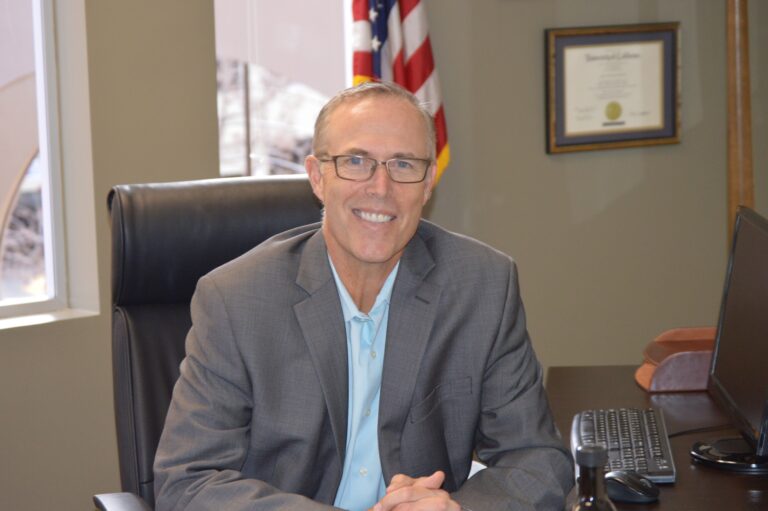
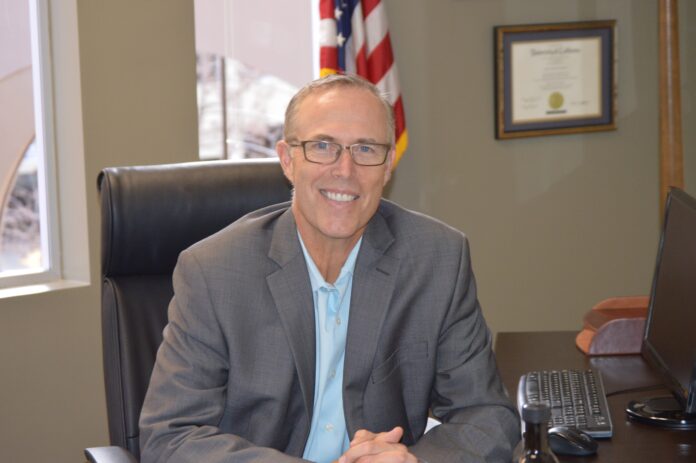
Jared Huffman and fellow representatives are urging the Federal Trade Commission to investigate Verizon.


Rep. Jared Huffman and a host of other members of Congress have joined together to demand an investigation into whether Verizon “throttled” its unlimited data plan for Santa Clara County firefighters battling the Mendocino Complex fire. Huffman and 11 others legislators signed a letter to the Federal Trade Commission asking the agency to investigate whether the communications company engaged in “unfair or deceptive” behavior pursuant to Section 5 of the Federal Trade Commission Act.

According to a court declaration filed by Santa Clara County, the fire department contracted with Verizon for an unlimited data plan but experienced heavy slow-downs when they had reached their cap—a cap that allegedly shouldn’t have been there. According to Huffman’s office, these reduced speeds severely undermined firefighters’ ability to respond to the fire, the largest in state history. When the fire department contacted Verizon about the slow speeds, they were reportedly told they would have to switch to a new data plan at more than twice the cost.

In an interview Tuesday following a panel discussion held at the College of Marin entitled “Holding the President Accountable” attended by some 500 people, Huffman said firefighters complained that reduced data speeds became “a critical problem and at critical moment.”

Some of the members who signed the letter include Democratic representatives Nancy Pelosi, Anna Eshoo, a senior of member of the Energy and Commerce Committee, and Mike Thompson.

“It is unacceptable for the communications providers to deceive their customers, but when the consumer in question is a government entity tasked with fire and emergency services, we can’t afford to wait a moment longer,” the members wrote. “The FTC must investigate whether Verizon and other communications companies are being unfair or deceptive in the services they’re offering to public safety entities.”

But don’t hold your breath for action by the FTC. The Federal Communications Commission repealed the Obama-era Open Internet Order, ending so-called net neutrality and the requirement that all telecommunications and cable companies treat all online and data traffic as equal. Critics say the FCC’s decision will give more power to internet service providers to set pricing and prioritize web and data traffic.

“Unfortunately, with its repeal of the 2015 Open Internet Order, the FCC has abdicated its jurisdiction over broadband internet communications and walked away from protecting consumers, including public safety agencies,” wrote the legislators. “We, therefore, call on the FTC to protect consumers from unfair or deceptive practices stemming from this incident.”

Huffman says efforts in the House and Senate to reinstitute net neutrality are already in the works, and his desire to see the FTC investigate may gain strength, he says, “depending on who holds the gavel.”


Cover Story: Rock With It


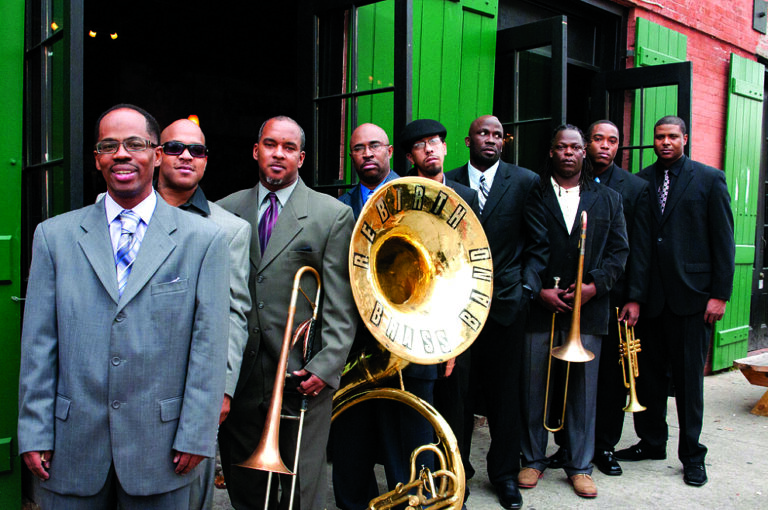
Sunday mornings around my sun-dappled rental cottage are always given over to soul music and the music of New Orleans—with a heavy emphasis on the thumping, bouncing, grooving music of the mighty Rebirth Brass Band.

The experience is church-like and all about the gratitude and the joy, and the music reminds me that I had some of the greatest fun I’ve ever had living in New Orleans, even as I struggled at times to find some purchase in a place that can be quite unforgiving in some ways.

I was truly blessed when I lived in NOLA to have made a friend who introduced me to the second-line culture and hooked me up with numerous living and job connections, for which I am eternally grateful.

On Sunday mornings in my house, a typical spin through YouTube will be heavy on New Orleans brass bands—the Rebirth, the Hot 8, the Soul Rebels, the TBC Brass Band—but I usually start with the mellower stuff. Louis Armstrong is always first out the gate, and especially his “St. James Infirmary Blues.”

Some mornings I’ll just let the YouTube play four or five versions of the song, a staple in New Orleans jazz clubs, which has been covered by everyone from the White Stripes to Hugh Laurie. I prefer Louis’ version.

As the Sunday morning winds on, and the caffeine takes hold, that’s when I’ll segue to the up-tempo brass-band music, which among other of its features, is perhaps the greatest music ever recorded to accompany a proper housecleaning. Come to my house on a Sunday morning, and that’s where you’ll find me: dancing along to the Rebirth Brass Band, washing the damn dishes, and getting the damn recycling out of the house. And, yes, there will be lots of sage burning, and perhaps even a pleasant conversation with Jesus.

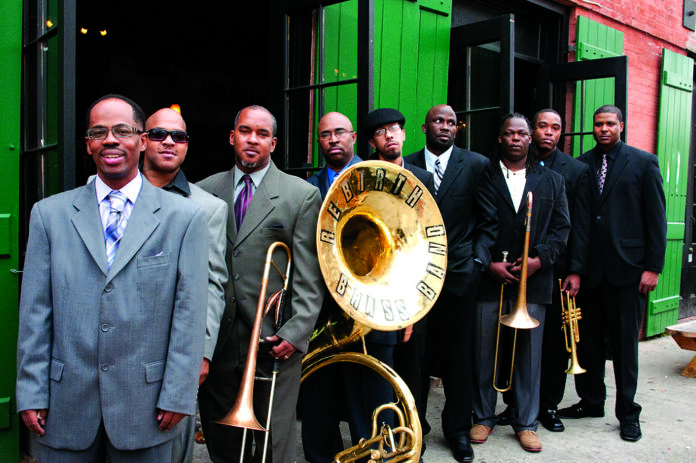
Praise the Lord and pass the tambourine! The Rebirth Brass Band, NOLA veterans since their inception in 1983, come to Mill Valley this week for an epic six-show stand at the Sweetwater, starting on Thursday night and going through Sunday afternoon. By Tuesday, the band will be back in New Orleans for their long-standing and world-famous regular show at the Maple Leaf bar.

The Maple Leaf gig qualifies as world-famous not just because of the band’s 2012 Grammy, which they won for Best Regional Roots Music Album (it was the first year there was a Grammy category for regional music). The gig is also famous for President Obama having once said that when he left office he was glad he’d have the time to check out the Rebirth at the Maple Leaf. That’s what I’d call high praise.

Phil Frazier, a founding member and the group’s tuba player, says in a phone interview from New Orleans that he’s ready to bring the joy to the North Bay as the band gears up for the California journey from a sticky, late-summer NOLA.

The feeling is mutual for those who hunger for the NOLA cultural bounty in the Bay Area—and there are lots of us out here. I like to joke with people that West Marin and New Orleans are similar in that there’s no place like either anywhere else in America.

“Man, we just love it out there,” says Frazier, who this year earned a major New Orleans accolade when he was elected Governor of the 2018 Zulu Social Aid and Pleasure Club. “The audience is great, the people—we have a big fan base out there.”

Indeed they do.

On Sunday afternoon I stopped in at a party that Vickisa Feinberg was hosting at her West Marin home. Feinberg does promotions at the Gallery Route One in Point Reyes Station, and she goes to New Orleans every year for the French Quarter Festival, a springtime shindig along the Mississippi that’s stacked with top-notch bands, tons of food vendors and all sorts of arts and crafts.

Feinberg has created some amazing art books from her trips, and from checking them out it’s obvious that she’s gotten the full cultural baptism beyond the low-hanging tourist draws along Bourbon Street. Some of her art graces our pages this week, including a rendering of trumpeter Kermit Ruffins, who was a founding member of the Rebirth and Mardis Gras Indian Monk Boudreaux.

The Nevilles are represented in Feinberg’s lovely art books, but so are other local luminaries who are otherwise pretty much unknown outside of their superstar NOLA status. There’s Dancing Man, a second-line legend who teaches a course in how to properly bomp to the second-line brass bands.

Feinberg has dug deep into the culture, and her art reflects it. I checked out her art in her studio barn and then got to talking with KWMR DJ Grey Shepard about music and musicians, various encounters we’ve had with New Orleans players or other rockers in our travels. One thing a person new to New Orleans comes to quickly understand is that the music culture is a very transactional experience—this is a town filled with working musicians, with an emphasis on work.

Gray and I talk about how many working musicians, whether they’re playing Django Reinhardt tunes in a coffeehouse or standing under an awning in San Rafael with a ukulele, are never going to get rich or famous. They’ll be lucky if they can pay the bills.

That sort of courage—to put your life on the line with your art, with all the risks entailed—is one of the purer forms of true courage, and it goes on all the time in New Orleans. As I rolled with the second-line flow in NOLA over several years, I learned that one can achieve a sense of total artistic emancipation—but that no one’s ever fully emancipated, thanks to capitalism. Freaking capitalism.  

The Rebirth Brass Band represent and reifiy that part of New Orleans that the nation at large holds near and dear to its heart when it reflects on the Big Easy: it’s party-time music that will get you on the dance floor pronto. But one really needs to spend time in the city to understand fully that there’s a kind of dialectical dance between the celebratory fronting and the backbeat of relentless, grinding poverty and racism that is just as much a part of the culture as the music.

In my experience, almost nothing comes easy in the Big Easy. It’s a tough and somewhat unforgiving town filled with exhibitionists and antic souls eager to write their own NOLA story—with a through line of personal weirdness, fully vindicated. It’s a town famous for the generous notion embodied in “lagniappe” or “a little something extra.” One quickly learns that there’s no lagniappe unless you first slap down some dollars. In New Orleans, everyone has a hustle.  

And then there’s the overhang of history and its rugged holdouts raging over the destruction of their beloved “heritage and traditions.” Witness last year’s massive public meltdown in New Orleans when old-guard civil rights leaders in town, and former Mayor Mitch Landrieu, succeeded in removing several statutes of heroes of the Confederacy—but not without vicious pushback. There’s a reason the O’Jays’ “Back Stabbers” is a popular cover among the brass bands of New Orleans, given the shuck-and-jive, post-plantation hypocrisies and injustices that black culture has endured for generations: “They smile in your face / All the time they want to take your place.”  

Last Sunday morning I was blasting the Rebirth’s classic “Let’s Go Get ’Em” and thinking about a long-forgotten snippet from an interview someone once did with the late Beat writer William S. Burroughs. As I recall the comment, Burroughs was talking about a car hubcap’s reflection—think about one of those dome-like hubcaps popular in decades past. He observed that when you look down into the hubcap as it reflects in the wet cobbled street, it’s a moment of eternity: You can see your own god in the reflection, your own rearview rendering as you briskly walk past the car and into the future.  

Whenever I put on the critic’s hat to think Deep Thoughts about the NOLA brass-band walking-parade tradition (and, look, I bought a lot of hats in that chapeau-friendly town), it hits me that the music both honors the past, is steeped in the past, and also chases after the future.

When it comes to the Rebirth, chasing the future has meant an embrace of hip-hop, reggae, funk and other contemporary music trends. In my humble little opinion, the greatness of the Rebirth is that the band looks into the hubcap as it charts a course to a future where dreams are no longer deferred for the African-American descendants of the great and ongoing sin, which dare not speak its name.  

After all, the Sunday second-line scene in New Orleans is literally music in forward motion—and there’s nothing like waiting on the parade on a spring day in New Orleans, watching with ear bent to the music as the parade makes its way to where you’re standing. You’ll see the colorful pendants denoting the social club that’s hosting the parade, then a vanguard of dancers—hey, there’s Dancing Man!—as men in pickup trucks hustle liquor drinks out a scratchy megaphone in a musical cadence that’s just as rhythmic as the band.

The trombone will emit its blatty punctuation mark, and then there it is, at long last, the tuba—or tubas—bouncing above everyone’s head. Before you know it, you’re engulfed in a rolling, dancing parade of laughing, joyful celebration. Everyone’s welcome.

The bottom line is that the New Orleans brass-band culture occupies a uniquely American piece of turf. It’s survivor’s music. It’s life or death music, whose nearest corollary in music is maybe punk rock—the music of defiance, of fighting back, of letting loose.  

It is music that’s literally close to the ground, that eats up the ground as it marches, and marches some more—as salvation from the poverty, the despair, the isolation, the bitterness, the fatalism and the betrayals that attend great American minority-majority cities like New Orleans.

Indeed, in a place like New Orleans, “the veil is thin” in ways that you just don’t experience anywhere else.  What that means is that on certain days, certain times of the year, certain places, the space—the veil—between our lowly corporeal lives and our version of the eternal is thin.

There’s a literal truth to the expression, sadly, when one reflects on the horrible Mother’s Day second-line shootings of 2013. But the figurative and poetic arc of the expression is one that any working stiff in the North Bay can relate to—anyone who’s been a paycheck away from abject poverty, living in the car and trying to sell a painting to make the rent.

“It’s the real deal,” Feinberg says. “It’s the real people. And speaking of veils, there is nothing in between. You get right to who they are because of the music. They are very connected. To see how they live, where they live, and how dangerous it can be there with the flooding and everything else—the resilience is amazing, and it’s a totally different way of life.”

New Orleans is the place to go if you want to experience the true cost of the dream deferred, as rendered by the American poet Langston Hughes in his poem “Harlem”:

What happens to a dream deferred?

Does it dry up

like a raisin in the sun?

Or fester like a sore—

And then run?

Does it stink like rotten meat?

Or crust and sugar over—

like a syrupy sweet?

Maybe it just sags

like a heavy load.

Or does it explode?

Hughes’ theme is picked up by the Lil’ Rascals Brass Band in their 2001 second-line classic, “Roll with Me, Knock with Me.”

The song is both an homage to other brass bands and the competition among them—and a gritty description of life in the neglected streets of New Orleans. First up in the homage is, naturally, the mighty Rebirth Brass Band. It’s a fun song and one of my Sunday morning staples—and has an uncanny rhythmic arc to the Hughes poem:

Rebirth tried to get me! Rascals roll with me!

Tenth Ward tried to get me! Sixth Ward roll with me!

Who that shot D-Boy? Gotta get him, gotta get him!

Wipe your weary eyes, mama don’t cry (Mama don’t cry!)

Living in the Sixth [Ward], baby, do or die (Mama don’t cry!)

Drugs and prostitution, people will die (Mama don’t cry!)

They say they’re certain there’s no cure for AIDS, but that’s a lie (Mama don’t cry!)

Ten years from now, where will I be? (Mama don’t cry!)

Will I shine like a star, bright as the eyes can see? (Mama don’t cry!)

Will I be kicking the breeze, hanging on St. Philip Street? (Mama don’t cry!)

All I can ask the Sixth, is come on and roll with me! (Mama don’t cry!)

I tried to find the William Burroughs hubcap interview online, or a quote from it, and in my search I ended up reading dozens of Burroughs quotes and passages before giving up—but not quite.

I hovered for a long time over the following Burroughs quote, which really stood out as a kind of exemplar of what the heart and soul of the New Orleans brass band traditions are getting at: overcoming struggle through whatever means necessary and finding some sort of personal salvation through art, while retaining some personal integrity along the way. Burroughs writes, “The first and most important thing an individual can do is to become an individual again, decontrol himself, train himself as to what is going on and win back as much independent ground for himself as possible.”

Phil Frazier is on the line from New Orleans. “Oh, the struggles, yes,” he says as the Rebirth Brass Band band gears up for their trip to the North Bay.

“The struggles . . . we all have them. You know, no matter what happens,” he says, “no matter what—we still have the music.”

This Week in the Pacific Sun

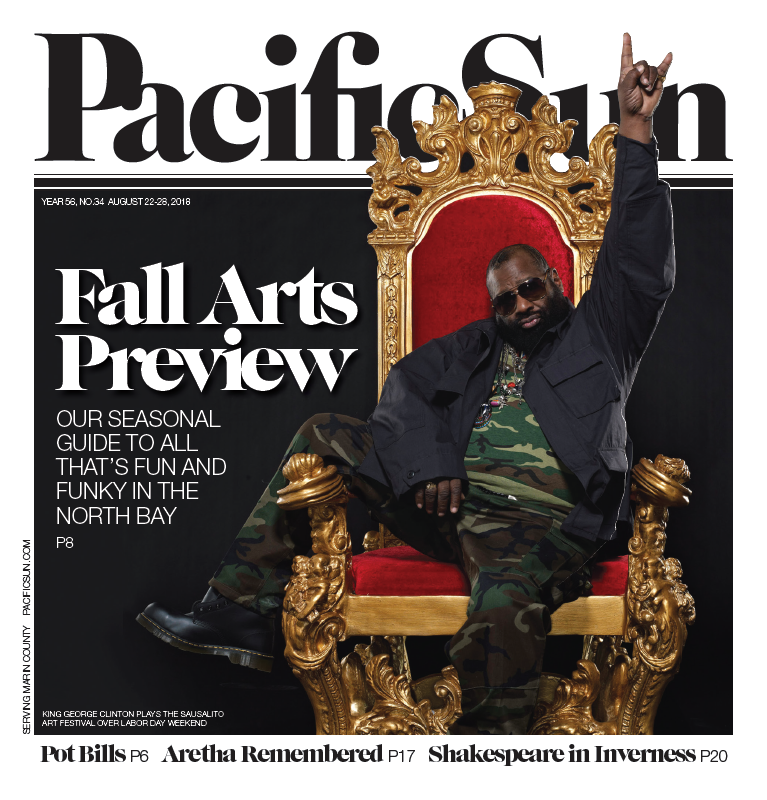
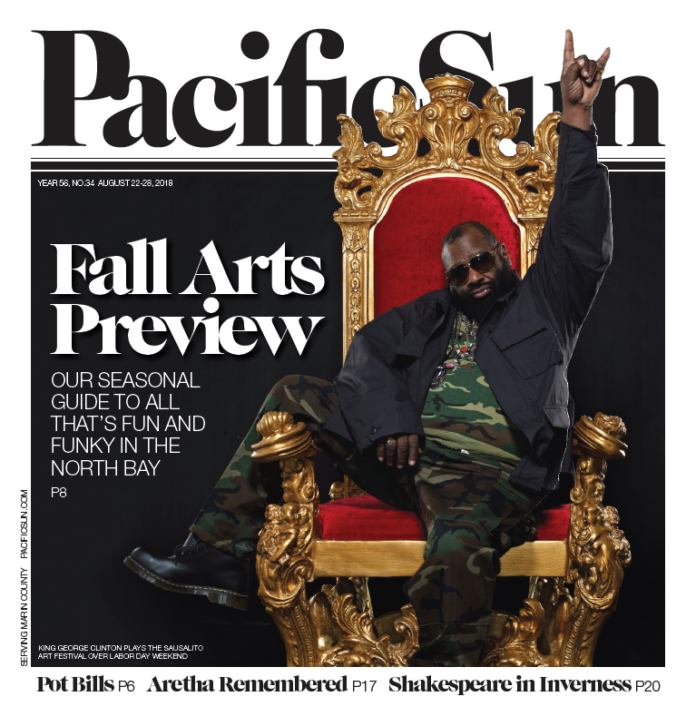
This week it’s our annual and epic Fall Arts Preview, penned by stalwart Arts Editor Charlie Swanson. There’s so many fun and funky events this fall—we don’t even know where to begin! George Clinton graces our cover, so let’s start there: He’s bringing the Parliament-Funkadelic to the Sausalito Art Festival over Labor Day Weekend, that’s so hot! Dig in, there’s something for everyone. Elsewhere in the pages of the nation’s oldest continuously published alt-weekly—that would be us—actor-writer Howard Dillon previews an upcoming offering of the Taming of the Shrew in Inverness and finds it to be quite lovely. Harry Duke’s on the case of a new play about John Brown, American hero. Tom Gogola interviews author Meredith Ochs about Aretha Franklin, the late Queen of Soul who is profiled in her upcoming book about the fiercest female musicians ever. Tanya Henry tames some sandos oozing with love and localism out in Inverness, and Heroes and Zeroes has a couple of items highlighting local heroes of Law Enforcement. Plus a big ol’ update on various pot-related bills under consideration this term in Sacramento. —Tom Gogola

Hero & Zero

Hero The “Crookedest Railroad in the World” opened in 1896 and transported tourists from downtown Mill Valley to the Tamalpais Tavern on top of Mt. Tam for almost 35 years. The eight miles of track wound around 281 curves and offered stunning vistas of San Francisco. In 1920, a new steam locomotive, Heisler Engine No. 9, manufactured in Pennsylvania, joined...

Hero & Zero

Hero The “Crookedest Railroad in the World” opened in 1896 and transported tourists from downtown Mill Valley to the Tamalpais Tavern on top of Mt. Tam for almost 35 years. The eight miles of track wound around 281 curves and offered stunning vistas of San Francisco. In 1920, a new steam locomotive, Heisler Engine No. 9, manufactured in Pennsylvania, joined...

Stockholm Syndrome

The fantasy sold in The Wife, based on Meg Wolitzer’s novel of the same name, is of winning the Nobel Prize for literature, and at first that’s fun. An old literary lion, Joe Castleman (Jonathan Pryce), and his wife, Joan (Glenn Close), are sleepless as they await the early morning phone call. Soon comes the comically Scandinavian-accented news, and...

Local Gem

There’s so much more to Mediterranean food than is usually expressed stateside. The region offers everything from undiscovered Turkish delights to slowly trending Israeli dishes. Petaluma’s new restaurant Pearl is attempting to bring the lesser known stars of the cuisine to the table with a focus the on eastern Mediterranean—Turkey, Israel, Syria and beyond—with a sprinkle of Moroccan and...

Cluster’s Pluck

  At a time when craft brewers are chasing the latest trends in new, trademarked hop varieties to juice up their juicy IPAs, some in the North Bay are digging up a relic of a bygone day for their brews—literally, they are digging up the roots of decades-old hop plants that have gone feral near the banks of the Russian...

Real Astrology

ARIES (March 21–April 19) In Alice’s Adventures in Wonderland, our heroine encounters a talking caterpillar as he smokes a hookah on top of a tall mushroom. “Who are you?” he asks her. Alice is honest: “I know who I was when I got up this morning, but I think I must have been changed several times since then.” She...

Advice Goddess

Q: I met somebody online, and we have a real connection, but he is agoraphobic and hasn’t really left his bedroom for 10 years. I have a job and a life, so it’s hard to keep up with his barrage of messages. However, it seems unfair to bail on dating him just because he has this condition. What causes...

Reps Throttle Verizon

Jared Huffman and fellow representatives are urging the Federal Trade Commission to investigate Verizon.     Rep. Jared Huffman and a host of other members of Congress have joined together to demand an investigation into whether Verizon “throttled” its unlimited data plan for Santa Clara County firefighters battling the Mendocino Complex fire. Huffman and 11 others legislators signed a letter to the...

Cover Story: Rock With It

  Sunday mornings around my sun-dappled rental cottage are always given over to soul music and the music of New Orleans—with a heavy emphasis on the thumping, bouncing, grooving music of the mighty Rebirth Brass Band. The experience is church-like and all about the gratitude and the joy, and the music reminds me that I had some of the greatest fun...

This Week in the Pacific Sun

This week it's our annual and epic Fall Arts Preview, penned by stalwart Arts Editor Charlie Swanson. There's so many fun and funky events this fall—we don't even know where to begin! George Clinton graces our cover, so let's start there: He's bringing the Parliament-Funkadelic to the Sausalito Art Festival over Labor Day Weekend, that's so hot! Dig in,...
3,002FansLike
3,850FollowersFollow