Real World Astrology

ARIES (March 21–April 19)  Humraaz is a word in the Urdu language. Its literal meaning is “secret sharer.” It refers to a confidante, a person in whom you have full trust and to whom you can confess your core feelings. Is there such a character in your life? If so, I suggest you seek him or her out for assistance in probing into the educational mysteries you have waded into. If there is no such helper you can call on, I advise you to do whatever’s necessary to attract him or her into your sphere. A collaborative quest may be the key to activating sleeping reserves of soul wisdom.

TAURUS (April 20–May 20)  Taurus author Roberto Bolaño suggests that the world contains more beauty than many people realize. The full scope and intensity of this nourishing beauty “is only visible to those who love.” When he speaks of “those who love,” I suspect he means deep-feeling devotees of kindness and compassion, hard-working servants of the greater good and free-thinking practitioners of the Golden Rule. In any case, Taurus, I believe you’re in a phase when you have the potential to see far more of the world’s beauty. For best results, supercharge your capacity to give and receive love.

GEMINI (May 21–June 20)  Once upon a time you were walking along a sidewalk when a fairy floated by and whispered, “I’m willing to grant you three wishy-washy wishes for free. You don’t have to do any favors for me in return. But I will grant you three wonderfully wise wishes if you perform three tasks for me.” You asked the fairy, “What would those three tasks be?” She replied, “The second task is that you must hoodwink the devil into allowing you to shave his hairy legs. The third task is that you must bamboozle God into allowing you to shave his bushy beard.” You laughed and said, “What’s the first task?” The fairy touched you on the nose with her tiny wand and said, “You must believe that the best way to achieve the impossible is to attempt the absurd.”

CANCER (June 21–July 22)  You Crabs tend to be the stockpilers and hoarders of the zodiac. The world’s largest collections of antique doorknobs and Chinese restaurant menus and beer cans from the 1960s belong to Cancerian accumulators. But in alignment with possibilities hinted at by current astrological omens, I recommend that you redirect this inclination so it serves you better. How? One way would be to gather supplies of precious stuff that’s really useful to you. Another way would be to assemble a batch of blessings to bestow on people and animals who provide you with support.

LEO (July 23–August 22)  Chinese mythology tells us there used to be 10 suns, all born from the mother goddess Xihe. Every 24 hours, she bathed her brood in the lake and placed them in a giant mulberry tree. From there, one sun glided out into the sky to begin the day while the other nine remained behind. It was a good arrangement. The week had 10 days back then, and each sun got its turn to shine. But the siblings eventually grew restless with the staid rhythm. On one fateful morning, with a playful flourish, they all soared into the heavens at once. It was fun for them, but the earth grew so hot that nothing would grow. To the rescue came the archer Hou Yi. With his flawless aim, he used his arrows to shoot down nine of the suns, leaving one to provide just the right amount of light and warmth. The old tales don’t tell us, but I speculate that Hou Yi was a Leo.

VIRGO (August 23–September 22)  You now have maximum command of a capacity that’s a great strength but also a potential liability: your piercing brainpower. To help ensure that you wield this asset in ways that empower you and don’t sabotage you, here’s advice from four wise Virgos. (1) “Thought can organize the world so well that you are no longer able to see it.”—psychotherapist Anthony de Mello  (2) “Keep some room in your heart for the unimaginable.”—poet Mary Oliver  (3) “I like to wake up each morning and not know what I think, that I may reinvent myself in some way.”—actor and writer Stephen Fry  (4) “I wanted space to watch things grow.”—singer Florence Welch

LIBRA (September 23–October 22)  “There are works which wait, and which one does not understand for a long time,” wrote Libran author Oscar Wilde. “The reason is that they bring answers to questions which have not yet been raised; for the question often arrives a long time after the answer.” That’s the weird news, Libra. You have been waiting and waiting to understand a project that you set in motion many moons ago. It has been frustrating to give so much energy to a goal that has confused you. But here’s the good news: Soon you will finally formulate the question your project has been the answer to. And so at last you will understand it. You’ll feel vindicated, illuminated and resolved.

SCORPIO (October 23–November 21)  Many seekers who read horoscope columns want common-sense advice about love, career, money and power. So I hope I don’t disappoint you by predicting that you will soon have a mystical experience or spiritual epiphany. Let me add, however, that this delightful surprise won’t merely be an entertaining diversion with no useful application. In fact, I suspect it will have the potential of inspiring good ideas about love, career, money or power. If I had to give the next chapter of your life story a title, it might be “A Thousand Dollars’ Worth of Practical Magic.”

SAGITTARIUS (November 22–December 21)  In 1962, when she was 31 years old, Sagittarian actress Rita Moreno won an Academy Award for her role in the film West Side Story. In 2018, she attended the Oscars again, sporting the same dress she’d worn for the ceremony 56 years before. I think the coming weeks will be a great time for you, too, to reprise a splashy event or two from the past. You’ll generate soul power by reconnecting with your roots. You’ll tonify and harmonize your mental health by establishing a symbolic link with your earlier self.

CAPRICORN (December 22–January 19)  The Committee to Reward Unsung Good Deeds hereby acknowledges your meritorious service in the trenches of the daily routine. We praise your tireless efforts to make life less chaotic and more coherent for everyone around you. We’re grateful for the patience and poise you demonstrate as you babysit adults who act like children. And we are gratified by your capacity to keep long-term projects on track in the face of trivial diversions and petty complaints. I know it’s a lot to ask, but could you please intensify your vigilance in the next three weeks? We need your steadiness more than ever.

AQUARIUS (January 20–February 18)  You need a special pep talk that’s best provided by Aquarian poet Audre Lorde. Please meditate on these four quotes by her. 1. “Caring for myself is not self-indulgence, it is self-preservation. 2. “We have been raised to fear the yes within ourselves, our deepest cravings.” 3. “You cannot use someone else’s fire. You can only use your own. To do that, you must first be willing to believe you have it.” 4. “Nothing I accept about myself can be used against me to diminish me.” 5. “The learning process is something you can literally incite, like a riot.”

PISCES (February 19–March 20)  Warning: My horoscopes may interfere with your ability to rationalize your delusions; they could extinguish your enthusiasm for clichés; they might cause you to stop repressing urges that you really should express; and they may influence you to cultivate the state of awareness known as “playful wisdom.” Do you really want to risk being exposed to such lavish amounts of inner freedom? If not, you should stop reading now. But if you’re as ripe for emancipating adventures as I think you are, then get started on shedding any attitudes and influences that might dampen your urge to romp and cavort and carouse.
Bearing Witness

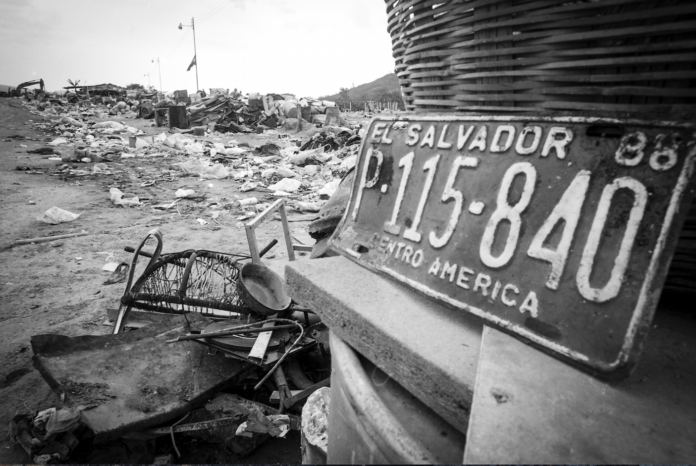
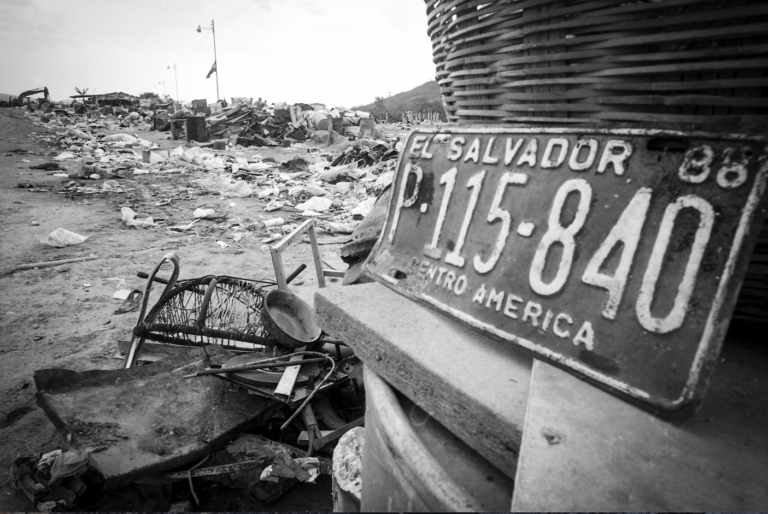
Giuseppe Dezza’s on a job site in Inverness taking a break from his carpentry work to talk about his photography show now on exhibit at the College of Marin Learning Resources Library. Dezza traveled to El Salvador in 1990 as a volunteer with the non-governmental Human Rights Commission.

His photography hobby was soon put to the test. Dezza was supposed to volunteer at the commission for two months and instead stayed on for four years—and photographed the tail end of the Salvadoran civil war that raged from 1979 to 1992.

“My job was documenting human rights abuses,” says the 58-year-old native of Italy and resident of Fairfax. “The basic human right we were focused on was the right to life.”

His photos are haunting and visceral. There’s one of a young child perched atop a pile of garbage; another shows a toddler in the foreground with Salvadoran security forces in the background, looking quite scary and intimidating.

The work was as politically dangerous as it was artistically fulfilling. Dezza went to El Salvador as part of a shield program initiated with the Marin Interfaith Task Force. The mission was to document human-rights abuses and diminish the possibility of the Salvadoran military targeting members of the commission. He didn’t flinch. “You’ve got to get close, you’ve got to be there, you’ve got to smell it, you had to see it, you had to feel it,” Dezza says in a statement from the college.

The country was ravaged by its civil war, and there were numerous assassinations, interrogations and instances of torture directed at human-rights workers during the conflict.

Dezza’s show is part of a semester-long enterprise at the school called “Eyes of Compassion: War, Immigration and Transformation.” The opening this week was timed to coincide with the California Undocumented Student Week of Action.

The school will also welcome Salvadoran poet (and College of Marin graduate) Javier Zamora on Nov. 7, at 1pm in Fusselman Hall, room 120. Zamora was born in El Salvador during the civil war and his parents brought him to the United States to escape the violence.

Dezza is headed back to El Salvador this week, he says. The mother of his child is Salvadoran, and so is his wife (who is not the mother of his child). “I go there as much as I can,” he says.

As for his show, he hopes people will come away “with a sense of humanity, maybe their hearts and minds are a little more open.”

‘Giuseppe Dezza: Beyond the Image’ is up through Dec. 21 at the College of Marin Kentfield Campus, Learning Resources Center, Second Floor, 835 College Ave., Kentfield.

Advice Goddess

I hit it off with this guy I met on Match.com. We’ve been dating for a month and slept together twice. He said he’d delete his Match profile because things were going so well, so I deleted mine. Recently, a mutual friend told me he’d just gone on Tinder. I’m super upset, and though we didn’t have the exclusivity talk, it seemed implied. —Dumbfounded

A: Okay, so it seems he didn’t quite get around to mailing out the formal invitations to the funeral for his freedom.

Now, the guy may be an out-and-out lying cad, cooing commitment-y things to you that he never intended to follow through on. However, it’s also possible that he was legit enthusiastic in that moment when he offered to delete Match— confusing the buzzy high of a love thing that’s brand-new with a love thing that’s really right.

Neuroscientist Wolfram Schultz discovered that things that are new to us—people, relationships, pleasure-producing substances— activate our brain’s reward circuitry and its chemical messenger boy, dopamine, in a way things we’re used to do not. (That very first bite of chocolate cake is always the tastiest, most chocogasmic.)

In fact, Schultz’s research suggests that “novel rewards” may be two to three times more dopamine-elevating than delishy stuff we’ve previously experienced. Basically, once we’ve tried something, even if we really, really enjoyed it the first time (hot diggity!), it becomes less motivating to us (kinda lukewarm diggity).

This motivational downshift comes out of how dopamine neurons are, in a sense, fortuneteller cells; they predict how rewarding things or situations will be. Dopamine, contrary to what countless books and articles contend, is not a “pleasure chemical.” It does not generate a heroin rush-type euphoria. It’s stimulating. It drives wanting and seeking, motivating us to explore new stuff that might enhance our ability to pass on our genes.

After dopamine calculates the difference between the initial high a thing gave us when it was new and its current level of more meh rewardingness, it can push us to go out and chase the initial high—seek some new provider, and then another and another: “Sure, I could have a stable adult relationship—or I could continue my groundbreaking research into The Tramp Stamps of Tinder.”

This is not an excuse for this guy’s lack of forthcomingness but a possible explanation for why he said he’d delete Match but then signed right up for Tinder. It’s also possible the powerful human fear of regret is at play. Going exclusive with you would mean waving bye-bye to the rest of womankind. It’s possible that he and his penis feel the need for a second opinion.

The problem from your end is that your wanting to go exclusive with him is the dating version of the impulse purchase. A month in, you don’t have enough information to judge his character, see whether he’s boyfriend-grade, and see whether there’s, uh, brand loyalty. You should be just starting to see who he is and reserving judgment—much as you’d like to believe that he’s a wild dude seeking domestication, kind of like a lion knocking on the door of the zoo: “Got any vacancies, chief?”

Got a problem? Write Amy Alkon at 171 Pier Ave. #280, Santa Monica, CA 90405, or email ad*******@*ol.com. @amyalkon on Twitter. Weekly radio show, blogtalkradio.com/amyalkon.

Seeing Red

In Mandy, we face the question of how much you can gussy-up the kind of movie that most people have been watching since they were 10 years old.

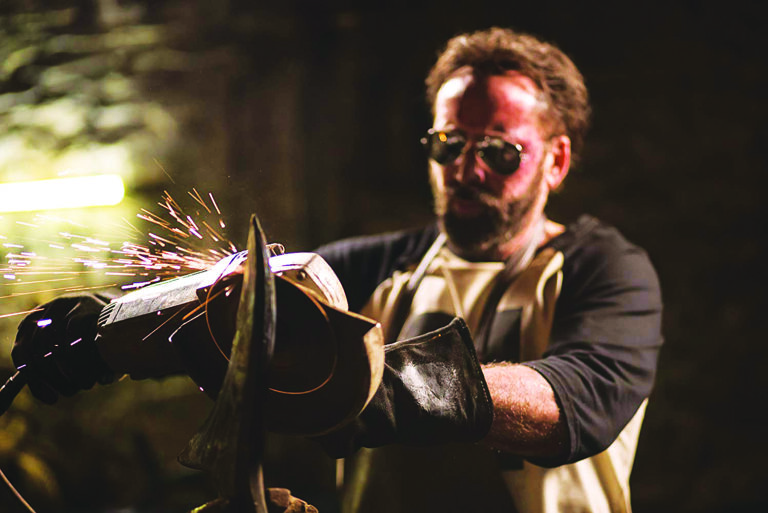
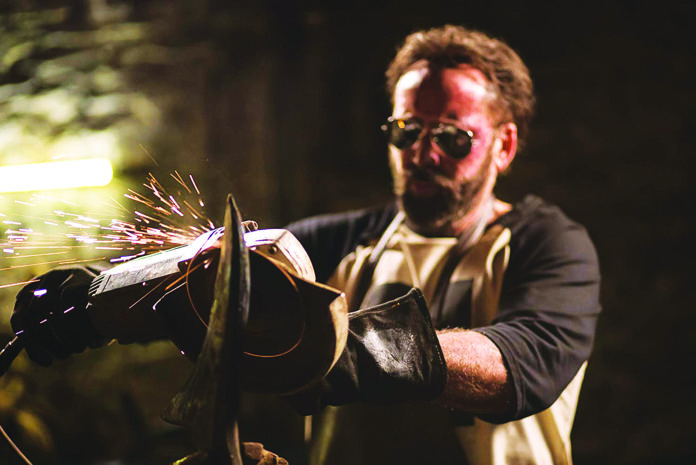
In 1983, the wary lumberjack Red Miller (Nicolas Cage) returns to the safety of the cabin he shares with his zonked, facially scarred wife Mandy (Andrea Riseborough, who, as in Battle of the Sexes, looks more like a hippie than most of the actual hippies of the hippie years).

Along comes a Mansonoid cult run by Brother Jeremiah (Linus Roache) who, like Charlie Manson, severely overestimates his skills as a musician and has to kill people to make them pay attention to his LP.

Jeremiah sees Mandy, wants her and captures her with the aid of a quartet of demonoids called the Black Skulls that he summons with a diabolical ocarina. When Mandy refuses Jeremiah’s seduction, he kills her in front of Red, after which—to paraphrase the Bride in Kill Bill—Red goes on what the movie advertisements refer to as a “roaring rampage of revenge”; he roars, he rampages, and he gets bloody satisfaction.

This revenge actioner simmers in neon colors, a carnival of evil staged in another part of the David Lynch forest. Director Panos Cosmatos is the son of the man who directed Rambo: First Blood Part II (1985). He has inherited his father’s gift for making a forest look really primeval. In Benjamin Loeb’s strobing, lurid photography, even a mud pit is lit up like a Route 66 motel.

Mandy tries, and sometimes succeeds, in becoming the kind of movie you should only see after midnight. At times it’s a great shuddery acid trip, or the cinematic equivalent of prog rock—indeed, King Crimson’s “Starless” is featured in Jóhann Jóhannsson’s soundtrack.

But a slow pace is fatal to grindhouse. The changes of emphasis and time that are so fearfully disorienting in Lynch’s films are more like dead air here. As the atmosphere is more important than the setup and payoff, this is an artsy recreation of a death trap instead of a successor to the grindhouse skullbusters of yesterday.

Cage is triumphantly virile. Strung up with barbed wire by these bad apples, suffering his way into transcendence, one can glimpse how fantastic he would have been as Jesus. Cage can do the ecce homo face like nobody else.

Mandy is crazy, but studiously crazy. Like prog rock when it doesn’t work, it’s like the efforts of classical musicians tackling Delta blues with theremins and Mellotrons.

‘Mandy’ plays through Thursday, Oct. 18, at select theaters and is available on demand at Amazon.com.  


Heroes and Zeroes

In honor of our annual Heroes of Marin edition, we’re scrapping the Zero this week. First, we have Françoise, who took a bad tumble on some uneven pavement in the Larkspur Ferry parking lot. A kind gentleman exiting the ferry helped her stand up and guided her to a bench near the gate. Seeing her cuts and bruises, he asked a crew member walking by for assistance. That crew member fetched another, who arrived with ointment and bandages. Crew member 2 treated her injuries, escorted her to a seat on the boat and requested that crew member 3 bring ice for the swelling and watch over Françoise during the crossing. Once the ferry was underway, the captain stopped by to ensure that she was comfortable and to offer his help disembarking. Françoise extends her gratitude to the team of heroes that aided her on her journey.

With all the mishegoss in the federal government right now and the important measures and propositions on our ballot, we must get off our tushes to vote on Tuesday, Nov. 6. Marin couldn’t make it any easier for a registered voter.

Choose from three options:

1) Vote by mail—just get that ballot postmarked by or on Election Day.

2) Vote at the poll. Personally, we love that patriotic feeling of walking into our polling place on Election Day, casting our ballot and receiving the red-white-and-blue “I VOTED” sticker.

3) Early voting. Can’t wait to vote? Marin County’s got an early voting system all lined up. Just walk in to the Elections Department at the Marin County Civic Center, now through Election Day, Monday through Friday, 8am to 4:30pm. If you need a lift to the polls, catch a free ride with Uber on Nov. 6. If you’re not sure you’re registered? Call 415.473.6456 or visit the county website. Not registered? Do it at registertovote.ca.gov.

Got a Hero or a Zero? Please send submissions to ni***************@***oo.com. Toss roses, hurl stones with more Heroes and Zeroes at pacificsun.com.


Letters

Rants, Raves and Rape

No wonder your paper has become such a dud (“Wasted Justice,” Oct. 10). Not really reporting in any sense of journalism. What the hell happened to innocent until proven guilty. I don’t care who was right but . . . the woman could remember nothing! So you are going to convict on that?

How stupid and vapid and mindless just because you believe one side over another. How about the McCarthy years of guilty until proven innocent, or communism, or living in a totalitarian society.

We have laws here to protect all of us, and she is literally saying, no, if we believe you are guilty without any proof, then you are guilty, so off to the cell. Is this really what you want our country to start doing?

Shame. I will never pick up a copy of your stupid paper again and will advise the same on the internet and to friends. It used to have some semblance of “middle of the road,” a long time ago. Now just a left-wing, socialist Marxist newsletter to the deaf and dumb.

John Monte

Via Pacificsun.com

What an important story. Maia, you are very brave. You were so young when these things happened to you. We were all so naïve back then, and there wasn’t all the information that we have now. Thanks for being a Hera (hero) and telling this story.

Sara

Via Pacificsun.com

Thank you for covering the news around Marc Levine’s sexual harassment bills, Nikki Silverstein’s reporting on the difficulty of rape victims’ obtaining assault examinations “on what is likely the worst day of their lives,” and the brave and heartbreaking article by Maia Boswell-Penc on her observations as a multiple rape survivor.

As a man, I remain aghast at how rape survivors continue to face stigma and fear in today’s America. “Justice Denied” is an apt title for the issue.

Christine Blasey Ford has still not been able to return home because of the volume of death threats she has received since she accused Brett Kavanaugh of sexual assault.

Ford previously told the Senate Judiciary Committee she was forced to leave her home with her family on Sept. 16. She then said her “greatest fears have been realized,” as she continues to receive death threats and lives in hiding.

This nation suffers from some great evils today. Shockingly, sexual assault and the ongoing victimization of women by men are still among them.

Paul Bonapart

Corte Madera


Fortunate Ones

0

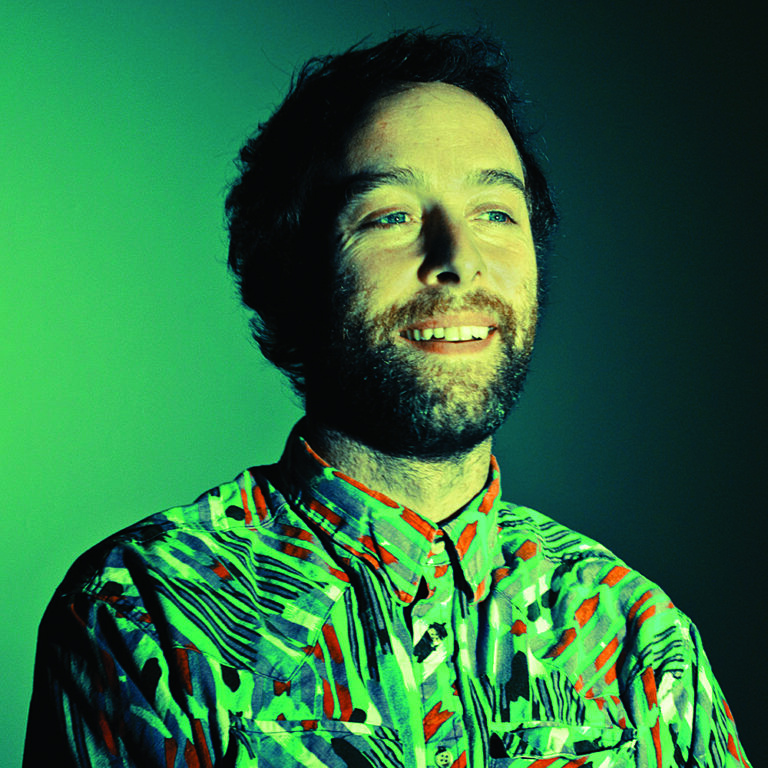
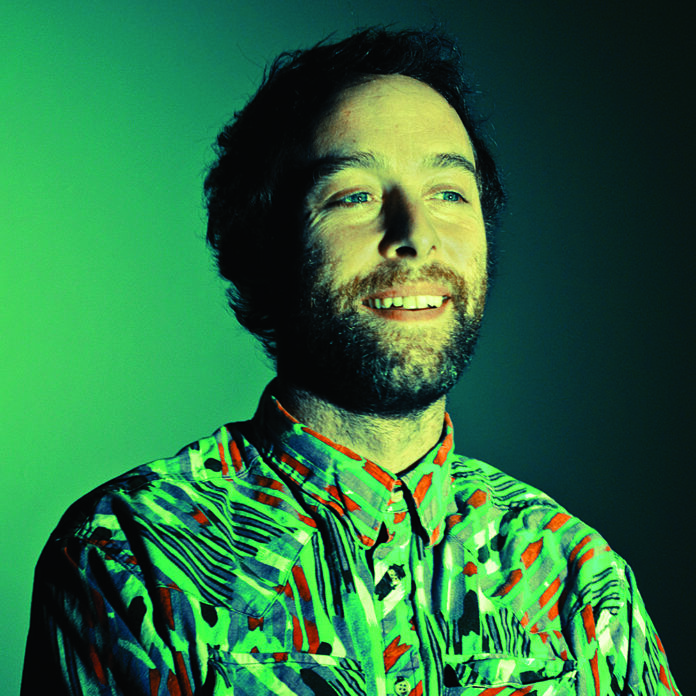
When singer-songwriter Luke Temple moved from the East Coast to West Marin two years ago, he felt fortunate to leave the noise of New York City and replace it with the peaceful sounds of Inverness—even though the acclaimed solo performer and bandleader of indie-rock outfit Here We Go Magic was faced with the task of starting over socially.

Luckily, Marin is jammed with musicians, many of whom share a penchant for indie-rock and folk aesthetics as well as communal creativity, and Temple has tapped into that vein with his ongoing concert series, Good Fortune.

“I moved here from New York, and I had been there for 15 years and had strong musical connections,” Temple says. “When I came out here, I didn’t know anybody, so it was an attempt to get to know the musical community.”

Good Fortune began life at Gospel Flats farm and gallery space in Bolinas, where Temple would perform solo. Soon, more and more musicians were checking in, and the event moved to the Old Western Saloon in Point Reyes Station.

“It turned into a jam,” Temple says. “I’ll have a band come and play a set to open, and then it’ll move into a structured improvisational jam where I sort of direct. Whoever wants to come play can come, and it always ends up turning into a dance party.”

Temple’s ability to direct rhythmically repetitive and often stream-of-consciousness songwriting shined on Here We Go Magic songs that had crowds dancing for joy at major festivals around the world between 2009 and 2015.

While the band still performs occasionally, Temple’s focus these days is his reinvigorated solo output, featuring intimate folk informed by his Marin surroundings, which bursts through on his patient, acoustic 2016 solo album, A Hand Through the Cellar Door.

Temple is also working on a pseudonymous project called Art Feynman that takes his tender ballad songwriting and infuses a healthy heaping of fuzzed guitars and four-track-tape grittiness. Temple will be taking Art Feynman on tour through Europe later this year.

Before that, he’s hosting another Good Fortune show on Oct. 20 with Bay Area garage band the Radio Fliers opening the show—before Temple and friends take over. “Everybody can get a chance to play an instrument,” he says. “I try to be as democratic as possible and get everybody up there.”

Good Fortune befalls you on Saturday, Oct. 20, at Old Western Saloon, 11201 Hwy. 1, Point Reyes Station. 9pm. $10. 415.663.1661.

RE: Scheduling

0

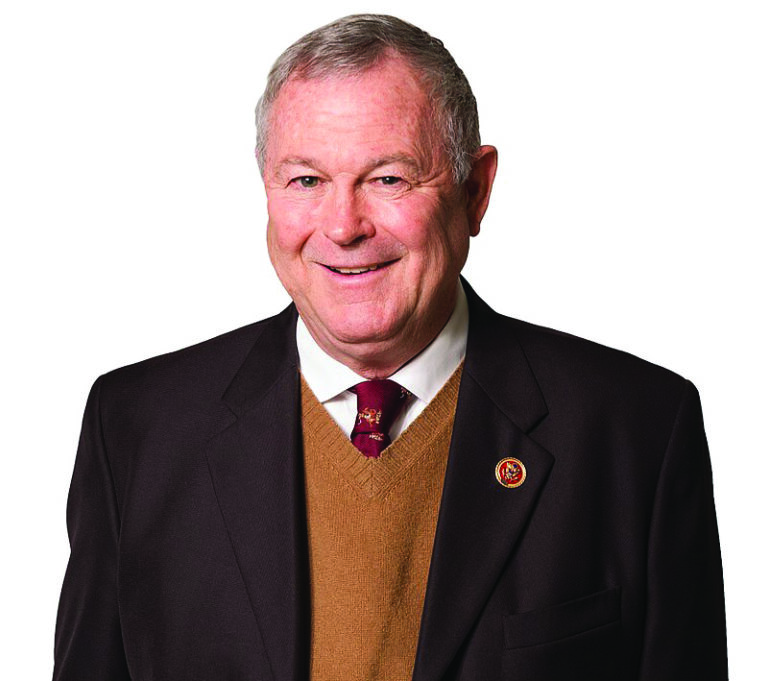
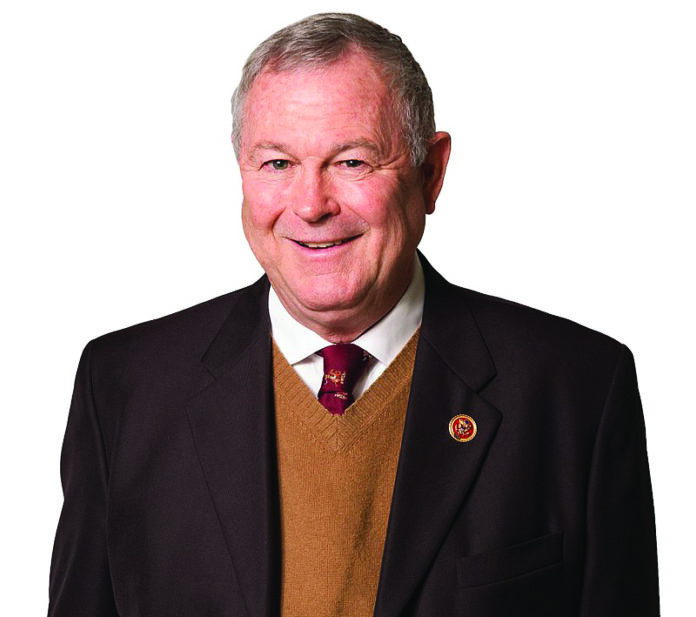
Pro-pot Republican Dana Rohrabacher swears that Donald Trump’s going to change the nation’s federal cannabis posture after the midterm elections.

“I have been talking to people inside the White House who know and inside the president’s entourage,” says the California congressman in a statement highlighted in a recent press release sent out by CMW Media in San Diego. “I have been reassured that the president intends on keeping his campaign promise.”

The CMW Media release notes that this “solid commitment” from Trump will be good for emergent pot businesses such as Hemp Inc. and GrowLife.

Trump’s campaign promise was that he would honor states’ rights when it came to cannabis law, and as NORML’s Paul Armentano wrote in The Hill last week, the reality-show president is supporting the bipartisan STATES Act that’s currently going nowhere under GOP congressional leadership that’s decidedly anti-pot.

The problem for GOP marijuana dead-enders appears to be that they’re getting squeezed at home at the same time they’re getting squeezed from elected office, thanks to their embrace of Trump and his rolling parade of amoral shenanigans. Pot legalization measures have made their way onto the ballot in conservative states like Utah and North Dakota this year, even as hardliners in Congress refuse to budge on any serious attempt to stop classifying cannabis as a Schedule 1 narcotic. Congressional anti-pot fiends in both houses have stymied numerous bills directed at pot reform.

Meanwhile, the Food and Drug Administration in June moved to reschedule the CBD-based drug Epidiolex from Schedule 1 to Schedule V, even as it reiterated that CBD is a Schedule 1 drug under the Controlled Substances Act “because it is a chemical component of the cannabis plant.” The anti-epilepsy drug is produced by the U.K.-based GW Pharmaceuticals.

FDA commissioner Scott Gottlieb, in announcing the approval, wrote that “it’s also important to note that this is not an approval of marijuana or all of its components. This is the approval of one specific CBD medication for a specific use.” The FDA has not jumped on any larger de-scheduling bandwagon. “Marijuana is a Schedule 1 compound with known risks,” he wrote.

The FDA’s move this year occurred, as Armentano noted, even as hardliners moved to gut a popular Senate proposal that set out to “facilitate medical cannabis access to military veterans.”

Now pro-pot Republicans like Rohrabacher are smoke-signaling that it will take a Democratic takeover of the House for any serious motion on cannabis reform to take place. That’s both ironic and sort of desperate, given that fivethirtyeight.com gives Rohrabacher’s Democratic opponent, Harley Rouda, a 66.5 percent chance of beating the incumbent, who’s been in the House since 1988.

According to Oslo

0

At a time when the language of diplomacy has been reduced to a 140-character tweet transmitted at 3am, it’s good to be reminded of the men and women for whom the quest for peace demanded actual thought and personal interaction.

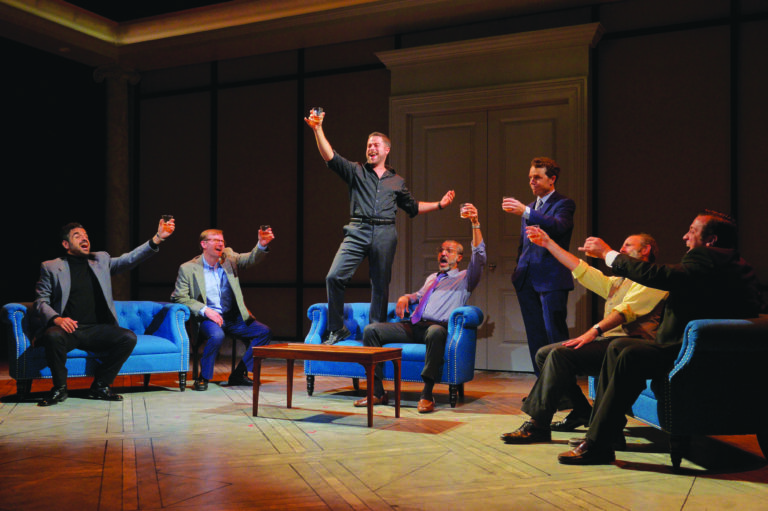
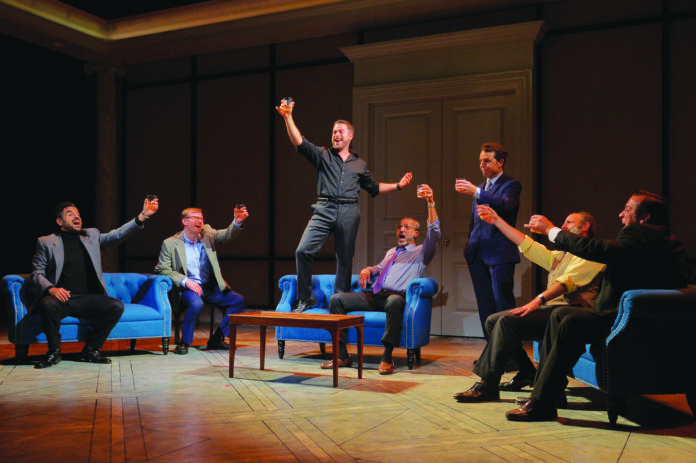
J.T. Rogers’ Oslo, now running in its West Coast premiere at the Marin Theatre Company through Oct. 28, is a look at the circumstances and personalities responsible for the Oslo Accords. The 1993 accords, considered to be a breakthrough in the search for Middle East peace, brought about Israeli acceptance of the Palestinian Liberation Organization as official representatives of the Palestinian people and the PLO’s recognition of the state of Israel.

Norwegians Terje Rød-Larsen (Mark Anderson Phillips) and Mona Juul (Erica Sullivan) are a well-connected husband and wife. He runs a think tank in Oslo; she is an official in the Foreign Ministry. They are the unlikely leaders of a plan to try a “gradualist” approach in Middle East diplomacy. Issues would be dealt with one at a time, from the smallest to the largest, and they would be resolved person-to-person, not nation-to-nation. As it was the official stance of both parties never to deal directly with each other, this had to be accomplished through secret back-channels. Those channels, though far from Washington, D.C., led to that moment on the White House South Lawn when Israeli Prime Minister Rabin shook the hand of PLO chairman Arafat.

Rogers’ play takes the same approach as the negotiations. We get to gradually know the individuals involved. As they become better acquainted, we become better acquainted. As the process evolves, the audience evolves with it to the point at which you would swear you were in the room with them.

Director Jasson Minadakis has gathered an exceptional cast of 14 to tell this story. Sullivan’s Juul acts as the narrator and provides context and humor, facilitating the initial connection between the audience and the play. Phillips is magnificent as part strutting peacock, part heartfelt peacemaker Rød-Larsen. His alcohol-fueled takedown by the participants at one point during the negotiations was wrenching. J Paul Nicholas and Ashkon Davaran as the PLO representatives and Brian Herndon and Ryan Tasker as the initial Israeli contacts are excellent as across-the-table enemies who soon develop a friendship.

Today, the accords are in tatters. Rabin met his end at the hand of an Israeli extremist, the PLO has been supplanted by the even more hardline Hamas, and a true peace remains elusive.

The accords may have failed, but Oslo gloriously succeeds in their shadow. This beautifully scripted, remarkably performed work reminds us that when humanity is allowed to enter a political process, there’s still hope.

‘Oslo’ runs Tuesday–Sunday through Oct. 28 at Marin Theatre Company, 397 Miller Ave., Mill Valley. 415.388.5208. $25–$70. marintheatre.org

Brown Out

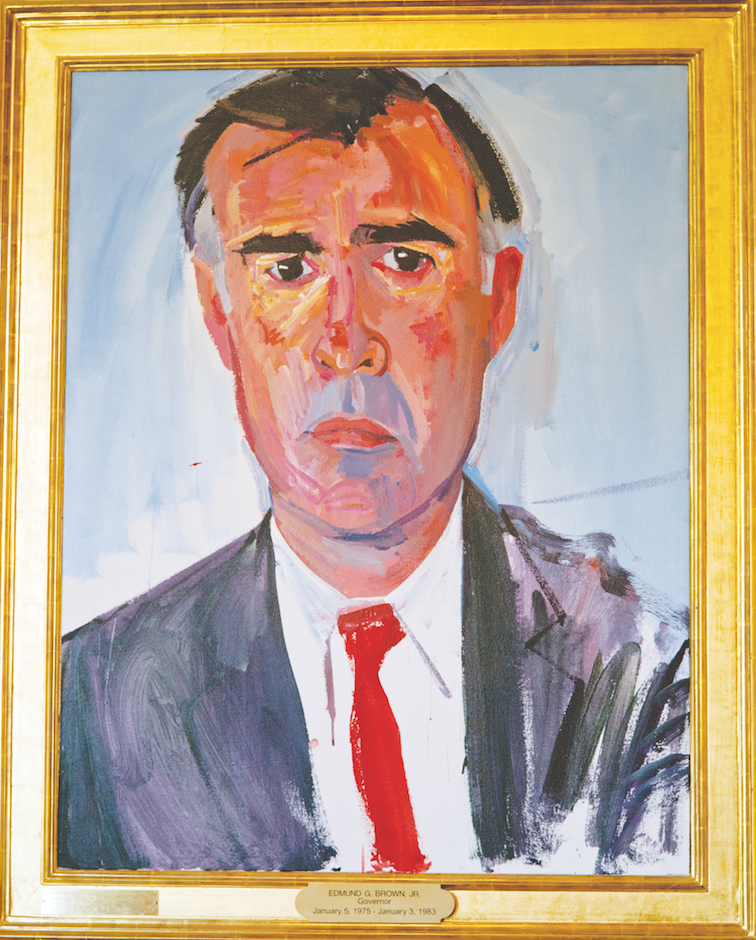
On its face, California’s Brown family political dynasty is the story of two men, but metaphorically it’s really the story of three.

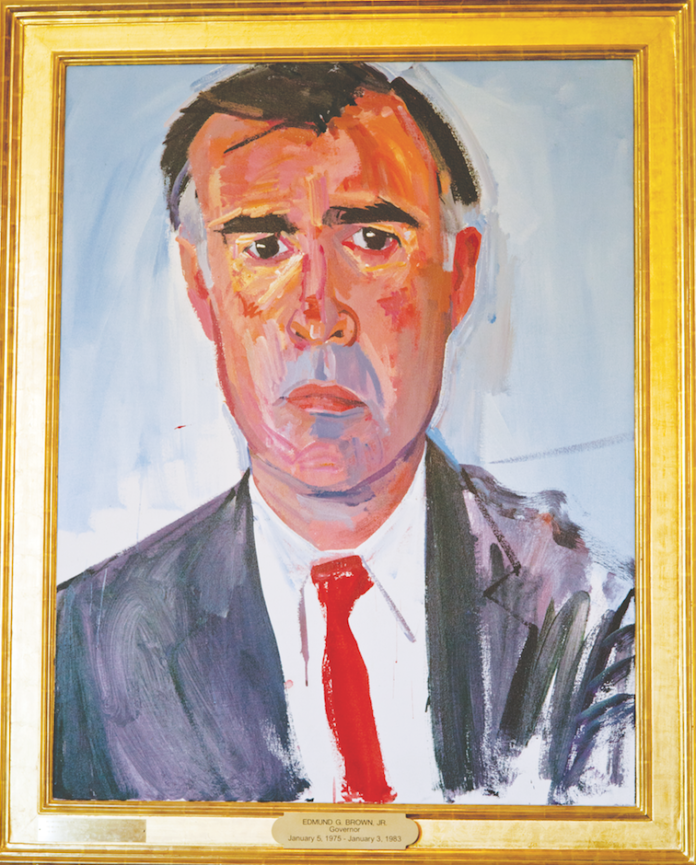
In the dialectical tale of the Browns, the thesis is Pat Brown, the buoyant old-school liberal who served as California’s governor in a time of expansion and optimism. Antithesis would be Brown’s brainy, aloof and austere son Jerry, who moved in to the governor’s office at the insufferable age of 36 with rock star Linda Ronstadt by his side, in a time of cynicism and retrenchment.

Then, in 2010, came synthesis, with the unlikely election of an older but wiser Jerry Brown, still the intellectually restless ex-Jesuit seminarian who, at the same time, had internalized much of the practicality and human touch that shaped his father’s career.

In a couple of months, Jerry Brown, at 80, is poised to step aside as California’s governor for the second time. As a narrative of political redemption, the Browns’ story is satisfying because it’s surprising. Back in 1983, when Jerry Brown’s first two-term stint as governor ended—brought low by Proposition 13, the Mediterranean fruit fly and his own reckless presidential ambitions—he was soundly defeated in a race for the U.S. Senate by Pete Wilson.

At that point, it looked like California’s relationship with the Browns was over. Today, at least to California’s majority Democrats, nothing seems more natural than Jerry Brown in Sacramento. Now, though, it’s almost a certainty that the Brown era is coming to an end in California. Jerry is both the only son in the family and childless, so at least the family name has reached the end of the line. It’s an ideal time for the intimately familiar story to be told in wide-angle grandeur. Journalist Miriam Pawel has risen to the occasion with her new book The Browns of California: The Family Dynasty That Transformed a State and Shaped a Nation (Bloomsbury).

The story of the Brown family almost exactly parallels the U.S. history of California. The family’s patriarch, German immigrant August Schuckman, arrived in California just a couple of years after statehood in the midst of the Gold Rush.

“I wanted to write a book that was a history of California as much as it was a biography, something that I thought would explain some of the unique and significant things about California,” Pawel says. “The family was a good vehicle to do that. I like to write history through people, and so this seemed to be a conjunction between an interesting and unusual family and an interesting and unusual state, and the impact and interplay that each one had on the other.”

Pawel, a Los Angeles Times reporter, fills in the colors of the Brown family with plenty of compelling secondary characters, chief among them Pat Brown’s freethinking mother and self-described “mountain woman,” Ida Schuckman Brown, who died at 96 the same year her grandson Jerry was first elected governor.

But mostly, Brown’s is a story of a father-and-son pair who provide an almost archetypal generational contrast, familiar to many who came of age in post-war America. Pat and Jerry Brown—that is, Edmund G. Brown Sr. and Jr.—were largely simpatico in political values. But in political styles, they could not have been more different.

Pat Brown was an engaging, exuberant, extroverted Hubert Humphrey–style liberal whose love of California was visceral and immediate. Pawel shows Pat’s enthusiasm for flying low in a propeller plane and gazing lovingly at the California landscape, and his habit of stopping in roadside restaurants to glad-hand potential voters. His upbeat personality reflected a kind of post-war optimism that guided him in initiating ambitious and legacy-building projects, particularly in the realms of higher education and water. Paradoxically, for a man considered the patriarch of a California dynasty, Pawel believes that Pat Brown has often been forgotten, especially considering his profound influence on the growth of California.

“It’s true that he’s been somewhat overlooked,” she says. “Part of that is the East Coast vision of California that he was a victim of, in some ways. There is one good biography of Pat Brown, and that’s it. And for someone who had such a major impact on the built environment of California—the water, the roads, the universities and the schools—it’s surprising there hasn’t been more exploration of his impact on the state.”

He was what is today an extinct American political species: the can-do liberal who dreamed big, then delivered. Along with educator Clark Kerr, the first Gov. Brown championed an ambitious master plan that turned the University of California system into the “model for modern research universities across the country,” with a commitment to keep the tuition free for all Californians.

Pat Brown also took on perhaps the state’s most intractable problem with one of its most ambitious solutions. Though the population of California was mostly in the south, the state’s water was mostly in the north. Early on, Brown declared a satisfactory solution to the water problem as “a key to my entire administration.” The result was the massive California State Water Project, featuring the giant aqueduct, now named for Pat Brown, that runs along the spine of California’s Central Valley.

In Pawel’s account, Pat Brown’s enthusiasms for governing California were charmingly sentimental. Brown was especially attentive to the moment when California surpassed New York as the nation’s most populous state. A billboard tallying the numbers was installed near the Bay Bridge, and when the moment finally came at the end of 1962, Gov. Brown declared a four-day celebration. Pat Brown also comes across as a proto-environmentalist who could not stay away from Yosemite and who said that his favorite spot in California was a High Sierra camp called Glen Aulin.

Brown was defeated for a third term by Ronald Reagan. After eight years of Reagan in Sacramento, turned off by the corruption of California favorite-son Richard Nixon in the Watergate scandal, California turned again to an Edmund G. Brown, this time the son.

In contrast to his father, Jerry Brown—at least in his first term as governor, from 1975 to 1983—was more a reflection of the Vietnam-Watergate generation: arrogant, intellectually voracious, almost puritanical in his disdain for mainstream politics, the brooding iconoclast who simultaneously hated displays of wealth and loved hanging out with rock stars. Though it was never overt, young Jerry was a walking rebuke of his father’s entire orientation to the world.

Jerry Brown’s mission was to attack the status quo, and he often did so in the most theatrical ways imaginable. He canceled the inaugural ball, flew commercial, rented a small apartment while turning his back on the Reagan’s governor’s residence, and chose to drive a blue Plymouth instead of ride in the governor’s Cadillac limo. His staff, often called “the Brownies,” were a collection of friends and acquaintances, many of whom had no experience in politics. He had no chief of staff or other gatekeeper, and he often conducted the state’s business during hours only a vampire would keep.

Jerry’s style resonated in a post-Watergate era of limits, but it bewildered many of his constituents, not the least of which was his dad.

In interviewing many of Jerry Brown’s friends, Pawel says that many of them told her that “Pat never quite got Jerry. He was off dating Linda Ronstadt and sleeping on a bed on the floor and canceling the inaugural and all that. A lot of people thought it was for show. At the time, it happened to be good politics, but it also was a reflection of who he was. But I think his father was hurt by not being relied on, or let in more as an adviser. In fact, the worst thing you could do if you wanted to lobby Jerry Brown was to have his father intercede on your behalf.”

The last third of The Browns of California retraces Jerry Brown’s time in the political wilderness—the doomed 1992 presidential campaign, the stint at the head of the California Democratic Party, a gig as a talk-radio host. Pat Brown died in 1996, and the next year, Jerry announced his candidacy to be mayor of Oakland. In ’99, he took office in Oakland and experienced a political reawakening. Ironically, he found himself fighting laws that he had created as governor.

He vowed to bring 10,000 people to downtown Oakland. He got involved in potholes and karaoke permits. He was a common sight on the streets with his dog, Dharma. The move from philosopher king of Sacramento to pragmatic mayor of Oakland invigorated him.

The other X-factor that transformed Brown was Anne Gust, the retail executive who became his wife in 2005. Gust provided a counterbalance to his harsher political instincts. Oakland and Anne rounded off Brown’s rougher edges, according to Pawel, and made him more of a practical and effective politician.

In a remarkable turn of events to which we’ve all been witness, Jerry Brown then got a second bite at the apple, becoming governor again in 2010. Instantly he became a trivia question, as both the youngest California governor since the Civil War, and the oldest one ever.

Brown came into office ready to wrestle with the state’s chaotic finances and take on its dysfunctional penal system. He proved to be more moderate than many of his liberal supporters had hoped, but turned around a huge state deficit—thanks in large part to Democratic supermajorities and revenue-friendly ballot measures. Pat Brown didn’t survive to see his son’s second ascent to the governor’s office—the older Brown would have found the second Jerry Brown administration much more comprehensible than the first. But time has run out for Jerry Brown and the Brown family dynasty. He has mastered the art of politics just when it’s time to leave the stage.


Real World Astrology

ARIES (March 21–April 19)  Humraaz is a word in the Urdu language. Its literal meaning is “secret sharer.” It refers to a confidante, a person in whom you have full trust and to whom you can confess your core feelings. Is there such a character in your life? If so, I suggest you seek him or her out for...

Bearing Witness

Giuseppe Dezza’s on a job site in Inverness taking a break from his carpentry work to talk about his photography show now on exhibit at the College of Marin Learning Resources Library. Dezza traveled to El Salvador in 1990 as a volunteer with the non-governmental Human Rights Commission. His photography hobby was soon put to the test. Dezza was supposed...

Advice Goddess

I hit it off with this guy I met on Match.com. We’ve been dating for a month and slept together twice. He said he’d delete his Match profile because things were going so well, so I deleted mine. Recently, a mutual friend told me he’d just gone on Tinder. I’m super upset, and though we didn’t have the exclusivity...

Seeing Red

In Mandy, we face the question of how much you can gussy-up the kind of movie that most people have been watching since they were 10 years old. In 1983, the wary lumberjack Red Miller (Nicolas Cage) returns to the safety of the cabin he shares with his zonked, facially scarred wife Mandy (Andrea Riseborough, who, as in Battle of...

Heroes and Zeroes

In honor of our annual Heroes of Marin edition, we’re scrapping the Zero this week. First, we have Françoise, who took a bad tumble on some uneven pavement in the Larkspur Ferry parking lot. A kind gentleman exiting the ferry helped her stand up and guided her to a bench near the gate. Seeing her cuts and bruises, he...

Letters

Rants, Raves and Rape No wonder your paper has become such a dud (“Wasted Justice,” Oct. 10). Not really reporting in any sense of journalism. What the hell happened to innocent until proven guilty. I don’t care who was right but . . . the woman could remember nothing! So you are going to convict on that? How stupid and vapid...

Fortunate Ones

When singer-songwriter Luke Temple moved from the East Coast to West Marin two years ago, he felt fortunate to leave the noise of New York City and replace it with the peaceful sounds of Inverness—even though the acclaimed solo performer and bandleader of indie-rock outfit Here We Go Magic was faced with the task of starting over socially. Luckily, Marin...

RE: Scheduling

Pro-pot Republican Dana Rohrabacher swears that Donald Trump’s going to change the nation’s federal cannabis posture after the midterm elections. “I have been talking to people inside the White House who know and inside the president’s entourage,” says the California congressman in a statement highlighted in a recent press release sent out by CMW Media in San Diego. “I have...

According to Oslo

At a time when the language of diplomacy has been reduced to a 140-character tweet transmitted at 3am, it’s good to be reminded of the men and women for whom the quest for peace demanded actual thought and personal interaction. J.T. Rogers’ Oslo, now running in its West Coast premiere at the Marin Theatre Company through Oct. 28, is a...

Brown Out

On its face, California’s Brown family political dynasty is the story of two men, but metaphorically it’s really the story of three. In the dialectical tale of the Browns, the thesis is Pat Brown, the buoyant old-school liberal who served as California’s governor in a time of expansion and optimism. Antithesis would be Brown’s brainy, aloof and austere son Jerry,...
3,002FansLike
3,850FollowersFollow