Not a Lark

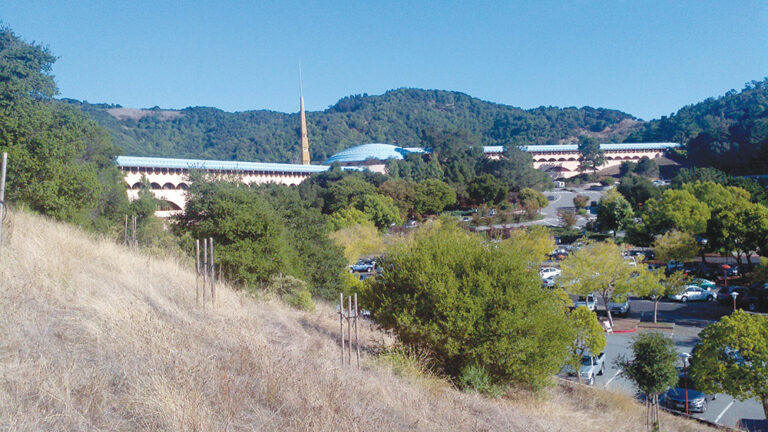
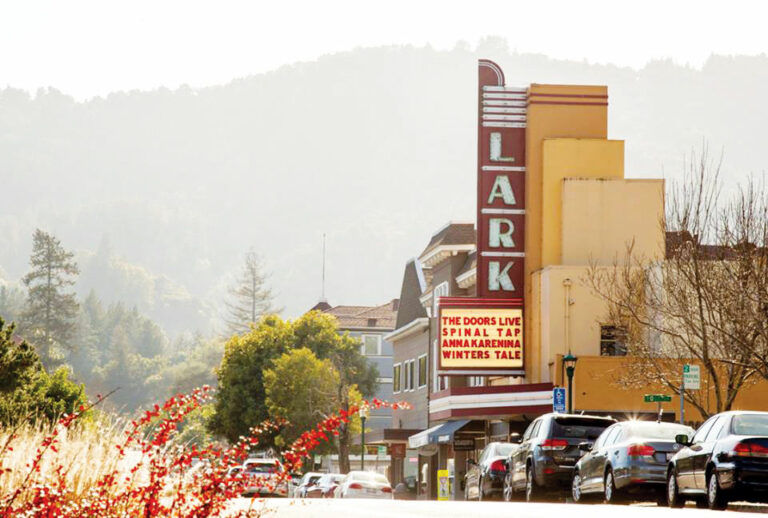
Nothing makes a pleasant village even more pleasant, than the marquee of a movie theater. The first light on in the evening and the last light to go dark, it’s a particularly fine sight on a summer night. The Arteco Lark Theater, a part of Larkspur for more than 80 years, is squeezed into a corner at the north end of the five-block-long stroll on Magnolia Avenue. It’s the kind of small neighborhood theater that’s gone extinct in most of the nation. It thrives here as a nonprofit, owned and operated by members, reopened 15 years ago this week.

The nearly 50-year-old Lark closed in the mid 1980s because of competition from home video and multiplexes. When it faced demolition in the early 1990s, Larkspur local Bernice Baeza organized an LLC to keep the then-closed theater from being gutted. The “Save the Lark” work continued after her unexpected death. Today, the Lark is still being renovated. Fundraising paid for a new HVAC system, and a parklet will soon open next to the theater so people can sun themselves before a show. This single-screen theater of less than 250 seats does everything: it has rotating movie programs, leases out the space for private parties and community functions and serves as a venue for high school classes. The Lark also runs a popular discount show: $5 plus a free small popcorn before 11am.

Matt Molloy, the Lark’s GM, worked at theaters from Los Angeles to Santa Cruz before he started at the Lark five years ago. Molloy meets with reps of other small, beautiful theaters at Utah’s Art House Convergence in January, held in advance of the Sundance Film Festival. Last year some 700 exhibitors and programmers met to discuss strategies to surviving the era of peak television. Molloy said that the community is essential for supporting these single-screen theaters. “The businesses here all help each other out,” he says.

Before the movie begins, there are advertisements for neighboring businesses—the Left Bank Brasserie, the Farm House Local and the Larkspur branch of Perry’s restaurant, operating in the site of the old Lark Creek Inn. In addition, Molloy notes, “We have the best volunteers around. The staff has very little turnover. The customers recognize the staff and vice versa.” Friends of the Lark come from as far away as Sacramento and Portland.

When digital cinema became a cost-effective replacement for 35mm film several years ago, small single-screens around the country had to dig deep to purchase the new technology. “Digital was the downfall for many theaters,” Molloy says, “but the Lark has been on a resurgence ever since.”

The stage lighting and sound system doesn’t eclipse the view of the screen or the gold-brocaded proscenium arch. Greek key pattern border the wine-colored walls. The current 4pm show is the independent documentary Be Natural: The Untold Story of Alice Guy-Blache. As narrated by Jodie Foster, it’s Pamela B. Green’s deeply researched account of a French pioneer of early cinema. Seeing this crowd-sourced film was enlightening enough. Seeing it in a crowd-sourced theater with decades of history behind it was where the real magic came in.

Seeing Is Believing

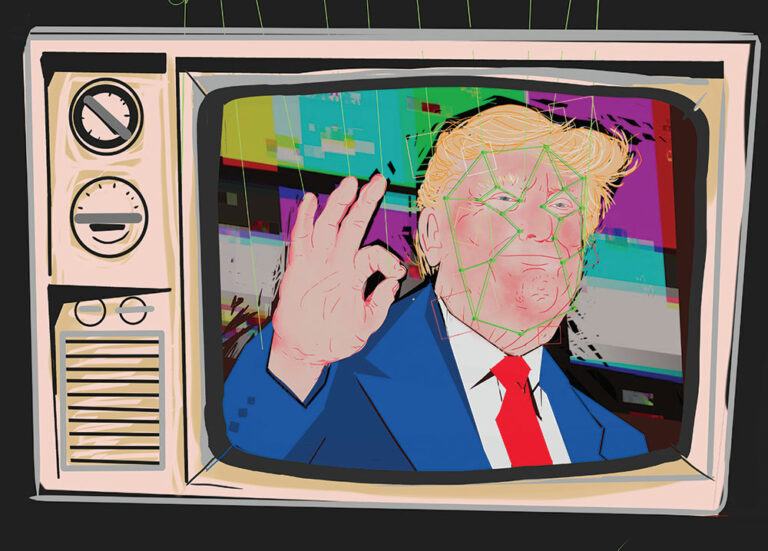
The future of misinformation is here. It reared its ugly head in May in the form of a doctored video of House Speaker Nancy Pelosi—manipulated to show her slurring her words, as if she were drunk. The trick was simple; the footage of Pelosi, speaking at a conference on May 22, was merely slowed down 25 percent. In the world of video editing, it’s child’s play.

The video went viral shortly after Pelosi said that Donald Trump’s family should stage an intervention with the president “for the good of the country.” The faked video surfaced on Facebook, where it was viewed more than 2 million times within a few hours. It was also shared by Trump lawyer and apologist Rudy Guiliani with a caption (since deleted) that read: “omg, is she drunk or having a stroke?” followed by “She’s drunk!!!”

The incident called to mind an even cruder video dust-up in 2018 involving footage of CNN reporter Jim Acosta, manipulated to give the impression that he had behaved aggressively against a White House intern at a press conference. The deceptive clip was actually released by press secretary Sarah Huckabee Sanders.

The country’s most powerful people lending their authority to objectively bogus video as a political weapon is enraging enough. But compared to what’s coming over the digital media horizon, the Acosta and Pelosi videos will soon look and feel as antique as a Buster Keaton short alongside Avengers: Endgame.

Cue Bachman-Turner Overdrive’s “You Ain’t Seen Nothin’ Yet.” Welcome to the Age of Deepfakes.

The term “deepfakes” is a portmanteau, a reference to artificial intelligence-assisted machine learning, a.k.a. “deep learning.” It’s an emerging technology that can potentially put the kind of highly realistic video and audio manipulation once only accessible to Hollywood in the hands of state intelligence agencies, corporations, hackers, pornographers or any 14-year-old with a decent laptop and a taste for trolling. In its most obvious application, a deepfake can create an utterly convincing video of any celebrity, politician or even any regular citizen doing or saying something that they never said or did. (For the record, the Pelosi video is not technically a deepfake; it is to deepfakes what a stick figure drawing would be to a high Renaissance painting).

The buzz about deepfakes has penetrated nearly every realm of the broader culture—media, academia, tech, national security, entertainment—and it’s not difficult to understand why. In the constant push-pull struggle between truth and lies, already a confounding problem of the Internet Age, deepfakes represent that point in the superhero movie when the cackling bad guy reveals his doomsday weapon to the thunderstruck masses.

“If 9/11 is a 10,” says former White House cybersecurity director Andrew Grotto, “and let’s say the Target Breach (a 2013 data breach at the retailer that affected 40 million credit card customers) is a 1, I would put this at about a 6 or 7.”

Deepfake videos present a fundamentally false version of real life. It’s a deception powerful enough to pass the human mind’s Turing test—a lie on steroids.

In many cases, it’s done for entertainment value and we’re all in on the joke. In Weird Al Yankovic’s face-swap masterpiece, “Perform This Way”—a parody of Lady Gaga’s “Born This Way”—nobody actually believes that Weird Al has the body of a female supermodel. No historian has to debunk the idea that Forrest Gump once met President John F. Kennedy.

But the technology has now advanced to the point where it can potentially be weaponized to inflict lasting damage on individuals, groups, and even economic and political systems. For generations, video and audio have enjoyed almost absolute credibility. Those days are coming to an abrupt and disorienting end. Whether it’s putting scandalous words into the mouth of a politician or creating a phony emergency or crisis just to sow chaos, the day is fast approaching when deepfakes could be used for exploitation, extortion, malicious attack or even terrorism.

For a small group of otherwise enormously privileged individuals, that day is already here. If you’re part of that tiny elite of female celebrities deemed sexually desirable on the Internet—think Emma Watson, Jennifer Lawrence, Gal Gadot—you wake up every morning knowing you’re a click or two away from seeing yourself in explicit porn in which you never participated. Scarlett Johansson is the most highly paid woman in Hollywood and one of the most famous people in the world. But with all that cultural power, she can’t stop fake porn that uses her image. “Trying to protect yourself from the internet and its depravity,” she told the Washington Post, “is basically a lost cause.”

Of course, creating fake videos that destroy another person’s reputation, whether it’s to exact revenge or ransom, is only the most individualized and small-scale nightmare of deepfakes. If you can destroy one person, why not whole groups or categories of people? Think of the effect of a convincing but completely fake video of an American soldier burning a Koran, or a cop choking an unarmed protester, or an undocumented immigrant killing an American citizen at the border. Real violence could follow fake violence. Think of a deepfake video that could cripple the financial markets, undermine the credibility of a free election, or impel an impetuous and ill-informed president to reach for the nuclear football.

Why now?

Ultimately, the story of deepfakes is a story of technology reaching a particular threshold. At least since the dawn of television, generations have grown up developing deeply sophisticated skill sets in interpreting audiovisual imagery. When you spend a lifetime looking at visual information on a screen, you get good at “reading” it, much like a lion “reads” the African savanna.

Discerning the real from the phony isn’t merely a vestige of the video age. It was a challenge even when the dominant media platform wasn’t the screen but the printed word. Psychologist Stephen Greenspan, author of the book Annals of Gullibility, says that the tensions between credulity and skepticism have been baked into the American experience from the very beginning.

“The first act of public education was in the Massachusetts Bay Colony, long before the country even existed,” said Greenspan whose new book Anatomy of Foolishness is due out in August. “The purpose of that act was to arm children against the blandishments and temptations of Satan. It was even called ‘The Old Deluder Act.’”

The advent of still photography, movies, television and digital media each in turn added a scary new dimension to the brain’s struggle to tell true from false. At one point, video technology was able to create realistic imagery out of whole cloth, but it quickly ran into a problem known as the “uncanny valley effect,” in which the closer technology got to reality, the more dissonant small differences would appear to a sophisticated viewer. Deepfakes, as they now exist, are still dealing with that specific problem, but the fear is that they will soon transcend the uncanny valley and be able to produce fake videos that are indistinguishable from reality.

“It would be a disaster,” Greenspan says of the specter of deepfakes, “especially if it’s used by unscrupulous political types. It’s definitely scary because it exploits our built-in tendencies toward gullibility.”

How they work

Deepfakes are the product of machine learning and artificial intelligence. The applications that create them work from dueling sets of algorithms known as generative adversarial networks, or GANS. Working from a giant database of video and still images, this technology pits two algorithms—one known as the “generator” and the other the “discriminator”—against each other.

Imagine two rival football coaches, or chess masters, developing increasingly complicated and sophisticated offensive and defensive schemes to answer each other. The GANS process works when the generator and discriminator learn from each other, creating a kind of technological “natural selection.” This evolutionary dynamic accelerates the means by which the algorithm can fool the human eye and ear.

In its current iteration, the software is still very data-intensive. The more images it has to work with, the more convincing the end product will be. That means hundreds, if not thousands of still images are needed to capture every subtlety of lighting, face angle, pose, expression and skin tone. When you’re face-swapping Steve Buscemi and Jennifer Lawrence for a laugh, those subtleties are not a big deal. When you’re trying to fool the brain, which is designed to detect the real from the imaginary, you’re playing on a much more demanding level of deception. (Even this hurdle may be fast becoming obsolete. Last month, in a scary development, it was reported that Samsung had developed an AI application that could create a deepfake from a single photo.)

Naturally, the entertainment industry has been on the forefront of this technology, and the current obsession with deepfakes might have begun with the release in December 2016 of Rogue One, the Star Wars spin-off that featured a CGI-created image of the late Carrie Fisher as a young Princess Leia. A year later, an anonymous Reddit user posted some deepfakes celebrity porn videos with a tool he created called FakeApp. Shortly after that, tech reporter Samantha Cole wrote a piece for Vice’s Motherboard blog on the phenomenon headlined “AI-assisted Fake Porn is Here and We’re all Fucked.” A couple of months later, comedian and filmmaker Jordan Peele created a video in which he put words in the mouth of former President Obama as a way to illustrate the incipient dangers of deepfakes. Reddit banned subreddits having to do with fake celebrity porn, and other platforms, including PornHub and Twitter, banned deepfakes as well. Since then, everyone from PBS to Samantha Bee has dutifully taken a turn in ringing the alarm bells to warn consumers (and, probably, to inspire mischief-makers).

The deepfakes panic had begun.

Freak Out?

Twenty years ago, the media universe—a Facebook-less, Twitter-less, YouTube-less media universe, we should add—bought into a tech-inspired doomsday narrative known as “Y2K,” which posited that the world’s computer systems would seize up, or otherwise go haywire in a number of unforeseen ways, the minute the clock turned over to Jan. 1, 2000. Y2K turned out to be a giant nothing-burger and now it’s merely a punchline for comically wrongheaded fears.

In this case, Y2K is worth remembering as an illustration of what can happen when the media pile on to a tech-apocalypse narrative. The echoing effects can overestimate a perceived threat and even create a monsters-under-the-bed problem. In the case of deepfakes, the media freak-out might also draw attention away from a more nuanced approach to a coming problem.

Riana Pfefferkorn is the associate director of surveillance and cybersecurity at Stanford’s Center for Internet and Society. She’s been at the forefront of what deepfakes will mean to the legal system. “I don’t think this is going to be as big and widespread thing as people fear it’s going to be,” she says. “But at the same time, there’s totally going to be stuff that none of us see coming.”

The ramifications of deepfakes showing up in the legal ecosystem are profound. Video and audio have been used in legal proceedings for decades, and the veracity of such evidence has rarely been challenged. “It’s a fairly low standard to get

admitted so far,” said Pfefferkorn. “One of the things I’m interested in exploring is whether deepfake videos will require changing the rules of evidence, because the threshold now is so low.”

But deepfakes won’t only have the potential to wreak havoc in the evidentiary stages of criminal and civil court. It could have effects in probate and securities law—to fake a will, for example, or to get away with fraud. Pfefferkorn is calling on the legal system to make its adjustments now, and she’s confident it will. “When (Adobe’s) Photoshop came out in the ’90s,” she said, “a lot of news stories then talked about the doctoring of photos and predicted the downfall of truth. The courts figured that out and adapted, and I think we’ll probably survive this one as well.”

What’s more troubling is the other side of the deepfakes conundrum—not that fake videos will be seen as real, but that real ones will be seen as fake. It’s a concept known as the “Liar’s Dividend,” a term championed by law professors Danielle Citron and Robert Chesney who’ve been the leading thinkers in academia on the deepfakes issue. “One of the dangers in a world where you can accuse anything of being fake is the things you can get people to disbelieve,” said Pfefferkorn. “If people are already in this suspicious mindset, they’re going to bring that with them in the jury box.”

Andrew Grotto is a research fellow at Stanford’s Hoover Institute and a research scholar at the Center for International Security and Cooperation, also at Stanford. Before that, he served as the senior director for cybersecurity policy at the White House in the Obama and Trump administrations. Grotto’s interest in deepfakes is in how they will affect the electoral process and political messaging.

Grotto has been to Capitol Hill and to Sacramento to talk to federal and state lawmakers about the threats posed by deepfakes. Most of the legislators he talked to had never heard of deepfakes and were alarmed at what it meant for their electoral prospects.

“I told them, ‘Do you want to live and operate in a world where your opponents can literally put words in your mouth?’ And I argued that they as candidates and leaders of their parties ought to be thinking about whether there’s some common interest to develop some kind of norm of restraint.”

Grotto couches his hope that deepfakes will not have a large influence on electoral politics in the language of the Cold War. “There’s almost a mutually-assured-destruction logic to this,” he says, applying a term used to explain why the U.S. and the Soviet Union didn’t start a nuclear war against each other. In other words, neither side will use such a powerful political weapon because they’ll be petrified it will then be used against them. Such a notion seems out of tune in the Trump Era. And political parties don’t have to use deepfake videos in campaigns when there are countless partisan sources, many of them sketchy, who will do it for them.

One of the politicians that Grotto impressed in Sacramento was Democrat Marc Berman, who represents California’s 24th District (which includes Palo Alto and the southern half of the Peninsula) in the state assembly. Berman chairs the Assembly’s Elections and Redistricting Committee, and he’s authored a bill that would criminalize the creation or the distribution of any video or audio recording that is “likely to deceive any person who views the recording” or that is likely to “defame, slander or embarrass the subject of the recording.” The new law would create exceptions for satire, parody or anything that is clearly labeled as fake. The bill (AB 602) is set to leave the judiciary committee and reach the Assembly floor this month.

“I tell you, people have brought up First Amendment concerns,” Berman says over the phone. “It’s been 11 years since I graduated law school, but I don’t recall freedom of speech meaning you are free to put your speech in my mouth.”

The Electronic Frontier Foundation, which for almost three decades has fought government regulation in the name of internet civil liberties, is pushing back against any legislative efforts to deal with deepfakes. In a media statement, the EFF conceded that deepfakes could create mischief and chaos, but contended that existing laws pertaining to extortion, harassment and defamation are up to the task of protecting people from the worst effects.

Berman, however, is having none of that argument: “Rather than being reactive, like during the 2016 [presidential] campaign when nefarious actors did a lot of bad things using social media that we didn’t anticipate—and only now are we reacting to it—let’s try to anticipate what they’re going to do and get ahead of it.”

Good & Evil

Are there potentially positive uses for deepfake technology? In the United States of Entertainment, the horizons are boundless, not only for all future Weird Al videos and Star Wars sequels, but for entirely new genres of art yet to be born. Who could doubt that Hollywood’s CGI revolution will continue to evolve in dazzling new directions? Maybe there’s another Marlon Brando movie or Prince video in our collective future.

The Electronic Frontier Foundation touts something called “consensual vanity or novelty pornography.” Deepfakes might allow people to change their physical appearances online as way of identity protection. There could be therapeutic benefits for survivors of sexual abuse or PTSD to have video conferencing therapy without showing their faces. Some have speculated on educational uses—creating videos of, say, Abraham Lincoln reading his Gettysburg Address and then regaling Ms. Periwinkle’s fifth-grade class with stories from his youth.

Stanford’s Grotto envisions a kind of “benign deception” application that would allow a campaigning politician to essentially be in more than one place at a time, as well as benefits in get-out-the-vote campaigns.

But here at the top of the roller coaster, the potential downsides look much more vivid and prominent than any speculative positive effect. Deepfakes could add a wrinkle of complication into a variety of legitimate pursuits. For example, in the realm of journalism, imagine how the need to verify some piece of video or audio could slow down or stymie a big investigation. Think of what deepfakes could do on the dating scene, in which online dating is already consumed with all levels of fakeness. Do video games, virtual reality apps and other online participatory worlds need to be any more beguiling? Put me in a virtual cocktail party with my favorite artists and celebrities, and I’ll be ready to hook up the catheter and the IV drip to stay in that world for as long as possible.

If the Internet Age has taught us anything, it’s that trolls are inevitable, even indomitable. The last two decades have given us a dispiriting range of scourges, from Alex Jones to revenge porn. Trolling has even proven to be a winning strategy to win the White House.

“Let’s keep walking down the malign path here,” said former White House cybersecurity chief Grotto from his Stanford office, speculating on how deep the wormhole could go. Grotto brings up the specter of what he calls “deepfake for text.” He says it’s inevitable that soon there will be AI-powered chatbots programmed to rile up, radicalize and recruit humans to extremist causes.

“People watch videos, sure,” Grotto says. “But mostly what really gets people over the edge is chatting with someone who is trying to make the case for them to join the cause. Instead of passively watching YouTube or exchanging messages on Facebook, you now have the ability to create a persona to sit in front of somebody for hours and try to persuade them of this or that.”

What now?

In addressing the threat of deepfakes, most security experts and technologists agree that there is no vaccine or silver bullet. Watermarking technology could be inserted into the metadata of audio and video material. Even in the absence of legislation, app stores would probably require such watermarking be included on any deepfake app. But how long would it be before someone figured out a way to fake the watermark? There’s some speculation that celebrities and politicians might opt for 24/7 “lifelogging,” digital auto-surveillance of their every move to give them an alibi against any fake video.

Deepfakes are still in the crude stages of development. “It’s still hard to make it work,” Grotto says. “The tools aren’t to the point where someone can just sit down without a ton of experience and make something” convincing.

He said the 2020 presidential election may be plagued by many things, but deepfakes probably won’t be one of them. After that, though? “By 2022, 2024, that’s when the tools get better. That’s when the barriers to entry really start to drop.”

This moment, he says, isn’t a time to panic. It’s a time to develop policies and norms to contain the worst excesses of the technology, all while we’re still at the top of the roller coaster. Grotto says convincing politicians and their parties to resist the technology, developing legal and voluntary measures for platforms and developers, and labeling and enforcing rules will all have positive effects in slowing down the slide into deepfake hell.

“I think we have a few years to get our heads around it and decide what kind of world we want to live in, and what the right set of policy interventions look like,” he says. “But talk to me in five years, and maybe my hair will be on fire.”

Horoscope

ARIES (March 21-April 19): When the universe began 13.8 billion years ago, there were only four elements: mostly hydrogen and helium, plus tiny amounts of lithium and beryllium. Now there are 118 elements, including five that are key components of your body: oxygen, carbon, nitrogen, calcium and phosphorus. All of those were created by nuclear reactions blazing on the insides of stars that later died. So it’s literally true to say that much of your flesh and blood and bones and nerves originated at the hearts of stars. I invite you to meditate on that amazing fact. It’s a favorable time to muse on your origins and your ancestry; to ruminate about all the events that led to you being here today—including more recent decades, as well as the past 13.8 billion years.

TAURUS (April 20-May 20): Most American women couldn’t vote until a hundred years ago. Women in Japan, France, and Italy couldn’t vote until the 1940s. Universal suffrage has been a fundamental change in how society is structured. Similarly, same-sex marriage was opposed by vast majorities in most countries until 15 years ago, but has since become widely accepted. African American slavery lasted for hundreds of years before being delegitimized all over the Western world in the nineteenth century. Brazil, which hosted forty percent of all kidnapped Africans, didn’t free its slaves until 1888. What would be the equivalent of such revolutionary transformations in your own personal life? According to my reading of the astrological omens, you have the power to make them happen during the next 12 months.

GEMINI (May 21-June 20): Gemini musician Paul Weller is famous in the U.K., though not so much elsewhere. According to the BBC, he is one of Britain’s “most revered music writers and performers.” To which I say: revered, maybe, but mentally healthy? Not so much. He bragged that he broke up his marriage with his wife Dee C. Lee because “things were going too well, we were too happy, too comfortable, everything seemed too nice.” He was afraid that “as a writer and an artist I might lose my edge.” Don’t you dare allow yourself to get infected with that perverse way of thinking, my dear Gemini. Please capitalize on your current comfort and happiness. Use them to build your strength and resilience for the months and years to come.

CANCER (June 21-July 22): Cancerian voice actor Tom Kenny has played the roles of over 1,500 cartoon characters, including SpongeBob SquarePants, Spyro the Dragon, Jake Spidermonkey, Commander Peepers, and Doctor Octopus. I propose that we make him your role model in the coming weeks. It will be a favorable time for you to show your versatility; to demonstrate how multifaceted you can be; to express various sides of your soulful personality.

LEO (July 23-Aug. 22): Leo author Donald Miller reminds us that fear can have two very different purposes. On the one hand, it may be “a guide to keep us safe,” alerting us to situations that could be dangerous or abusive. On the other hand, fear may work as “a manipulative emotion that can trick us into living a boring life.” After studying your astrological indicators for the coming weeks, Leo, I’ve come to the conclusion that fear may serve both of those functions for you. Your challenge will be to discern between them; to know which situations are genuinely risky and which situations are daunting, but promising. Here’s a hint that might help: trust your gut feelings more than your swirling fantasies.

VIRGO (Aug. 23-Sept. 22): Why do flocks of geese fly in a V-formation? Because to do so enhances the collective efficiency of their travel. Each bird generates a current that supports the bird behind it. Let’s make this phenomenon one of your power metaphors for the coming weeks. What would be the equivalent strategy for you and your tribe or group as you seek to make your collaborative efforts more dynamic and productive? Unforeseen help will augment any actions you take in this regard.

LIBRA (Sept. 23-Oct. 22): “A conversation is a dialogue, not a monologue,” mused Libra author Truman Capote. “That’s why there are so few good conversations: due to scarcity, two intelligent talkers seldom meet.” That cynical formulation has more than a few grains of truth in it, I must admit. But I’m pleased to tell you that I suspect your experience in the coming weeks will be an exception to Capote’s rule. I think you have the potential to embark on a virtual binge of rich discussion and intriguing interplay with people who stimulate and educate and entertain you. Rise to the challenge!

SCORPIO (Oct. 23-Nov. 21): In accordance with astrological rhythms, you are authorized to make the following declarations in the next two weeks: 1. “I refuse to participate further in this situation on the grounds that it might impinge on the expansiveness of my imagination.” 2. “I abstain from dealing with your skepticism on the grounds that doing so might discourage the flights of my imagination.” 3. “I reject these ideas, theories, and beliefs on the grounds that they might pinch, squash, or deflate my imagination.” What I’m trying to tell you, Scorpio, is that it’s crucial for you to emancipate your imagination and authorize it to play uninhibitedly in the frontiers of possibilities.

SAGITTARIUS (Nov. 22-Dec. 21): Dear Sagittarius: I invite you to make a copy of the testimonial below and give it to anyone who’s in a position to support your Noble Experiment. “To Whom It May Concern: I endorse this Soulful Sagittarius for the roles of monster-tamer, fun-locator, boredom-transcender, elation-inciter, and mountaintop visionary. This adroit explorer is endowed with charming zeal, disarming candor, and abundant generosity. If you need help in sparking your enthusiasm or galvanizing your drive to see the big picture, call on the expansive skills of this jaunty puzzle-solver.”

CAPRICORN (Dec. 22-Jan. 19): Life will conspire to bring you a surge of love in the coming weeks—if you can handle it. Can you? Will you be able to deal adeptly with rumbling love and icy-hot love and mostly sweet, but also-a-bit-sour love? Do you possess the resourcefulness and curiosity necessary to have fun with funny, spiritual love and running-through-the-labyrinth love and unexpectedly catalytic love? Are you open-minded and open-hearted enough to make the most of brilliant, shadowy love and unruly, sensitive love and toughly graceful love?

AQUARIUS (Jan. 20-Feb. 18): I don’t endlessly champion the “no pain, no gain” theory of personal growth. My philosophy holds that we are at least as likely to learn valuable lessons from pleasurable and joyful experiences as we are from difficult and taxing struggles. Having said that, I also think it’s true that our suffering may lead us to treasure if we know how to work with it. According to my assessment, the coming weeks will bring one such opening for you. To help you cultivate the proper spirit, keep in mind the teaching of Aquarian theologian and author Henri Nouwen. He said that life’s gifts may be “hidden in the places that hurt most.”

PISCES (Feb. 19-March 20): The Japanese word “wabi-sabi” refers to an interesting or evocative imperfection in a work of art that makes it more beautiful than if it were merely perfect. “Duende” is a Spanish word referring to a work of art that gives its viewers the chills because it’s so emotionally rich and unpredictably soulful. In the coming weeks, I think that you yourself will be a work of art with an abundance of these qualities. Your wabi-sabi will give you the power to free yourself from the oppressive pressures of seeking too much precision and purity. Your duende can give you the courage you need to go further than you’ve ever dared in your quest for the love you really want.

Advice Goddess

Q: I’m a married lesbian working on having another baby with my fab wife. My new best friend is an attractive straight girl who lives in another state. We talk and text every day. It isn’t sexual or romantic at all, but my friend gets me in a way that, I’m sorry to say, my wife does not. My wife seems jealous. I’ve noticed her moping around when I’m on the phone and sometimes rolling her eyes when I’m laughing with my friend. How can I reassure her without giving up my new friend?—Concerned

A: Spouses can’t meet each other’s every need—and shouldn’t be expected to. Like, if you’re doubled over in pain, you don’t just hand your wife some dishwashing gloves and a knife and be all, “Kitchen-floor appendectomy, babe?”

Still, it makes sense that your wife is getting all green monster-y. Human emotions, including jealousy, are a tool chest for solving the mating and survival problems that have kept popping up throughout human history.

Jealousy is a guard-dog emotion, rising up automatically when we sense that our partnership might be threatened. Research by evolutionary psychologist David Buss finds that our jealousy, in turn, triggers mate-retention behaviors, such as going around all hangdog mopeypants to try to guilt our partner into spending less time with their sparkly new friend.

Now, it seems like you could just reason with your wife: “Come on…my friend’s fiercely hetero, she lives in another state and I’m having another baby with you.” However, though we each have the ability to reason, reasoning takes effort, while emotion comes up automatically, without mental elbow grease. So it turns out that emotion does a lot of our decision-making, and then we dress it up as reason after the fact.

Your best bet is be extra loving to your wife—basically to lovey-dovey her off the ledge. Psychologist Brooke C. Feeney’s research on the “dependency paradox” finds that the more an insecure partner feels they can count on their partner for love and comforting the less fearful and clingy they tend to be.

In other words, you should consistently go a little overboard in showing affection, like by sending your wife frequent random texts (“in supermarket & thinking about how much i love u”), caressing her face, doing little sweet things. Basically, stop just short of boring her to death with how much you love her.

Q: My male neighbor was married to a wonderful woman for 15 years. She died, and he was grieving heavily for several months, telling my husband and me she was the love of his life and he didn’t “know how to do life” without her, etc. Well, six months later, he was dating, and in less than a year, he’s engaged to somebody new! I’m beginning to wonder if all his “I’m so grief-stricken” was just for show.—Irate

A: The way you see it, he went through some Stages of Grief: 1) Wow, this is terrible and life-shattering. 2) Boobs!

However, it isn’t surprising that you’re “irate” at what you perceive to be a suspiciously speedy recovery. Evolutionary psychologist Bo Winegard and his colleagues believe grief evolved to be, among other things, a form of advertising. “Prolonged and costly” grief signals a person’s “propensity” to develop deep emotional attachments to others. This, in turn, suggests they can be trusted as a friend, colleague, or romantic partner.

The reality is, there are individual differences in how people respond to loss that don’t always square with widely held beliefs about how grief is “supposed” to work. These beliefs, explains grief researcher George Bonanno, “tend to create rigid parameters for ‘proper’ behavior that do not match what most people go through.” They end up fostering doubt and suspicion about what’s actually successful coping.

Understanding this, maybe you can try to be happy for the guy and support him in his new relationship. Don’t assume that his finding new love means he’s forgotten his late wife or no longer misses her.

Rough Terrain

0

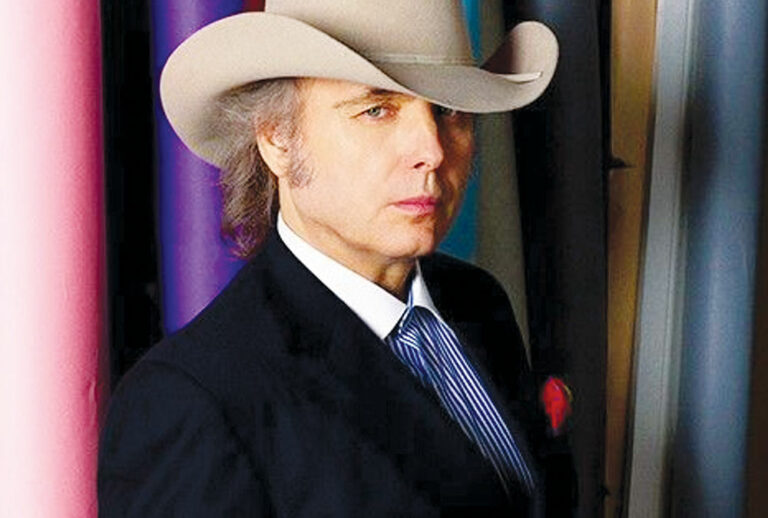
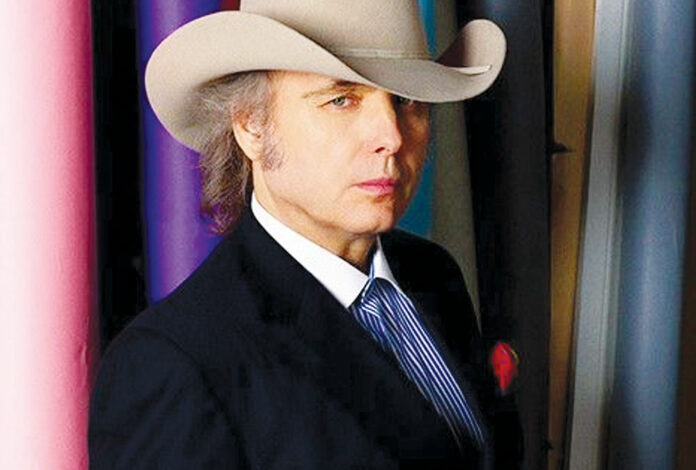
Dwight Yoakam launched a life in music at precisely the wrong time. But over the ensuing decades, he helped bend country music—or at least a significant part of it—in the direction he pursued. For his efforts, he became a commercially successful and critically acclaimed artist, winning two Grammys and awards from each of the three largest organizations in the genre.

Kentucky-born Yoakam hit Nashville intent on furthering his career. But at the time, the prevailing style in country music focused on the kind of slick pop exemplified by the 1980 film Urban Cowboy. Yoakam’s own music drew more from harder-edged honky-tonk country. Frustrated with Nashville, he moved on to Los Angeles. There, thanks in part to his commitment to rough-hewn authentic country, he fell in with the rockabilly and punk scenes where his music was appreciated for its unvarnished authenticity.

Without the backing of a label, Yoakam managed to independently finance his debut EP, Guitars, Cadillacs, Etc., Etc. Reprise soon offered him a contract and released an expanded version of the record in 1986. Sailing against the prevailing winds of country-pop, the album soared to Billboard‘s No. 1 spot.

Having established there was a market for his brand of country, Yoakam continued to tour and release albums. Both Hillbilly Deluxe (1987) and 1988’s Buenas Noches from a Lonely Room reached the top spot on the country album charts; they also fared reasonably well on the mainstream chart, showing that the singer-guitarist’s appeal extended beyond country.

Yoakam’s first two albums of the ’90s continued his platinum-selling streak, and his collaborations were equally well-regarded; Yoakam worked with Patty Loveless, Buck Owens, Ralph Stanley, John Prine and others.

In retrospect, Yoakam’s career seems linear and consistent; unlike many artists, he never really suffered a creative slump nor a fall from commercial favor. Instead, he continued to pursue his own musical vision, building and maintaining a solid fan base.

In between touring and recording commitments, Yoakam cultivated an acting career; his most recent notable role was as a character on Billy Bob Thornton’s Goliath television series. Yoakam also holds the distinction of being the most frequent musical guest in the history of The Tonight Show. His 2016 album Swimmin’ Pools, Movie Stars… was a bluegrass-tinged release, but two subsequent non-album tracks (“Then Here Came Monday” and “Pretty Horses,” both released last year) found Yoakam returning to his inimitable honky-tonk style.

Dwight Yoakam performs a sold-out show at the Marin County Fair on Wednesday, Jul 3, at Marin Fairgrounds, 10 Avenue of the Flags, San Rafael. 7:30pm. marinfair.org.

We’re Not So Bad

These days some people have a hard time recognizing anything good about our country. But the truth about the U.S. is complicated. Granted, the Trump years have brought us low, but for anyone coming from the global south, the U.S. still looks like paradise—at least, initially. Rule of law, due process, opportunity, democracy, as much as these have been diminished of late, they’re still there, battered but breathing. In raising public awareness of all that is wrong in the U.S., we’ve been discounting all that’s right.

Ron Lowe

Nevada City

Reform Prop. 13

Well-timed to accompany the election to defeat Trump in November of next year, an initiative to “adjust” Proposition 13 in the form of a “split roll” tax will also be on the ballot.

A split roll tax enables commercial and residential properties to be valued, assessed, and taxed differently. In the campaign there will be almost as much B.S. produced to confuse and irritate voters as in the presidential version.

We will read desperate claims by the California Chamber of Commerce and others who will say another $11 billion or so of taxes on businesses will kill economic growth in the state for centuries.

On the other side, the unions, including the California Teachers Association, Mark Zuckerberg and many community groups will claim that the initiative will promote greater fairness in the tax system and reasonably benefit the schools and other precious causes.

Governor Newsom will stay out of the battle for now until he sees which way the wind’s blowing, and will get away with that by telling us that any adjustment to Prop. 13, passed by 65 percent of voters in 1978, should be part of a general tax reform program.

No matter how you feel about Prop. 13, which took away many reasonable ways for municipalities to tax our citizens but not all of them, it’s going to be tested, as it should be.

What would be nice, and what will never happen in this state, is for all the interest groups involved, and our beloved and pretty useless state elected officials, to sit down now and once and for all hammer out a tax reform program that’s fair and equitable for all Californians, businesses and individuals, which, in part because of Prop. 13, we don’t presently have.

It won’t happen because democracy doesn’t work in this state, nor in this country, at this time.

We know this because people such Nancy Pelosi, Dianne Feinstein, Donald Trump, Mitch McConnell, and Brett Kavanaugh are in positions of power.

In a real-world, functioning democracy, these five people aren’t causing us any trouble. They’re working retail with me.

Craig J. Corsini

San Rafael

Hero & Zero

Hero

Farewell to fines at the Marin County Free Library (MCFL). Beginning July 1, the libraries go fine-free to entice residents to come on in to check out books, DVDs, audiobooks and more.

The 25 cents per day late fee created a barrier to library access and drove borrowers away, especially those on low or fixed incomes. “Everyone should have equal access to our materials regardless of their financial status or any other factor,” says MCFL Director Sara Jones.

Without the fear of fines, folks visit the library more often, the use of borrowed materials increases and customer satisfaction rises.

What about the funds raised by the fines? Turns out it’s negligible—less than half a percent of the MCFL budget. “In fact, it costs the library more in staff time to collect and account for the fees than the fees generate,” Jones said. “That saved staff time can be devoted to more patron services.”

If you owe fines, the slate will be wiped clean on July 1, just in time to catch up on your summer reading.


Zero

Marinites flip out about Trump supporters, but should they flip them off?

A caravan of about a dozen cars motored together for four miles in Novato last week to kick off Trump’s 2020 reelection campaign. Their cars, decorated with Trump-Pence signage and American flags, attracted attention from others traveling on 101. That’s when middle fingers began extending out of the windows of vehicles passing by the procession.

We’re not fans of the man, but we defend the right of his supporters to demonstrate in Marin. We also believe that people have the right to make obscene gestures to his followers; however, why bother going low?

If we want to get into a tizzy about Trump, we should keep our fingers to ourselves and volunteer in the swing states where our voice may make a difference.


email: ni***************@***oo.com


Hero & Zero

Hero

Farewell to fines at the Marin County Free Library (MCFL). Beginning July 1, the libraries go fine-free to entice residents to come on in to check out books, DVDs, audiobooks and more.

The 25 cents per day late fee created a barrier to library access and drove borrowers away, especially those on low or fixed incomes. “Everyone should have equal access to our materials regardless of their financial status or any other factor,” says MCFL Director Sara Jones.

Without the fear of fines, folks visit the library more often, the use of borrowed materials increases and customer satisfaction rises.

What about the funds raised by the fines? Turns out it’s negligible—less than half a percent of the MCFL budget. “In fact, it costs the library more in staff time to collect and account for the fees than the fees generate,” Jones said. “That saved staff time can be devoted to more patron services.”

If you owe fines, the slate will be wiped clean on July 1, just in time to catch up on your summer reading.


Zero

Marinites flip out about Trump supporters, but should they flip them off?

A caravan of about a dozen cars motored together for four miles in Novato last week to kick off Trump’s 2020 reelection campaign. Their cars, decorated with Trump-Pence signage and American flags, attracted attention from others traveling on 101. That’s when middle fingers began extending out of the windows of vehicles passing by the procession.

We’re not fans of the man, but we defend the right of his supporters to demonstrate in Marin. We also believe that people have the right to make obscene gestures to his followers; however, why bother going low?

If we want to get into a tizzy about Trump, we should keep our fingers to ourselves and volunteer in the swing states where our voice may make a difference.


email: ni***************@***oo.com


One 4 All

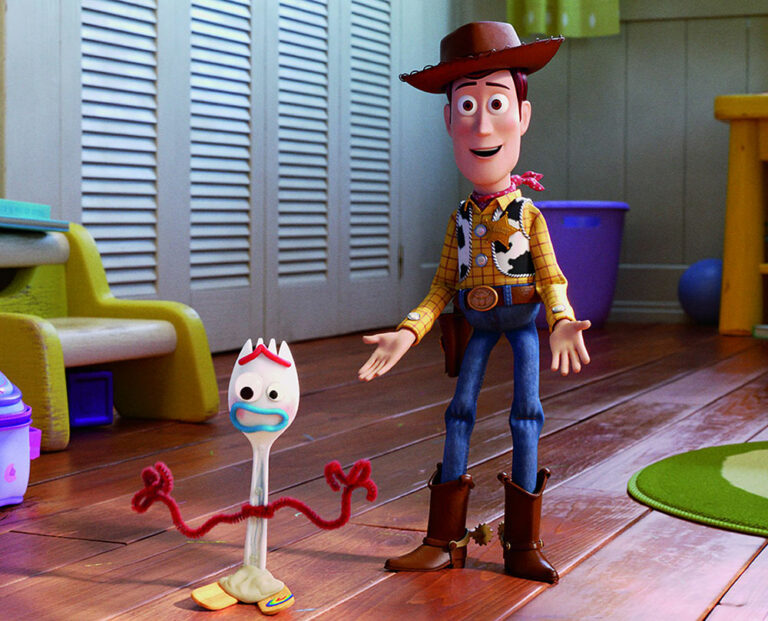
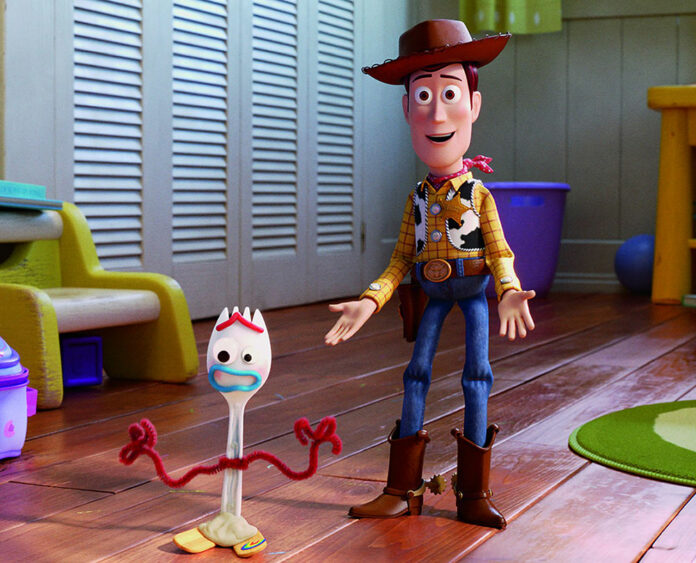
Nobody today knows how to drill into childhood trauma like Pixar, to find the nerves connected to an empty-nest parent’s anxieties, or to the fearfulness of being a child. There are scenes in Toy Story 4 that really sting, such as the observation of a little girl, weeping in misery in her first day in kindergarten.

The series took the example of Margery Williams’ 1922 The Velveteen Rabbit. It’s a kids’ book, as popular as it is dire, about the suffering of a stuffed bunny and its ultimate resurrection. In four installments, Pixar played with the ideas in that depressing book, satirizing the uncanniness of walking, talking toys. Here, debuting director Josh Cooley balances the ebullient humor of the toybox with the story’s essential tragedy.

This time around, the men will get it in the brisket harder than the women. In this installment, Cowboy Woody (voiced by Tom Hanks) is going through it. His porcelain pal Bo Peep (Annie Potts) gets Kondo-ized, shoved into a cardboard box and given away. And his new person, 5-year-old Bonnie, isn’t very interested in him. Obsolete and relegated to the dusty closet, Woody salves his dignity by protecting a tenderfoot toy Bonnie made out of a plastic spork, with pipe cleaner arms and googly eyes. Forky (Tony Hale), who longs to return to the garbage from which he was repurposed, is a flight risk. During a family RV vacation, he gets loose.

Woody tracks the fugitive to a tourist town antique store; a fortress run by a damaged 1950s baby doll called Gabby Gabby (a remarkable performance of neurosis and loneliness voiced by Christina Hendricks). This queen bee is protected by a mute goon squad of ventriloquist dummies; scary, but scary in a good way, that thrilling way that makes the best Disney cartoons sing.

Stalemated, Woody encounters a guerrilla band of freed toys living in the wilderness of a city park. They’re led by an old friend, now a wild woman with the skills of a general. Learning to take orders from her is part of Woody’s dilemma. This is not at all the kind of movie that grouses about a world in which women hold half the power. However, it treats the fears of males losing their traditional position of authority with sensitivity.

You can wring a sigh out of any former child, thinking about that loved toy they carelessly left in the park so many years ago, never to be seen again. It’s not always the big traumas that mark us, but the tiny death of a thousand cut losses. So, it’s a sweet thought to consider such toys as not lost, but free, getting up to lives of their own and seeing new horizons. A soaring moment has Woody taken up to the top of the antique store to have a look at the bright lights. He’s dazzled, after having once considered a mere nursery lamp his own personal lodestar. It’s all the opposite of the waiting in hope that the toys did in The Velveteen Rabbit, suffering until they were finally immolated.

The colors are, as always with Pixar, a delight. The evocative, busy small town background is stuffed with visitors and lit up by a carnival passing through. It’s all the more fun because Bonnie isn’t enraptured by it, she’s caught in her own personal kid business. Toy Story 4 has the look of summer in the western states: The painted beauty never gets in the way of the story.

Today’s movies aren’t built half as well as these cartoons, with their Hans Christian Anderson terrors and brash humor. There’s a lot of laughter in this series, such as the toys pranking the suburban dad like leprechauns in order to buy time for Woody’s mission of rescue. And, there’s one uproarious Looney Tunes-worthy sequence of a pair of fluffy-yet-shady carnival stuffed critters plotting to mug a sweet little old lady. (They call their plan “The Plush Rush.”) The engineering of fright, laughter, chases, and sweet relief here is just about classic.

‘Toy Story 4’ is playing in wide release.

Cruiser Control

1

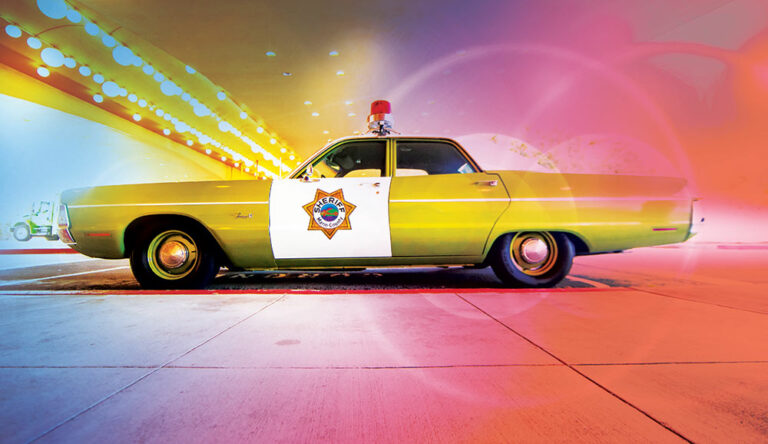
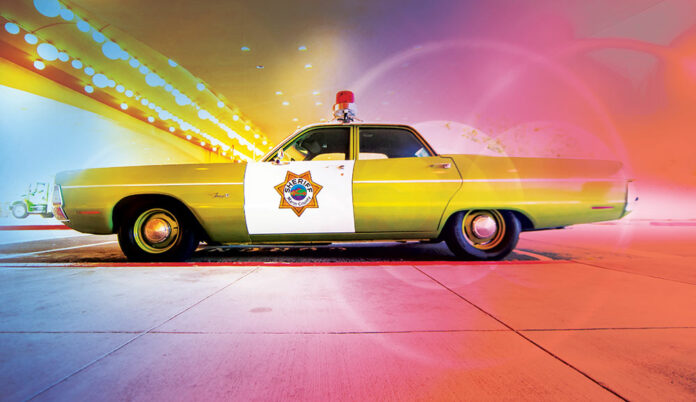
It’s a busy Saturday morning at the San Quentin Rifle Range as members from law enforcement agencies around Marin County receive instructions in use-of-force and weapons training. The facility is owned by San Quentin State Prison, but is used by the Marin County Sheriff’s Office (MCSO) and other local agencies. Officers gather in a training room filled with gear and safety-first posters and postings. There they load their weapons with live ammunition, strap on noise-canceling headphones and head for the range down the hall.

Now two uniformed MCSO officers stand in the open firing range while an instructor in a bright red shirt barks commands at them. The range is reminiscent of the inside of a parking garage—a vast expanse of sloping concrete that looks like an elongated auto ramp. Numerous bad-guy targets are set up for the police officers.

Officers are required to receive ongoing training in use-of-force protocols and today’s instructions focus on encounters with two suspects—one with a knife, the other with a gun. With the trainer behind them, the officers stand side by side and fire their service Glocks at the target, re-load and do it again. Shell casings hit the cement floor with a clattering sound. Like so many real-time encounters on the streets, the entire exercise is all over in a few short minutes.

The training is nothing new but what is new is a proposed state law, AB 392, that sets out to reframe use-of-force parameters for California peace officers. It’s a controversial bill largely driven by the 2017 police shooting of Stephon Clark in Sacramento. Clark was shot and killed by police officers who reportedly mistook his cellphone for a weapon. The officers were cleared in a shooting that prompted months of protest in the capital city that led to the introduction of AB 392 last year.

At the center of the debate over use-of-force protocols in Sacramento is Marin County Sheriff Robert Doyle. In his 50 years as a Marin County sheriff, Doyle’s seen everything from the 1970 Marin County Courthouse shootout to the Marin County floods of 2018.

The Pacific Sun recently sat down with Doyle at his office in San Rafael to talk about AB 392 and other bills that have emerged from Sacramento in recent years, and to take the pulse of the MCSO. He’s on the legislative committee of the California State Sheriff’s Association and as such is directly involved in negotiations over the bill.

“There’s two things that you don’t want to see being made,” Doyle says. “Sausage and laws.” The Clark shooting and its aftermath, he says, are evidence of what he calls a “clamor in Sacramento to write laws” whenever there’s a police-related incident that raises questions about use-of-force policies.

Of the Clark shooting he says, “there were a lot of factors in that shooting that provide it was a justified shooting—but legislators don’t seem to care about it.”

He describes a Democratic supermajority in Sacramento as not being anti-police, but as being immediately opposed to any bills that come before it that are designed to enhance or reinforce law enforcement in the state. “I think you are seeing the legislature doing things that affect law enforcement negatively,” he says. “I don’t want to bash all of the legislators, but it’s interesting that they have a lower approval rating even than our very unpopular president.”

The basic controversy over AB 392 centers on the distinction between use-of-force that’s “reasonable” versus what is “necessary.” In the Clark shooting, the suspect was hit with seven bullets, killing him.

But Doyle says it was, as originally proposed, a “terrible bill because it defined what ‘necessary’ was.” To law enforcement officers, it meant that “unless you are under fire, you can’t use lethal force”—a standard that’s unreasonable from the perspective of law enforcement, Doyle says. “The peace officer is a human being out there risking his or her life every day,” he says. “Other people are counting on him or her to protect them. It was a terrible piece of legislation.”

That’s when Gov. Gavin Newsom got involved. Doyle credits the governor for stepping in to try and make it a better bill for law enforcement. Plus, he says, “I don’t think there were the votes to pass it as written.” In the end, the law enforcement lobby headed by Doyle didn’t support it but also “sort of agreed to not oppose 392 because it would just come about again.”

He says it’s now a bill law enforcement can live with. The sheriff’s lobby hasn’t endorsed it or opposed it. Though the bill was prompted by the Clark shooting, there hasn’t been a high-profile use-of-force case in the state since the shooting occurred in 2018. “The governor’s staff made a great point,” Doyle notes. “There’s no controversial issue out there right now—this is a perfect time to resolve this.” The bill is now less focused on interpreting the definition of “necessary force” and when it’s allowed to be used. It passed the Senate committee on public safety on June 18 with a 6-0 vote.

Doyle’s seen use-of-force standards evolve over his half-century with the MCSO. “The standard has changed,” he observes. “A lot of things have changed, but years ago the standard was totally different.” The old standard was pretty cut-and-dry: If an officer didn’t see something that might be construed a threat to his or others’ safety, the officer couldn’t use lethal force. Then, as Doyle recalls, the courts started to get involved in use-of-force cases and started to look at the state of mind of the police officer at the time of the shooting, among other factors. Beginning roughly in the 1980s, the use-of-force standard started to “favor” law enforcement. Even if lethal force was found to be unnecessary under the circumstances, the officers had a reasonable expectation that it was necessary at the time of the incident.

In the Clark case, for example, even though the suspect was carrying a cellphone and not a gun, the perspective of the officers—and the conclusion of subsequent investigations into the shooting—was they believed he was, and the shooting was therefore reasonable even if it wasn’t necessary.

One problem amplified by the Clark case is the public perception, based largely on citizen-posted videos that weren’t a phenomenon until recently, that there’s been a big increase in police shootings in recent years. Doyle makes this point. Organizations such as Black Lives Matter highlight controversial police shootings as being the tip of an iceberg of police force-instigated injustices targeting non-white citizens.

“But if you look at the statistics,” says Doyle, “there aren’t as many police shootings as some of these groups would like the public to believe, and especially of unarmed people and of people of color.” He further notes that when it comes to murders, most occur between members of the same race. “Most crimes like that are white on white or black on black,” he says. “Of course there are egregious examples, and of course there are bad shootings. The problem is that everyone these days paints everything with a broad stroke.”

The debate over 392 comes at what might be considered an inflection point in law enforcement in California. Last year the legislature passed AB 1421, a transparency bill that unwound California’s long-standing status as having the most restrictive public access laws in the nation when it came to peace officers’ personnel records and records of complaints against officers. As a whole, the law enforcement community in California was opposed to 1421, as was Doyle, who says his position was that he didn’t believe “complaints that weren’t sustained should be made public. It’s unfair to the officer or the deputy.” His department, he says, has seen an uptick in records’ request since AB 1421; one such request has yielded the full investigative report of Marin General Hospital incident that ended with the death of a mentally-ill suspect. All officers involved in that tragedy were cleared of wrongdoing.

Doyle he also sees some value to AB 1421, or the transparency it does provide the public, at least when it comes to public perception of agencies and their disciplining of officers. Doyle recalls that in 2013, an MCSO officer fired off numerous shots in a reckless manner. Doyle and the MCSO as a whole came under intense fire from police accountability activists for allegedly covering up the officer’s misdeed. Because of the pre-1421 restrictions on law enforcement officials to release personnel files, “we were accused of whitewashing it,” says Doyle. “Even though we had fired the employee, we couldn’t talk about it.”

The county as a whole has one of the lowest rates of incarceration and overall crime rate of any county in the state, and Doyle notes that officers come from around the state and to serve here. It’s a mostly white force that reflects the demographic of Marin County, he says. About 15 percent of the force is comprised of African American officers, he says.

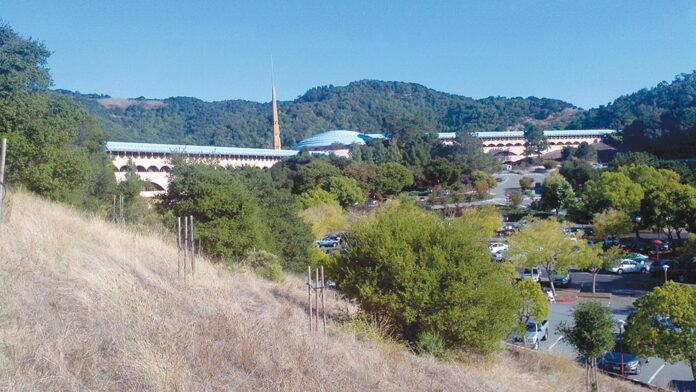
Doyle oversees a department of around 215 sworn officers and works out of an expansive office in Marin Commons, which houses the MSCO and some Kaiser Permanente office space.

All police agencies have a culture and if there’s one at MCSO, it’s driven by Doyle, who joined the force after serving in the Army and was sworn in as a patrol sergeant in 1969. He moved through the ranks and became sheriff in 1996.

Interactions and interviews with MSCO officers reveal a boss who demands respect for the chain of command and who drums the message into his officers to get out of their patrol cars and get to know the communities they serve.

Patrol officers don’t just represent MSCO as an agency, they’re told— they represent Doyle himself when they’re on duty. He’s known to counsel his force on knowing the difference between the spirit and the letter of the law and acting accordingly, says one deputy as he describes to a reporter the nuanced police work that goes in to, for instance, dealing with a meth-head with outstanding warrants, but who would be better served by going to the hospital than to jail because of a failure to appear in court. Sometimes, the warrant can wait for the perpetrator to first deal with their immediate health issues.

Doyle’s community-policing focus is a critical issue for the MSCO. Most of the 215 officers who patrol the streets don’t live in Marin County, owing to the outsized cost of living in the county. (Doyle lives in Novato.) Officers in Marin County are paid below the median average for the North Bay, a sticking point for the local union that represents the force and it currently negotiating a new contract with the county.

To accommodate the fact of Marin’s pricey housing costs and how that impacts on law enforcement, when MCSO moved its headquarters into the new building, it included numerous bunks and a no-frills but pretty cozy TV lounge for deputies. The MCSO headquarters now sleeps up to 42 officers over a 24-hour-period. It’s workable, if not ideal. There’s no residency requirement for officers who are nevertheless encouraged to get to know the residents and communities they patrol. Strongly encouraged, as one deputy put it to a reporter recently.

“We have people who live as far away as Yuba City and Sacramento,” says Doyle as he explains the challenges of having many officers commuting to work.

There’s also a state-of-the art gym, and the walls of the facility are adorned with slogans and sayings that highlight respect and service. A large self-defense gym room with padded floors features a huge, and somewhat jarring, mural of Deputy Ryan Zirkle, who died after a car crash on Highway 1 in 2018. Zirle was 24 years old. The message that’s drummed into deputies: Nobody is invincible.

Doyle’s overseeing his police agency during a period of great interest in the concept of “implicit bias” and its relation to law enforcement. He notes that the state’s training protocols on the subject are in the process of being revised, because “it’s gotten kind of stale.”

He says he supports the idea that you don’t want police officers acting on their biases, but adds that there’s always a risk of alienating peace officers by declaring, for example, that everyone’s a racist who needs training to address their racism.

When it comes to bias, Doyle says, “I think there’s some people who think we’re not accepting it, when in fact some law enforcement officials believe that implicit bias training is insulting to them. Of course we all have biases. We’re all born with that, whoever you are. The question is, do you act out on that? We have a pretty robust training program in our agency,” Doyle says, adding he’s not opposed, per se, to incorporating the state training module at some point. “Law enforcement resists it,” he notes. “It could be a little insulting to use—people telling us what we are thinking, or what we shouldn’t be thinking.”

Doyle grapples with the advent of social media and how it intersects with police work. In a way, he’s blessed, to the extent that Marin County has a low crime rate and hasn’t made the headlines in recent years over use-of-force issues or issues related to officers’ online conduct. The news, as nearby as San Francisco, is heavy of late with stories of peace officers posting racist or otherwise controversial material on their personal social media accounts. He says it hasn’t been an issue that he’s aware of with officers under his command.

Agencies with outstanding issues of trust with their local communities—such as Sonoma County after the 2013 police shooting of 13-year-old Andy Lopez—often use social media as a tool to help tell the “good stories” about policing that, they say, get drowned out whenever there’s a high-profile incident like the Lopez shooting.

But Doyle’s not interested in using Facebook to tell the good stories, he says. He’s using it “to provide information to the public. I know there’s some feel-good stories but it’s really to provide information. It’s not to sell us or put us in a good light.” Starting this year, he says, the MCSO will have a public information officer onboard who will deal with media requests, press conferences and the like—but will also deal directly with the public. “We’re doing it,” he says, “to provide information. Not to get people on our side.”

One reason to get the information out to residents is baked into the Marin low-crime-rate cake. When people live in a low-crime area, they tend to not think too much about the crimes that are, or could be, committed in their midst. It’s probably a good problem to have from the perspective of law enforcement, but still, it’s a problem.

For example, there’s been a spate of car break-ins recently in the tony Marin neighborhood of Bel Marin Keys involving some 30 vehicles. Except they really weren’t break-ins, as the doors to all the vehicles that were burglarized were all unlocked. The episode underscores how in Marin County, residents often have to be reminded that even if the crime rate’s low by state and national standards—there are still plenty of crimes being committed there every day.

And there’s a saying that “no call is too small,” when it comes to responding to residents’ complaints. On a recent weekend morning, MCSO’s dispatch desk receives a call from a Bel Marin Keys resident asking that an officer come out and check on a vehicle that’s been parked in front of his house. California has a 72-hour-law that says parked vehicles can remain in the same spot for three days before they have to move on. Given the county’s high cost of living and excessive rents, people living in their cars in Marin County is a fairly common phenomenon—as is local residents’ pushback to the street campers in their midst. It’s a thorny problem..

An officer arrives on scene and meets with the resident, an older man, who says he’d like to see the vehicle moved from in front of his house. It’s been there for a few days, he says. The officer knocks on the windows of the small, clean camper but nobody answers. The resident says he needs the car moved so he can work on his boat, which is parked next to the camper.

But the boat looks like it hasn’t been moved, or touched, in years. Its registration is out of date, and there’s so many cobwebs on the mast of the boat that it’s practically a sail unto itself.

Observing the scene, it wouldn’t be unfair to surmise that the owners of the camper parked next to the seemingly abandoned boat because, well, if an unregistered and cobwebbed boat can sit on the street of exclusive Bel Marin Keys, why can’t we?

The officer writes a courtesy note to the owner of the camper and chalks the tires of the vehicle. He’s got three days to move the vehicle. The episode and interaction reflect the real-time, and seemingly mundane issues that officers deal with all the time in Marin County from residents. In this case, the officer arches an eyebrow at the fact that the complainant himself is in apparent violation for parking an unregistered vehicle on the street. The episode, observed by this reporter, had a decidedly “only in Marin” feel to it, but also drove home a point Doyle made during a recent interview when he repeatedly referred to MCSO cops as “peace officers.”

You hear a lot in and around law enforcement about a so-called “warrior culture” that’s inherent in some police agencies and perhaps even encouraged in others. But this small-scale encounter in Bel Marin Keys highlights how most policing reflects anything but a warrior culture, and is far removed from the occasional hair-raising encounter with an armed perpetrator and the resulting split-second decisions cops would have to make.

And, it’s far removed from the highly emotional calls for service that involve a deceased child. Those are the sorts of incidents that lead officers to think of themselves as not the person they were when they joined the force. That may be similar to how military personnel see themselves following a combat tour—but that’s where the similarities end (even if some military training is applicable to law enforcement, as an officer at the firing range suggested).

It’s a message Doyle himself says he pushes to his officers. As a veteran of the U.S. Army, he rejects any denoting of peace officers as warriors. “I think it’s inappropriate,” he says. “I don’t think of any of us as warriors,” he adds, even if some officers look at it that way. He served in Vietnam and came back a 5-foot-eleven young man who weighed 115 pounds. “I hardly looked like a warrior,” he says with a laugh. “I was fortunate to come home physically intact and mentally intact.”

If Doyle took anything from his Vietnam experience, it’s to make sure his own officers come home from their shifts in the same condition. That’s the biggest untold story about the force he oversees, he says: the officers who comprise it.

PQs:

“There’s two things that you don’t want to see being made. Sausage and laws.”

“Of course we all have biases. We’re all born with that, whoever you are. The question is, do you act out on that?”

Not a Lark

Nothing makes a pleasant village even more pleasant, than the marquee of a movie theater. The first light on in the evening and the last light to go dark, it’s a particularly fine sight on a summer night. The Arteco Lark Theater, a part of Larkspur for more than 80 years, is squeezed into a corner at the north...

Seeing Is Believing

The future of misinformation is here. It reared its ugly head in May in the form of a doctored video of House Speaker Nancy Pelosi—manipulated to show her slurring her words, as if she were drunk. The trick was simple; the footage of Pelosi, speaking at a conference on May 22, was merely slowed down 25 percent. In the...

Horoscope

ARIES (March 21-April 19): When the universe began 13.8 billion years ago, there were only four elements: mostly hydrogen and helium, plus tiny amounts of lithium and beryllium. Now there are 118 elements, including five that are key components of your body: oxygen, carbon, nitrogen, calcium and phosphorus. All of those were created by nuclear reactions blazing on the...

Advice Goddess

Q: I’m a married lesbian working on having another baby with my fab wife. My new best friend is an attractive straight girl who lives in another state. We talk and text every day. It isn’t sexual or romantic at all, but my friend gets me in a way that, I’m sorry to say, my wife does not. My...

Rough Terrain

Dwight Yoakam launched a life in music at precisely the wrong time. But over the ensuing decades, he helped bend country music—or at least a significant part of it—in the direction he pursued. For his efforts, he became a commercially successful and critically acclaimed artist, winning two Grammys and awards from each of the three largest organizations in the...

We’re Not So Bad

These days some people have a hard time recognizing anything good about our country. But the truth about the U.S. is complicated. Granted, the Trump years have brought us low, but for anyone coming from the global south, the U.S. still looks like paradise—at least, initially. Rule of law, due process, opportunity, democracy, as much as these have been...

Hero & Zero

Hero Farewell to fines at the Marin County Free Library (MCFL). Beginning July 1, the libraries go fine-free to entice residents to come on in to check out books, DVDs, audiobooks and more. The 25 cents per day late fee created a barrier to library access and drove borrowers away, especially those on low or fixed incomes. “Everyone should have equal...

Hero & Zero

Hero Farewell to fines at the Marin County Free Library (MCFL). Beginning July 1, the libraries go fine-free to entice residents to come on in to check out books, DVDs, audiobooks and more. The 25 cents per day late fee created a barrier to library access and drove borrowers away, especially those on low or fixed incomes. “Everyone should have equal...

One 4 All

Nobody today knows how to drill into childhood trauma like Pixar, to find the nerves connected to an empty-nest parent’s anxieties, or to the fearfulness of being a child. There are scenes in Toy Story 4 that really sting, such as the observation of a little girl, weeping in misery in her first day in kindergarten. The series took the...

Cruiser Control

It’s a busy Saturday morning at the San Quentin Rifle Range as members from law enforcement agencies around Marin County receive instructions in use-of-force and weapons training. The facility is owned by San Quentin State Prison, but is used by the Marin County Sheriff’s Office (MCSO) and other local agencies. Officers gather in a training room filled with gear...
3,002FansLike
3,850FollowersFollow