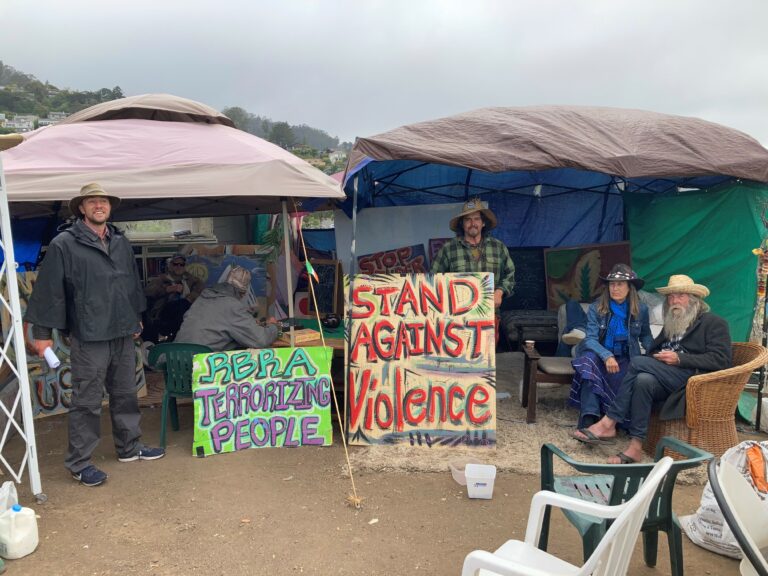
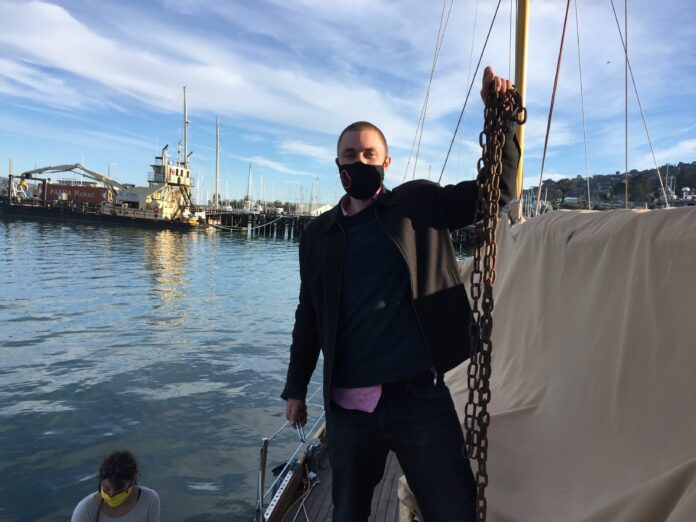
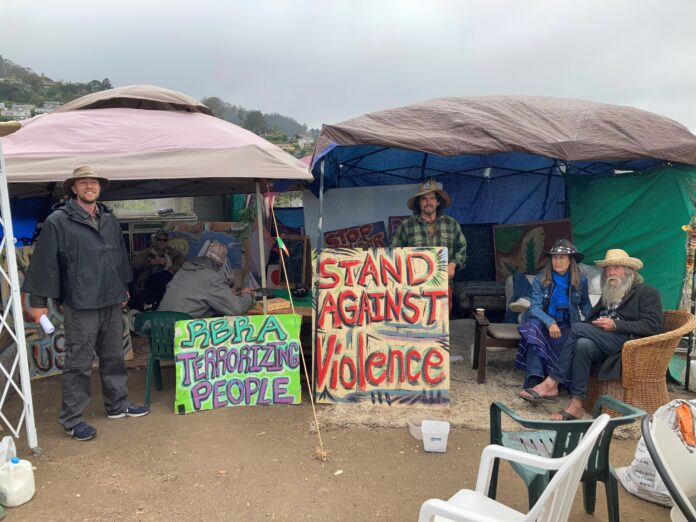
In December of 2020, tents began popping up on the Sausalito waterfront next to Dunphy Park. Since then, an encampment of homeless people has congregated on the park.
Last week, Sausalito Art Festival Foundation announced that it has canceled production of the 2021 Sausalito Art Festival, scheduled to take place this Labor Day Weekend, due to the potential relocation of the homeless encampment to the festival’s traditional location at Marinship Park.
SAFF states that its members began working with the Sausalito Parks and Recreation division to find an alternative location for the festival since learning of the city’s intention to move the encampment. In the process, the group identified Dunphy Park as the most viable location for the event, assuming the homeless encampment would be moved to Marinship Park.
However, SAFF says that the Sausalito Parks and Recreation Commission and local residents voiced opposition to the use of Dunphy Park.
“Unfortunately, we are simply out of time to work through the opposition voiced to the movement of the Festival to Dunphy Park,” stated Sausalito Art Festival Foundation Chairman Louis Briones. “At this point, we owe it to the artists who have committed to exhibit at the Festival, to release them so they can attend other Labor Day Weekend events.”
A recent legal decision in the United States Court of Appeals for the 9th Circuit affirmed that people cannot be punished for sleeping outside on public property when a city is unable to offer them a suitable alternative shelter option.
In addition, the pandemic has created a new level of complexity to the situation. According to the Centers for Disease Control (CDC), encampments should “remain where they are,” to prevent infectious disease spread.
Earlier this year, a legal battle erupted earlier this year between the City and the recently organized Sausalito Homeless Union, it’s up to U.S. District Court Judge Edward Chen to decide the fate of the encampment.
On May 14, Judge Chen asked the City of Sausalito to provide within three days information on how many individuals residing at the encampment had received their first and second COVID-19 vaccinations in an effort coordinated by the City and the County of Marin Department of Health and Human Services. This information may or may not result in a final decision about the relocation by Judge Chen.
“This situation is extremely difficult for everyone involved. After spending the last year to reimagine the 68th annual Sausalito Art Festival, we very much looked forward to bringing the Festival back to the community of artists, locals and visitors,” states Briones. “We were confident that we could meet the requirements imposed on us by the Feds and State in regards to Covid restrictions, but the pandemic has created a chain reaction of events that we could not anticipate. It impacted the homeless, which impacted the parks, which impacted the City, which impacted the Festival. There clearly is no winner here but with help, we’ll all be in a better place next year and the Festival will return.”
All told, the two papers claimed two first-place awards, one second-place award, and two fourth place finishes. In addition, weeklies owned by the San Jose-based Weeklys group won 42 additional awards, for a group total of 47. (Links to winning entries appear below.)
Pacific Sun columnist Nikki Silverstein won first place for her weekly column. “Compelling writing along with top-notch reporting make this submission the clear winner in the category,” the judges commented.
Bohemian reporters Chelsea Kurnick and Will Carruthers won a first place award for their coverage of last year’s racial justice protests in Sonoma County.
Kurnick won a second place award for her enterprise news story “Sonoma County DACA Recipient Battles with DA’s Office Over DUI Charge.” The article showcased Kurnick’s ability to select “a very complicated subject and present it in a way where the reader can understand the entire issue, in-depth,” according to the judges.
Arts editor Charlie Swanson won a fourth place award for his Pacific Sun profile of several successful North Bay teenagers.
Carruthers won fourth place for his enterprise article examining the two storylines which emerged after a bystander filmed a Sonoma County Sheriff’s dog biting a Graton man’s leg for over a minute last year.
It’s that time of year again, when the hallowed halls of academia open and release hordes of black-robed graduates like bats out of hell. Congrats are in order for all concerned. It’s been a remarkable year, and to those who made it to the finish line—students, educators, guardians and society-at-large—you did it!
If the pandemic has taught us anything it’s that nothing is as it was except our resilience, which has remained steadfast in the face of extraordinary challenges. Like remembering to mute ourselves on Zoom before complaining about it. That said, muted or otherwise, such sentiments are echoed by many this year.
“Emotionally, students must feel like they missed out on many ‘lasts,’” says Grant Aldrich, the CEO of Online Degree, an educational platform with tuition-free classes. “The last walk through campus, the final celebration with friends. Though some graduations are in-person, a vast majority are still virtual.”
Even if the ceremonies aren’t virtual, they’re not recognizable as the ceremonies of yore, either. This year, for example, Sonoma State University will host a “Drive-Thru” ceremony.
“Yes, we are excited to celebrate our 2021 graduates with hybrid drive-thru and virtual commencement celebrations,” states the university’s website. “As a graduate, you will have the opportunity to attend in person, in a vehicle, accompanied by your family and friends. You will be able to exit your car, walk across the stage, receive your diploma cover, and take a photo on stage wearing your regalia.”
For those who can’t make the caravan, there will be a livestream at Sonoma.edu. Those who can, however, are reminded that “party busses” are not allowed.
Not everyone is in a celebratory mood, however. Genesis Gutierrez, a member of the Class of 2021 who is graduating from University of California, Los Angeles, is decidedly more reflective.
“I feel like the number one thing I’m experiencing right now, more than ever, is sadness because of how fast I was pushed into reality without getting a chance to even think about it,” says Gutierrez, who is also the founder of the wellness blog and e-commerce company Seven Souls. “When Covid happened, I had to figure out where I wanted to work, moving out of my college apartment not knowing if I was coming back, and didn’t look back. I feel like my life started, and I had to learn to grow up without a warning, and so graduating feels numb. It doesn’t even feel like this whole school year happened.”
Inasmuch as many students can justifiably rue the past year, it’s their futures that garner the most concern.
“Without a doubt, new graduates are feeling uncertainty about the future. Finding a full-time job in the field they studied in is difficult, and many are seeking alternative avenues,” Aldrich says. “According to a study by Monster and Wakefield, 77% of graduates plan to take on freelance or gig work, and 73% took a job out of desperation.”
Besides their career prospects, there is also the question of our new graduates’ general well-being, particularly their mental health as they enter a world full of unknowns.
“New graduates may be experiencing intense anxiety as they navigate going out into a world that feels unsafe,” says Julia Gold, a psychotherapist and founder of Hopeful Bluebird Consulting, LLC. “New graduates have to deal with job searching in an unstable economy while keeping their families safe. New graduates have to deal with layers of trauma from a global pandemic, an insecure job economy and navigate changing social rules.”
It’s not all doom and gloom though, reminds Aldrich, who points to companies’ willingness to hire graduates with transferable skills—even if they didn’t study in the exact field of the job—as a silver lining.
“For example, let’s say a student studied international relations, but is looking for jobs in social media marketing. Even without a marketing degree, they may be able to find a job if they have samples or a portfolio,” Aldrich says.
Joe Wilson, senior career advisor at MintResume, a resume and career website, agrees.
“On the plus side, these graduates have learnt to be adaptable,” he says. “They have learnt to thrive in a world that is constantly changing, and these are the people who can take this attitude and skill forward. They have experienced harder times, adapted to different ways of living and learning, and they will be more equipped to adapt to change as it continues.”
Wilson’s observation underscores the experience of Madeleine Knight, a graduating senior at Rohnert Park’s Credo High School.
“I think that we, as a whole, have gained knowledge on what needs to be fixed in the world, and we have gained different insights on how to better our world,” says Knight, a talented and accomplished artist. “I think that we were just one of the unlucky generations that needed to go through this. In this past month it has been getting a lot better as we get closer to the graduation ceremony date, but because we are graduating now—and through all of this happening—there is a bit of an unsatisfactory feeling to it. There are some people that I know I will probably never see again, and that’s what scares me the most.”
California is one week closer to fully reopening, and the North Bay is getting in on the fun with several safe, distanced events this week in addition to online and virtual get-togethers. Here’s a sample of what’s in store for this weekend.
Live Pop-Up Shop
Marin art, crafts and plants go on display this weekend in the a Spring Pop-Up and Plant Sale. Find vintage finds from a local artist’s estate, a curated collection of home and garden items, artwork ranging from plein-air oil paintings to prints and watercolors, and specialty plants that are perfect for the season. The sale benefits the Marin Art and Garden Center, which is complying with a health guidelines indoors and out during the pop-up event on Saturday, May 22, at 30 Sir Francis Drake Blvd., Ross. 10am to 3pm. Free admission. Maringarden.org/shop.
Live Event
Now that Napa’s di Rosa Center for Contemporary Art is open to in-person visitors, the center is ramping up it’s event calendar, beginning with this week’s panel discussion; In Conversation: Nicki Green, Sahar Khoury, & Maria Paz. The three artists are currently exhibiting at di Rosa in the group show, “Ceramic Interventions,” which celebrates the Bay Area’s enduring and thought-provoking ceramic art movement. Now, the artists come together for an intimate, insightful and socially distanced in-person conversation with exhibition curator Twyla Ruby on Saturday, May 22, at di Rosa, 5200 Sonoma Highway, Napa. 4pm. $10, free with admission. dirosaart.org.
Live Art Reception
Housing 23 artists’ studios, three showroom galleries and two warehouses packed with fine art and furniture, Fulton Crossing is reopening its doors to visitors this month with featured artist Teresa Ferrari exhibiting “Movement in Our Oceans.” The paintings on display feature ocean and coastal scenes created with a deep palette of color and broad strokes from an oil brush that calls to mind masters like van Gogh or Monet. This weekend, Ferrari and the gallery’s other featured and working artists are on hand for a distanced art reception on Saturday, May 22, at Fulton Crossing, 1200 River Rd., Fulton. 4pm. Free. fultoncrossing.com.
Live Comedy
Multi-faceted actor, comedian, and author Finesse Mitchell (pictured) burst onto the comedy scene with his three-year run on NBC’s iconic late night sketch series Saturday Night Live, in the hit urban movie Who’s Your Caddy, and as a series regular on the family sitcom “Outmatched.” Now, he’s coming to wine country to headline a special fundraising stand-up show hosted by Barrel Proof Comedy, Pasta & Punchlines, that pairs big laughs with pasta dinners. The event will be held Saturday, May 22, outside at the Boys & Girls Club of Greater Santa Rosa, 1011 Hahman Dr., Santa Rosa. 5:30pm. $75 and up. santarosaboysandgirlsclub.com.
Virtual Theater
Formed in 2015, Marin Shakespeare Company’s Returned Citizens Theatre Troupe gives actors who have survived incarceration the opportunity to continue their study of theater and to share their stories with the help of a dedicated support group. This weekend, the troupe presents its latest online production, Stages of Healing: Voices From the Inside Out, which tells stories that reflect on life during the pandemic. This original theater performance was created to give voice to those who are incarcerated in California State Prisons by taking their written word from the page to the stage on Saturday and Sunday, May 22 and 23, at 7:30pm. Marinshakespeare.org.
Live Concert
SF-Marin Food Bank welcomes the North Bay to an afternoon of music and fun this weekend at its sixth annual concert fundraiser, Festival For Food. The local lineup includes Mat Karan & Buds, Key Lime Pie, Susan Z & Friends, Johnny Mosley Quartet and Rai Z Jobe. Barbecue, beverages and other goodies are available, and a raffle helps raise funds for the SF-Marin Food Bank’s ongoing mission to feed the Bay Area. The Festival For Food commences in a safe, outdoors setting on Sunday, May 23, at the San Rafael Elks Lodge, 1312 Mission Ave., San Rafael. Noon to 6pm. $10; free for kids under 13. elks1108.org.
Thank you for the article about people who don’t pick up after their dogs (Pacific Sun, News, April 27). I live on the part of Stinson Beach where dog people bring their dogs. What do you think is the first thing a dog wants to do when he gets to the beach after riding over Mt. Tam for 45 minutes? Yup, that’s right. Poop! Dog owners look the other way, pretending not to notice, as if they don’t think their dog is running around frantically looking for a place to leave a big steamer.
People have told me dog poop is organic, biodegradable, full of nutrients for the ocean. Others won’t use the plastic bags we provide because “they are not biodegradable.” So many dog owners walk right past the bag dispenser and the pet waste container on their way to and from the beach. Can you imagine what a drag it would be to take your four dogs to the beach and have to carry back four big sacks of poop? Well, some folks do it religiously and I want to thank them for that. Pick up after your pet like your children, who play in this sand. Thanks everyone!
Dino Colombo, Stinson Beach
Local Hero
While under the influence of my own special chaos fairy, I dropped my wallet on the street right in busy downtown San Anselmo. I didn’t even have time to realize my wallet was missing when my neighbor called to tell me a Good Samaritan had returned my wallet to my home address—with a not-insignificant amount of money (at least to me) still intact! What a sweet and heroic thing to do! So happy to have such a potentially big problem taken care of for me! We need to celebrate the general goodness of so many people in this world, and I definitely want to thank my own special hero.
Sandra Rae Davies lives in San Anselmo.We welcome your contribution. To have your topical essay of 350 words considered for publication, write le*****@********un.com.
Last Sunday, I stood in the Sausalito tent city on Richardson Bay talking with unhoused people about their plight and the uncertain future of their encampment. Not 100 yards away, happy couples gathered at the private Sausalito Cruising Club in Dunphy Park and danced to live big band music.
The two groups were so close, yet so far apart.
Residents have pressured local politicians to shut down the camp since December, when the first homeless man pitched his tent next to Dunphy Park in downtown Sausalito. Much to the City’s chagrin, approximately 40 unhoused people, some displaced anchor-outs, now live at the site.
The Sausalito City Council wants to close the visible encampment near Dunphy Park, and relocate it to the less-noticeable area of Marinship Park. However, the campers want to stay put.
Because a legal battle over the issueerupted earlier this year between the City and the recently organized Sausalito Homeless Union, it’s up to U.S. District Court Judge Edward Chen to decide the fate of the encampment.
If Sausalito officials do successfully close the encampment next to Dunphy Park, they may be unhappy with the end result: a substantial increase in the number of homeless people throughout the City.
There is virtually no more room for additional tents in the area adjacent to Dunphy Park, which means the camp can’t continue to expand in its current location. Marinship Park is much larger and would provide ample space for the camp to grow.
Still, the City is persisting in pushing the move, and it looks like they may get their wish. Based on the questions Chen asked expert witnesses during an evidentiary hearing last Friday, the fate of the campers is likely a fait accompli. The smart money is on Chen ruling for the City, and allowing the closure of the current encampment and the move to Marinship Park.
“Marinship Park is going to be filled with campers from other parts of the county and the state,” said Anthony Prince, attorney for the Sausalito Homeless Union. “The pandemic has permanently altered the housing and employment status of millions of people. That camp is going to grow. There’s no question in my mind, they’re not going to be able to keep it small.”
Another issue is that the city can’t force the current campers to move to Marinship Park. The Sausalito Homeless Union maintains the Marinship Park location is contaminated from the adjacent U.S. Army Corps of Engineers’ boat crushing operation.
“Nobody from this camp is interested in going to Marinship,” said Robbie Powelson, a housing activist and sometime resident of the Sausalito camp.
Although many people experiencing homelessness prefer to stay in encampments due to safety concerns and camaraderie, it appears many Sausalito campers plan to disband. They could choose to disperse into different areas of the city, and they have the right to do so.
The United States Court of Appeals for the 9th Circuit ruling in Martin v. Boise affirmed people cannot be punished for sleeping outside on public property when a city is unable to offer them a suitable alternative shelter option.
The City of Sausalito issued a Notice to Vacate this week to a camper at City Hall. The eviction seems to fly in the face of Martin v. Boise, since not enough shelter or housing exists in Marin.
Right now, 16 people from the Sausalito encampment await temporary shelter or housing, according to Marin County Health and Human Services (HHS). They may be on hold for a long time because of a lack of all forms of housing.
“Marin County does have in the range of 500 folks who have been assessed for and determined appropriate for permanent supportive housing, and they’re just waiting for an available bed,” said Ashley Hart McIntyre, a homelessness policy analyst with Marin HHS. “We need more housing overall and more money for support services.”
With permanent supportive housing, an assigned case manager visits the household regularly to assist with life skills, such as teaching the resident how to pay rent and grocery shop. Over time, most residents gain self-sufficiency. Other services may include connecting the resident with education, job programs and mental health treatment, depending upon their individual needs.
“Marin has roughly a 94% retention rate,” Hart McIntyre said. “We know how to end homelessness. There are 30 years’ worth of evidence-based practices and studies on what works. If you pour in enough money and political will, we can end homelessness.”
Perhaps help is on the way. Gov. Newsom announced last week a plan to allocate $12 billion to end California’s homelessness in five years. Whether it is enough money remains to be seen.
In the meantime, the unhoused people from the Sausalito camp are besieged on all fronts. The City wants to evict the campers from the place they call home and move them to a spot they believe is toxic. In addition, some residents have declared war on them.
Earlier this month, a group on the social media site Nextdoor learned that families live in the encampment. They encouraged everyone to contact Marin County Child and Family Services (CFS) and report the children in the camp are being abused.
A Sausalito man said the children are suffering psychological abuse because they are within earshot of other campers who he allegesscream obscenities and threats in the middle of the night.
Another neighbor suggested reporting that the children aren’t going to school. Ironically, the kids living in the encampment aren’t of school age.
“Homelessness by itself is not child abuse,” Hart McIntyre said. “CFS does not remove children from their families for being homeless. For emotional or psychological abuse to be found, there would need to be evidence that the behavior the child is subjected to is having a significant detrimental effect.”
Fortunately, the two families living in the encampment may be able to escape the animosity of their housed neighbors. One received a housing voucher and is now searching for an appropriate home. The other is on thelist for permanent supportive housing.
Meanwhile, as everyone awaits the judge’s forthcoming decision about moving the encampment to Marinship Park, perhaps Sausalito politicians and residents should consider the consequences of achieving their goal. With the Covid-19 eviction moratorium ending on June 30, there is the potential for newly unhoused people to find their way to Marinship Park. And the current Sausalito campers may scatter to other public properties throughout the City.
I wonder what Nextdoor members will have to say about that.
It’s been a long road to BottleRock Napa Valley this year, though the massive music, food and wine festival’s return is now taking shape.
Several months ago, BottleRock Napa Valley organizers officially moved the festival’s 2021 dates from its traditional Memorial Day weekend to Labor Day weekend, September 3 to 5, 2021.
Now, the three-day event has it’s musical lineup, featuring some headlining acts that were scheduled to perform in 2020, as well as new additions to the party.
Guns N’ Roses, Stevie Nicks, Foo Fighters, Miley Cyrus, Megan Thee Stallion, G-Eazy and Run The Jewels and more than 80 other musical acts will appear at the Napa Valley Expo on September 3-5, 2021. Three-day festival tickets go on sale at 10am on Thursday, May 20, and single-day tickets go on sale Thursday, May 27, at BottleRockNapaValley.com.
“We’re thrilled to be bringing live music back to the Napa Valley this fall, arguably the most beautiful time of the year in wine country,” says Dave Graham of BottleRock Napa Valley in a statment. “We are happy to reward our loyal fans with a lineup that once again features a wide variety of genres, combining legendary performers with up and coming bands and some of the most talked about artists in the world.”
The BottleRock Napa Valley lineup also includes Brandi Carlile, Cage The Elephant, Portugal. The Man, Young the Giant, Maren Morris, Black Pumas, Future Islands, James Murphy (DJ Set), Jimmy Eat World, FINNEAS, Polo G, Jack Harlow, Milky Chance, Jessie Reyez, Dominic Fike, Chromeo, Mavis Staples, Jon Batiste, Walk Off The Earth, Olivia O’Brien, MAX, Digable Planets, Kota the Friend, MOD SUN, Turkuaz w/Jerry Harrison & Adrian Belew: Remain in Light, Village People, Gracie Abrams, Matt Nathanson, Watchhouse, Hobo Johnson & The LoveMakers, Lawrence, Hamilton Leithauser, Absofacto, Joywave, Big Freedia, MUNA, Atlas Genius, White Reaper, Mondo Cozmo, Ripe, Meg Myers, North Mississippi Allstars, Spafford, DeVotchKa, BabyJake, Donna Missal, Reignwolf, JJ Wilde, 99 Neighbors, Smith & Thell, Full Moonalice, Suki Waterhouse, DJ Z-Trip (Silent Disco), Black Joe Lewis & The Honeybears, The Last Bandoleros, Valley, Six60, In the Valley Below, Oliver Riot, The Alive, Crimson Apple, HOKO, Molly Moore, Chris Pierce, Pacific Radio, Buffalo Gospel, S8NT ELEKTRIC, Peter Harper, Lily Meola, Sam Johnson, OTTTO, Grass Child, Obsidian Son, The Silverado Pickups and Napa Valley Youth Symphony.
BottleRock Napa Valley will also present its popular Williams Sonoma Culinary Stage each day. The culinary stage has itself become an attraction at the festival for its exciting showcase of cooking demonstrations featuring renowned chefs, celebrities and festival performers. Details on the 2021 Williams Sonoma Culinary Stage will be announced at a later date.
With the new 2021 dates and updated lineup, festival organizers have informed all existing ticket holders that their current tickets are valid for the September dates, along with their ticket return options.
To offer a safe festival experience, BottleRock Napa Valley will follow all local and state Covid-19 health and safety guidelines required at the time of the festival’s return in September. BottleRock Napa Valley is produced by Latitude 38 Entertainment and presented by JaM Cellars.
Petaluma has always been aspirational. As a native, I’ve watched it dream of seceding from the United States of Americana—looking at you, Lucas and Coppola—and of joining bougier Marin County. Now, with its million-plus-dollar homes dotting the alphabetic West Side grid, it’s difficult to distinguish Petaluma, on paper, from its sister county’s tonier towns. In person, however, it’s a different story.
This is Petaluma, summed up in a single moment: The local, Waldorf-inspired, kindergarten-through-eighth-grade charter school, with all its hand-knitting and kale beds, shares its grounds with the local fairground, which is why the “Fair Food” drive-thru is parked in front of the school, selling slushies, hot dogs and deep-fried paeans to the heart of the nation.
Other culinary curiosities include the best Middle Eastern-themed food in town available at the Swedish restaurant, Stockhome (stockhomerestaurant.com), unless we’re talking about the best hummus, which is found at La Dolce Vita Wine Lounge (ldvwine.com). These aren’t contradictions, so much as complementary conundrums. Think cantaloupe and prosciutto—who knew, right?
Before proceeding further, consider this: Though this piece may bear a “spotlight” badge, please don’t confuse this effort with, say, the Boston Globe’s “Spotlight” investigative team. No investigation occurred here; this riff is highly subjective, personal and idiosyncratic to the nth degree. It reflects no special interests other than my own and what I found interesting in any particular moment. It is, by definition, wildly incomplete, lopsided and shaded by my own proclivities and peculiarities.
This is to say, don’t bother writing a “letter to the editor” to complain about my apparent willful—or more likely, “blissful”—ignorance of your favorite spot. You have better things to do than share a piece of your mind with a writer who you will never know; instead, share a piece of your heart with someone who you do. Life is too short for hate mail—send someone a love letter instead. Moving on …
It took a pandemic for Petaluma to finally accept that it has a natural water feature in the form of the Petaluma River, which lines the aptly named Water Street. This is our Left Bank. It is both our Seine and drain. And soon to be bain—as in French for “bath”—when a controversial public art installation, consisting of 5 sculpted bathtubs on stilts, goes up. Before the “Bathwatergate” conspiracies start, consider dining al fresco along the waterfront. Restaurants abutting Water Street that now have outdoor dining include faves Cucina Paradiso (cucinaparadisopetaluma.com) with its Cal-Ital lunches—my wife and occasional Bohemian contributor Kary Hess and I had some laughs there with cannabis columnist Jonah Raskin—and the nearby Wild Goat Bistro (wildgoatbistro.com), whose killer short rib is a welcome part of their permanent menu.
For a European piazza experience with enough wine to keep your spirits afloat until Covid ends, visit the aforementioned La Dolce Vita Wine Lounge (ldvwine.com) in Theater Square. Pandemic measures led LDV to flow seating into the Square, which made a perfect experience even more so. The wine list is beautifully curated and well-matched with a rotating array of house-made hummuses, soup, salads, pizzas, sandwiches and more. Pro tip: LDV is ideal for a date at any stage of your relationship—sip, kiss, sip, kiss. … Everybody’s doing it.
Heading down D Street Extension into the wilds of West Petaluma, it’s a relief to find the road is mellower than when I was a teenager and “Hell Driving” through the hills was a rite of passage—I realize now it was just Darwinism on wheels. The county line falls on San Antonio Creek, which I’m presuming once had an indiginous name that was replaced by some missionary. St. Anthony was the patron saint of lost and stolen articles—including land, it would appear.
The elbow joint that connects Sonoma and Marin counties is the Marin French Cheese Co., a.k.a. the Cheese Factory (marinfrenchcheese.com). It boasts picnic tables, a pond and floating fowl of some kind—I’m not an ornithologist, I don’t play “Name That Duck.” To me, they’re all water chickens. It’s a perfect stop for motorists and bicyclists alike. If you grew up around these parts like I did, the cheese factory was a favorite school field trip, apart from the funky smell of aging cheese that once permeated the premises. That’s gone now, and you no longer need to duck your nose into your Izod polo shirt to avoid it. Ironically, I now miss the smell. Double irony—I’m also wearing a mask.
Further west is a striking illustration of the effects of climate change in real time—the mud puddle that was once the Nicasio Reservoir. Where did all the water go? It never arrived due to our truncated rain season. Area fire departments are already alerting citizens about potential fire hazards. Drive by and see if you can spot the vertebrae of the long-dried out sea monster, “Nicasio Nell.”
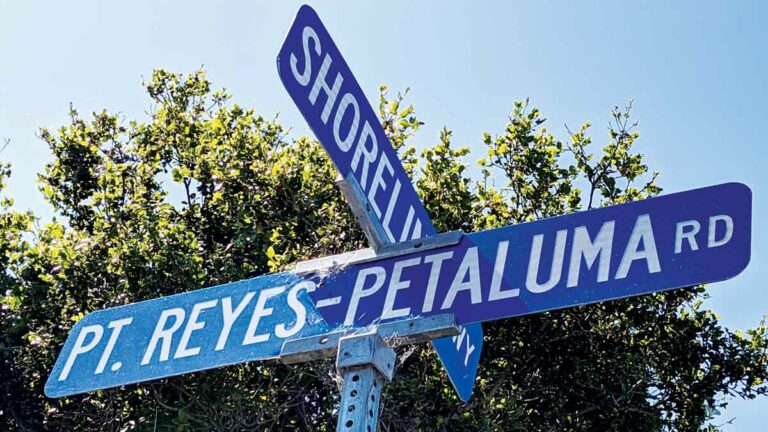
What’s the difference between Pt. Reyes and Pt. Reyes Station? Everyone I stopped on the street to ask where we were was a tourist, and thought they were in Pt. Reyes. I left it at that.
The best way to gauge the intellectual health of a town is to visit its local bookstore. Pt. Reyes Books (ptreyesbooks.com) is, as my Chron colleague Nick Marino put it, “The platonic ideal of a modern indie bookstore,” which means that visitors are likely surrounded by the cognoscenti of Marin County. Pt. Reyes Books is a browser’s paradise, and a buyer’s moral obligation.
Inasmuch as a good book can feed the soul, stepping next door for a coffee and a pastry courtesy of Bovine Bakery (bovinebakeryptreyes.com) can feed the body. The beloved bakery has adapted to the times and provides a convenient walk-up service, with its usual line of devoted patrons now winding down the street. Conceivably, the line could be long enough that you end up across the street at Toby’s Feed Barn (tobysfeedbarn.com), a family-owned-and-operated “general store and working feed barn that has been serving the community since 1942,” according to its website. Toby’s offers a variety of fresh, organic produce as well as pet food, hay and grain. Toby’s coffee bar also offers a CBD latte for $7.25, which, by all accounts, is well worth it. What’s also worth it is driving the 7.7 miles westerly to Pt. Reyes National Seashore (nps.gov/pore/index.htm), which the National Park Service bills as a “natural sanctuary, a human haven.” And, for once, the government got it right. You’re invited to respectfully frolic with over 1,500 species of plants and animals; but be wary, as there is a Red Flag fire warning in effect at present writing. “Outdoor burning is not recommended” is the understatement of the year. So leave the barbecue at home, and enjoy the fresh air.
Whenever there’s a drought in Northern California, local DJs play “Box of Rain,” “Right as Rain,” “Have You Ever Seen the Rain,” plus Van Morrison, who wails “Oh, the water” in his rock hymn, “And It Stoned Me.” The lyrics haven’t worked better than rain dances. Longtime Marin farmers, Moira and Jesse Kuhn, at Marin Roots Farm, haven’t planted this season. There’s no water to irrigate leafy greens. At Marin’s Shao Shan Farm, Scott Chang-Fleeman—a third-generation Chinese-American who studied farming and ecology at UC Santa Cruz—is cultivating two crops—squash and tomatoes—not his customary 40.
“We get the rain we deserve,” ag maven Bob Cannard tells me, which isn’t the same as the rain we need. With the drought on my mind, I drove to Bolinas, the legendary Marin coastal town, known for billionaires, bohemians, celebrities like Joel Coen and Frances McDormand, and extraordinary farmers who don’t badmouth their wealthy neighbors. Like ordinary folks, the wealthy buy veggies, too. Zip code 94924, once considered funky, is now fashionable.
It rained the day before I drove to Bolinas. Enough to freshen the face of the earth, but not enough to help parched farmers. My guide, Ilka Hartmann—an internationally renowned photographer and a Bolinas notable—had water on her mind. Signs everywhere, courtesy of the Bolinas Community Public Utility District, read “Water Supply Shortage, Reduce Usage Now!”
Hartmann introduced me to three farmers: Dennis Dierks at Paradise Valley Produce; Annabelle Lenderink at Star Route; and Mickey Murch at Gospel Flat. They know one another and they have all the water they need. So does Peter Martinelli at Fresh Run Farms. Years ago, Martinelli, Dierks and Warren Weber had the foresight to build ponds on their property. They had help from conservation organizations that wanted to protect endangered species like Coho salmon, aid farmers and keep water flowing in Pine Gulch Creek, once an important waterway for the Miwok that runs year round, even in droughts.
The three Bolinas farms made it clear to me that change in ag starts on the edge and gradually moves to the mainstream. During the pandemic, when corporate food systems were undependable, small local farms provided produce reliably.
Star Route
PACK ’EM Geena Tognini and Patricia Buzzotta at Star Route. Photo by Jonah Raskin
Star Route, in Bolinas, is the oldest certified organic vegetable farm in California. Annabelle Lenderink is the manager. She has help from Nick Civetz, who belongs to a Central Valley farming family, has a degree in ag, and more importantly can take apart a tractor and put it back together again.
Annabelle grew up on Curacao, an island off the coast of Venezuela, where scrappy Portuguese farmers from the island of Madeira used their secret skills to grow vegetables with few resources. They were self-sufficient or they went hungry.
Warren Weber, once a Shakespearean scholar, founded Star Route in 1974 and turned it into a profitable enterprise, in part by selling produce to high-end city restaurants. In 2017, he sold to the University of San Francisco. USF improved housing and added fencing, but it’s essentially the same place Weber ran for 33 years. Annabelle says, “USF saved Star Route. Without their purchase, we would now have a mansion, or two, with swimming pools and Arabians.”
She showed me two treasured volumes, California Fruits (1889) and California Vegetables (1898), both by horticulturist Edward Wickson. The books reminded me that there’s a long history of writing about Golden State fruits and vegetables and that California, from its earliest days, mass-produced crops to feed the nation.
Of the 100 total acres at Star Route, 40 are in production, with ordinary, garden-variety crops like carrots, cabbage, beets and kale and specialty items like fenugreek, craved by Indian chefs, and Puntaralle, a favorite with Italians. Star Route sells produce to restaurants like Zuni as well as at the Ferry Building in San Francisco. Also at the thriving San Rafael Farmers Market on Civic Center Drive, which Annabelle calls “a behemoth.” She’s been there for decades—she knows her loyal customers, and they know her.
The Star Route farm stand, on the side of the Olema Bolinas Road, is open Fridays. Customers also subscribe to a CSA. “There’s a big demand for fresh, local produce,” Annabelle tells me. “Our numbers are way up.” She has kept the books for decades and has the figures at her fingertips. “Warren, with his keen business sense, taught me what to worry about and what to look for,” she says.
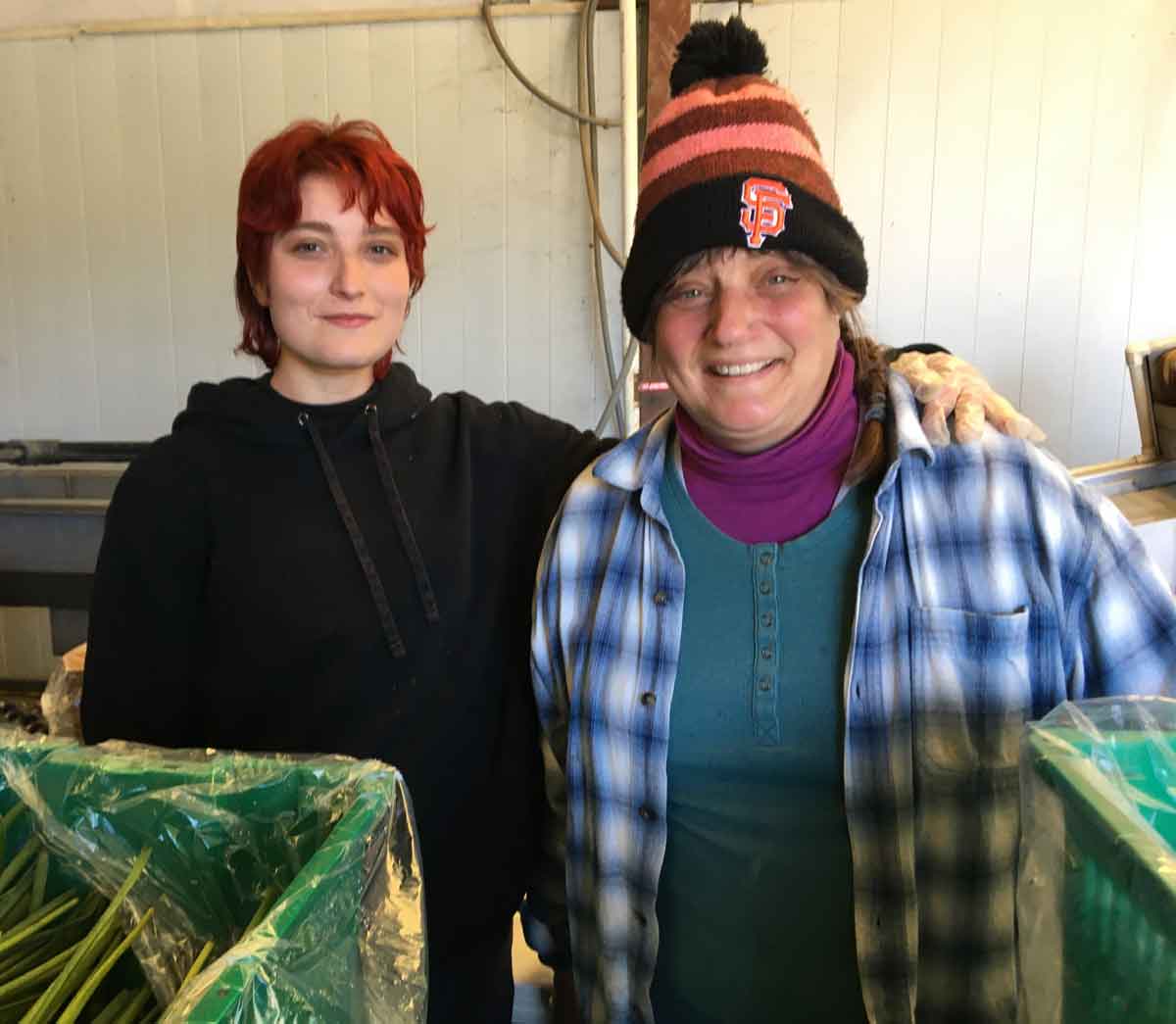
To keep up with demand, Star Route has increased production and hired more employees, including Geena Tognini and Patricia Buzzotta—both with Italian ancestors, who work in the packing shed filling boxes with veggies. When Annabelle isn’t in the fields or the office, she’s at home cultivating an acre of tomatoes which she’ll use to make her famed tomato sauce and put in salads.
Back to the Future
In the early 1970s, Marin County newspaper editors and reporters had a field day with the starry-eyed urbanites who descended on Bolinas to farm, create counter-cultural communities and build their own homes. The make-shift structures landed hippies in trouble with officials at the Civic Center, designed by Frank Lloyd Wright, and known to locals as “Big Pink.”
Orville Schell, who became the Dean of the UC Berkeley Graduate School of Journalism, explained in the early 1970s that the back-to-the landers were not “ignoring the problem areas of power, sewage and owner-built shelters,” but rather “seeking to solve them in new ways.” The Pacific Sun ran an article in 1973, by Judith Weston, titled “There’s Trouble in Paradise.” The Independent Journal published a piece by veteran reporter, Paul Liberatore, that same year titled, “Marin Pioneers—Rough Row to Hoe.”
In 1976, Hartmann and Schell wrote and published a book about Bolinas, with words and photos, titled The Town That Fought to Save Itself. To help protect Bolinas, the authors gave the town a fictional name: “Briones.” Decades later, it’s still fighting to save itself. No signs point travelers and tourists to the town that doesn’t want to be found.
The ’70s pioneers who came to Bolinas, many of them college graduates, realized it would not be easy to create utopia on the edge of the continent. They knew, too, that the rich bottom land was near perfect for growing crops, and that “Paradise Valley” was protected from the chilly winds that blew on higher grounds. Original settlers created a non-profit to protect “open space” and promote agriculture. Now, the Bolinas Land Trust caps development.
Paradise Valley Produce
These days no one mocks Dennis Dierks, who moved to Bolinas in 1973 from San Francisco, where he worked as a commercial artist. In Paradise Valley, he built a home with salvaged lumber and his own two hands. “I believe in recycling,” he tells me on a morning that feels like paradise. “I also believe in feeding the soil. That was my goal from day one. The soil is my medium.”
Dennis’ farm, Paradise Valley Produce, has ample water. It was certified organic in 1976, soon after the term “certified organic” was created. Every year, Dennis makes compost. He has grown leeks, squashes, chard, kale, spinach and more, turned cucumbers into pickles and other vegetables into kimchi. Once, his produce went to Alice Waters’ Chez Panisse, where the chef introduced foodies to the health benefits, the tastes and the beauty of fresh local vegetables that weren’t buried in sauces.
At times, Dennis finds it difficult to find laborers who care about the land, and who are willing to learn to farm organically. “It’s been hard work, but it has also been a pleasure to do it,” he says. “I came to Paradise Valley when I was 30, and I’ve stayed with it. You can make a good living as a farmer.”
Dennis would like local, organic vegetables to be more widely available than they are now. “You can’t just grow for the elite,” he says. He also wants consumers to know that while big farms use the term “organic,” they have lost sight of its original meaning. “They grow hydroponically and not in real soil,” he says. “Their operations are all plastic.”
Though he has plenty of water, good soil and lots of sun, he won’t grow acres of vegetables this year. Rather, he’ll have a small garden, and focus on cover crops to replenish the soil. Call him a regenerative farmer.
Gospel Flat Farm
Like Dennis, Mickey Murch at Gospel Flat Farm thinks of himself as an artist whose medium is the soil. The son of a farmer, Mickey vowed not to grow up and become a farmer like his father, Don. For years, he observed Don’s frustrations, his long hours and his commutes to deliver produce to distant markets.
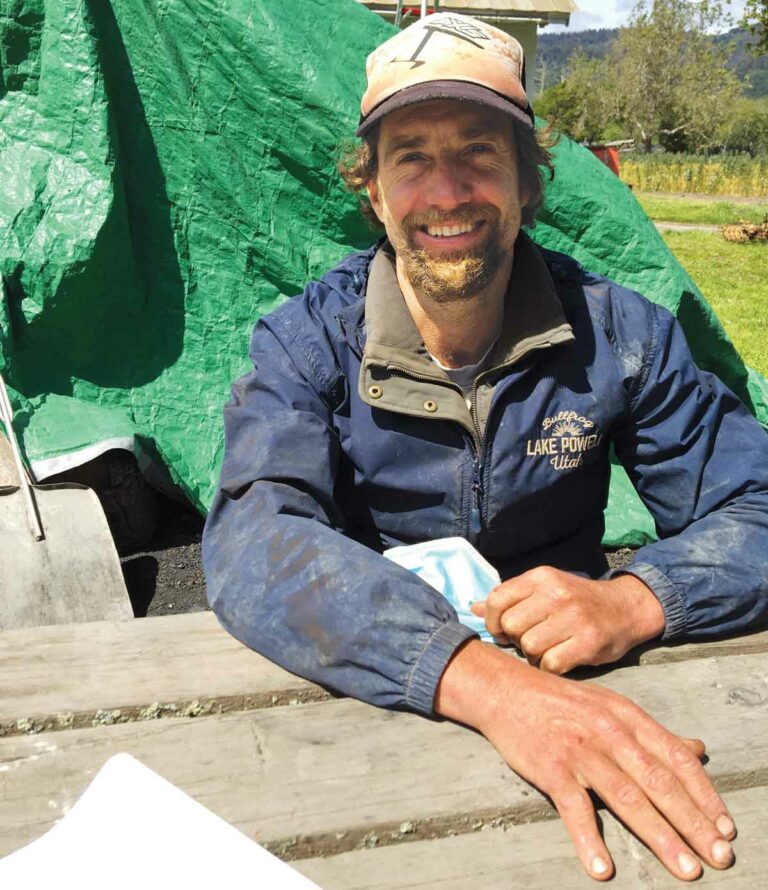
Born in 1984 in Bolinas and raised there, Mickey went to Reed College in Portland to study science and become a scientist, like his mother, who experimented with corn. At Reed, he realized the beauty of farming. “The color of a red tomato was more beautiful than any pigments you could mix,” Mickey tells me. He went home and began to farm as an “experiment in self-sufficiency,” he says.
He built things without buying anything, applied his skills as a plumber and electrician, cultivated corn, harvested it, ground it and made tortillas. As a boy, he toiled on a small plot in a corner of a large field, courtesy of his father. Mickey grew pumpkins, sold them on the side of the road and made enough money to buy a skateboard. “I was a farmhand, but there was no pride in that,” he says. Then he heard the gospel, and realized he didn’t have to follow in his father’s footsteps. He could do it his own way. “I’ve always wanted to think outside the box,” he tells me. “I’ve always wanted to have something different from everyone else.”
In 2007, he opened a farm stand on the Bolinas Olema Road, just minutes from Star Route. Almost overnight the Gospel Flat Farm Stand created a sensation. At first it was a tent. Now it’s a real building with an art gallery. It’s open 24 hours a day, seven days a week. The produce is so alive it practically sings. The whole operation works on the honor system. Nobody stands at a cash register, collects money and gives change. “The experiment in self-sufficiency became a total living thing, with the community and with interactions,” Mickey says. “Sometimes raccoons have gotten in and I have had to hide produce, but that was as bad as it got.”
This season, Mickey is growing vegetables on 10 different parcels in Bolinas, some on hillsides and some in the floodplain where the soil is especially rich. He’s planning to grow on the land where Scott Chang-Fleeman has decided to scale way down. “I’m an optimist,” Mickey says. He’ll grow anywhere, most anytime, make money and enjoy making art, too.
Build Reservoirs
DRY Water is in short supply in Bolinas. Photo by Jonah Raskin
At 80 years young, Warren Weber—one of California’s preeminent organic-farming pioneers—also sounds like an optimist. He’s not currently planting and harvesting vegetables, but he owns and operates an 80-acre vegetable farm in Coachella Valley, near the edge of a desert. What’s needed, Weber says, are reservoirs—like those in Bolinas—on dairy ranches all across Marin and also in some urban areas.
“If we caught just 10% of the rain that falls, it would make a huge difference and provide for food security and protection against fires,” he tells me. “We need the political will, the backing of county supervisors like Steve Kinsey—who aided us for years—plus support from local, state and federal agencies. We need to streamline the process and we need to act now.”
Jonah Raskin is the author of “Field Days: A Year of Farming, Eating and Drinking Wine in California.”
In December of 2020, tents began popping up on the Sausalito waterfront next to Dunphy Park. Since then, an encampment of homeless people has congregated on the park.
Currently, the Sausalito City Council is trying to relocate the homeless encampment from Dunphy Park to Marinship Park, citing the fact that Marinship Park is a better location because it has...
A remarkable school year concludes
It’s that time of year again, when the hallowed halls of academia open and release hordes of black-robed graduates like bats out of hell. Congrats are in order for all concerned. It’s been a remarkable year, and to those who made it to the finish line—students, educators, guardians and society-at-large—you did it!
If the pandemic has...
California is one week closer to fully reopening, and the North Bay is getting in on the fun with several safe, distanced events this week in addition to online and virtual get-togethers. Here's a sample of what's in store for this weekend.
Live Pop-Up Shop
Marin art, crafts and plants go on display this weekend in the a Spring Pop-Up and...
What a Scoop!
Thank you for the article about people who don’t pick up after their dogs (Pacific Sun, News, April 27). I live on the part of Stinson Beach where dog people bring their dogs. What do you think is the first thing a dog wants to do when he gets to the beach after riding over Mt. Tam...
By Sandra Rae Davies
Amazing moon
Lets spoon
Honey on crackers
Cheese and laughter
Mooning with you
Makes me
Crazy
Wishing upon a star
You’re not far
Away
Now
Cow jumps over
Green leaf clover
In her mouth
Howling
Mooning with you
Makes me
Looney
Shake off
Pants
Let’s dance
Mooning the moon
Cow breathlessly gallops
Crazy not lazy
Anymore
Another luna dance
With your magnetism
Wildly out of my mind
Afterwards
Passionately
Melting
Like a lemon drop
Sandra Rae Davies lives in San Anselmo. We welcome your contribution. To...
It’s been a long road to BottleRock Napa Valley this year, though the massive music, food and wine festival's return is now taking shape.
Several months ago, BottleRock Napa Valley organizers officially moved the festival's 2021 dates from its traditional Memorial Day weekend to Labor Day weekend, September 3 to 5, 2021.
Now, the three-day event has it's musical lineup, featuring...
From Petaluma to Pt. Reyes
Petaluma has always been aspirational. As a native, I’ve watched it dream of seceding from the United States of Americana—looking at you, Lucas and Coppola—and of joining bougier Marin County. Now, with its million-plus-dollar homes dotting the alphabetic West Side grid, it’s difficult to distinguish Petaluma, on paper, from its sister county’s tonier towns. In...
Revitalizing via vegetables
Rain & Water
Whenever there’s a drought in Northern California, local DJs play “Box of Rain,” “Right as Rain,” “Have You Ever Seen the Rain,” plus Van Morrison, who wails “Oh, the water” in his rock hymn, “And It Stoned Me.” The lyrics haven’t worked better than rain dances. Longtime Marin farmers, Moira and Jesse Kuhn, at Marin...