Celebrate your inner and outer artist at the 22nd annual Marin Open Studios the first two weekends in May. This exciting, inspiring and free event lets you tour the studios of more than 270 local Marin artists—from painters to sculptors to jewelers to stained-glass artisans. You not only get to see really cool stuff, but you get to meet and chat with the artists who created the work, and purchase those pieces you just can’t live without. This is a do-it-yourself tour, so you can see as many—or as few—as your art heart desires.
A Marin Open Studios gallery exhibition will be held April 21 through May 10, 11am-6pm, Tuesday-Sundays at 302 Bon Air Center, Greenbrae.
Marin Open Studios: Saturday and Sunday, May 2-3, artist studios in south and central Marin. Saturday and Sunday May 9-10, artist studios in west and north Marin. 11am-6pm. For more information and to get the free MOS Artist Tour Guide, visit marinopenstudios.org or call 415/343-5667
I am mad. I just spent about 10 minutes circling the parking lot outside of the row of restaurants and shops at the Northgate Mall where the BJs, Chipotle, Peet’s, etc. are. With my daughter in the car, planning to have lunch and then have our nails done at Fingers & Toes. My daughter has cardiac and respiratory health issues that make it difficult for her to walk long distances. And she has a doctor-prescribed handicap placard for the car.
After about our 10th lap around the parking lot, trying to find an open handicap space or at least an open regular space halfway between Chipotle and Fingers & Toes, I started counting the number of designated handicap spaces and the number of spaces that are just as close to the shops but are designated for … online ordering … curbside pickup.
On the Fingers & Toes side of this strip of shops, there are two handicapped spaces at the sidewalk. Compare this to the eight (eight!) spaces reserved for people who are in most cases probably healthy enough to walk a few more feet from the general spaces to get their food, but just don’t want to expend the extra time and/or energy to make that journey. I say “journey” because for someone who doesn’t have the physical capability of walking that far, it is indeed a journey!
It’s a disturbing question. And it’s a surprising question considering the place and time (Marin County, 2015 … are we moving forward or backward?)
Why does the Northgate Mall discriminate against the physically disabled by not providing enough designated spaces for them but rather chooses to accommodate a segment of the population that could probably do well with a little extra exercise? Food for thought.
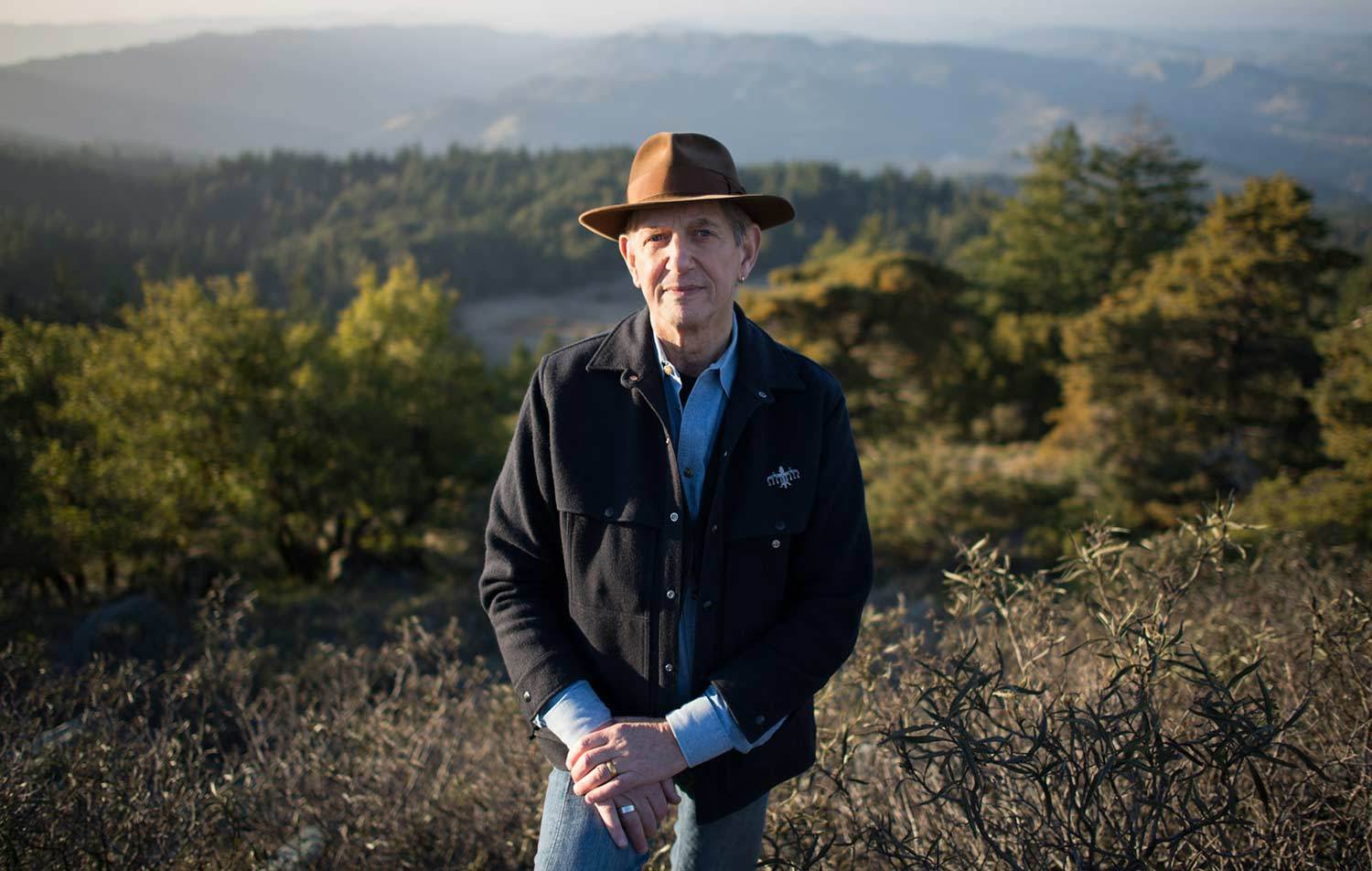
The last four paragraphs of Steve Heilig’s interview with Peter Coyote [“Looking Back and Moving On,” April 24] should be required reading for everyone in Marin County. Having lived in Marin over the same decades, I’ve not seen anyone articulate so well the paradigm shift in values which jeopardizes the fabric of this county that Mill Valley exemplifies.
Really enjoyed Steve [Heilig’s] cover story [“Looking Back and Moving On,” April 24]. Sorry to see Peter [Coyote] move to Sonoma … West Marin, not Olema in the Sixties, has the feel of yesterday’s Mill Valley.
I am responding to a couple of letters in the April 24 issue of the Pacific Sun by cyclists seeking more access to single-track trails in Marin.
One of the cyclists’ letters mentions spending money in Marin. I’m not sure why this is relevant unless it argues for dollars entitling cyclists to some particular privilege.
The writer notes that all narrow trail users co-exist “just fine” in other counties. This is what someone might think if they have not been present for an injury or death. Personally, I think cars and cyclists co-exist “just fine” on busy roadways—I’ve never seen a cyclist get hit by a car!
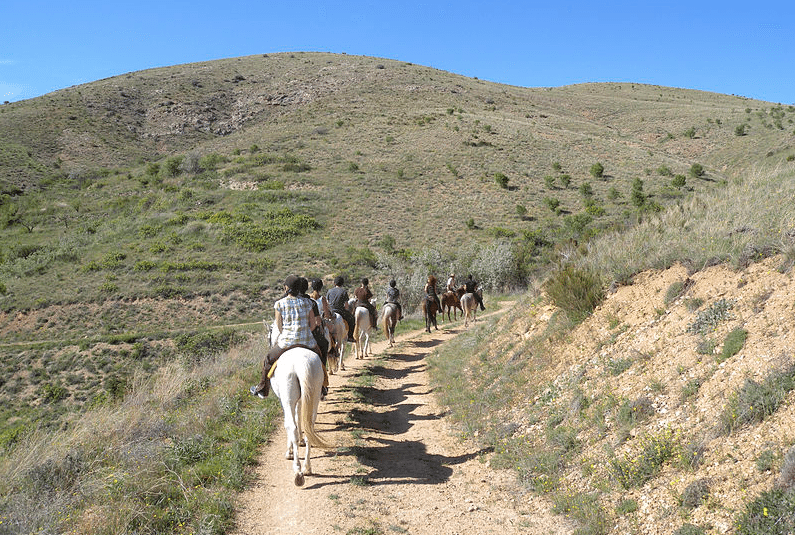
Just a couple of weeks ago on Willis Evans trail in Woodacre, a cyclist tore down a blind rise and around a blind curve just ahead of my horse, who, to my great relief, held her ground. Had we been 50 feet further up the trail, one or both of us might have been seriously injured or killed. I screamed, “Stop!”, but the cyclist ignored me and [sped] right past me down the hill. I was amazed. A grown man! These incidents happen not infrequently to me and other equestrians.
I have done all I can to expose my mare to bikes, and she’s a seasoned, solid trail horse. But when a bike flies down a narrow trail or crashes down from a hill or around a blind curve, even she can react.
One cyclist complained about wanting access to trails away from “busy thoroughfares”. I understand. Cyclists, like equestrians, try to minimize the inherent risks of their sport. Cyclists would prefer not to have life and limb dependent on every driver’s courtesy, awareness and skill.
I would like to enjoy hiking and riding without staking my life on every cyclist’s courtesy, awareness and skill. It is simply not possible for all users to share narrow trails safely. I get that cyclists want to enjoy their sport. But sharing every trail safely is an illusion.
Thanks to a group of dedicated individuals, the Fairfax Food Pantry will turn 4 years old this month. The Fairfax Volunteers have partnered with the town and the Fairfax Community Church to offer groceries provided by the SF-Marin Food Bank to as many as 140 families once a week. Every Saturday from 9am to 11am, anyone in Fairfax and San Anselmo who needs assistance can go to the Fairfax Community Church located at 2398 Sir Francis Drake Blvd. and pick up what they need—typical offerings include grains, bread, protein and seasonal fruits and vegetables. The group also currently delivers as many as 15 boxes of food to folks in the area who are housebound or unable to get to the site. For volunteering opportunities or to learn how you can help or receive help, check out their website: fairfaxvolunteers.org/the-food-pantry.
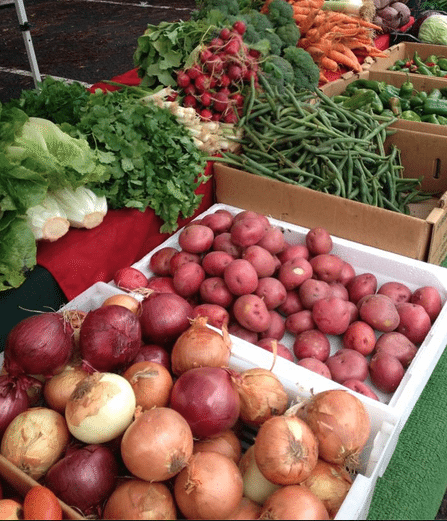
FAIRFAX FUN I’m a little biased, but the Fairfax Community Farmers’ Market is my favorite in the county, and I’m excited that it will be starting back up on April 29 after its usual fall/winter break. The lively market goes from 4pm to 8pm and will run every Wednesday until the end of October. Bring the kids, grab some dinner, buy fresh, organic veggies and visit with your neighbors under the redwood trees in Bolinas Park at 124 Bolinas Rd., Fairfax.
ART & WINE Head over to Hamilton for a good cause—and good food and wine! The 5th annual Divine Wine & Food Extravaganza will benefit Novato’s Marin School of the Arts, which provides students access to a high-caliber public school education with a strong foundation in the arts. More than 10 wineries will present their finest vintages for tasting, and an equal number of local restaurants will offer a specialty dish for a unique pairing experience. The Marin School of the Arts jazz band plays on the lawn at Unity Center. General admission tickets are $95. The event takes place on Saturday, May 9, 5:30pm-9:30pm at the Unity Center, 600 Palm Dr., Novato (Hamilton Air Force Base.) For more information, visit divinewine.org or call 415/389-7266.
TUNES ‘N’ TASTES I suppose it goes without saying that a music fest in wine country MUST have a solid lineup of food and drink to go along with the tunes. The list of chef luminaries at this year’s BottleRock Napa Valley includes the likes of Masa Morimoto, Michael Mina and Top Chef Michael Voltaggio. The three-day music event is slated for May 29-31 and there will even be a Williams-Sonoma Culinary Stage that will showcase the country’s top chefs and sommeliers with musicians and celebrities. Not sure who the musicians are, but I’m going for the food! Buy tickets and learn more at bottlerocknapavalley.com.
MAY FIESTA I would be remiss not mention at least one Cinco de Mayo celebration in Marin this week—and this is the one that gets my vote. It just so happens to be Copita’s 3rd birthday on May 3rd, and they have some serious festivities lined up for the entire week. May 1 through May 5, Copita will be serving luxe lobster tacos (three for $20) and a margarita tasting-flight ($18) that includes the classic margarita (herradura blanco, fresh lime juice, agave nectar)—my personal favorite, Barb Wire (tequila blanco, strawberry rhubarb purée, maraschino liqueur, lime) and Some Like it Hot (housemade spicy tequila, Lillet, grapefruit, lime, agave, fresh ground pepper). On Copita’s official birthday, Sunday, May 3, the kitchen team will serve up fire-roasted ancho chile adobo porchetta with tomatoes, fava beans, epasote, salsa, tomatillo white beans and spicy candied kumquats. Let the celebration begin! Learn more at copitarestaurant.com.
Share your hunger pains with Tanya at th****@********un.com.
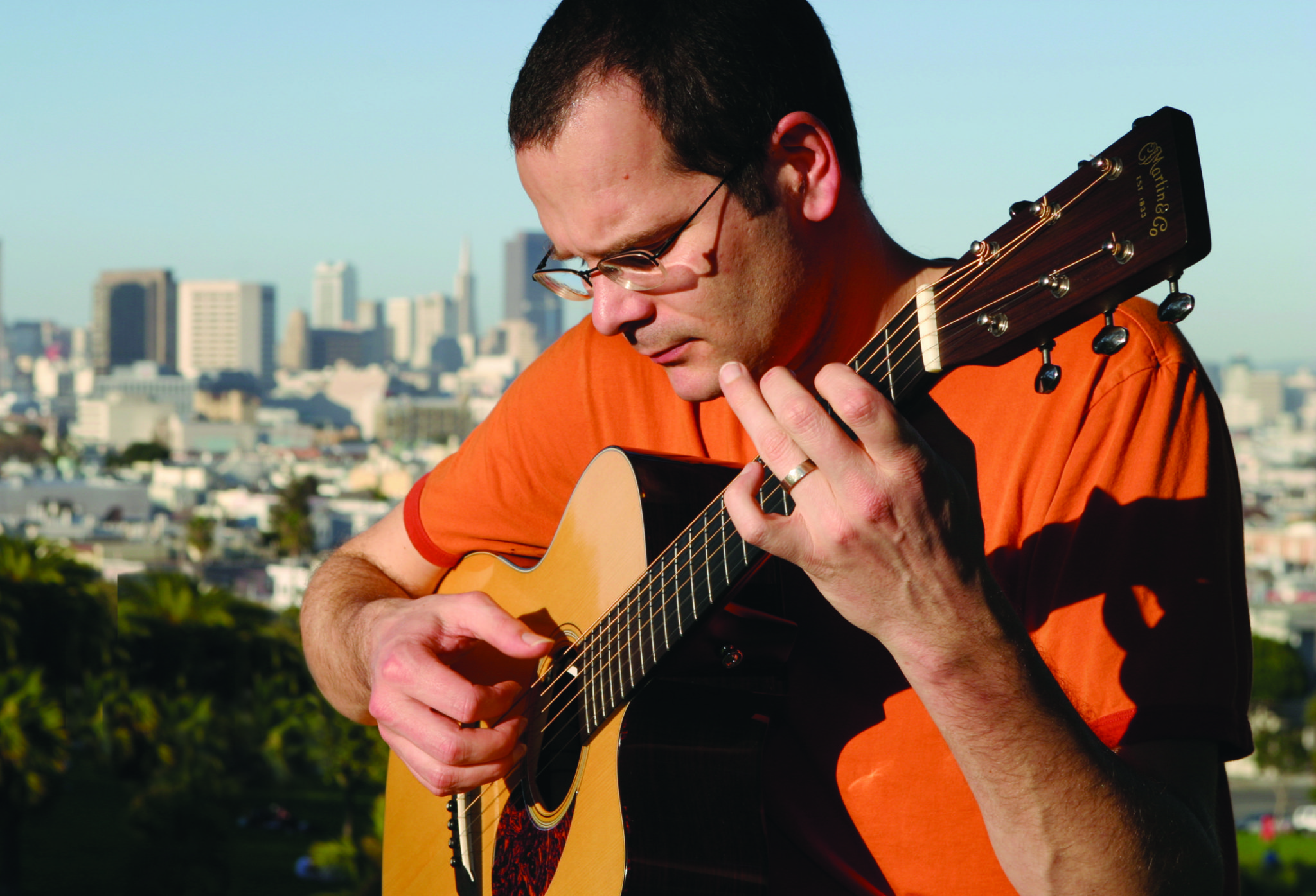
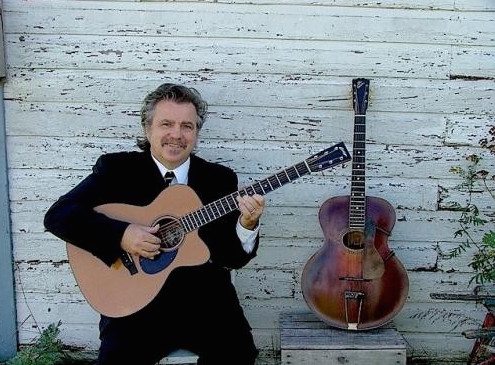
Fingerstyle guitar fans fret no more—an evening of masterful, world-class music awaits. Teja Gerken, Matthew Montfort and Tim Sparks will come together on Thursday, May 7 at the Throckmorton Theatre to blend world-fusion, jazz, blues, classical, celtic and more at the Acoustic Guitar Summit.
Gerken, who organized the event, has been bringing different players together to perform a variety of styles for more than 20 years.
“Tim and Matthew have never met but they have a ton in common,” says Gerken, who has played with both of them before. “I just really can’t wait to kind of see what happens with the two of them together. They both have this strong world music background with those odd rythms and meters—they really know that music and I just know they’re going to hit it off, but I haven’t seen it yet, so I am pretty excited about it.”
Gerken says that the three of them will get together just a few days before the event and craft an evening that will include solo sets, duets and trios. “We all play steel string acoustic guitars but we all sound completely different,” he says.
Gerken, who writes a lot of his own music, describes his style as a mix of many different things, including classical, jazz and celtic. He says his biggest influences were John Renborn and Burt Jansch (from the ’60s folk/jazz band Pentangle), along with other well-known Windham Hill fingerstyle guitarists Michael Hedges and Alex de Grassi. Gerken utilizes a very distinctive guitar technique that he says is sometimes called “harmonic slaps,” along with two-handed fretting or tapping, where “you are actually fretting a note which then allows you to free up the left hand to do other stuff.” These techniques create special “sound effects” that are unique to acoustic fingerstyle guitar playing. He also likes to use alternate tunings, because he feels that they “extend the instrument.”
Matthew Montfort
San Rafael resident Matthew Montfort is a world music pioneer, best known for his work with the world-fusion group Ancient Future, which recently had its 35-year original member reunion concert at the Throckmorton. Unlike the other two guitarists, Montfort plays mostly with a pick. “He really is a world music pioneer so his whole thing is to bring music from Bali and India to the guitar,” Gerken says. “His guitar has a scalloped fingerboard so he can bend the notes like he could on a sitar. The spaces between the frets are kind of hollowed out so you can push down the strings and bend the notes. He basically plays a modified guitar but his understanding of the music is so deep that he can really transfer all those scales and musical ideas to the instrument as it is—pretty remarkable.”
Tim Sparks
Tim Sparks, who is coming from Minnesota for the summit, has a completely different style. “Tim is really an interesting guy because his range of influences is so big,” Gerken says. Sparks grew up in South Carolina surrounded by bluegrass and country blues, and then studied classical guitar for a long time. His first breaktrough album was a complete guitar transcription of the Nutcracker Suite, and is very highly regarded.
His other influences include Balkan and Klezmer. “He is difficult to put into a genre but at the same time, once you hear him and you are familar with his work, there is a common thread that goes through everything,” Gerken says, “and I think that’s the mark of a really unique musician—to be able to put that stamp on everything.”
Gerken’s guitar summits are unique events, since they always include different players—and this one promises to be noteworthy.
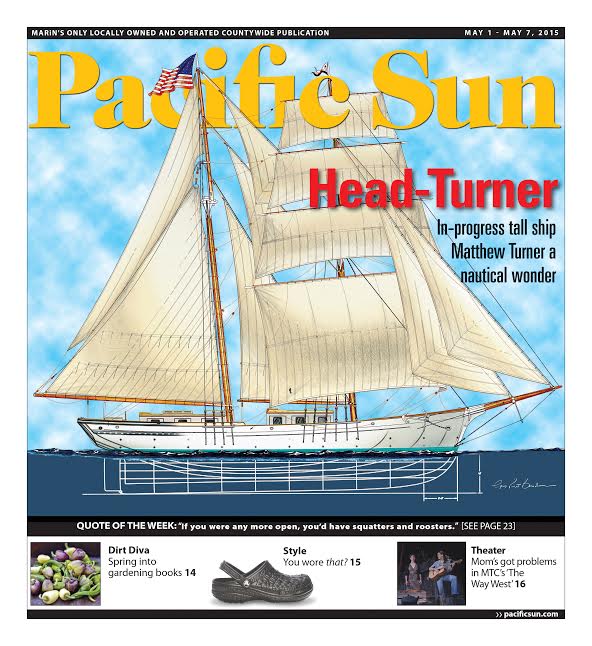
In this week’s issue of the Pacific Sun, David Templeton and Trent Anderson sit down with Alan Olson, founder and director of Educational Tall Ship, to learn more about the construction of the Matthew Turner tall ship in Sausalito. Dirt Diva Annie Spiegelman recommends gardening books for Mom for Mother’s Day and style expert Katie Rice Jones provides tips for avoiding fashion mistakes. Charles Brousse reviews Marin Theatre Company’s ‘The Way West,’ and Peter Seidman shines a light on a local flood plan. All that and more online and on stands today.
So proclaims the curious but slightly inconspicuous sign perched just outside a massive, white, circus-like tent structure across from Marinship Park in Sausalito.
Inside is, well, a tall ship. Part of one, anyway.
That there would be a nautical vessel of some kind tucked away inside should come as no surprise to anyone. But unprepared visitors to the noisy, bustling construction site—alive with the sound of electric saws, hammering and the shouts of a team of carpenters and other workers—are surely expecting anything other than what is actually being built there.
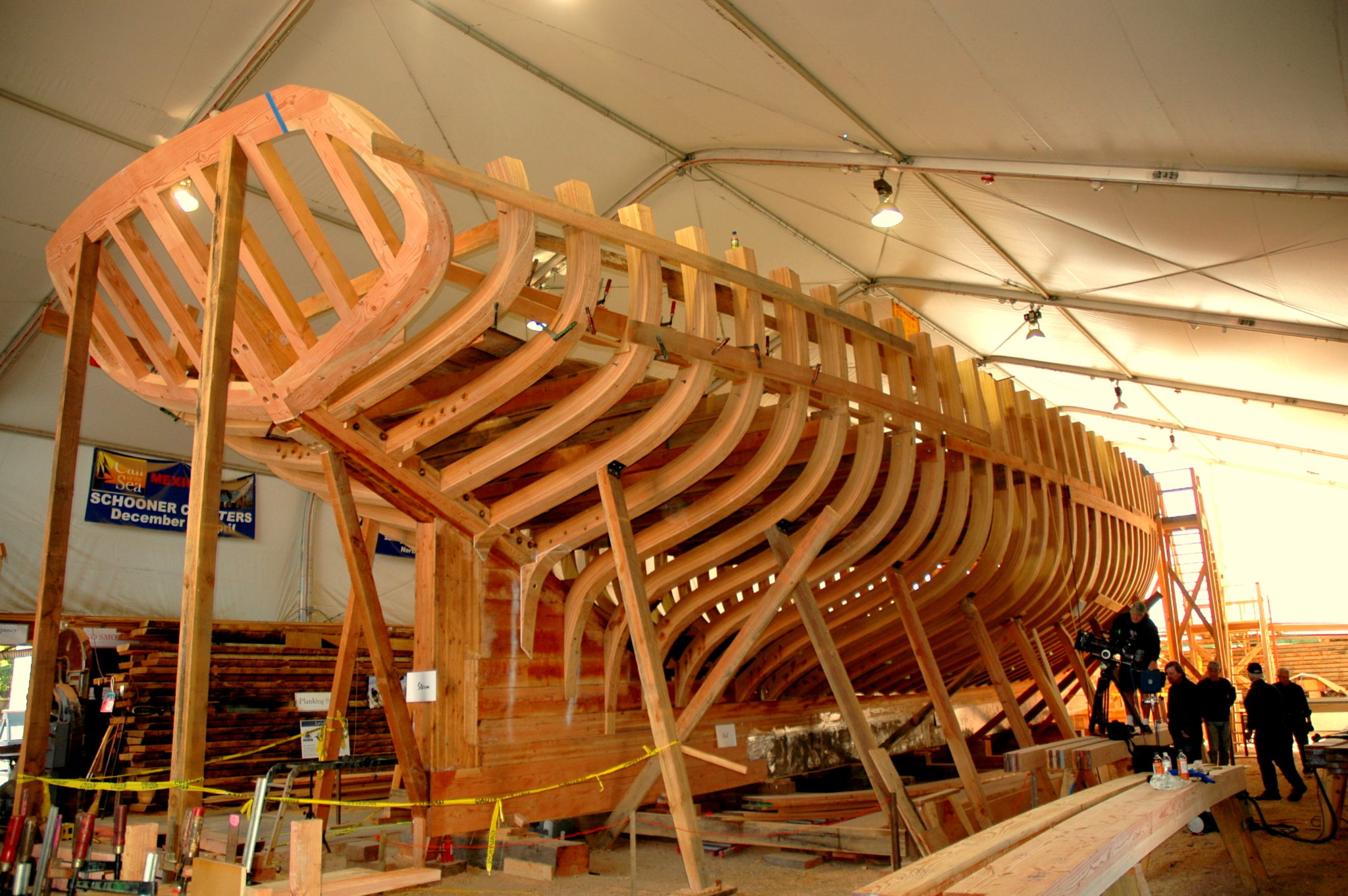
The Matthew Turner, its massive, still-skeletal frame resembling the stripped carcass of a whale, is a traditional “tall ship,” a rigged, two-masted wooden sailing vessel the likes of which is more common on the pages of a history book than tucked away under a circus tent in modern-day Sausalito. It’s not a small ship, either. The deck alone will be 100 feet long, and have a 25-foot beam. The interior will include passenger and crew quarters with 38 berths. When finished, it will be the first wooden ship of its size and kind to be built in the San Francisco Bay Area in more than 100 years.
The ship’s namesake—the late Matthew Turner—was a legendary 19th century seafarer, ship’s captain and shipbuilder who built a total of 228 ships in his lifetime, 154 of them manufactured at the Matthew Turner shipyard in Benicia, right here in the Bay Area.
“He was easily the most prolific builder of his time,” says Alan Olson, founder and executive director of Educational Tall Ship, the locally based nonprofit organization that is managing the construction and overseeing the financial end of the project. With 50 years of experience in maritime construction, engineering, restoration and sailing, Olson is uniquely suited for this $6.2 million project.
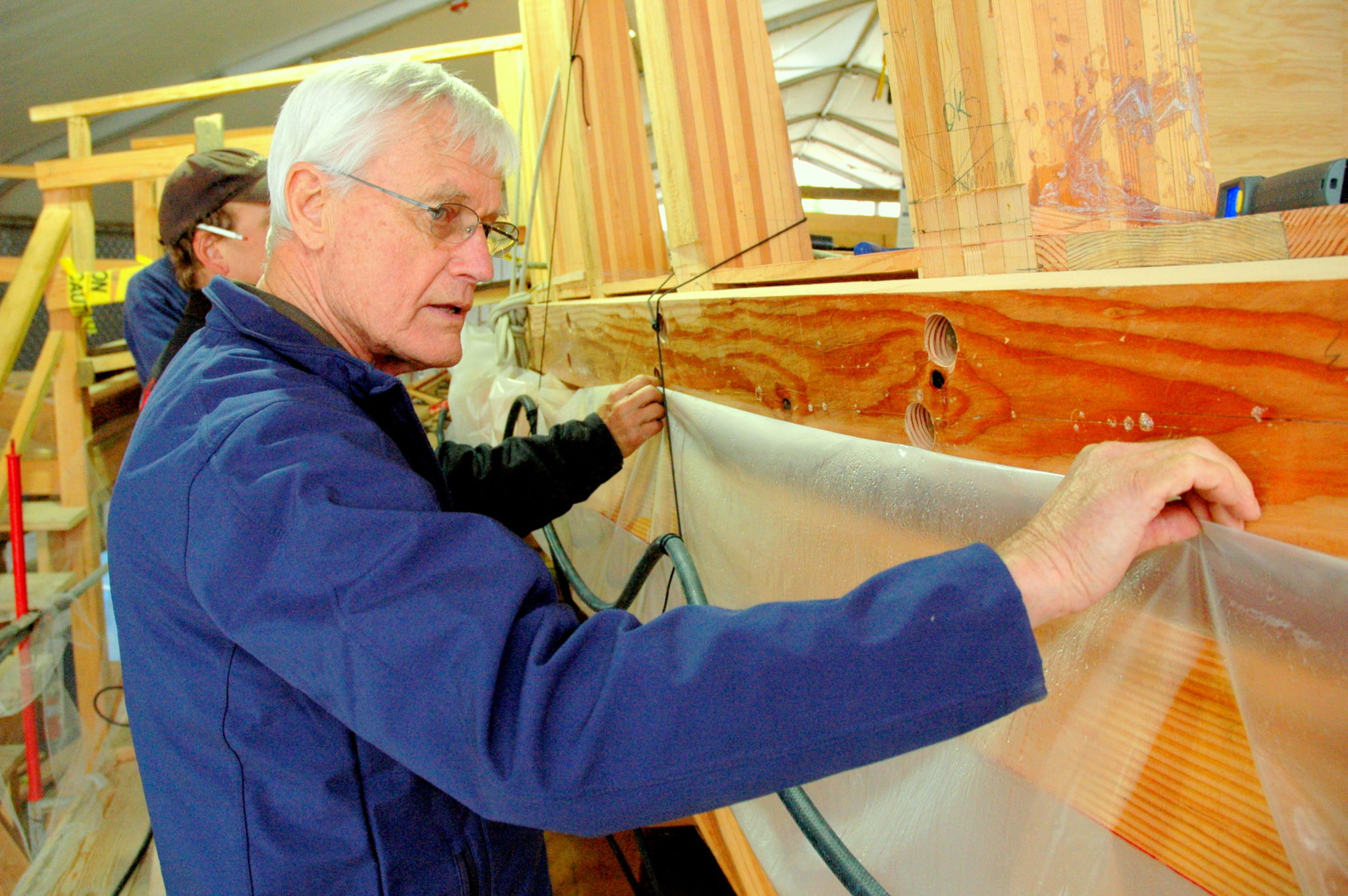
Alan Olson works on the Matthew Turner. Photo by John Skoriak
A lifelong sailor, he’s built a fair number of ambitious projects on land and sea, from a scaled-down brigantine—another breed of tall ship, often distinguished from each other by the number and arrangement of sails—to an impressive Zen temple he designed and built in Northern California. Even in his dreams, Olson has felt a connection to the sea and vessels that crossed them.
“I was inspired at a young age,” he says, “by early images and movies of sailing ships.”
The mission of Educational Tall Ship is to first complete construction of the Matthew Turner—which began construction in 2013—and then to provide on-the-water and shore-based experiential education for students of all ages and school levels. Programs will include sailing instruction, classes in marine ecology and maritime history and programs aimed at encouraging teamwork and responsibility. It’s a dynamic project, with rich educational opportunities throughout the entire construction process, and hopefully long after.
For now, a team of more than 150 active volunteers is working on a daily basis to complete the building, which is expected to continue for at least another two years. According to Olson, 32,000 hours of volunteer time have already been logged on the project. About a quarter of the work is done with paid staff, leaving three-quarters in the hands of a small army of craftspeople and laborers who just want to be part of an effort this rare and ambitious.
Earlier this year, Pacific Sun contributor David Templeton and former owner and producer of Media Group, Trent Anderson, sat down with Olson at his office just across from where the Matthew Turner is rising from the stuff of dreams into jaw-dropping reality.
Trent Anderson: When I first walked in and looked at what you are creating in there, I couldn’t believe it. What inspired you to build this kind of tall ship … in Sausalito?
Alan Olson: Well, it’s not really an original idea. If you look around the country and around the world, there are cities and countries building tall ships that represent who they are. They build them for education and for youth experiences. The only thing that’s original about what we’re doing is that nobody has done it yet here in the San Francisco Bay Area, with all of its history, and all of its money and all of its beauty. With all of that going on around here, we started wondering, where’s our tall ship?
So, way back in the early ’90s, we put together a group of people, and we formed a nonprofit with the idea of building our own tall ship in the Bay Area. This was many years ago. We weren’t able to pull it off. We weren’t able to crack the funding nut at that time. So we set it aside. We postponed the idea of actually building the ship. I went off and did some sailing, actually.
David Templeton: When did you resurrect the idea of building your own tall ship?
Olson: It was 2002. During the time I was off doing other things, I kept thinking that someone else would come along who was smarter, or who had more resources and connections. It just seemed like such an obvious project for San Francisco.
Templeton: What’s your background in relation to boats?
Olson: Well, I’ve always loved boating, and I’ve built some sailboats and other kinds of things. There are a few of the boats I’ve built [Pointing to some photographs of various vessels]. I once helped build a 150-foot catamaran down in Miami many years ago, but this thing outside is easily the biggest boat I’ve ever built. The catamaran was big, but it was just a big box tourist boat; but this is a real ship.
Anderson: From the plans and pictures you’ve created, I’m guessing it isn’t going to be some ancient-looking ship, which is what some might expect.
Olson: You’re right. It’s not going to look too ancient. It’s a late 19th century design. Ships like this were built in 1891. This design was probably the best that they had amongst the ships built for commercial use in the Pacific Ocean.
The deck of the Matthew Turner takes shape. Photo by John Skoriak
After that, they pretty much stopped building these kinds of sailing ships altogether. Everything went to steam and oil. But this was the epitome of the sailing ship era. Even clippers had stopped being built by then. I think the last clipper to be built was in 1875.
Anderson: Maybe it’s just my experiences with the Living History Center, but from what I see out there under the tent, I just assumed the finished project was going to look more like a pirate ship. But this is very different.
Olson: [Laughing] Yes! No pirate ships! This is definitely not going to be a pirate ship! There’ll be no cannons. We won’t be dressing up like Johnny Depp.
But everybody walks in, takes a look at what we’re building, and says, ‘Pirate ship!’ The so-called “Golden Age of Piracy” was back in the 1600s and 1700s.
This is something totally different. This is a fast, commercial trader of the late 19th century. For what it’s worth, pirate ships were actually pretty slow. This one is not that. This design broke a lot of speed records in its time, and some of those records are still standing. One of Matthew Turner’s boats made it to Tahiti in 21 days.
Templeton: Did Turner ever have a ship named after him?
Olson: He did, though it wasn’t one he built himself. There was a ship named the Matthew Turner built in Tahiti. It was built by descendants of a company he built in Tahiti.
Anderson: Will the new Matthew Turner have an engine in it?
Olson: There will be two electric-drive propulsion motors. But the sails will be its primary power. Modern sail-makers love projects like this. They can make big sails with no problem. These sails will be a little different. They’ll use a little softer material than Dacron. We might put together the sails here, ourselves, if we can find the space to do it.
Templeton: This project is primarily being funded by individual donations, isn’t that right?
Olson: We’ve raised just about 75 percent of the money we need to complete the building of the ship. We just had a nice pledge come in recently, and a few more hanging in the balance.
Templeton: So, what’s your sales pitch when asking someone to donate to this kind of project? What’s the hook?
Olson: Well, most of our donors—not all of them, but most of them—come from a boating background. Some of them have retired from it, but they remember how important boating and sailing was to them. They can see the value of young people having the chance to get out on a ship like this. Some of them are focused on the educational part of it. Most of them just want to be part of something that promotes and preserves a tradition that is important to them. If they were golfers, they’d probably want kids to learn something about golfing.
One of the goals of Educational Tall Ship is to get kids excited about protecting the ocean. Photo courtesy of Educational Tall Ship.
We want to make sure kids have the opportunity to be sailors, or at least to experience sailing. So, that’s primarily it. Though some donors come in from the historical point of view. They want to keep these kinds of sailing vessels alive. But for most of us, it’s all about the experience of being out on a boat like this. There’s just nothing like it.
Templeton: And then, there’s the experience of getting to be part of building a boat like this. It’s one thing to see a tall ship on the water. We don’t get many chances to see a ship of this kind in the process of being put together from scratch.
Olson: It is amazing, isn’t it? People are blown away. When it’s all said and done, if you don’t see the bones of the thing, the structure, the way it all fits together, you don’t really know what a boat like this is. It’s fascinating to a lot of people. It certainly is to me. I’m a builder. I want to know how a thing is put together. When I go out on a boat, I start looking around, under the bilge, everywhere, because I’m just interested in how a thing is made.
There are a lot of people who feel that way. Most of the people out there working on this right now come from a boating background, or maybe a carpentry background, or are very skilled builders in some way. Getting to be part of a project like this, a ship built of wood—it’s sort of the Holy Grail of carpentry.
If you are a carpenter, if you want to make something really one-of-a-kind, this is probably at the top of the line in terms of the complication of the project, the shapes, the lines and the use of materials.
Anderson: Where will the completed ship be docked?
Olson: It will be docked at the Bay Model pier. But we’ve got a long way to go yet. We’ll start planking soon—that’s the skin of the boat—but that will take a while, and we’ll leave a section of it unplanked for a long time, so people can see what the inside looks like, and so builders can pass things in and out to each other.
I know it looks impressive now, with just the frame of the boat in place, but even with the planking on, I promise you, it will be a pretty imposing sight.
Anderson: The general purpose of this, then, is to give kids the experience of sailing on a tall ship?
Olson: Yes. It’s about young people and their experience. Not only the experience of sailing, but just being on the water. What it means to work together, as a team. But also—and this is a very important part of why we’re doing this—to get kids tuned into the ecology of the ocean, to water and what’s going on with it.
Most people, kids or otherwise, think the ocean is just this big thing that’s out there. Maybe they know fish come out of it, but they don’t know much more. Our hope is that by falling in love with the ocean, it will inspire them to become better stewards of the ocean, and of the entire planet.
Ask Trent and David if they’re lost at sea at le*****@********un.com.
SEE HISTORY COME ALIVE: Check out the progress of the Matthew Turner Mondays through Saturdays from 8am to 4pm at 2330 Marinship Way, Sausalito. To learn more about the Educational Tall Ship, or to donate to the project, call 415/886-4973 or visit educationaltallship.org.
by Lily O'Brien
Celebrate your inner and outer artist at the 22nd annual Marin Open Studios the first two weekends in May. This exciting, inspiring and free event lets you tour the studios of more than 270 local Marin artists—from painters to sculptors to jewelers to stained-glass artisans. You not only get to see really cool stuff, but you get...
Exercise might do you good
I am mad. I just spent about 10 minutes circling the parking lot outside of the row of restaurants and shops at the Northgate Mall where the BJs, Chipotle, Peet’s, etc. are. With my daughter in the car, planning to have lunch and then have our nails done at Fingers & Toes. My daughter has...
Required reading
The last four paragraphs of Steve Heilig’s interview with Peter Coyote should be required reading for everyone in Marin County. Having lived in Marin over the same decades, I’ve not seen anyone articulate so well the paradigm shift in values which jeopardizes the fabric of this county that Mill Valley exemplifies.
Terence Cox
Peter, don’t go
Really enjoyed Steve cover story . Sorry to see Peter move to Sonoma ... West Marin, not Olema in the Sixties, has the feel of yesterday’s Mill Valley.
Allan Bortel
Just an illusion?
I am responding to a couple of letters in the April 24 issue of the Pacific Sun by cyclists seeking more access to single-track trails in Marin.
One of the cyclists’ letters mentions spending money in Marin. I’m not sure why this is relevant unless it argues for dollars entitling cyclists to some particular privilege.
The writer notes that...
by Tanya Henry
Thanks to a group of dedicated individuals, the Fairfax Food Pantry will turn 4 years old this month. The Fairfax Volunteers have partnered with the town and the Fairfax Community Church to offer groceries provided by the SF-Marin Food Bank to as many as 140 families once a week. Every Saturday from 9am to 11am, anyone in...
by Lily O’Brien
Fingerstyle guitar fans fret no more—an evening of masterful, world-class music awaits. Teja Gerken, Matthew Montfort and Tim Sparks will come together on Thursday, May 7 at the Throckmorton Theatre to blend world-fusion, jazz, blues, classical, celtic and more at the Acoustic Guitar Summit.
Gerken, who organized the event, has been bringing different players together to perform a...
In this week's issue of the Pacific Sun, David Templeton and Trent Anderson sit down with Alan Olson, founder and director of Educational Tall Ship, to learn more about the construction of the Matthew Turner tall ship in Sausalito. Dirt Diva Annie Spiegelman recommends gardening books for Mom for Mother's Day and style expert Katie Rice Jones provides tips...
by Trent Anderson and David Templeton
Building a Tall Ship
So proclaims the curious but slightly inconspicuous sign perched just outside a massive, white, circus-like tent structure across from Marinship Park in Sausalito.
Inside is, well, a tall ship. Part of one, anyway.
That there would be a nautical vessel of some kind tucked away inside should come as no surprise to anyone....