Advice Goddess

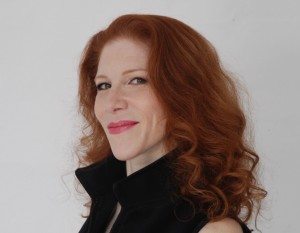
Q: I get very lonely around the holidays. My family is just my parents, and they’re far away. I don’t have a boyfriend right now. I have many friends and good people in my life, but instead of hanging out with them, I find myself isolating. So . . . it seems my treatment for loneliness is loneliness, and then feeling sorry for myself that I’m home alone. Help!—Pity Party Animal

A: Each of us gets into the holiday spirit in our own special way. Some of us build gingerbread houses; some of us build gingerbread psychiatric hospitals. To understand how you can long for human connection and (ugh!) long to avoid it at the very same time, it helps to understand the mechanics of loneliness—the pain we feel when we’re disconnected from others. Like other emotions, loneliness is “adaptive,” meaning it has a function. It most likely evolved to motivate ancestral humans to behave in ways that would help them survive and mate.

The problem is, our psychology is complex, and work orders laid out for us by different emotional adaptations—different functional feelings—sometimes conflict. For example, the sadness that comes with loneliness is also motivating—only it can motivate you to lie facedown on the couch. This probably seems anything but useful, but psychiatrist and evolutionary psychologist Randolph Nesse explains that the slowing down in energy that’s a partner to sadness gives us time to examine our behavior, figure out whether we might do better with different tactics, and, if so, change our MO.

It’s important to take stock like this—to a point. But if you remind yourself of the evolved job of emotions, you’ll see that it’s sometimes in your interest to override them. In short, you can do your sadness homework without making your loneliness worse by spending your entire holiday mumbling into the throw pillows.

Tell your besties that you could use some cheering up, and give yourself an emotional work assignment: going to a minimum of three parties over the holidays where groups of your friends will be in attendance. Keep in mind—while you’re lifting what feels like your 3,000-pound arm to apply mascara before going to some shindig—that we’re bad at predicting what will make us happy or unhappy. Chances are, once you’re at the party, you’ll catch a buzz from the eggnog, get laughing with your friends, and accidentally slack off on your fashionable nihilism—your muttering that it’s all nothingness and you’re alone in the universe except for your unpaid debts.

Q: I’m a 32-year-old guy with a really great female friend. We talk on the phone, grab food, etc. She even kept me company in the hospital after I got into a motorcycle accident. I’ve started falling for her, and I want to ask her out, but I’m afraid of losing her friendship.—Conflicted

A: It’s just a bit of a twist on the friendship ring. You’d like to give her a friendship penis. Risk researchers find that decision-making in the face of uncertainty, when we can’t be sure of what the outcome will be, is really hard for us. However, by plugging in all the information we have, positive and negative, we can make an educated prediction about how things are likely to turn out—and whether we can afford the loss if our effort is a bust.

For example, if you have only one friend and if you’re pretty sure you could never make another—say, because you live on one of those tiny desert islands in a New Yorker cartoon—you might decide it’d be too costly for you to risk saying something. And if, on a scale from 1 to 10, your friend is a 9.2 and you’re more on the bridge troll end of the spectrum (in both looks and career prospects), your chances of romance with her might be pretty slim. (Shrek is not a documentary.)

If, after weighing the pros and cons, you decide to ask this woman out, you could simply say, “I’d like to take you on a date. Would you be interested in that?” Yes, it’s possible that doing this would tank your friendship, but chances are, you’d just act a little weird around her for a while. Then again, if you said nothing and constantly agonized over wanting her, you might also end up acting all weird—in ways that would make continuing your friendship impossible. (OK, so she’s not into you, but maybe if you send her yet another love poem written in your own blood . . .)

Darkroom Star

Bob Minkin has always been a collector. Before he got into music, he collected comics, stamps, things like that. Once he fell for rock and roll as a teenager, he started collecting concerts.

“It was such an experience, and I wanted a souvenir for myself,” says Minkin, who developed a passion for taking photos at live shows in his hometown of Brooklyn.

A certified Deadhead, Minkin first came to the Bay Area to photograph the Grateful Dead at Winterland in 1977. “Around that time, I was friends with the publisher of Relix magazine, based in New York—they covered that scene,” says Minkin. “He started publishing my pictures and paying me. I thought, there’s something to this, and I never stopped.”

For the last 40 years, Minkin­—who would move to Marin with his family in 1990, after a decade of frequent visits to the area—has amassed a collection of live concert photos numbering in the hundreds of thousands. He shares the best of the best from his time in the North Bay in a new book, The Music Never Stopped: Marin County’s Music Scene, that boasts over 500 never-before-seen images, including performance shots and intimate backstage, off-stage and at home photographs of over a hundred local musicians.

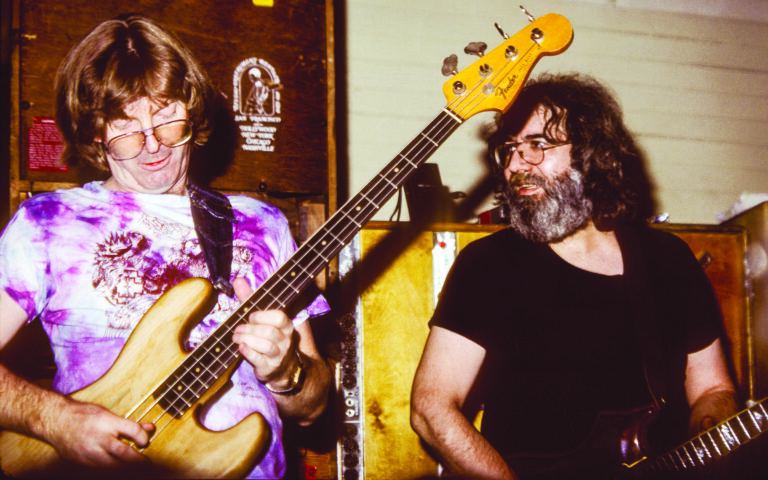
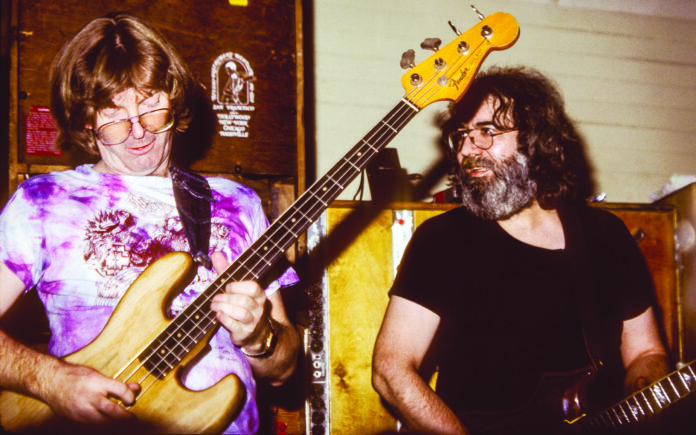
Highlights include a rare shot of the Jerry Garcia Band performing in Fairfax in 1981 (pictured) in a set that featured Dead bassist Phil Lesh joining Jerry onstage, a rare treat for JGB fans.

“It blew me away to see Jerry in this low-key setting,” says Minkin. “When he came to New York, it was always a big deal, but here in Marin, it was like, ‘Oh, yeah, he’s playing in Fairfax, wanna go?’”

Covering the Marin music scene closely, Minkin says there was a brief lull in the late 2000s, after the original Sweetwater closed in Mill Valley, but since the opening of Terrapin and the new Sweetwater, the local scene is as strong as ever.

Minkin is currently the house photographer for the Sweetwater Music Hall as well as a prominent presence at Terrapin Crossroads and other venues, and he has established himself in the scene and gained access to stars like Mickey Hart, Bob Weir and others featured in the book.

Categorized by city and venue, The Music Never Stopped is a virtual concert road trip for Marin music lovers. “The idea was to honor the musical heritage of Marin, to honor the musicians, and to honor the fans,” Minkin says. “I’m a fan, too.”

Minkin’s book also includes several contributions from musicians like Steve Kimock and Dead drummer Bill Kreutzmann, a forward from Phil Lesh and an introduction from Pete Sears—all of which add personal insights into the stories behind the shots.

Minkin also gives room in the book for the younger musicians coming up in the scene. “A new generation has picked it up and are moving it forward,” he says. “So truly the music never stopped, and, hopefully, it never will.”

Bob Minkin appears on Friday, Dec. 7, at the Depot Bookstore & Cafe, 87 Throckmorton Ave., Mill Valley. 7pm. Free. 415.383.2665.

Horoscope

ARIES (March 21–April 19) When I write a horoscope for you, I focus on one or two questions because I don’t have room to cover every single aspect of your life. The theme I’ve chosen this time may seem a bit impractical, but if you take it to heart, I guarantee you it will have practical benefits. It comes from Italian author Umberto Eco. He wrote, “Perhaps the mission of those who love humanity is to make people laugh at the truth, to make truth laugh, because the only truth lies in learning to free ourselves from insane passion for the truth.” I swear to you, Aries, that if you laugh at the truth and make the truth laugh in the coming days, you will be guided to do all the right and necessary things.

TAURUS (April 20–May 20) You have a cosmic mandate and a poetic license to stir up far more erotic fantasies than usual. It’ll be healthy for you to unleash many new thoughts about sexual experiments that would be fun to try and novel feelings you’d like to explore and people whose naked flesh you’d be interested to experience sliding and gliding against yours. But please note that the cosmic mandate and poetic license do not necessarily extend to you acting out your fantasies. The important thing is to let your imagination run wild. That will catalyze a psychic healing you didn’t even realize you needed.

GEMINI (May 21–June 20) In my continuing efforts to help you want what you need and need what you want, I’ve collected four wise quotes that address your looming opportunities. (1) “What are you willing to give up, in order to become who you really need to be?”—author Elizabeth Gilbert (2) “Leave the door open for the unknown, the door into the dark. That’s where the most important things come from.”—Rebecca Solnit (3) “You enter the extraordinary by way of the ordinary.”―Frederick Buechner (4) “Happiness is like a butterfly which, when pursued, is always beyond our grasp, but, if you will sit down quietly, may alight upon you.”―Nathaniel Hawthorne

CANCER (June 21–July 22) I’ve called on author Robert Heinlein to provide your horoscope. According to my astrological analysis, his insights are exactly what you need to focus on right now. “Do not confuse ‘duty’ with what other people expect of you,” he wrote. “They are utterly different. Duty is a debt you owe to yourself to fulfill obligations you have assumed voluntarily. Paying that debt can entail anything from years of patient work to instant willingness to die. Difficult it may be, but the reward is self-respect. But there is no reward at all for doing what other people expect of you, and to do so is not merely difficult, but impossible.”

LEO (July 23–August 22) What does beauty mean to you? What sights, sounds, images, qualities, thoughts and behavior do you regard as beautiful? Whatever your answers might be to those questions right now, I suggest you expand and deepen your definitions in the coming weeks. You’re at a perfect pivot point to invite more gorgeous, lyrical grace into your life; to seek out more elegance and charm and artistry; to cultivate more alluring, delightful magic.

VIRGO (August 23–September 22) You know the expiration dates that appear on the labels of the prescription drugs you buy? They don’t mean that the drugs lose their potency after that date. In fact, most drugs are still quite effective for at least another 10 years. Let’s use this fact as a metaphor for a certain resource or influence in your life that you fear is used up or defunct. I’m guessing it still has a lot to offer you, although you will have to shift your thinking in order to make its reserves fully available.

LIBRA (September 23–October 22) Libran rapper Eminem is renowned for his verbal skill. It may be best exemplified in his song “Rap God,” in which he delivers 1,560 words in six minutes and four seconds, or 4.28 words per second. In one stretch, he crams in 97 words in 15 seconds, achieving a pace of 6.5 words per second. I suspect that in the coming weeks, you will also be unusually adept at using words, although your forte will be potent profundity rather than sheer speed. I encourage you to prepare by making a list of the situations where your enhanced powers of persuasion will be most useful.

SCORPIO (October 23–November 21) In May of 1883, the newly built Brooklyn Bridge opened for traffic. Spanning the East River to link Manhattan and Brooklyn, it was the longest suspension bridge in the world. But almost immediately people spread rumors that it was unstable. There was a growing fear that it might even crumble and fall. That’s when charismatic showman P. T. Barnum stepped in. He arranged to march 21 elephants across the bridge. There was no collapse, and so the rumors quickly died. I regard the coming weeks as a time when you should take inspiration from Barnum. Provide proof that will dispel gossipy doubt. Drive away superstitious fear with dramatic gestures. Demonstrate how strong and viable your improvements really are.

SAGITTARIUS (November 22–December 21) Robert Louis Stevenson published his gothic novel Strange Case of Dr. Jekyll and Mr. Hyde in 1886. It was a bestseller, and quickly got turned into a theatrical production. In the ensuing 132 years, there have been well over a hundred further adaptations of the story into film and stage productions. Here’s the funny thing about this influential work: Stevenson wrote it fast. It took him three feverish days to get the gist of it, and just another six weeks to revise. Some biographers say he was high on drugs during the initial burst, perhaps cocaine. I suspect you could also produce some robust and interesting creation in the coming weeks, Sagittarius—and you won’t even need cocaine to fuel you.

CAPRICORN (December 22–January 19) A blogger on Tumblr named Ffsshh composed a set of guidelines that I think will be apt and useful for you to draw on in the coming weeks. Please study these suggestions and adapt them for your healing process. “Draw stick figures. Sing off-key. Write bad poems. Sew ugly clothes. Run slowly. Flirt clumsily. Play video games on ‘easy.’ OK? You do not need to be good at something to enjoy it. Sometimes talent is overrated. Do things you like doing just because you like doing them. It’s OK to suck.”

AQUARIUS (January 20–February 18) Aquarian athlete Michael Jordan is the greatest basketball player who ever lived. He was also the first to become a billionaire. But when he was growing up, he didn’t foresee the glory that awaited him. For example, in high school he took a home economics class so as to acquire cooking abilities. Why? He imagined that as an adult he might have to prepare all of his own meals. His ears were so huge and ungainly, he reasoned, that no woman would want to be his wife. So the bad news was that he suffered from a delusion. The good news was that because of his delusion, he learned a useful skill. I foresee a similar progression for you, Aquarius. Something you did that was motivated by misguided or irrelevant ideas may yield positive results.

PISCES (February 19–March 20) The Bible does not say that Mary Magdalene was a prostitute or even a “sinner.” There’s no mention of her sexual proclivities at all. Delusional ideas about her arose in the Middle Ages, instigated by priests who confused her with other women in the Bible. The truth is that the Bible names her as a key ally to Christ, and the crucial witness to his resurrection. Fortunately, a number of scholars and church leaders have in recent years been working to correct her reputation. I invite you to be motivated and inspired by this transformation as you take steps to adjust and polish your own image during the coming weeks. It’s time to get your public and private selves into closer alignment.

The Rent Kept a-Rollin’

“THE FUTURE IS RIDING ON METRO”

Never had I ever read such a prescient message as the one stamped at the bottom of my rail-ticket receipt. It was Oct. 27, and I had just bought a SmarTrip card at the Metrorail’s Reagan Airport station in Washington, D.C., and was on my way to a big conference about the benefits and problems that ensue when a new commuter train comes to town.

I was in D.C. to report how the conference’s findings might intersect with the Sonoma Marin Area Rail Transit system that’s been running up and down the North Bay for the past year, with lots of questions buzzing around about what it will mean for the region moving forward. In linking Santa Rosa with San Rafael, can SMART be seen as an arbiter of what’s to come for a region crippled by an ongoing absence of affordable housing? Alas, yes.

I have a personal and professional affinity for train travel. I was, ten years ago, an intern at the Central Japan Railway Company (aka JR Central). One of JR Central’s subsidiaries, Nippon Sharyo, performed the final assembly of SMART’s rolling stock at its Illinois plant. JR Central was hosting a reunion event in the nation’s capital for all former interns, and I was invited to the all-expense-paid junket. The event included a conference at K&L Gates—the law firm that represents JR Central domestically—followed by a reception at the swank St. Regis hotel.

I hopped on a plane to learn more about how JR Central’s business might affect train travel moving forward for SMART—well, especially for millennial SMART riders of the scrappy freelancer variety, who can barely afford to live in the North Bay as it is, but who love to ride the train whenever possible.

There was the big takeaway from the Washington conference. For all the talk of “transit-oriented development” in the North Bay, for all the civic concern about affordable housing, workforce housing, tiny homes, rent control and etc., the research points in one direction when it comes to commuter trains: they drive up real-estate prices in regions where they’ve been built.

It’s no fault of the train systems, of course, and SMART faces its own affordable-housing problem as a company in need of a reliable, and preferably local, workforce that it can retain.

“There are many instances of transit-oriented [development] nationwide that include affordable housing,” says SMART spokeswoman Jeanne Mariani-Belding via email. “Those land-use issues typically rest with local jurisdictions. Businesses throughout the North Bay, including SMART, are feeling the effects of the lack of affordable housing and the challenges that creates in terms of hiring and retaining people.”

SMART has been rolling along for just over a year, offering lots of discounts and fairly priced monthly passes for commuters, and when I took my parents on the green machines this August, plenty of riders were traveling north to and from San Rafael, for work and fun.

Despite a few notable collisions involving pedestrians and trucks, the much-delayed SMART rollout has been a success, and a net positive for the region. But the success may also herald a less-than-desirable new challenge for North Bay residents. When the commuter rail comes to a region, the price of housing tends to go up, and then up some more. That’s a critical issue for a region that is struggling mightily to square up its housing scene to sync with the promise of a 21st-century SMART rail system that’s accessible and affordable to all.

It was a cold, blustery day in the nation’s capital that suggested a harsh winter was right around the corner. The White House was a sad sight with all the extra security and barricades that extended 70 feet from the main wrought-iron fence, to say nothing of its occupant.

Circling back around to K&L Gates, I stepped into a conference room full of JR Central employees, former interns and my Japanese-American relations professor from Vanderbilt, James Auer. He made it possible for students like me to participate in the internship. After a few minutes of greetings, we sat at our assigned seats to find materials detailing JR Central’s latest advancements in maglev technology, and the company’s impressive growth in the decade since I interned.

The first speaker was deputy general manager Rikuhei Daimon, who organized the reunion. Telling us that we would always be members of the JR Central family, he introduced Masahiro Nakayama, JR Central’s general manager in the United States. Nakayama filled our heads with visions of the N700S Shinkansen, the train model that in the near future will connect Dallas and Houston in 90 high-speed minutes. Neat.

The most eye-opening talk—and the one that’s very relevant to North Bay residents—was given by rail researcher Mike Schlicting, a former JR Central intern and a current doctoral student at the University of Wisconsin in Madison.

Schlicting discussed his research into the economic impact of reliable passenger rail on economically depressed and underdeveloped areas. The findings are clear, he said: when a city has access to fast and dependable rail transportation, rents and real estate prices go through the roof. Poorer residents are pushed out, replaced by urban professionals. How far through the roof do prices skyrocket? He exclaimed that the prices of commercial and residential real estate rose “from $5 a square foot, to $20 or $30 dollars a square foot.”

As he spoke, any idea of owning a home in the North Bay devolved from dim hope to cruel joke. And he just kept talking. Schlicting showed attendees before-and-after photos of western Washington, D.C., that illustrated the effects of what happened when the Metro line was extended. This was a part of town where you never wanted to get caught after dark, he reported, which now boasts high-density, high-rent apartment clusters over each station. The buildings are typically 15 to 20 stories, and the clusters looked like their own mini cities.

Schlicting’s presentation evoked the regional mantra about high-density development in urban areas: the model could support the continuance of the regionally accepted wisdom of urban-growth boundaries—if North Bay residents are willing to accept a SMART corridor that’s dotted with tall apartment buildings at every train stop and that abandons any pretext that those buildings will be set aside for local workforce housing.

When it comes to passenger rail systems, Schlicting stressed that they are not built for the people who live in the region; they are built for people who are going to move their to pursue new economic opportunities. Without attendant population growth, systems such as SMART can’t sustain themselves and risk becoming another Napa Wine Train.

Schlicting wasn’t alone with the words of warning. Every speaker’s message clashed with the current reality in Sonoma and Marin counties: new rail lines only make sense as long as local communities along the route invest heavily in affordable housing. Until that day happens, SMART will remain a niche product.

Santa Rosa’s Press Democrat has already been reporting that one of SMART’s most significant challenges is that it appeals mainly to the “white and well-off.” Many of today’s riders choose to use SMART even though they could drive.

The conference broke up and we headed to the St. Regis’ James Monroe Room, where JR Central hosted a swanky shindig. I approached general manager Nakayama, and we talked a bit about the company’s rolling stock, its cars. How would the company deal with domestic orders for new cars now that Nippon Sharyo no longer operates a factory in the United States? He said the company would try to honor its previous price structure for open contracts. His answer implied that prices had nowhere to go but up, but what else is new?

I assured Nakayama that Sonoma and Marin county residents appreciated that they had an alternative to the jam-packed highway, high gas prices and road rage. We happily chatted about the beautiful Northern California scenery and how he or another JR Central manager travels here once or twice a year to check up on SMART.

Keep on checking. New SMART train cars might be added to accommodate demand, and train tickets may get pricier in coming years. And if the conference experts are right, the northern Sonoma County real estate market should boom when the train line is expanded north—for better and worse.

I asked SMART to weigh in on this irony: Even as the railroad struggles to retain its workforce—because of the high cost of living in the North Bay—rail experts maintain that the commuter system is itself driving up the cost of living here. The SMART response was to send links to its fare schedule and to note that the railroad does provide steep discounts to senior and student riders.

I’d suggest readers of lesser means start saving up for that $400,000 chicken-shack in affordable-for-now Cloverdale. And I’ll join with fellow millennials as we keep our fingers crossed for some SMART-adjacent affordable housing to emerge, somewhere along the gentrified line. Who knows, maybe it will. Petaluma? Novato? Santa Rosa?

Here’s hoping—but I’ll believe it when I see it.

Gatekeeper

Supposedly there are 35 films about Vincent van Gogh. It’s a tribute to the depth and clearness of Willem Dafoe’s acting that the latest, At Eternity’s Gate, is as affecting as it is.

At Eternity’s Gate is director Julian Schnabel’s best film, giving a small-camera approach to the drama, shot amid the medieval ruins and hills of the South of France. These landscapes are given a little digital toasting to make this fairest place on earth (except for Northern California, of course) look like van Gogh’s paintings, gilding the weeds, purpling the shadows and bringing out the bright orange stripes in the painter’s straw hat to match the accents in his self-portrait.

Dafoe is very pure here. The rawboned face hides nothing, showing lucidity even in the torment of his madness. This film doesn’t poeticize the artist’s insanity, as per the complaints comedian Hannah Gadsby made about the received idea that van Gogh painted because he was mad, instead of despite it.

Schnabel even airs a conspiracy theory of how the artist died. True, he was persecuted. The great-grandparents of the people who charge you to see van Gogh’s house signed a petition to get him out of Arles. But the vortex of the sadness is the abandonment by his friend Paul Gauguin (a calm, unflamboyant Oscar Isaac). Such an unfortunate friendship, between a man who needed love so desperately and a man who never really cared much about that kind of thing.

Schnabel has the good taste to black out the self-mutilation, but in the end, he corners his subject clinically with a pair of interrogations, one by the doctor Felix Rey (Vladimir Consigny), the other by a priest (Mads Mikkelsen). As a longtime fan of Emmanuelle Seigner ever since Bitter Moon, I enjoyed watching her measured friendliness as Mme. Ginoux as she chats with van Gogh about books, before he scares her off with his intensity.

The film could have used a bit less of Tatiana Lisovskaya’s soundtrack—a lot of piano with the hard-pedal leaned on; it clashes with At Eternity’s Gate’s successful attempt to give van Gogh an aura of silence and space.

‘At Eternity’s Gate’ opens Friday, Dec. 7, at the Smith Rafael Film Center.

Hero Zero

Hero

Puff, puff, puff away on your vape juices and menthol cigarettes now, because beginning Jan. 1, specialty tobacco stores in unincorporated Marin won’t sell flavored tobacco products anymore. Even better, a ban for all sellers in the area goes into effect on July 1. The county follows the lead of Sausalito, Fairfax and Novato, as they previously legislated against the merchandise. Damning data shows that vaping more than doubled in the past two years among Marin’s seventh, ninth and 11th graders. “After decades of progress on the reduction of tobacco use, we’re losing ground,” says Matt Willis, Marin County’s public health officer. Most cigarette users become addicted at a young age, and they started by using the flavored stuff, which introduces them to addictive nicotine. What’s the allure for kids? Remember, big tobacco is a genius marketer. Yummy flavors, including cotton candy, buttered popcorn and bubble gum, mask the harshness of regular tobacco. Kudos to the Marin County Board of Supervisors for the new prohibitions.

Zero

Who does Marin County Sheriff Robert Doyle think he’s fooling? Not us. He announced last week that he will no longer alert U.S. Immigration and Customs Enforcement (ICE) to inmate release dates, unless the person has been charged with or convicted of a serious crime. We previously blasted Doyle on his policy of sharing inmate info with ICE, and at first glance, it appears he’s changed his icy position on the matter. Nope. It’s all smoke and mirrors. You’ll still find release dates for jail inmates on the sheriff’s office public booking log webpage. Gee, is that info invisible to ICE? No. In addition, if ICE calls for information, Doyle’s office will provide it. What changed? In essence, nothing. Sure, the sheriff is no longer contacting ICE directly with an inmate’s release date; however, he makes it readily available online. Good try, Doyle, but we’re not buying that you’ve seen the light. We wish you’d remember that you work for Marin, not ICE.

Letters

Powerage

My argument: for those seniors on a fixed income, or those living in hospital beds or needing to refrigerate their meds, it’s tough to have a power outage for two days (“Paradise Glossed,” Nov. 21). PG&E said they wouldn’t reimburse groceries this year if they decided to turn off the power! And for folks who are ill, who had money to go buy a generator or fuel to start it or the ability to turn it on? What about those with a well? Their power outage means they can’t hose down their roof or barn?

Catherine Renee Gumina

Via Facebook

PG&E should not be turning off our power every time it gets windy to try and solve their transformers causing fires!

J. Kirk Feiereisen

Via Facebook

They have to. I know it seems rough, but when the winds get going and the dry trees snap . . . PG&E is being sued for the deaths last year, and will face more for Paradise. Gotta turn off the ignition factor.

Sharon Jane Hughes

Via Facebook

Opinion: We’ve Had Enough Clintonism

Twenty-five years ago, when I wrote False Hope: The Politics of Illusion in the Clinton Era, I didn’t expect that the Democratic Party would still be mired in Clintonism two and a half decades later. Such approaches to politics continue to haunt the party and the country.

The last two Democratic presidencies largely involved talking progressive while serving Wall Street and the military-industrial complex. The differences in personalities, and behavior, of Bill Clinton and Barack Obama diverted attention from their political similarities. In office, both men rarely fought for progressive principles, and routinely undermined them.

Clinton brought the country NAFTA, welfare “reform” that was an assault on low-income women and families, telecommunications “reform” that turned far more airwaves over to media conglomerates, the repeal of Glass-Steagall regulation of banks that led to the 2007–08 financial meltdown, and huge increases in mass incarceration.

Obama bailed out big banks while letting underwater homeowners sink, oversaw the launching of more missiles and bombs than his predecessor George W. Bush, ramped up a war on whistleblowers, turned mass surveillance and the shredding of the Fourth Amendment into bipartisan precedent and boosted corporate privatization of public education.

It wasn’t only a congressional majority that Democrats quickly lost and never regained under Obama. By the time he left the White House, nearly a thousand seats in state legislatures had been lost to Democrats during the Obama years.

Thanks to grassroots activism and revulsion toward President Trump, Democrats won back the House last month and recaptured one-third of the state legislative seats that had been lost while Obama led the party and the nation.

During the last two years, progressive momentum has exerted major pressure against the kind of corporatist policies that Clinton set into cement atop the Democratic Party. But today, the party’s congressional leaders, like Nancy Pelosi and Chuck Schumer, are still in a mode loosely replicating Clinton’s sleight-of-tongue formulas that have proved so profitable for corporate America, while economic inequality has skyrocketed.

As 2018 nears its end, the top of the Democratic Party is looking to continue Clintonism without the Clintons. Or maybe Clintonism with the Clintons. A real possibility is now emerging that Hillary Clinton will run for the 2020 Democratic presidential nomination—but whether she runs or not, Clintonism is a political blight with huge staying power. It can be overcome only if and when people at the grassroots effectively insist on moving the Democratic Party in a genuinely progressive direction.

Norman Solomon

Inverness Park

True Believers

0

For Marin audiences seeking live, holiday-themed entertainment, local theater companies are currently presenting an ecclesiastical musical and a one-man holiday reminiscence.

In 1985, writer-composer Dan Goggin adapted his line of greeting cards that featured nuns saying outrageous things into a cabaret show and then an off-Broadway musical. That show, Nunsense, told the tale of the Little Sisters of Hoboken putting on a variety show to raise funds to bury the last of 52 nuns accidentally poisoned by the convent cook. That basic plot has sustained the Nunsense franchise over six sequels and three spinoffs.

The College of Marin presents Nuncrackers: The Nunsense Christmas Musical, the holiday version of the popular franchise. This time, the Sisters are broadcasting from a TV studio in the basement of the convent where they host a cable-access show to raise funds for the Mount St. Helen’s School. Under the imperious guidance of Sister Mary Regina (director Lisa Morse) and the assistance of Father Virgil Manly Trott (Izaak Heath), the Sisters and their parochial school students will sing, dance, tell groan-inducing jokes and perform a habit and tutu-clad version of The Nutcracker.

It’s a silly piece of holiday fluff, performed earnestly by the (mostly) youthful cast. It wouldn’t hurt to have an understanding of the tenets of Catholicism, but if you’ve seen Sister Act, you’re good to go.

In San Rafael, the Belrose is hosting David Templeton’s Polar Bears, an autobiographical piece about the lengths a father will go to keep his children happy. His own belief in Santa Claus obliterated at the tender age of four, David (played by Chris Schloemp) is intent on seeing his children’s belief maintained until a reasonable age—a task that becomes increasingly difficult to maintain as his marriage ends, his ex-wife succumbs to cancer and his children grow older.

Not as somber as that sounds, it’s actually a rather sweet and humorous tale told well by Schloemp.


‘Nuncrackers’ runs through Dec. 9 at the College of Marin Studio Theatre, 835 College Ave., Kentfield. Thursday–Saturday, 7:30pm; Sunday, 2pm. $15–$30. 415.485.9385. pa.marin.edu. ‘Polar Bears’ runs through Dec. 15 at the Belrose, 1415 Fifth Ave., San Rafael. Friday–Saturday, 7:30pm; $20–$25. 707.338.6013. thebelrose.com.

Needle in the Hay

Shot in West Marin and based on a pair of father-and-son memoirs, Beautiful Boy concerns the tragedy of addiction from two angles.

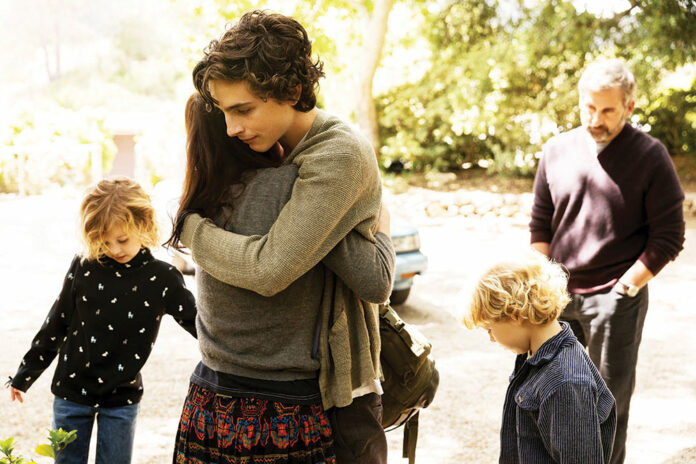
Young Nic Sheff (Timothée Chalamet of Call Me by Your Name) is readying for college when he tailspins into hard partying. His concerned father, David (Steve Carell), gets Nic into rehab fast, but it’s already too late; the first half of the film commences with Nic graduating to needles.

The youth tries the good old geographical cure, by going down to L.A. to live with his mother (Amy Ryan), but returns and vanishes into the Haight, and later, the Tenderloin, in San Francisco.

When a catastrophe befalls somebody else, it’s natural to look for causes and to ask, “What did these people do that I would have had the sense to avoid?” There are three potential factors here.

The Sheffs live in one of those rustic $3 million homes off Sir Francis Drake Boulevard—fancier than the place where Jackson Maine danced with his demons in A Star Is Born. This leads us to a snap judgment of addiction because of “affluenza.” And Carell’s David is humane as all get out; maybe Nic’s call of the wild is an escape from David’s moist, buddying parenting.

The movie also suggests that rock music was a factor. Nic worships the band Nirvana, and the framed trophies of David’s writing career include Playboy interviews with John Lennon and Yoko Ono. But all of this is too simple to describe or diagnose Nic’s addiction.

The second half of the film decays into a series of broken trusts and relapses. On the plus side, Maura Tierney, as David’s wife, displays the kind of strong yet unobtrusive acting that should have made Jessica Hecht more famous.

The ever-rising Chalamet has everything needed to play Nic—he’s devious as well as beautiful, as the addiction makes him lie and steal. Vistas of the Point Reyes cliffs mirror the existential plummet an addict faces, just as they were supposed to do.

Yet the eclectic soundtrack (everything from hippie band Pavlov’s Dog to Polish composer Henryk Górecki) adds to the movie’s formlessness rather than defining it. Beautiful Boy’s sentimental heart is revealed in the soundtrack’s choice to play Perry Como shooting a tranquilizer dart into Fiddler on the Roof’s Sunrise, Sunset.”

‘Beautiful Boy’ is playing at select theaters in the North Bay.

Hero Zero

Hero

An adult doe ended up with her face stuck in a coffee can in Mill Valley. As she crashed into fences and parked cars, she dented the can, which caused it to fit more tightly around her face. Neighbors attempted to help, but couldn’t corral her. Enter Southern Marin Fire District. “There is no such thing as a routine call. SMFD responded to what started out as a possible vehicle accident and resulted in a deer with its head stuck in a can,” the department posted on Facebook. Animal services officer Erica Lilly of Marin Humane joined the crew and used a control pole (a long rod with a cable loop at the end to put around the animal’s neck) to restrict the doe’s movement while firefighters removed the can. Unfortunately, before the animal ran off, she kicked Lilly and bruised her hand. Ouch! We hope that heals quickly. Thanks to the neighbors, the Southern Marin Fire District and Marin Humane for helping to free the deer.

Zero

I stepped in dog poop today. Frankly, I’m surprised I don’t step in it every day. It’s all over. Parks, beaches, next to sidewalks. Once a couple of people don’t clean up after their dogs in a particular spot, others start to leave their pooches’ poops in the same area, like it’s a contagious behavior. My poop, or rather the poop on the bottom of my sneakers, came from a trail where you’ll find enough feces to fertilize a baseball field. The biggest offenders walk dogs for a living and frequent the trails where their charges can run free. Though Marin County allows six dogs per walker, three on-leash and three off, scofflaws exceed the limits. I’m barely able to keep track of my one crazy pup while he bounds about off-leash, so how can someone monitor the movements of several dogs? If the dog walkers won’t pick up the waste willingly, then c’mon, Marin: cut down the number of dogs or force all six to remain leashed.

Got a Hero or a Zero? Please send submissions to ni***************@***oo.com. Toss roses, hurl stones with more Heroes and Zeroes at pacificsun.com.

Advice Goddess

Q: I get very lonely around the holidays. My family is just my parents, and they’re far away. I don’t have a boyfriend right now. I have many friends and good people in my life, but instead of hanging out with them, I find myself isolating. So . . . it seems my treatment for loneliness is loneliness, and...

Darkroom Star

Bob Minkin has always been a collector. Before he got into music, he collected comics, stamps, things like that. Once he fell for rock and roll as a teenager, he started collecting concerts. “It was such an experience, and I wanted a souvenir for myself,” says Minkin, who developed a passion for taking photos at live shows in his hometown...

Horoscope

ARIES (March 21–April 19) When I write a horoscope for you, I focus on one or two questions because I don’t have room to cover every single aspect of your life. The theme I’ve chosen this time may seem a bit impractical, but if you take it to heart, I guarantee you it will have practical benefits. It comes...

The Rent Kept a-Rollin’

“THE FUTURE IS RIDING ON METRO” Never had I ever read such a prescient message as the one stamped at the bottom of my rail-ticket receipt. It was Oct. 27, and I had just bought a SmarTrip card at the Metrorail’s Reagan Airport station in Washington, D.C., and was on my way to a big conference about the benefits and...

Gatekeeper

Supposedly there are 35 films about Vincent van Gogh. It’s a tribute to the depth and clearness of Willem Dafoe’s acting that the latest, At Eternity’s Gate, is as affecting as it is. At Eternity’s Gate is director Julian Schnabel’s best film, giving a small-camera approach to the drama, shot amid the medieval ruins and hills of the South of...

Hero Zero

Hero Puff, puff, puff away on your vape juices and menthol cigarettes now, because beginning Jan. 1, specialty tobacco stores in unincorporated Marin won’t sell flavored tobacco products anymore. Even better, a ban for all sellers in the area goes into effect on July 1. The county follows the lead of Sausalito, Fairfax and Novato, as they previously legislated against...

Letters

Powerage My argument: for those seniors on a fixed income, or those living in hospital beds or needing to refrigerate their meds, it’s tough to have a power outage for two days (“Paradise Glossed,” Nov. 21). PG&E said they wouldn’t reimburse groceries this year if they decided to turn off the power! And for folks who are ill, who had...

True Believers

For Marin audiences seeking live, holiday-themed entertainment, local theater companies are currently presenting an ecclesiastical musical and a one-man holiday reminiscence. In 1985, writer-composer Dan Goggin adapted his line of greeting cards that featured nuns saying outrageous things into a cabaret show and then an off-Broadway musical. That show, Nunsense, told the tale of the Little Sisters of Hoboken putting...

Needle in the Hay

Shot in West Marin and based on a pair of father-and-son memoirs, Beautiful Boy concerns the tragedy of addiction from two angles. Young Nic Sheff (Timothée Chalamet of Call Me by Your Name) is readying for college when he tailspins into hard partying. His concerned father, David (Steve Carell), gets Nic into rehab fast, but it’s already too late; the...

Hero Zero

Hero An adult doe ended up with her face stuck in a coffee can in Mill Valley. As she crashed into fences and parked cars, she dented the can, which caused it to fit more tightly around her face. Neighbors attempted to help, but couldn’t corral her. Enter Southern Marin Fire District. “There is no such thing as a routine...
3,002FansLike
3,850FollowersFollow