Covid Assistance Available to Marin County Renters, Landlords

Renters in Marin County who have experienced hardship due to the Covid-19 pandemic can apply online for assistance from a $16 million fund provided by recent federal legislation.

The amount was in addition to nearly $6 million in local funding already allocated, Marin County officials said Wednesday. 

The county’s safety-net rental assistance program started in March 2020 when the Marin County Board of Supervisors approved a local relief fund partnership with the Marin Community Foundation to support the most financially needy locals.

Eligibility for the federal funds have income limits, according to details provided by the county.

A household of three with an income at or below $125,000 a year, for example, is eligible if they are qualified for unemployment benefits, experienced a reduction in income, incurred significant Covid-related costs, are at risk of homelessness or endured other financial hardship due to the coronavirus. Priority is given to households that are considered extremely low income, which in Marin would be a family of three with an income of no more than $43,550.

The online application is available at www.marincounty.org/rentalassistance. Anyone with questions about the program can also call program staff at (415) 473-2223.

Local landlords have a choice to accept 80% of unpaid rent owed between April 1, 2020, and March 31, 2021, in exchange for forgiving the remaining 20%. 

If a landlord chooses not to accept the offer, tenants may still apply for relief valued at 25% of unpaid back rent owed for the covered period.

Marin County Moves Into Orange Tier

San Francisco, Santa Clara and Marin counties moved into the state’s orange tier of Covid-19 restrictions Tuesday, allowing them to expand indoor capacities for some businesses and reopen bars outdoors. 

The three counties join San Mateo County as the only Bay Area counties to proceed into the orange tier since the state’s stay-at-home order was lifted in January. 

The tier change from red to orange will allow each county to increase indoor capacity from 25% to 50% for sectors like places of worship, movie theaters and restaurants while gyms and fitness centers will be allowed to raise capacity from 10% to 25%. 

Orange is the most restrictive tier in which bars can operate under any circumstance. A move to the yellow tier allows a county to resume indoor operations at bars at 25 percent capacity or 100 people, whichever is fewer, according to the California Department of Public Health.

In addition, business sectors like family entertainment centers, cardrooms, offices and wineries will be allowed to resume indoor operations after being limited to opening outdoors or being closed altogether in the red and purple tiers. 

On April 1, counties in the orange tier can allow 33% capacity crowds at outdoor professional sporting events and 25% capacity or 500 people, whichever is fewer, at amusement parks. 

Guests at outdoor arenas must be state residents while amusement park guests must live in the same county as the venue. 

Details on which businesses can operate in the orange tier and at what capacity can be found at covid19.ca.gov/safer-economy.

SPAWN Spans San Geronimo Creek

If there was ever an outdoor activity engineered to garner side-eye from environmentalists and underscore the optics of class warfare, it’s golf. 

Sure, it has its defenders—the former president is the perfect poster boy—but I submit that this is, in part, why Marin County voters opposed a ballot measure this time last year that would have prevented the former San Geronimo Golf Course from becoming a public park. And, of course, there were the fish.

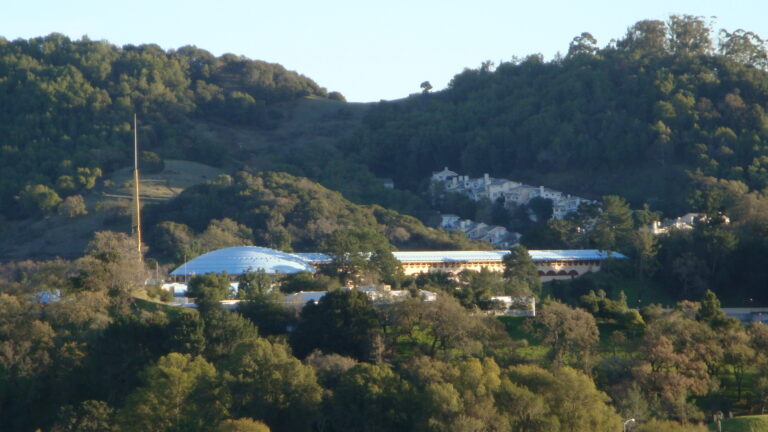
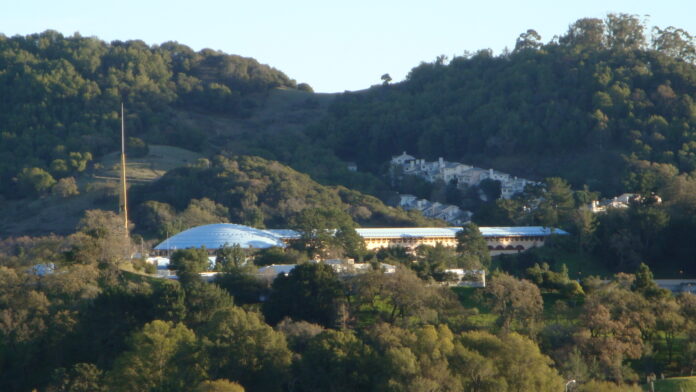
As a sort of belated victory lap, last week saw the opening to the public of a new 100-foot pedestrian bridge installed by Salmon Protection And Watershed Network (SPAWN). The bridge connects the community with trails on the former golf course and also sits directly over San Geronimo Creek, one of the most important remaining watersheds for endangered coho salmon.

Literally “a bridge over troubled salmon,” the walkway replaces a 100 year-old dam so that the endangered coho and similarly threatened  steelhead trout can freely migrate.

Moreover, the bridge allows visitors to enjoy vista views and walk a giant loop around the 157-acre property, without the threat of sustaining a golf-related injury. Assessing data from a study by the British Journal of Sports Medicine, GolfSupport.com found “the risk of injury among amateur golfers has an incidence between 15.8% to 40.9% on an annual basis.”

Why intrude a “sports” injury statistic into a feel-good story about restoring a fish habitat? To make nakedly apparent the dangers of mistreating our local watersheds—by building golf courses on them!—and to spotlight the efforts of organizations like Olema-based Turtle Island Restoration Network (progenitors of SPAWN), that stepped up to reverse the tide.

Any freshman communications major can tell you that data has more relevance when personalized. There are probably some readers for whom endangered salmon are a non-starter, but I think most would prefer not getting a golf ball upside the head. A specious argument but a species saved.

The nearly $2 million dollar project was funded by the California Department of Fish & Wildlife and SPAWN members.

“The area around the bridge remains an active irrigated restoration and revegetation site, so we ask visitors to remain behind the orange fencing and keep their dogs on leash so our native plants can flourish and the riparian habitat can develop,” reminds Preston Brown, SPAWN’s director of watershed conservation and project manager.

Audrey Fusco, SPAWN’s restoration ecologist and nursery manager added, “More than 65 native species are being planted, ranging from beautiful small sedges like roundfruit sedge to large redwood trees.”

All of the incoming flora was propagated from seeds and cuttings collected by staff and SPAWN volunteers in the Lagunitas Creek Watershed and nurtured at SPAWN’s native plant nursery.

“This is an exciting day for the thousands of community members already enjoying this public space, thanks to the efforts of The Trust for Public Land,” said Todd Steiner, project supervisor and executive director of SPAWN. “We look forward to continuing to make this land a model of shared flourishing where humans and endangered species can coexist in harmony.”For more information, visit www.seaturtles.org/salmon.

Marin County Policing Data Shows Racial Disparity in Stops, Arrests

A Black person in Marin City is 50% more likely than a white person to be stopped for a traffic violation by the Marin County Sheriff’s Office, according to four months of data recently released online by the agency.

The Racial and Identity Profiling Act (RIPA), created by California Assembly Bill 953, requires law enforcement agencies to collect and report 16 different data elements about every stop, including the perceived race or ethnicity of the person stopped. The purpose of RIPA is to eliminate racial and identity profiling in law enforcement.

Although the state has required the eight largest law enforcement agencies to report the data since 2018, the law doesn’t go into effect until 2023 for agencies the size of the Marin County Sheriff’s Office.

Still, the Marin County Sheriff’s Office chose to begin posting partial RIPA data online on Sept. 30, more than two years ahead of schedule.

“We thought it was important,” Marin County Undersheriff Jamie Scardina said. “Quite frankly, it was an opportunity for us to be transparent with the community. They were asking for this information and we knew we were going to have to provide it in two years, so we decided, well, let’s do this now.”

The Sheriff’s Office currently reports about five of the 16 data elements which will eventually be required, including race statistics. The information is updated daily.

Marin County activist and retired business executive Frank Shinneman crunched the numbers for the first 128 days of the Marin County Sheriff’s RIPA data, from Sept. 30, 2020 through Feb. 5, 2021. He focused his analyses on Marin City and San Rafael using the reason for the stop and the result of the stop. The data was then narrowed to consider the rates at which Black and Latinx people are stopped versus white people. The findings show a troublesome trend.

In Marin City, a Black person compared to a white person is:

  • 50% more likely to be stopped for a traffic violation.
  • Three times more likely be stopped for reasonable suspicion of criminal activity.
  • Five times more likely to be arrested with or without a warrant.            
  • 60% more likely to receive a warning.
  • Three times more likely to be let go without a warning or citation.

The total population of Marin City is 2,862, according to the 2010 United States Census, the latest available census data. The race breakdown is 36% Black, 36% White, 13% Latinx, 10% Asian, 1% Pacific Islander and 1% Native American.

Shinneman has drawn a couple of conclusions from his research and the initial data analysis. The higher stop rates combined with the higher rate of no action may indicate that deputies are more suspicious of Black people than white people. Marin City is also the training ground for newly hired young deputies, which has been criticized by activists for years and may account for racial profiling due to lack of experience.

Scardina believes there is a problem with the RIPA data collection because it does not reflect where the person resides. They could be from another Marin locale or from another county.

“The people that are being pulled over and that are being categorized under RIPA are not necessarily all Marin people,” Scardina said. “In Marin City, between those dates you have, we don’t know if those are actually Marin City residents.”

True. However, we do know based on the data how many Black people are stopped—whether they reside in Marin City or are just visiting. And that data shows they’re stopped and arrested much more frequently than white people.

A similar racial disparity is occurring in San Rafael for stops of the Latinx population by the Marin County Sheriff’s Office. A Latinx person compared to a white person is:

  • Two times more likely to be stopped for traffic violations.
  • Two times more likely to receive a warning.
  • Five times more likely to receive a citation.

“I think this data provides what RIPA intended,” Shinneman said. “More transparency based on race.”

Undersheriff Scardina is not concerned with the trends identified, as he maintains analyzing four-months of data is not a long enough period of time.

“We have not analyzed it,” Scardina said. “We’ve certainly looked at it. But I think it’s still a little too soon. I mean it’s not even six months. I don’t know if we necessarily have a good sense of the data. I don’t know when a good time is. Do we look at this data in a year?”

If four months is not enough, let’s examine the racial disparity for more than three decades of the Marin County Sheriff’s Office arrests referred to prosecution. Activist Eva Chrysanthe collected 31 years of the data through the California Public Records Act.

“I just can’t believe what I’m looking at,” Chrysanthe said in an email. “For arrests referred to prosecution 1990 through 2020, the Marin County Sheriff’s Office on average was hitting Black individuals at over eight times their demographic presence in the county. In the year 2000, it was over 12 times their demographic presence.”

Chrysanthe, who is biracial, grew up in Mill Valley. She now resides in Berkeley but concentrates her activism on Marin County. Although she has been criticized for not releasing the data she collected and for refusing to be interviewed by the media, she did provide the Pacific Sun 31 years of raw data and her analyses for arrests referred to prosecution. In addition, she answered the questions posed to her via email and phone.

Her analyses for the last five years of data shows some improvement since 2000 with the Black population. Yet the numbers still remain extremely high from 2016 through 2020, again demonstrating the racial disparity that exists in Marin County.

“Black arrests referred to prosecution remain over eight times their demographic population, Latino arrests referred to prosecution remain generally above their demographic population and white arrests referred to prosecution remain under their demographic population,” Chrysanthe said in an email.

Without reforms, the data trends ferreted out by Shinneman and Chrysanthe will no doubt continue. Shining a light on the racial inequities may be the first step towards prompting systemic changes.

“As time goes on, we will analyze this [RIPA] data,” Scardina said. “We’ll use the data to identify any disparities that we may have within the Sheriff’s Office. And we’ll use that to evaluate ourselves in the department and look at the reasons and causes for those differences. If they continue, we’ll create policies or practices to eliminate those disparities.”

Given the abundance of data available, perhaps the time for analysis is now.

Culture Crush: Local Groups Mark a Year of Virtual and Distanced Events

It’s been a full year since the Covid-19 pandemic forced locals to isolate and events to go online or stay socially distant. This week, several groups keep the distancing going even as some venues begin reopening. Here’s a roundup of what’s coming up.

Virtual Exhibit

While Mill Valley’s O’Hanlon Center for the Arts hopes to be able to get together in small groups by this summer, the gallery’s hybrid of alternating in-gallery and online exhibitions is working well for local art lovers. Currently, the center is hosting a virtual exhibition, “My American Experience,” featuring several artists from across the country. Works include “Click Here to Unsubscribe to European Beauty Standards,” by Nigeria-born and Dallas-based artist Abi Salami (pictured) and “Dalili the Doctor” by Los Angeles artist and screenwriter Mark Landry. See all the art online now through April 30 at Ohanloncenter.org.

Distanced Shopping

Located in the heart of Napa Valley, the exceedingly walkable town of Yountville is packed with Michelin-starred restaurants, Napa Valley wineries, luxury retailers and other celebrated offerings. This weekend, members of the public can park their cars and take a stroll to enjoy the first-ever Yountville Sidewalk Cellar Sale. Over 10 Yountville wineries and retailers will offer exclusive savings, including Handwritten Wines, Heron House, Hestan Vineyards, Hill Family Estate, Hope & Grace Wines, JCB Collection, Jessup Cellars and Priest Ranch Wines. Stock up on your cellar and enjoy some Napa Valley charm on Sunday, March 28, from 10am to 2pm. For more information, visit Yountville.com/events.

Virtual Show

When Covid-19 forced Novato resident Claire Hennessy to shelter-in-place, she joined forces with Regina Stoops of Pleasanton to form the online storytelling show Six Feet Apart Productions. So far, the pair has put on more than 30 shows featuring a mix of stories and storytellers who range from well-known professionals to first-time performers. Six Feet Apart Productions promotes diverse voices from varied backgrounds and puts a spotlight on important events and social issues such as June Pride and Black Lives Matter. Now, Six Feet Apart Productions presents a one-year anniversary show streaming for free on Monday, March 29, at 6pm. SFAPshows.com.

Virtual Reading

Last month, Sonoma County Library launched the online Read BIPOC Book Club to virtually discuss books by authors who are Black, Indigenous or People of Color. Led by the local librarians, the club meets the last Tuesday of every month through November to talk about a different book. This month’s book is the 2017 novel Exit West by Pakistani author Mohsin Hamid, which deals with themes of emigration and refugee issues and which is available as an eBook, eAudiobook and in print. Join the Read BIPOC Book Club on Tuesday, March 30, at 6pm. Free. Registration required; call your local Sonoma County Library branch or register online at Sonomalibrary.org.

Virtual Exhibit

Over the past year, as California State University campuses and their art galleries have largely shut their doors to in-person classes and events due to Covid-19, the artists who are on faculty in the CSU system have continued to teach and create. This month, the University Art Gallery at Sonoma State University celebrates these at-home art educators in the online exhibition, “Art @ CSU.” On display through April 18, the show boasts dynamic and creative work from nearly 20 artists working in the CSU system, and the art ranges from painting, printmaking and photography to sculpture, ceramics, digital and time-based arts. Visit the University Art Galleries online exhibit at Artgallery.sonoma.edu.

Open Mic: Thoughts on Spring

The first blossoms of the spring season’s colors have exploded, coaxed on by the sun and the rains.

Sunbeams earthward-bound brighten the dark seasons around this globe—a light seen by many, but not all.  Many last breaths drawn, seasons of life for many over. And for many more that remain—sorrowful eyes view the natural order of life that reemerges, informing us all of what has been and what is.

Personal nightmares fail to recede, as nighttime awakenings show an arm gently reaching across to feel and hold warmth that is no longer there—as the light of gray dawn slowly reveals a half-occupied bed.

The favorite foods, no longer bought, the special songs, once remembered, with smiles—no longer sung, now listened to with humbling silence. The places and events, defined by time and emotion—now mere footnotes, captured snapshots along the highways of life: the dates, pre- and post-, before and after.

How do we begin to search for answers—are there any answers—that will relieve and release us; to tame our minds, lift our spirits, to give us ease of being, for what has befallen us?

Are memories a blessing or a curse—or both? And what remains that we dare not forget: the connections and intimacies, over a lifetime’s journey? Are the remembrances of those sacred rituals with someone enough to pull us through? Like this new, untrodden path—we now must navigate the geography of our bruised hearts moving forward. Can we seek direction from our love’s compass as we stumble along—is it enough?

And yet, the first blossoms have arrived again, on time, for their brief visit on this good earth—not unlike our own short stay here. For we are all subject to the winds, both gentle and blustery, that tell us our time has come—and to accept—as petals do, the falling from stems and branches, that new growth will appear and fruit will ripen heavy and sweet on branches and vines.

Healing will come—faith is a verb.

E. G. Singer lives in Santa Rosa. To have your topical essay considered for publication, write to us at op*****@********un.com.

Letters to the Editor: Forests and Homes

My heart goes out to anyone who has lost a home or loved ones during a fire. That must be one of the most devastating, terrifying and disorienting experiences anyone can go through.

At the same time, I am alarmed by Jane Broughton’s response (Open Mic, March 10), which I believe is not based on the latest science.

Scientists from around the world have pleaded with world leaders to stop cutting forests in the name of fire protection and public safety. Increasingly the science is showing that the best way to protect homes and communities from the flying embers that have caused most of the devastating home fires of recent years is by “home hardening” and creating defensible space immediately around homes and communities.

The science is showing increasingly that clearing of forests miles from communities is actually counter-productive, doing nothing to protect homes and a great deal to damage valuable forest ecosystems, which protect our watersheds and provide essential wildlife habitat. Thinning did nothing to protect the town of Paradise from the Camp Fire.

A major cause of fire is climate change; we need to stop greenhouse gas emissions and “draw down” carbon out of the atmosphere. According to international climate scientists, one of the best ways to do this is to capture carbon in large trees, and the best way to do this is by protecting existing forest ecosystems.

Let’s learn from the tragedies of the Camp, Woolsey, Thomas and Tubbs fires and implement activities that maintain our forests unlogged and protect our communities.

The issue that needs to be addressed is community and home protection, not increasing logging of our forest ecosystems.

Jenny Blaker, Cotati

Write to us at le*****@********un.com.

Jesse Brewster Sings From the Heart on New Album

Seasoned San Rafael singer-songwriter Jesse Brewster always looked up to his older brother Jim.

“After high school, I wasn’t driven towards any goal, but I was playing guitar,” Brewster says. “He was a big encourager of what I was doing, so I probably wouldn’t be doing it without him.”

When Jim passed away from Polycystic Kidney Disease (PKD) when he was 29 and Jesse was 23, the younger Brewster began writing lyrics about the experience, and soon stepped out of the rock & roll–sideman role into that of a solo artist.

Brewster released his first record in 2004, and he’s been going strong ever since. This month, Brewster releases his fifth album, The Lonely Pines, which features 10 tracks of folk- and roots-rock storytelling songs.

The Lonely Pines will be available online and on vinyl now.

Throughout his songwriting career, Brewster has instilled autobiographical lyrics into his character-driven storytelling. In addition to songs inspired by his sibling, Brewster chronicles his own battle with the same disease; including how he received a life-saving kidney transplant from his wife six years ago.

The Lonely Pines is a continuation of that trend, with songs that musically range from acoustic folk to rollicking Americana while lyrically examining Brewster’s past, present and thoughts on the future.

“I’m always trying to get something out there that is cohesive, and the songs luckily were coming,” he says. “So, I followed that vein.”

Some tracks on the album depart from the Americana aesthetic, including the glam rock-infused “Follow It Down,” the saloon song “Bitter Pill” and the Celtic folk-inspired “Amber Kinney.”

“There’s many songs I could have put on the record, but these ones seemed to be ones that all had at least a little bit to do with each other,” he says.

Brewster was still recording the album when the pandemic hit in early 2020, and he was forced to finish the album’s final three tracks in his home studio, playing nearly every instrument himself.

Among those tracks is the song “Close to Home,” a roots-rocker filled with vocal harmonies and jangling guitar riffs, that was written in the first days of Covid-related isolation.

“It’s super-reflective of what everybody was going through in those first days of the pandemic and you didn’t know what was going to happen,” Brewster says.

Originally, “Close to Home” was not going to appear on The Lonely Pines, as it was composed for a grant project.

“You had to write a song, record it, make a video and you could get this grant,” Brewster says. “It’s always fun to be given an assignment, it forces your hand and it’s a good [songwriting] exercise for sure.”

Now a year into isolation, Brewster­—who is immunocompromised due to PKD­—is not exactly itching to get back on the road, though he is not satisfied with simply streaming his concerts on social media, either.

“I want performances to be an event, not just an expectation,” he says. “What I want to be doing and what I normally would be doing during this time would be getting out there.”

“The Lonely Pines” will be available online and on vinyl. Jessebrewster.com.

Mill Valley Chamber’s Blog Post Prompts Outrage

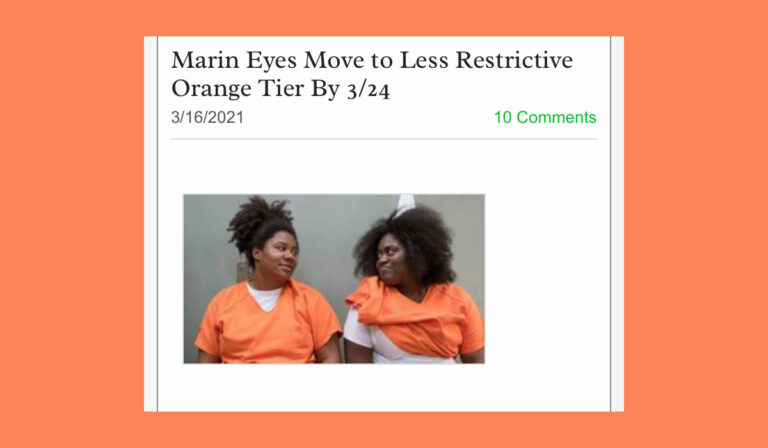
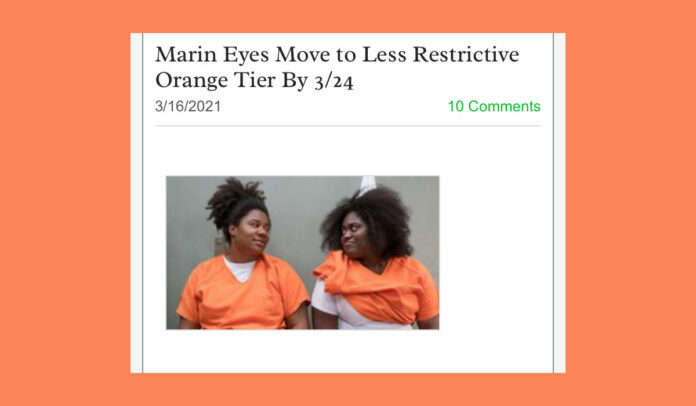
Although Mill Valley residents continue to call for a permanent Diversity, Equity and Inclusion (DEI) committee, the city council refuses to create one. As if to prove how desperately the city needs the commission, the Mill Valley Chamber of Commerce posted a racist photo to accompany an innocuous blog post.

The Chamber’s story detailed Marin’s possible move into the orange tier this week. Oddly, the photo depicted two Black women dressed in orange prison garb. Not exactly what I picture when informed the county achieved a lower Covid-19 rate and may graduate to a less restrictive tier. If you want to celebrate orange, you could choose a picture of a persimmon, a pumpkin or maybe even something more obscure, like an orange.

Jim Welte, director of membership and community engagement for the Mill Valley Chamber of Commerce, eventually replaced the photo with slices of an orange, apologized for his previous selection and explained the insulting image was from the TV show Orange is the New Black. Then he made an irrelevant political statement by saying he’s “a massive fan of the show and its work to give sunlight to the need for criminal justice reform and the treatment of incarcerated women.” In addition, he made excuses about working late at night and being lazy.

Welte missed the point, at least initially. In his first apology, which took him three days to post, he failed to mention that he hurt people, although many folks explained their feelings in the blog’s comments section. Finally, a full five days after the original post, he amended his remarks to address the harm he caused. Still, it’s difficult to unring the bell.

“It’s outrageous!! How do I explain this to my black children? It’s getting increasingly difficult to be proud to live in Mill Valley,” Alfie P wrote in the comments section below the blog post.

I’ll bet it is, Alfie, since this is just the latest blunder by a Mill Valley community leader. During a city council meeting in June, a week after George Floyd’s death, a resident asked what Mill Valley was doing to show that Black Lives Matter.

“It is our council policy that we do not take action on issues that are not of immediate local importance,” Mayor Sashi McEntee responded.

How many more racist gaffes will it take before the mayor and the rest of the city council appoint a permanent DEI commission? Clearly, Mill Valley needs it.

If you’ve experienced race-based discrimination, volunteer therapists of color are offering free 16-week Racial Trauma Support Groups for Marin residents and workers of color. Contact Cesar Lagleva at 415.846.3789 or gi*****@***oo.com for more information.

Changes Coming for Marin County Fair This Summer

Even as Covid-19 vaccines are distributed throughout California, the uncertainty surrounding the pandemic’s immediate future is forcing many summertime events and gatherings to delay or change their plans for the second year in a row.

One of those events is the popular Marin County Fair, which virtually celebrated Marin’s art, agriculture, and community last summer, and which will look a little different when it returns for 2021. 

The Marin County Department of Cultural Services recently announced that it is unable to plan a full-scale fair due to the need for a vaccination dispensing location at the Marin Center facility in San Rafael.

Since the Veterans’ Memorial Auditorium, Exhibit Hall, and Showcase Theater are in use for the pandemic response for the foreseeable future, Cultural Services is planning a much smaller and safer alternative for fair-going families this summer.

Plans will include a drive-through fair food event, a modified online competitive exhibits program, a special day of surprises on the Fourth of July, and more to come. Cultural Services will share further details  in the coming months.  

Dr. Matt Willis, Marin County’s Public Health Officer, noted that the Marin Center complex has served as a location of a drive-through COVID-19 testing site, an emergency alternate care site for ill patients, and now a coronavirus vaccination clinic.

“The fairgrounds have been serving our community in a different way throughout the pandemic,” he says in a statement. “In the past few months, tens of thousands of people have received vaccination doses there. Our fair has always promoted health and well-being for our community and has won major awards for being the healthiest fair. Consistent with that, it’s best that we not gather for a fair this year. Last year’s virtual fair was a big success as people had fun while adhering to public health guidelines on social distancing, so I hope it’s successful again this summer.”

Last year’s virtual version of the Marin County Fair featured several social media events and online contests, and the fair’s social media pages experienced dramatic increases in viewership and participation. At the beginning of this year, the Marin County Cultural Services staff won 12 awards from the Western Fairs Association for its virtual 2020 fair.

“We are eagerly awaiting community-wide vaccinations to be able to celebrate the arts, the Marin County Fair, and the myriad cultural events that take place year-round on our Marin Center campus,” says Gabriella Calicchio, Director of Cultural Services, in a statement. “We miss the fair just as much as the rest of our community, but we hope to offer a little fair fun this summer while keeping everyone safe and healthy. Meanwhile, we thank everyone for their continued support of the Marin County Fair.”  

Covid Assistance Available to Marin County Renters, Landlords

Money cash rent California
Marin County renters who have struggled during the Covid-19 pandemic can apply online for assistance from a $16 million fund.

Marin County Moves Into Orange Tier

Marin Civic Center California
Marin County moved into the state's orange tier of Covid-19 restrictions Tuesday, allowing the county to expand indoor capacities for some businesses and reopen bars outdoors.

SPAWN Spans San Geronimo Creek

If there was ever an outdoor activity engineered to garner side-eye from environmentalists and underscore the optics of class warfare, it’s golf.  Sure, it has its defenders—the former president is the perfect poster boy—but I submit that this is, in part, why Marin County voters opposed a ballot measure this time last year that would have prevented the former San...

Marin County Policing Data Shows Racial Disparity in Stops, Arrests

pixabay - police car lights
A Black person in Marin City is 50% more likely than a white person to be stopped for a traffic violation by the Marin County Sheriff’s Office, according to recently released data.

Culture Crush: Local Groups Mark a Year of Virtual and Distanced Events

It's been a full year since the Covid-19 pandemic forced locals to isolate and events to go online or stay socially distant. This week, several groups keep the distancing going even as some venues begin reopening. Here's a roundup of what's coming up. Virtual Exhibit While Mill Valley's O'Hanlon Center for the Arts hopes to be able to get together in...

Open Mic: Thoughts on Spring

The first blossoms of the spring season’s colors have exploded, coaxed on by the sun and the rains. Sunbeams earthward-bound brighten the dark seasons around this globe—a light seen by many, but not all.  Many last breaths drawn, seasons of life for many over. And for many more that remain—sorrowful eyes view the natural order of life that reemerges, informing...

Letters to the Editor: Forests and Homes

typewriter opinion newspaper
My heart goes out to anyone who has lost a home or loved ones during a fire. That must be one of the most devastating, terrifying and disorienting experiences anyone can go through. At the same time, I am alarmed by Jane Broughton’s response (Open Mic, March 10), which I believe is not based on the latest science. Scientists from around...

Jesse Brewster Sings From the Heart on New Album

Seasoned San Rafael singer-songwriter Jesse Brewster always looked up to his older brother Jim. “After high school, I wasn’t driven towards any goal, but I was playing guitar,” Brewster says. “He was a big encourager of what I was doing, so I probably wouldn’t be doing it without him.” When Jim passed away from Polycystic Kidney Disease (PKD) when he was...

Mill Valley Chamber’s Blog Post Prompts Outrage

Orange tier Mill Valley Chamber of Commerce
A recent blog post by the Mill Valley Chamber of Commerce is the latest example of a racist gaffe in lily white Marin County.

Changes Coming for Marin County Fair This Summer

Even as Covid-19 vaccines are distributed throughout California, the uncertainty surrounding the pandemic's immediate future is forcing many summertime events and gatherings to delay or change their plans for the second year in a row. One of those events is the popular Marin County Fair, which virtually celebrated Marin's art, agriculture, and community last summer, and which will look a...
3,002FansLike
3,850FollowersFollow