The Scoop on Marin Dog Poop

I took a very scientific poll of all my Marin friends and the one thing they agree on is that pooch poo is pervasive in our parks, on our trails and at our beaches.

Nary a week goes by without a reader sending me an email griping about the vast quantity of dog waste in our recreation areas. Considering I’ve been working at the Pacific Sun for 15 years, that’s a lot of crappy kvetching.

I grumble about it too, but excrement left on the sidewalks bothers me even more. The soles of my shoes behave like magnets for the waste.

Often the poor pets are maligned about doing their doody duty, though of course we should blame the dog owners for not picking it up and placing it in the proper receptacle. Bagging the poop and then leaving the full plastic bag behind is also bad behavior.

For the record, do not put dog turds in the compost or recycling bins. It goes in the can headed to the landfill, even if you use biodegradable bags.

And, for goodness’ sake, don’t just leave it and pretend you’re fertilizing … because you’re not. While dog excrement contains trace nutrients, it also harbors 23 million fecal coliform bacteria per poop gram, some of which can cause disease in humans, according to the Environmental Protection Agency.

If that doesn’t make you pick up your dog waste, maybe getting more specific will help the cause. Humans can get E. Coli, salmonellosis, giardia, roundworms, tapeworms and an assortment of other diseases and parasites from dog feces. When it rains, dog poop melts and runoff carries it into our waters.

An average-size, 40-pound hound excretes 274 pounds of poop per year. Since Marin has an estimated 64,777 dogs, how much doggy-doo do we host on an annual basis? The very scary answer is almost 18 million pounds.

Another fun fact: we have 52,214 human children in our county. Marin has fewer kids than dogs. Frankly, I’m surprised there aren’t even more mutts here. In my lifetime, I’ve produced zero children and adopted four canines.

Hikers frequently urge people to clean up after their pooches. On the Oakwood Valley Trail in Mill Valley, one desperate trekker resorted to covering feces in multi-colored glitter to bring attention to the matter. Unfortunately, glitter is also litter. I came across pieces of poop skewered with toothpicks flying little signs imploring, “Pick Me Up,” when hiking on Crown Road in Kentfield.

Byron, a dog lover residing in Kentfield, used to love hiking around nearby Phoenix Lake in the Marin Municipal Water District. Now, he’s concerned about dog excrement in our water supply.

“My post-retirement life was going to be hiking in the water district, and I’ve pretty much stopped going to Phoenix Lake,” he says. “I’ve got incredible photos of dog crap and bags of poop right next to the lake. I wrote to the water district board of directors and said, ‘This is the municipal water supply. It isn’t an appropriate place to serve as an outdoor toilet for dogs.’”

Gross. I’m glad I use a water filter.

There is a solution to get people to clean up after their pups. Enter PooPrints, a biotech company serving more than 5,000 apartment complexes, condo communities and similar properties. Residents must provide a DNA sample from their dog, which is analyzed and kept on file at PooPrints. When a rogue piece of poop appears on the property, it’s scooped up, sent to PooPrints and compared to DNA samples in the database. Voila. The offending pup is identified.

With a big enough fine, people learn to bag their dog’s poop and throw it away. Sure, it’ll be challenging to administer a dog DNA program for an entire county, but we live in Marin and that means we’re special.

In lieu of DNA tests for dog dung, may I suggest you simply clean it up? Your dog’s not going to do it for you.


College of Marin Looks to the Stars in NASA-Funded Program

The sky is the limit–literally–for students at College of Marin, following the college’s recent acceptance into an exclusive NASA-backed grant program.

The California Space Grant Consortium (CaSGC) is a NASA-funded program that provides university-level educational opportunities for community college students and encourages underrepresented groups to participate in science, technology, engineering, and math (STEM) projects.

College of Marin is using its funding from the program to start a science hub that will give students a variety of studies beyond the normal physics, engineering, and astronomy curriculum; including the opportunity to participate in an internship with NASA over the summer.

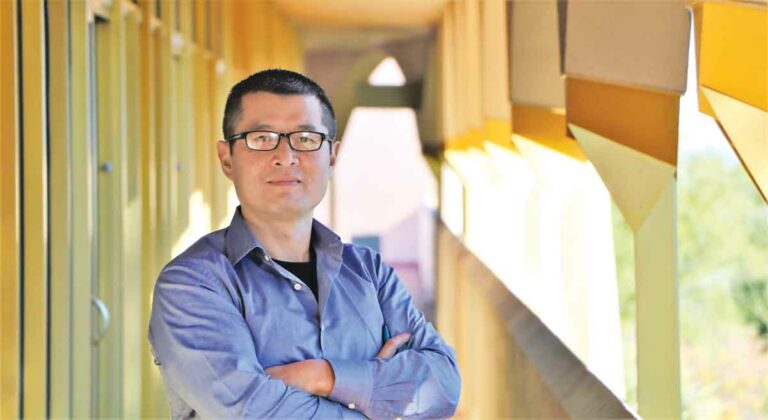
Astronomy and Physics Professor Antonino Cucchiara, Ph.D., leads the science hub and selected students from the astronomy, physics, and engineering programs, as well as the Puente and Umoja groups on campus, to participate.

In an effort to support the CaSGC program’s inclusivity goals, the student makeup is 40-percent women and 55-percent from underrepresented groups. Cucchiara notes the program will highlight the college’s commitment to increasing diversity in its STEM-related departments.

“Aligning these activities with the broader effort of the College will provide new avenues for African American, Latinx, and other underrepresented students to explore academic and career paths that they may not have considered before,” Cucchiara says in a statement. “Through these fun, hands-on experiences, these students will gain skills that will allow them to explore a new world in a safe, stress-free environment while interacting with NASA scientists and other like-minded students.”

The funding, which lasts three years, will afford College of Marin students the chance to attend a NASA research seminar and meet with NASA scientists to learn more about their research challenges and to get career counseling advice. Students will also get to participate in webinars prepared by the California-based NASA research centers.

Students participating in the program will also receive a $650 stipend to fund team projects that they will present to NASA scientists and engineers during their visit to the research lab.

According to CaSGC, students have previously put together projects in near-space ballooning, small satellites, UAV auto-pilots, autonomous ground robots, and wearable sensor vests for sports and health monitoring.

Participation in the Consortium also funds professional development for the college’s faculty, including a field trip to a NASA research facility to learn how to bring NASA content to their campus programs and their STEM projects.

To learn more about the astronomy offerings at College of Marin, visit marin.edu. To learn more about the California Space Grant Consortium’s work with community colleges, visit casgc.ucsd.edu.

North Bay Art Galleries Lead the Way with Live Openings

The North Bay is opening back up after more than a year in isolation, as Covid restrictions slowly, but surely, continue to ease and vaccination numbers increase.

In Marin, Napa and Sonoma counties, art galleries are among the first venues that are ready for reopening, and several shows open to distanced crowds with live receptions over the next few weeks.

Marin County artists Richard Blair and Kathleen Goodwin are known for their coffee table art books like Point Reyes Visions. They rarely exhibit on walls, though Goodwin’s large original paintings and Blair’s sharp photographs are showing in the exhibit “The Astonishing Beauty of Point Reyes” at Toby’s Gallery in Point Reyes Station.

Goodwin and Blair both photograph Point Reyes landscapes during peak light. Goodwin then projects the images on canvas to make her art, and Blair turns his images into black-and-white photographs in the vein of Ansel Adams. Both artists will be on hand for the show’s opening reception on Saturday, May 1, at Toby’s Gallery, 11250 Highway One, Point Reyes Station. 2pm to 4pm. blairgoodwin.com.

Sonoma County artists Lisa Beerntsen and Tony Speirs are acclaimed for their paintings and teachings. Now, the artists work together for the exhibit “Los Dos: Lisa Beerntsen & Tony Speirs Collaborative Works” at Sofie Contemporary Arts in Calistoga.

The art is inspired by the artists’ travels, and reflects those adventures. The pieces on display seem like vintage postcards from other places and times, both real and imagined, and the works feature folk and pop-culture imagery interwoven with political and cultural commentary. “Los Dos” includes these collaborative works and the artists’ individual pieces when it opens on Saturday, May 1, at Sofie Contemporary Arts, 1407 Lincoln Ave., Calistoga. 4pm to 7pm. Sofiegallery.com.

Members of Pacific Rim Sculptors are participating in a new group exhibit in San Rafael that asks the big question of “Beauty or Truth.” the sculptural exhibit is open for virtual or in-person viewing at Art Works Downtown through June 13. The gallery is open to visitors Fridays, 5pm to 8pm; and Saturdays and Sundays, 1pm to 5pm. The show will have virtual receptions on May 14 and June 11 at 6pm at artworksdowntown.org.

O’Hanlon Center for the Arts in Mill Valley is also welcoming visitors back to the gallery for its latest in-person exhibit, “Movement.” The show–juried by dancer, poet, teacher and author Daria Halprin–features paintings, ceramics, photographs and mixed media works that convey rhythm or a sense of action. O’Hanlon is currently alternating between in-person and virtual gallery shows, and “Movement” is open for by-appointment viewing Thursdays and Fridays, 1pm to 3pm; or Saturdays, 11am to 1pm, through May 21. The gallery’s next scheduled in-person exhibit is “Local Inspiration,” opening in June. Get details at ohanloncenter.org.

San Francisco Opera Returns to Live Performance with Marin Center Drive-In Shows

The acclaimed San Francisco Opera stages its first live opera performances in more than a year this weekend, and it is doing so in Marin County.

Opening on Friday, April 23, SF Opera presents a newly adapted production of Gioachino Rossini’s The Barber of Seville in a drive-in setting on the grounds of the Marin Center in San Rafael.

Running for eleven performances through May 15, the production is part of a larger return to live shows for the first time in the North Bay since the onset of the global pandemic.

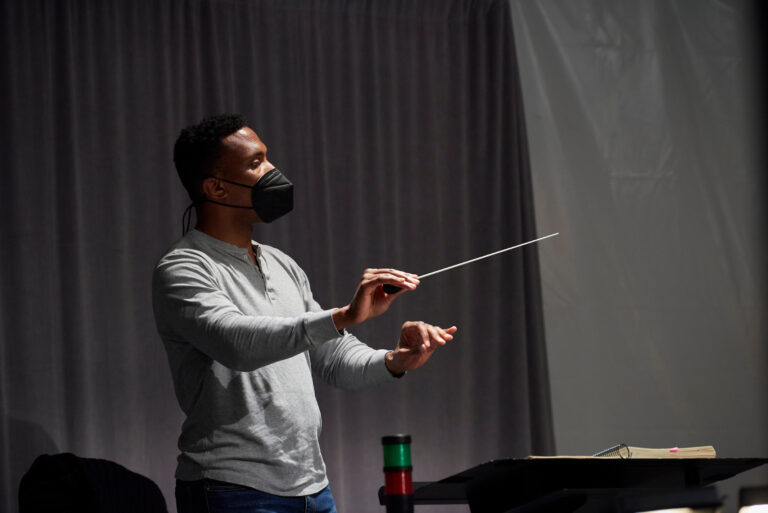
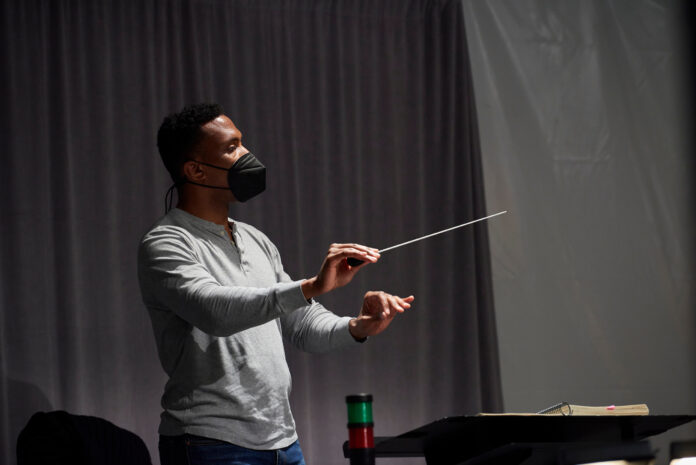
For these drive-in performances, SF Opera Director Matthew Ozawa has adapted The Barber of Seville into a 90-minute (no intermission) backstage comedy that retains all of the work’s humor and vocal fireworks, and Conductor Roderick Cox makes his Company debut leading the 18-piece orchestra.

SF Opera is employing several rigorous safety protocols, such as housing the orchestra in an 80’ by 40’ tent behind the stage (part of an outdoor backstage compound erected to support all aspects of the production). Musicians and singers are also utilizing specially designed wind masks and singer’s masks (singer’s masks used only for rehearsals in the socially distanced staging) developed by Dr. Sanziana Roman of UCSF and the San Francisco Opera Costume Shop.

The operatic action takes place on an adapted version of the set originally intended for SF Opera’s production of Beethoven’s Fidelio, which was postponed due to the pandemic last year. Work on the set continued in the company’s scene shop during the shutdown and the opera’s creative team utilized the structure’s flexibility of design for the Marin Center drive-in production.

Ozawa’s concept finds singers returning to the opera house after a pandemic and bringing opera back to life, mingling the antics of backstage life with the wit of this beloved work in a poignant and riotously funny staging. The full-scale production takes place on a massive festival stage erected on site for these performances. Conceived by Bay Area designer Alexander V. Nichols, the set and projection designs will take on the appearance of the War Memorial Opera House, especially the backstage dressing rooms. 

Audiences for these rain-or-shine drive-in performances have a choice of purchasing tickets for one of two neighboring locations on the Marin Center campus. The Fairgrounds has a view of the set and live performers, while the Lagoon area allows ticket holders to experience the performance live via simulcast to a drive-in movie screen. A limited number of spots in the Lagoon simulcast area are available for free by arrangement with San Francisco Opera to organizations employing essential workers, as well as to community organizations in Marin.

SF Opera is also presenting three concerts by the San Francisco Opera Adler Fellows at the Marin Center. The Opera’s eleven resident artists perform a program of operatic favorites by the world’s greatest composers in the outdoor setting on April 29, May 6 and May 13. Get details on these shows and The Barber of Seville performances at sfopera.com.

CovaX: The final jib-jab

0

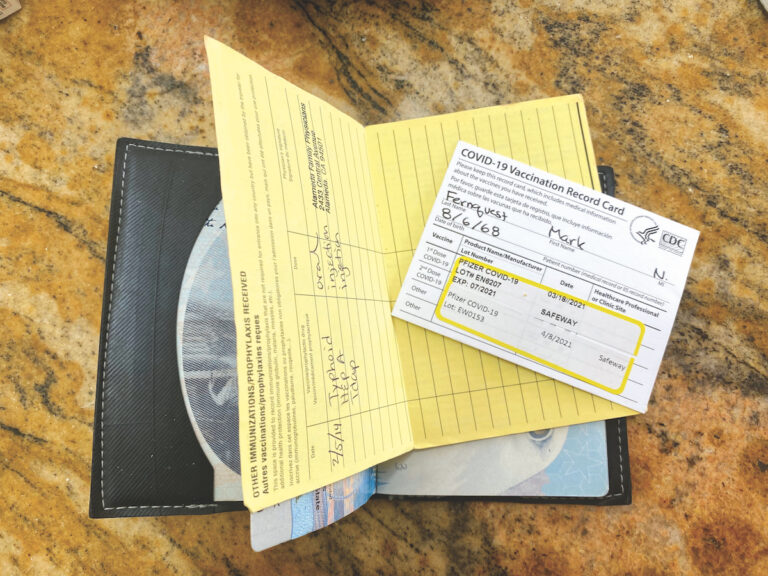
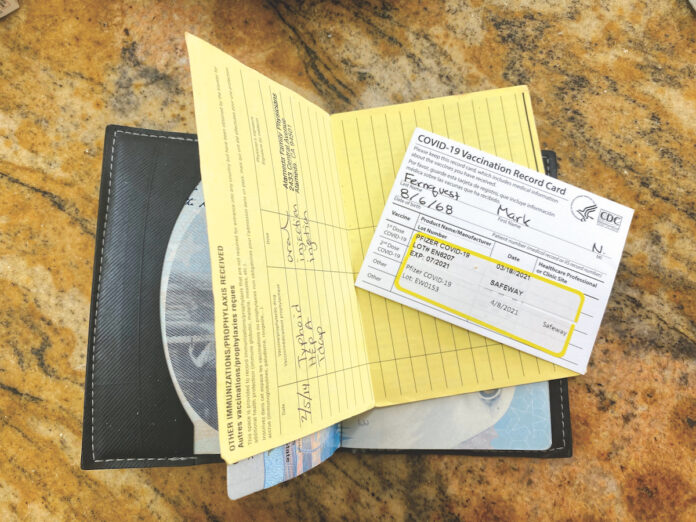
There’s a story behind everything we do. Case-in-point: My second Covid vaccine. I received it yesterday, and sit here now in a state of minor delirium with a tale to tell.

Today I no longer fear the jib-jab, but life wasn’t always this way.

A year-and-a-half ago I decided to get a Shingles vaccine after witnessing the horror it inflicted on my friend’s right eye. I showed up for an appointment and then spent 10 sweat-filled minutes unsuccessfully attempting to let the injectress jab me. I could not take my eyes off the gleaming, spiky jib she wielded, and the fear it instilled in me was so overwhelming that I left, sans jib-jab, and never did get the ShinglesvaX. It’s the story of my life—an inability to acquiesce to jib-jabs.

So, when Covid-19 engulfed the world, I worried and wondered how I would go through with the eventual mandatory CovaX jib-jab, going so far as to engage puzzled strangers in extended monologues about it on numerous occasions. When the opportunity came to make my first CovaX appointment a month ago, I did so without hesitation, knowing my life depended on it. But still I worried.

There has to be a way, I told myself every day.

And then, a few days before appointment time, I had an epiphany: I won’t see the needle if I close my eyes. Simple words, but unlike any I’d ever told myself before. I listened.

At my first CovaX appointment, I informed the injectress of my jib-jab phobia, sat in the hot seat and closed my eyes. Intuitively understanding my plight, she immediately jabbed me. I felt almost nothing whatsoever—not in the psychopathic sense I experienced in my teens, but in the warmer, “Where’s the fear? Cuz it ain’t here, Dear” sense, if such a sense actually exists.

I felt no symptoms from the first CovaX jib-jab, either. True, I’m a universal donor, and the DL on the electronic avenues is that type “O”s have higher immunity to Covid than other blood types, but, I mean, whatever. Right?

The second jib-jab was a cakewalk. I encountered the same injectress, who called me by name when I entered the clinic—I’m that memorable—and again immediately jabbed me when I sat down and closed my eyes. Again: no fear.

But after 18 hours I did get a minor headache, feel somewhat achey-wakey and experience a mild state of agitated confusion.

So here I sit, stoned on CovaX: The final jib-jab. And all things considered, it ain’t so bad.

Mark Fernquest attends deep-desert post-apocalyptic festivals in his spare time.

Hesitancy to Receive Covid Vaccine Could Delay Herd Immunity

To vax or not to vax? For many, the answer comes easily, while others hem and haw about their decision.

Most people I know tried to make an appointment for the vaccine on the day they became eligible. I’m needle phobic, but I was happy to step right up, roll up my sleeve and get jabbed on two occasions.

Some folks remain on the fence about getting vaccinated. “Vaccine hesitant” is the term used to describe them, and they represent about 10–15% of the population, according to Dr. Matt Willis, Marin County’s public health officer.

Others don’t believe in vaccinations in general or in the Covid vaccination specifically. They make up the anti-vaccine movement and represent about 2–3% of the population, Willis says.

I spoke with two Marin anti-vaxxers. Neither woman will get the Covid-19 vaccination, although they’re both aware the decision is controversial. One agreed to be interviewed under a pseudonym, as she doesn’t want to face backlash. The other agreed to provide a written statement, and was still concerned her words would be taken out of context.

I couldn’t verify many of their claims. Their opinions are wholly their own. One thing is certain, they are just as sure they shouldn’t be vaccinated as Anthony Fauci is sure they should be.

Joan Andrews—not her real name—74, has had a lifelong interest in health. However, the Mill Valley resident says none of the information about the Covid-19 vaccine in the mainstream media rang true.

“Mass hysteria was being created by the papers,” Andrews says. “I started investigating. First of all, it’s not a vaccine. It’s actually experimental gene therapy. The reason they’re calling it a vaccine is so that they bear no liability should anyone have an adverse reaction. Who knows what could happen a month down the road, two months down the road? The whole nation needs to be a lot healthier, so we don’t resort to a vaccine. Our body will take care of things.”

Andrews’ perspective is revealing, because the vaccine-hesitant are likely looking at the same type of information. Over 31 million people follow anti-vaccine groups and pages on Facebook, most of which are run from the United States, according to a 2020 report by the Center for Countering Digital Hate.

To reach community immunity, Marin needs most of the vaccine-hesitant to end up in favor of vaccination. Otherwise, we will remain vulnerable, Willis says.

“If we can get 85% of everyone age 12 and above vaccinated, I think we’re going to be much better protected as a community,” Willis says. “As the variant infections march their way across the country and into California, I think we will be well-protected if we get to those levels of the vaccination.”

As of now, only those 16 and older are eligible for the vaccine; however, vaccinating 12- to 15-year-olds is fast approaching. Pfizer asked the Food and Drug Administration (FDA) earlier this month to expand emergency approval of its Covid-19 vaccine. The company hopes to begin administering the vaccine to this age group before the start of the next school year in the fall.

Currently, more than 75% of people age 16 and older have received at least one dose of the Covid-19 vaccine, and more than 51% have completed the vaccine series in Marin. While those numbers are high, and Marin is far above the state vaccination rate, the last percentage points needed for herd immunity may be difficult to achieve.

Marin recently surveyed approximately 6,000 residents about their vaccine beliefs. Many of those in the vaccine-hesitant camp think the process to develop the Covid-19 vaccine happened too quickly. Willis hopes people will become comfortable after more time passes and they learn about the safety of the vaccine.

The political setting in which this vaccine was developed also contributed to vaccine hesitancy, according to Willis. A lack of trust in government, which seems to have reached a height in recent years, made some people tentative about getting vaccinated. However, that dynamic is changing. On a national basis, fewer people are hesitant now than when the vaccine was first released.

Some people may rely on the assumption that the rest of the population will achieve herd immunity on their behalf. That’s not a safe strategy. The vaccine-hesitant often spend time with like-minded people and share the same social groups within a community, Willis says. This results in clusters of people who are not vaccinated, rather than a random distribution. When a group has a low vaccination rate and the virus is introduced to them, it spreads quickly.

“The more of us who are vaccinated, the better protected we all are,” Willis says. “Hesitancy will affect any community. People who are unvaccinated are reservoirs for the virus to remain active in the community and that puts everyone at risk.”

An important incentive in choosing to get vaccinated is the freedom it allows. The state of California announced earlier this month that people who are fully vaccinated do not need to stay six feet apart at live events. A venue requiring proof of vaccination is rewarded with increased capacity. There is also talk of vaccine passports for travel. Schools already require vaccinations for a variety of diseases, and it’s not a stretch to imagine the Covid vaccination will be added to the list.

Anti-vaxxers are calling foul on the restrictions. Maureen Block, of San Rafael, an attorney who is cofounder of the Children’s Health Defense – California Chapter, says the role of government is to protect the people, not industry.

“Vaccine passports are dangerous for our democracy,” Block wrote in an email. “First, the ACLU is against them and they will hurt minorities. Second, it goes against civil rights, in general, and HIPPA. Third, it creates a new minority class that will be discriminated against based on their genetics that makes vaccines dangerous for them. Fourth, we are dealing with Emergency Use Authorization products [vaccines]. These are not FDA approved products.”

Willis believes we’ll see more settings where a person’s vaccine status determines how they participate, because it doesn’t make sense to hold everybody back from community activities. He suggests anyone with concerns about the Covid-19 vaccine talk to their personal physician. They are well-equipped to discuss the pros and cons of vaccination.

“The best way for us to put this pandemic behind us, the single most important thing you can do, is get vaccinated,” Willis says. “If not for yourself, then for your family and your community.”

Exploring the Future of Marin County Cannabis

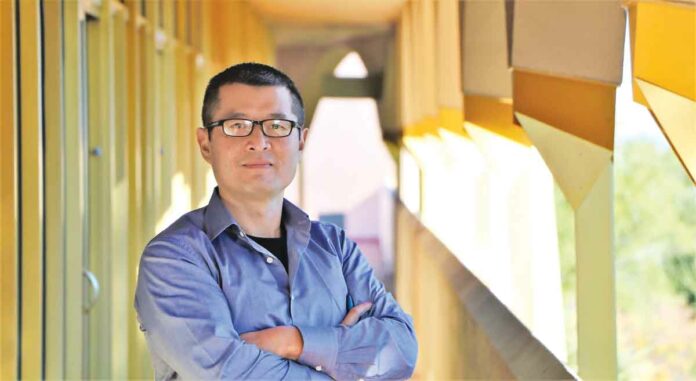
A conversation with Community Development Agency director Tom Lai

Tom Lai, who has spent his entire 29-year professional career with the County of Marin, officially became the director of the Community Development Agency (CDA) last week. Lai has served as acting director since longtime director Brian Crawford’s retirement in December 2020. Among other prior achievements, Lai and his teams developed Ordinance 3639, the County’s first ordinance regulating storefront dispensaries for medicinal cannabis in 2015.

During that process, staff worked closely with a subcommittee of the Board of Supervisors to establish appropriate local controls, including buffer zones from schools, permitting processes—through a competitive, business-license type permit—and specific license number limits including the provision that there be no more than four licenses issued for the unincorporated area. To date, the county has issued only three licenses, and only one business has started operations.

“We provided maps on our website showing areas that are ‘eligible’ for siting dispensaries, then hosted meetings in those communities to solicit feedback,” Lai said, reflecting on the ordinance in a recent email interview. “While there were supporters, these community meetings elicited strong, vocal opposition. I’d say only community meetings discussing housing have generated more hostility and opposition.”

Which begs the question, why are Marin County’s cannabis programs clustered under the Community Development Agency rather than, say, public health?

“This is a good question,” Lai said. “There are  different governmental structures used by counties/cities to regulate cannabis businesses, ranging from public health to law enforcement to community development [Planning]. I think because so much of the issues raised are related to land-use conflicts, the Board decided that CDA’s Planning Division would best take the lead in launching this program because of our knowledge and expertise in regulating land uses and construction.”

What’s interesting to note is that the Board of Supervisors’ regulatory authority only extends over the unincorporated areas of the county. Cities and towns have independent legal authority to regulate these businesses. This is why cities such as San Rafael can issue limited commercial cannabis licenses and not be in violation of county statutes. To that end, however, when it comes to Prop. 64, which allows brick-and-mortar cannabis businesses in California, it seems that Marin is of two minds—pro-cannabis entrepreneurs who want to launch local businesses, and those with anti-cannabis sentiments of the “not in my backyard” variety. Lai isn’t optimistic that these divergent sentiments will be easily reconciled.

“Based on the County’s experience in attempting to license up to four storefront medicinal dispensaries, I think it is difficult—if not impossible—to reconcile both,” Lai said. “I hope the success of the delivery-only model will enlighten those in the anti-cannabis camp that if properly regulated, there are certain cannabis businesses that could co-exist well in certain commercial areas in the unincorporated parts of the County.”

One of the major locational disadvantages that the County faces, Lai explained, is the limited amount of commercial or industrial areas that remain unincorporated. The areas that do exist are often near or within what are primarily residential neighborhoods.

“Not all those in the ‘anti’ camp oppose the notion of cannabis—either as medicine or for personal use—they just don’t think there are suitable areas in Marin to accommodate these businesses,” Lai said. “In some ways, because I hear anecdotally that businesses delivering into Marin are doing well, it would seem that our residents are getting the product, just from businesses delivering into the County.”

For more information regarding Marin County cannabis programs, visit https://www.marincounty.org/depts/cd/cannabis-programs

Letters to the Editor: Foppoli Faux Pas

Dear Editor,

Many people and groups supported Dominic Foppoli in his 2020 mayoral campaign. This includes the entire Board of Supervisors (Shirlee Zane, but not Chris Coursey) and council members from every city except Petaluma.

Supporters also included school board members from Windsor and Santa Rosa, and the Sonoma County Board of Education, members of the Hispanic Chamber of Commerce, Sonoma County Conservation Action, Legal Aid of Sonoma County, and of course, the Press Democrat. It’s a veritable Who’s Who of Sonoma County.

But even if we leave out the accusations of sexual assault, and the racist and homophobic comments attributed to him, why did all these people endorse Dominic Foppoli?

Mr. Foppoli supposedly went to the Trump inauguration in 2016 before apparently changing political parties. But he still posted pictures online of himself with Ted Cruz (R-TX) and Marjorie Taylor Greene, the Qanon congresswoman from Georgia. I hardly think these are “Sonoma County values,” but none of it seemed to bother his supporters. Why?

Let me guess. Mr. Foppoli is a wealthy young man who supports growth, business, the wine industry and the status quo. That alone was enough to make him a darling among our rulers. After all, those are the only values that truly matter. Sonoma County isn’t as liberal or progressive as we like to think it is.

And, if he follows Efren Carrillo’s playbook, he can merely blame alcohol, go into rehab and soon enough he’ll be forgiven and back in everyone’s good graces. They’ll all be slapping him on the back and taking smiling selfies like they did with Carrillo. #MeToo? What’s that?

Laura Gonzalez, Santa Rosa

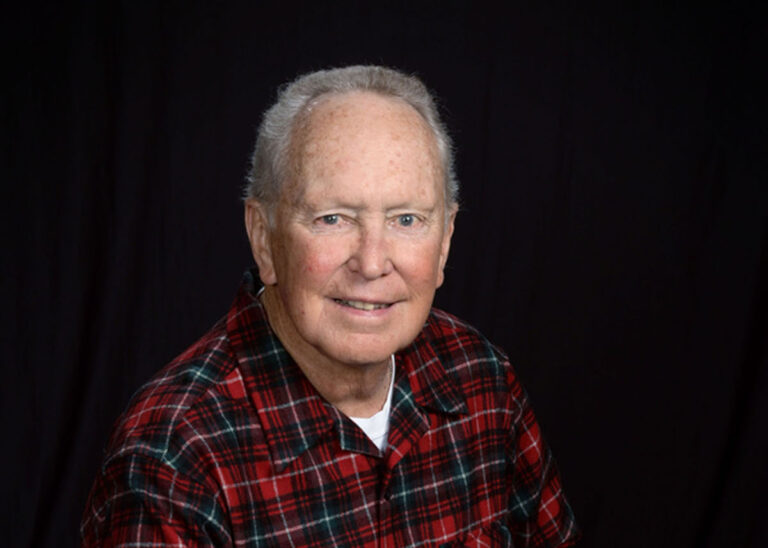
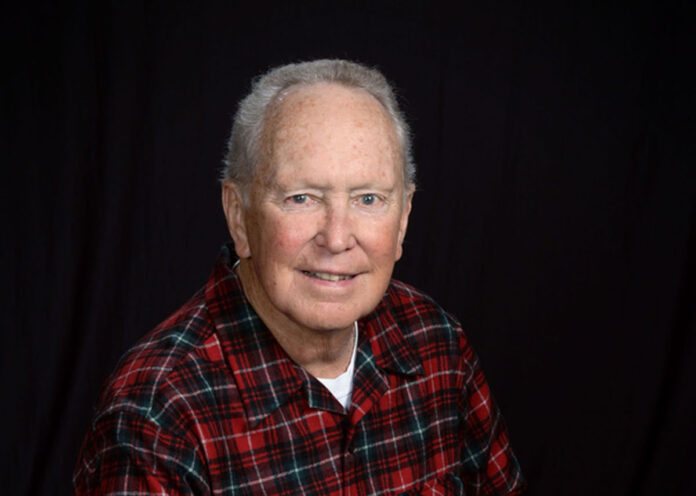
Open Mic: Remembering a True Californian, Gerald Haslam (1937- 2021)

He was the first real Californian that I met and got to know, back in the day when I didn’t realize how vast California is and the variety of Californians. 

As an ex-New Yorker who thought of New York as the center of the world, I was surprised that New York didn’t figure in Haslam’s universe. He didn’t care to be published by a New York publishing company, and he didn’t live for a review in a New York newspaper. He was content to be a Californian, his books known, read and appreciated by other Californians.

Haslam was definitely of the West, or as one might say, West of the West. For decades, we taught together at Sonoma State University, swam in the pool on campus, attended conferences together and gathered at Haslam’s home in Penngrove, where he lived with his wife and near-constant companion, Jan.

A loner and a joiner, one of a kind and a team player, Haslam knew more about the Great Central Valley and beyond than anyone in the world. He made it his business to know what was happening from Bakersfield, where he was born, to San Francisco, where he went to college, and to Sonoma County, which he grew to love.

There wasn’t an area of California life he didn’t know about, whether it was dance palaces in Bakersfield, the future of farming in the Golden State or Merle Haggard’s music, which he wrote about in his classic, Workin’ Man’s Blues, which he co-authored with his daughter Alexandra.

Haslam probably introduced more people, through his anthologies, to the literature of California than anyone else in his generation. He also preserved, in his short stories, ways of life that no longer exist in places like Oildale, where his dad worked in the oil fields. An only child, he cobbled together a tribe of ancestors who belonged to diverse ethnic groups. One of his early books was titled The Wages of Sin, which I suspect was ironic. He paid me a compliment when he told me, “You’re a closet Catholic.” We agreed that California was, if nothing else, a land of hope. No one was more hopeful than Haslam, who made room in his life and his home for an ex-New Yorker like me trying to find a place in the Golden State.

State Oversight Agency Places PG&E Under ‘Enhanced Oversight’

Already under fire for its vegetation management practices by the federal judge overseeing its criminal probation proceedings, PG&E got slammed Thursday by another one of its masters.

Citing numerous deficiencies in PG&E’s wildfire mitigation efforts, the California Public Utilities Commission voted to adopt a resolution that places PG&E on Step 1 of a six step ladder of “enhanced oversight” that at Step 6 would lead to “the potential revocation of PG&E’s ability to operate as a California electric utility.”

The six stages of oversight were established as part of the CPUC’s approval of PG&E’s plan of reorganization, the mechanism by which PG&E was able to exit from its Chapter 11 bankruptcy proceedings. 

The “Triggering Event” that sparked the CPUC’s order was a finding that PG&E has not made adequate progress in utilizing risk management tools to determine where its vegetation management efforts should be directed.  

The management of trees and shrubbery throughout PG&E’s extensive system of power distribution and service lines is of great importance in reducing wildfires because when high winds blow trees or vegetation onto uninsulated wires, sparks can fall to the ground and ignite the dry grasses. 

U.S. District Judge Alsup is currently considering proposals that would require PG&E to consider the risk of trees falling onto power lines as part of the conditions to its criminal probation.  

Alsup has been highly critical of PG&E’s efforts to abate the risk of wildfires. In one recent order Alsup recounted what he called a “a stunning chapter in California history.” 

According to his tally, since PG&E was placed on probation following a 2016 conviction for a 2010 gas pipeline explosion in San Bruno, “PG&E has ignited 20 or more wildfires in California, killing at least 111 individuals, destroying at least 22,627 structures, and burning half a million acres.”

Alsup’s order recounted the grim specifics:  the Wine Country Fires in 2017 (22 dead, 3,256 structures destroyed); the Camp Fire in 2018 (85 dead, 18,793 structures burned); the Kincade Fire in 2019 (374 structures destroyed); and most recently the Zogg Fire in 2020 (4 dead, 204 structures destroyed). 

Judge Alsup has frequently criticized PG&E for neglecting to perform vegetation management at required levels for a decade. The judge has also criticized CPUC for allowing that neglect.

The CPUC order requires among other things for PG&E to submit within 90 days a “corrective action plan” that explains in detail “how it will both perform risk modeling and use the results of risk modeling to ensure the highest risk power lines are prioritized for vegetation management.”

The action was based on an audit conducted the Wildfire Safety Division of the CPUC during the period from Oct. 21, 2020 to Feb. 5, 2021. The audit identified deficiencies in PG&E’s use of risk modeling to inform its vegetation management efforts.

The Scoop on Marin Dog Poop

Sunset dog pooping
To the chagrin of many residents, pooch poo is pervasive in Marin County parks, trails and beaches. What's to be done?

College of Marin Looks to the Stars in NASA-Funded Program

The sky is the limit–literally–for students at College of Marin, following the college’s recent acceptance into an exclusive NASA-backed grant program. The California Space Grant Consortium (CaSGC) is a NASA-funded program that provides university-level educational opportunities for community college students and encourages underrepresented groups to participate in science, technology, engineering, and math (STEM) projects. College of Marin is using its...

North Bay Art Galleries Lead the Way with Live Openings

The North Bay is opening back up after more than a year in isolation, as Covid restrictions slowly, but surely, continue to ease and vaccination numbers increase. In Marin, Napa and Sonoma counties, art galleries are among the first venues that are ready for reopening, and several shows open to distanced crowds with live receptions over the next few weeks. Marin...

San Francisco Opera Returns to Live Performance with Marin Center Drive-In Shows

The acclaimed San Francisco Opera stages its first live opera performances in more than a year this weekend, and it is doing so in Marin County. Opening on Friday, April 23, SF Opera presents a newly adapted production of Gioachino Rossini’s The Barber of Seville in a drive-in setting on the grounds of the Marin Center in San Rafael....

CovaX: The final jib-jab

There’s a story behind everything we do. Case-in-point: My second Covid vaccine. I received it yesterday, and sit here now in a state of minor delirium with a tale to tell. Today I no longer fear the jib-jab, but life wasn’t always this way. A year-and-a-half ago I decided to get a Shingles vaccine after witnessing the horror it inflicted on...

Hesitancy to Receive Covid Vaccine Could Delay Herd Immunity

Vaccine CDC/Unsplash
To vax or not to vax? For many, the answer comes easily, while others hem and haw about their decision. Most people I know tried to make an appointment for the vaccine on the day they became eligible. I’m needle phobic, but I was happy to step right up, roll up my sleeve and get jabbed on two occasions. Some folks...

Exploring the Future of Marin County Cannabis

Marin County Cannabis
A conversation with Community Development Agency director Tom Lai Tom Lai, who has spent his entire 29-year professional career with the County of Marin, officially became the director of the Community Development Agency (CDA) last week. Lai has served as acting director since longtime director Brian Crawford’s retirement in December 2020. Among other prior achievements, Lai and his teams developed...

Letters to the Editor: Foppoli Faux Pas

typewriter opinion newspaper
Dear Editor, Many people and groups supported Dominic Foppoli in his 2020 mayoral campaign. This includes the entire Board of Supervisors (Shirlee Zane, but not Chris Coursey) and council members from every city except Petaluma. Supporters also included school board members from Windsor and Santa Rosa, and the Sonoma County Board of Education, members of the Hispanic Chamber of Commerce, Sonoma...

Open Mic: Remembering a True Californian, Gerald Haslam (1937- 2021)

He was the first real Californian that I met and got to know, back in the day when I didn’t realize how vast California is and the variety of Californians.  As an ex-New Yorker who thought of New York as the center of the world, I was surprised that New York didn’t figure in Haslam’s universe. He didn’t care to...

State Oversight Agency Places PG&E Under ‘Enhanced Oversight’

Transmission lines California
PG&E has not made adequate progress in utilizing risk management tools to determine where vegetation management efforts should be directed.
3,002FansLike
3,850FollowersFollow