It was not my first. At the other two services, my mind and emotions shut off. I don’t remember them, more than arriving, feeling weird and feeling no connection with anyone else present, alive or underground, although I was related to the celebrants.
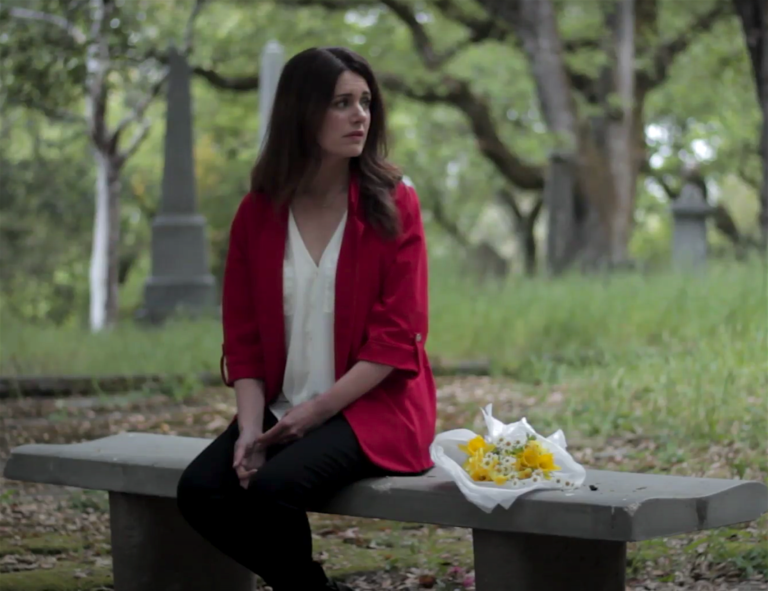
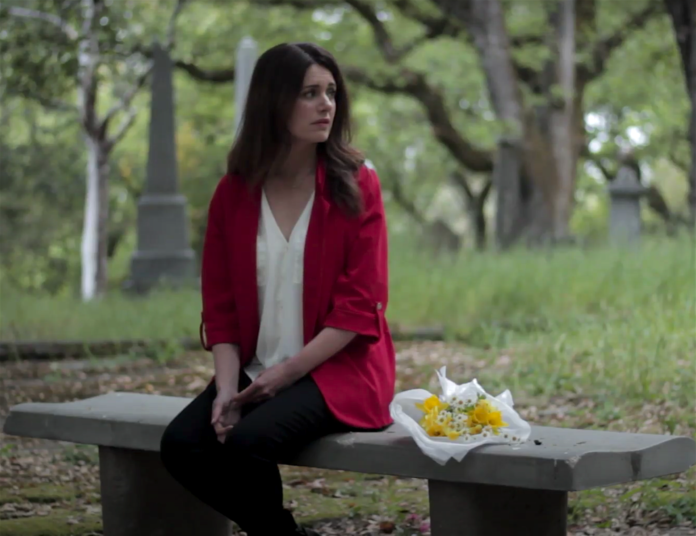
I didn’t know what to expect from a funeral service, much less that it was being held in a cemetery, at her gravesite. A friend asked, “Where else would it be held?” “Uh, I don’t know,” I answered.
The lady was a gracious, gentle soul who delighted in life and in nurturing life around her. Her joy at being alive was unmistakable; that she revered life in all its forms was obvious.
I suppose I had some preconceived notions about size being important. “The bigger the better.” “The one with the most toys when he dies, is the winner!“ (or, in this case, “she”). The greater the number of people who show up for the service, indicates how “good” a person they were or “how well-loved” or “how many points they had accumulated in their lifetime” …
Achievements are often listed pompously and at great volume; her achievements were palpable in the loving gentleness and the humorous laughter shared by her family members and friends present for their last farewell, a remembrance of her kindness and encouragement to all. A life well lived and well loved.
The feelings were authentic, as was she. The sadness I experienced among the witnesses at her last resting place and felt at the service was mixed with the elation her loved ones held close to their hearts at remembering how much joy she brought to all, each day she walked with us.
I had no clue that a funeral remembrance service could be so fulfilling, so uplifting, so honoring of her enjoyment of life and overflowing with unifying community spirit. Could we but exchange those feelings with each other every day, remembering that each moment of life is a gift, and hoping that we can all tune into sharing the “present.”
Joy Appleby lives in West Marin. We welcome your contribution. To have your topical essay of 350 words considered for publication, write op*****@******an.com.
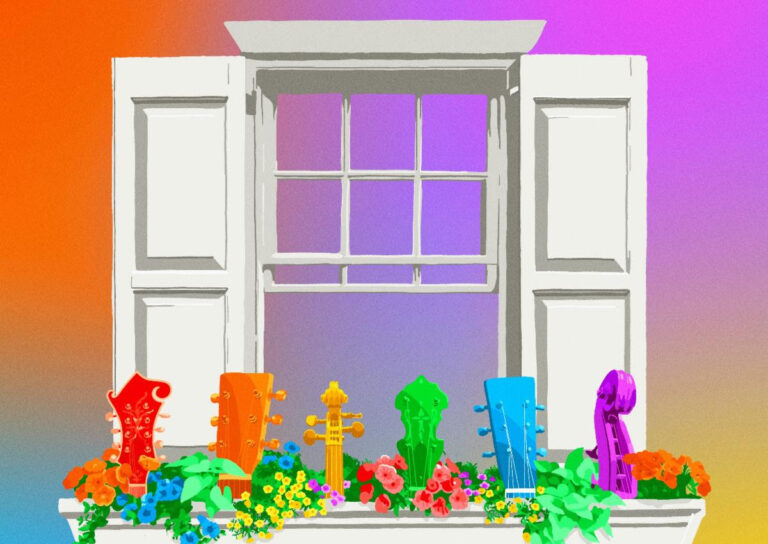
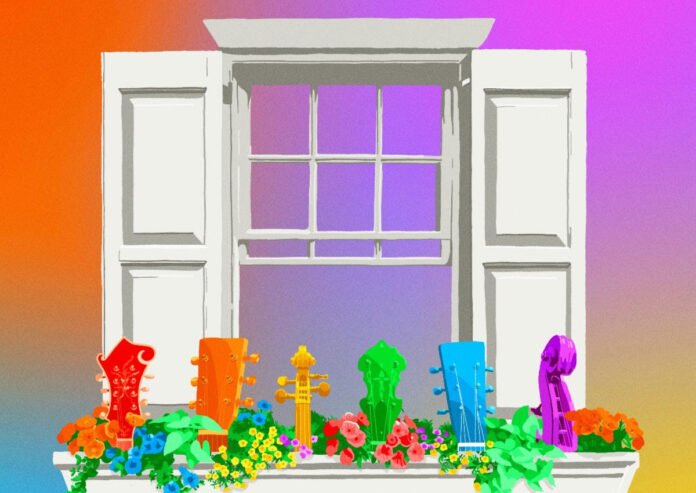
Bay Area-based nonprofit organization Bluegrass Pride lifts up LGBTQ+ musicians and creators within the bluegrass music community; largely through concerts, jam sessions, showcases, festivals and parades.
In 2020, after the pandemic forced Bluegrass Pride to cancel in-person Pride programming, the organization made the pivot online, hosting a two-day livestream festival that raised more than $23,000 for the LGBTQ+ and allied artists on the lineup.
This year, the Bluegrass Pride Board of Directors has expanded that two-day livestream into a month-long virtual festival and fundraising event, Porch Pride, which will take place online throughout June.
Over the course of Pride month, Porch Pride will feature performances by bands and artists like Lavender Country, Rainbow Girls, Gangstagrass, Po’ Ramblin’ Boys, Jake Blount, Sunny War and others. The festivities will also include a virtual Bluegrass Pride brunch and open house, a beginner-friendly jam, and more.
The virtual Porch Pride event kicks off on Sunday, June 6, with Lavender Country Live, hosted by acclaimed musician, scholar, and Bluegrass Pride board member Jake Blount.
The following weekend, Bluegrass Pride hosts its popular and informal brunch gathering and open house on Saturday, June 12. The next day, virtual participants can join a friendly jam session featuring protest songs and movement music led by queer Nashville-based singer-songwriter Luisa Lopez on June 13.
The final two weekends of Porch Pride 2021 will feature two virtual festivals. On Saturday, June 19, Bluegrass Pride partners with Brandi Pace and Decolonizing the Music Room for Juneteenth: A Rainbow Revival. The three-hour series of performances highlights the trailblazing contributions of Black queer folks and trans folks to the Pride movement as well as to bluegrass and roots music.
Juneteenth: A Rainbow Revival is a proud recipient of the IBMA Foundation’s inaugural Arnold Schultz Fund grants. The International Bluegrass Music Association created the IBMA Foundation in 2007, and the foundation recently established the Arnold Shultz Fund to support activities increasing participation of people of color in bluegrass music. Arnold Shultz (1886–1931) was an African American musician from western Kentucky who had a profound influence on Bill Monroe and the development of bluegrass.
June’s final weekend will see a return of Porch Pride proper, this time celebrating Bluegrass Pride’s fifth anniversary and once again featuring two days of live music, performances, songs, and more, featuring headlining sets from Gangstagrass on June 26 and Rainbow Girls on June 27.
All of the event’s virtual programs are free to view and attend, and will be available to view online after airing. The nonprofit encourages fans, followers and listeners to donate to support the musicians and the ongoing work of Bluegrass Pride.
Under the supervision of art instructor Ginny Geoghegan, the Tomales High School art program remained a bedrock of creativity for students navigating the course of the past year’s unprecedented distanced learning ordeal.
With the support of the school staff, these art students flourished at home and continued to develop a pantheon of new artworks inspired by their individual experiences and growing identities.
This month, several of those students participate in Gallery Route One’s exhibition, “Tomales High School Artist Showcase 2021,” featuring paintings, drawings, photography and mixed media works.
The show opens with a virtual reception on Friday, May 14, and will be viewable online as well as in-person from Thursdays to Sundays, 11am to 5pm, through May 23.
Gallery Route One is following all recommended safety protocols related to the pandemic, including sanitizing, distancing and mandatory face coverings in place for visitors.
“I hope you will enjoy escaping into these works for a little while,” instructor Ginny Geoghegan writes in a statement. “I send my deepest thanks to Gallery Route One for giving us a chance to escape our Zoom screens and celebrate the brilliant work of our THS artists.”
In the Tomales High School art classroom, students explore a broad spectrum of topics, media and sources including comics, portraiture, linoleum block printing, acrylic painting, observational drawing and color theory.
In the past year, art has been particularly essential to students currently processing the many emotions which have stemmed from the pandemic’s interruption of their social and personal lives.
The exhibited work in the “Tomales High School Artist Showcase 2021” displays the ways in which the students have used creativity to explore their contemporary world, while at the same time escaping into the realm of imagination, innovation, and possibility.
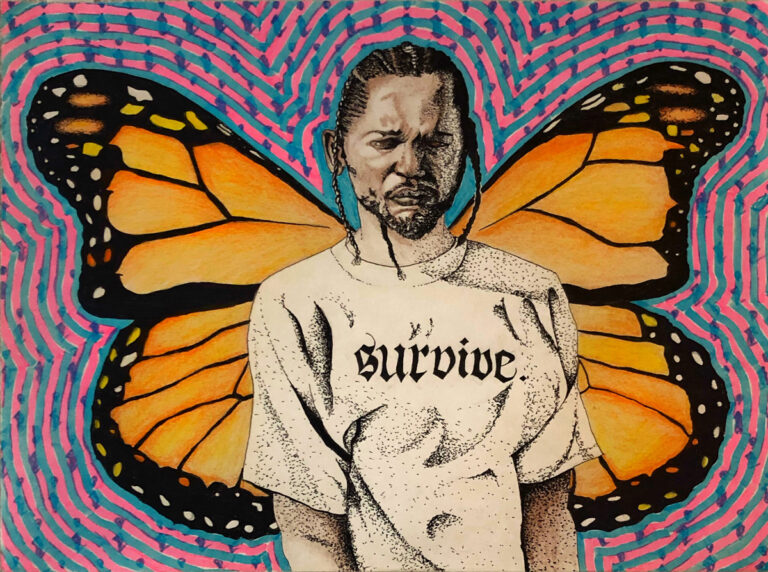
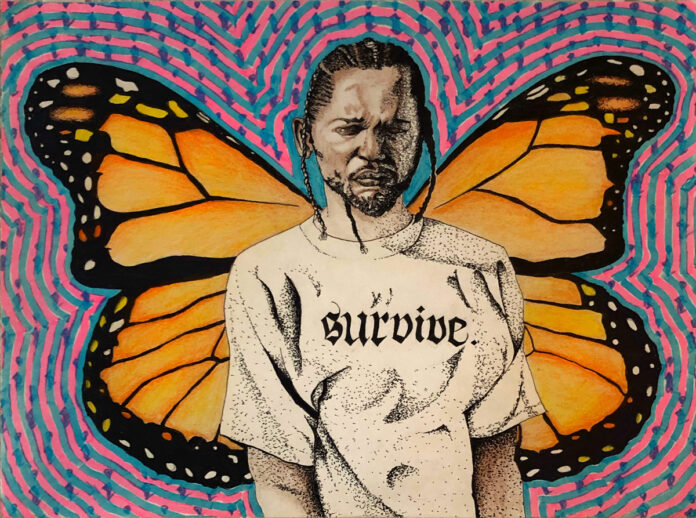
In addition to the artwork itself, some students have also contributed a short essay about the motivations, imagery and motifs in their piece. Liam Riley writes that his painting To Pimp a Caterpillar (pictured) was “based on American rapper, songwriter, and record producer, Kendrick Lamar’s 2015 album, “To Pimp a Butterfly.” The album…addresses our society’s conflicts. It embodies the struggle and change within Kendrick Lamar’s inner self, and preaches his conscious findings for the world to hear and learn from.”
In my English class, we were studying Greek Gods and their myths so I was inspired to make a poster about Eirene, urging citizens to remain neutral,” writes fellow art student Sloo writes about their painting Remain Neutral. “I hope this speaks to those who see it, to be the soldier who carries Peace herself on their back, trying to venture forward in tranquility instead of hostility.”
“Tomales High School Artist Showcase 2021” runs May 13–23 at Gallery Route One, 11101 Highway One, Point Reyes Station. Thurs–Sun, 11am to 5pm. galleryrouteone.org.
Right now, the National Park Service is rewriting its General Management Plan for Point Reyes National Seashore, and the agency must decide whether to sunset the expired livestock grazing leases across tens of thousands of publicly-owned acres, or to continue authorizing unsustainable overgrazing, tillage agriculture and even the killing of native tule elk by extending leases that were never intended to continue on indefinitely.
It shouldn’t be a difficult choice for the National Park Service, but the livestock industry has some surprising supporters. Rep. Jared Huffman, a former National Resources Defense Council attorney and Green New Deal signatory, has staked out an anti-environmental position on what is arguably the most important environmental issue inside his own congressional district, and is in fact leading the charge in advocating for continuing the ongoing environmental destruction on Point Reyes.
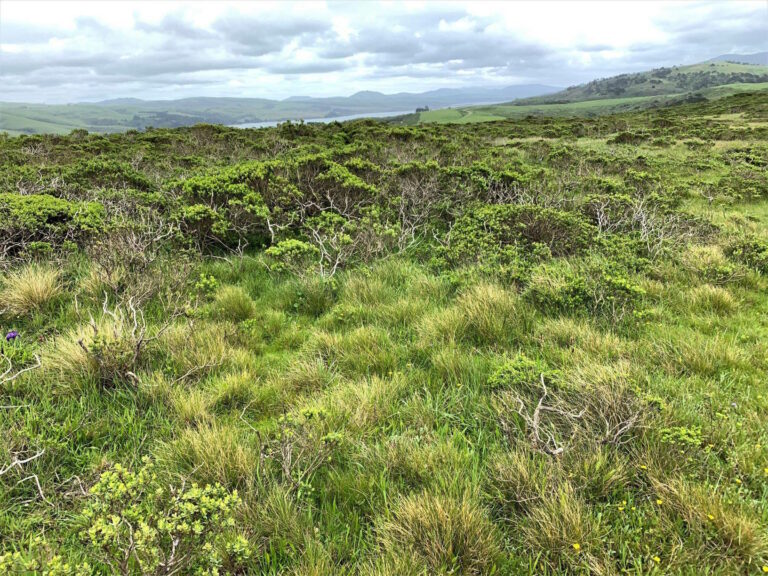
The ranchers who rent National Park Service lands are permitted to graze them down to bare dirt. As a result, the cattle pastures are made up uniformly of European annual grasses and foreign thistles. Livestock grazing has completely destroyed the native coastal prairie on Point Reyes and turned it into a vast weed patch, destroying native shrubs and bunchgrasses that otherwise would have beneficially sequestered soil carbon underground. On top of the direct grazing impacts, almost 1,000 acres of Point Reyes are devoted to producing “silage crops”—more non-native weeds, which infiltrate surrounding lands—which are harvested in spring using combine harvesters, mowing down ground-nesting birds and deer fawns in a grisly spectacle attended by flocks of carrion birds. In addition, the dairies produce cow manure by the ton, which gets spread out on the hilltops, runs into the stream courses and creates some of California’s most polluted waters. These streams run to beaches and estuaries frequented by beachgoers, exposing them to potentially fatal fecal coliform contamination and other animal-borne diseases.
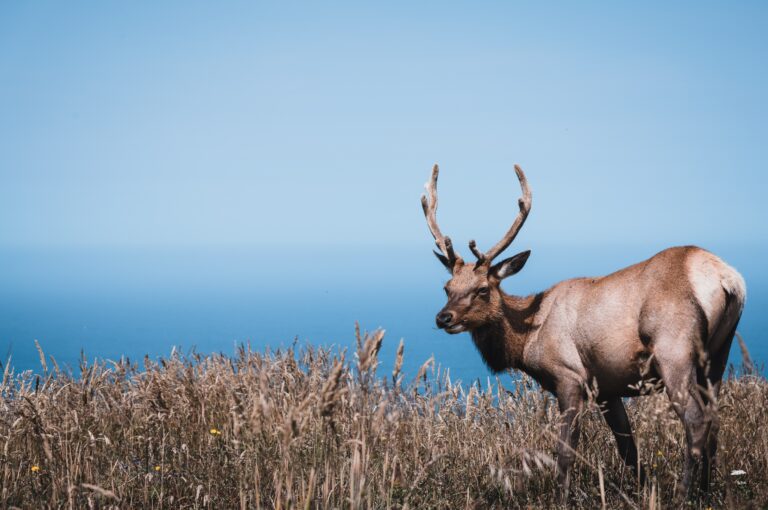
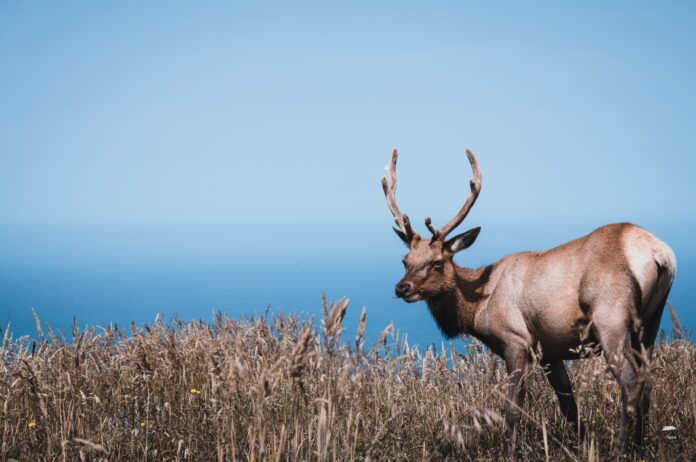
Then, consider that most of the tule elk, the rarest subspecies of elk in the world, are trapped by a tall fence on a small peninsula of the National Seashore for the sake of protecting forage resources for cattle. Without adequate water and forage, tule elk die by the hundreds during droughts—which are becoming deeper and more frequent—unable to escape to find food and water through natural dispersal. Outside the fence, small elk herds are harassed by ranchers and even killed by the Park Service for wandering onto lands leased by cattle. And then there are Endangered Species Act–listed plants, birds, amphibians and salmon runs on the National Seashore, and none of them flourish in these degraded habitats.
It’s that bad, and paradoxically, Huffman is fighting hard to keep it that way.
Huffman isn’t listening to his constituents. Not even when 91% of those who commented on the Park’s proposed plan wanted to end industrial agriculture on the Seashore. Not when locals showed up at his town hall meetings demanding protections for native tule elk. And not when his constituents picketed his district office and staged massive protests outside the elk fence during a new die-off that even now is killing more than 150 elk. It’s a strange position for an elected official to take, but Californians seem cursed to live in interesting times.
Huffman has some strange bedfellows in his quest to keep ranching the Seashore. Former President Trump made it a personal priority to extend cattle operations on Point Reyes. Trump invited Kevin Lunny, the ringleader of the Point Reyes ranching lobby, to be a featured speaker at a White Housebill-signing ceremony. His administration then proposed a management plan which would not only extend commercial ranching and dairying on the park lands, but expand livestock use and further harass and kill tule elk for the benefit of livestock operations.
When Huffman authored legislation to force the National Park Service to extend industrial-scale dairy and beef operations on Point Reyes and authorize the Park Service to kill tule elk at the behest of tenant ranchers, he turned to Utah Rep. Rob Bishop to co-sponsor the legislation. Bishop was Public Lands Enemy #1 during his tenure in Congress. He tried to repeal the Endangered Species Act. He supported transferring federal public lands to the states, and sought to amend the Antiquities Act to strip the president of the authority to designate National Monuments. Bishop’s lifetime League of Conservation Voters score is 3%. Bishop’s endorsement of Huffman’s bill should be a red flag that it’s a big problem, but Huffman seems proud to have Bishop on board.
The League of Conservation Voters scores Huffman’s lifetime voting record at 98% pro-conservation. But while Huffman’s voting record has been reliably good on national conservation issues from climate change to endangered species protection to wilderness designations, his currently abysmal, anti-environmental record on Point Reyes will haunt him in his home district. We hope he comes around, and starts listening to the 3 million National Seashore visitors who aren’t coming for the unsavory sights and sounds of working dairies and ranches. They’re coming for the public recreation, benefit and inspiration for which, by law, Point Reyes is supposed to be managed.
Point Reyes National Seashore—and its iconic tule elk—are too special to sacrifice for politics.
Erik Molvar is Executive Director, and Greta Anderson is Deputy Director, of Western Watersheds Project, a conservation nonprofit working to protect and restore wildlife and watersheds throughout the American West.
All across the U.S., Americans of every shape, size and skin color are taking up farming and growing vegetables in the spirit of Joy Harjo, the Native American poet who writes:
Remember the earth whose skin you are:
red earth, black earth, yellow earth, white earth, brown earth.
They’re remembering the earth in the North Bay’s valleys and hillsides, and they’re jump-starting the latest incarnation of the worldwide farming movement that comes and goes, from boom to bust and back to boom again.
Right now, the movement is cresting at Radical Family Farm, where Leslie Wiser and her partner, Sarah Deragon, grow Asian vegetables. The two women and their children are newcomers to farming and might need reminding that “radical” means “of, relating to, or proceeding from a root.” Carrots, beets, radishes, corn, turnips and many more vegetables have roots.
Unlike most local farmers, Wiser broadcasts her many identities: “Queer, first-generation Taiwanese-Chinese-German-Polish-American.”
Also, unlike most farmers, she says that her farm is on “Coast Miwok and Southern Pomo land.” Once, all the land was indigenous, though the Native Americans didn’t have European ownership with deeds and titles. They “tended the landscape,” as it’s called, and grew plants, radically.
During the pandemic, local farms and farmers fared well. Vegetables continue to grow despite Covid-19. Farmers markets from San Rafael and Point Reyes Station to Sebastopol and Sonoma sold produce hand over fist, while Instagram helped the farm movement grow by leaps and bounds.
Curiously, some farms keep such a low profile that it’s impossible to find them. I tried to locate County Line Harvest in Marin, but it wasn’t where it was supposed to be, and there was no sign of its legendary founder, David Graetsky. Rumor has it he moved to Thermal, California where he has more abundant land than North of the Golden Gate and more water, which is almost always a worry in these parts.
Oak Hill Reborn
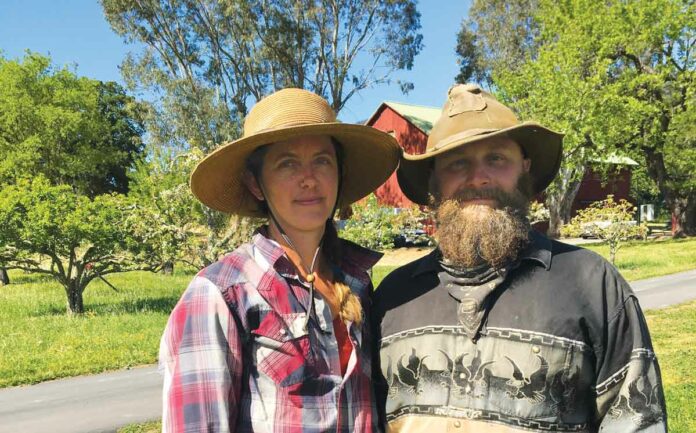
Oak Hill Farm in Glen Ellen, which has been around for decades, is a multi-generational family operation drawing on the resources and skills of the whole Bucklin tribe, which has deep roots in Sonoma Valley. You can’t miss Oak Hill or the Red Barn where produce is sold. For years, Anne Teller, the family matriarch, ran Oak Hill with a team of versatile Mexican field workers and a series of white guys who came and went and sometimes thought they knew most everything about vegetables. Not true.
When Anne passed on May 27, 2019, a month or so shy of her 88th birthday, hundreds of friends, neighbors and family members attended her memorial. In the wake of her passing, the farm descended into near chaos. Anne’s daughters, Arden and Kate, scrambled to get Oak Hill back on track and managed to keep their heads above water, barely.
“The farm was a wreck,” Arden tells me. “Morale was low, the land was depleted and leadership lacking.”
Oak Hill didn’t really find its stride again until Arden and Kate’s niece and nephew, Melissa Bucklin and Jimi Good, both of them young but experienced farmers, relocated from Oregon, put down roots, ploughed fields, planted and harvested, and persuaded the earth to sing again. They also tested and amended the soil, planted cover crops and added compost.
“When Melissa and Jimi first applied to work here, I said ‘No,’” Arden tells me. “I didn’t want more family. But I have come to see that having skin in the game makes all the difference in the world.”
Melissa and Jimi have helping hands from everyone in the family, including those of their 8-year-old son, Bodhi, who minds the chickens and gathers the eggs. Aunt Lizanne looks after the bees and collects the honey, and Melissa’s father, Ted, adds his skills as a carpenter. Kate works on the farm’s infrastructure.
Arden lends her wisdom almost every day. Across Highway 12, a stone’s throw away, Lizanne’s husband, Will, grows grapes and makes full-bodied red wines that go well with pasta, steak and grilled veggies.
Soon after I first met Anne Teller in 2007, she told me, “People come and go, the land remains.” It was hard for me to wrap my head around that idea, but the longer I thought about it the more it made sense. Anne’s second husband, Otto Teller, an avid environmentalist, was gone. Now Anne was gone and so were the two farmers, Paul Wirtz and David Cooper, who aimed to put their own stamp on the land and sometimes clashed with the family matriarch.
On a warm spring afternoon, I sat and talked with Melissa and Jimi, 38, the new kids in the fields. It was obvious that the land remained, though it had been punished by drought and fire, and though field workers came and went. Some went back to Mexico for good. “I’m the greasy thumb and take care of all the farm machinery,” Jimi tells me. “Melissa is the green thumb and spends most of her days in the fields.”
Jimi adds, “In Sonoma the growing season starts earlier and runs later than where we were farming in Oregon. It’s hotter here, and the rainy season doesn’t last as long.”
He and Melissa are learning about the climate and about the people who buy their produce inside the Red Barn at Oak Hill and at the Friday morning outdoor market in the town of Sonoma where locals meet and greet one another, and tourists join the festivities.
“It’s essential to communicate,” Jimi says. “Also, we have to educate our customers, and explain for example how to prepare turnips.” Melissa adds, “People want stuff for salads, so we’re growing more lettuce.”
At Oak Hill there are 90 different species of flowers and dozens of different kinds of vegetables and fruits. “Diversity is the way to go,” Melissa says. “It allows for year-round cultivation and seasonal plantings. You can rotate, not suck nutrients out of the soil and keep a field crew going in all four seasons.”
After 15 months at Oak Hill, she and Jimi seem as settled as any farmers can be. They are balancing what they call “the romance of farming” with the “practically of farming.”
Arden tells me, “My mother would do things differently, but I think she’d be proud of how things are going and growing at Oak Hill now.”
Jimi smiles and says, “There’s nothing more manly than farming.” Melissa adds, “Farming is for everybody.” Arden says that young, college-educated women, more than any other demographic group, want jobs on farms, perhaps because farming is associated with nurturing and harmony with Mother Earth. “It beats the hell out of sitting at a desk and looking at a screen,” she adds.
No longer can a landowner expect migrants from Mexico to plant and harvest. It’s also a challenge to persuade low-income families to buy local produce, which is more expensive than produce cultivated by big machines in the Central Valley. Still, if the pandemic taught Sonoma farmers one thing, it’s that shoppers want vegetables grown close to home. The question, “Is it local?” is heard every Friday at the farmers’ market and in the Red Barn. Arden smiles and says, “Yes.”
The Cannards
RETURNING Ross Cannard followed in the footsteps of previous generations of his family and joined Green String farm, which runs a local CSA program and also provides vegetables for Alice Waters’ Chez Panisse restaurant in Berkeley.
There are several beautiful family farms, including Green String, within a 15-mile radius of Oak Hill. Green String is run by Bob Cannard, the grandfather of local, organic agriculture. Bob educated thousands of farmers who now grow crops from Maine and Florida to Michigan and New Mexico. The Green String Store sells honey, vinegar, olive oil, eggs, dairy, meats, fruits and vegetables galore.
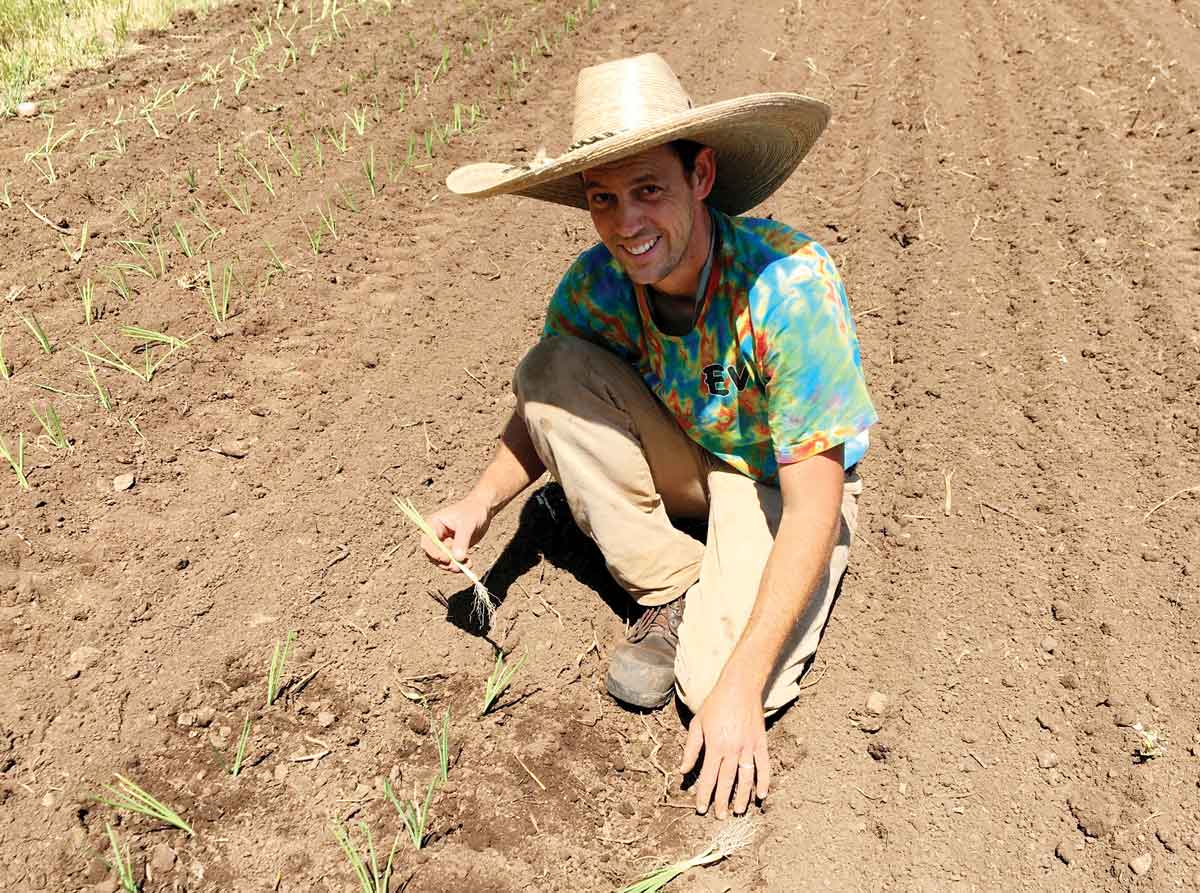
Bob’s son, Ross, who studied linguistics at UC Santa Cruz, came home to follow in the footsteps of his father and grandfather. “Studying linguistics at Santa Cruz isn’t helping me plant onions this morning,” he tells me. Along with his wife, he’s rearing two small children.
Ross belongs to the “returning generation” which is populated by the sons and daughters, grandsons and granddaughters of farmers who went away and then felt the tug of the land and did an about-face. On Sobre Vista Road—a short distance, as the crow flies, from Green String—Ross grows year-round. He and his dad respect one another and keep a comfortable distance.
Fifty or so locals subscribe to Ross’ CSA. Once a week, they receive a box with goodies which they pick up at the Tasting House for Sixteen 600 Winery in Sonoma, where they can visit with wine maven, Sam Coturri, and purchase excellent grenache and cabernet from local, organic grapes.
Ross provides vegetables to Chez Panisse, the Berkeley restaurant founded by Alice Waters, who has done more than any other chef in America to educate the public about local produce and healthy food. On a Monday morning when I visited Ross, two women, both bartenders at Chez, were planting thousands of onions in a field bathed in sunlight. Kayla and Sydney belong to what might be called the bartending-to-outdoors movement. Sydney says, “I’ve learned how hard farming is and how much planning is involved.”
Ross looks away from the onions he’s planting. “Farming goes in cycles,” he tells me. “Until the 1940s, small farms were the norm around here. Then, Big Ag arrived. Now the pendulum is swinging back. The small farm movement is growing again all around the world.”
And close to home, too.
The “Farmily”
Flatbed Farm in Glen Ellen on Highway 12, a mere 1.8 miles from Oak Hill, is operated by three women who call themselves “a farmily.” Sofie Dolan owns the farm with her husband, Chris, the co-founder, and with his cousin, Matthew, the executive chef at 25 Lusk, which is one of my favorite San Francisco restaurants. Once, Lusk took much of the produce Flatbed had to offer. Now, the produce is mostly sold on Saturdays, from 9am to 3pm, to loyal locals who shop as though it’s part of their religion.
“We have a series of monthly outdoor workshops to educate people on how to garden on their own,” Sofie says.
Her family members were farmers in Sweden. She still remembers “Hostbeck”—that’s the name of the farm—the land, the hayloft and the chicken coop. “We’ve tried to recreate some of Hostbeck here,” she says.
Hayley, from Maine, has long felt passionate about plants. She’s the farm manager during the day and in the evening a waitress at Salt & Stone on Highway 12 in Kenwood—which features local mushrooms, oysters from Drake’s Estero and Atlantic lobster.
“During the pandemic, Flatbed has been my sanctuary and my pride,” Hayley tells me. “I talk to the plants and play classical music for them.” She pauses a moment and adds, “One of the silver linings of the pandemic is that it has brought the farming community closer together than ever before. We have reached out one to another, shared seeds and did trouble shooting together.”
Hayley is helping to educate customers about companion planting. She’s also putting into practice things she learned at school. “I belong to a network of women farmers who are also mothers,” she tells me. “We embrace Mother Nature and have a sense of acceptance about the rhythms and cycles of farming.”
Amie Pfeifer writes the Flatbed newsletter, which includes recipes for meals that are “fast, healthy and delicious.” She also runs the Flatbed store, which sells produce, flowers and “value-added products” like preserves and pickles. Amie grew up on a farm in Nebraska which once depended on manual labor, but is now “industrialized” and grows GMO corn. “I got out of unhealthy and into health,” Amie tells me. “If you want to be happy, don’t take a pill, go to a farm or to a farmers’ market.”
It’s time to head to Flatbed, where you can buy vegetable starts and meet the “farmily.” Hayley, Amie and Sofie would like nothing better. Erase the blues. Turn over the soil and grow your own. You might find it addicting.
Jonah Raskin is the author of “Marijuanaland: Dispatches from an American War.”
Bay Area transportation officials this week announced the 2021 Bike Champion of the Year winners, honoring people from each of the region’s nine counties for their commitment to bicycling.
The Metropolitan Transportation Commission and local transportation agencies operate the annual Bay Area Bike to Work Day, which during the pandemic has been changed to Bay Area Bike to Wherever Days.
Organizers of the event launched the annual Bike Champion of the Year awards, with many of this year’s honorees being veteran bike-cruisers who started initiatives to increase the use of bikes as a mode of transportation or have spent years leading by example.
Winners this year include Napa County’s Kate Miller, who started bike riding 30 years ago around Seattle; Sonia Elkes, from San Mateo County, who founded advocacy group San Carlos Bikes; and David Wood and his three daughters, who ride their bikes to school every day in Santa Clara County.
Hilary Noll, the winner from Marin County, hopes for a future where bike riding is normalized and more accessible.
“People from ages 8 to 80 feeling more comfortable biking for everyday needs,” Noll said. “More women riding, especially as commuters. More women- and minority-owned bike shops. A cycling culture in which everyone—from elite riders to everyday folks getting started—are welcomed and empowered.”
Recipients of the award receive a Tailgator brake light and water bottle from Mike’s Bikes, a bicycle-only membership for 24/7 roadside assistance from Better World Club, a laminated set of San Francisco map cards from the Association of Bay Area Governments, and a cycling jersey from the Bay Area Air Quality Management District.
A full list of this year’s winners can be found here.
After more than a year since the pandemic canceled live events, local theater companies have moved online and are still finding new ways to produce dramatic works for virtual and distanced audiences.
In May, two North Bay productions add interactive and multimedia elements to their plays, as Left Edge Theatre presents Eat the Runt, May 1–23 and Marin Theatre Company presents the world premiere of Brilliant Mind, May 18 to June 13.
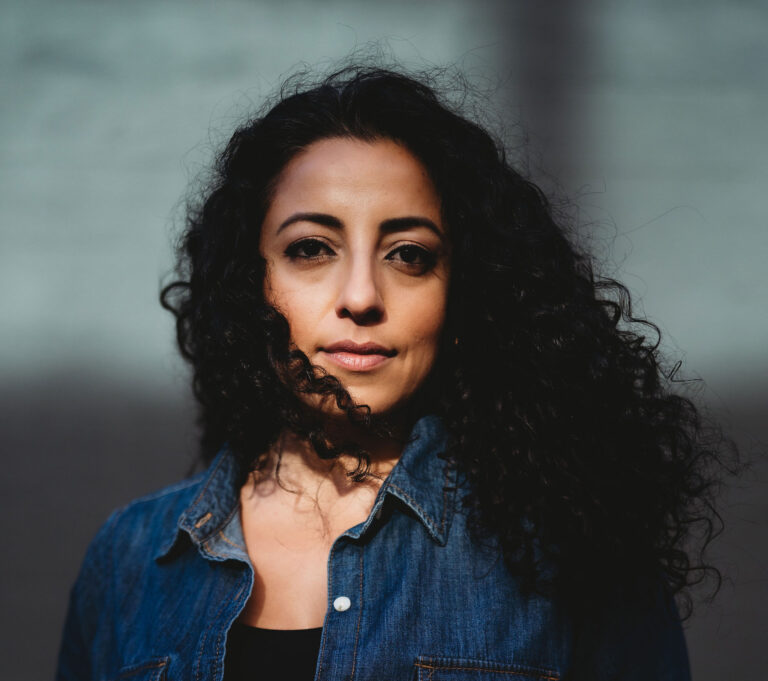
Inspired by true stories of first-generation Americans, Brilliant Mind is an innovative new work, created by Egyptian-American playwright Denmo Ibrahim, that deals with generational trauma and the challenges facing immigrant communities, as well as a story of hope, resiliency and family.
“The idea for the project stemmed around my interest in immigrant communities and their relationship to mental health, in particular when they are developing families in America,” Ibrahim says.
After the death of her father in November 2020, Ibrahim developed the plot of two siblings who learn of their estranged father’s death and bury a man they never knew.
Knowing that the play would not be told in a live setting anytime soon, Ibrahim shared the idea with producer and digital and interactive designer Marti Wigder Grimminck, and they began collaborating on the project though Storykrapht, an international production company the two launched earlier this year.
“I had already been dreaming of a digital experience, and as soon as I started telling Marti this idea of family and perception, she could see how the technology could support the story,” Ibrahim says.
Utilizing the digital platform, Brilliant Mind tells its personal story through the lens of real-time live performance blended with film, text messaging and other audience engagements.
Ibrahim adds that Marin Theatre Company Artistic Director Jasson Minadakis committed to the project before he saw the finished work, and that his support to the process gave space for the creative team to reimagine what a theatrical experience could be in a digital space.
“In this experience, we’ve had to think about this story in many different textures,” Grimminck says. “But, we’re not losing sight of this story; it’s a beautiful story that Denmo has written, and we don’t want the tech to overshadow that.”
Audiences can also get involved in Left Edge Theatre’s digital production of the satirical comedy Eat the Runt. The play streams live May 1–9 and on-demand May 10-23.
Each night, the eight actors don’t know which of 7 roles they’ll play until the audience chooses any one of the 40,320 possible casting combinations through an interactive online poll.
“It’s really different night by night,” Left Edge Theatre Artistic Director Argo Thompson says of the play, which is about a series of job interviews. “It’s a play about your preconceived ideas about people and the job interview process, and how it’s a hotbed of politicization.”
Thompson hopes that Eat the Runt will be Left Edge’s last digital-only production as Covid restrictions ease. The company is already planning to present its final play of the season, Slow Food, in-person as well as online in June.
“We’re going to continue to record our shows and offer them livestreaming or on-demand, even after we move to in-person,” he says.
Point Reyes Seashore is a national treasure in our own backyard. Every year more than 2 million people come to the Seashore to be in nature, hoping to glimpse rare wildlife like the migrating whales and majestic tule elk. The Seashore is a refuge for people, as it is for 200 rare, threatened and endangered species. People love the National Seashore, but few know of the threats to this fragile coastal ecosystem from the 6,000 cattle that graze 24/7 on these public lands.
As a local resident, I became interested in learning how a handful of ranchers manage to remain on leased lands, subsidized by our tax dollars on this seashore—the ONLY National Seashore on the West Coast of the U.S.? And why does the National Park Service permit these privately owned commercial dairies and beef operations to continue despite the damage to the land, water, wildlife and our climate?
I’ve been exploring the threats facing our backyard paradise and encourage anyone who loves this place to learn more. Point Reyes: A Wilderness in Peril is a series exploring Point Reyes National Seashore and the decades-long battle to reclaim and restore the park for the public and future generations. Airing on MarinTV Channel 26 or on cmcm.tv. I encourage anyone who cares about this place to take an interest in protecting it.
Everyone’s a rock star; it’s true. What is also true conversely, is that every “rock star” is a person just like you. How so? Rock stars appear to do what they want, when they want. They make cool things, keep their own hours. They live by their own rules. How am I also, a rock star? I’m just a normal person.
You can approach this existence simply by being yourself; a “normal person.” By being open to the fact that “rock stars” are everywhere. You can attract other stars more easily than you think. And, as we come out of this pandemic mess, it all starts locally.
You like sculpture? Start a sculpture-appreciation night once a month and host walking tours of acceptable locales. Food? Throw together a cooking class at the BBQ in the park to show what you’ve got. There’s no limit.
Passionate about music? Put up a flyer and invite musicians over. If your yard is too cluttered, ask a local establishment if you can “drum up some business” every other week and start a local music night at the local falafel shop. What you focus on expands.
Combine your interests for fun and merriment. If you like something and wish it to be more prevalent in your life, make it so! Love live music? Making friends? You like to know what’s going on in your town? You wish to practice extroversion?
Create space for these things to happen. Create a space where ideas are shared, where things happen. In Coviddy times, it can be your front yard or garage—that vacant lot at the end of the block.
What’s important—in fact, the only important thing—is to be yourself and share your passion. Passion comes through. Passion resonates. Pretty soon, you’ll find yourself getting better at living your dream life.
Pretty soon you’ll realize you’ve been amongst rock stars this entire time.
Greg Ceniceroz—a.k.a. “Ceni”—hosts Open Mic With Ceni at Hopmonk Sebastopol every Tuesday night, forever. To have your topical essay considered for publication, write to us at op*****@********un.com.
Heroines, Harpies and Harlots—a theater project born to let all who identify as female have a voice—returns for a second year with another festival of theater pieces that delve beneath the surface of what society thinks a woman should be to find who they actually are through individual stories.
They are presenting, in conjunction with the Cloverdale Performing Arts Center, a program of original works titled “In Their Own Voice: a virtual on-line festival about what happens when you let a woman speak.” The festival will stream May 8–16.
The festival features an all femme/female-identifying/non-binary group of Sonoma County artists of varying ethnicities, races, sexualities and ages. “I started looking for artists in the community that I knew had stories to tell,” said festival-producer Beulah Vega. “Artists who I respected as strong human beings, who I saw as people who had stared trauma in the face and who had found ways to grow beyond it. I looked for artists who I saw turning around to help others along the way. I especially looked for artists who had something to say, and were never given a chance to say it.”
Last year, Vega worked very hard to find stories about women/female-identifying/non-binary people that were not focused on domestic or sexual violence, as she believes there is more to telling someone’s story than just the worst moment of their lives.
For this year’s festival, 22 Sonoma County–based artists are working on five pieces in which the authors will also perform. “Yes, some of the stories that came from this are traumatizing,” Vega said, “but some stories are only focused on trauma as a way of saying ‘Look! You wanted to see real trauma, look at it for what it is. Now change it!’”
Vega adds that other stories, while rooted in trauma, are about rising from it and coming back to wholeness.
“Some of the stories don’t focus on or use trauma at all, they are stories about the experience of deciding to be oneself no matter what others say you should be, and no matter what the world does,” she said. “Some are true stories about the artists themselves, some are conglomerate stories about a slew of experiences. There is dance, poetry, storytelling and traditional theater. The voices are multi-racial. The voices are every color on the queer spectrum. The voices come in every shape and size. The one thing that they all have in common is their strength.”
I just attended a funeral.
It was not my first. At the other two services, my mind and emotions shut off. I don’t remember them, more than arriving, feeling weird and feeling no connection with anyone else present, alive or underground, although I was related to the celebrants.
I didn’t know what to expect from a funeral service, much less that...
Bay Area-based nonprofit organization Bluegrass Pride lifts up LGBTQ+ musicians and creators within the bluegrass music community; largely through concerts, jam sessions, showcases, festivals and parades.
In 2020, after the pandemic forced Bluegrass Pride to cancel in-person Pride programming, the organization made the pivot online, hosting a two-day livestream festival that raised more than $23,000 for the LGBTQ+ and allied...
Under the supervision of art instructor Ginny Geoghegan, the Tomales High School art program remained a bedrock of creativity for students navigating the course of the past year's unprecedented distanced learning ordeal.
With the support of the school staff, these art students flourished at home and continued to develop a pantheon of new artworks inspired by their individual experiences and...
Local farming makes a comeback
Rooted
All across the U.S., Americans of every shape, size and skin color are taking up farming and growing vegetables in the spirit of Joy Harjo, the Native American poet who writes:
Remember the earth whose skin you are:
red earth, black earth, yellow earth, white earth, brown earth.
They’re remembering the earth in the North Bay’s valleys and...
Bay Area transportation officials this week announced the 2021 Bike Champion of the Year winners, honoring people from each of the region's nine counties for their commitment to bicycling.
The Metropolitan Transportation Commission and local transportation agencies operate the annual Bay Area Bike to Work Day, which during the pandemic has been changed to Bay Area Bike to Wherever Days.
Organizers...
After more than a year since the pandemic canceled live events, local theater companies have moved online and are still finding new ways to produce dramatic works for virtual and distanced audiences.
In May, two North Bay productions add interactive and multimedia elements to their plays, as Left Edge Theatre presents Eat the Runt, May 1–23 and Marin Theatre Company...
Point Reyes Seashore is a national treasure in our own backyard. Every year more than 2 million people come to the Seashore to be in nature, hoping to glimpse rare wildlife like the migrating whales and majestic tule elk. The Seashore is a refuge for people, as it is for 200 rare, threatened and endangered species. People love the...
By Greg Ceniceroz
Everyone’s a rock star; it’s true. What is also true conversely, is that every “rock star” is a person just like you. How so? Rock stars appear to do what they want, when they want. They make cool things, keep their own hours. They live by their own rules. How am I also, a rock star? I’m...
Heroines, Harpies and Harlots—a theater project born to let all who identify as female have a voice—returns for a second year with another festival of theater pieces that delve beneath the surface of what society thinks a woman should be to find who they actually are through individual stories.
They are presenting, in conjunction with the Cloverdale Performing Arts Center,...