Wedding for One

Saying ‘I Do’ to You

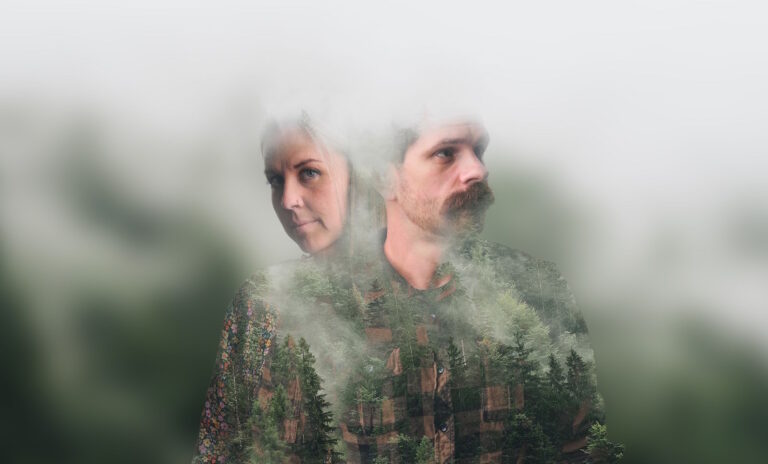
Summer is “wedding season,” but why feel left out when you can simply marry yourself? That probably sounds like something a narcissistic celebrity would say, but we in the spirit world know that even the most trivial notions reveal deep cosmic secrets.

The inner union between soul and spirit is an idea found in many of the world’s traditions, including high magic, Hinduism and Native American mythologies. In Greek it is known as the hieros gamos, or sacred marriage, and forms the chief aim of alchemy, whose magnum opus is the conjunction of opposites symbolized by the sun and moon. Countless woodcuts from the Medieval and Renaissance periods depict a disturbing but fascinating mystical-erotic union of king and queen, who are royal because this path is trod by the few, and brother and sister because they share the same Father.

If you suffer from frustrating inner conflict, then you probably need to officiate over an inner marriage. The hieros gamos bequeaths a four-dimensional consciousness that transcends the masculine-feminine binary, with one reborn as the Hermetic hermaphrodite, child of Hermes and Aphrodite. As one alchemical text puts it, “I lost myself, I found myself, I mated with myself, I gave birth to myself, I am myself.”

Jungian psychology refers to the process of integrating opposite-sex characteristics as individuation, with the result that ones becomes a Self with a capital S. Spiritual seekers might call the process a return to the Primordial State of the original spiritual blueprint of Man—as in mankind—an androgynous being called in Gnosticism the Anthropos.

It was only after the descent into material form, or because of a “fall” from the spiritual Garden of Eden, that the sexes were divided into two, for purposes of reproduction. The quest for inner wholeness thus marks the journey back to the original state, and preparation for the real marriage, which is the soul’s brideship with its creator upon the completion of its earthly life. 

It requires a long and arduous courtship to wed one’s mind-spirit-consciousness solar side with one’s feeling-intuitive-unconscious lunar side. It is also fraught with danger, as the ego feels deeply threatened and destabilized by the injection of opposite-gender content into consciousness with the goal of assimilating it. Not afraid? In the words of a big-eared little green sage, “You will be.”

But, if you succeed, you will be able to echo the words of Oscar Wilde, who famously quipped, “Love of oneself is the beginning of a lifelong romance.”

Culture Crush: Find Live Events This Week

North Bay

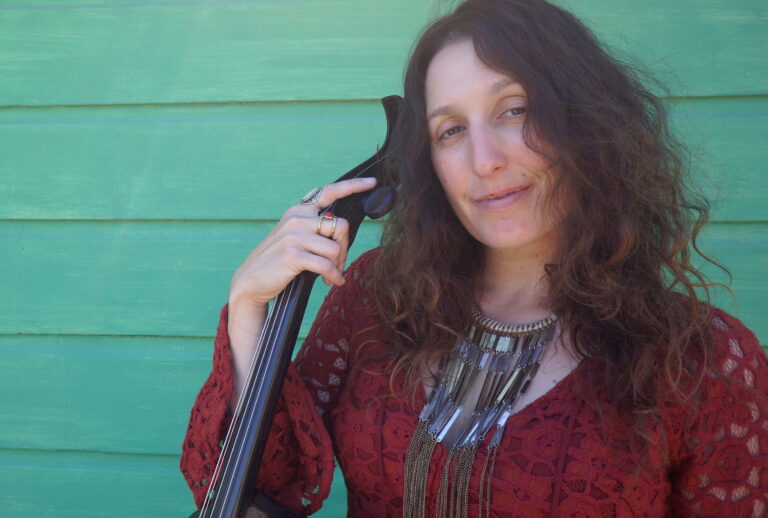
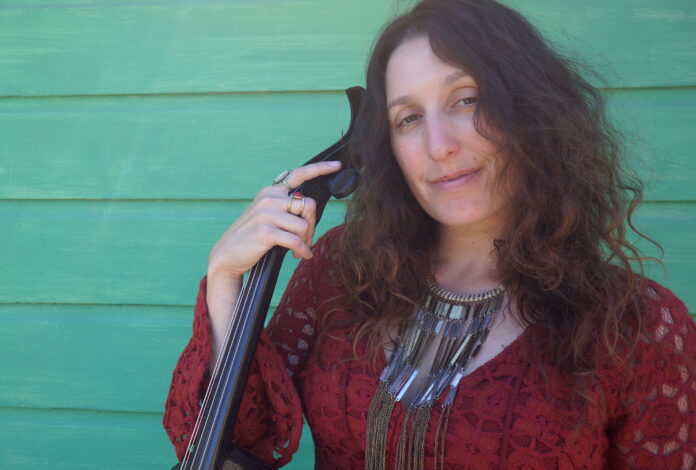
Before heading to Iceland for a tour later this month, acclaimed cellist Rebecca Roudman and her virtuosic bluegrass band Dirty Cello will play all around the North Bay this week. The band performs a concert in the park on Thursday, July 8, at Lyman Park, 1498 Main St., St. Helena. Following that, the band plays two sets on Friday, July 9, at HopMonk Tavern, 230 Petaluma Ave, Sebastopol. Next, Dirty Cello once again rocks outdoors with a concert on Sunday, July 11, at at Piccolo Pavilion in Menke Park, Redwood and Corte Madera Avenues, Corte Madera. Dirtycello.com/shows.

San Anselmo

Under the musical direction of internationally-acclaimed conductor Daniel Canosa, the ECHO Chamber Orchestra is ready to once again bring its energy and musical verve to orchestral performance with a live show this weekend. The concert, titled “A Musical Promenade,” will feature musicians of the orchestra placed at socially distant outdoor stations and playing music for small ensembles, culminating indoors with three pieces for a full orchestra. Join the promenade on Saturday, July 10, at First Presbyterian Church, 72 Kensington Rd., San Anselmo. 6pm. $20. Echorchestra.com.

Santa Rosa

Man’s best friend will put on a show at the inaugural Wine Country Canine Fun Run. The fundraiser for Marin Humane will feature local pups racing against time—not each other—in groups of small, medium and large dogs, with special groups for puppies, senior dogs and dogs with disabilities, too. The daylong event will also feature a ceremony to honor first responders, live music, demonstrations and more. See dogs run on Saturday, July 10, at the Sonoma County Fairgrounds, 1350 Bennett Valley Rd., Santa Rosa. Gates open at 7:30am. Free admission, dog entry fee is $25 and race entry deadline is July 8. FastDogsUSA.com.

Napa

After missing a year due to the pandemic, Napa County Landmarks’ annual Riverfront Captains & Mansion District Walking Tour is back in town this weekend. Napa Mayor Scott Sedgley leads the walk around the town’s old Riverfront District down to the Napa Abajo East neighborhood on the Napa River. Along the way, Sedgley will point out the many historic homes from the 19th and early 20th centuries, and share the homes’ interesting stories and the neighborhood’s role in Napa’s past. The walking tour meets on Saturday, July 10, at 500 Main St., Napa. 10am. $5–$10. Napacountylandmarks.org.

Larkspur

The French cuisine connoisseurs at Left Bank Brasserie in Larkspur always celebrate the holidays with special menus and offerings, though the restaurant goes all-out each summer on the French holiday of Bastille Day. This year, Left Bank gets into the spirit of the day with rustic, authentic French additions to the restaurant’s lunch, dinner and cocktail menus, plus festive blue, blanc and rouge decorations, live music and other attractions ranging from a stilt walker and face painter to staff ensembles and costumes. Reserve a spot at the all-day celebration on Wednesday, July 14, at 507 Magnolia Ave., Larkspur. Leftbank.com.

MDMA Goes Mainstream

Last Saturday at Acre Petaluma, over iced coffees and salmon toast, I had the pleasure of sitting down with Dr. Jim Matto-Shepard, psychologist, psychotherapist and licensed Soul Motion Conscious Dance teacher. 

We discussed the properties and benefits of MDMA—a hot topic at the moment, as the DEA and FDA have begun to ease back on restrictions around the drug’s medical use, and we enter a sort of MDMA renaissance.

MDMA, also known as Ecstasy or Molly, was first developed in 1912 by German chemist Anton Kollisch, as a parent compound to a drug intended to control bleeding during medical procedures. Its psychedelic properties weren’t explored until the 1970s and early ’80s, when psychiatrists began to notice an enhanced capacity for communication in their patients who were under the influence of the drug.

At this time MDMA also became more common at parties and other recreational settings, and in 1985, despite numerous testimonies from psychiatrists and psychoanalysts—including Rick Doblin, the founder of the Multidisciplinary Association for Psychedelic Research (MAPS), who has spear-headed MDMA legalization and treatment—the DEA declared an emergency ban on the substance. MDMA is a Schedule 1 drug, meaning a substance with “no currently accepted medical use and a high potential for abuse.”

But circumstances are beginning to change. And this is where my conversation with Dr. Jim Matto-Shepard took off.

Matto-Shepard is one of the founders of Temenos Center for Integrative Psychotherapy in Petaluma. Temenos offers psychedelic assisted psychotherapy to people suffering from depression, PTSD and other psychological issues. In early 2020 Temenos was one of nine clinics in the country selected to do Expanded Access work with MDMA. Developed by Dr. Doblin and the staff of researchers, scientists and psychiatrists at MAPS, the Expanded Access program allows for the legal use and study of MDMA, as a treatment for patients suffering from PTSD who have been unresponsive to other forms of treatment. Since this approval, and in the wake of Covid, Temenos is gearing up to take referrals.

You may be wondering what “temenos” means. It’s a Greek word which refers to a piece of land dedicated to sacred use. Matto-Shepard and his colleagues chose it because the clinic provides a safe, sacred space in which to begin and fortify lasting trauma resolution and psychological evolution in its patients. The use of psychedelics—in this case, MDMA, though the clinic also works with ketamine—allows for a state of brain function from which the patient can engage with circumstances and memories negatively impacting their life, from an observational and self-empathetic space. Matto-Shepard explained the neurodynamics of an MDMA dose to me in this way:

“Essentially, the medicine calms the amygdala, which is your brain’s fight-or-flight center. A traumatized person essentially lives in the amygdala, in a perpetual state of fight or flight. It’s a crippling experience. So, MDMA quiets the amygdala, while amplifying the communication between the hippocampus, your memory and emotional regulation center, and your neocortex, where your brain processes language and general function. All this while increasing the production and release of oxytocin, often referred to as the ‘love hormone,’ which produces empathy, trust and indeed, love.”

From this brain state, a person can safely observe and analyze their circumstances, and begin to observe and resolve harmful neurological patterns. They put their brain into a state which allows them to begin rewriting its system of functioning. A great book on neurodynamics, by the way, is The Neuropsychology of Grace by Charlotte Tomaino, which affords amazing and super-digestible insight into brain function.

Matto-Shepard was quick to emphasize that the medicine itself is not the cure, but the thing that enables the patient to assess their state and address the immediate needs. From this place, they are then able to implement lasting change in their lives. I offered the analogy of shining a light into a closet that needs to be cleaned out, which he liked, but after our conversation I thought of a better example. MDMA works in the way that an anesthetic does: calming the brain enough to enable the reopening of an infected wound. Once opened and sterilized, the wound begins to heal itself, being now in optimal condition to do so.

MDMA, unlike most contemporary legal antidepressants, is not meant to be used perpetually. It is administered once-to-a-handful of times, in a moderated setting, in order to optimize neurological function. Once this process is initiated, like the healing wound, the brain works on its own, and patients need only assist the process, with the same TLC they would give a scraped knee or a broken arm. We know how to heal, but we still need the cast and the care, and MDMA allows the brain to move into that mode of function. No longer fighting or freezing, we can start actually being.

This MDMA revitalization is almost entirely thanks to MAPS. Doblin has advocated for the legalization and right to administer MDMA since the DEA-declared emergency ban in 1985. It’s taken 36 years, but clinics like Temenos—for a full list, visit the MAPS website—do finally have their green light to begin legally working with patients who fit the DEA outlined profile. At this point in legality only the aforementioned PTSD patient profile, unresponsive to all other treatment, qualifies for MDMA treatment, but hopefully within the next five to 10 years, MDMA-assisted therapy will become available to those of us experiencing other forms of acute and developmental trauma, without us having to first go through other, potentially less effective and certainly longer-term, avenues. Frankly, I hope this treatment will soon be available to everyone who feels called to participate in it.

Matto-Shepard and I also discussed my personal experiences with MDMA, of which I’ve had two.

The first time I used anything like MDMA I was 17 years old. It wasn’t pure—we called it Thizz. I had a boyfriend at the time who, one evening, asked if I wanted to try some. It came in the form of a little red pill with an alien face impressed upon it. I stared at that face for nearly 20 minutes before someone knocked loudly on the bathroom door—I was at a coffee shop. Without another thought, I popped it into my mouth and swallowed it.

It was an exceptional night. As the drug took hold, I remember my vision seeming to expand, my peripheral sight becoming sharper. The textures of clothing, the feeling of skin, the very act of drawing breath, felt better. I felt calmer than I had in a long time, and when I looked in the mirror, I saw a playful, joyful version of myself looking back at me. Everyone seemed illuminated, and I felt an expansive sense of love.

But I was looking for excitement and new experiences, not engaging with the drug to resolve my trauma in any conscious way. Though the experience was overall intriguing and pleasurable, it ended at 5am with a headache that rivaled the birth of Athena—right out of Zeus’ skull. This, I suppose, is the risk you run when a semi-suspect guy you’re dating hands you a red, alien-faced pill. But hey, I wouldn’t trade in the experience.

That was in 2009. Fast forward 10 years. At 27 I was living in upstate New York, having just graduated from Bard College. I’d developed a close relationship with a family whose children I took care of, and their mother, an amazing woman I’ll call Margaret, was a huge proponent of MDMA. Margaret and her husband often took it to aid them in working through relationship challenges. Matto-Shepard, by the way, is particularly interested in developing MDMA treatments geared toward couples. As I packed to move across the country to California, Margaret gave me a double dose, pressed into a little blue pill—insert Matrix reference—straight from Amsterdam. Take it when you’re ready, she said. You’re going to love it.

I drove across the U.S. with that little blue pill, scored to split, in a small cigar box next to some Picasso projector slides and a perfume bottle from my grandmother. It became another treasure, loaded with story and sentiment, but I didn’t know when I would ever take it, or if I ever would.

I’m not opposed to drug use—though I was raised with the “Just Say No” mantra, I was generally open to the experiences of LSD, mushrooms and marijuana. LSD in particular, which I took in New Mexico with a very dear friend, brought me to a level of emotional awareness and receptivity that shapes me to this day. But my experience with Thizz hadn’t left me feeling anything I felt the need to revisit; my recollection of the headache alone was enough to turn me off from future use. Even though I knew what Margaret had given me was different, I didn’t feel compelled to explore its effects.

On my extended migration to California I stopped back in New Mexico for almost a year, and one evening found myself at a birthday party out in Tesque. It was hosted in a beautiful, small adobe, nestled in those inimitable New Mexican mountains veined with quartz and magic. Under a dome-sky turning fuchsia and lavender, and filled with sparkling stars, I pulled up, the cigar box still in the trunk of my car.

My friend Prince—not the rockstar, sadly—was there. Prince was really the only person I would consider doing MDMA with at the time, and somehow it came up in conversation that there was a little blue pill in the vicinity.

“Let’s do it!” Prince said, his eyes and smile wide and sweet. Margaret’s voice echoed in my mind: Take it when you’re ready. I went to the car, opened up the trunk and took the pill out of the cigar box. We looked into each other’s eyes, promised to have a wonderful time, cut it and ate it, and then Prince began telling a story. 

People I didn’t know, and people I did, stood around the kitchen island as he wove his narrative, illustrating with his hands and emphasizing with his shoulders and eyebrows.

As I stood listening, chiming in, laughing, I felt something begin to swell inside of me. A wave began building, sweet and strong, becoming stronger and stronger. I felt it gathering momentum, and I took a deep breath. Suddenly it broke—

I was flooded.

I felt, for two or three minutes, utterly miraculous. I was entirely alive and entirely at peace.

Then, something changed.

 A  voice entered my head, and rang clearly through the sensation.

This isn’t real, it said. This sensation of peace is externally induced. You’re not actually this content, Jane. 

A wave of frustration swept through me. It wasn’t sharp or acute, but I felt anger. Something was off. I looked around, and took a brief assessment of my situation: I was in a beautiful house, yes. I was with people I loved, yes. But it was almost midnight, and I knew I’d be awake through the morning. People were smoking cigarettes, drinking Fireball, railing lines of cocaine and lying in various states of incapacitation. I don’t want to be here, I realized. This isn’t who I want to be.

I’d been actively trying to break away from a certain lifestyle—this lifestyle—for the last four years. Throughout college I’d practised crossfit, yoga, meditation, good nutrition, sleeping eight hours a night—fighting to get away from the destructive nihilism and ennui that liberal arts colleges can perpetuate, and working to restructure my social circle towards people who desired the same kind of physical, mental and emotional health. I wanted a life that allowed for natural serotonin and oxytocin production; a life lived outside of a hyperactive amygdala which left me in a constant state of running or fighting. I’d transferred schools in search of it, studied somatic therapy and Zen Buddhism, and written my thesis on the psychology of divinity; I was endeavoring to build my life on pillars of physical, mental and spiritual excellence. Yet, my old patterns kept returning, triggered by one thing or another, and I would find myself lost again, as though sleepwalking, living behaviors that weren’t serving me.

Usually, becoming aware of this filled me with panic and vicious self-judgment. My feelings of weakness and shame around struggling to liberate myself from bad habits built on pain from my youth were often as crippling as the habits themselves. It was a Catch-22. Try, fail, shame myself for failing, fail again. We all know some version of this utterly ineffective cycle.

At that moment, while at a party in Tesuque, New Mexico, on an MDMA pill from New York via Amsterdam, I was able, for maybe the first time in my life, to observe without being hijacked by emotion, my own habits and practices. I was able, without being thrown into the hyperactive amygdala state, to witness myself.

I was able to construct clear directives with myself like, Jane, you don’t want to be here. You love these people, but they’re not part of your life anymore. Jane, you’re a different person than you thought you were, and these habits are coming from a place of pain, not a true part of your identity. Jane, babe, you know what you need to do, you’ve been doing it. Just keep at it, girl.

I was able to calmly, peacefully, witness the things in my life that were not calm or peaceful. Two years almost to the day after this experience, the circumstances of my life are as I had always prayed they would be. I sleep well, eat well, study and cultivate my spiritual and mental health. I am reconciled with past trauma, and I experience that very sense of natural joy I desired so clearly that night in Tesuque.

I’ve always thought of that night as a turning point in my development, but until my conversation with Matto-Shepard, I wasn’t aware of the degree to which MDMA assisted in that shift. Having the neurological language to explain and understand my experience only increases my amazement and gratitude. If I had such a beneficial experience alone and unguided, I can only marvel at what a clinically administered and professionally guided session can offer patients, and I see no reason why such treatment should not be available to the population at large. 

As of 2019, the MAPS success rate in the treatment of PTSD was 68% at the one-year mark, meaning these men and women are no longer diagnosable with PTSD. This research and treatment could bring about a new way of being with one another in the world.

As Dr. Stanislav Grof—a Czech-born psychiatrist and mentor to Doblin—said, “Psychedelics are to the human consciousness what the microscope is to biology and the telescope is to astronomy.”

We all remember how people responded to Galileo when he posited the universe was not, in fact, geocentric. But he was on to something, wasn’t he? It might be a tough pill to swallow—pun absolutely intended—but we owe it to each other, and to the world at large, to continue exploring the frontiers of psychological wellness.
To learn more about Temenos and Dr. Matto-Shepard, visit temenos.center.


Open Mic: Life In a No-Kill Household

By Sam Case

In Marin and Sonoma, we love our wildlife—but in the wild, not in our houses. Alas, in our house our cats and their cat door mean that raccoons, rats, mice, birds and, yes, one skunk have all ended up inside. We awoke one night to find two bats flying around the living room. They were part of the feline catch-and-release program—catch outside and release inside. My wife, Judy, and I do our best to usher this wildlife back into the wild as gently as possible.

This nonviolent attitude seems to have rubbed off on our cat, Harold. For a time, Harold caught mice and brought them into the house. He never killed them, but played with them until they inevitably escaped under some piece of furniture.

Occasionally, in the evenings, one of the mice would emerge into the living room. This provoked an explosion of activity as Judy leaped up to catch the mouse and carry him outside, while Harold tried to pin him down for more one-sided play. Eventually, the mice formed a commune behind the stove, which they soon rendered unusable by employing the oven as a toilet. We were saved by a better mousetrap: a device that trapped the mice without harming them.

A more difficult problem has arisen recently: a plague of tiny moths that lay eggs in flour and other foodstuffs. The resulting worms are hard to detect and are sometimes baked into bread or muffins, thus causing the most dedicated vegetarian to become an unwitting meat eater.

Some weeks into this invasion, I told Judy I had a solution: I would buy a small butterfly net, and remove all the moths from the house. She pondered this for a while, then announced that, while this method might work, we had certain responsibilities. The moths, like Elsa the lioness of Born Free, had grown up in captivity. Before we released them into the wild then, we would—as they did with Elsa—have to teach them how to hunt.

I’m still trying to figure out how to accomplish this …

Sam Case lives in Fairfax. We welcome your contribution. To have your topical essay of 350 words considered for publication, write le*****@********un.com.

North Bay Summer Concert Programs Are Heating Up

For many North Bay music lovers, summer is a smorgasbord of outdoor concerts and community gatherings. Last summer, all the popular concert programs were forced to cancel their plans due to the pandemic, though this summer is heating up with free live music in July and August.

In Marin County, the City of Sausalito Parks and Recreation Department once again presents its annual summer concert series Jazz and Blues by the Bay. Concerts take place at Gabrielson Park in Downtown Sausalito every Friday, 6:30–8pm, through Aug. 27.

Jazz and Blues by the Bay’s local lineup of live music includes West Coast Cool on July 9 and Andre Theirry on July 16. Attendees can reserve table seating for the concerts, and free lawn seating will be available as well. In addition to the music, local nonprofits will be selling food and beverages again this year at each concert. jazzandbluesbythebay.com

Local bands and musicians are also appearing weekly at Town Center Corte Madera for the center’s Summer Music Series, running on select Saturdays and every Sunday, 1–3pm, through Sept. 19.

The family-friendly shows will highlight the region’s array of talented musicians while also shining a light on the Town Center’s variety of food, shopping and other delights. The series will feature popular acts like Z & the Benders on July 11 and Brian Francis Baudoin on July 18. shoptowncenter.com

This week, the St. Helena Chamber of Commerce’s Summer Concert Series opens four weeks of fun in Lyman Park. Live music, local restaurant partners and lots of wine are on hand each Thursday in July, from 6–8pm. The free series opens with Dirty Cello on July 8, and features Planet Groove on July 15. sthelena.com

Also in Napa Valley, Calistoga’s Concerts in the Park returns for a summertime schedule of music, wine and picnics at Pioneer Park. The series opens on July 22, from 6:30–8:30pm, with Arkansas-based indie-folk duo National Park Radio. visitcalisotga.com

Dynamic wine country marketplace Cornerstone Sonoma is currently hosting its Summer Music Series every Saturday and most Sundays; gathering local musicians, organic wine country cuisine, local wines and craft cocktails.

On Saturday, July 10, the Cornerstone’s Summer Music Series features singer-songwriter Sean Patrick Garvey’s solo Americana project Obsidian Son, performing 11am to 3pm. Future dates bring out local rockers the Henry Coopers on July 17 and the Steve Pile Band on July 18. cornerstonesonoma.com

In Sebastopol, the long-running Peacetown concert series is moving from Ives Park to the Barlow for an expanded weekly event that encompasses four stages of local music running each Wednesday through Sept. 8.

On July 14, the Peacetown concert series hosts the Pulsators at the Barlow’s main stage, Free Peoples on the Crooked Goat Brewing stage, Mundo Rio on the Woodfour and Fern Bar stage, James Patrick Regan at Community Market and Kevin Russell’s Americana showcase with 3 Acre Hollar at nearby HopMonk Tavern. The music starts at 4:30pm at the Barlow and 5:30pm at HopMonk. peacetown.org

This article was updated on July 7, 2021.

Letters to the Editor: Point Reyes Horror

The article in the Bohemian and Pacific Sun (“Death by Design,” June 30) describes the horror of the mistreatment of the beautiful tule elk herd at the Point Reyes National Seashore. I have seen them many times hiking there, and they are amazing. Starving them, forcing them to die of thirst and sadistically butchering them is just unacceptable. Point Reyes is a public resource owned by the people of the United States, but is being run at our expense for the benefit of a few ranchers. The ranchers are charged rent far below market rate, $7 per head, which probably does not even cover the cost of separating the cattle and elk.

Point Reyes is a very unique place where such a large coastal tract is preserved in an approximate natural state. We need to focus on strengthening the protections of the natural environment there, and not rolling them back.

One curious thing is that the ranchers claim to barely break even, but somehow have enough money to contribute to Rep. Huffman’s campaign to influence him. Could there be outside money involved? If so who is contributing? If not, the ranchers are doing well enough they can do with fewer cattle to make room for the elk and pay more to rent the land from us. Huffman should steer clear of this money—there are interests who strive to erode the protections of our National Parks to build hotels, golf courses and drill for oil. This is not just an attack on Point Reyes, it is part of a privatization attack on our beautiful National Park System.

The agreements that were made 60 years ago were from a different era. Things change, and it’s time to start buying out the ranchers and letting the elk roam free. If the elk overpopulate because there are no predators, then cull the herd. Don’t cull them just to make room for more environmentally destructive cattle so we can produce more milk and burgers.

Dr. John W. Cruz, Sebastopol

Write to us at le*****@********un.com.

Documentary Chronicling Andy Lopez Shooting set to Debut on July 15

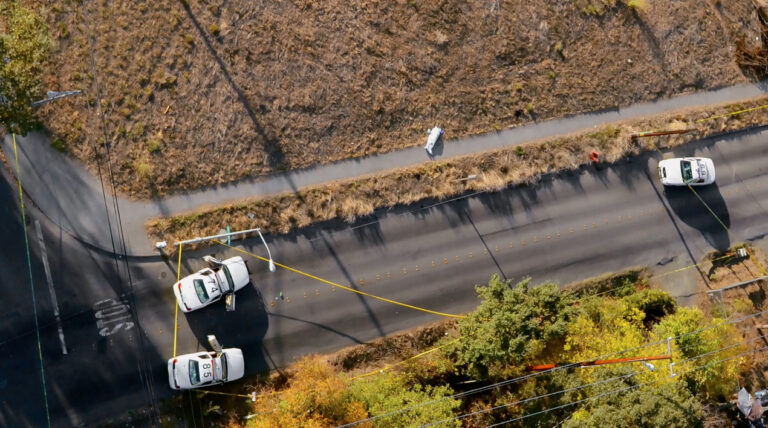
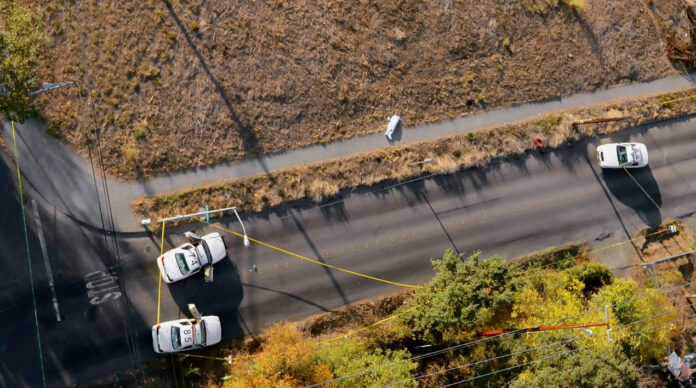
On Oct. 22, 2013, Sonoma County Sheriff’s deputy Erick Gelhaus shot and killed 13-year-old Andy Lopez on Moorland Avenue in Southwest Santa Rosa.

Gelhaus, a 24-year veteran of the Sheriff’s Office, and his partner spotted Lopez walking down the street holding what looked like an assault rifle. Seconds after calling out to Lopez, and as the boy turned around to see who was yelling at him, Gelhaus fired eight shots, seven of which hit Lopez. Lopez’s weapon turned out to be a toy, and the killing sparked months of protests seeking criminal charges against Gelhaus.

Nearly eight years later, despite a sizable financial settlement paid to Lopez’s family, some law enforcement reforms and the county’s creation of a memorial park at the site of the boy’s death, Lopez’s name is still invoked in many conversations about the role of law enforcement in the North Bay and beyond. The persistent anger tied to the case may be in part because, although Lopez’s death made national news, many details of the handling of the case have largely remained hidden from public view while law enforcement scandals—many involving the Sheriff’s Office—continue to be common occurrences in Sonoma County.

3 Seconds in October: The Shooting of Andy Lopez, a 28-minute documentary set to debut on KRCB TV on July 15, offers some needed insight into Lopez’s death and the events that followed. Despite its short length, the film covers a lot of ground—centering Lopez’s death within the ongoing nationwide debate about law enforcement accountability and transparency following a fatal incident.

According to Ron Rogers, the film’s producer, the filmmakers conducted 45 interviews and obtained numerous internal documents and recordings during the past seven years.

“The impact of the Andy Lopez shooting can still be felt today, and will continue for a while. I don’t know that there has been closure yet,” Rogers said in an interview after previewing the film for the Bohemian/Pacific Sun. “The [Lopez family’s civil] lawsuit was settled for $3 million, but additional details of what happened were never released. That doesn’t help the closure or bringing closure to the family or the community.”

One of the most shocking moments of the film is based on the Santa Rosa Police Department’s (SRPD) independent investigation into whether Sheriff’s deputy Gelhaus should face criminal charges for shooting Lopez.

“Starting from the very day of the incident continuing to the present time, there was a huge difference between how Erick Gelhaus was treated and the Lopez family [was] treated,” Rogers said.

For instance, according to the documentary, immediately following the shooting, Gelhaus consulted with a union representative and an attorney for six hours at a Santa Rosa hotel. Then, he was questioned by an SRPD detective and an attorney supplied by the Sonoma County Deputy Sheriffs’ Association as part of the SRPD’s independent investigation. According to a recording of the interaction played during the documentary, an SRPD detective assured Gelhaus that he was being “interviewed as a victim.”

The same day, Lopez’s family members were taken to SRPD headquarters where detectives asked whether Lopez was affiliated with any gangs or had anger management issues. At the end of the interview, the detectives informed Andy Lopez’s family members that the boy was dead.

Knowing that the investigation began this way, it is not surprising how it ended.

After receiving SRPD’s independent investigation into Gelhaus, Sonoma County District Attorney Jill Ravitch declined to press criminal charges. Gelhaus later quietly retired from the Sheriff’s Office after being promoted to sergeant.

Shortly after Lopez’s death, his family filed a civil case against Gelhaus, the Sheriff’s Office and Sonoma County. The County appealed the case all the way to the U.S. Supreme Court before settling with the family for $3 million in December 2018, more than five years after Lopez’s death.

Despite the long production period, the film’s subject matter is still very timely.

According to the documentary, 32 people have died during or after interactions with law enforcement in Sonoma County since Lopez’s death. In the same time period, Sonoma County jurisdictions have paid out $10 million to settle civil lawsuits tied to law enforcement’s use of excessive force—a figure which, though high on its own, does not include the amount of money the public agencies spent on lawyers fighting the cases.

3 Seconds in October: The Shooting of Andy Lopez” will air on the North Bay’s KRCB TV on Thursday, July 15, at 10pm on Channel 22 (Comcast, AT&T and Dish) and on the South Bay’s KPJK TV on Saturday, July 17, at 10pm. A live stream of both channels is available for Bay Area residents at norcalpublicmedia.org.

Corte Madera and Larkspur popular getaways as economy reopens

With Southern Marin blanketed in fog during the summer months, I often leave my little abode in Sausalito and seek the sun. I travel north on 101, past the Mill Valley exits, until the first rays of light appear in Central Marin. My sights are set on scenic Corte Madera and Larkspur.

My recent forays found the towns bristling with activity, seemingly fully recovered from the Covid-19 pandemic. The time spent in Corte Madera and Larkspur was a welcome respite from foggy weather and the loneliness of the lockdown.

Corte Madera

Heading west on Tamalpais Avenue, the main drag in town, I’m treated to the magnificent view of Mt. Tam bathed in sunshine. My first stop is usually Café Verde for a latte and a chocolate croissant. Dogs are always welcome on the large outdoor patio, which borders the Corte Madera Town Park. Locals praise the spot for the neighborhood atmosphere created by owner Tony Farahmand.

A favorite place to walk my senior mutts is along the path from downtown Corte Madera to downtown Larkspur, which is paved and just over a mile long. The commuter railroad ran through the area until 1941, and the path follows the old tracks. Though I’ve never heard an official name, the Rails-to-Trails Conservancy calls it the NWP Railroad Trail, short for Northwestern Pacific Railroad. There’s ample parking in the lot across from the gazebo in Corte Madera.

When I’m traveling sans dogs, my regular Corte Madera haunt is Book Passage. The independent bookstore has an outstanding selection of books, author events and writing classes. Book Passage is open daily now from 10am to 5pm, but the events and classes will remain online for a while due to the pandemic. As much as I appreciate listening to authors read from the work in the intimate setting of the bookstore, I’m equally as happy watching them online while wearing my pajamas.

I’m reluctant about sharing the deets of Burmatown, because the wait can already be a bit long at this tiny Burmese and Asian fusion restaurant on Corte Madera Avenue. Let me assure you that the tea leaf salad is totally worth the wait. I mosey over to Zinz Wine Bar down the street and get a glass of wine until my table at Burmatown is ready.

Masterworks Fine Arts Studio, a hidden gem in Corte Madera, offers fine art classes for children. I once attended an art show at the studio in Old Corte Madera Square, and was duly impressed with the work of the young artists. Parents rave about Masterworks’ founder Lisa Jones, who began teaching art to Marin children in 1997. Summer camp for kids ages 6 to 14 includes classes in watercolors, fashion illustration and mosaic arts.

Larkspur

Downtown Larkspur is a pleasant place to while away a summer evening. I can don my warm weather wardrobe and leave my parka in Sausalito.

This past weekend, I sat outside on the patio at Don Antonio Trattoria on Magnolia Avenue and enjoyed a leisurely meal with a friend. I remembered the owner from his days 30 years ago as a waiter at San Rafael’s long-gone Salute restaurant. Don Antonio’s stone tile floor and festive lighting are the perfect backdrop for the flavors of its robust Italian fare. I ordered the Romana salad and melanzane parmigiana, which were both delicious.

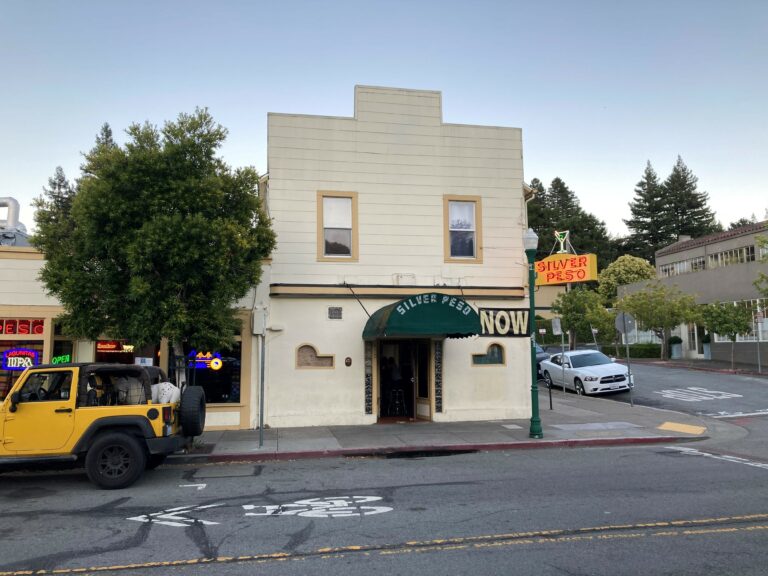
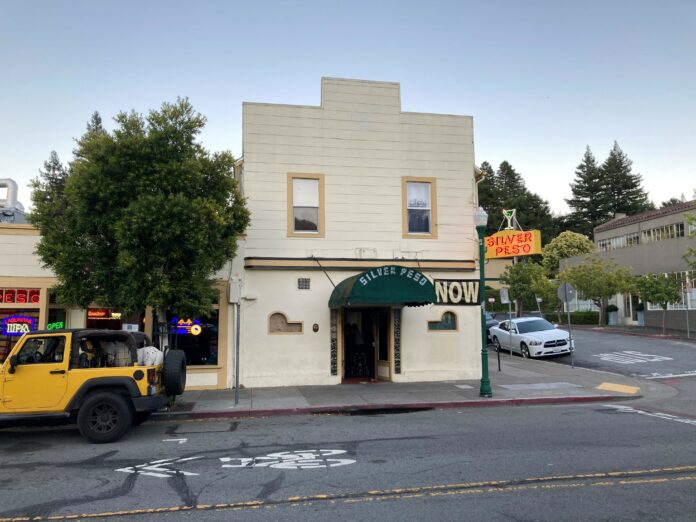
After dinner, we strolled down Magnolia and peeked into the Silver Peso, a tavern with pool tables. The place was hopping. Housed in a historic building, it has been a bar since the 1930s. While watching the crowd was interesting, a bright yellow Jeep parked out front vied for my attention. A spotted miniature horse stood in the back of the open vehicle. While I admired the precious cargo, a man came out of the Peso, jumped in the Jeep and promptly fed the horse, whose name is Picasso, a piece of bread.

Spending the day in Larkspur is also delightful. I’ve written many an article for the Pacific Sun sitting in Emporio Rulli, an authentic Italian coffee and pastry café. The smell of the freshly roasted coffee and the whir of the espresso machine always whet my appetite for my customary order: a double latte and a custard “bombolini,” an Italian doughnut.

I recently picnicked in Piper Park with my pal Patty and my pooches. We tossed a blanket down near the creek and relaxed in the sun while we munched on our sandwiches and salads from Rustic Bakery. Piper Park, hands down, has the county’s best views of Mt. Tam. After lunch, we walked through the 2-acre park, which was packed with people playing volleyball, kids having fun in the elaborate playground and pups frolicking in the dog park.

Before I get back in my car to drive back to foggy Sausalito, I retrieve my winter coat from the trunk. Though Corte Madera and Larkspur are just a few miles up the road from my home, I feel like I’m on vacation when I visit these lovely locales. I’ll probably return again tomorrow.

Point Reyes Books Launches Subscription Club

A staple of West Marin for over 50 years, Point Reyes Books is more than a shop, it’s a community hub that reflects the sensibilities and interests of its namesake town.

In addition to hosting world-renowned authors in conversation both in-person and online, Point Reyes Books connects to the locals through programs such as the Point Reyes Books Canon, a collection of titles that capture the essence of the store, and the Natural History Library, featuring a collection of books that touches on local topics.

The store also offers a Community Supported Bookstore Loyalty Program that is inspired by the Community Supported Agriculture (CSA) movement, which encourages loyal customers to help local farmers be sustainable. Now, Point Reyes Books is establishing a new curated program, “Thinking Like a Mountain,” a quarterly subscription and event series that delivers literary works about ecosystems, resilience and climate. 

The subscription series is inspired by writer Aldo Leopold, considered by many to be the father of wildlife ecology and the United States’ wilderness system, who coined the term “thinking like a mountain” in his 1949 book A Sand County Almanac. In the book, Leopold describes taking a holistic approach to understanding ecosystems by centering on the interconnectedness of life.

In that vein, Point Reyes Books’ new series focuses on books that, “examine how we relate and connect to the natural world in a time of unprecedented human-made change.”

Once a season, subscribers will receive a subscription box including a featured fiction or non-fiction book or collection of poetry or essays. The box will also contain an interview with the writer (when possible) as well as suggestions for further reading, listening or viewing, occasional merchandise and a link to an exclusive event.

The bookstore will host in-person gatherings when it is safe to do so, though it will commit to providing a streaming option and will also record the event for later viewing. 

In addition to these exclusive subscription events, Point Reyes Books is hosting several virtual readings and conversations with acclaimed authors and writers about ecological issues.

On Tuesday, July 6, Michael Pollan virtually celebrates the release of his new book, This is Your Mind on Plants, at 6pm. The following Tuesday, July 13, Cynthia Barnett present her latest book, The Sound of the Sea: Seashells and the Fate of the Oceans, at 4pm. On Thursday, July 22, poet and nonfiction writer Lisa Wells discusses her new book, Believers: Making a Life at the End of the World, at 7pm.

Get tickets to these and other readings, and join the “Thinking Like a Mountain” subscription series at ptreyesbooks.com.

Sausalito Clears Encampment

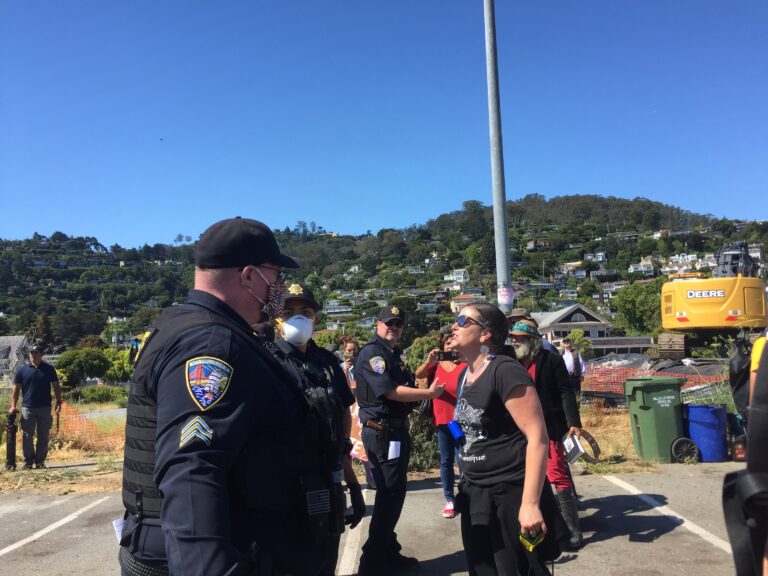
The Sausalito police arrived at the downtown homeless encampment before 6:30 a.m. on Tuesday to prepare for the day’s work: clearing the area of its unhoused occupants and their belongings. Within minutes, a bulldozer rolled up.

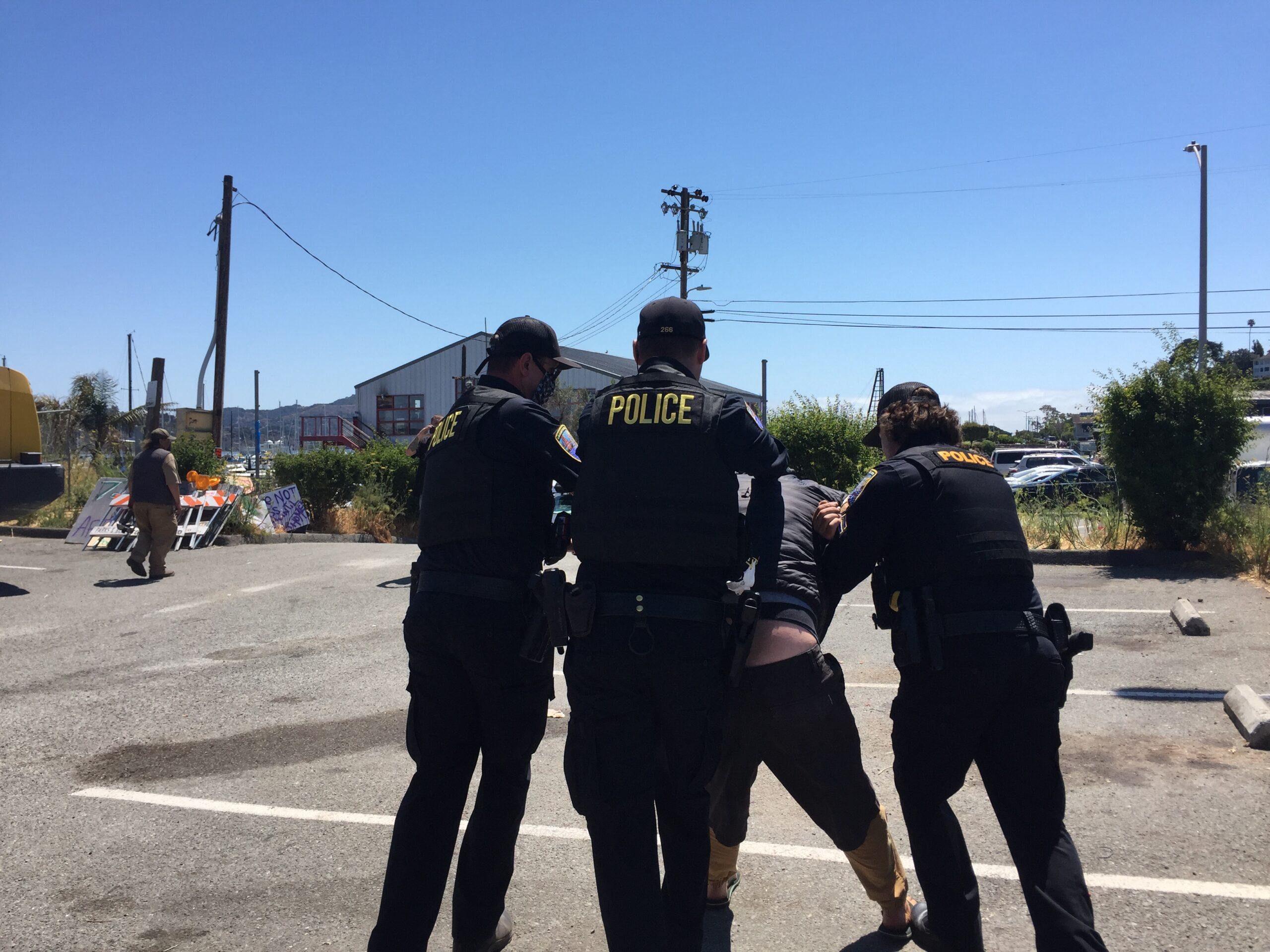
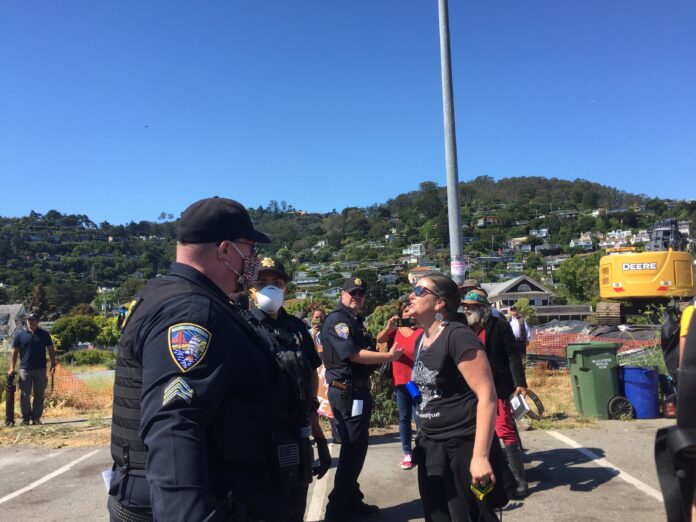
Daniel Eggink, 84, the first person to pitch a tent on the empty plot of land near Dunphy Park last December, held an American flag and walked in the parking lot adjacent to the encampment. Upon seeing the bulldozer, Eggink moved toward it and then stopped in front of a police car. In a show of unnecessary force, officers approached Eggink and one put his hands on the elderly man.

“Don’t touch me,” Eggink said.

Activist and part-time resident of the encampment, Robbie Powelson, placed himself between an officer and Eggink. The police then arrested Powelson for obstructing/resisting a police officer, unlawful assembly, and camping in a park, according to Charles Dresow, Powelson’s attorney. It was the only arrest of the day.

“He shouldn’t be charged,” Dresow said. “We’ll just have to see what the DA thinks. The Constitution protects peaceful protests.”

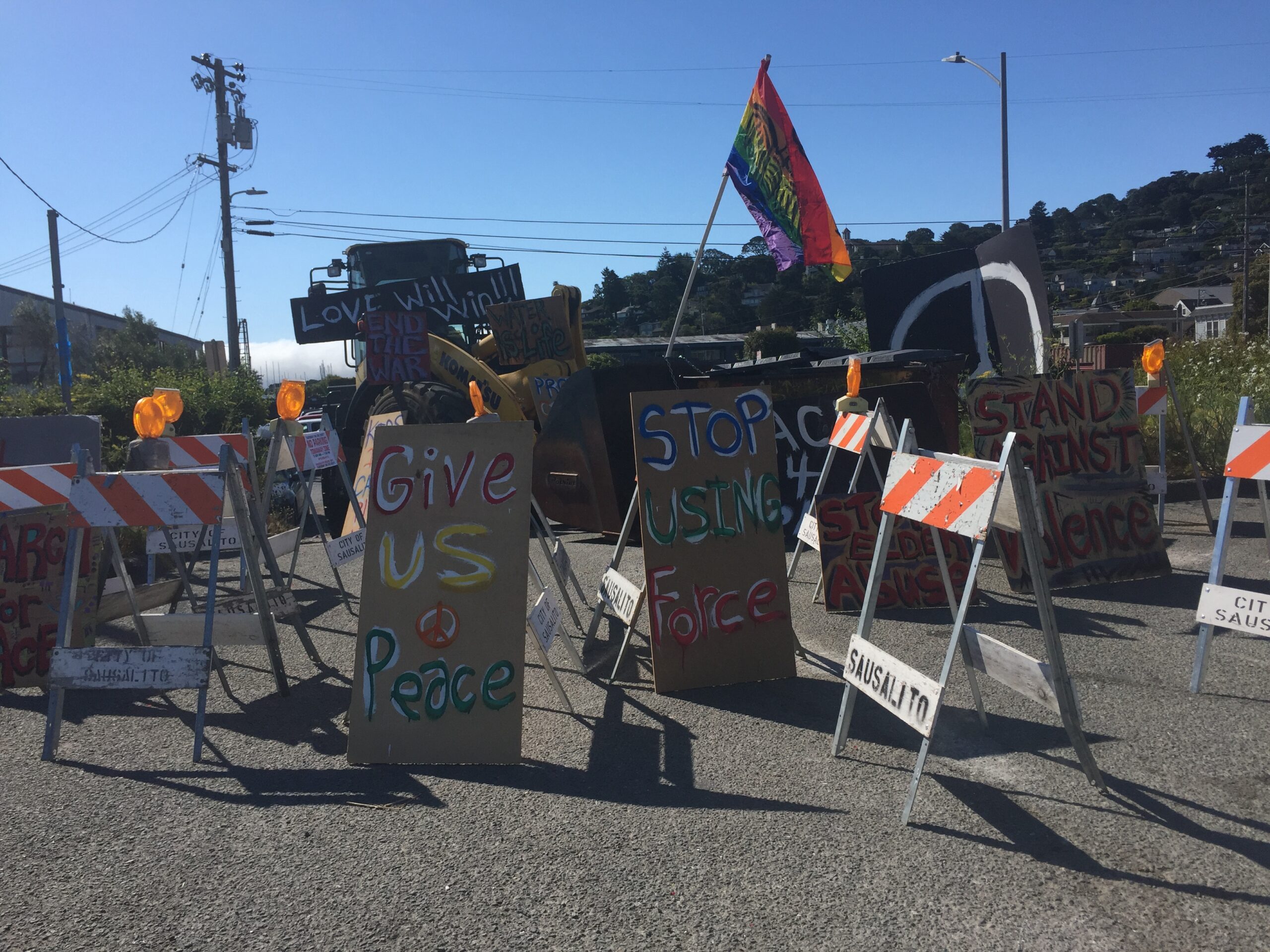
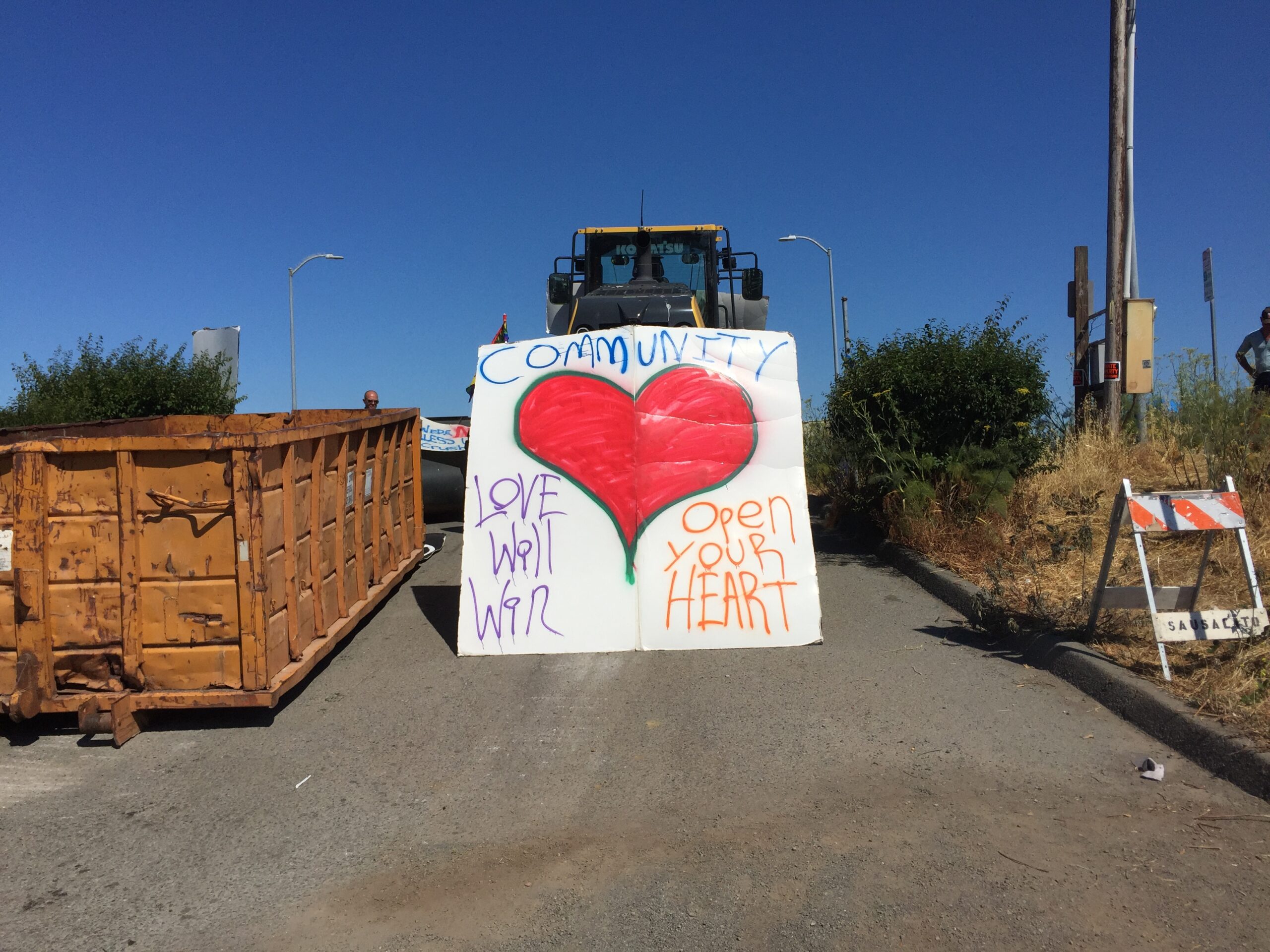
The bulldozer pulled into the parking lot. Protesters placed signs on the piece of equipment: “Love Will Win, End the War, Protect Our Community.”

About a dozen campers, along with their supporters, made a last stand at the camp near Dunphy Park, which abuts a large area of toxic dirt, and protested its closure. Most of the campers had already relocated to a new city-designated encampment at the less visible Marinship Park, located about a mile away, after Sausalito served them on Friday with a notice to vacate. Last month, a federal court granted the city permission to move the encampment, although it maintained an order to allow daytime camping.

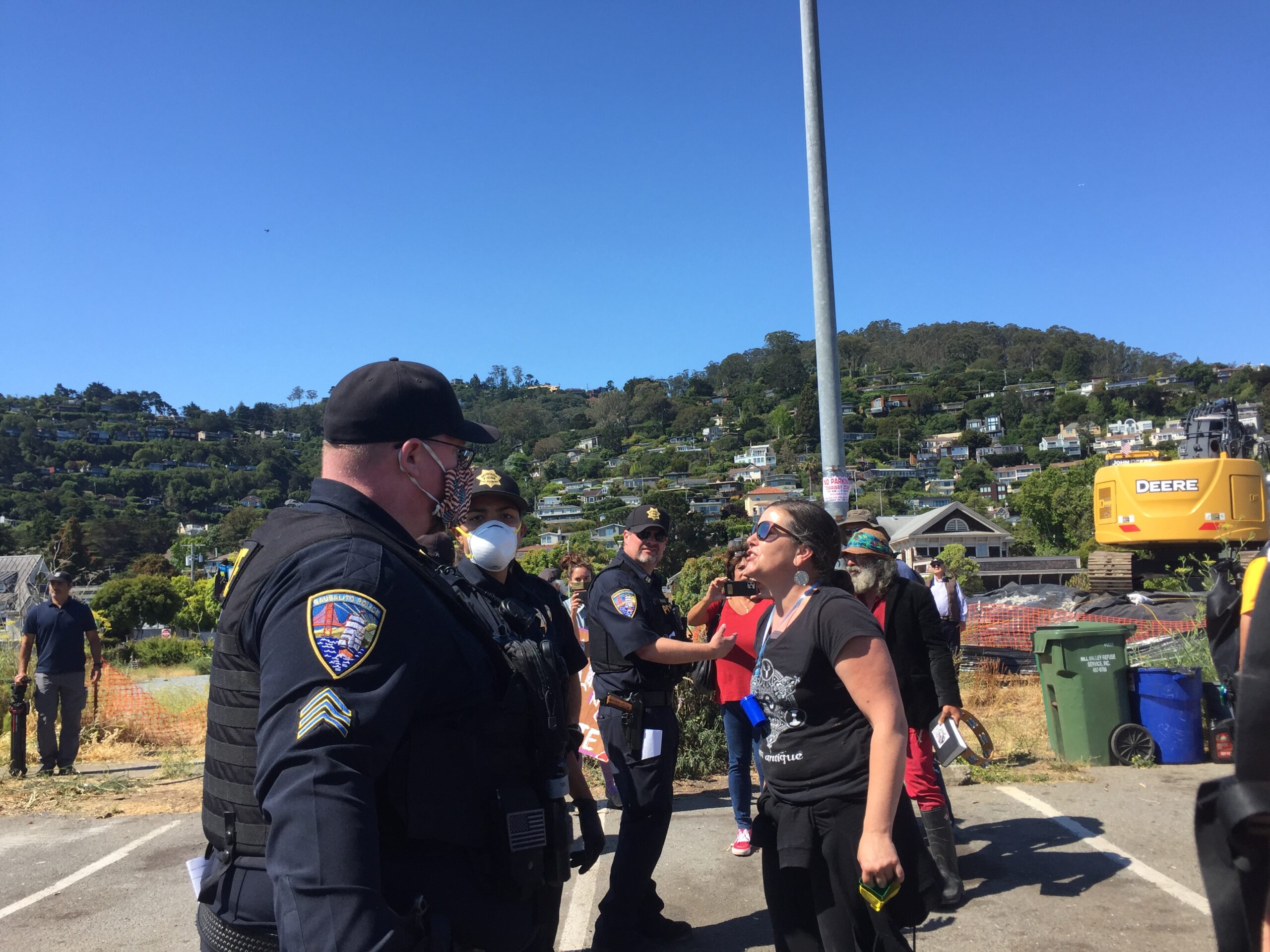
Initially, the crowd and the cops milled about the parking lot. Protesters yelled through megaphones and heckled the police. The campers insisted the eviction notice was illegal because it listed the wrong address. Supporters demanded the police produce a signed warrant. Police refused to answer questions, directing people to contact Sausalito Mayor Jill Hoffman.

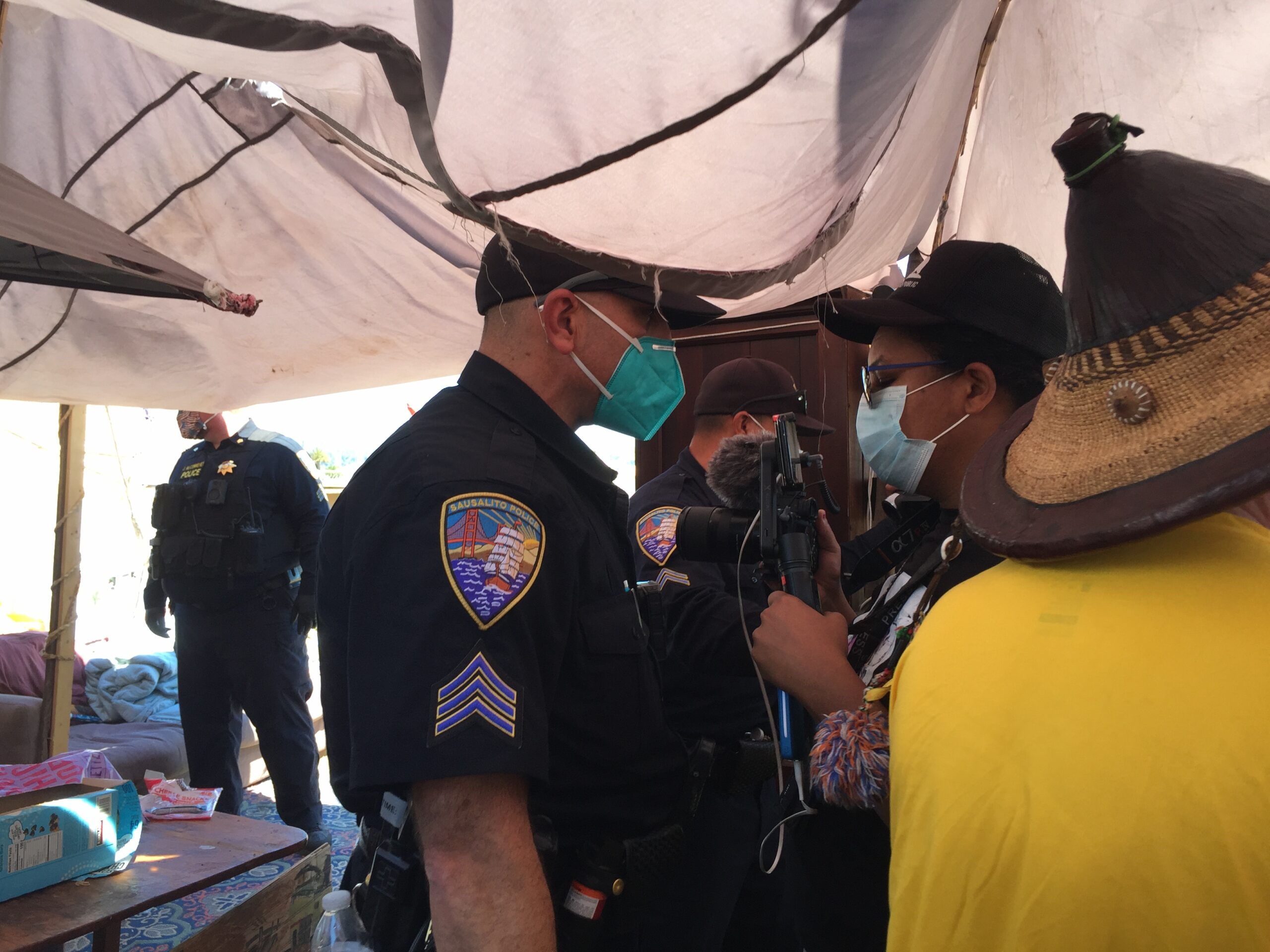
When contractors hired by the city arrived to erect chain link fencing around the tents on public property, the police and the protestors moved into the encampment. Police checked inside the remaining tents for “hazardous” materials, while the protestors banged on drums, shook a tambourine, sang, preached and gave interviews to Bay Area reporters. 

The camp residents spoke of the need to stay at their current location on Richardson Bay, which gives shore access to “anchor outs,” the mariners living on the anchorage. Though a federal judge ruled the new location at Marinship Park is not contaminated, the campers claim it is polluted due to the adjacent boat crushing facility spewing fiberglass dust into the air. They also wanted more time to move structures they had built, including a large wigwam under construction by Chris, an Indigenous man living at the encampment. 

“They pretty much just want to destroy everything we’ve been building,” Michael Ortega said. Ortega, his partner and their child became camp residents after his boat was destroyed in a fire when police raided it to arrest another man living on the vessel.

Powelson was released from the Marin County jail and returned to the encampment. Amid cheers, Powelson took the megaphone and addressed the crowd. Mostly, he referred to the campers who were former mariners living on the Bay and had their boats seized and destroyed by the Richardson Bay Regional Agency for violating the 72-hour anchorage regulation.

“Right now, what we’re witnessing, the City of Sausalito, the Bay Conservation Development Commission, the Richardson Bay Regional Agency dispossessing an entire community of people,” Powelson said. “Homes have been crushed. This camp was formed by the misguided and cruel, unlawful policies of the alphabet agencies on the Bay, of the City of Sausalito. We created this community over six months ago. Now they’re tearing it down.”

An elderly Sausalito resident, Karl Preskot, entered the encampment and yelled at the campers to go home. He was met with jeers from the crowd.

“I can’t walk here at night safely because I’m scared,” Preskot said. “This is not their property.”

An activist from Wood Street People’s Collective in West Oakland, Leah Van Winkle, returned from a tour of the Marinship Park encampment, where all the spaces marked by the city were already occupied. Van Winkle questioned whether the city was violating Martin v Boise by forcing the closure of the encampment and not providing an alternative space for the campers. Martin v Boise, a 9th Circuit Court of Appeals ruling, affirmed people cannot be punished for sleeping outside on public property when a city cannot offer them an adequate shelter option.

At about 11:45 a.m., the scene reached a fevered pitch. A dog fight erupted between a St. Bernard mix and a Siberian Husky. Officers shouted for people to leave the encampment. People began moving toward the parking lot, but not quickly enough to satisfy some of the police. One cop, for no apparent reason, aggressively kicked down a wood wall of the large common area structure. A reporter was knocked to the ground and injured. 

Once the encampment was cleared of residents and protesters, the contractors began taking down tents and other structures. The City of Sausalito was forced to hire outside contractors when the union for the employees of the Sausalito public works department sent a cease and desist letter to the city, which stated union members could not work to remove the encampment.

Reverend Paul Mowry, of the Sausalito Presbyterian Church, watched as the camp was dismantled. 

“The city council, by a vote of 4 to 1, passed a resolution that they were committed to treating people who are experiencing homelessness with compassion and dignity,” Mowry said. “There’s very little, except for maybe the Safe Harbor program [a program that covered slip fees for a few anchor outs], that the city has ever done to make that a true fact.”

Slowly, people left the encampment near Dunphy Park and made their way to Marinship Park, where all the spaces inside a fenced area were filled. The fence is covered by a heavy material, which keeps the campers from seeing out and the public from seeing into the encampment.

“We’re trying to find a space for everyone,” Sausalito Mayor Jill Hoffman said. “It’s going to get sorted out. It might take a day or two.”

The campers took the matter into their own hands and pitched their tents on the other side of the fence, where they remain visible to the public. 

“These are the most vulnerable people around us,” Reverend Mowry said. “They set up camp behind a football field of toxic dirt. They were not in Dunphy Park. Yet, the city council moves them to Marinship Park, which is actually a park in use. They just want to get them out of sight.”

Wedding for One

Saying 'I Do' to You Summer is “wedding season,” but why feel left out when you can simply marry yourself? That probably sounds like something a narcissistic celebrity would say, but we in the spirit world know that even the most trivial notions reveal deep cosmic secrets. The inner union between soul and spirit is an idea found in many of...

Culture Crush: Find Live Events This Week

North Bay Before heading to Iceland for a tour later this month, acclaimed cellist Rebecca Roudman and her virtuosic bluegrass band Dirty Cello will play all around the North Bay this week. The band performs a concert in the park on Thursday, July 8, at Lyman Park, 1498 Main St., St. Helena. Following that, the band plays two sets on...

MDMA Goes Mainstream

MDMA
Last Saturday at Acre Petaluma, over iced coffees and salmon toast, I had the pleasure of sitting down with Dr. Jim Matto-Shepard, psychologist, psychotherapist and licensed Soul Motion Conscious Dance teacher.  We discussed the properties and benefits of MDMA—a hot topic at the moment, as the DEA and FDA have begun to ease back on restrictions around the drug’s medical...

Open Mic: Life In a No-Kill Household

By Sam Case In Marin and Sonoma, we love our wildlife—but in the wild, not in our houses. Alas, in our house our cats and their cat door mean that raccoons, rats, mice, birds and, yes, one skunk have all ended up inside. We awoke one night to find two bats flying around the living room. They were part of...

North Bay Summer Concert Programs Are Heating Up

For many North Bay music lovers, summer is a smorgasbord of outdoor concerts and community gatherings. Last summer, all the popular concert programs were forced to cancel their plans due to the pandemic, though this summer is heating up with free live music in July and August. In Marin County, the City of Sausalito Parks and Recreation Department once again...

Letters to the Editor: Point Reyes Horror

The article in the Bohemian and Pacific Sun (“Death by Design,” June 30) describes the horror of the mistreatment of the beautiful tule elk herd at the Point Reyes National Seashore. I have seen them many times hiking there, and they are amazing. Starving them, forcing them to die of thirst and sadistically butchering them is just unacceptable. Point...

Documentary Chronicling Andy Lopez Shooting set to Debut on July 15

Andy Lopez - Santa Rosa, California
"The impact of the [2013] Andy Lopez shooting can still be felt today," says the producer of "3 Seconds in October: The Shooting of Andy Lopez."

Corte Madera and Larkspur popular getaways as economy reopens

Silver Peso - Larkspur, California
"Though Corte Madera and Larkspur are just a few miles up the road from my home, I feel like I’m on vacation when I visit these lovely locales," writes Nikki Silverstein.

Point Reyes Books Launches Subscription Club

A staple of West Marin for over 50 years, Point Reyes Books is more than a shop, it's a community hub that reflects the sensibilities and interests of its namesake town. In addition to hosting world-renowned authors in conversation both in-person and online, Point Reyes Books connects to the locals through programs such as the Point Reyes Books...

Sausalito Clears Encampment

On Tuesday, about a dozen campers made a last stand at the camp near Dunphy Park as Sausalito police and city contractors moved to clear the controversial encampment.
3,002FansLike
3,850FollowersFollow