Dry Farmers Challenged by Drought

By Naoki Nitta

As the drought drags on with no end in sight, California farmers face the sobering prospect of springs and wells drying up.

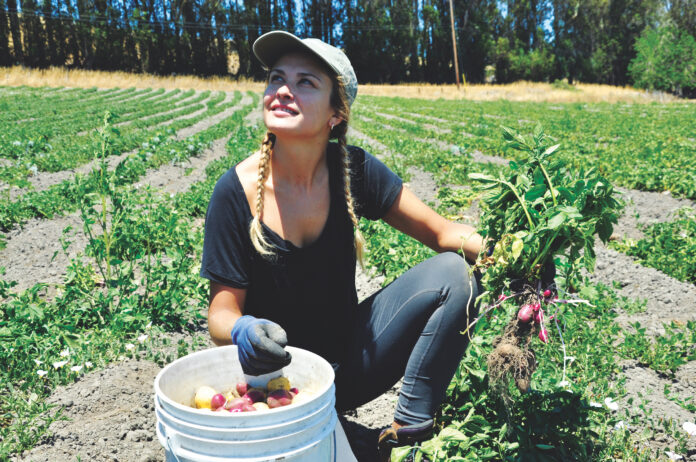
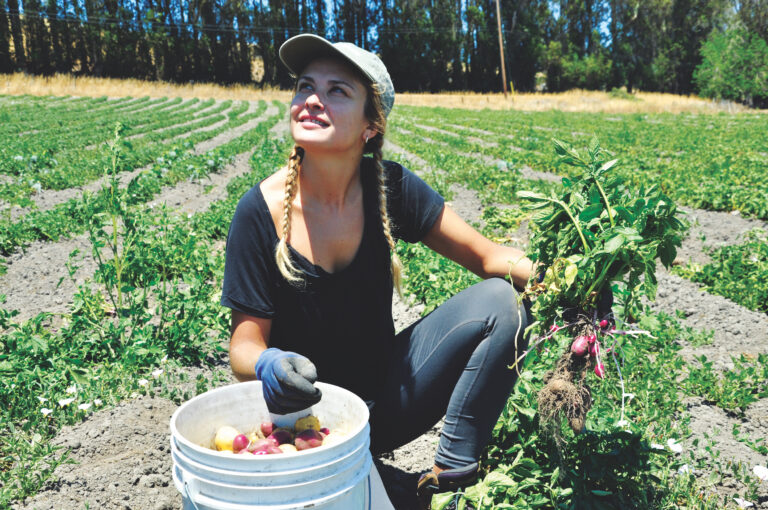
But at Red H Farm in Sebastopol, that isn’t a consideration, much less an option, because their well collapsed six years ago. That’s when farmer Caitlin Hachmyer turned to dry farming. Now, she relies on the rain to feed her crops, and obsesses over the soil to keep it moist through the dry season. It works; most of her fields don’t need any irrigation, and while yields are lower, less water makes for a more concentrated flavor—a bite of her dry-farmed tomatoes is a reminder that they are, in fact, a fruit.

But after two years of meager rain, the ground is parched. Blasting heat waves serving up triple-digit temperatures, and fleeting coastal fog, are beginning to take a heavy toll. “I’m at about 50% of my usual harvest this time of year,” Hachmyer says. Clearly, there’s only so much dryness that even dry farming can take. She’s anxious about the long, hot months ahead, and hopes the remaining crops nestled in her lower-lying fields fare better.

Given the region’s arid climate, the sustainable ethos of dry farming seems like a no-brainer. Heavy rains soak loamy and clay fields in the winter, and cool summer fog helps to lock it in during the dry months. Meanwhile, drought-tolerant, early maturing crops sip moisture through deep roots while developing rich, intense flavors. But as seasonal precipitation gets stingier and less reliable, its long-term sustainability in the North Bay is starting to look uncertain. Local farmers are abandoning dry fields as they contemplate shutting down for the season, or moving altogether to greener, more water-secure pastures up north.

Seasonal patterns were consistent on Hachmyer’s 1.2-acre family farm for as long as she can remember. “I grew up here,” she says, her slender frame capped by a no-nonsense bun, “so I have a 37-year relationship with this particular place.” Fields flooded in winter, and foggy mornings rarely pushed summer temperatures past the high 80s. By fastidiously working the soil with absorbent organic matter and protecting it with woven tarps and thick mulch, her crops thrived without irrigation, even during past droughts.

“Usually, June is the most lush, beautiful time on the farm,” Hachmyer says. “Things start drying out in July and August, but in a regular year, I’d still be harvesting broccoli florets from a February planting.” Typically, she’d have a summer bounty of vegetables, leafy greens and squash, followed by a fall crop of flavor-rich tomatoes. “But this year, there’s just no water,” she says. And an early summer heat wave left many of her plants withering. “Even in [previously dry] years, my soil has still had tons of moisture, but this extreme drought is like ‘next level.’”

North Bay rainfall has averaged 13 inches this year—about a third of normal. That sounds extreme, even for dry farming, but the volume of rain is only one factor, says Paul Vossen, an agricultural consultant based in Santa Rosa. Filling the soil profile with moisture also requires consistent and cumulative precipitation.

“If you get 13 inches all in a few rains, particularly if one was in late spring, then you’d have your soil profile full,” he says, “and everything would be pretty good, actually.” Intermittent sprinkles can turn the hills grassy in the spring, but crops require deeper, consecutive soakings.

Vossen recently retired as the University of California Cooperative Extension farm advisor, where he specialized in farming in drought conditions. After 35 years on the job, he’s seen it all—but agrees that this year is exceptional. And the rise in seasonal temperatures only adds to the challenges. “It’s one thing to dry farm when it’s in the 80s [during the day] and cool at night,” he says, “and another when it’s 100 degrees every day.”

On a 10-acre farm outside of Petaluma, Jesse and Moira Kuhn of Marin Roots Farm are down to their last harvest of dry-farmed greens. They didn’t get their usual profusion of native crops like chickweed and miner’s lettuce this spring, says Jesse Kuhn, and their fields are crackling dry. “We’ve got a little bit of chamomile, lamb’s quarters, dandelion and spring onions—maybe one last pick.”

Kuhn, who grew up in San Geronimo, enlisted his father’s help in digging a deeper spring, which he’s using to irrigate herbs and microgreens inside two greenhouses. “It’s still very, very little water,” he says, shaking freshly dug pebbles out of his pockets. “But we have to rely on it to carry whatever we plant through the remainder of the season, because whatever little water is left in the soil is going to go quickly.” He grins solemnly beneath his handlebar mustache.

The Kuhns have resisted the siren call of more water security, in less-pricey regions up north. “We both have family here,” he says, “along with all of our restaurant accounts and farmers markets, [largely within] a 50-mile radius.” But with no signs of the drought easing, they’re looking to plant new roots in Marin, in fields with better access to water.

Twenty miles northwest, towards Bodega Bay, David Little has dry-farmed potatoes and tomatoes on nearly 50 acres of coastal land for the past quarter century. The San Anselmo native runs Little Organic Farm with his daughter, Caressa, and her fiancé, Anthony Giaccobe, on fields cobbled together on five different ranches across the Marin-Sonoma border.

Little is quick to note that he fallows nearly half of his acreage, often for two to three years at a time, to allow the soil to recharge with moisture and nutrients. He also sites his fields carefully, planting crops at the base of slopes and hills, where water tends to collect underground. It’s a long-term investment in land management, and this year, the odds seem a bit tenuous. 

Loquacious and eccentric, Little’s presence is as big as his personality. “Alice Waters came by my [farmers market] booth and asked me how I was doing with the drought,” he says. He and the famous Chez Panisse owner go way back, apparently. “I just told her, ‘less yields, smaller potatoes, more flavor, less waste.’”

Indeed, his tubers are compact, ranging in size from marbles to golf balls, perfect as sides to a fancy dish. Little digs up an entire plant, shaking the clumpy-but-dry soil off the roots to pick a cluster of baby Crimson Kings. He harvests about six per plant, explaining that were he to leave them longer, they would continue to grow in size and yield upwards of 14. “We’re robbing the cradle to get new potatoes for the sweetness and texture, and also to get back in the market because we’re strapped for money.”

For farmers, “the struggle is real,” Giaccobe says. “Normally, our tomato crop pays for the harvest of the potatoes, but I don’t even know if [they’re] going to grow this year.” He was surprised at the number of customers who balked at their 25% price hike last year. “There’s a disconnect between what’s going on in nature, how hard the work is and how much everything else—paper bags, boxes and labor—is going up in price.” He and Caressa hope to boost business by venturing into potato chips. “It’s a great way for us to utilize everything; all the ugly potatoes that people don’t want to buy.”

The farm also experienced an unexpected blow in late May, when a freak frost hit a low-lying field and destroyed three acres of potatoes. It came on the heels of plummeting restaurant sales during the Covid pandemic, and a two month market hiatus during a dip in yields. “If I sound disgruntled, it’s because I am,” Little says. “It’s just crazy times for small farms.”

As the dry season continues, farmers pray for emergency relief, which looks as elusive as the next rainfall. Currently, federal and state drought relief is limited to livestock and perennials, not diversified annual crops, says Red H’s Hachmyer, adding that immediate funds are desperately needed to keep family farms afloat. “It’s slim margins as it is,” she says. “It’s really important to make sure that small-scale farmers don’t throw in the towel this year.”

Meanwhile, Hachmyer is considering raising funds to dig a new well. “There’s really not a whole lot more adapting that I can do,” she says. “At some point, my plants just need at least a little bit of water.”


Naoki Nitta is a food and sustainability writer based in San Francisco.

North Bay Theaters Plan Live Seasons

After a year of performing to virtual audiences, North Bay theater companies are ready to welcome people back to the theater, and several local companies have announced their 2021–2022 seasons of shows, ranging from classics to world premieres.

Earlier this summer, Left Edge Theatre in Santa Rosa became the first organization to perform indoors again, at the production of the comedy Slow Food

Now, Left Edge is taking advantage of the return of social gatherings by premiering a season entirely made up of both local and world premieres. Opening the season, North Bay playwright Kelly Gray pens the new experimental one-act play Beautiful Monsters, succinctly described as an “obituary for the year 2020 with music and dance.” The one-act actually makes its world premiere outdoors at Horse & Plow Winery in Sebastopol Aug. 20–22, before moving indoors to Left Edge Theatre Sept. 4–19.

When Beautiful Monsters does premier indoors in September, it will join another one-act, I and You, written by Bay Area playwright Laura Gunderson, about two classmates who bond over Walt Whitman. leftedgetheatre.com

Also in Santa Rosa, 6th Street Playhouse is planning a full in-person season with five shows in the 184-seat GK Hardt Theater and five in the 99-seat Monroe Stage Theater. The season, which opens Aug.12 with the Nora and Delia Ephron-written comedy Love, Loss and What I Wore, is curated for mass appeal and features classic plays like A Raisin in the Sun, zany murder whodunnits like Murder for Two and crowd-pleasing musicals like Scrooge in Love in the holiday season. 6thstreetplayhouse.com

Sonoma Arts Live, which performs on the Rotary Stage in Andrews Hall in the Sonoma Community Center, is calling this a season to celebrate. 

“Governor Newsom’s June 15th announcement was such a celebratory day for all of us,” says Sonoma Arts Live Artistic Director Jaime Love. “It was then that we knew we could finally announce what we’d been hoping for; the ability to open our doors and provide entertainment for a live audience. I feel that people are ready to gather safely and share an experience again.”

The season will begin Sept. 24 with Sunset Boulevard, directed by Carl Jordan and featuring local star Dani Innocenti Beem (Merman’s Apprentice, Hello, Dolly!) as the silent film star Norma Desmond. Sonomaartslive.org

Sebastopol’s Main Stage West will also re-emerge from the unexpected hiatus with a season of six plays that all speak to the post-pandemic landscape. The season opens with the workplace comedy Patty from HR on Aug. 27. mainstagewest.com

Marin Theatre Company is still putting the final touches on its 2021–2022 season, though the season is starting strong with its September opening production, the Ivy-league dramatic mystery The Sound Inside, penned by Pulitzer Prize finalist Adam Rapp and directed by Marin Theatre Company Artistic Director Jasson Minadakis. marintheatre.org

Also in September, the Ross Valley Players kicks off its 92nd season with the clash-of-wills comedy Ripcord, running Sept. 10 to Oct. 10. Next, Ross Valley Players teams with Marin’s longrunning Mountain Play Association for an indoors production of the musical Camelot in November. rossvalleyplayers.com

Culture Crush: Live Events This Week

Napa Valley

After a year on hold, Festival Napa Valley welcome audiences back for a full program of events this summer. Marking the Festival’s 15th anniversary and celebrating the return to live events, the concert schedule includes opera, chamber music and jazz. Festival Napa Valley kicks off with an Opening Night recital on Friday, July 16, featuring soprano Lisette Oropesa (pictured) at Charles Krug Winery in St. Helena, and the festival’s lineup also boasts highlights ranging from a Tony Bennett tribute to the Arts For All Gala featuring superstar Jennifer Hudson to free symphonic concerts with Festival Orchestra Napa and more. July 16-25, tickets available at Festivalnapavalley.org.

Bolinas

For the last year, Bolinas Museum has partnered with photographers to take black-and-white portraits of Bolinas and Stinson community members for “Together Alone / Alone Together,” a project that is displayed in the museum’s windows. This week, the museum teams with Smiley’s Schooner Saloon for the project’s Together Again Open House. The evening includes a slideshow of portraits from the project and copies of the Together Alone / Alone Together book on hand. There will also be a story booth in which participants can record their own stories. Then, move to Smiley’s to enjoy live music on Friday, July 16, at 48 Wharf Rd, Bolinas. 5pm. Free. bolinasmuseum.org.

Rohnert Park

This past May, the SOMO Grove Dinner Series was one of the first ways for the North Bay to see live music in over a year. The series—which blends locally sourced meals and locally sourced bands at socially distant, outdoor shows—was such a rousing success, it’s returning for four new dates of live music featuring popular local acts. This week, the series hosts stellar vocalist Stella Heath leading the Billie Holiday Project for a night of jazzy tunes and dinner from Heirloom Café on Friday, July 16, at SOMO Village, 1100 Valley House Dr., Rohnert Park. Doors 6:30pm, Show 7:30pm. $35. Tickets at somovillage.com.

Ross

Native Californian explorer and writer Obi Kaufmann examined the state’s most precious resources in his books The California Field Atlas, The State of Water and The Forests of California. Now, Kaufmann returns to Marin Art and Garden Center to share a new presentation, “The State of Nature,” in which he speaks on a number of unfolding crises in California, the nation and the biosphere. Kaufmann will also sign copies of his books—which will be for sale—and he will celebrate the reopening of the center’s newly renovated and wonderfully rustic outdoor Redwood Amphitheater on Sunday, July 18, at 30 Sir Francis Drake Blvd, Ross. 11am. Free. Maringarden.org.

Glen Ellen

Inspired by the seafaring adventures of author Jack London and his wife Charmian, the Jack London Yacht Club has all the trappings of a traditional yacht club, except for the fact that the “yachts” measure 22 inches long. These miniature boats normally sail each spring in the Jack to Jack Yacht Race, though the pandemic canceled this year’s event. In its place, the club is popping mini Champagne bottles at the Anchors Aweigh Yacht Christening. Several small boats will be on display, and new members will christen their vessels, at a gathering with food, live music, auctions and more on Sunday, July 18, at Jack London Lodge, 13740 Arnold Dr., Glen Ellen. 2pm. $55–$70. Jacklondonyachtclub.org.

Open Mic: Burying Power Lines

By Jonathan Greenberg

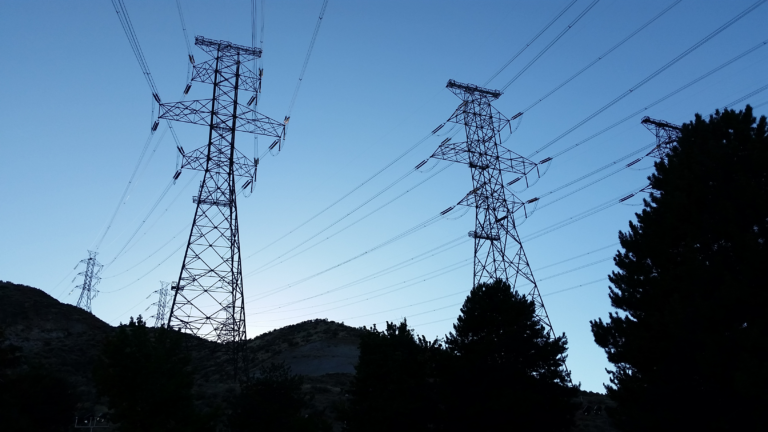
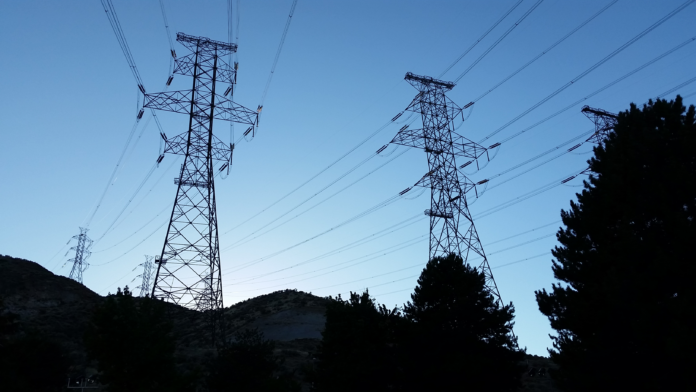
As we wait, with dread, for this year’s fire season, it is astonishing that not a single dollar of California’s immense $76 billion budget surplus is being allocated for the only means of preventing wildfires from starting, which is burying overhead power lines.

Since 2017, four of the six most destructive fires in the state—three of them here in Norcal—were sparked by overhead power lines. Burying those overhead power lines that pose the highest risk of fires is by far the most important preventive measure that our government can take to protect us from wildfire. It would also eliminate the expanding number of crippling power shutdowns that PG&E orders because of the fire risks that overhead—but not underground—power lines pose.

Senator Mike McGuire and the Wildfire Working Group recently announced a package of new bills to legislatively complement the $2 billion that Gov. Newscom plans to spend on CAL FIRE to prepare for, remediate and fight wildfires after they start.

Yet none of this funding will go toward burying power lines or slowing power shutdowns. That’s why the Sonoma Independent and the Davis Community Vision Alliance formed a grassroots Bury Fire-Causing Power Lines Now! Campaign and a Change.org petition to “Use 2% of California’s Budget Surplus to Bury Highest Risk Fire-Causing Power Lines.”

Please join us in calling on Sen. McGuire and the Senate Natural Resources Committee Chair Henry Stern to ask them to introduce an emergency trailer bill allocation of $1.5 billion to bury the 500 riskiest miles of overhead power lines.

Our proposed bill and related information can be read at SonomaIndependent.org. It requires utility companies to match every $2 of state funding with $1 of their own, and will quadruple the number of risky overhead power lines that are being buried currently.

The legislature will vote on this to append our tax dollars by the end of the month. Let’s make sure that it protects us all with effective fire prevention, and not just preparation and response.

Jonathan Greenberg is the founder and editor of SonomaIndependent.org. We welcome your contribution. To have your topical essay of 350 words considered for publication, write le*****@********un.com.

Letters to the Editor: Point Reyes Reactions

Local Coverage

Thanks so much for your coverage of our public lands, Point Reyes (“Death by Design,” June 30)! It is so valuable for me to find local coverage of the Seashore. Great to see a paper with independent integrity!

Catherine L. Portman, Woodland

Myths of Point Reyes

I appreciate the letter from Dr. John W. Cruz on July 7 regarding the horrors of elk culling in Point Reyes National Seashore. I agree with him that it’s high time to restore Point Reyes. 

Where Dr. Cruz writes “The agreements that were made 60 years ago were from a different era … and it’s time to start buying out the ranchers,” I point out that there were no agreements, ever, that ranching should stay in perpetuity in our national park. In fact, the reservations of use were explicitly time-bound—25 years or life—and the lease agreements are legally cancelable by the Interior Secretary at any time.

Furthermore, the ranches were already bought by the public, for the time-adjusted amount of almost $400 million, plus the mentioned period of continued occupancy. It’s a testament to the thickness of the fog of obfuscation generated by the interested parties that such basic facts are misapprehended even by people distinctly interested in the health of the park.

Other persistent myths are that the ranches in Point Reyes are good stewards of the land in Point Reyes—they are documented as significant sources of air and water pollution, soil depletion and erosion, invasive species, etc.—that they preserve and honor history there—they are modern, industrial-scale operations which obscure and disrespect the much older Coast Miwok history—and more. These and other myths are detailed in a recent webinar from the Coalition to Save Point Reyes National Seashore that can be found at savepointreyesnationalseashore.com.

Ken Bouley, Inverness

Write to us at le*****@********un.com.

Three Marin Cities Take Differing Approaches to Homeless Encampments

Three cities in Marin County, San Rafael, Sausalito and Novato, all have a significant number of people living in homeless encampments. Each has chosen a different approach to contend with the homelessness issue in their community.

San Rafael says they have been a “leader in the county on addressing homelessness.” Sausalito maintains they treat their homeless residents with “care and compassion.” Novato asserts they are “proactively addressing homelessness.”

While all three cities recently passed laws restricting camping, San Rafael and Sausalito have provided fenced-in encampments for a portion of their homeless populations. Novato has failed to provide a designated area for its homeless population to camp and has also enacted the most restrictive camping bans.

Of the three municipalities, San Rafael seems to practice a kinder, gentler course of action with its homeless population. The police department employs a full-time mental health liaison, Lynn Murphy, a licensed clinician who is out on the street every day.

“I do outreach and engagement with people experiencing homelessness,” Murphy said. “I make it a point to know every person living outdoors.”

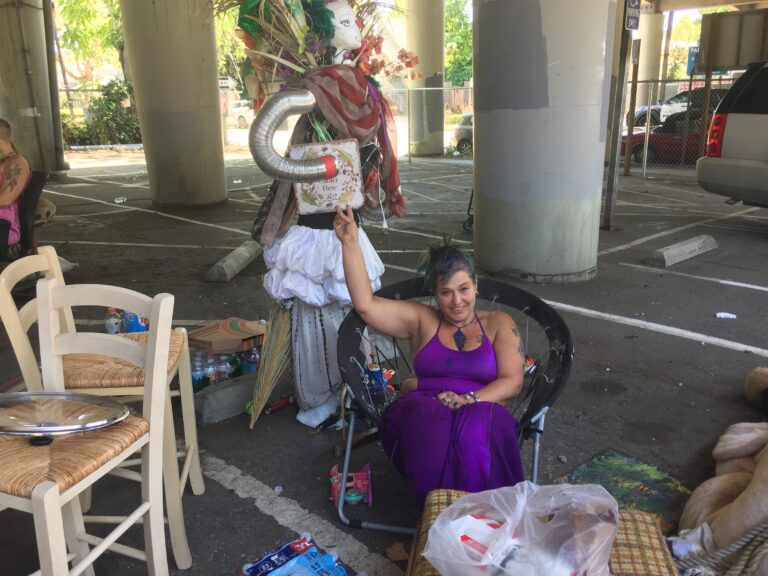
Approximately 50 people were displaced in San Rafael last week when Caltrans swept a homeless encampment from a parking lot located under the Highway 101 viaduct. More than 30 of the ousted campers elected to move to a new city-sanctioned homeless encampment, the “service support area,” located under the freeway at Fifth Avenue.

The spot is extremely loud due to traffic noise. It was chosen because the campers were already living there, says San Rafael Mayor Kate Colin. In addition, Caltrans, the owner of the property, was willing to work with the city on a supportive area.

San Rafael is providing restrooms, handwashing stations, a phone charging station and garbage pick-up at the service support area, which can accommodate up to 44 people. Surrounded by chain link fencing, a 24-hour security guard is posted at the entrance. Campers may come and go at will; however, guests are not allowed inside the enclosure.

“The security was at the request of the women,” Murphy said. “They don’t want weird guys coming into their tents in the middle of the night, which is what was happening at the other sites.”

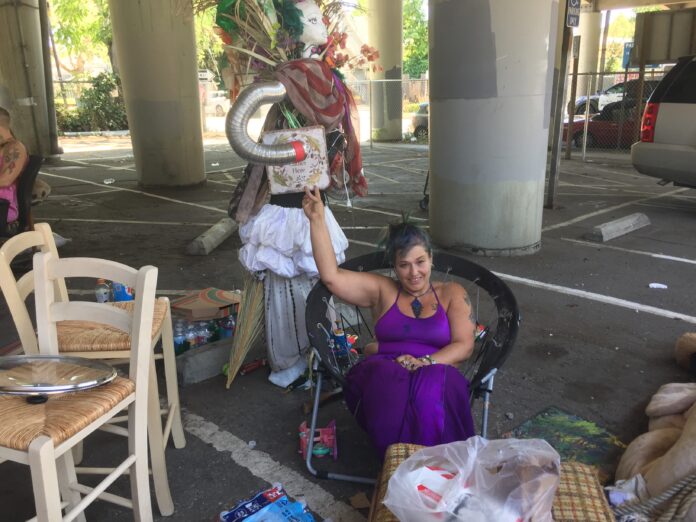
Christal Gift, a resident of the service support area, says she was anchored out in Richardson Bay. The boat she stayed on was eventually seized by the Richardson’s Bay Regional Agency. She’s been living under the freeway for months and decided to move into the designated area.

“It’s OK here,” Gift said. “But I wake up and all I see is fences.”

With the goal of putting campers on the path to housing, the service support area is a temporary measure. The wait could be long. The county, which is short on emergency shelter space, recently reported that 500 homeless people are on the waiting list for permanent supportive housing, though Marin just received 115 housing vouchers from the federal government.

Still, there are 1,034 homeless people in the county, according to the latest homeless count conducted in early 2019. Murphy believes the number increased during the pandemic.

San Rafael’s support service area population represents only a portion of the city’s estimated 255 homeless people. Those living outside the encampment will be affected by an anti-camping ordinance passed last week by the San Rafael City Council. Two popular places for the homeless to camp, Boyd Park and the downtown parking garages, are now off-limits due to concerns about fires, according to the mayor. Aside from these locations, camping is permitted on public property.

The police will enforce the new camping ban; however, if they write a citation, there is no monetary fine. Instead, the case is resolved in Marin Community Court, which is designed to assist the homeless and people with mental health issues. A judge may order the defendant to connect with social services or perform community service.

“This is not necessarily a criminal justice issue,” Sgt. Carl Huber of the San Rafael police department said. “The fine system wasn’t getting us anywhere.”

Sausalito, on the other hand, is currently issuing citations with a fine of up to $500 to anyone camping in Marinship Park outside of the designated homeless encampment. The city marked 40 spots for tents within a fenced area. On Friday evening, I counted 42 tents, a “gym,” and a child’s play zone. Based on the configured space, there is no room for additional tents, though there is still plenty of open space in Marinship Park to expand the camp. 

“Some of the campers are a bit spread out and have more than one tent,” Sausalito Mayor Jill Hoffman said. “The city continues to monitor.”

Last month, Novato passed two ordinances severely curtailing camping on public property. One ordinance includes a sweeping daytime camping ban, yet a federal judge recently prevented Sausalito from enacting such a law.

A violation of Novato’s ordinances is a misdemeanor; however, enforcement won’t begin until the CDC relaxes restrictions about keeping homeless encampments in place or Marin County reaches a 90% vaccination rate for residents 16 and older.

California Homeless Union Attorney Anthony Prince says Novato’s anti-camping laws are unconstitutional and a violation of the 9th Circuit Court of Appeals decision in Martin v. Boise. The ruling affirmed people cannot be punished for sleeping outside on public property when a city cannot offer them an adequate shelter option. The Homeless Union will be filing in federal court for an injunction prohibiting the enforcement of Novato’s ordinances.

Novato just announced it is considering entering into an agreement with nonprofit Homeward Bound to provide up to 15 spaces in its Novato shelter. With more than 300 homeless people tallied in Novato during the last count, it won’t be enough to allow the city to skirt Martin v Boise.

Sausalito, too, may soon be back in court. A federal judge authorized Sausalito to move a homeless encampment from a location near Dunphy Park to Marinship Park. However, Prince thinks the city is now violating the court order by ticketing campers who are in Marinship Park, but not in the enclosed section.

“A city does have a right to place reasonable limitations on camping to prevent interference with city business, or for public health and safety, such as on a railroad track or getting in and out of a hospital,” Prince said. “As far as camping in an otherwise public space, they cannot cite people without first offering relocation to a shelter or housing.”

As cities struggle to connect their homeless populations with Marin’s limited shelter, housing and supportive services, they’ll likely continue to push the boundaries of Martin v Boise. And the Homeless Union vows to be there when they do.

Next week, we’ll examine Marin County’s efforts to provide housing for people experiencing homelessness.

EDITOR’S NOTE: Paragraph ten has been changed to reflect the fact that the boat Gift was staying on was seized by the Richardson’s Bay Regional Agency, not Sausalito.

Grow Green

Farms not factories

I read the news today, oh boy. Maybe, you did, too. It was all over the place, and, though it struck me as rather sad, I had to laugh, especially after talking with longtime, cool-headed marijuana grower Jamie Ballachino, who has appeared previously in this column.

I thought Jamie would moan and groan. After all, the county board of supervisors voted 5–0 to require costly and time-consuming analysis of the impacts of pot cultivation on the environment.

To some growers, the vote sounded like the beginning of the end. Not to Jamie, though he points out that Sonoma County is “Grape-Nuts,” with 65,000 acres of grapes and 10 acres of marijuana, and that vineyards consume much more water than pot. Jamie even praises Supervisor David Rabbitt, who called for environmental review years ago.

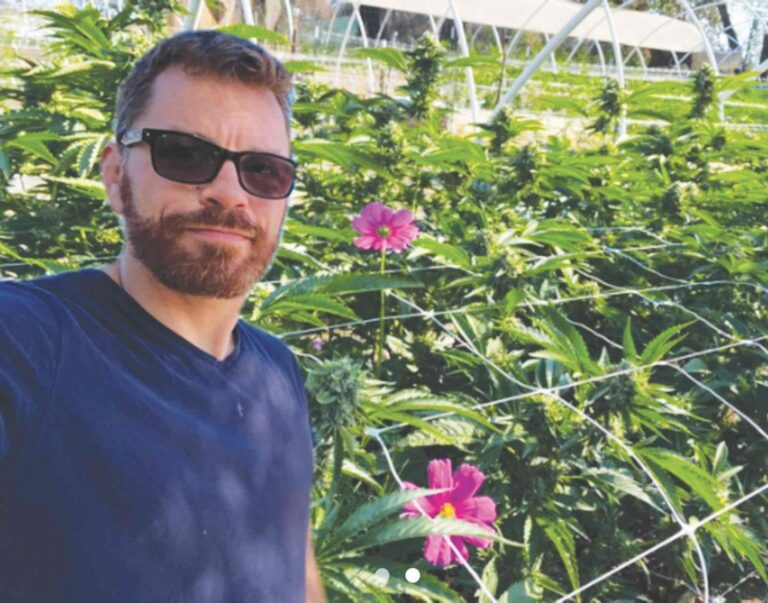
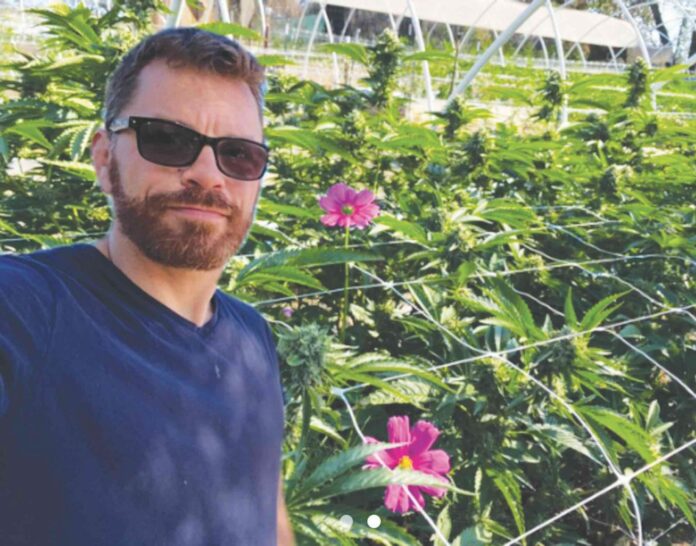
Like most marijuana growers in the county, Jamie doesn’t have a permit for the quarter-of-an-acre that he cultivates on a sunny hillside. He has followed all the rules. “Hands in the Earth,” the name of his company, sits outside the town of Healdsburg.

Jamie harvests weed four times a year with help from three employees. He has harvested ever since 2006, when he began to grow under Prop. 215, which allowed for medical cannabis. “Marijuana will never leave Sonoma County,” Jamie tells me. “As long as it’s here, it’s going to fight to expand its canopy.” He offers a quip from cannabis maven, Ed Rosenthal: “Cannabis isn’t addictive, but farming it sure is.”

The 5–0 vote has not stopped Jamie or anyone else from growing, distributing and selling weed all over NorCal.

He and other pot farmers worry that Sonoma County will open a big barn door to corporate cannabis and close the door to modest growers, and that it may not require stringent environmental review for the big guys. Jamie thinks there’s a double, and even a triple, standard. He uses no electricity, except for a well pump and a few five-watt bulbs, and no harmful pesticides or herbicides. Indeed, Jamie protects the environment.

He believes in outdoor, not indoor, cultivation. “We are farmers, not factory workers,” he tells me. “We belong in the sun, our hands belong in the earth. We take care of the land. Growing in a factory is asking for climate change to get worse. Does anyone notice that the climate is changing around us due to our careless industrial practices?”

What recommendation does he have for the supervisors? “The best thing is for them to smoke a joint and watch the sunrise,” he says. Jamie and dozens of farmers like him deserve a far better deal than the county has so far offered. And get cranky pot foes off their backs.

Jonah Raskin is the author of “Marijuanaland: Dispatches from an American War.”

By the Numbers

0

A world of wonder

In the beginning was the creation of light, a prism that disperses the seven colors of the rainbow.

Seven is a rather magical number that belongs to that mysterious architecture of the cosmos called sacred geometry. Seven astral bodies are visible from earth with the naked eye, for which the days of the week are named. There are seven energy wheels called chakras in the body, and seven heads on a hydra, so watch out. The Sound Of Music teaches us do-re-mi-fa-so-la-ti, which are the seven tones in the musical scale that Miles Davis used to write “Seven Steps to Heaven.” In the Old Testament, Salome performs the dance of the seven veils, and in the Babylonian myth Ishtar descends to the underworld through seven gates, there to find all the used VHS copies of Ishtar.

Twelve is another special number. Two sets of 12 make the 24 hours of the day, half for the sun and half for the moon. There are 12 apostles of Christ, 12 gods of Mount Olympus, 12 signs of the zodiac and 12 donuts in a dozen, but don’t eat them all because the gods punish small things quickly.

Sacred geometry shows us that the universe repeats the same patterns at different levels of resolution. A spiral can be as small as a snail’s shell or as vast as a galaxy. Sacred geometry even comes through sound waves, since stroking a violin bow on a metal sheet covered with sand causes the sand to create a snowflake pattern. Change the tonal frequency of the stroke and the snowflake changes. Even the vastness of space is mirrored in the emptiness of the atom. 

The earth’s movement is also full of mystery. It rotates daily and orbits the sun annually, but it also wobbles on its axis, which is tilted at 23.5 degrees. This causes the spring equinox to cycle backward through the 12 signs of the zodiac over the course of 26,000 years in what’s known as the precession of the equinoxes. Jesus of Nazareth was born in the age of Pisces and is thus closely associated with the symbol of the fish. The 1967 musical Hair hails the dawning of the Age of Aquarius. 

The universe is a majestic place, and how fortunate we are to live in its eternity for a speck of time. The ancients said the bulk of mankind lives in a state of limited awareness akin to sleep, and the process of opening one’s consciousness is called the doctrine of awakening. So close your eyes, open your mind and begin to see.

When You Say ‘I’

0

Mental Health Month

There once was a girl named Sunny, whose smile was as bright as the California sky, until she lost her spark and became depressed. She began meditating in the park every day, but the answer to her troubles never came to her. “Oh my God, what’s wrong with me?” she asked herself. Then one day an old friend saw Sunny and laughed. She said that meditation was useless and to come have a few drinks and just forget her troubles.

Sunny did, but that night something strange happened. She didn’t know if it was a bad dream from too much wine, but a man appeared in her room and said his name was Michael and that he had a message for Sunny. “The message is from God,” he said. “He wants you to know that when you go to the park each day in search of answers, is it not He who summons you there?”

This tale of the girl, whose inner spark went out, comes from an old Arab proverb, and like the Archangel Michael I, too, bear a message. May is Mental Health Month, during which the stars have aligned for the Bohemian and Pacific Sun to launch a new column on spirituality, metaphysics, ancient wisdom and the secret laws of the cosmos that will help you cultivate the strength and tranquility you need for navigating these uncertain times.

Problems of the heart and mind, after all, can also be called problems of the soul and spirit. Overcoming them requires expanded consciousness; a broader frame of reference based on transcendence of the merely human. This is what is meant by the notion that you are not your thoughts, but rather the being that has thoughts. But when you’re despondent, you become identified with the gray clouds in the sky—rather than the sky itself. This is why the world’s spiritual traditions focus so much on what you mean when you say, “I.” 

Prince Siddharta—the man who became known as the Buddha or Enlightened One—was a lot worse off than you. He left his palace and family to wander for six years, nearly starving himself to death, before finally he saw through the illusion of his misery and could say, “Enlightenment means the end of suffering.”

It has been wisely said that we are not human beings seeking a spiritual experience, but spirit beings having a human experience. Think of me as a fellow adventurer, a travel writer with a map to inner awakenings and flashes of insight that can guide you on your hero’s journey. Because whether you know it or not, you’re on one.

Christian Chensvold blogs about the world’s wisdom traditions at trad-man.com.

Tamalpais Beverage Company Bottles CBD

I thought it was following me, but maybe I was following cannabis. When I moved to San Francisco recently, I learned that my neighborhood store, Other Avenues, carries a popular CBD beverage from Tamalpais Beverage Company. 

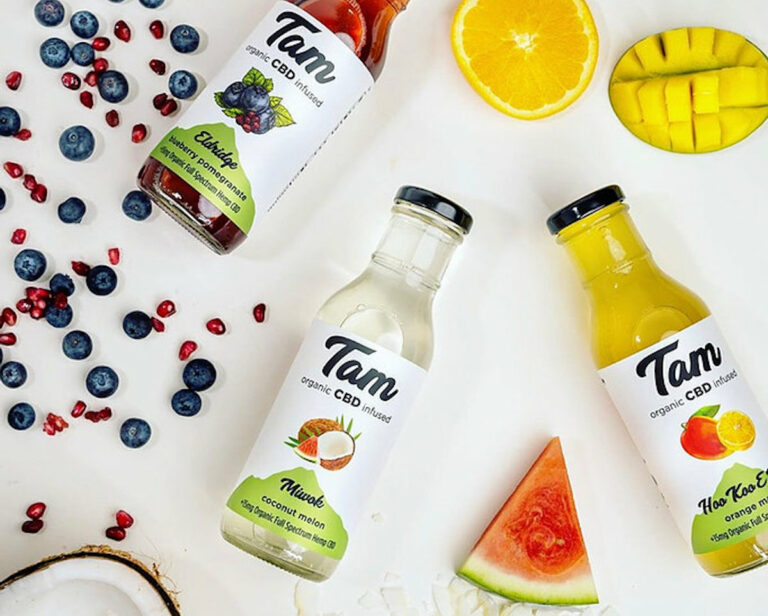
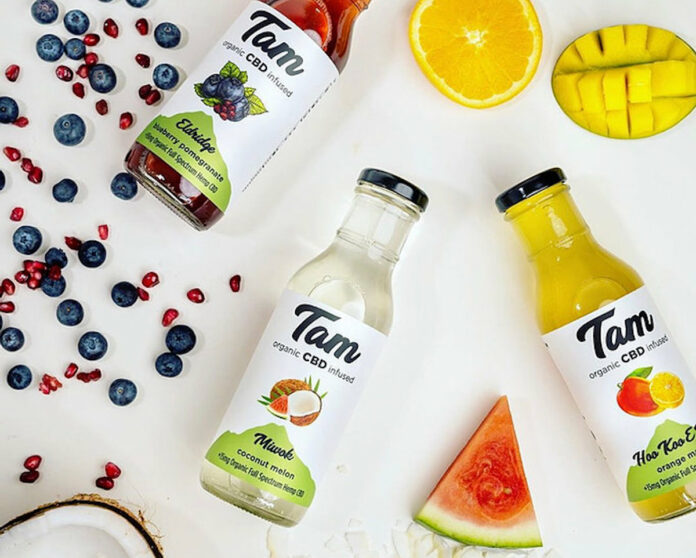
Greg Moore founded the company in 2019. Now, he makes five different organic drinks which might help with relaxation but not inebriation. All the beverages are named for trails on Mt Tam. The ingredients are beneficial for the body.  

“We sell our products at colleges and universities, like SF State,” Greg tells me. “They’re popular with students who sip and go to class without being on edge.”

The drinks are in stores both big and small, from San Jose to Sacramento. They come in five flavors: Blueberry Pomegranate — “Eldridge”; Orange Mango— “Hoo-Ko-E-Koo”; Apple Tumeric— “Dipsea”; Peach Ginger—“Bolinas”; and Coconut Melon—“Miwok.”

Greg explains: “Our products have a slight hemp taste. The people who seem to like them the most want an alternative to alcohol. That’s what we offer. Over the last year we’ve provided a natural way to help people relax. Our biggest competition is from the sparkling drinks that have CBD, but usually don’t have a taste profile.”

He’s been in the beverage biz for much of his adult life, often as a consultant. Raised in Marin, he attended Marin Catholic High School and UC San Diego. Now he lives in Mill Valley.

Greg enjoys beer and wine, but he often prefers a non-alcoholic drink that provides a sense of relaxation and that also contains wellness ingredients such as ginger, turmeric, l-theanine and electrolytes.

He does some of the distribution himself, aided by his team. That means driving in Bay Area traffic, which can be hellish. “I like visiting stores and talking with customers,” he says. “We donate a portion of our sales to local arts and recreation programs.”

The CBD in his beverages comes from the full spectrum of the hemp plant so you get the entourage effect. Greg tells me: “The whole plant has many benefits, including terpenes, adaptogens, and cannabinoids like CBN and CBG that are as beneficial as CBD. We keep it real, the way nature intended.” 

Greg himself is a walking-talking advertisement for Tamalpais Beverage Company, which is headquartered in Sausalito, not far from the iconic mountain that overlooks much of the county.

When you’re ready to hike, Mt. Tam State Park offers 69 trails, including the Dipsea which lifts you up and takes you down gently. Bring a beverage, like “Coconut Melon Miwok” for hydration and relaxation, and, when you’re at Ocean Beach in San Francisco, visit Other Avenues, a great local food store and only a ten-minute walk from the Pacific.

Jonah Raskin is the author of Marijuanaland: Dispatches from an American War.

Dry Farmers Challenged by Drought

By Naoki Nitta As the drought drags on with no end in sight, California farmers face the sobering prospect of springs and wells drying up. But at Red H Farm in Sebastopol, that isn’t a consideration, much less an option, because their well collapsed six years ago. That’s when farmer Caitlin Hachmyer turned to dry farming. Now, she relies on the...

North Bay Theaters Plan Live Seasons

After a year of performing to virtual audiences, North Bay theater companies are ready to welcome people back to the theater, and several local companies have announced their 2021–2022 seasons of shows, ranging from classics to world premieres. Earlier this summer, Left Edge Theatre in Santa Rosa became the first organization to perform indoors again, at the production of the...

Culture Crush: Live Events This Week

Napa Valley After a year on hold, Festival Napa Valley welcome audiences back for a full program of events this summer. Marking the Festival’s 15th anniversary and celebrating the return to live events, the concert schedule includes opera, chamber music and jazz. Festival Napa Valley kicks off with an Opening Night recital on Friday, July 16, featuring soprano Lisette Oropesa...

Open Mic: Burying Power Lines

Transmission lines California
By Jonathan Greenberg As we wait, with dread, for this year’s fire season, it is astonishing that not a single dollar of California’s immense $76 billion budget surplus is being allocated for the only means of preventing wildfires from starting, which is burying overhead power lines. Since 2017, four of the six most destructive fires in the state—three of them here...

Letters to the Editor: Point Reyes Reactions

Local Coverage Thanks so much for your coverage of our public lands, Point Reyes (“Death by Design,” June 30)! It is so valuable for me to find local coverage of the Seashore. Great to see a paper with independent integrity! Catherine L. Portman, Woodland Myths of Point Reyes I appreciate the letter from Dr. John W. Cruz on July 7 regarding the horrors...

Three Marin Cities Take Differing Approaches to Homeless Encampments

Christal Gift - San Rafael, California
Three cities in Marin County, San Rafael, Sausalito and Novato, all have a significant number of people living in homeless encampments. Each has chosen a different approach to contend with the homelessness issue in their community. San Rafael says they have been a “leader in the county on addressing homelessness.” Sausalito maintains they treat their homeless residents with “care and...

Grow Green

Farms not factories I read the news today, oh boy. Maybe, you did, too. It was all over the place, and, though it struck me as rather sad, I had to laugh, especially after talking with longtime, cool-headed marijuana grower Jamie Ballachino, who has appeared previously in this column. I thought Jamie would moan and groan. After all, the county board...

By the Numbers

A world of wonder In the beginning was the creation of light, a prism that disperses the seven colors of the rainbow. Seven is a rather magical number that belongs to that mysterious architecture of the cosmos called sacred geometry. Seven astral bodies are visible from earth with the naked eye, for which the days of the week are named. There...

When You Say ‘I’

Mental Health Month There once was a girl named Sunny, whose smile was as bright as the California sky, until she lost her spark and became depressed. She began meditating in the park every day, but the answer to her troubles never came to her. “Oh my God, what’s wrong with me?” she asked herself. Then one day an old...

Tamalpais Beverage Company Bottles CBD

I thought it was following me, but maybe I was following cannabis. When I moved to San Francisco recently, I learned that my neighborhood store, Other Avenues, carries a popular CBD beverage from Tamalpais Beverage Company.  Greg Moore founded the company in 2019. Now, he makes five different organic drinks which might help with relaxation but not inebriation. All the...
3,002FansLike
3,850FollowersFollow