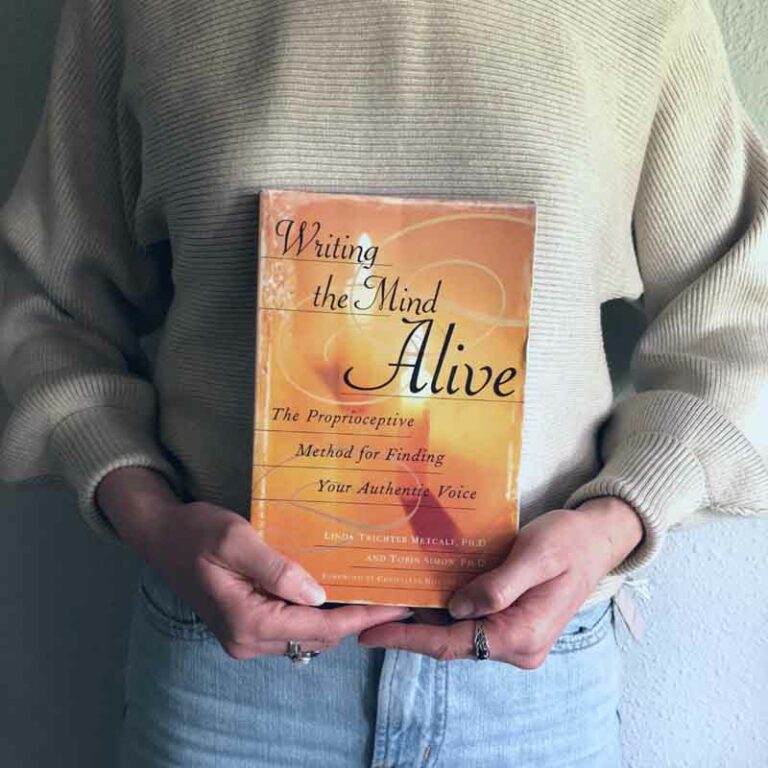
Author offers a method for reconnecting to personal identity through writing
By Jane Vick
There’s a certain irony to writing about writer’s block. But those of us who put pen to paper, or fingertips to keys, for a living are no stranger to the affliction.
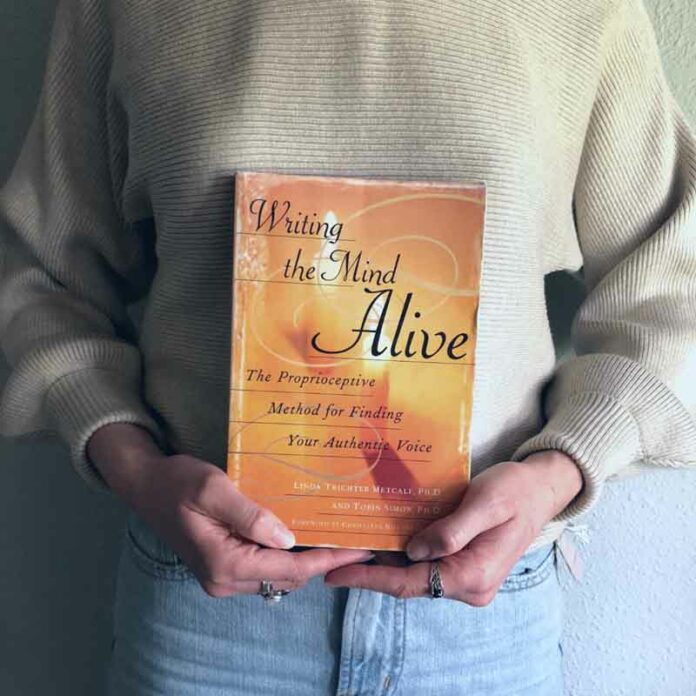
Searching for the right words to convey a story, a sensation, or to translate a demanding but as-yet-cryptic feeling can be a process akin to pulling teeth. Luckily, Linda Tritchter Metcalf, an author who is all too familiar with this challenge, has developed a method of writing to counteract blockages. It’s called Proprioceptive Writing.
Metcalf, who received her MA and PhD in literature from New York University, began developing the process inadvertently as she finished her dissertation while teaching English and humanities at Pratt College. Examining her subjective response to a Shirley Jackson novel, Metcalf spent six hours a day for three months reading and writing about her experience with the work.
After this period of intense reflection, Metcalf noticed a profound change in her entire being—a notably increased sense of clarity, focus and self-awareness. Her connection to self improved to a degree she had never experienced before, and her mind felt alert and active in an entirely new sense.
Inspired, Metcalf took the practice to her students the following semester, as did her partner, Tobin Simon, a fellow professor in the Pratt English department. The changes they witnessed in their students in the subsequent weeks and months were evidence enough of Proprioceptive Writing’s potency. In 1982, Metcalf and Simon left their academic careers and founded the Proprioceptive Writing Center in Maine.
A center in New York City followed in 1996, and, in 2006, they moved West, founding a Proprioceptive Writing Center in Oakland. Simon retired in 2014, but Metcalf continues to teach and direct the center, offering teacher training, classes and immersive workshops. The next workshop will be held from June 8-12 at the Santa Sabina Center in San Rafael.
The Process of Proprioceptive Writing
I spoke with Metcalf on a clement Wednesday afternoon—ah, the difference between May in Maine and May in California—for more details on her discovery and cultivation of Proprioceptive Writing, what the practice entails, and how she sees it benefiting her students.
“Those three months were glorious,” said Metcalf, of the dissertation work that led to her discovery. “I’ll never get another three months like it in my life, I don’t think. It was summer, my son was in daycare, I was completely alone.”
As she sat writing, working in the then highly popular style of criticism in which careful attention is paid to the reader’s subjective perspective of a novel, Metcalf said she began to hear herself in a way she never had before.
“Two thirds of the way through the process, I began to experience changes in myself. I know this may sound strange, but I suddenly became ticklish, when I never had been before. I started to feel things I’d never felt before—I had never been able to make contact with myself like that. I’d always felt divided from myself, conflicted,” Metcalf said.
In the roughly 400 hours she spent working through Jackson’s novel, Metcalf only made it through one and a half pages, such was the intensity of her outpouring. As though previously disconnected wires were rejoining, she found herself suddenly able to think more clearly, and more decisively, as a result of listening to her own thought process so intently. Though Metcalf had been successful and, as she put it, “made the ordinary advances that people make” in her then 36 years, it wasn’t until the activation brought about by this hyper-focused writing practice that she actually felt happy.
“Prior to this process, my life felt divided—thinking one thing, saying another, not knowing what I was feeling, being unable to connect to my childhood, feeling like a visitor to my own life. This was the first time I truly connected to myself.”
What came about subsequently—now called Proprioceptive Writing—is really a practice in listening to the self, and—this is my observation—validating one’s perspective and experiences. It is this style of self-investigation that creates an intimacy and trust in self-connection.
The steps of Proprioceptive Writing are specific. The conditions of the room during a “Write”—so named by Metcalf’s Pratt students—need to be as follows:
Firstly, the room must be empty of any distractions, in order to cultivate solitude—though if others are present and also engaging in a “Write,” that is acceptable.
Secondly, Baroque music must be playing. When I asked Metcalf why Baroque in particular, she simply said:
“It must be Baroque. There were tremendous studies done on Baroque music, as a specifically valuable style of classical music. But I don’t know what they are! What I know is I was listening to Bach throughout my process and endeavoring to replicate exactly what I’d done.”
I confess I’m listening to Baroque as I write this, and the keyboard is smoking…
Thirdly, one must have a blank sheet of white paper—I didn’t ask if laptops were allowed. From there, Metcalf gives three directions. Write what you hear, listen to what you write, and be ready to ask “the proprioceptive question,” which is the personal meaning of a word or phrase you’ve used. This step in particular I find evocative—to consider what might prompt one to use such a phrase as “he twisted his mouth into a sneer.” Or “she lifted herself gracefully from the couch.” Why twisted? Why lifted, or gracefully? To explore deeper into word choice is a significant deepening in self-understanding. Very Ludgwig Wittgenstein.
The “Write” goes on for 20 or 25 minutes, and when it’s over, four follow up questions are posed: What were the thoughts heard but not written? How is the individual feeling after the “Write”? What is the larger story being told? And finally, Any direction for future “Writes”?
This is the process of Proprioceptive Writing, in a nutshell, and it can go on indefinitely, providing ongoing benefit to the practitioner.
“[Proprioceptive writing] is for those looking to achieve a kind of contact with themselves that they don’t normally experience. It’s for those who sense missing links, or blockages, in their writing, their lives or both,” Metcalf told me.
For more information on Proprioceptive Writing and upcoming workshops, including the one in June at the Santa Sabina Center in San Rafael, visit www.pwriting.org.
Relive the ’60s when the Beatles Guitar Project Rock Orchestra comes to the North Bay on Saturday, June 11, to play live in concert. The 40-piece professional rock orchestra with special guest vocalists will play two Beatles’ albums, Rubber Soul and Revolver, in their entirety, using a rhythm section, strings, woodwinds, brass, percussion and a choir. The performance will also include a special graphical film and light show to honor George Harrison. The show begins at 7pm at the Marin Veterans’ Memorial Auditorium in San Rafael. Tickets, priced at $102, $86, $64 and $42, include Marin Center fees. Proceeds from the show will benefit the Beatles Guitar Project and Scholarship Fund and the iHeartMusic.Org Scholarship Fund. Tickets available at www.tinyurl.com/3rxch27c.
San Anselmo
Bringing the ’60s Back Home
Experience music and community this July when a 13-piece band, under the direction of local musician and producer Joe Bagale, kicks off the first Beatles in the Park in two years. An annual tradition for more than a decade, the act was derailed by Covid but is officially back on for Saturday, July 23. The show, which starts at 6pm and goes until 9pm, will be held at Creek Park, 249 Sir Francis Drake Blvd. Tickets are $35 for adults and $12 for youths 12 years and younger. Children under two are free. Tickets are available at Eventbrite.
Santa Rosa
Swing Legends Return
Kick off Luther Burbank Center for the Arts’ new 16-show lineup with a swingin’ live musical performance this summer when Big Bad Voodoo Daddy comes to town. In 1993, this band, named after an autograph by blues legend Albert Collins, introduced swing to a new generation of Americans with its unique horn-powered blend of jazz, Dixieland and swing. Now internationally famous, their high-energy show will rock the LBC house on Friday, Aug. 5, at 8pm. Don’t miss out. All tickets are General Admission and are priced at $39.
Sonoma County
Museum-Go-Round
Catch up on history of all kinds by taking advantage of this year’s Museum Member Swap Weekend. That’s right, on May 21–22 participating Sonoma County museums will offer free admission to members of all other participating museums. The list of participating museums includes California Indian Museum & Cultural Center, Charles M. Schulz Museum and Research Center, Children’s Museum of Sonoma County, Museum of Sonoma County, Pacific Coast Air Museum, Petaluma Historical Library/Museum, Sonoma Valley Museum of Art, Luther Burbank Home & Garden and Sebastopol Center for the Arts. Participants must bring proof of membership.
ARIES (March 21-April 19): “The only way to the truth is through blasphemy,” declared Aries author Flannery O’Connor. I appreciate the cheeky sentiment, but I don’t believe that all truth requires blasphemy. In many cases, rebellion, irreverence and skepticism may be enough to pry loose hidden and buried information. Outright blasphemy isn’t necessary. What does this have to do with you? Well, I’m hoping you will be feisty and audacious in your quest for interesting truths. As you dig, I invite you to be less than perfectly polite. Don’t be rude or unkind, of course. Just be charmingly bold.
TAURUS (April 20-May 20): “I am so beautiful, sometimes people weep when they see me,” declares comedian Margaret Cho. I would love for you to summon her level of self-esteem and bravado in the coming weeks. According to my interpretation of the astrological omens, you now have the right and duty to boost your self-worth. All of creation is conspiring with you to develop more faith in yourself. And if you do the work to deepen your confidence and self-esteem, there will be an added bonus: a health breakthrough. As spiritual author Caroline Myss says, “Belief in oneself is required for healing.” My prediction: You will rouse an enhanced power to get the soul medicine you need.
GEMINI (May 21-June 20): According to the blogger Artemisiasea, “The grandeur of life is the attempt, not the solution. It’s about behaving as beautifully as one can under completely impossible circumstances, making room for what breathes in the presence of the attempt—in the coming-to-be.” I invite you to embrace that wisdom in the coming weeks, Gemini. You won’t be dealing with impossible circumstances, but you may have to navigate your way through fascinating brain teasers and heart riddles. Whatever your destination might turn out to be, enjoy the ride with all the verve you can summon. At least for now, put aside your longing for particular results and instead simply live your life as if it were a magnificent work of art.
CANCER (June 21-July 22): It will be in your interest to change more than usual in the coming weeks. I suppose you could wait around passively and scramble to adjust as life flings challenges your way. But the better approach would be to make conscious decisions about how you want to transform. Identify the situations that would most benefit from modification and then initiate the transitions. Rather than depending on fate to provide you with random wake-up calls, choose constructive wake-up calls that are fun and invigorating.
LEO (July 23-Aug. 22): “If everyone likes you, it probably means you aren’t saying much,” declared politician Donna Brazile. I suspect you will disprove her theory in the coming weeks. According to my reading of the astrological omens, you will have a lot to say; your communications will be even more interesting than usual. And yet, I also expect you will receive extra respect and appreciation from others. While you may articulate ideas that are challenging to some, you will do so with enough charisma to disarm agitated reactions. A winning combination: expressiveness and approval.
VIRGO (Aug. 23-Sept. 22): Have you heard of Virgo adventurer Reinhold Messner? The man is a marvel, and not just because he’s a passionate environmental activist. He was the first mountaineer to reach the top of Mt. Everest alone, as well as the first to ascend Everest without supplemental oxygen. No one before him had ever climbed all 14 of the world’s peaks higher than 26,000 feet. He has transited Greenland and Antarctica without the aid of dog sleds or snowmobiles. He also completed a solo trip across the Gobi Desert. I propose we make Messner your inspirational role model for the next four weeks. You may not achieve history-making triumphs like him, but you could surpass what you assumed were your limits. I trust that you will break at least one of your personal records.
LIBRA (Sept. 23-Oct. 22): “The world is a very puzzling place. If you’re not willing to be puzzled, you just become a replica of someone else’s mind.” Author Noam Chomsky said that. It’s useful counsel for you right now. I’ll go even further. I will advise you to relish the healthy pleasures of being both mysterious and mystified. Seek out fertile enigmas and be a fertile enigma yourself. Explore the rejuvenating wisdom of being indefinable and uncategorizable. Exult in the quizzical joys of Eternal Paradox.
SCORPIO (Oct. 23-Nov. 21): Have you ever contemplated the beauty of the people and animals you care for and thought, “I would love to give them the strongest blessings I have to give, the smartest love I can express, and the best listening I’m able to provide.” If so, Scorpio, the coming days will be an excellent time to do that. You will have an extra capacity to offer exceptional gifts that are useful and inspirational. You will be at the peak of your ability to home in on what your beloveds need.
SAGITTARIUS (Nov. 22-Dec. 21): Sagittarian author Madeleine L’Engle told us, “The discoveries don’t come when you’re looking for them. They come when for some reason you’ve let go of conscious control.” That approach isn’t absolutely true, but it may be useful for you to deploy in the coming weeks. I invite you to relinquish at least a modicum of your conscious control. And if zesty discoveries start flowing in, consider relinquishing even a bit more conscious control.
CAPRICORN (Dec. 22-Jan. 19): Is it a legend or a true story? Scholars disagree about whether Capricorn scientist Isaac Newton really was spurred to formulate the theory of gravity when an apple fell from the tree he was sitting beneath. This much is certain: Newton lived in the home near the famous apple tree. And that tree is alive today, 380 years after his birth. Ripe apples still fall from it. Is there an equivalent landmark or keystone from your own past, Capricorn—where an important insight arose or pivotal event happened? The coming weeks would be a good time to revisit that power spot, at least in your imagination, in quest of fresh inspiration.
AQUARIUS (Jan. 20-Feb. 18): Aquarian poet Jack Gilbert devoted himself to soulful beauty. I swooned when I first read his line, “We must unlearn the constellations to see the stars.” I cried for joy when he said, “We must have the stubbornness to accept our gladness in the ruthless furnace of this world.” On the other hand, I suspect Jack may have been overly consumed with his pursuit of lyrical moments. His girlfriend, Linda Gregg, said, “All Jack ever wanted to know was that he was awake—that the trees in bloom were almond trees—and to walk down the road to get breakfast. He never cared if he was poor or had to sleep on a park bench.” I bring this up, dear Aquarius, hoping you will avoid Gilbert’s lack of attention to practical matters. In the coming weeks, I invite you to be your extravagant, idiosyncratic, interesting self to the max. But also be sure to eat healthy food, engage in pleasurable exercise and get plenty of rejuvenating sleep—preferably in a comfortable bed rather than on a park bench.
PISCES (Feb. 19-March 20): The Uberfacts Twitter account informs me that if you were to consume the amount of food equivalent to what a hummingbird eats, you would eat 300 hamburgers or 7,800 cabbages per day. To match the amount of exercise a hummingbird gets while burning all those calories, you’d have to do approximately 37 bazillion jumping jacks. You will never do this, of course. But in the coming weeks, you may be more metaphorically hungry than usual. I predict you will be voracious for new information and novel experiences and fresh ideas. Not 300 hamburgers or 7,800 cabbages’ worth—but still, a lot. My advice: Have fun being insatiably curious and greedy for stimulation.
Norwegian playwright Henrik Ibsen’s A Doll’s House premiered in 1879 to great controversy. His look at the limitations and restrictions placed on women in a patriarchal society was considered quite scandalous at the time. Many consider it to be the beginning of modern feminist literature, though Ibsen himself denied that. Suffice it to say that a play that ended with a wife and mother walking out on her family (cue door slam) was not the norm.
Not content to let the sound of a slamming door be the last “word”, playwright Lucas Hnath picks up the story of Nora and Torvald 15 years later with A Doll’s House, Part 2. The Novato Theater Company has a production running through June 12.
It’s now 1894, and the stately silence of the Helmer household is interrupted by a knock at the door. Nanny-turned-housekeeper Anne Marie (Shirley Nilsen Hall) opens the door and admits Nora (Alison Peltz) into the household she abandoned long ago. Nora has spent the last 15 years living an independent life as a successful writer. Her latest book challenges the very concept of marriage, much to the consternation of the powerful men whose wives have walked out on them after reading it. Under a threat of blackmail, Nora is shocked to discover that she is still married as Torvald (Mark Clark) never filed for divorce. She seeks to enlist the aid of Anne Marie and eventually her own daughter Elly (Jannely Calmell) to convince Torvald to file. He has his own ideas.
You don’t need to be familiar with the Ibsen original to get this show, and folks fearing a stuffy 19th-century Norwegian drama will be presently surprised to find that Hnath has taken a very modern approach to the material. The dialogue is peppered with expletives and the humor is sharp and pointed but the essence of Ibsen remains.
Energetically directed by Gillian Eichenberger, the show zips along and packs a lot in its 85 intermission-less minutes. Each character gets their moment, and each performer delivers their moment with verve. Peltz in particular does a nice job of balancing Nora’s ambitions with her imperfections.
By show’s end, we still don’t know what lies ahead for Nora. Maybe in another 138 years…
‘A Doll’s House, Part 2’ runs through June 12 at the Novato Theater Company, 5420 Nave Drive, Ste. C, Novato. Fri & Sat, 7:30pm; Sun, 2pm. ASL-interpreted performance Sun, May 29. $12–$27. 415.883.4498. Proof of vaccination and masking are required to attend. novatotheatercompany.org.
The war in Ukraine is proving that the future of the human race looks very grim, unless the United States and Russia can end the ugly Cold War between us. This angry rivalry has divided much of the world into two enemy camps and has kept humankind on the brink of nuclear war for over 60 years.
Those who have supported the nuclear arms race have argued that the “balance of terror” between our intensely competitive nations is the only way that peace between our two nations can be maintained. However, the present war in Ukraine is pushing the world beyond all acceptable limits of danger. It is time to recognize that the constant threat of nuclear war is not going to save us from an eventual outbreak of that nuclear war. And it is irrational and suicidal to remain hoping that world peace can be maintained from our mutual terror of that always possible Third World War.
If we in the West truly want to extend freedom and human rights in the world, then our fanatic competition with Russia (and China) must be replaced with a genuine and reliable friendship with these current enemies.
As the weather warms up and our coastal forest is blanketed in that summer smell of redwoods, have I got an idea for you. Go west, young human, for an afternoon of cannabis consumption at one of the sweetest, most historically significant spots in the new world of cannabis.
We’re talking about Riverside Wellness Collective in Guerneville, one of the cultural landmarks along the Cannabis Trail, a non-profit project commemorating the people and places that helped to establish the legal cannabis we know and love today.
I spoke with the Cannabis Trail founder, Brain Applegarth, about the legacy of Riverside Wellness and the Cannabis Trail Project.
“Currently there are 10 cultural landmarks along the Cannabis Trail that are installed and ready for visitors … all the way from San Francisco up to Humboldt County,” Applegarth told me during a recent phone chat. So far, Sonoma County is home to two of those landmarks—one is Riverside Wellness.
“Riverside Wellness is a cultural landmark that honors [not just the dispensary’s importance in] cannabis history,” he said, but also the story of Brownie Mary and what they call “the bust heard around the world.” This occurred when the medicinal activist Mary Jane Rathbun, already famous for providing cannabis to AIDS patients in the Castro, was arrested at the home of a pot grower in Cazadero.
The national attention given to the bust “opened up a huge dialogue around medicinal cannabis, and lo and behold four or five years later, [the bust] led to Proposition 215,” said Applegarth, referring to California’s Compassionate Use Act of 1996, which legalized the sale and use of cannabis for medical purposes.
To get to Riverside Wellness, drive west along River Road from Santa Rosa. Just as you enter Guerneville, the dispensary is on your left. You’ll find that Riverside Wellness is situated in one of the most beautiful places in the world, right along the Russian River, in the little resort town known for a mix of hippy counter culture, farm-to-table foodie-ism and queer chill.
“They have a beautiful location with all kinds of sitting areas by the river. You can’t get a much better environment to be relaxed and enjoy nature,” Applegarth said. Right next door you’ll find the lovely Farmhand Cafe for bites and bevies.
Ah yes, I think soon I’ll go get a half gram pre-roll and walk into town for some ice cream in Guerneville. Sounds perfect. I can’t imagine a more fitting tribute to the work of the pioneers celebrated by the Cannabis Trail than for buying a joint on a summer afternoon to be the most normal thing in the world.
Ah, summer! Sunny days, languidly stretching into clement, starry evenings.
In Marin County, there is no shortage of fun to be had and food to be enjoyed in the coming months. The wine flows freely and the savory smell of BBQ is lifted on a warm breeze to perk the appetite. So don’t wait another second! Fill those calendars with outings and aboutings. Here are a few ideas to get started.
Dirty Cello at Rancho Nicasio’s BBQs on The Lawn
Kick off your Marin County summer with an evening of blues, rock and Americana with a classical twist—the cross-over cello stylings of Dirty Cello band leader Rebecca Roudman. The locally-based band is an international phenom that offers an eclectic mix of music that the L.A. Times once observed “really shouldn’t make sense but somehow does.” And they’re taking requests! Name your tune at the band’s Facebook page (facebook.com/DirtyCello) and cross your fingers.
Nicasio—which means the “hidden one”—is a sweet, tucked away spot, relatively untouched by the developments of our fast-paced modern world. Rancho Nicasio, built where the town’s hotel stood until it burned down in the 1940s, is the town’s central meeting place.
Dirty Cello inaugurates the June leg of the rancho’s BBQs on The Lawn Series, which runs through September, offering jams, sweet sunsets and of course BBQ.
Dirty Cello plays 7pm June 3, at Rancho Nicasio, 1 Old Rancheria Rd., Nicasio. The gig is preceded by a barbeque at the roadside eatery—for more information and tickets, visit ranchonicasio.com and dirtycello.com.
Novato Art, Wine & Music
A delicious libation-filled event. Step out on June 18 and 19 for the Novato Chamber’s annual Novato Festival of Art, Wine & Music. Stages will be packed with music from bands like AZ/DZ, Petty Theft, Spike Sikes and His Awesome Hotcakes and more. Art vendors, food vendors and beverage purveyors will be on site. Prepare for a day of purchases, eats and completely danceable music. For more information on how to attend the event, volunteer or register as a vendor, visit www.novatochamber.com.
Rock The Ride
Gun violence continues to be an issue in our country, and the citizens of Napa Valley continue to use their voices—and their feet—to raise awareness and to fund a change. Rock the Ride is back this year on June 25, offering various options for those looking to put their funds and their endorphins towards ending gun violence. Options range from a 50-mile bike ride to a three-mile walk through downtown Yountville, to virtual involvement. Get more information and register at www.raceroster.com or by calling 707-278-8377.
Marin County Fair
After two years of Covid cancellations, the in-person Marin County Fair is back this year from June 30 to July 4. This award-winning tradition is arguably the county’s premiere community event, drawing over 120,000 attendees annually. Produced by the Marin County Department of Cultural Services in partnership with the Marin Cultural Association, it’s advertised as the “Healthiest and Greenest Fair on Earth since 2008.” The event’s eco bonafides include a solar-powered carousel and stage, as well as a 92% waste diversion rate. Healthy food options and alcohol-free sponsorships make the fair an all-around perfect way to spend the day. Welcome summer the classic way—at the fair! For more information and to purchase tickets, visit www.fair.marincounty.org.
Downtown San Rafael Dining Under the Lights
Hungry yet? San Rafael’s Dining Under the Lights series is back! Held Thursdays from 6pm-10pm, starting May 26, the series will have an extra Friday night block party in the West End. Expect al fresco dining, open storefronts, on-street entertainment and an opportunity to meet neighbors and visitors alike. The Marin County community is especially encouraged to come out and support the resilient San Rafael eateries that survived the first two years of the pandemic. For more information on this European transformation of San Rafael, visit www.downtownsanrafael.org.
Ember Stop Marin
Fire Safe Marin is bringing fun to fire preparation May 28 from 11am-5pm at Ember Stomp, the first-ever wildfire prevention festival in Marin County. Come to the Marin Center Fairgrounds for a day of food, music, games, a magician, and myriad workshops and training sessions on how to prepare the home and community in the event of a wildfire. A demonstration house and garden will be set up to maximize learning opportunities. Experts will be on hand all day to answer questions and to facilitate fun. For more information, visit www.firesafemarin.org.
Fairfax Festival
The Fairfax Festival represents all values dear to Marinites: community, family, social responsibility, sustainability and, of course, a great party. Back for its 43rd year, the festivities kick off with a traditional Family Film Night in the Ballfield on Friday, June 10, followed by the annual parade at 10am the next morning. After that, there will be two more days of celebrating the good things in life and in Fairfax. For more information, visit www.townoffairfax.org.
Tommy Odetto CD Release Party
Come out to Mac’s at 19 Broadway on Friday, June 10 for the opening night of the Fairfax Festival and CD release party of the one and only Tommy Odetto. His latest album, Soul on Arrival, brings his signature blues rock sound to a whole new level with songs like “Crying in the Rain” and “Lead My Way.” The night promises to rock and roll, and the first 100 ticket buyers get a free CD—so don’t sleep on it! For more information and tickets, visit www.macsat19broadway.com.
Sweetwater Summer
The original Sweetwater Music Hall opened in 1972, in a rustic, downtown Mill Valley storefront previously occupied by a local watering hole called The Office. On its opening night, the Sweetwater presented an acoustic folk-rock group that was so popular that fans lined up halfway down the block to get in. Decades later, this spot is still the place to be for both the music and good vibes. Shows are lined up all summer long, from open mic nights to the venue’s Jazz Mafia Presents series. For the whole schedule, visit www.sweetwatermusichall.com.
Muir Beach Fireman’s BBQ
After a two-year hiatus, the 48th Annual Muir Beach Volunteer Firemen’s Barbecue returns this Memorial Day weekend. Enjoy food, live music, craft beers, premium wine and a whole lot of family activities. The festive gathering raises funds for the Muir Beach Volunteer Fire Department. Come dance, eat and support our fire heroes. This year, the event will run from 12pm to 5pm on Sunday, May 29 at Santos Meadows on Frank Valley Road in Muir Beach. For more information, visit www.muirbeachfire.com.
Cookout Concert Series ’22 at Hopmonk
Brews, tunes and food? Yes, yes and yes. The annual Cookout Concert Series returns to Hopmonk Novato Beer Garden for its ninth iteration, beginning June 12 with the Cherry Poppin’ Daddies and special guest The Pulsators (sponsored by JAMBAR, Marin’s own organic artisan energy bar). The fun runs deep into October, so pace yourself! For more information, visit hopmonk.com/novato.
Juneteenth Celebration
Come celebrate Juneteenth and the continued efforts towards equality in Marin County with live poetry readings, guest speakers, jazz music and more at Tiburon Peninsula Chamber of Commerce’s 2nd annual celebration. The June 17 event will highlight the chamber’s ongoing efforts to support BIPOC businesses through their WE ARE ONE MARIN project. For more information, visit www.tiburonchamber.org.
Chief Marin, Leader, Rebel, and Legend by Betty Goerke traces how European settlers drove Indigenous peoples out of Marin County with guns, crosses and cows. Without irony, the colonizers named the territory after the Miwok rebel leader Marino.
The forests and wetlands of these coastal lands—tended since time immemorial by humans, elk, lions, birds, insects and plants—were transformed by the spread of extractive industries, cattle ranching, freeways and suburbs, and the old ways were overwhelmed.
In Chief Marin, we read the words of an unnamed Wintu woman, recorded by a 20th century anthropologist, “The white people never cared for land or deer or bear. When we Indians kill meat we eat it all up. When we dig roots we make little holes. When we build houses we make little holes. When we burn grass for grasshoppers we don’t ruin things. We shake down acorns and pine nuts. We don’t chop down trees. We use only dead wood. But the white people plow up the ground, pull up the trees, kill everything. … The spirit of the land hates them.”
Indeed, global heating and rising seas may be construed as warnings from the spirit of the land to Petroleum Man; change or die.
The populace of Marin largely supports sequestering rural lands from urban development and reducing climate harms. Funded by private donations and government grants and sales tax revenues, the Marin Agricultural Land Trust (MALT) and the Marin Resource Conservation District (MRCD) are examples of county conservation efforts. However, these two organizations are limited by design to primarily serving the interests of commercial ranching. Members of cattle and dairy ranching families have long formed majorities on both boards of directors.
On June 7, Marin will vote on renewing Measure A, a $16 million per year sales tax supporting county parks and dairy and beef ranching enterprises. The ordinance is written to ensure that 14% of the sales tax revenue will continue to fund MALT and MRCD.
In the official election guide, prominent environmentalists, such as Dr. Martin Griffin and Kenneth Brower, urge the public to vote against Measure A. They claim that the sales tax “bankrolls the private businesses of Marin County’s largest landowners.” They suggest that Measure A be rewritten to fund only parks and be re-voted upon in the fall.
Proponents of renewing the sales tax, including MALT co-founder Phyllis Faber, retort, “These grants are not gifts to private landowners, but an opportunity to purchase development rights on private parcels so that natural ecosystems can flourish and be sustained.”
Public records show, however, that MALT and the MRCD often use sales tax revenue intended for conservation purposes to capitalize ranching enterprises which, in some cases, are operated by board members and their families.
MALT and Measure A
Since 2012, MALT has expended $13.3 million in Measure A monies to purchase conservation easements from ranching families. Easements prohibit the selling of conserved lands for non-agricultural development—such as freeways, malls, or housing.
“Malted” ranchers often use the cash to buy more land and pay off mortgages and business debts and to erect barbed wire fences. In 2020, Pacific Sun-Bohemian reported that MALT’s board of directors had purchased $50 million in easements from two dozen board members and their families since 1980. The investigation related how MALT was compelled by the county to return $833,000 in Measure A funds after it was revealed that executives had not disclosed an appraisal for the purchase of an easement from a board member that was less than the amount paid by the county. Subsequently revamped MALT policies now prohibit the buying of easements from current, but not former, board members and staff.
Public opinion has soured on using county funds to pay for private ranching easements, according to a poll conducted last year by Marin County Parks. MALT is campaigning hard in support of Measure A, proclaiming that without more MALT easements, West Marin will turn into Malibu. That may have been the case 50 years ago. But since then Marin has insulated rural areas from urban development with a combination of zoning and property tax restrictions and scores of MALT easements, all prohibiting nonagricultural development.
MALT is not hurting for money. Its audited financials through June 2021 reveal assets of $30 million, much of it invested in securities. Last fiscal year, MALT received $7.6 million in grants and private donations and investment earnings. The non-profit corporation spent $5.8 million and posted a $1.8 million surplus. MALT is flush without Measure A funds, yet its 20-member board, largely composed of West Marin ranchers, is pushing for more sales tax money to finance buying more private easements. MALT stands to pull about $15 million in Measure A funds during the next decade, if the controversial sales tax is approved.
Measure A and the MRCD
If the 0.25% point of sales tax is renewed by two-thirds of the voters, MRCD is slated to harvest 4% of the projected revenues, $640,000 a year, nearly $6 million through 2031.
According to the MRCD’s audit for the year ending June 30, 2020, about 40% of its $1.3 million budget was sourced from Measure A, the Marin County General Fund, MALT and donations. The balance was filled by federal and state conservation grants.
Since 2011, MALT has granted $1.3 million to the MRCD for improving specified ranches. And since 2000, MRCD has expended $22 million in public monies on ranching infrastructure and habitat restoration. Records show that the underlying purpose of most of these projects is to protect ranching environments from the degrading impacts of ranching, including greenhouse gas emissions and water and soil pollution.
According to a MRCD report published in 2009, “A Half Century of Stewardship,” the district had serviced West Marin ranchers by procuring funds for 173 miles of barbed wire fencing, 60 miles of irrigation pipelines, 24 stock ponds and 592 livestock watering facilities. MRCD supported the construction of miles of ranch access roads, a score of loafing barns and more than 100 “lagoons” holding liquified manure for use as fertilizer on pastures.
It turns out that from 2014-2021, MRCD expended $664,850 in Measure A funds on construction and restoration projects on West Marin ranches and dairies—including for projects benefiting its own board members.
FENCES Ranchers have used Measure A funds from MALT and MRCD to construct fences on their properties, although fences don’t improve carbon sequestration. Photo by Marin Resource Conservation District
How it all began
Shortly before he died in 2012, Gary Giacomini, 76, taped an interview archived at the Marin County Library. As a teenager, he sailed the Bay and hunted on ranching lands owned by his many relatives. Law school was a necessary bummer, he recalled.
After earning six figures as a land use lawyer, Giacomini sat on the board of supervisors from 1972-1996, representing West Marin, salary: $14,000. When he returned to private practice, Giacomini bragged that he earned several million dollars in his first year. Money and politics are synergistic, of course. And in no small part, the geography and ecology of Marin County was shaped by Giacomini as a supervisor, and as the go-to attorney for the ranching families who own or lease most of West Marin and a third of Point Reyes National Seashore.
“They came from a place called Chiavenna, which is up near the Swiss border. … All the ranchers are either Portuguese or Italian. They’re all hopelessly intermarried,” Giacomini mused.
In the 1970s, allied with local environmentalists, such as Griffin, and Rep. Phil Burton, Giacomini moved to kill developer plans to build freeways and suburbs in rural Marin. Funded by local philanthropists and government programs, a coalition of Marin environmental interests bought up land for parks and open spaces and passed a zoning law that prohibited more than one dwelling per 60 acres.
Alongside ranchers Ralph Grossi and Ellen Straus and Phyllis Faber, Giacomini co-founded MALT in 1980. Sitting on MALT’s board, while still serving as a county supervisor, Giacomini oversaw the dispensation of millions of MALT easement dollars to his friends and relations. In the interview, he admitted misgivings, “There’s a ghost that haunts me. … We saved the place. But there were collateral effects. … It’s one of the big reasons Marin is so expensive. There’s hardly any place for the kids to grow up and live here. The seniors can’t afford to stay here. So one of the unintended consequences of all that—having open space and agriculture zoning—has been to really run up the prices and values. … It would wreck affordable housing, because you’re not going to have any affordable housing on one unit on 60 acres, right?”
And it was racist in effect. “The effect of the zoning excluded minorities … We did it with a big, broad brush. And we were heroes. We painted everything green. … Well, really, a lot of that land wasn’t good ag lands, we just did it because we could. … And I think that’s one thing in hindsight I would have been more careful. … We could have had some development on the margins.”
Resources for whom?
Founded in 1959, the MRCD is a member of the California Association of Resource Conservation Districts which lobbies on behalf of 96 local districts. That organization is supported by state and federal agencies, farm bureaus, corporate-sponsored conservation groups and PG&E. It partners with industry-led organizations, such as National Grazing Coalition, which itself partners with the National Cattlemen’s Beef Association, a “free market” trade group dedicated to promoting beef worldwide as “the protein of choice.”
Over the decades, the MRCD has restored some salmon spawning habitats that were desiccated by 150 years of the ranching industry. It has fenced off streams from herds of defecating cows, often curtailing the freedom of wildlife to roam the lands in search of food and drink unimpeded by artificial obstacles. The district’s official mission statement combines mutually exclusive goals: “To conserve and enhance Marin’s natural resources, including its soil, water, vegetation and wildlife. It is our belief that the health of the county’s natural landscape is dependent upon a robust agricultural economy and the active preservation of our agricultural heritage.”
In practice, the MRCD’s historical mission may be more accurately described as protecting the profitability of ranching operations impacted by the rising costs of complying with increasingly stringent environmental regulations.
MRCD is required to hold regular elections for its five seat board of directors, but it is not democratic—only local landowners are eligible for office. And candidates must be nominated by five other land owners. The law allows the board of supervisors to appoint candidates as directors if there are not more than five declared candidates, and board seats are rarely contested. The director of the California Association of Resource Conservation Districts, Karen Buhr, told the Pacific Sun-Bohemian that, typically, conservation district boards “pass their seats down generation after generation, for better or worse.”
Buhr also confirmed that the MRCD board is governed by the California conflict of interest laws which prohibit its directors from receiving district grants.
POND The MRCD’s Pine Gulch Creek Enhancement and Pond Project spent $3.2 million building a series of massive, landscape-altering, water storage reservoirs on the three organic farms.
Fair political practices
This investigation analyzes MRCD records produced to Pacific Sun-Bohemian in March by executive director, Nancy Scolari, and Marin deputy county counsel, Tarisha Bal. In response to a request for records providing more details on transactions with board members, Bal wrote that those records would be produced on May 2. On May 2, she wrote that the records will not be produced until June 9, which is two days after the referendum on Measure A.
This investigation also utilized MRCD project reports available online from the California Association of Resource Conservation Districts. Scolari told Pacific Sun-Bohemian that some of those reports contain serious data entry errors—as much as $9 million in one instance, and she provided some corrections. Notwithstanding, the available records demonstrate a pattern of board members receiving MRCD grants during decades of service.
According to the California’s Fair Political Practices Commission’s A Quick Guide to Section 1090, all governmental agencies and districts are bound by California Government Code Section 1090:
“When members of a public board, commission or similar body have the power to execute contracts, each member is conclusively presumed to be involved in the making of all contracts by his or her agency regardless of whether the member participates in the making of the contract. In most cases, this presumption cannot be avoided by having the interested board member abstain from the decision. Rather, the entire governing body is precluded from entering the contract.”
Furthermore,
“Apart from voiding the contract, where a prohibited interest is found, the official who engaged in its making is subject to a host of civil and (if the violation was willful) criminal penalties, including imprisonment and disqualification from holding public office in perpetuity. The FPPC also may impose administrative penalties for violations of Section 1090.”
When asked if the MRCD is subject to state conflict of interest laws, Scolari confirmed that the district is covered by Section 1090, but, she wrote, “Section 9412 of the Public Resource Code authorizes …. MRCD to provide assistance to private landowners who are directors of the district. It states, ‘Notwithstanding the fact that the landowner or land occupant is also a director, any landowner is qualified to and may receive assistance or loans under this program.’” County counsel Brian Washington concurred.
After being informed of Scolari’s claim, Fair Political Practices Commission spokesperson, Jay Wierenga, stated without equivocation, “1090 applies to all district officers and employees.” Notably, the FPPC Guide cites a California state appeals court opinion, “An important, prophylactic statute such as a Section 1090 should be construed broadly to close loopholes. It should not be constricted and enfeebled.” According to the FPPC Guide, even the “appearance of a conflict of interest” is prohibited. State law requires MRCD board members to periodically take a refresher course in Public Service Ethics Education authorized by the California attorney general. Four current MRCD board members and Scolari are recorded as doing so.
Note that as a non-profit corporation, MALT is not covered by state conflict of interest laws that apply to governmental institutions such as the MRCD. It is covered by state and federal rules and regulations applying to non-profits, which are somewhat more permissive than state regulation of governmental institutions.
Giacomini, Giacomini & Giacomini
Waldo Giacomini was the founding president of the MRCD board. His son, Robert Giacomini, joined the MRCD board in 1997 and there he sits. Robert and four daughters operate the Point Reyes Farmstead Cheese Company. The family’s fortunes have long been affected by the synergies of MRCD and MALT.
Robert served on the MALT board from 1983-1994. In January 2005, the agricultural land trust purchased a $1.86 million easement on Robert Giacomini Dairy’s 714 acre cattle ranch on Tomales Bay.
Robert’s daughter, Lynn Giacomini Stray, joined the MALT board in May 2005, serving until 2013. Daughter Diana Giacomini Hagan has served on the MALT board since 2018; she is the treasurer.
While Robert was on the MRCD board in 2020, district “cost share” grants to Giacomini dairy included $33,271 from Measure A, $17,425 from MALT and $31,300 in state funds to build a sediment basin to comply with state water quality mandates.
In past years, MRCD has funded Giacomini Dairy with $9,000 for “gutter and roof replacements,” $12,000 for a “manure irrigation gun,” $15,000 for a “compost turner” and $6,870 for a “Prop 13 reimbursement.”
In 2018, Giacomini was awarded a MALT—and MRCD—supported Carbon Farm Plan, but it is not currently funded.
MRCD board minutes show that Giacomini and other board members have abstained on voting to approve certain projects funding their businesses. Giacomini confirmed receiving the MRCD grants, but he did not respond to a Pacific Sun-Bohemian query about his possible conflicts of interest under Section 1090 as a member of the MRCD board.
Point Reyes Farmstead Cheese Company executive Jill Giacomini Basch told Pacific Sun-Bohemian that “there are no ethical issues surrounding receipt of [MALT] funds” for MALT and MRCD projects while Ms. Hagan has served on the MALT board, pointing to MALT’s bylaws and conflict of interest policy. MALT, of course, is a nonprofit corporation and not subject to Section 1090, as is MRCD, a governmental body.
Gale enterprises
The president of the MRCD board, Sally Gale, was appointed by the board of supervisors in 1996. Gale and her husband, Mike Gale, own the 586-acre Chileno Valley Ranch “settled” by her Swiss immigrant great-great-grandfather.
In 2000, MALT bought a $586,000 easement from the Gales. According to MALT, the Gales “leveraged the capital from the conservation easement to restore the barn and purchase their first herd of beef cattle.” Mike served on the MALT board from 2008 until 2018.
With funding from MRCD and the MALT Stewardship Assistance Program, the Gales have controlled invading thistles and installed fencing to exclude cattle from creeks.
MRCD board minutes show that when the board voted to approve a Carbon Farming Plan for Chileno Valley Ranch in 2021, Sally Gale abstained. Gale told Pacific Sun-Bohemian, “The carbon plan is in process.” Its budget is under development.
Responding to a Pacific Sun-Bohemian query about possible conflicts of interest, Gale replied that the MRCD board is allowed to award grants to directors, citing Scolari’s response.
Gale confirmed that her property tax is reduced by 35% in return for agreeing that the land only be used for agricultural purposes.
According to the California Department of Conservation, the Williamson Act and Farmland Security Zone programs “enable local governments to enter into contracts with private landowners for the purpose of restricting specific parcels of land to agricultural or related open space use” in return for tax reductions of up to 65%.
Chileno Valley Ranch does not appear to be just a farm. According to its website, the ranch “is an authentic California farm wedding venue with a 150-year-old redwood barn and beautifully restored Victorian farmhouse.” For a $8,000 fee, “Mike and Sally” will plan your wedding and a banquet in the barn. Tables and chairs, “vintage wedding props,” catering, food, liquor, photographers and porta potties are extra.
Gale told Pacific Sun-Bohemian that, contra the website, they stopped doing weddings and events three years ago. After this inquiry, the website’s wedding and events section disappeared.
Asked if MALT easements that prohibit non-agricultural uses allow for hoteling and the hosting of commercial events, MALT executive director Jenifer Carlin replied, “The purpose of MALT easements is to enable properties to remain in agricultural use for the production of food and fiber, and we interpret all easements with that purpose in mind. If limited events, lodging and related activities are not interfering with agricultural use and can help allow property owners to financially support agriculture, we believe they are generally consistent with our easements. At the time some of MALT’s earlier agricultural conservation easements were written, many agritourism-based events were not envisioned, and thus are not explicitly addressed.”
Martinelli & Quince
At Michelin-starred Quince restaurant in San Francisco, the course tasting with wine pairing is $655 before tax and tip. The organic chow is local, seasonal, sustainable and curated by Peter Martinelli, who operates Fresh Run Farms at his Paradise Valley Ranch in Bolinas.
Martinelli was on the MALT board from 2008 to September 2017. In 2014, while he was on the board, MALT purchased a $2.5 million easement on his coastal ranch which requires the land to be used for agriculture in perpetuity. Martinelli said he recused himself from voting to approve his own easement.
Four years later, the county lowered Martinelli’s property tax exposure in return for him agreeing, again, to keep the land in agriculture.
In August 2017, Martinelli was appointed to the MRCD board, where he still serves and MRCD supports his business.
Pine Gulch Creek runs through Martinelli’s ranch into Bolinas Lagoon. In 1997, the National Park Service determined that drawing water out of Pine Gulch Creek for agricultural use was draining the summer habitat of Coho salmon spawn. According to MRCD reports, Martinelli’s and two adjacent organic farms, Paradise Valley Produce and Star Route Farms, were pumping large amounts of water from Pine Gulch Creek to irrigate their crops. Thus began years of searching for an ecological solution.
From 2015-2018, the MRCD’s Pine Gulch Creek Enhancement and Pond Project spent $3.2 million building a series of massive, landscape-altering, water storage reservoirs on the three organic farms—including $78,133 from Measure A and $12,702 from MALT. In return, the ranchers voluntarily agreed to only draw water from the creek during the wet season when it was recharging the water table.
It turns out that the construction of the reservoirs required extensive excavation and installing pumping machinery and thousands of feet of pipe. Marin County records reveal that the project was slated to cause substantial changes to its arboreal and wetland surrounds and to the many sites where Indigenous peoples had inhabited the watershed. After intensive lobbying by the MRCD, the Marin County Community Development Agency ruled that a scientific study of the ecological and archeological consequences of constructing the industrial reservoirs would not be necessary under the California Environmental Quality Act. According to the county, there would be “no significant impact to the environment” due to proposed “mitigations” of the effects of construction and the impacts of operating the irrigation system. Ultimately, the reservoirs fundamentally altered the landscape and the natural hydrology system.
RANCH PROJECTS According to a 2009 MRCD report, the agency has supported the construction of miles of ranch access roads, a score of loafing barns and more than 100 “lagoons” holding liquified manure for use as fertilizer on pastures. Photo by Marin Resource Conservation District
Problems with carbon farming
Henry Corda was appointed to the MRCD board in 1990 and stayed for 26 years.
In 1994, MALT bought an easement on Corda Ranch near Petaluma for $1 million. Corda told Pacific Sun-Bohemian that he is the trustee of the entity that owns the ranch.
Along with MALT and the Carbon Cycle Institute, MRCD is a core member of the Marin Carbon Project. In 2013, the district implemented a Carbon Demonstration Farm on Corda’s ranch. The district secured $30,000 to spread compost—an oxygenated churn of cow manure and organic waste—upon 20 acres of Corda’s grazing land in an attempt to sequester carbon.
Corda said the project brought him no monetary gain, and it was the only MRCD project he participated in during his tenure on the board.
Composting is a main component of the Marin Carbon Project’s carbon farming plans, and it is expensive. MRCD calculates the cost of composting an acre at more than $600.
Field studieson a composted West Marin test site performed by University of California scientists from 2008-2011 reveal that improvements in carbon sequestration rates are generally short-lived, and are often canceled out by a range of unwanted side-effects. For example, compost itself contains carbon dioxide and nitrous oxide that floats into the atmosphere as planet heating gasses, and nitrogen that leaches into the soil, feeding invasive plant species. Fossil-fueled trucks haul raw materials distances to production sites and then truck the compost to farms. Oil-driven machinery mixes and spreads the fertilizer on fields. Cows ruminate the super-charged grasses into methane, which is 25-80 times more harmful greenhouse gas than carbon dioxide. Composting grazing lands may have some positive effects as part of a more comprehensive carbon reduction strategy, but deployed by itself, composting is a largely ineffective carbon-reduction strategy, experts say.
The district’s carbon farming plans utilize a software application designed by the U.S. Department of Agriculture called Comet-Planner. MRCD claims as a “reported performance measure” that the Corda project sequestered 32 metric tons of greenhouse gasses. But Comet-Planner does not measure performance results. According to the U.S. Department of Agriculture, the program only estimates the potential greenhouse gas impacts of conservation practices, and should be used for planning purposes only.
Scientifically testing soil to measure the impacts of carbon farming requires high-tech instruments and years of experiments. Carbon farming in general is not a magic tool, far from it, observe many studies. Scolari agreed that Comet Planner does not empirically measure the performance of carbon sequestration; she did not explain why MRCD uses it as a performance measure.
Got bucks?
A 2003 University of California studyreported that 63% of the dairy and beef operations in Marin were unprofitable. The study concluded that public and private subsidies of “grass-fed” and “organic, sustainable” boutique products for rich consumers was the best option for promoting survival of the ailing dairy and cattle businesses.
One of the biggest names in Marin’s organic dairying industry receives MALT, MRCD and Measure A monies, the Straus family.
The late Ellen Straus co-founded MALT in 1980 and served either as a director of the corporation or on its “advisory board” until 2003.
In 2016, Robert McGee, who is the president of Straus Family Creamery, joined the board. This year, Vivien Straus, Ellen’s daughter, signed on. Siblings Vivien, Miriam and Michael Straus own Straus Home Ranch.
Brother Albert Straus owns Blakes Landing Farms and Straus Family Creamery, where Vivien served as the marketing vice president.
In 1992, MALT approved two deals on Straus family properties while Ellen sat on the advisory board. It paid $223,768 for an easement on Straus Home Ranch, and $664,564 for an easement on Blakes Landing Farms.
The Marin County assessor has granted both properties tax breaks in return for restricting the land to agricultural and open space uses.
According to its website, Straus Home Ranch is available for “magical” weddings for a minimum fee of $9,500. The cost for a stay in the four-bedroom ranch house—complete with chef’s kitchen and “sustainable” bed linens—is $1,782 per night. Corporate retreats at the Straus Home Ranch can be customized to the cost of one’s tastes and guests are invited to “meet the heifers.”
In response to a Pacific Sun-Bohemian query about the propriety of these non-agricultural uses, the Home Ranch Strauses replied, “The farm stays, agritourism and private events which we host are, to our understanding, compatible with our MALT easement. Our understanding is that the reduced property tax assessments were set up as a mechanism for protecting agricultural and open space land from premature and unnecessary urban development and, as we have been engaged in agriculture on our contracted lands and have not added any new structures, we are in complete compliance.” Albert Straus and McGee did not respond to requests for comment.
MRCD records indicate that in the last two decades, MRCD has overseen more than $300,000 in grants for Straus family projects. According to Scolari, Straus Dairy has received $29,810 in Measure A and MALT cost share funds. Straus Home Ranch has received $33,419 in Measure A and MALT cost share funds. Here are a few examples.
At Blakes Landing in 2012, MRCD constructed “a permanent barbed wire fence [to] exclude livestock from the creek … while a fence does not directly increase biological carbon sequestration, this fencing practice is a necessary supporting practice …”
In 2013, Albert Straus was awarded Carbon Farm Plan #2, budgeted at $1 million. MRCD reports securing $30,000 of the projected cost, and “no accomplishments to report.”
In 2018 at Blakes Landing, a quarter mile of fence was replaced. A quarter mile of livestock pipeline and a cattle watering trough were installed on a pasture. Noting that the project does not sequester carbon, MRCD explained, “Providing cost-share to help ranchers be proactive stewards of the land empowers them and ultimately benefits their operation in the long run.”
In 2013, MRCD supported Straus Home Ranch with two conservation grants to install fencing and a hedgerow and to support “agri-tourism.” MRCD explained that the “ranch promotes agritourism by renting the historical home. Landowner goals include: continuing the family legacy …. sustainable organic agriculture … carbon sequestration.” A few hundred feet of hedgerow were planted in 2014 and 14 acres were “mulched” in 2019. MRCD used Comet-Planner hypotheticals to claim that 51 tons of greenhouse gasses were sequestered by these activities.
Records show that in 2014/15, MRCD paid Straus Home Ranch LLC a $6,280 “consulting fee” to repair a washed out dirt road and build water diversion ditches on the ranch.
Back to the future
If Measure A did not include millions of dollars for MALT and the MRCD, environmentalist-led opposition to renewing the sales tax would likely evaporate, as parks are protected public spaces enjoyed by all. And in contrast to MALT and MRCD practices, there are climate-conscious land conservation methods in play in rural Northern California that do not capitalize commercial ranching operations.
For example, the Sonoma County Land Trust often purchases agricultural lands to remove them from agriculture and urban development and generating greenhouse gasses.
There is a growing, world-wide, Indigenous-led movement to protect open spaces, forests, lakes, oceans and the atmosphere by titrating down on the breeding of our animal relatives as food and the practice of consigning cows to endless pregnancy, calf-removal and lactation.
In truth, we can farm our foods without depending on fossil fuels. We can meet our need for sustenance without degrading the lands and waters—and even “grass-fed” and “sustainable” dairy and cattle ranching are fountains of pollution. Using modern permaculture methods and the lessons of Indigenous science, we can provide the millions of acres of healthy carbon sinks our planet needs to ameliorate or partly reverse the disastrous impact of atmospheric heating—which threatens to eclipse the planetary hegemony of the sapiens species.
Or perhaps we will continue to fail to meet the existential challenge. If we cannot do it in “progressive” Marin County, where can we do it?
In the early 1930s, Miwok elder Tom Smith told Isabelle Kelly a story. “Coyote lost his people once. After a while he made another kind of people.”
All is not lost.
This story is supported by the Fund for Investigative Journalism and the Reporter’s Committee for Freedom of the Press. Support investigative journalism: www.peterbyrne.info
We live in interesting times. War is in the news, and it’s cause for concern. Twelve weeks into Russia’s invasion of Ukraine, cities lie in ruins, civilian deaths continue to mount and both sides are digging in for a prolonged ground conflict.
What can we do here, halfway around the world, to show support for the people of Ukraine during this time of suffering? One way is to attend the upcoming Sausalito Art Festival Foundation’s Art For Ukraine Benefit Art Sale.
In an effort to learn more about the event and the Sausalito Art Festival Foundation itself, I contacted Sausalito local Louis Briones. Briones sits on the board of the decades-old nonprofit foundation, serving as both chairperson and executive director for the cultural and fine arts organization whose mission is to “encourage, promote and support community arts.”
“The May 21–22 event, Art For Ukraine, is not an art festival,” Briones tells me via email. “It is a benefit art sale to raise money to support the victims of war in Ukraine. The idea was hatched at a board meeting a few months ago when the group was talking off the agenda about the horrific events being forced on the citizens of Ukraine.
“From there, the idea of a benefit art sale was sprung into action, and we reached out to our artists and asked them to donate art to the event. The response was very positive, and we now have over 60 artists participating in the event—including some from Marin Open Studios and the ICB [Industrial Center Building]. Proceeds from the sale will go to UNICEF, the Red Cross and World Central Kitchen.”
He adds, “Because we don’t have a park in which to hold the event, we are collaborating with the newly formed Sausalito Center For The Arts (SCA) in downtown Sausalito. Their facility, the former Bank of America building, is being transformed into an art gallery, with one or two pieces of art from each artist being displayed for sale. Their executive director, Monica Finnegan, has embraced the event and is working closely with us to make it a success.”
I inquire with Briones as to whether there will be a festival this year, in addition to the benefit art sale.
“Like all live events, Covid shut us down in 2020, and legally we were not allowed to hold the festival because all big events were disallowed,” he tells me. “The board took the time to reimagine the festival, because it had grown too big and expensive to produce and we needed to make changes to the model. We were in the process of holding the 2021 festival with a changed format and had opened the artist application process, when a homeless encampment moved into Marinship Park, where we hold the festival. It became apparent that the encampment was there to stay, and we were forced to cancel the 2021 event. We did manage to hold an online auction to support our artists, but the live festival was not possible.”
“Since 2021, we have been working with the Sausalito city manager, Chris Zapata, and his staff, along with members of the Sausalito City Council, to find a new location,” he continues. “We explored multiple sites within Sausalito, but realistically there is no place other than Marinship Park to hold an event that resembles the previous festivals. Consequently, we reduced the size of the festival plan but kept the core components of quality art, music, food/beverage and downsized it considerably. Instead of 220 artists, the plan [now] calls for 50; instead of two music stages, one small stage, etc.
“In spite of the reduced festival plan, we still have not been able to secure a location because of various impediments that come with each possible location in Sausalito, but we continue to try to overcome the obstacles.”
Briones’ own involvement with the festival and SAFF stretches back many years.
“Like most [Sausalito] residents, I attended the festival every year and was impressed by the art and entertained by the music,” he tells me. “In 2014, I was asked by Jerry Spolter, a trustee, if I had interest in joining the group; I have an advertising and marketing background, and they were looking for that skill set. I grew up in Santa Fe and was surrounded by art from an early age and started collecting in my 30s, so I’ve always had a passion for it. In fact, Jerry and I were in Santa Fe when we first started talking about the SAFF board.”
In addition to the festival and benefit art sale, SAFF has for years funded programs to support art and community in Sausalito. These include the Leonard Kaprielian Grant, which was awarded to the Sausalito Historical Society in 2021, and scholarships, which are awarded annually to local college-age students who exhibit special talent. In addition, SAFF developed Artists Teaching Art, an arts education program which serves K–12 students in local public and private schools. According to the SAFF website, “In the past five years, the Sausalito Art Festival Foundation has donated $500,000 to the Artists Teaching Art program.”
I ask Briones how he feels about art and community at this critical moment in time, when war threatens from afar and a myriad of changes—environmental, economic and pandemic—threaten our well-being here on the Left Coast.
“My feelings on art and community have never been stronger,” Briones says. “Through my association with SAFF and SCA, I have an opportunity to interact with art and artists all the time, and I know that the past two years has been tough for them. There are many good things happening in the online art world, but the majority of art is sold face-to-face, and that channel has been off-limits due to the pandemic. Things are opening up now, but the artists were hit hard and more than ever need our support.”
“It’s easy to think of art as a luxury, but war often reveals its true power,” he adds. “Whether it’s people in bomb shelters seeking comfort though familiar music and dance, children in unimaginable circumstances being calmed through arts and crafts, or even what we are trying to do: use the power of art to raise funds for people in need.”
The Ukraine Benefit Art Sale will take place Sat–Sun, May 21–22, from 10am to 5pm, at the Sausalito Center for the Arts, located in downtown Sausalito at 750 Bridgeway.
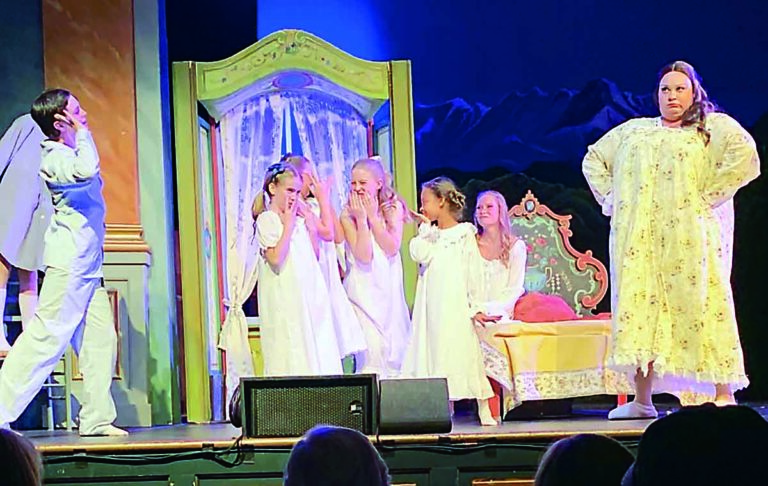
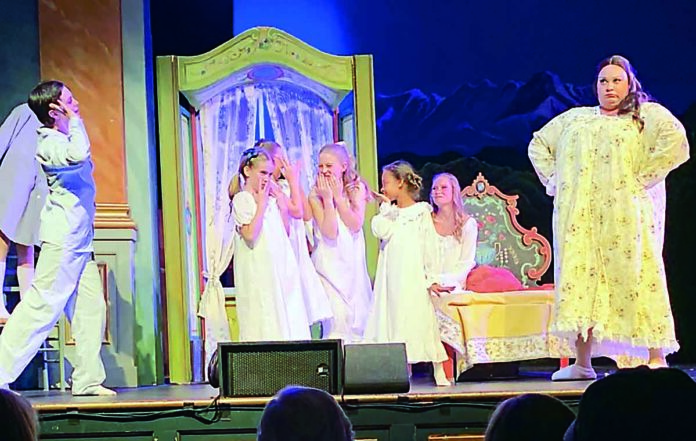
Mill Valley’s Throckmorton Theatre is alive with The Sound of Music. Their production of the Rodgers and Hammerstein classic runs through May 29.
The show stars Katrina Lauren McGraw in the role of Maria Rainer, a spirited postulant at an Austrian abbey who’s assigned to be the governess for a local baron’s seven rambunctious children. Things get complicated when the nun-to-be finds herself falling in love with Captain von Trapp (David Schiller). Further complications arise with the annexation of Austria by Nazi Germany.
The 1959 Tony-award winner for Best Musical has had a long life, including the blockbuster Oscar-winning 1965 film adaptation starring Julie Andrews as Maria. It’s a role in which McGraw never envisioned being cast, but that’s one of the great things about community theatre. There’s often a freedom to do things differently, whether necessitated by budget or a strong creative vision, that more commercial entities rarely enjoy.
Community theatre audiences are frequently more accepting of change (or forgiving of errors) because it’s their friends, neighbors and family members on stage. They know experience levels vary, performances will range from the refined to the hammy, lines will be bobbled, costumes will often be anachronistic and on-stage mishaps will occur. They know the singing will sometimes be great and sometimes not. They know they’re not attending a Broadway touring show.
As long as they get a reasonable facsimile of the show they’re coming to see and the songs they’re coming to hear, they’ll walk out of the theatre with smiles on their faces. Director Adam Maggio and his cast of 30 ensure that and more here.
McGraw clearly loves the role she’s playing, and that love is palpable, particularly in her relationship with the children. The children are, of course, adorable, with sprightly Juliet Bambuck-Vasquez frequently eliciting “awws” from the audience. Maisie McPeek impressed with some fine vocal and movement work as Liesl.
Fine vocal work was also displayed by David Schiller as the baron, Kimberly Marron as Baroness Schraeder and by the nuns of the abbey in several ensemble scenes. As the Mother Abbess, Désirée Goyette’s delivery of “Climb Every Mountain” was a high point—pun intended.
Musical director Justin Pyne’s solid nine-piece orchestra was placed behind the audience, which helped ensure every lyric could be heard.
The audience of friends and family leapt to their feet at the conclusion of the performance. I left smiling, too.
‘The Sound of Music’ runs through May 29 at the Throckmorton Theatre. 142 Throckmorton Ave., Mill Valley. Fri & Sat, 7:30pm; Sun, 2:30pm. $25-$45. Masking required. 415.383.9600. throckmortontheatre.org
Author offers a method for reconnecting to personal identity through writing
By Jane Vick
There’s a certain irony to writing about writer’s block. But those of us who put pen to paper, or fingertips to keys, for a living are no stranger to the affliction.
Searching for the right words to convey a story, a sensation, or to translate a demanding but...
Beatles’ Night
Relive the ’60s when the Beatles Guitar Project Rock Orchestra comes to the North Bay on Saturday, June 11, to play live in concert. The 40-piece professional rock orchestra with special guest vocalists will play two Beatles’ albums, Rubber Soul and Revolver, in their entirety, using a rhythm section, strings, woodwinds, brass, percussion and a choir. The performance...
ARIES (March 21-April 19): “The only way to the truth is through blasphemy,” declared Aries author Flannery O'Connor. I appreciate the cheeky sentiment, but I don't believe that all truth requires blasphemy. In many cases, rebellion, irreverence and skepticism may be enough to pry loose hidden and buried information. Outright blasphemy isn't necessary. What does this have to do...
Sequel to Ibsen drama in Novato
Norwegian playwright Henrik Ibsen’s A Doll's House premiered in 1879 to great controversy. His look at the limitations and restrictions placed on women in a patriarchal society was considered quite scandalous at the time. Many consider it to be the beginning of modern feminist literature, though Ibsen himself denied that. Suffice it to say...
The war in Ukraine is proving that the future of the human race looks very grim, unless the United States and Russia can end the ugly Cold War between us. This angry rivalry has divided much of the world into two enemy camps and has kept humankind on the brink of nuclear war for over 60 years.
Those who have...
As the weather warms up and our coastal forest is blanketed in that summer smell of redwoods, have I got an idea for you. Go west, young human, for an afternoon of cannabis consumption at one of the sweetest, most historically significant spots in the new world of cannabis.
We’re talking about Riverside Wellness Collective in Guerneville, one of the...
Music, fairs, fests and BBQ bonanzas
Ah, summer! Sunny days, languidly stretching into clement, starry evenings.
In Marin County, there is no shortage of fun to be had and food to be enjoyed in the coming months. The wine flows freely and the savory smell of BBQ is lifted on a warm breeze to perk the appetite. So don’t wait another...
Chief Marin, Leader, Rebel, and Legend by Betty Goerke traces how European settlers drove Indigenous peoples out of Marin County with guns, crosses and cows. Without irony, the colonizers named the territory after the Miwok rebel leader Marino.
The forests and wetlands of these coastal lands—tended since time immemorial by humans, elk, lions, birds, insects and plants—were transformed by the...
We live in interesting times. War is in the news, and it’s cause for concern. Twelve weeks into Russia’s invasion of Ukraine, cities lie in ruins, civilian deaths continue to mount and both sides are digging in for a prolonged ground conflict.
What can we do here, halfway around the world, to show support for the people of Ukraine during...
Mill Valley’s Throckmorton Theatre is alive with The Sound of Music. Their production of the Rodgers and Hammerstein classic runs through May 29.
The show stars Katrina Lauren McGraw in the role of Maria Rainer, a spirited postulant at an Austrian abbey who’s assigned to be the governess for a local baron’s seven rambunctious children. Things get complicated when the...