ARIES (March 21-April 19): One of your callings as an Aries is to take risks. You’re inclined to take more leaps of faith than other people, and you’re also more likely to navigate them to your advantage—or at least not get burned. A key reason for your success is your keen intuition about which gambles are relatively smart and which are ill-advised. But even when your chancy ventures bring you exciting new experiences, they may still run you afoul of conventional wisdom, peer pressure and the way things have always been done. Everything I have described here will be in maximum play for you in the coming weeks.
TAURUS (April 20-May 20): Your keynote comes from teacher Caroline Myss. She writes, “Becoming adept at the process of self-inquiry and symbolic insight is a vital spiritual task that leads to the growth of faith in oneself.” Encouraging you to grow your faith in yourself will be one of my prime intentions in the next 12 months. Let’s get started! How can you become more adept at self-inquiry and symbolic insight? One idea is to ask yourself a probing new question every Sunday morning, like “What teachings and healings do I most want to attract into my life during the next seven days?” Spend the subsequent week gathering experiences and revelations that will address that query. Another idea is to remember and study your dreams, since doing so is the number one way to develop symbolic insight. For help, I recommend the work of Gayle Delaney: tinyurl.com/InterviewYourDreams.
GEMINI (May 21-June 20): The TV science fiction show, Legends of Tomorrow, features a ragtag team of imperfect but effective superheroes. They travel through time trying to fix aberrations in the timelines caused by various villains. As they experiment and improvise, sometimes resorting to wildly daring gambits, their successes outnumber their stumbles and bumbles. And on occasion, even their apparent mistakes lead to good fortune that unfolds in unexpected ways. One member of the team, Nate, observes, “Sometimes we screw up—for the better.” I foresee you Geminis as having a similar modus operandi in the coming weeks.
CANCER (June 21-July 22): I like how Cancerian poet Stephen Dunn begins his poem, Before We Leave. He writes, “Just so it’s clear—no whining on the journey.” I am offering this greeting to you and me, my fellow Cancerians, as we launch the next chapter of our story. In the early stages, our efforts may feel like drudgery, and our progress could seem slow. But as long as we don’t complain excessively and don’t blame others for our own limitations, our labors will become easier and quite productive.
LEO (July 23-Aug. 22): Leo poet Kim Addonizio writes a lot about love and sex. In her book, Wild Nights, she says, “I’m thinking of dating trees next. We could just stand around all night together. I’d murmur, they’d rustle, the wind would, like, do its wind thing.” Now might be a favorable time for you, too, to experiment with evergreen romance and arborsexuality and trysts with your favorite plants. When was the last time you hugged an oak or kissed an elm? JUST KIDDING! The coming weeks will indeed be an excellent time to try creative innovations in your approach to intimacy and adoration. But I’d rather see your experiments in togetherness unfold with humans.
VIRGO (Aug. 23-Sept. 22): In her book, Daughters of the Stone, Virgo novelist Dahlma Llanos-Figueroa tells the tale of five generations of Afro-Cuban women, her ancestors. “These are the stories of a time lost to flesh and bone,” she writes, “a time that lives only in dreams and memories. Like a primeval wave, these stories have carried me, and deposited me on the morning of today. They are the stories of how I came to be who I am, where I am.” I’d love to see you explore your own history with as much passion and focus, Virgo. In my astrological opinion, it’s a favorable time for you to commune with the influences that have made you who you are.
LIBRA (Sept. 23-Oct. 22): In accordance with astrological omens, here’s my advice for you in the coming weeks: 1. Know what it takes to please everyone, even if you don’t always choose to please everyone. 2. Know how to be what everyone wants you to be and when they need you to be it, even if you only fulfill that wish when it has selfish value for you. 3. DO NOT give others all you have and thereby neglect to keep enough to give yourself. 4. When others are being closed-minded, help them develop more expansive finesse by sharing your own reasonable views. 5. Start thinking about how, in 2023, you will grow your roots as big and strong as your branches.
SCORPIO (Oct. 23-Nov. 21): Even if some people are nervous or intimidated around you, they may be drawn to you nonetheless. When that happens, you probably enjoy the power you feel. But I wonder what would happen if you made a conscious effort to cut back just a bit on the daunting vibes you emanate. I’m not saying they’re bad. I understand they serve as a protective measure, and I appreciate the fact that they may help you get the cooperation you want. As an experiment, though, I invite you to be more reassuring and welcoming to those who might be inclined to fear you. See if it alters their behavior in ways you enjoy and benefit from.
SAGITTARIUS (Nov. 22-Dec. 21): Sagittarian rapper and entrepreneur Jay-Z has stellar advice for his fellow Sagittarians to contemplate regularly: “Ain’t nothin’ wrong with the aim; just gotta change the target.” In offering Jay-Z’s advice, I don’t mean to suggest that you always need to change the target at which you’re aiming. On many occasions, it’s exactly right. But the act of checking in to evaluate whether it is or isn’t the right target will usually be valuable. And on occasion, you may realize that you should indeed aim at a different target.
CAPRICORN (Dec. 22-Jan. 19): You now have extra power to exorcize ghosts and demons that are still lingering from the old days and old ways. You are able to transform the way your history affects you. You have a sixth sense about how to graduate from lessons you have been studying for a long time. In honor of this joyfully tumultuous opportunity, draw inspiration from poet Charles Wright: “Knot by knot I untie myself from the past / And let it rise away from me like a balloon. / What a small thing it becomes. / What a bright tweak at the vanishing point, blue on blue.”
AQUARIUS (Jan. 20-Feb. 18): In accordance with current astrological rhythms, I am handing over your horoscope to essayist Anne Fadiman. She writes, “I have always felt that the action most worth watching is not at the center of things, but where edges meet. I like shorelines, weather fronts, international borders. There are interesting frictions and incongruities in these places, and often, if you stand at the point of tangency, you can see both sides better than if you were in the middle of either one.”
PISCES (Feb. 19-March 20): Over the course of my life, I have been fortunate to work with 13 psychotherapists. They have helped keep my mental health flourishing. One of them regularly reminded me that if I hoped to get what I wanted, I had to know precisely what I wanted. Once a year, she would give me a giant piece of thick paper and felt-tip markers. “Draw your personal vision of paradise,” she instructed me. “Outline the contours of the welcoming paradise that would make your life eminently delightful and worthwhile.” She would also ask me to finish the sentence that begins with these words: “I am mobilizing all the energy and ingenuity and connections I have at my disposal so as to accomplish the following goal.” In my astrological opinion, Pisces, now is a perfect time to do these two exercises yourself.
For good reasons, the spotlights of the media have been shining brightly on the fate of our electoral democracy, but it’s an error to gaze only where the light shines most brightly.
Important developments pertaining to our democracy, particularly to economic democracy, are unfolding in many places outside the spotlight. In a northeast corner of Los Angeles, not far from where I live, there’s a neighborhood called Atwater Village, and in that neighborhood an enterprise called the Proof Bakery does a thriving business.
Three years ago, its founder and owner, Na Young Ma, decided to relinquish ownership, but instead of selling the bakery to an outside owner, she took the more challenging, time-consuming path of initiating a transition to a worker-owned cooperative, inspired by the long-running, successful Cheese Board Collective and Arizmendi Bakeries in the Bay Area (Oakland, Berkeley, San Francisco, San Rafael, Emeryville).
Ms. Ma sought out advice from a non-profit consulting group called Project Equity, and after two years, she sold the bakery to her employees in August, 2021.
Since the bakery opened as a cooperative a little over a year ago, it now has 13 worker-owners and 12 employees.
Visiting the bakery recently, I spoke with one of the worker-owners, James Lee. He discussed the very different expectations that the new worker-owners brought to the fledgling enterprise, and about the efforts to get to know one another as they continued to work through those differences.
But he also spoke about the value of sharing not only the profits but also the stresses associated with running the co-op, stresses widely acknowledged as very high in the food and restaurant businesses. “We talk a lot about community, accountability,” he said. “The conversation is about people, about us.”
As we consider the aftermath of the midterms, and extend our gaze beyond the brightly-lit theater of political action, it may well be worthwhile to ask how rich a society we really are. And, perhaps, how real richness might someday emanate from an enterprise on the very next block in our neighborhood.
Andrew Moss is an emeritus professor at the California State Polytechnic University, Pomona.
It’s an October morning at Point Reyes National Seashore and I’m scooting under barbed wire fences, wary of sliding into cow pies.
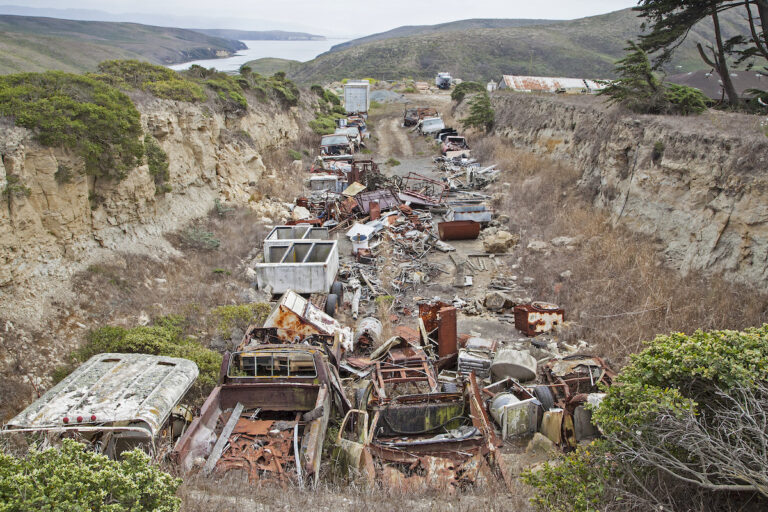
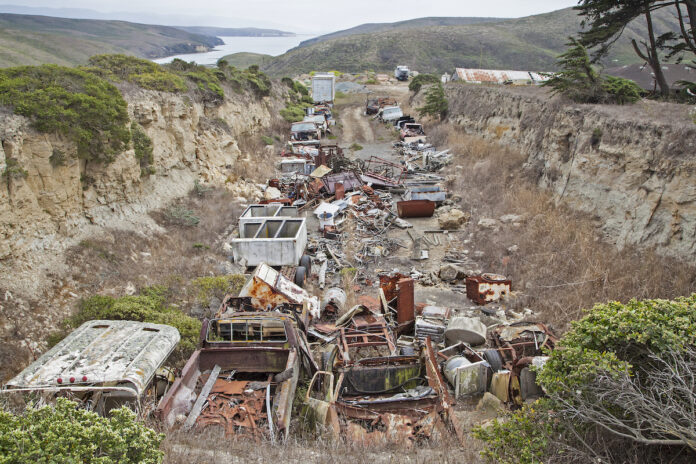
My guide on this safari is Jocelyn Knight, wildlife photographer. We’re stalking a toxic waste dump hidden from public view behind a hill at “Historic E Ranch, established circa 1859” land lorded by the National Park Service.
Park regulations require Seashore pastures to remain open to the public, but the dump is inside the E Ranch “core” of barns and dwellings, and the public is disallowed.
To avoid encounters with park rangers or others who might want to thwart our mission to photograph the dump, we crawl on hands and knees through a thorny thicket, around a pond polluted with old tires, empty barrels, oxygen-depleting algae.
Duckwalking up the hill toward the dump, dried out dirt clods seem to explode underfoot. We deploy hand signals, as there’s a large dog we’d rather not greet. It’s all a bit nerve wracking.
A year ago, August, Knight made this trek by herself, photographing a trench packed with broken car and truck bodies, oily engines, fuel containers. She emailed the evidence to Park Superintendent Craig Kenkel. He replied, “When leaseholders violate lease conditions, our approach, if possible, is to hold the leaseholder responsible for correcting the violation. Thus far, Mr. Nunes is doing so.” Kenkel cautioned Knight not to revisit the site without an invitation from the Nunes family, which leases and operates E Ranch.
But we intend to find out if the waste was removed. Rising to full height, Knight shoots the dump, snap, snap. Much of the waste is gone, but there are still dead machines, piles of tires, plastic barrels. Kenkel and the Department of Interior did not respond to inquiries about the toxic waste dump. Members of the Nunes family did not respond to requests for comment.
There’s another type of environmental disaster at E Ranch. According to a Marin County Environmental Health Services (EHS) investigation in June, “There was a very puddled (appeared to be sewage) area in the cow pasture adjacent to the [E Ranch] home. … It is clear that [the] present leach field is not accepting sewage from the tank properly.” According to EHS investigators, a septic tank was installed without the required permit; its sewage level exceeded the operational limit; they could not locate a leach field. The ranch land drains into the Pacific.
The Nuneses have farmed in Point Reyes for more than a century. In 1971, they sold E Ranch to the Park Service, leasing it back for cattle grazing; the family also runs a dairy at A Ranch adjacent to the Lighthouse. A third of the park is given over to cattle and dairy ranching by the lineal descendants of European farmers who settled Point Reyes in the mid 19th century.
Park histories portray these “multi-generational ranching families” as “stewards of the land,” and the ranches are listed on the Register of Historic Places. Since the 1970s, Parks has spent millions of dollars improving commercial ranching infrastructures at the “historic” ranches, even as cattle trample Indigenous archeological sites, and bovine and human wastes contaminate pastures, streams, estuaries, bays, wetlands and the ocean.
In February, motivated by a hiker’s discovery of raw sewage pooling in a pasture, Marin EHS began inspecting ranch septic systems, for the first time in modern memory. More than half of the 17 septic systems examined had serious leakages; seven were so far out of compliance with regulations that they require completely new installations. Simultaneously, the California Water Quality Control Board investigated environmental conditions at Seashore dairies, finding many instances of animal wastes leaking into coastal waters.
TIRES PILED A year after it was brought to park officials’attention, a trash heap remains at E Ranch in violation of a lease agreement. Photo by Jocelyn Knight
In a systemic failure of oversight, the local, state and federal agencies charged with protecting the environment of Point Reyes have allowed agricultural wastes to assault it. And this is not an isolated case. A 2022 study byEnvironmental Integrity Project determined that more than half the waters of the United States are polluted by agricultural sources due to the failures of environmental agencies to enforce the Clean Water Act of 1972.
But these agencies are being pressured to remove beef cattle and dairy ranching from Point Reyes by members of the public and national environmental organizations who are collectively sounding an alarm in the press and filing lawsuits to protect the park.
Manure meadow
In January, environmentalist organizationssued the National Park Service in federal court, alleging violations of the National Environmental Policy Act. Resource Renewal Institute, Western Watersheds Project and the Center for Biological Diversity are demanding that Parks protect the degraded ecology of Point Reyes by discontinuing cattle and dairy ranching.
The environmentalistsargue that ranching “violates the Point Reyes Act, which established the Point Reyes National Seashore in 1962 for the purposes of ‘public recreation, benefit and inspiration;’ the Organic Act, which requires the agency to leave natural resources ‘unimpaired’ for the benefit of future generations; and the Clean Water Act by allowing ranches to circumvent water quality standards.”
Opposing the environmentalists, the Park Service asks the court to expand the scope of allowable ranching activities, and to greenlight 20-year ranching leases to a score of family-owned businesses, renewable in perpetuity. The Department of Interior, led by Secretary Debra Haaland, intends to strengthen the grip of industrial ranching at the Seashore by constructing 20 road projects, 16 bridge-culverts, 59 miles of fencing, 25 ponds to hold liquified manure, pumps, pipelines, barns and worker housing.
These actions will block wildlife corridors and render already polluted lands and waters even more inhospitable for increasingly scarce predators, mammals, fish, rodents, native plants, frogs, butterflies and migrating birds, according to governmentstudies and expert critics of the ranching plan. Environmentalists are asking authorities to unburden the land, allowing it to naturally restore itself from centuries of agricultural pollution. The parties are in confidential settlement talks as we go to press.
Decades of scientific studies, including anEnvironmental Impact Statement published by the National Park Service in 2020, demonstrate that ranching in the Seashore is harming rare and endemic plants and animals and aquatic life, some to the point of extinction. Fecal bacteria, phosphorus, nitrates, ammonia and pathogens flush into Tomales Bay and the Pacific.
According to U.S. Department of Agriculture formulas, bovines deposit more than 130 million pounds of manure onto Point Reyes lands and into waterways every year. Adding to this ecological harm, unmaintained septic systems have long been leaking sewage into the watershed.
Last year, more than 100 environmental groups and thousands of individuals petitioned the California Coastal Commission to intervene. But, in September, it voted 6-5 to approve extending the leases, in return for Parks’ promise to reduce the negative impacts of animal waste if it can find the funds to do so. Opposed, commissioner Dayna Bochco remarked, “There isn’t a person who has the ability to think straight who thinks this [plan] is a good idea.” Marin County Supervisor Katie Rice voted to approve the plan, while Sara Aminzadeh (Marin) and Caryl Hart (Sonoma) voted no.
NOAA’s draft
The U.S. Department of Commerce’s National Oceanic and Atmospheric Administration (NOAA) is charged with protecting commerce inthe marine environment. In March 2021, NOAA’s Fisheries Service issued an inter-agencyBiological Opinion or BIOP assessing Parks’ plan to extend ranch leases and agricultural infrastructure at Point Reyes. Much, but not all of thelanguage and content of the BIOP was based on aBiological Assessment made by Parks.
Under the Endangered Species Act, Parks was allowed to grant its rancher-lessees the status of “co-applicants” when it asked NOAA to render its Biological Opinion, because ranchers’ proposed actions could be environmentally destructive. Environmental groups who proposed to restore the damaged environment were not granted this special advisory status.
Under the Freedom of Information Act, this news organization obtained internal communications on NOAA’s drafting of the BIOP, much of it redacted. According to its “consultation history,” NOAA officials met with ranchers in January, 2020 and again in August. In November, pursuant to this “co-applicant” status, NOAA sent selected draft sections of the BIOP to the Point Reyes Seashore Ranchers Association for review and suggested edits.
Members of the public and environmental organizations were not allowed to see, much less comment upon, these drafts, marked “confidential” and “not for public distribution.” NOAA spokesperson Michael Milstein said, “It is normal during consultations to share this so the parties understand what they are responsible for implementing.”
For months, NOAA officials “went back & forth on revisions” with Parks and the ranchers, generating more than 22 drafts. The NOAA staffer in charge of the BIOP wrote, “This project is SNAFU,” commonly defined as “a chaotic mess.”
In late December, the ranchers’ association officially requested revisions. “The draft BIOP omits … important context [that] minimize[s] the impact of cattle grazing on the fish and critical habitat.” The association asked for changes in scientific terminology, and asserted that since, in its opinion, building fences, roads and ponds “would benefit fish and habitat” construction activities should not be mentioned as harming fish.
On Jan. 29, 2021, NOAA “requested a 21-day extension … due to necessary revisions in response to rancher applicants.” Milstein said the agency “does not have anything describing the changes between drafts of the BIOP.” But a redacted Feb. 18, 2021 email between the officials in charge of the BIOP begins, “Revised after receiving info from the park today ….” Most of the next two pages areblacked out.
Asked to comment on the practice of allowing ranchers to review drafts and propose changes to the BIOP, whilst equally concerned parties, such as conservationists, were disallowed, Western Watersheds Project’s California director, Laura Cunningham, remarked, “This is shocking and totally disregards the public process and science.”
A fish tale
In its final Biological Opinion, NOAA focused on specific threats to salmon, while acknowledging the truism that cattle grazing “degrades water quality by increasing levels of contaminants such [as] fecal indicator bacteria.” NOAA noted that nutrient-laden manure supercharges the growth of noxious weeds and algae that can harm and kill many forms of aquatic life, including salmonids.
The BIOP recognizes that active ingredient pesticides used at Point Reyes “are likely to also adversely affect the food base for salmonids” and can “lead to altered development of embryos.” Herbicides, soil erosion and fecal wastes negatively impact the habitability of streams used by protected fish, NOAA found.
NOAA did not mention that, according to U.S. Environmental Protection Agency formulas, the park’s 5,000 cows annually belch more than a million pounds of methane, a greenhouse gas that heats oceans and harms protected species. It did acknowledge that building roads, expanding ranching facilities and “dewatering” streams would “impair water quality,” “adversely affect critical habitats” and exterminate about 3% of the park’s “endangered” and “threatened” salmon species. But because these commercial ventures would not make extinct the resident species of salmon, NOAA approved the plan.
Justifying this counter-intuitive decision, NOAA cited Parks’ promise to require its ranchers to “mitigate” ecological harm by finding millions of dollars to invest in “best management practices.” Historically, cattle and dairy ranching in Point Reyes have relied upon government subsidies to survive; neither Parks nor NOAA explained how ranchers will finance construction projects and the considerable expense of damage mitigation.
It turns out that Parks was already out of compliance with a similar agreement it made with NOAA in 2004. Fifteen years later, NOAA admonished Parks for failing to deliver required “annual summaries or 3-year detailed reports … summarizing in-stream suspended sediment fecal coliform, channel bed conditions, water temperatures, and riparian vegetation conditions.” NOAA’s Milstein said that Parks is now in compliance with those historical reporting requirements.
Echoing NOAA’s underlying concerns, the San Francisco Bay Regional Water Quality Control Board wrote to Parks in 2019 that its plan to extend ranching “could potentially increase discharges of sediment, pathogens, nutrients, and pesticides [and] sewage generation.” And in 2020, the U.S. Environmental Protection Agency complained Parks’ plan was not adequately assessing the future impacts of climate change, nor the “potential for discharge of pollutants into sensitive water bodies.” Parks did not change course.
Got milk?
California State Sen. Peter Behr was a founder of Point Reyes National Seashore. Behr told historian John Hart, “I don’t think we are going to see any significant change [in the park] unless the dairy industry goes broke. … They have the most powerful lobby of any industry in the country.” In Farming on the Edge,published in 1991,Hart reported that agencies charged with monitoring water quality in the park were missing in action, and that, “After rainstorms [shellfish] harvesting [in Tomales Bay] is stopped for fear of contamination from faulty septic tanks and … cow manure.”
U.S. Sen. Dianne Feinstein and North Coast Rep. Jared Huffman receive significant campaign donations from dairying and agribusiness. They wield influence over the budgets of Parks, NOAA and other environmental agencies. Both politicians strongly support expanding ranching at the Seashore. Other proponents include organizations run for and by ranching industries, the pro-businesseditorial board of Marin Independent Journal, Marin Conservation League and rancher-governed Marin Agricultural Land Trust.
Opposition to ranching at the Seashore includes more than 100 environmental groups, the Indigenous-led Coast Miwok Tribal Council and Alliance for Felix Cove, a retired National Park Service attorney, ecological biologists, rangeland experts, wildlife and water quality specialists, software engineers, nature and wildlife photographers, animal rights and vegan activists, conservationists, bird watchers and hikers. Since 2020, local, regional and national press has frequently reported the pro-wildlife message of hundreds of people who regularly engage in peaceful protests at the Seashore asking for an end to environmentally destructive ranching.
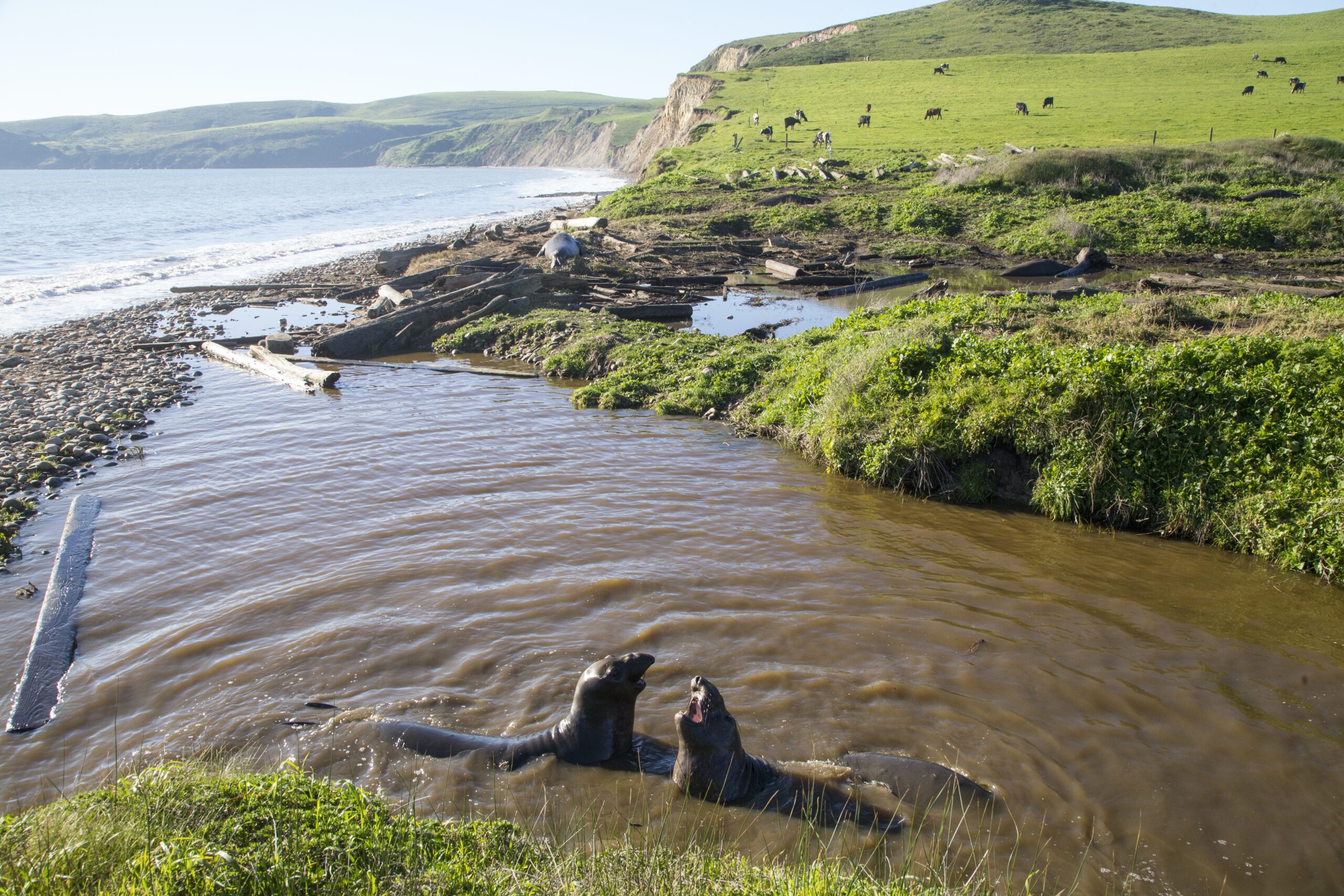
POLLUTED Elephant seals raise pups in a lagoon adjacent to B Ranch where, earlier this year, E. coli levels were measured at 11.5 times greater than the maximum exposure allowed. Photo by Jocelyn Knight
Got guns?
Western United Dairies is a trade organization that lobbies for extending ranch leases at the Seashore. On April 8, 2021, its Marin representative emailed executives at the Water Board complaining about press coverage of demonstrations at Point Reyes. Melissa Lema wrote, “For you and your staff contacts, dairies in the national seashore have been dealing with rampant, often unmitigated and sometimes violent protesters for months, with yet another demonstration planned this Saturday in the park.” Western United Dairies did not respond to a request for an example of the purported violence.
Portraying peaceful protestors as violent is a common public relations tactic, but there is a deeper level of potentially violent reactivity emerging in this developing situation, and it is not coming from conservationists and protestors. According to USASpending.gov, since 2019, Point Reyes park administrators have spent $54,000 buying guns and ammunition. In 2019, they purchased Sig Sauer and Luger pistols with silencers and some 30,000 bullets.
In 2022, administrators spent $12,612 on a “LessLethal Launcher” capable of firing “less lethal” bullets and tear gas, and $8,333 on “frangible” bullets, which fragment upon impact. The recent expenditures on weapons and bullets are more than 10 times amounts spent on weaponry in comparable years. Point Reyes staff did not respond to a query about why they are stocking up on lethal and less-lethal anti-personnel weapons.
Wastewater waivers
Laurie Taul is the Water Board official who oversees Point Reyes. According to records received via a public records request, on Jan. 12, 2021, Taul informed her boss, “On Monday, Albert Straus [owner of Straus Dairies which sources raw milk from Point Reyes] emailed me and [he] is concerned that Coastal Commission staff are asking for a water quality plan from the Park for the ranches and dairies. It sounds like he feels this is redundant because we [already] require the dairies and grazers to prepare plans and report annually.”
Those reports are self-reports, and the Water Board had not inspected a Point Reyes dairy since 2007, said its Bay Area manager, Xavier Fernandez.
A 2003 report by Taul observes that dairy runoff “may include manure waste, wastewater, milk barn wash, silage leachate, irrigation tailwater, dead animals, waste milk, medical waste, spoiled feed, bedding.” Dairy waste poses “a significant threat to both surface and groundwater quality, irrespective of herd size. Animal waste discharges … contribute pathogens, ammonia, salts, and sediment to nearby streams.”
For its part, the Water Board asks dairy ranchers to “visuallyinspect the closest water … to monitor any change in water quality resulting from facility operations.” Ranchers are required to self-certify “under penalty of law” that they have not seen any water quality problems.
However, an examination of annual reports from all five of the Point Reyes dairies operating throughout 2021 did not find a single instance of a ranch operator affirming, “Based on your visual inspections and observations during the past year, did you discover any threats to water quality or pollutant discharges to surface or groundwater?” When it started to use its own eyes, the Water Board discovered “high risk” threats to water quality at three dairies, and less serious issues at two dairies.
In an April 2021 memo, Taul acknowledged that fecal bacterial levels in Point Reyes waters were exceeding allowable standards. She relied on recent tests commissioned by Western Watersheds Project, because Parks had discontinued testing in 2013. Taul wrote that the Water Board has long depended upon Parks to inspect the ranches, but now, “We plan to inspect [the] ranches and dairies at our earliest opportunity.” That opportunity did not arrive until 10 months later, when a hiker stepped in a puddle of raw sewage in a pasture at B Ranch and complained to the Water Board, environmental groups and reporters.
MODERN DAIRY Straus Organic Family Creamery sources milk from B Ranch. Photo by Jocelyn Knight
Nightmare at B Ranch
B Ranch is leased and operated by Jarrod Mendoza as Double M Dairy. According to Water Board inspectors, “the [B Ranch] loafing barn is in poor condition and is currently unusable.”
Consequently, hundreds of dairy cows were housed in a field “adjacent to three wastewater ponds full of liquefying manure.” Pond and stormwater diversion systems were dysfunctional.
Mendoza did not have “a complete and updated Waste Management Plan,” nor required records documenting inspections. There was erosion on grazing pastures due to “too much animal traffic.” “There were no measures to prevent soil and manure from washing off [a livestock] crossing into the creek below.” According to the Board, “best management practices” were largely lacking. Ground water quality was testing below standards.
To help meet a state regulation that requires dairies to regularly test the quality of ground waters, the Water Board has outsourced that task to an industry group that, since 2019, has offered Point Reyes ranchers a non-laboratory-based testing service which cannot detect fecal bacteria. Water Board records reveal that the Sonoma Farm Bureau’s 2018 and 2021 field tests of a site near B Ranch found that levels of nitrogen, ammonia and other “measures all exceeded benchmarks. … indicating that the facility’s stormwater discharges are likely adversely impacting water quality.” But no action was taken until the raw sewage complaint was filed.
Concurrent with the Board’s first inspection of a Point Reyes dairy in 15 years, Marin EHS and Parks were motivated to inspect, for the first time, a septic system serving five houses and 19 bedrooms at B Ranch. The “system was non-functional. … Two pipes originating from the four residential dwelling units in the ranch core were observed to be discharging raw sewage into the cow pasture.” Under one residence, “staff identified a broken pipe … discharging sewage into the space beneath the house.” A septic tank appeared to be discharging sewage into a pasture. Inspectors could not locate a tank serving the farmworker’s restroom.
In sum, human bodily waste was sluicing into fields of bovine effluvia, blending into a fecal soup percolating downhill into a wetland bordering Drakes Bay, where a culvert spews stinky, brown sludge into a lagoon where elephant seals raise their newborns. This year, water quality tests in the lagoon measured E. coli levels at 11.5 times greater than the maximum exposure allowed. Mendoza did not respond to requests for comment.
Ranch leases require that ranchers pay for and maintain the septic systems. However, as the B Ranch disaster unfolded, Parks chose to pay for installing six porta-restrooms, new pipelines, a 5,000-gallon septic tank, and drafting “a conceptual design that can be used for compliance approval and planning purposes.” On Feb. 23, Parks noted, “We are currently purchasing supplies and material to connect the two septic lines that daylight into the pasture area.”
The sludge thickens
The Water Board went on to inspect the Seashore’s four other operating dairies, including the McClelland Dairy at L Ranch, which drains into the Tomales Bay and Abbotts Lagoon. Operated by Robert and Jolynn McClelland, the dairy sells to the Organic Valley brand. Inspectors noted that the dairy did not have a current Waste Management Plan for two manure ponds separated by a stream.
“The ponds are undersized. … the facility includes one unused and condemned barn … there were no Best Management Practices in place to prevent pollution discharge …. the calf corral likely discharges sediment and possibly manure into the adjacent pastureland. … the second waste pond [could] discharge into the downhill pastureland and drain toward the nearest stream.”
Marin EHS determined that the L Ranch septic system serving six houses was non-functional. The operators were told to pump and cap it and rebuild from scratch. In emails obtained from the county agency, Inspector Gwen Baert wrote, “It appears the Park Service doesn’t want to be heavy-handed, but I think we should be.” The McClellands did not respond to requests for comment, nor did Parks.
Marin EHS went on to examine 42 septic systems on 17 Park ranches leased to ranchers. Baert explained to colleagues, “Marin County did not have an agreement with the National Park Service to do routine sanitary surveys, it is quite possible that the inspections that were conducted this year represented the first time that many of the ranches and dairies had a sanitary review of the septic systems.”
Water protectors to the rescue
A National Park Servicestudy of Point Reyes in 2013 by Anitra Pawley and Mui Lay found “numerous ranches, dairies and pasture lands that contribute to water quality degradation through bacteria and nutrient loading from animal waste and runoff [and]failing septic system leach fields result in nutrient and pathogen loading. … Kehoe and Abbotts Lagoon periodically exhibit high bacterial counts affecting human uses including swimming and shellfish harvesting. … There is clear evidence of significant declines in some nearshore fish species.” Parks declined to comment on any of the facts and events presented in this story.
In 2021, tests sponsored by Western Watershed Project found unacceptable levels of pathogens at Point Reyes beaches. Last winter, Turtle Island Restoration Networks sponsored a more comprehensive testing regime.
As rosy dawn light splashed the parking lot at Abbotts Lagoon in January, about 30 people accepted labeled vials from geoenvironmental scientist Douglas Lovell. Once a week for two months, volunteers—ordinary folks trained in the rigorous protocols of water sampling techniques by Lovell—took water samples at 14 sites covering four watersheds in the park.
Slogging through brambles and muck and tangles of barbed wire outside the ranch cores, they captured 125 specimens to be analyzed in the Bay Area labs of McCampbell Analytical.
In late October, Lovell released his full report, with these highlights.
The level of fecal bacterial indicators in the waters draining from J and L ranch are so elevated, “it is likely that visitors to Kehoe Lagoon and Kehoe Beach have contracted gastrointestinal illness from exposure to cattle manure pathogens.”
“The National Park Service claim that conventional cattle manure management practices will adequately protect surface water quality is false … protection …. will require reduction of the active dairy herds.”
“A Ranch and B Ranch drainages are significantly impaired … bacteria concentrations were more than 10 times the [allowed measure].”
The overall cattle manure load in the sampled watersheds is sufficient to cause dangerous agal and cynobacterial bloom.
“The National Park Service has not warned park visitors of these risks despite full knowledge of the risks.”
These findings are not unexpected; Parks, the Water Board, NOAA, the EPA, Marin EHS and the Coastal Commission have known about the deleterious impacts of beef and dairy ranching for decades. The agencies have long acted as if they are charged with protecting ranching from the existential needs of wildlife, native plants, aquatic life and not the reverse.
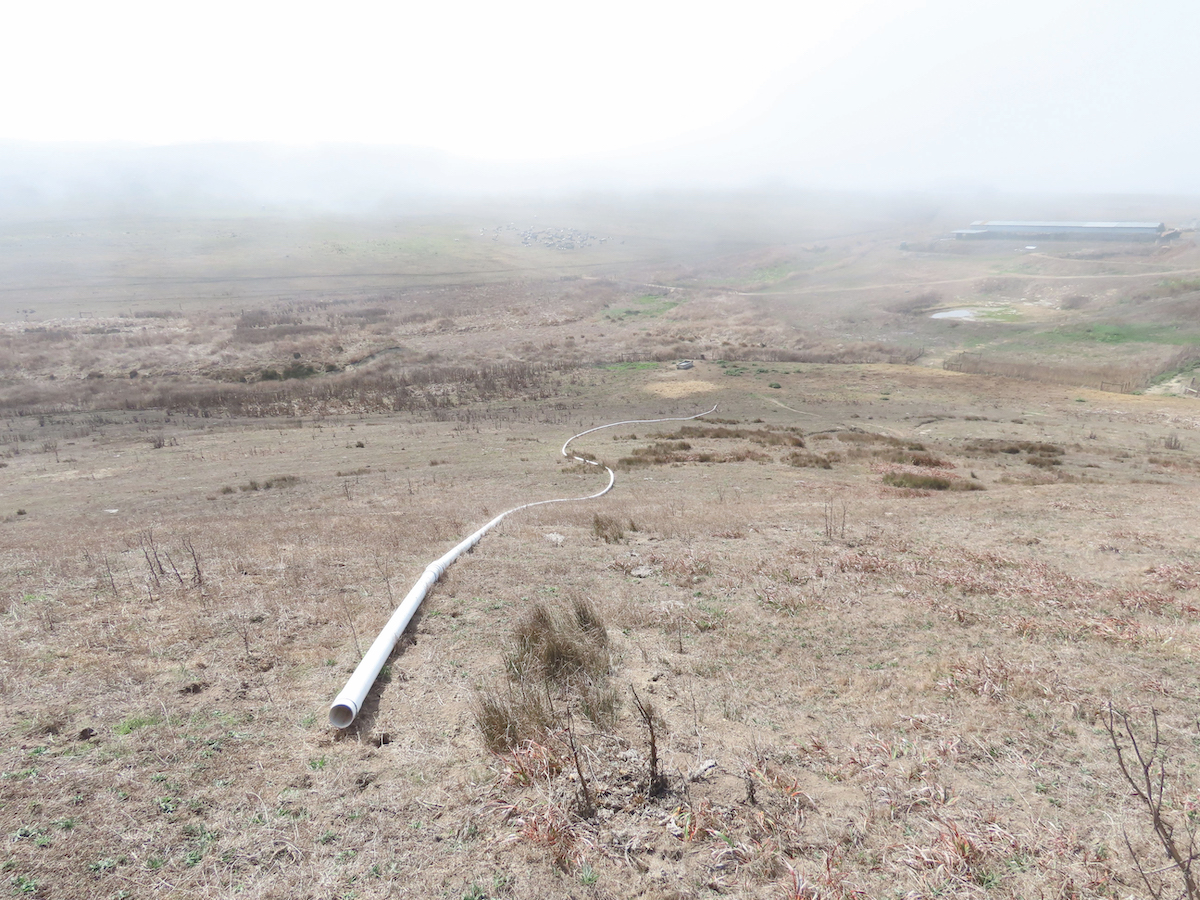
HOSED A pipe used to spread manure across B Ranch. Photo by Jocelyn Knight
A sad story
An environmentalhistory of Tomales Bay published by Parks in 2009 explained:
“Dairy farmers had typically sought properties with creeks that would provide water for their stock, but these same creeks carried animal wastes into the bay. When manure washed into the estuary, the high levels of ammonia in the waste poisoned fish and posed threats to human health. In rainy weather, sewage ponds overflowed, and waste material washed into the nearby waterways. The 10,254 dairy cows and beef cattle in the watershed produced 1,066,574 pounds of manure per day in 2000. Cattle also increased erosion as they trampled streambanks, causing [48,000 tons of] silt to wash into the bay [every year].”
At the millennium, Parks hydrologist Brannon J. Ketcham, reported:
“[Water testing] has revealed degraded water quality conditions below most of the dairy operations within the Seashore … identifying fecal coliform and toxic ammonia as primary indicators. … High pollutant levels … are attributed to direct access to water [by cows] or persistent sources (septic systems). … The waters of [the Seashore are] extremely diverse, valuable, and sensitive [and] dependent upon the water quality. … best management practices have not been established … streams within the pastoral zone … support endangered or threatened species.”
Ketcham complained that a lack of funding for testing had stymied a pressing need to “meet the detailed monitoring requirements … necessary on most watershed[s] within the pastoral zone. … A complete inventory of the water quality … has never been performed.”
Ketcham noted, “Dairy runoff … does affect water quality on Drakes Bay and offshore waters of northern Point Reyes. [Parks] is currently working with these ranches to improve dairy facilities and management to correct these problems.”
Parks, the Water Board and Marin Resource Conservation District have spent more than $10 million in the last decade on “bestmanagement practices” at the Seashore, primarily installing miles of barbed wire fencing to, in theory, keep cattle from defecating into ponds, streams, estuaries. In practice, many fences are broken due to lack of maintenance, and cattle freely wallow in waters throughout the park. Fencing makes public lands inaccessible to hikers, boaters, swimmers, fishers. It disrupts wildlife migration and cuts off their access to water.
Fence-confined bovines unload millions of pounds of concentrated fecal matter into pastures adjacent to ponds and streams. When the rains come, fences cannot stop bacteria from infiltrating the waters.
Science of fencing
Parks has responded to queries about water pollution by citing a2021 study on the Kehoe Creek and Abbotts Lagoon watersheds by Ketcham and Park ecologist Dylan Voeller, who oversees environmental monitoring at the dairies, and Benjamin Becker, a Parks employee.
They opinethat pollution levels may be waning due to “best management practices,” i.e., fencing, and spraying liquid manure on fields to lower the levels of overflowing manure ponds.
Inverness-based financial software architect Ken Bouley disagrees. In ananalysis submitted to a California Coastal Commission hearing in September, Bouley detailed his belief that the Voeller-Ketcham study is flawed by a “paucity of data and omitted explanatory variables.”
Meaning he assessed the authors did not examine enough data points to substantiate their opinions, and that they neglected to adequately consider statistical models that could contradict their conjecture that fencing lowers the rate at which fecal pathogens sluice into streams, and that, therefore, the best way to reduce cow-induced pollution is to build more fences. Bouley observed “that even after numerous, costly projects, water quality still exceeded regulatory thresholds between half and three-quarters of the time.”
He found an error in the study’s data sourcing that called into question its concluding opinions. Bouleybrought up the matter with Voeller, who agreed that there was an error, although he stood by his opinions. Neither Ketcham nor Voeller responded to requests for comment.
Parks also refers to a2019 study co-authored by Voeller and David Lewis, who directs the University of California Cooperative Extension, Marin and is a board officer of Marin Conservation League. Their paper opines that the installation of fencing had likely caused a “downward trend” in fecal bacterial counts over 19 years.
The study discounts stream samples taken after rainstorms that exhibited increasing trendsin levels of fecal bacteria. And the removal of 780 acres from cattle grazing during the study period was a one-time effect which may have lowered pollution levels temporarily but may not represent a trend. Voeller and Lewis admit, “It is often difficult to demonstrate, beyond a reasonable doubt, that grazing management practices result in quantifiable water quality improvements.”
It is not difficult to demonstrate that the UC Cooperative Extension is quantifiably funded by agribusiness. The Extension self-describes as “part of the agricultural community, we help farmers implement more efficient growing methods and solve pest management problems.” Public records show that the Extension has received tens of thousands of dollars in donations from chemical corporations that produce artificial pesticides and livestock feed additives. Major donors include Dow AgroSciences and Bayer Corporation (which owns Monsanto Company and its controversial Roundup pesticide). Lewis did not respond to requests for comment.
Sacred lands
Point Reyes embraces scores of ancient Indigenous sites destroyed by ranching and the indifference of the National Park Service. A 1998 Sonoma State University archeological study by Barbra Polansky observed a shell midden located on the trail that leads to Kehoe Beach:
“There is a recently constructed National Park Service bathroom facility on the South side of the trail, adjacent to traces of the midden.”
The Department of Interior dug a latrine on top of a sacred burial ground. It has similarly desecrated other sacred sites at the Seashore and throughout North America. But increasingly faced with governmental environmental malfeasance, people all over the world are starting to listen to the lessons of Indigenous science and the Land Back movement—the topic of an upcoming story on how and why the battle for Point Reyes is a contest for the future of life.
This investigation is supported by the Fund for Investigative Journalism and Reporters Committee for Freedom of the Press. Support journalism at www.peterbyrne.info.
The holidays are here, and no winter season is complete without a festive local production of the classic Nutcracker ballet.
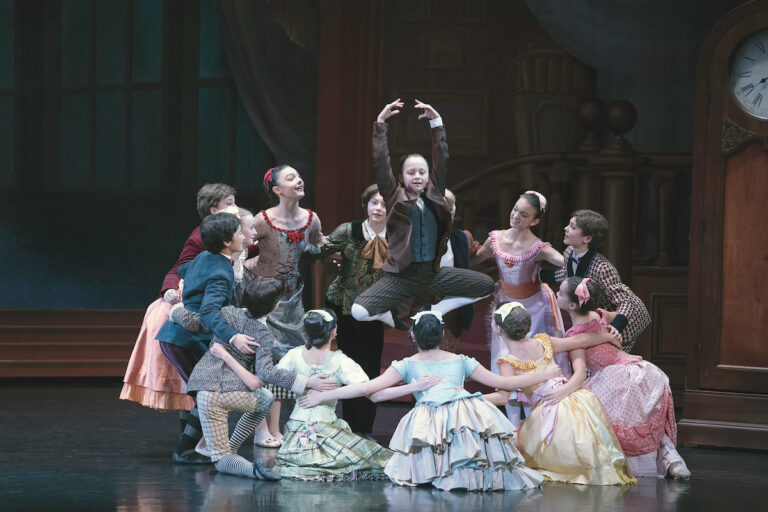
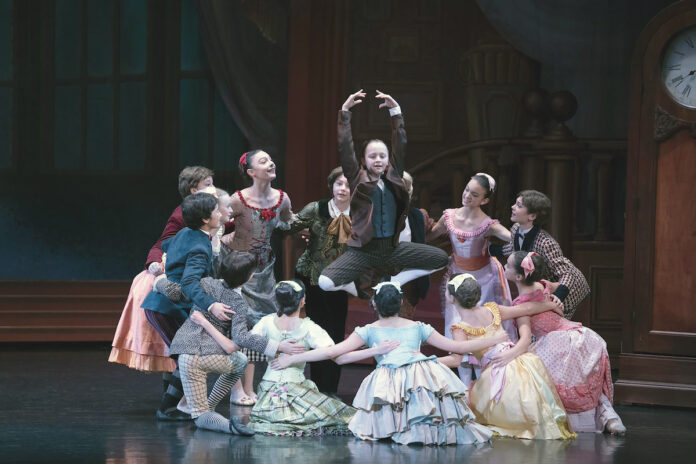
Here in Marin, where the arts are as valued as they are varied, Marin Ballet is ready to stun its audience (as it has for the past 60 years) with its annual performance of The Nutcracker.
This rendition of Nutcracker features 145 children, aged from second grade to seniors in high school, all taught by the esteemed and knowledgeable staff at Marin Ballet. Choreographer and retired professional ballet dancer Julia Adam continues to produce dances for talented local children and is excited to hit the stage once again with her version of Nutcracker.
“I’m a Canadian, and my mother was a ballerina as well,” said Adam. “I went to a ballet boarding school in Toronto and ended up defecting to America and joined the San Francisco ballet under the tutelage of Helgi Tomasson. I climbed the ladder and became a principal dancer, the highest rank, and I started making dances and felt very lucky.”
Adam went on to begin making works (i.e. choreography) for her school and was soon given the opportunity to do three works for the San Francisco Ballet, which launched her choreographic career. Only when she became pregnant, however, did she decide to retire from the main stage and wholeheartedly pursue choreography, leaving San Francisco behind in the process.
“When I saw a cute little apartment in San Anselmo, I fell in love with Marin,” said Adam. “Now I have some of the most interesting artist friends that live out here, and my husband and I raised our children here—it’s been an amazing community for me.”
Adam brings her extensive knowledge, experience and history in the ballet industry to the children of Marin County. She has been sharing her skills and talent for almost two decades.
“I have a long history with Marin Ballet and a wonderful team, and it’s a connection that grew organically over time,” said Adam. “I’m positioned in teaching the kids who are a little bit older, like for the part of Clara.
“A fun part of the production is when everything is taught and I come into the studio and watch them, give little ideas, sprinkle a little fairy dust on them—they’re so focused on the technicalities, and I like to remind them that you can’t forget that people have come to watch you tell a story. It’s a lot of moving pieces, and I couldn’t do it without the team. They’re working hard, and it’s so wonderful watching the kids work with their coaches and mentors.”
Adam’s production of Nutcracker is unique, as it takes into consideration the classic tale and form, but adds her own twist that incorporates a lot of humor and unexpected storytelling. She describes her production as being, “a little tongue in cheek and told brilliantly by remarkable children.”
In addition, the sets, costumes and lighting for Marin Ballet’s Nutcracker are all created by a brilliant professional team that makes for a very beautiful and grand visual experience. On top of a stunning and festive performance, attendees can expect lavish Victorian costumes and sets and an airborne surprise at the final curtain. Marin Ballet is presenting live piano entertainment during intermission, as well as a holiday boutique for Christmas shopping.
“I think things are changing in the ballet industry, and the ‘break them down to build them up’ method of teaching in ballet is becoming less popular,” explained Adam. “It’s still an intense discipline and takes a commitment. People are always surprised because Marin Ballet is a school and the dancers are children, but the telling of the Nutcracker story with children is more appropriate. There’s something about it that’s so charming when told with children performing. It’s a visual treat and quite special.”
The only adult performer, a professional ballet dancer whom Adam hires for the annual Nutcracker performance, plays the part of the Drosselmeyer. Apart from him, the remaining cast of this huge performance is composed entirely of local children who have often been a part of Marin Ballet throughout their childhoods. Adams asserts that they are excited to begin performing under normal circumstances, since COVID restrictions greatly impacted the dancers’ ability to perform their annual rendition of Nutcracker.
“The first year of COVID, we obviously couldn’t go into the theater,” explained Adam. “So, I choreographed this sort of strange Nutcracker performance, where it was all done on Zoom. We built a little stage in the parking lot of the Marin Ballet, and the dancers performed outside, still masked. It was all live, and it was wonderful and terrible at the same time. Last year, we were in the theater, but everyone was masked, which was intense in its own way. This year, it’s looking like we’re going to be able to do it like we always used to. It was hard, especially for these kids who come to Marin Ballet to move and bond with their peers.”
Marin Ballet was founded in 1963 as the Marin Civic Ballet Association by dance educator Leona Norman and a group of volunteers led by Max and Phyllis Thelen. Accredited by the National Association of Schools of Dance, the organization is celebrating its 60th anniversary in 2023. Currently, Marin Ballet provides free dance instruction to local public school students, reaching more than 450 students in the 2021-22 academic year.
“I’ve danced every part you can imagine in the Nutcracker, from the Gingerbread Cookie to the Sugar Plum Fairy,” concluded Adam. “By the time I retired, I was exhausted from doing The Nutcracker. But then I was asked to do my own version for Marin Ballet, and it holds a very special place in my heart. Ballet is like magic; it’s telling a story with the body. I love that I get to meet all these kids and watch them grow through the production. It’s almost heartbreaking to see them start as sweet little fairies, and then they’re Clara, asking for a college letter of recommendation.”
The Marin Ballet ‘Nutcracker’ is located at Marin Veterans’ Memorial Auditorium, 10 Avenue of the Flags, San Rafael. Performances will be held at 1 and 5pm Dec. 10, and 1pm Dec. 11. Tickets are $28 to $47 and are available at tickets.marincenter.org. For more information, visit www.marinballet.org/performances.
ARIES (March 21-April 19): Virginia Woolf wrote a passage that I suspect will apply to you in the coming weeks. Woolf said, “There is no denying the wild horse in us. To gallop intemperately; fall on the sand tired out; to feel the earth spin; to have—positively—a rush of friendship for stones and grasses—there is no getting over the fact that this desire seizes us.” Here’s my question for you, Aries: How will you harness your wild horse energy? I’m hoping that the self-possessed human in you will take command of the horse and direct it to serve you and yours with constructive actions. It’s fine to indulge in some intemperate galloping, too. But I’ll be rooting for a lot of temperate and disciplined galloping.
TAURUS (April 20-May 20): “The failure of love might account for most of the suffering in the world,” writes poet Marie Howe. I agree with that statement. Many of us have had painful episodes revolving around people who no longer love us and people whose lack of love for us makes us feel hurt. That’s the bad news, Taurus. The good news is that you now have more power than usual to heal the failures of love you have endured in the past. You also have an expanded capacity to heal others who have suffered from the failures of love. I hope you will be generous in your ministrations!
GEMINI (May 21-June 20): Many Geminis tell me they are often partly awake as they sleep. In their dreams, they might work overtime trying to solve waking-life problems. Or they may lie in bed in the dark contemplating intricate ideas that fascinate them, or perhaps ruminating on the plot developments unfolding in a book they’ve been reading or a TV show on which they’ve been binging. If you are prone to such behavior, I will ask you to minimize it for a while. In my view, you need to relax your mind extra deeply and allow it to play luxuriously with non-utilitarian fantasies and dreams. You have a sacred duty to yourself to explore mysterious and stirring feelings that bypass rational thought.
CANCER (June 21-July 22): Here are my two key messages for you. 1. Remember where you hide important stuff. 2. Remember that you have indeed hidden some important stuff. Got that? Please note that I am not questioning your urge to lock away a secret or two. I am not criticizing you for wanting to store a treasure that you are not yet ready to use or reveal. It’s completely understandable if you want to keep a part of your inner world off-limits to certain people for the time being. But as you engage in any or all of these actions, make sure you don’t lose touch with your valuables. And don’t forget why you are stashing them.
LEO (July 23-Aug. 22): I know I don’t have to give you lessons in expressing your sensuality. Nor do you need prods and encouragement to do so. As a Leo, you most likely have abundant talent in the epicurean arts. But as you prepare to glide into the lush and lusty heart of the Sensuality Season, it can’t hurt to offer you a pep talk from your fellow Leo bon vivant, James Baldwin. He said: “To be sensual is to respect and rejoice in the force of life, of life itself, and to be present in all that one does, from the effort of loving to the breaking of bread.”
VIRGO (Aug. 23-Sept. 22): Many Virgos are on a lifelong quest to cultivate a knack described by Sigmund Freud: “In the small matters, trust the mind. In the large ones, the heart.” And I suspect you are now at a pivotal point in your efforts to master that wisdom. Important decisions are looming in regards to both small and large matters. I believe you will do the right things as long as you empower your mind to do what it does best and your heart to do what it does best.
LIBRA (Sept. 23-Oct. 22): Social media like Facebook and Twitter feed on our outrage. Their algorithms are designed to stir up our disgust and indignation. I confess that I get semi-caught in their trap. I am sometimes seduced by the temptation to feel lots of umbrage and wrath, even though those feelings comprise a small minority of my total emotional range. As an antidote, I proactively seek experiences that rouse my wonder and sublimity and holiness. In the next two weeks, Libra, I invite you to cultivate a focus like mine. It’s high time for a phase of minimal anger and loathing—and maximum reverence and awe.
SCORPIO (Oct. 23-Nov. 21): Scorpio author Sylvia Plath had a disturbing, melodramatic relationship with romance. In one of her short stories, for example, she has a woman character say, “His love is the twenty-story leap, the rope at the throat, the knife at the heart.” I urge you to avoid contact with people who think and feel like that—as glamorous as they might seem. In my view, your romantic destiny in the coming months can and should be uplifting, exciting in healthy ways and conducive to your well-being. There’s no need to link yourself with shadowy renegades when there will be plenty of radiant helpers available.
SAGITTARIUS (Nov. 22-Dec. 21): I like Sagittarian healer and author Caroline Myss because she’s both spiritual and practical, compassionate and fierce. Here’s a passage from her work that I think will be helpful for you in the coming weeks: “Get bored with your past. It’s over! Forgive yourself for what you think you did or didn’t do, and focus on what you will do, starting now.” To ensure you make the most of her counsel, I’ll add a further insight from author Augusten Burroughs: “You cannot be a prisoner of your past against your will—because you can only live in the past inside your mind.”
CAPRICORN (Dec. 22-Jan. 19): How would you respond if you learned that the $55 t-shirt you’re wearing was made by a Haitian kid who earned 10 cents for her work? Would you stop wearing the shirt? Donate it to a thrift store? Send money to the United Nations agency UNICEF, which works to protect Haitian child laborers? I recommend the latter option. I also suggest you use this as a prompt to engage in leisurely meditations on what you might do to reduce the world’s suffering. It’s an excellent time to stretch your imagination to understand how your personal life is interwoven with the lives of countless others, many of whom you don’t even know. And I hope you will think about how to offer extra healings and blessings not just to your allies, but also to strangers. What’s in it for you? Would this bring any selfish benefits your way? You may be amazed at how it leads you to interesting connections that expand your world.
AQUARIUS (Jan. 20-Feb. 18): Aquarian philosopher Alfred North Whitehead wrote, “The silly question is the first intimation of some totally new development.” He also said, “Every really new idea looks crazy at first.” With these thoughts in mind, Aquarius, I will tell you that you are now in the Season of the Silly Question. I invite you to enjoy dreaming up such queries. And as you indulge in that fertile pleasure, include another: Celebrate the Season of Crazy Ideas.
PISCES (Feb. 19-March 20): We all love to follow stories: the stories we live, the stories that unfold for people we know, and the stories told in movies, TV shows and books. A disproportionately high percentage of the entertainment industry’s stories are sad or tormented or horrendously painful. They influence us to think such stories are the norm. They tend to darken our view of life. While I would never try to coax you to avoid all those stories, Pisces, I will encourage you to question whether maybe it’s wise to limit how many you absorb. The coming weeks will be an excellent time to explore this possibility. Be willing to say, “These sad, tormented, painful stories are not ones I want to invite into my imagination.” Try this experiment: For the next three weeks, seek out mostly uplifting tales.
Join the Santa Rosa Junior College for the culmination of their Fall 2022 Arts & Lecture series, featuring a conversation with Ada Limón,the 24th and current United States poet laureate. A Sonoma-county native, Limón is the author of six books of poetry, including The Carrying, which won the National Book Critics Circle Award in 2018, and Bright Dead Things, which was a finalist for the same prize. She teaches at Queens University of Charlotte and hosts the critically-acclaimed and poetry-devoted podcast, The Slowdown. Librarian of Congress Carla Hayden describes Limòn as “a poet who connects. Her accessible, engaging poems ground us in where we are and who we share our world with. They speak of intimate truths, of the beauty and heartbreak that is living, in ways that help us move forward.” Limón will speak Tuesday, Nov. 22 at the Santa Rosa Junior College Luther Burbank Auditorium, 1501 Mendocino Ave. 12pm. Free. www.santarosa.edu
Santa Rosa
Anita Lofton and Easy Queen
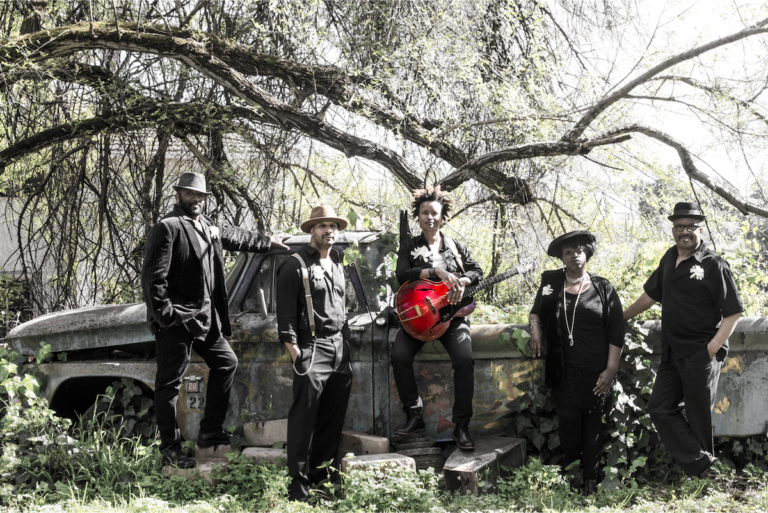
Spend an evening at Santa Rosa’s Lost Church with artists Anita Lofton and Easy Queen.Punk in origin, Lofton is transitioning to a more complex, developed sound, dubbed The Anita Lofton Project. Lofton is a singer/songwriter who played as part of the punk trio Sistas In The Pit, touring China and Europe and appearing in a U.S. tour with Iggy Pop and the Stooges during their reunion. Easy Queen is an Oakland-based trio that has built a following in the Bay Area celebrating the power of diversity, queer community and creativity. Their music is inspired by such bands as Sonic Youth, Neil Young, Jeff Buckley and Van Halen. Come check out this musical medley Friday, Nov. 18 at Lost Church Santa Rosa, 427 Mendocino Ave. Doors 7:30pm, show 8:15-10:30pm, with intermission. Tickets $15. www.thelostchurch.org
Novato
Pat Campbell Memorial Show
HopMonk Novato is hosting a show celebrating the long career of bluegrass bassist Pat Campbell. The afternoon will include an expansive appreciation of his career—Campbell was considered a bluegrass stalwart, and played with a pantheon of musical bigtimes, including Jerry Garcia, Michael Bloomfield, Ramblin’ Jack Elliott and Big Joe Turner. Music from David Nelson, Nick Gravenites, Mark Karan, David Getz, Craig Caffall, Bill Cutler, Joe New, Randy Rood, Diane Vitalich, David Freiberg, Linda Imperial, Kurt Huget, Dan Healy and more. Additional music will be provided by the Stockton Gang & Bluegrass/Acoustic Boys. The house band will be composed of Peter Harris, Steve Valverde, Dore Coller, Willow Van Den Hoeck, Robin Zickel, Marcus David and Steve Shufton. Chuck Poling will MC the event. The Pat Campbell Memorial Show will be Sunday, Dec. 4 at HopMonk Tavern, 224 Vintage Way, Novato. 2-6pm. Tickets $20 in advance, $25 at the door. www.hopmonk.com/novato
San Rafael
Cedars Holiday Craft Fair
It’s time again for the Cedars Holiday Craft Fair!For more than 100 years, Cedars has supported adults with developmental disabilities, helping them live dignified and joy-filled lives. The craft fair features one-of-a-kind artisan goods lovingly handcrafted by the Cedars residents and program participants. When buying a Cedars artist piece, 50% of the sales go to supporting the independent life of the artist who made it. There will be such gift options as handwoven textile napkins, placemats and table runners; homemade jams, marmalades and hot sauces; artisan soaps; and much more. This is a place to buy all the holiday gifts this year, and feel extra good about doing it. The Cedars Holiday Craft Fair is Wednesday, Nov. 16 and Thursday, Nov. 17 at 2500 Fifth Ave., San Rafael. 11am-2pm. Free. www.cedarslife.org
Our Sonoma County Library (SCL) is my go-to for entertainment, edification, upliftment: international films for armchair travel, favorite TV shows to revisit, books spurring spiritual growth.
And in the wake of culture war assaults on school curriculums—laws suppressing race, sex and gender education—I’ve been reminded that libraries are vital to democracy, real free speech and community-building.
Recently, after helping me locate The Good Wife: Season 5, my branch librarian pointed to a display table. “What do you think of our banned books—free to take home?” she asked.
Taking a closer look, I registered with appreciation the effort to champion educational and expressive freedoms, and social justice. Afterward, in the foyer area, I discovered the American Library Association’s Library Bill of Rights (LBOR) leaflet. Moved, impressed, heartened, I went back to thank the librarian.
“Come with me,” she counseled, offering me SCL’s Statement of Inclusivity (SOI) flyer. “Black Lives Matter,” she pronounced, “and there’s more,” showing me their free, kid-friendly ed booklet, “Pride Flags and Pronouns.”
I’m proud to live where we value and advocate for these kinds of freedoms. And I’m so grateful for courageous librarians nationwide, standing up and speaking out in today’s scary, adversarial climate. Many have resigned because of ugly threats from far right opposers, from fear of retaliations, in concern for their families’ safety.
I agree with my librarian that “books are meant to be read.” That ideas are meant to be shared and discussed and argued with respect and civility. View the LBOR, adopted in 1948: www.loc.gov/resource/rbpe.1000660d/#viewer-image-wrapper. Appreciate that our Sonoma County Library “values diversity, empowerment, community, unity, kindness, connection and equity, servicing all races, genders, sexual orientations, religions, abilities, ages, national or ethnic origins, all languages, citizenship statuses, economic statuses, political affiliations.”
May we as a nation come to realize these aspirations, and come to know our history—all of it.
In concert with the ALA, I envision that one day, with open minds and hearts, we’ll embrace our differences and celebrate our common humanity.
Get inspired at your local branch. And take home a great weekend movie, too.
Marcia Singer’s Love Arts Foundational programs fund well-being through mindful, heart-centered practices. lovearts.info.
ARIES (March 21-April 19): When you Aries people are at your best, you are driven by impeccable integrity as you translate high ideals into practical action. You push on with tireless force to get what you want, and what you want is often good for others, too. You have a strong sense of what it means to be vividly alive, and you stimulate a similar awareness in the people whose lives you touch. Are you always at your best? Of course not. No one is. But according to my analysis of upcoming astrological omens, you now have extra potential to live up to the elevated standards I described. I hope you will take full advantage.
TAURUS (April 20-May 20): In my experience, you Tauruses often have more help available than you realize. You underestimate your power to call on support, and as a result, don’t call on it enough. It may even be the case that the possible help gets weary of waiting for you to summon it, and basically goes into hiding or fades away. But let’s say that you, the lucky person reading this horoscope, get inspired by my words. Maybe you will respond by becoming more forceful about recognizing and claiming your potential blessings. I hope so! In my astrological opinion, now is a favorable time for you to go in quest of all the help you could possibly want. (PS: Where might the help come from? Sources you don’t expect, perhaps, but also familiar influences that expand beyond their previous dispensations.)
GEMINI (May 21-June 20): Sometimes, life compels us to change. It brings us some shock that forces us to adjust. On other occasions, life doesn’t pressure us to make any shifts, but we nevertheless feel drawn to initiating a change. My guess is that you are now experiencing the latter. There’s no acute discomfort pushing you to revise your rhythm. You could probably continue with the status quo for a while. And yet, you may sense a growing curiosity about how your life could be different. The possibility of instigating a transformation intrigues you. I suggest you trust this intuition. If you do, the coming weeks will bring you greater clarity about how to proceed.
CANCER (June 21-July 22): “We suffer more often in imagination than in reality,” wrote ancient Roman philosopher Seneca. That’s certainly true about me. If all the terrible things I have worried about had actually come to pass, I would be unable to function. Luckily, most of my fears have remained mere fantasies. What about you, fellow Cancerian? The good news is that in the coming months, we Crabs will have unprecedented power to tamp down and dissipate the phantasms that rouse anxiety and alarm. I predict that as a result, we will suffer less from imaginary problems than we ever have before. How’s that for a spectacular prophecy?
LEO (July 23-Aug. 22): Poet Matt Michael writes, “Sure, the way trees talk is poetry. The shape of the moon is poetry. But a hot dog is also poetry. LeBron James’ tomahawk dunk over Kevin Garnett in the 2008 NBA Playoffs is poetry. That pothole I always fail to miss on Parkman Road is poetry, too.” In accordance with current astrological omens, Leo. I’d love for you to adopt Michael’s approach. The coming days will be a favorable time to expand your ideas about what’s lyrical, beautiful, holy and meaningful. Be alert for a stream of omens that will offer you help and inspiration. The world has subtle miracles to show you.
VIRGO (Aug. 23-Sept. 22): Virgo author Michael Ondaatje was born in Sri Lanka, but as a child moved to England and later to Canada. His novel, Running in the Family, describes his experiences upon returning to his native Sri Lanka as an adult. Among the most delightful: the deluge of novel sensory sensations. On some days, he would spend hours simply smelling things. In accordance with current astrological omens, I recommend you treat yourself to comparable experiences, Virgo. Maybe you could devote an hour today to mindfully inhaling various aromas. Tomorrow, meditate on the touch of lush textures. On the next day, bathe yourself in sounds that fill you with rich and interesting feelings. By feeding your senses like this, you will give yourself an extra deep blessing that will literally boost your intelligence.
LIBRA (Sept. 23-Oct. 22): You evolved Libras understand what’s fair and just. That’s one of your potencies, and it provides a fine service for you and your allies. You use it to glean objective truths that are often more valuable than everyone’s subjective opinions. You can be a stirring mediator as you deploy your knack for impartiality and evenhandedness. I hope these talents of yours will be in vivid action during the coming weeks. We non-Libras need extra-strong doses of this stuff.
SCORPIO (Oct. 23-Nov. 21): Here are tips on how to get the most out of the next three weeks: 1. Be a master of simmering, ruminating, marinating, steeping, fermenting and effervescing. 2. Summon intense streams of self-forgiveness for any past event that still haunts you. 3. Tap into your forbidden thoughts so they might heal you. Discover what you’re hiding from yourself so it can guide you. Ask yourself prying questions. 4. Make sure your zeal always synergizes your allies’ energy, and never steals it. 5. Regularly empty your metaphorical trash so you always have enough room inside you to gleefully breathe the sweet air and exult in the Earth’s beauty.
SAGITTARIUS (Nov. 22-Dec. 21): “I straddle reality and the imagination,” says Sagittarian singer-songwriter Tom Waits. “My reality needs imagination like a bulb needs a socket. My imagination needs reality like a blind man needs a cane.” I think that’s great counsel for you to emphasize in the coming weeks. Your reality needs a big influx of energy from your imagination, and your imagination needs to be extra well-grounded in reality. Call on both influences with maximum intensity!
CAPRICORN (Dec. 22-Jan. 19): Sometimes, Capricorn, you appear to be so calm, secure and capable that people get a bit awed, even worshipful. They may even get caught up in trying to please you. Is that a bad thing? Not necessarily—as long as you don’t exploit and manipulate those people. It might even be a good thing in the coming weeks, since you and your gang have a chance to accomplish big improvements in your shared resources and environment. It would take an extra push from everyone, though. I suspect you’re the leader who’s best able to incite and orchestrate the extra effort.
AQUARIUS (Jan. 20-Feb. 18): If you have been posing as a normal person for too long, I hope you will create fresh outlets for your true weird self in the weeks ahead. What might that entail? I’ll throw out a couple of ideas. You could welcome back your imaginary friends and give them new names like Raw Goodness and Spiral Trickster. You might wear fake vampire teeth during a committee meeting or pray to the Flying Spaghetti Monster to send you paranormal adventures. What other ideas can you imagine about how to have way too much fun as you draw more intensely on your core eccentricities?
PISCES (Feb. 19-March 20): I suspect you will have metaphorical resemblances to a duck in the coming weeks: an amazingly adaptable creature equally at home on land, in the water and in the air. You will feel comfortable anywhere you choose to wander. And I’m guessing you will want to wander farther and wider than you usually do. Here’s another quality that you and ducks will share: You’ll feel perfectly yourself, relaxed and confident, no matter what the weather is. Whether it’s cloudy or shiny, rainy or misty, mild or frigid, you will not only be unflappable—you will thrive on the variety. Like a duck, Pisces, you may not attract a lot of attention. But I bet you will enjoy the hell out of your life exactly as it is.
The roots of racism run deep in the American housing market. Playwright Lorraine Hansberry addressed it in 1959 with A Raisin in the Sun, the first play written by an African-American woman performed on Broadway and the first to have an African-American director.
Playwright Bruce Norris took Hansberry’s story and in 2010 wrote a “spinoff” of sorts with Clybourne Park. Healdsburg’s Raven Players has a production running through Nov. 20.
Hansberry’s original told the story of the Youngers, an African-American family looking to improve their lot in life. The purchase of a home in an all-white neighborhood is the catalyst for family drama and neighborhood strife.
Norris continues the story from the perspective of the white family selling their home to the Youngers, and then jumps 50 years into the future when the neighborhood that once struggled with integration now struggles with gentrification.
Russ (Craig Peoples) and Bev (Elizabeth Henry) are packing up their home when their clergyperson, Jim (Matt Farrell); neighbor, Karl (Christopher Johnston); and Karl’s hearing-impaired wife, Betsy (Kate Edery), arrive. Karl has discovered the house is to be sold to a Black family and wants Russ to back out of the deal. As the argument over what’s “best” for everyone escalates, Russ and Bev’s maid, Francine (Jeanette Seisdedos), and her husband, Albert (Nicholas Augusta), are dragged into the fray.
The cast returns for the second act as different characters and modern-day residents of Clybourne Park. It has been a Black neighborhood for years, and now a white couple is looking to move in.
Director Steven David Martin and his cast tell the tale well. The cast does a good job of playing multiple roles in different eras. Particularly strong moments come from Peoples and Henry in the first act, while the entire ensemble shines in the second.
The first act lacks a clear sense of period that stronger costuming and prop choices might have supported. The second act is more potent as it turns darkly and uncomfortably comedic.
The live performance is preceded by a screening of the documentary, Segregated by Design, an exploration of how laws and policies fostered segregation. Don’t believe it? Check the deed to your home.
‘Clybourne Park’ runs through Nov 20 at the Raven Performing Arts Theater, 115 North St., Healdsburg. Thursday–Saturday, 7:30pm; Sunday, 2pm. $10–$25. raventheater.org
Join Petaluma Arts Center (PAC) for their annual Members Exhibition.A tradition since 2008, each year the PAC proudly showcases the work of their many local artist and maker members, realizing their central mission of building community through the arts. This year’s exhibition is curated by Jennifer Bethke and Vicky Kumpfer, and features a wide variety of media, from painting to sculpture to ceramics and beyond. Each work is an invitation to explore the artist’s approach to art making and artistic vision. Come marvel at the talent and creative passion the Petaluma community holds, and perhaps discover a newfound inspiration to create art. The Petaluma Members Exhibition runs Nov. 17-Dec. 17 at the Petaluma Arts Center, 230 Lakeville St. Opening reception Nov. 17. 5:30-7:30pm. Free. www.petalumaartscenter.org
Ross ‘Gypsy: A Musical Fable’
Familiar with the famous burlesque singer Gypsy Rose Lee? This is a great chance to get acquainted! Join the community of Ross at the Barn Theater for Gypsy: A Musical Fable,with music by Jule Styne, lyrics by Stephen Sondheim and book by Arthur Laurents. The musical is loosely based on Lee’s 1957 memoirs, and focuses on her mother, Rose, who is known familiarly as “the ultimate show business mother.” Following the dreams and efforts of Rose Lee to raise two daughters in show biz, the show shines an affectionate eye on the gritty demands of a life in the performance world. The musical contains many songs that became popular standards, including “Everything’s Coming Up Roses,” “Together (Wherever We Go),” “Small World,” “You Gotta Get a Gimmick,” “Let Me Entertain You,” “All I Need Is the Girl” and “Rose’s Turn.” Gypsy: A Musical Fable plays Nov. 11-Dec 18 at The Barn Theater, 30 Sir Francis Drake Blvd., Ross. Times vary. Tickets $40. www.mountainplay.org
Santa Rosa ‘Duke Ellington’s Nutcracker’
It’s a Christmas classic with a whole new swing! Join the Luther Burbank Performing Arts Center for Duke Ellington’s Nutcracker.Performed by the New World Ballet Junior and Senior Company dancers—New World Ballet is a BIPOC-led nonprofit organization that supports equal opportunity for high-quality dance education— along with professional dancers and the 16-piece Marcus Shelby Orchestra, this performance is one for the books. Act I features a jazzified 1920s Harlem-based performance with a diverse cast. Holiday classics like “Santa Baby” and “Winter Wonderland” (the disco version) are on the roster. The production is choreographed by New World Ballet’s artistic director, Victor Temple, of Dance Theater of Harlem, Oakland Ballet and Cirque du Soleil. Duke Ellington’s Nutcracker is Sunday, Dec. 4 at the Luther Burbank Center for the Arts, 50 Mark West Springs Rd., Santa Rosa. 3pm. Tickets $45 and $60. www.lutherburbankcenter.org
Mill Valley Will Bernard and Freelance Subversives
Join Sweetwater Music Hall for a rocking night of music with Will Bernard and Freelance Subversives. Guitarist Bernard is a Berkeley native and Brooklyn, NY transplant who studied guitar and piano from a young age with such greats as Dave Creamer, Julian White and Art Lande. He received his degree in music from UC Berkeley and has been on a musical adventure ever since, recording and performing as a member of Peter Apfelbaum’s Hieroglyphics Ensemble, performing under projects led by producer Lee Townsend and becoming a bandleader himself in 1998 with the release of “Medicine Hat.” Bernard has performed at The Monterey, North Sea, SF Jazz, Jazz a Vienne, Bumbershoot, Be-Bop and Brew, Montreal, Vancouver, Caribbean Sea and The High Sierra festivals, as well as at clubs and festivals across the U.S., Europe and Canada. Will Bernard and Freelance Subversives play Thursday, Nov. 10 at Sweetwater Music Hall, 19 Corte Madera Ave., Mill Valley. Doors 7pm, show 8pm. Tickets $24. www.sweetwatermusichall.com
ARIES (March 21-April 19): One of your callings as an Aries is to take risks. You're inclined to take more leaps of faith than other people, and you're also more likely to navigate them to your advantage—or at least not get burned. A key reason for your success is your keen intuition about which gambles are relatively smart and...
For good reasons, the spotlights of the media have been shining brightly on the fate of our electoral democracy, but it’s an error to gaze only where the light shines most brightly.
Important developments pertaining to our democracy, particularly to economic democracy, are unfolding in many places outside the spotlight. In a northeast corner of Los Angeles, not far from...
It’s an October morning at Point Reyes National Seashore and I’m scooting under barbed wire fences, wary of sliding into cow pies.
My guide on this safari is Jocelyn Knight, wildlife photographer. We’re stalking a toxic waste dump hidden from public view behind a hill at “Historic E Ranch, established circa 1859” land lorded by the National Park Service.
Park regulations...
The holidays are here, and no winter season is complete without a festive local production of the classic Nutcracker ballet.
Here in Marin, where the arts are as valued as they are varied, Marin Ballet is ready to stun its audience (as it has for the past 60 years) with its annual performance of The Nutcracker.
This rendition of Nutcracker features...
ARIES (March 21-April 19): Virginia Woolf wrote a passage that I suspect will apply to you in the coming weeks. Woolf said, "There is no denying the wild horse in us. To gallop intemperately; fall on the sand tired out; to feel the earth spin; to have—positively—a rush of friendship for stones and grasses—there is no getting over the...
Santa Rosa
U.S. Poet Laureate
Join the Santa Rosa Junior College for the culmination of their Fall 2022 Arts & Lecture series, featuring a conversation with Ada Limón, the 24th and current United States poet laureate. A Sonoma-county native, Limón is the author of six books of poetry, including The Carrying, which won the National Book Critics Circle Award in 2018,...
Sonoma County Library champions inclusivity
By Marcia Singer, MSW
Our Sonoma County Library (SCL) is my go-to for entertainment, edification, upliftment: international films for armchair travel, favorite TV shows to revisit, books spurring spiritual growth.
And in the wake of culture war assaults on school curriculums—laws suppressing race, sex and gender education—I’ve been reminded that libraries are vital to democracy, real free...
ARIES (March 21-April 19): When you Aries people are at your best, you are driven by impeccable integrity as you translate high ideals into practical action. You push on with tireless force to get what you want, and what you want is often good for others, too. You have a strong sense of what it means to be vividly...
The roots of racism run deep in the American housing market. Playwright Lorraine Hansberry addressed it in 1959 with A Raisin in the Sun, the first play written by an African-American woman performed on Broadway and the first to have an African-American director.
Playwright Bruce Norris took Hansberry’s story and in 2010 wrote a “spinoff” of sorts with Clybourne Park....
PetalumaMembers Exhibition
Join Petaluma Arts Center (PAC) for their annual Members Exhibition. A tradition since 2008, each year the PAC proudly showcases the work of their many local artist and maker members, realizing their central mission of building community through the arts. This year’s exhibition is curated by Jennifer Bethke and Vicky Kumpfer, and features a wide variety of media,...