
For many people in Marin and Sonoma counties, the paycheck runs out before the bills are paid. That leaves tough choices, often forcing folks to slash their grocery budget.
“Joe” knows that math. Layoffs and the competitive job market have left the Marin resident with part-time employment to support a family of four, including two sons in elementary school. As food prices continue to rise, his family struggles with food insecurity.
Like hundreds of folks across the North Bay, Joe and his wife rely on a free neighborhood food pantry to supplement their grocery store purchases with fresh, nutritious food.
“Our table wouldn’t be empty, but it wouldn’t have a lot,” Joe said as he stood in line at the Peoples Inter-Cities Fellowship food pantry in Marin City. “Certain days, we wouldn’t have enough. It’s good that this is here.”
Marin and Sonoma counties rank among the wealthiest in California. Yet, one in five Marin residents are at risk of going hungry, said Will Dittmar, CEO of ExtraFood, a food recovery organization. In Sonoma County, it’s one in four.
Dittmar points to several factors contributing to a rise in food insecurity. Wages haven’t kept pace with the increasing cost of living. Food prices are up, reports the USDA. Consumers paid 2.9% more at grocery stores in April 2026 than in April 2025.
Meanwhile, summer has arrived, and school meals for children are gone until fall. Then there’s the Trump administration’s budget cuts that gutted food programs people depend on.
One such program, SNAP, the federal government’s largest initiative to combat hunger, has new work requirements beginning this month that may put people at risk of losing their benefits. Called CalFresh in California, it provides funds for grocery purchases to eligible low-income individuals and families.
“In Marin, an estimated 2,885 CalFresh recipients are anticipated to lose their benefits due to expanded work requirements that are burdensome and designed to reduce access to CalFresh,” said Michael McAlpin, spokesperson for the SF-Marin Food Bank. “For every meal the Food Bank provides, CalFresh provides nine.”
Nearly 6,000 Sonoma County residents on CalFresh will be subject to the new work requirements, likely impacting food security for community members, according to a May 29 memo from Sonoma County administrator David Guhin to the Board of Supervisors.
“We cannot food bank our way out of the hunger crisis that will be created by the federal cuts to CalFresh/SNAP,” McAlpin said.
Dittmar agrees. As the federal government reduces or eliminates food programs, more people are heading to the nonprofit food network. That pressure has created a new problem.
“What we are losing is a bit of the human touch, the ability to make sure these programs are as equitable and dignified as possible,” Dittmar explained.
Among the issues that people with food insecurity face is access. A mother working two jobs has no time to reach a pantry before it closes. The homebound senior can’t get there at all. An immigrant family is afraid to ask for help.
Both counties rely on numerous organizations to break down barriers and feed those in need. In Marin, the SF-Marin Food Bank and ExtraFood anchor the response by supplying food to those nonprofits.
The SF-Marin Food Bank procures food from farms across California, distributors and wholesalers. Grocery stores donate quality food with cosmetic imperfections. Proteins and grains are purchased.
Working with 53 nonprofits across Marin, the Food Bank’s fresh groceries and staple goods reach about 5,500 Marin households, McAlpin said. People receiving support typically get bags of groceries including proteins, such as chicken and eggs, fresh produce and staple goods.
One of the Food Bank’s partners, North Marin Community Services in Novato, uses the donated food for a weekly food pantry that serves about 260 people. According to Kate Shilvock, vice president of operations, demand has increased. They’re working toward doubling capacity.
ExtraFood complements the Food Bank, using a different model for collecting and distributing food to 100 nonprofit partners in the county. By recovering fresh surplus food from grocery stores, farmers markets, restaurants, farms and even backyard gardens, last year it saved more than 1.37 million pounds of food that would have ended up in the landfill.
A team of 280 Marin volunteers quickly moves the fresh food—often within an hour of rescue—to the organizations that distribute it to the community.
At Community Action Marin, they use ExtraFood’s contributions to prepare breakfast, lunch and snacks for those enrolled in the early childhood meal program, serving healthy food to 600 children annually.
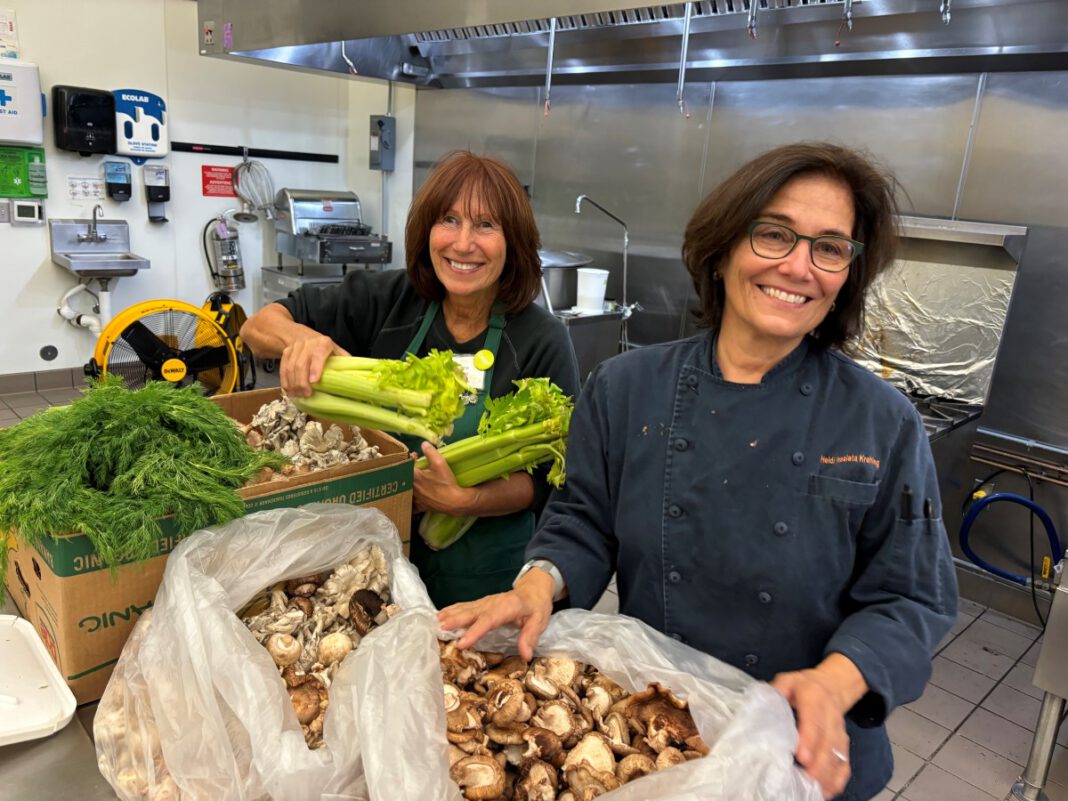
In addition to providing food to its partners, ExtraFood operates an innovative program, where a celebrated Marin chef cooks for people who need it most. Chef Heidi Krahling, founder of Insalata’s restaurant in San Anselmo, leads ExtraFood’s SOUPer Food Kitchen. Each week, Krahling and a group of volunteers create soups, stews and broths from rescued surplus ingredients. They produce about 600 meals weekly, distributed primarily to low-income seniors and homebound seniors.
“It’s a perfect example of how partners come together to transform food and provide it to people who now have access to really nutritious meals,” Dittmar noted.
In Sonoma County, food insecurity is also addressed through a network of organizations. The Redwood Empire Food Bank is the region’s largest food bank. ExtraFood expanded into the county in 2024, focusing on Sonoma Valley with a grant from the Sonoma Catalyst Fund. Programs include food recovery, gleaning produce from farms and backyards, and stocking community fridges.
“You don’t have to go through some enrollment process to access a community fridge,” Dittmar said. “You create a more equitable food access point that alleviates some of the demand around hours of operations for traditional food pantries and food programs.”
One of those fridges is at Sonoma Family Meal Unity Kitchen, which is also the valley’s largest recipient of ExtraFood deliveries. With donations from ExtraFood, the Unity Kitchen provides 300 hot meals—five days a week—and brings food to homebound seniors, said executive director Whitney Reuling.
Share the Bounty, ExtraFood’s gleaning program, sends volunteer teams into farms, orchards and backyards to harvest food.
“The greatest opportunity for bringing more food into the system is by increasing our gleaning program,” said Kathy Carver, ExtraFood’s Sonoma expansion manager. “That is our emphasis right now.”
While food insecurity continues to grow in places of abundance like Sonoma and Marin counties, ExtraFood and the SF-Marin Food Bank have some simple asks for the community.
“Speak up about the inequity that exists in our area,” Dittmar said. “Speak up about the value of food recovery. Speak up about the charitable food system.”
For more information about ExtraFood, visit extrafood.org. SF-Marin Food Bank is at sfmfoodbank.org.









Thank you Nicki for this important story…The Trump criminal regime is following the Billionaires plan to cut the population of the world by 80% within the next few decades starting with the end of USAID and genocide in Africa and Gaza and War on Iran…and Cuts to poverty programs and health care and research grants here at home…