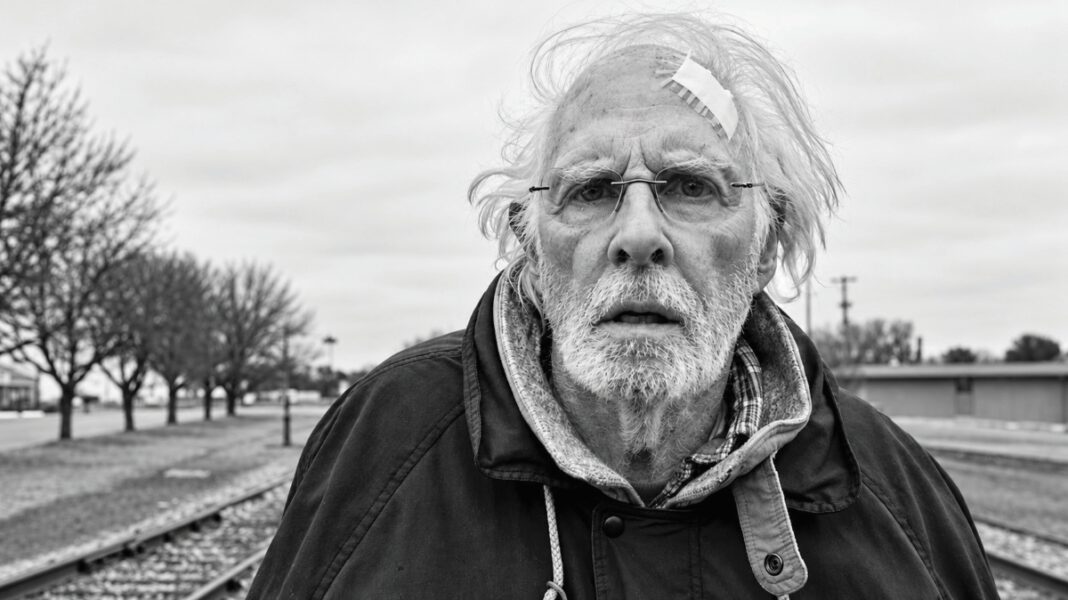
Actor Bruce Dern’s characters often give the impression that they were in the middle of something before the movie itself barged into the moment.
They have private histories, unfinished business and personal reasons for looking at everyone else sideways. Whatever the script says, one suspects they might have a few words of their own—and Dern, at 90, still finds them.
His career spans such seminal cinema as They Shoot Horses, Don’t They?, Silent Running, The King of Marvin Gardens, The Great Gatsby, Black Sunday, Coming Home, Nebraska and Once Upon a Time in Hollywood.
Besides the ruddy excellence of his work—often playing cantankerous to cunning outsiders—Dern’s 65-year-plus filmography connects filmmakers as far flung as Elia Kazan and Alfred Hitchcock to Alexander Payne and Quentin Tarantino, linking generations, genres and movements in moviedom.
Dern will be honored Nov. 5 at the inaugural Tiburon Playhouse Foundation gala at Cinelounge Marin. There will be a reception, an award and a screening of Mike Mendez’s documentary, Dernsie: The Amazing Life of Bruce Dern, followed by a conversation with its director and subject.
When I spoke with Dern, our conversation became something of an impromptu master class in his craft.
Regarding auditioning, for example, whatever time one’s been allotted, Dern figures it’s actually considerably less when it comes to the actual attention paid. Make it count.
“You make sure you don’t leave that room unless you’ve left a piece of yourself,” he says.
That means bringing something personal into the encounter, even through ordinary conversation. Trying to arrive as a fully realized character can obscure the very person the filmmakers might want to hire.
Dern traces his approach to his early experience at the Actors Studio, where Lee Strasberg and Kazan recognized something useful in his untrained instincts. They encouraged him to work on scenes without responsibility for dialogue, allowing behavior to come first.
For those of us who write dialogue, this is mildly alarming, but Dern’s point is that a character “exists” and behaves as they do prior to the dialogue a screenplay puts in their mouth. Moreover, that behavior occurs in the moment, in the reality of a scene. Thus he describes rehearsing the mechanics of a scene while saving its emotional life for the moment itself.
“I rehearse, but I don’t rehearse with feeling,” he says.
The aim is an ability he distills into a compact phrase: “To be publicly private.”
Which brings us to the “Dernsie.”
Jack Nicholson coined the term while directing him in Drive, He Said. It describes a spontaneous bit of behavior or dialogue Dern contributes beyond the script, something fleeting that gives a character an unexpected pulse. A gesture might do it. So might a few words.
The practical instruction: Ask the director for a few extra seconds, without announcing what will happen. Allow the discovery to reveal itself on camera.
It’s a useful explanation for a career populated with characters who seem to have wandered into the movie as wholly incarnated people, carrying entire lives that have been lived off screen. Dern gives them habits, impulses and humanity.
Now Tiburon gets to celebrate the man responsible. The occasion also supports an independent theater, one of the few places where such stellar cinema can flourish.
It’s a fitting tribute to Dern, who has spent more than six decades giving the movies something they didn’t know they needed and can’t do without.
The Tiburon Playhouse Foundation gala runs 5:30–9:30pm, Thursday, Nov. 5, at Cinelounge Marin, 40 Main St., Tiburon. Reception tickets are $125; gala and screening tickets are $300. Reception admission for guests under 30 is $70. Proceeds support theater preservation and community programming. secure.givelively.org.