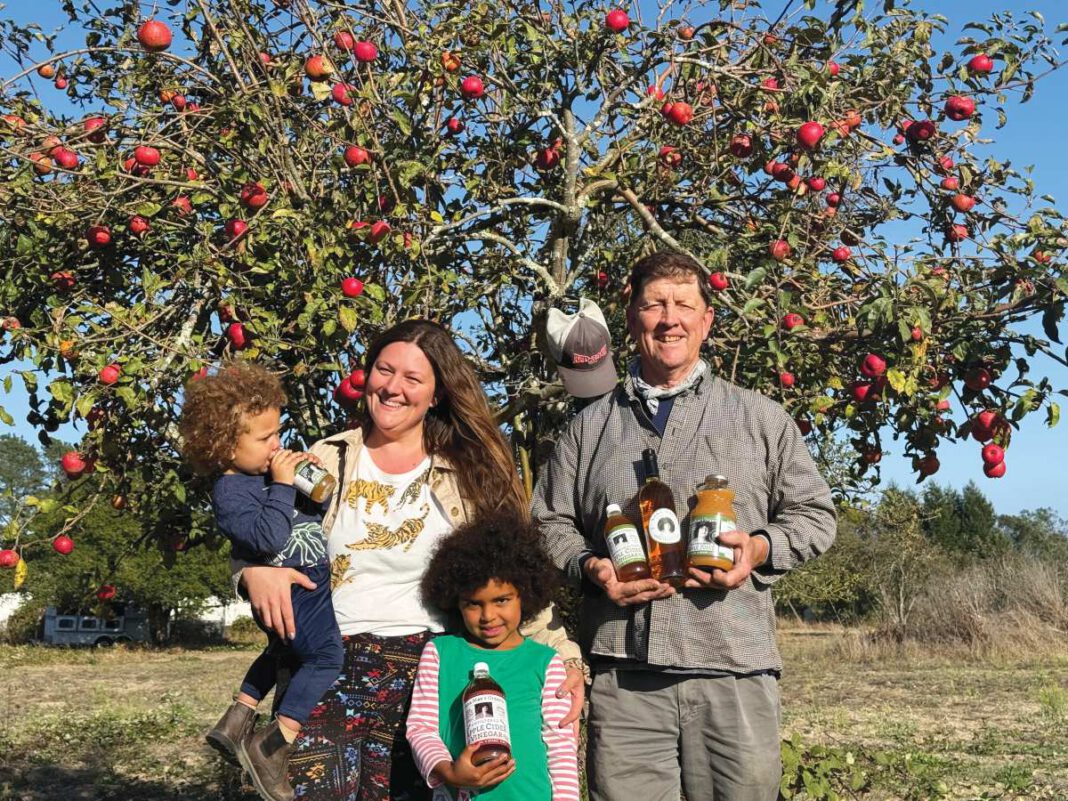
Some might call these bones of mine lazy, but I went no further than my fridge for this week’s lede. There, in my crisper drawer, I stock 10-ounce bottles of Nana Mae’s tart organic apple juice.
It is lazy, perhaps. But it’s in my home—a part of it. And in these times of violent change, one must actively advocate for the things one loves. If one hopes to see them on the morrow.
I love this juice. It remains my favorite way to consume the (locally) famous Gravenstein apple.
Its tart, sweet acid is the very thing for a savory palate overlaid with dinner’s fat. Suggest you pop a bottle, reader—there are few things refreshing’er.
And how did I reach Paul Kolling, owner of Nana Mae’s? I turned the bottle in my hand a quarter turn. There, on the side of the label, is his own phone number. His email too.
That surprised me. Until, on second thought, I realized that such a trust marks a local family-owned business where deals are done at one to two degrees’ remove from kith and kin.
I arranged through Kolling and his “publicist” to meet at one of the orchards Nana Mae’s tends and harvests.
There I met him; two of his grandkids; and his daughter, Eva Granahan—the erstwhile publicist. She had a laugh at that, and his eye twinkled at the foolery. In truth, she and her brothers have moved through a dozen business and farm roles as needed.
The orchard where we met was small—a few acres attached to a house. A house not theirs.
Nana Mae’s contracts with some 400 orchards in West Sonoma County, none more than a few acres of old apple trees—remnants of what was once a vast apple industry. “We’re nomadic farmers,” quipped Kolling.
He pointed out that this orchard was not only organic but dry-farmed and low-till—hence its semi-demi wild look.
“You can ‘see’ the difference that makes if you get quiet. Hear the birds?” he asked. I did—a considerable chatter of birds. There were also signs of deer and rabbits. Together it formed a remarkable contrast to the ordered silence of our vinelands—that one ecologist described as our vast viniferous valley “desert,” devoid of life.
More than I had anticipated, Nana Mae’s presents itself as a cause as much as a bottle. Kolling’s family business protects what remains of the apple industry. One can buy the bottles and smash them undrunk—they are payment for maintaining much of West Sonoma County’s rustic charm.
In these times of change, they could use the support. Nana Mae’s is winding down its popular applesauce line after the closure of the Manzana apple press (now on the market for $7 million). Juice and vinegar processing has moved to the South Bay at considerable expense (and carbon cost). A smaller, less versatile replacement is planned at Gold Ridge Organic Farms. A pivot to fresh apples will make up for a fraction of Nana Mae’s lost income (find them at Marin Civic Center’s farmers market).
At the end of our time, Kolling expressed gratitude for being able to pick apples on hundred-year-old trees sold by the great Luther Burbank himself.
Learn more: Meet this charming farm family and their ilk at Apple-y Ever After on Saturday, Nov. 7, from 1 to 5pm, at the Arlene Francis Center in Santa Rosa. With representatives and seasonal offerings from Baba Chai, The Gentle Hearth, Californian Homemakers Association, music, dance, crafts, children’s activities and more. $30 suggested donation.
Learn more about the author: linktr.ee/cincinnatushibbard.