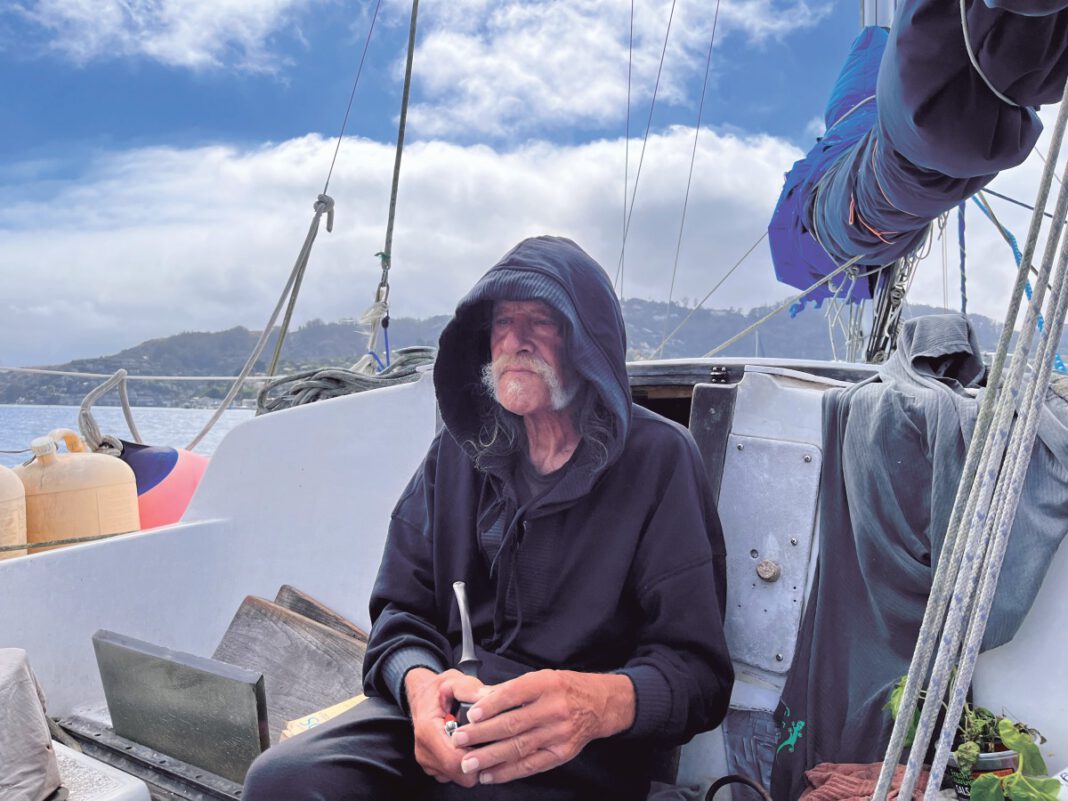
Richard Ashlock helps me aboard his sailboat, a well-maintained Hunter 37 anchored in Richardson Bay. While the 75-year-old mariner has lived on the waters off Sausalito for 15 years, his days here are numbered.
By late October, Richard must pull up anchor and leave. He’s not sure where he’s going.
For the last six years, I’ve reported on the anchor-out community, people who have lived aboard boats in Richardson Bay since the 1960s. When I first started the beat, there were 135 vessels. Only four remain.
Richard’s departure will mark the end of an era.
The Richardson Bay Regional Agency (RBRA) entered into a 2021 settlement agreement with the Bay Conservation and Development Commission (BCDC) to remove all the anchor-outs. Environmental and safety concerns were among the reasons cited.
As I sit in the cockpit of Richard’s boat, I’m reminded of why I’m so fond of the man. He notices what most people miss.
Richard, who calls himself an ornithologist, points to an elegant tern, a bird deserving of its name. We watch it hover, dive straight down and come back up with a fish in its beak. Then he climbs down into the cabin to retrieve his bird guide. He knows exactly which page has the elegant tern’s drawing and description.
I take pictures of seabirds and raptors, but I don’t know much about them. Together, we go through the photos on my phone. He identifies the red-shouldered hawk, the great blue heron and the brown pelican, explaining each one’s behavior.
What troubles him most is that the United States and Canada have lost about 30% of their bird population since 1970. Humans, he says, should take heed, calling the birds canaries in the coal mine.
Though Richard rows his skiff to shore to do odd jobs or volunteer at the food bank, he spends most of his time on the water, reading and keeping his boat in tip-top shape. He’s content with a life he says has been good. Now he’s also thinking about his future.
He turned down the RBRA’s offer of a housing voucher. It wasn’t even a close call.
“I don’t want to live off my boat,” he says. “This is my home. I bought this boat in 2008 for 30 grand and then I put another 10 grand into it. And that was all the money I had saved up and a little inheritance I got.”
The RBRA can force him off the anchorage, but it can’t make him leave his boat. Still, Richard doesn’t have the budget for a local marina. Liveaboard berths are hard to come by, with the BCDC limiting them to 10% of slips.
He has a few ideas, including moving outside the area governed by the RBRA. The waters are deeper and rougher, and he’ll be farther from land. Rowing to shore and weathering storms would be more dangerous. Richard pounds his fist on his chest to show me that he’s still fit and capable but acknowledges that leaving the safety of the anchorage isn’t his first choice. Perhaps he’ll go to the Delta.
Or maybe he’ll get a night watchman position at the Sausalito Community Boating Center, which could come with a berth and small stipend.
“I would love to have a dock space,” Richard says. “I’d have more of a social life.”
Doreen Gounard, assistant to Marin County Supervisor Stephanie Moulton-Peters, confirmed that discussions about the job are underway. Neither she nor the supervisor’s office is involved in the process.
“He’s been my friend for years,” Doreen said. “I really want his happy ending.”
Even so, Richard isn’t counting on it.
“I’m worried about the world,” he says. “People don’t understand me. I’m not worried about myself. I’m a survivor. If I have to move, I have to move.”
Pete Glaser, 65, is losing the same fight, on a faster timeline. Another of the last four anchor-outs, he entered the RBRA’s housing voucher program. Working with a case manager, he found an apartment in Tiburon. He has a view of Richardson Bay.
I caught up with him after the Marin County Sheriff towed his sailboat to a dock at the Army Corps of Engineers in Sausalito. The movers haven’t come yet. When he’s done moving his belongings off, the boat will be crushed there.
“I’ve been depressed for a couple of months now, knowing that, you know, my time on the water has come to an end and that they won and, you know, we lost,” Pete says.
He has been on the anchorage for 27 years. I climb carefully onto his vessel, trying to find somewhere to fit. The entire cockpit is full. A bike, a milk crate, a laundry basket and items that I can’t identify. Down below, it’s organized. Boxes and garbage bags are packed and ready to go when the movers arrive.
Dressed in jeans and a T-shirt that says “Millionaire’s Bacon,” he takes a break from packing and turns off the radio, giving up the Giants game for a chat.
He’d rather stay on the water and “live off the grid.” During a test run, a night in his new apartment, he woke up four times because he’s used to the bay rocking him to sleep. Pete frets about how his cat named Kitty will adapt.
Washing dishes is hard on a boat without a sink, but he’s always managed. The apartment has a washer and dryer. No microwave though.
His friend, a former anchor-out, lives across the street from his new place. Pete doesn’t have a car, and he’ll be living far from Sausalito, his backyard for almost three decades.
A nonprofit furnished his place, and he likes what the designers chose for him. Yet, in the next minute, he talks about his adventures with marine mammals while rowing his skiff to shore.
“The seals love me,” Pete says. “I talk to them. I bark at them, you know, when I’m rowing out, and they’ll bark back. Yeah, the younger ones are really curious and follow me a long ways. And I race them, you know, and then they fall behind and they give up.”
It’s hard not to laugh with Pete about his conversations with seals. But my stomach lurches when he connects it to what he’s losing.
“I’ll miss the wildlife,” Pete says. “I miss the rhythm of the water and just sort of, I miss our community. I mean, I’ve been missing that even when I was still out here because, yeah, they really decimated it.”
From 135 to 4. Soon there will be none.