Trigger warning: This article contains broad reference to wartime violence.
In the far distance, a firework sounded—pop, pop, bang. It startled George Schult as he sat in his cool riverside cottage and set his teeth on edge.
He reached for the sketch pad that was always with him. Drawing soothes him. In a former time, Schult would have reached for the bottle. That 15-year misadventure with “self-medication” was gratefully over.
Schult is an old man now. And the Vietnam war ended 51 years ago. But his body still sometimes crouches like a wary animal anticipating the explosion that will never come.
Early in his tour, he had seen—and felt in his body—an ammo dump rise into the sky in a cascade of pops and explosions, mushrooming like a low-yield atomic bomb. It happened again before he left, undermined by Viet Cong sappers. He was an impressionable teenager then—a 19-year-old draftee from Brooklyn.
It was not his job to carry the mortar or the rifle but to handle the unprintable aftermath of such violence as a medic. Schult told me wistfully of the “beautiful boys” he had known in Vietnam, sometimes trailing off into private places within himself, his expression masked.
He still speaks in a streetwise Brooklyn accent, and the sly affability of his manner returned as our conversation shifted to art. His accent, banter, theatricality, service work (and resemblance to St. Nicholas) make him something of a local celebrity in the riverlands. I was surprised at his willingness to tell me—and our readers—all of this life. But his frankness and readiness to use his story to help others is key to his recovery, reinforced by the 12-step communities in which he is a light.
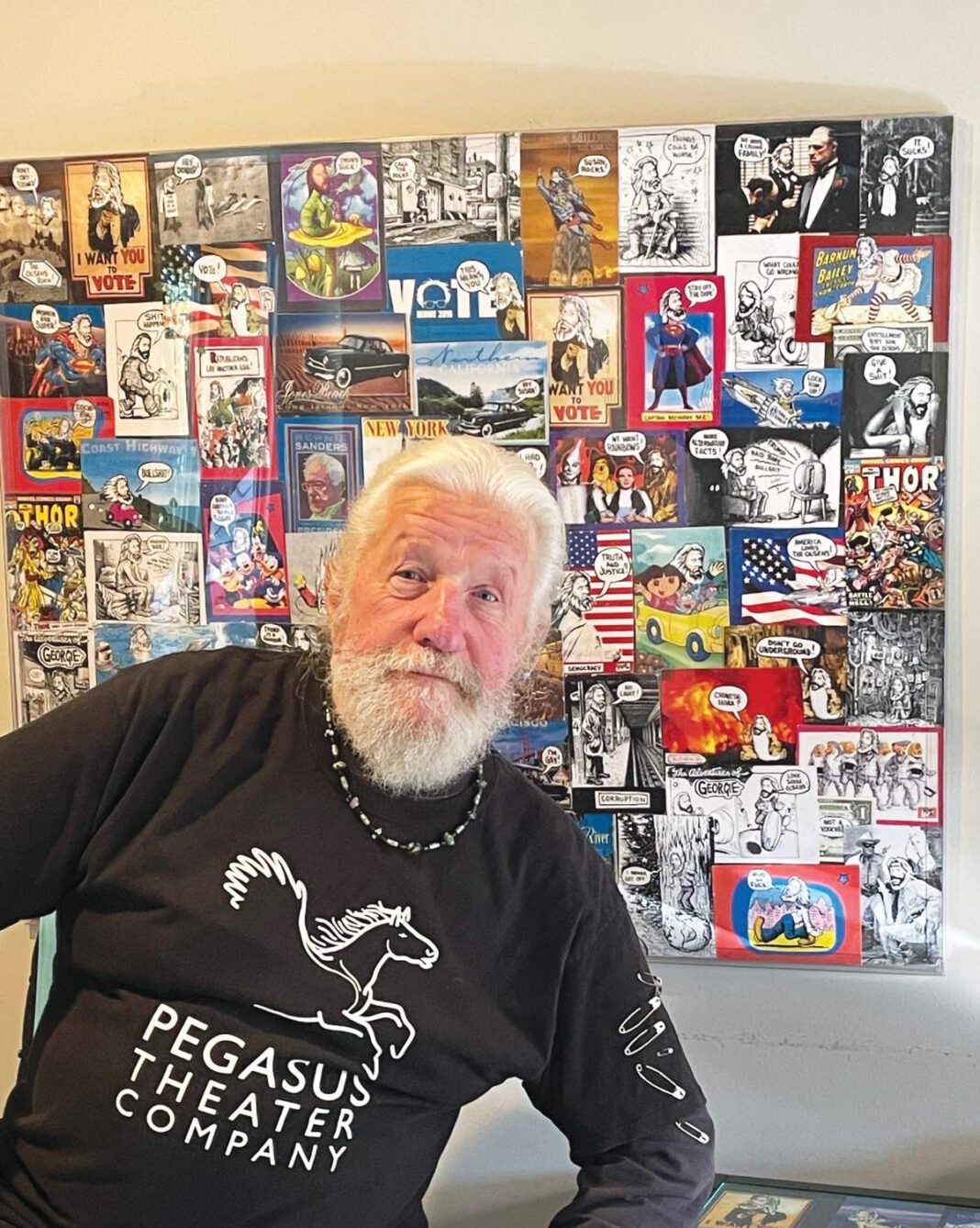
I had come ostensibly to interview him about his postcard art series, now in its 25th year of mailings. I riffled through bundles as he spoke—hundreds of cards sent over the years to hundreds of friends. Each is cut from watercolor paper and fronted with photocopied or hand-reproduced art—iconic, comic, camp, historic—with Schult’s sainted head and wry smile pasted into the scene. (“Interjected” is his amused word.)
Passing through my hands: Schult pasted onto beach hunks, R. Crumb bodies, toy robots, the Seven Dwarfs, parachutists, gurus, streakers, Uncle Sam, Santa. On the back—and sometimes the front—in black ink or bright marker: punch lines, political slogans, recovery sayings, personal anxieties or “I miss yous.” All in the key of his fond and affectionate love.
The project began accidentally—a single postcard sent to his daughter, with him posted into her then-favorite singing group, Donny and Marie. It became a vast correspondence.
Like many great artists, he doesn’t have much profound to say about his art. But one can tell that, along with humble honesty and fellowship, it is his balm and medicine.
After 15 years as “a stone-cold addict,” bottoming out on the street, he worked at treatment and recovery centers for another 15 before being declared fully disabled by the VA. There is a fine karmic balance of debt and repayment in that.
In his cool cottage, crammed with art, George Schult expressed gratitude and sheer wonderment that he is still alive—graced to survive his addiction and his deeper wounds.
I am personally grateful. These many thousands of mailings are one measure of the love that would have been lost.
Learn more: George Schult can often be found at Indivisible peace protests. At the polls and elsewhere, he urges us to ‘vote for goodness.’ The veterans’ crisis line number is 988—then press 1.