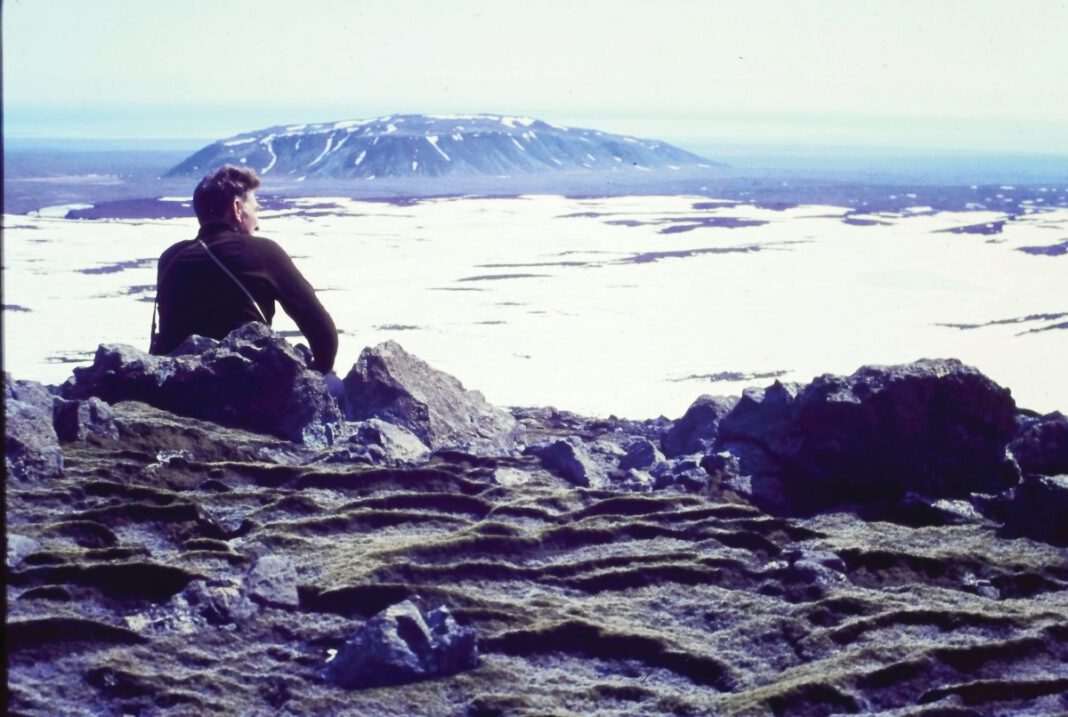
Filmmaker Sara Dosa’s new documentary, Time and Water, begins with a disappearance in Iceland—not in the Nordic noir-sense, but alarming all the same. In Dosa’s film, the dramatic departure is experienced by a glacier.
From there, the Oscar-nominated filmmaker behind 2022’s Fire of Love crafts something far more intimate than a climate documentary and far more expansive than a family memoir. The result is a lyrical meditation on memory, mortality and the strange challenge of living through a moment when entire landscapes are vanishing within a single human lifetime.
Released via National Geographic Documentary Films, Time and Water follows Icelandic writer, filmmaker and environmental advocate Andri Snær Magnason as he confronts two parallel losses: the death of Iceland’s glaciers and the deaths of beloved family members whose stories are preserved in photographs, home movies and personal archives.
For Dosa, whose Fire of Love transformed the story of French volcanologists into a visually intoxicating reflection on love and obsession, the challenge was finding order within an overwhelming abundance of material.
“It was a massive undertaking for sure,” Dosa said in a recent phone interview, describing the trove of family photographs, films and archival materials assembled by Magnason and his grandparents. “We also were working with the Icelandic Historical Archive. And on top of that, our own original shooting. So it really was a lot of material.”
Yet rather than constructing a conventional environmental documentary, Dosa and her collaborators found themselves drawn to a metaphor that emerged early in the editing process: Glaciers are archives.
“One line in Andri’s book talks about glaciers as a manuscript, an ancient manuscript,” Dosa noted. “Thinking about glaciers as an archive itself just seemed like a fascinating parallel.”
That insight became the film’s organizing principle. The glaciers contain planetary memory frozen in ice while family photographs, videos and stories preserve human memory. Both, the film suggests, are vulnerable to loss.
That said, Dosa resisted making the metaphor too explicit.
“We didn’t want to overemphasize the metaphor in a way where we were instrumentalizing a glacier for a human story,” she said. Instead, the filmmakers hoped audiences would discover the connection for themselves.
That restraint gives Time and Water its unusual power. The film unfolds less like an argument than a tone poem, drifting through family history, Icelandic folklore, geology and climate science with quiet confidence.
A collaborative relationship between Dosa and Magnason proved essential. The filmmaker describes years of conversations, creative retreats and shared editorial work that helped shape the project.
“We were always in touch,” Dosa recalled. “There were a lot of different states and flows to our creative process, but it was very collective the whole way through.”
That collaboration also required trust. Magnason handed over deeply personal family materials while allowing Dosa and her team the creative freedom necessary to shape a film that avoided becoming a work of hagiography, “which none of us, of course, wanted,” Dosa noted.
The finished film arrives at a moment when climate conversations often feel trapped between the polar extremes of alarmism and outright denial. Dosa aims for Time and Water to reach audiences not through stats or policy debates but through shared human experience.
“It’s really my hope that wide audiences could be met with climate storytelling,” she said, particularly at a time when environmental realities are increasingly politicized.
Interestingly, Time and Water continues a pattern in Dosa’s work. If Fire of Love was a film about volcanoes and molten earth, this new project is centered on ice and water. The connection, she says, wasn’t intentional.
“I’m so awed by the power of our elements,” Dosa remarked. “Volcanoes certainly do that. Ice certainly does that for me.”
Her next project, incidentally, concerns earthquakes.
Fire. Ice. Earth.
For Dosa, these elemental subjects are less about spectacle than scale. Geological time has a way of making human life feel both fleeting and precious.
Playing throughout the North Bay.