Free Will Astrology

By Rob Brezsny

ARIES (March 21-April 19): According to the online etymological dictionary, the verb “fascinate” entered the English language in the 16th century. It was derived from the Middle French fasciner and the Latin fascinatus, which are translated as “bewitch, enchant, put under a spell.” In the 19th century, “fascinate” expanded in meaning to include “delight, attract, hold the attention of.” I suspect you will soon have experiences that could activate both senses of “fascinate.” My advice is to get the most out of your delightful attractions without slipping into bewitchment. Is that even possible? It will require you to exercise fine discernment, but yes, it is.

TAURUS (April 20-May 20): One of the largest machines in the world is a “bucket wheel excavator” in Kazakhstan. It’s a saw that weighs 45,000 tons and has a blade the size of a four-story building. If you want to slice through a mountain, it’s perfect for the job. Indeed, that’s what it’s used for over in Kazakhstan. Right now, Taurus, I picture you as having a metaphorical version of this equipment. That’s because I think you have the power to rip open a clearing through a massive obstruction that has been in your way.

GEMINI (May 21-June 20): Filmmaker Alfred Hitchcock did a daily ritual to remind him of life’s impermanence. After drinking his tea each morning, he flung both cup and saucer over his shoulder, allowing them to smash on the floor. I don’t recommend that you adopt a comparable custom for long-term use, but it might be healthy and interesting to do so for now. Are you willing to outgrow and escape your old containers? Would you consider diverging from formulas that have always worked for you? Are there any unnecessary taboos that need to be broken? Experiment with the possible blessings that might come by not clinging to the illusion of “permanence.”

CANCER (June 21-July 22): Terence was a comic playwright in ancient Rome. He spoke of love in ways that sound modern. It can be capricious and weird, he said. It may provoke indignities and rouse difficult emotions. Are you skilled at debate? Love requires you to engage in strenuous discussions. Peace may break out in the midst of war, and vice versa. Terence’s conclusion: If you seek counsel regarding the art of love, you may as well be asking for advice on how to go mad. I won’t argue with him. He makes good points. But I suspect that in the coming weeks you will be excused from most of those crazy-making aspects. The sweet and smooth sides of love will predominate. Uplift and inspiration are more likely than angst and bewilderment. Take advantage of the grace period! Put chaos control measures in place for the next time Terence’s version of love returns.

LEO (July 23-Aug. 22): In the coming weeks, you will have a special relationship with the night. When the sun goes down, your intelligence will intensify, as will your knack for knowing what’s really important and what’s not. In the darkness, you will have an enhanced capacity to make sense of murky matters lurking in the shadows. You will be able to penetrate deeper than usual, and get to the bottom of secrets and mysteries that have kept you off balance. Even your grimy fears may be transformable if you approach them with a passion for redemption.

VIRGO (Aug. 23-Sept. 22): New friends and unexpected teachers are in your vicinity, with more candidates on the way. There may even be potential comrades who could eventually become flexible collaborators and catalytic guides. Will you be available for the openings they offer? Will you receive them with fire in your heart and mirth in your eyes? I worry that you may not be ready if you are too preoccupied with old friends and familiar teachers. So please make room for surprises.

LIBRA (Sept. 23-Oct. 22): More than any other sign, you have an ability to detach yourself from life’s flow and analyze its complexities with cool objectivity. This is mostly a good thing. It enhances your power to make rational decisions. On the other hand, it sometimes devolves into a liability. You may become so invested in your role as observer that you refrain from diving into life’s flow. You hold yourself apart from it, avoiding both its messiness and vitality. But I don’t foresee this being a problem in the coming weeks. In fact, I bet you will be a savvy watcher even as you’re almost fully immersed in the dynamic flux.

SCORPIO (Oct. 23-Nov. 21): Are you an inventor? Is it your specialty to create novel gadgets and machines? Probably not. But in the coming weeks you may have metaphorical resemblances to an inventor. I suspect that you will have an enhanced ability to dream up original approaches and find alternatives to conventional wisdom. You may surprise yourself with your knack for finding ingenious solutions to longstanding dilemmas. To prime your instincts, I’ll provide three thoughts from inventor Thomas Edison. 1. “To invent, you need a good imagination and a pile of junk.” 2. “Just because something doesn’t do what you planned it to do doesn’t mean it’s useless.” 3. “Everything comes to those who hustle while they wait.”

SAGITTARIUS (Nov. 22-Dec. 21): Some unraveling is inevitable. What has been woven together must now be partially unwoven. But please refrain from thinking of this mysterious development as a setback. Instead, consider it an opportunity to reexamine and redo any work that was a bit hasty or sloppy. Be glad you will get a second chance to fix and refine what wasn’t done quite right the first time. In fact, I suggest you preside over the unraveling yourself. Don’t wait for random fate to accomplish it. And for best results, formulate an intention to regard everything that transpires as a blessing.

CAPRICORN (Dec. 22-Jan. 19): “A waterfall would be more impressive if it flowed the other way,” said Irish author Oscar Wilde. I appreciate the wit, but don’t agree with him. A plain old ordinary waterfall, with foamy surges continually plummeting over a precipice and crashing below, is sufficiently impressive for me. What about you, Capricorn? In the coming days, will you be impatient and frustrated with plain old ordinary marvels and wonders? Or will you be able to enjoy them just as they are?

AQUARIUS (Jan. 20-Feb. 18): Years ago, I moved into a rental house with my new girlfriend, whom I had known for six weeks. As we fell asleep the first night, a song played in my head: “Nature’s Way,” by the band Spirit. I barely knew it and had rarely thought of it before. And yet there it was, repeating its first line over and over: “It’s nature’s way of telling you something’s wrong.” Being a magical thinker, I wondered if my unconscious mind was telling me a secret about my love. But I rejected that possibility; it was too painful to contemplate. When we broke up a few months later, however, I wished I had paid attention to that early alert. I mention this, Aquarius, because I suspect your unconscious mind will soon provide you with a wealth of useful information, not just through song lyrics but other subtle signals, as well. Listen up! At least some of it will be good news, not cautionary like mine.

PISCES (Feb. 19-March 20): When I advise you to GET NAKED, I don’t mean it in a literal sense. Yes, I will applaud if you’re willing to experiment with brave acts of self-revelation. I will approve of you taking risks for the sake of the raw truth. But getting arrested for indecent exposure might compromise your ability to carry out those noble acts. So, no, don’t actually take off all your clothes and wander through the streets. Instead, surprise everyone with brilliant acts of surrender and vulnerability. Gently and sweetly and poetically tell the Purveyors of Unholy Repression to take their boredom machine and shove it up their humdrum.

Homework: Go to realastrology.com to check out Rob Brezsny’s Expanded Weekly Audio Horoscopes and Daily Text Message Horoscopes. Audio horoscopes are also available by phone at 877/873-4888.

Advice Goddess

By Amy Alkon

Q: Two friends of mine are in “love at first sight” relationships. (One went from chills at seeing the guy to moving in with him weeks later.) Each has said to me, “When it’s right, you just know.” Well, as I get to know this new guy I’m seeing, I like him more and more. It’s just not the instant love of the century like they have, and that makes me feel a little bad.—Lacking Thunderbolts

A: Getting the chills the moment you set eyes on a person may be a sign that you have love at first sight—or an incipient case of malaria. (In time, you’ll find out whether you have lasting love or lasting liver damage, seizures and death.)

Love at first sight is made out to be the rare, limited-edition Prada purse of relationships—that extra-special luvvier kind of love that we romantic commoners don’t get access to. However, what the “first-sighters” actually have is not the enduring love that poets write about, but the kind animal behaviorists do—when the boy baboon spots the girl baboon’s big red booty. People in this fleeting first phase of love are basically on a biochemical bender, high off their asses from raging hormones and neurotransmitters, and shouldn’t be operating heavy machinery or making plans any heavier than where to show up for dinner on Tuesday.

Those who end up staying together will often say with a sniff, “We just knew!”—which sounds better than, “We are idiots who got hitched 20 minutes after meeting and got lucky we turned out to be well-matched.” Their initial belief that they’re perfect for each other is probably driven by a cognitive bias—an error in reasoning—that psychologists call “the halo effect.” Like the glow cast by a halo, the glow from, “Wow, she’s hot!” spills over, leading to an unsupported positive view of a person’s as-yet-unseen qualities. But, early in a relationship, you can only guess how someone will behave—say, at 3am, when you’re awakened by period cramps that feel as if some big Vegas boxing match accidentally got scheduled in your uterus. Will he mumble, “Feel better” and roll over, or go to the drugstore and roll you home a barrel of hippo-strength Midol?

Maybe real romance is finding out all the ways somebody’s disturbingly human and loving them anyway. This happens about a year in, after the party manners have fallen off and after you see—for example—whether your partner fights ugly or like someone who loves you but thinks you’ve temporarily fallen into the idiot bin. In other words, you’re wise to get to know this guy instead of immediately drawing little sparkly hearts in your head about your magical future together. Keep unpacking who you both are and see whether you keep wanting more—or whether one of you goes out for a smoke and, a month later, sends a postcard from the Netherlands.

Q: I’m in my early 40s and newly divorced. I fooled around with this guy—my first time with somebody besides my husband in 12 years. We had weekend plans, but two days passed with no texts from him. I texted him angrily, repeatedly telling him he’d hurt my feelings, and he cut off contact. Now, months later, he has resurfaced, saying I’ve been in his thoughts. What could he want?—Puzzled

A: Men you’ve dated briefly will sometimes resurface—much like bloated dead bodies in New York’s East River.

As for why this one’s coming around again, chances are, the paint on “she’s crazy” dried and he remembered that you are also pretty and do that crazy thing with your tongue. OK, so you were short on nonchalance in your first post-divorce dating situation. After a long sex-and-affection famine, a newly divorced woman, like any starving refugee, is unlikely to simply nudge a hot piece of meat around on her plate like one of those skeletal “ladies who lunch” (but do not eat).

The truth is you probably weren’t going off on him merely because he failed to meet your text-pectations. Your behavior most likely stemmed from what psychologists call a “priming effect,” describing how exposure to one situation colors how you react to another. Being mindful of this can help you tell a guy what you need and give him a chance to come through—instead of immediately texting him with all the casual cool of a kidnapper demanding a bag of unmarked small bills. Should you give this guy another chance, see that you’re only asking questions he’s prepared to answer, like where he went to elementary school and why his previous relationship ended—not, “Will I be alone forever?” and, “Wanna come over and try to fill the vast void I have inside?”

This week in the Pacific Sun

0

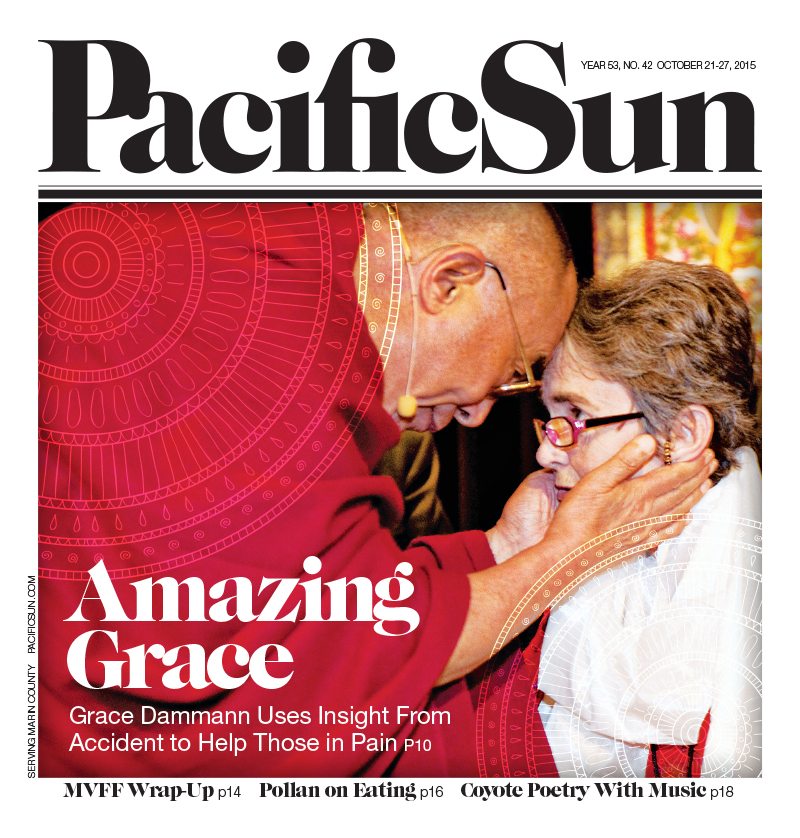
This week in the Pacific Sun, you’ll find our cover story, by Joanne Williams, on physician Grace Dammann, who survived a 2008 head-on collision on the Golden Gate Bridge, and who now works with chronic pain patients. On top of that, Joseph Mayton writes about Marin homeowners saving energy and water by adopting the HERO Program, Tanya Henry reports on ‘In Defense of Food,’ the film based on Michael Pollan’s book by the same title, Mal Karman and Samantha Campos wrap up the Mill Valley Film Festival and Steve Heilig writes about an upcoming show at the Throckmorton that will combine Peter Coyote’s poetry with music. All that and more on stands and online today!

Music: Melding art

0

by Steve Heilig

Poetry married with jazz enjoyed a brief heyday in the San Francisco Bay Area and elsewhere during the fabled Beatnik era, although legendary poet Kenneth Rexroth reportedly called the melange “a shotgun wedding.” Still, some musicians and poets have soldiered on, melding carefully chosen poetic forms and adventurous music into something, well, cool indeed.

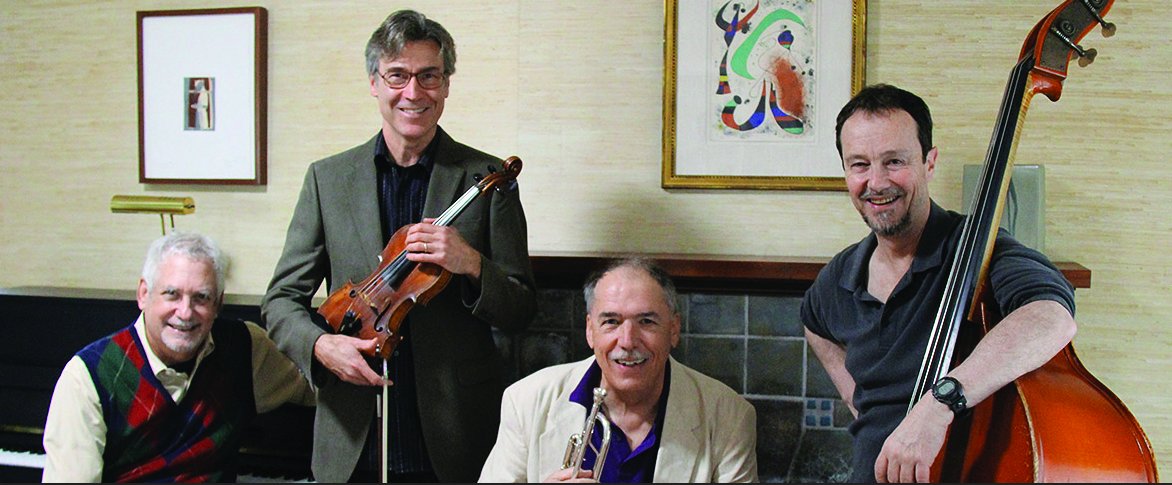
Longtime Marin cohorts Peter Coyote and Lewis Richmond, decades-long colleagues in Zen Buddhism, have now forged an artistic collaboration in a one-time performance of poetry and music on Sunday, October 25 at 2pm at the Throckmorton Theatre in Mill Valley. Richmond’s contemporary classical music group, The Melanthium Ensemble, will perform his original compositions, and together they will present premieres of poems by Coyote, for which Lewis composed original music.

Besides Coyote’s renown as an actor, author and narrator—who recently received an Emmy for his work on Ken Burns’ The Roosevelts—he has for decades quietly cultivated the craft of poetry, which he will be reading in public for the first time. Richmond, a Zen teacher and author (most recently of Aging as a Spiritual Practice), brings a lifetime of musical studies in piano and composition to the stage with his “chamber fusion” blend of classical, jazz and blues influences.

Coyote has been Richmond’s Buddhist student for many years, and now they teach together. Of their Zen relationship, Richmond says, “Peter and I are a natural fit. I have always felt that the true role of Buddhist practice is to develop the clarity and courage to actually be truly of help to people wherever you might find them. In all his various activities and roles, as a political and social activist, performer and teacher, Peter has always done that; he has a natural gift for it which his Zen study has further enhanced.”

“My work with Lew has been an inspiration,” notes Coyote, who is now an ordained Zen priest. “He has inspired me to dedicate myself to ‘Suzuki-roshi’s way’—the path clarified for him by his teacher, the founder of San Francisco Zen Center. The icing on the cake is humor, mutual respect and a common dedication to helping others. Plus, he swings musically.”

The other members of the Melanthium Ensemble are all highly regarded veterans of the Bay Area music scene. Craig Fry, violin, is a veteran of many styles, including tango, klezmer and vintage jazz. He was the long-time violinist for The Paul Dresher Ensemble, a featured performer with the Margaret Jenkins Dance Company, and has performed at Lincoln Center, and in Japan, Europe and Indonesia. Fred Randolph, bassist, is widely known as a master jazz performer. He leads his own jazz group, and his latest CD is Song Without Singing. Jay Rizzetto, trumpet, is a master teacher and performer whose career as a soloist and symphony musician spans many decades.

Thus, this musical and poetic wedding, “shotgun” or not, promises to be a happy and fruitful celebration.

The Melanthium Ensemble with Peter Coyote; Sunday, October 25; 2pm; 142 Throckmorton Ave., Mill Valley; $21-$36; throckmortontheatre.org/event/melanthium/; 415/383-9600.

Theater: Tiny fragments

0

by David Templeton

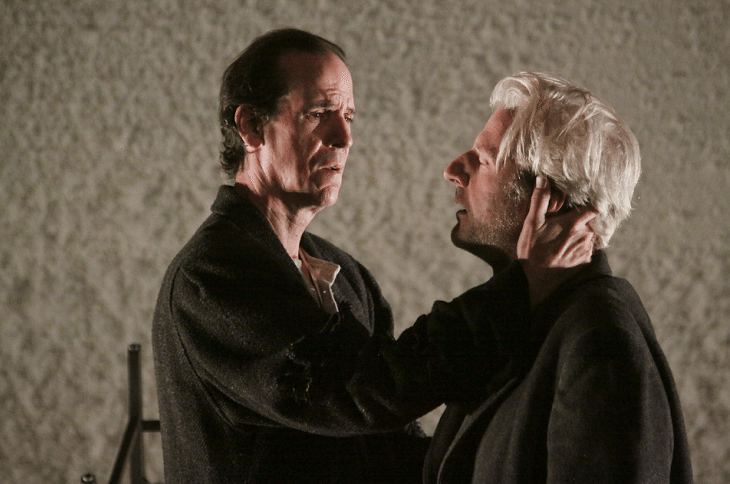
In Mary Shelley’s Frankenstein, as everyone knows, a creature is assembled from dead body parts and granted the spark of life. In Trevor Allen’s The Creature—a daring, artful, but ultimately problematic adaptation, the playwright puts Victor Frankenstein’s creation process in reverse, taking the original story apart and reassembling it into something similar, but entirely different.

Like Victor Frankenstein’s infamous original science project, it’s a bold idea that almost works, but ultimately goes more than a little bit wrong. As directed by Jon Tracy, at the Cinnabar Theater in Petaluma, mixing up a meta-theatrical cocktail of misty atmosphere and sheer guts—Allen’s poetically minimalist take on the 1818 novel uses little more than three chairs, a snowy slab of white, a journal—and a trio of actors. Eschewing special effects, action scenes and monster makeup, the three barefooted narrators of Shelley’s 1818 novel—Victor Frankenstein (Tim Kniffin), Captain Walton (Richard Pallaziol), and the Creature (Robert Parsons)—all take turns telling their side of the story, rarely moving or even interacting, as they spin together a long string of beautiful but oft-tangled words.

Unlike the novel—a tale within a tale within a tale—Allen places the narratives side by side, and they bounce back and forth like a ping-pong ball, every sentence or two. Confusion and exhaustion are just some of the by-products of the playwright’s fiendish experiment. Even worse, by breaking each man’s tale into such tiny fragments, the power of Shelley’s original story is almost entirely diminished, literally smashed to pieces.

As Walton, the ship’s captain who discovers Frankenstein near the North Pole and takes his deathbed confession, Richard Pallaziol is quite good, and Tim Kniffin, as the dying mad scientist, nicely captures the last-gasp desperation of the character. But in delivering his entire story in a steady, near-lifeless monotone, the emotional arc of Frankenstein’s horrific personal journey becomes one-note, sadly hammered flat and cold.

As the Creature, Robert Parsons is served the best, and he brings an impressive sense of wounded dignity to the role of an abandoned child. But in the script, Allen goes too far in trying to make the character sympathetic, even altering the details of the Creature’s various murders. In a deliberate deviation from Shelley’s text, Allen turns each murder—including the calculated act of framing an innocent woman for one of the deaths—into a regrettable but mostly unintentional accident.

“I only wanted to speak to him!” is a recurring line.

While such story and plot changes might go unnoticed by those unfamiliar with the novel, they do matter. By turning the Creature into a hapless victim who never turns monstrous, it throws off the balance of the drama, and robs the story of much of its complexity. Imagine if Dracula never wanted to bite his victims, but somehow kept accidentally tripping and falling on their necks.

On the plus side, Jon Tracy’s set—a sloping swath of snow that runs across the stage and curves up the wall and out of sight—is beautifully done, and the lovely light design (also Tracy) and sound design (Jared Emerson Johnson) set the mood beautifully.

Though fascinating at times and visually haunting, this Creature—despite the best intentions of its talented creators—turns out to be less than the sum of its parts.

NOW PLAYING: The Creature runs through Nov. 1 at Cinnabar Theater, 3333 Petaluma Blvd. N., Petaluma; Fri.-Sat.; 8pm; Sunday matinees at 2pm; $15-$25; 707/763-8920.

Arts: Lifetimes of achievement

by Samantha Campos

Sir Ian McKellen arrived to a legion of fans who’d gathered on the sidewalk alongside a red carpet leading into the Smith Rafael Film Center on Sunday, October 11. Accompanied by an entourage, McKellen walked, beaming, towards the photographers’ pen, stopping short to ensure that a young girl got “a good shot.”

Inside the theater a few minutes later, Mill Valley Film Festival (MVFF) Director Mark Fishkin ran through McKellen’s illustrious career and awards, then showed a montage of such crowd-pleasers as Gods and Monsters, Lord of the Rings and X-Men. Before presenting the Lifetime Achievement Award on behalf of MVFF, surprise guest Armistead Maupin, famed author of Tales of the City, regaled attendees with stories about his friend of 35 years, including the time McKellen stayed at his house and left a note on the pillowcase that read, “Gandalf and Magneto slept here—with each other.”

Onstage with Zoe Elton, MVFF’s director of programming, McKellen discussed his thespian origins. “I was brought up in the north of England, in a town where there were three live theaters, and my parents used to take me to them,” he said. “I was so enchanted by what I saw. How do they do it, is what I wanted to find out. What happens behind that curtain? How do they learn their lines? How is it all done? It was because of that, I decided to act.”

At the start of his career, McKellen often performed in very large theaters, with 1,500 people in attendance. “So I was a big actor—at times perhaps thought to be a bit overblown,” he said. Then he did Macbeth in 1976 with Judi Dench at a Stratford-upon-Avon theater of just 100 people.

“You didn’t have to project your performance, you didn’t have to tell the audience what to look at—they were close enough to touch you,” McKellen said. “And I loved it. It was that production that was the preparation that got me ready for the closest audience of all, which is the camera.

“Acting is the same whether you’re in front of a camera or in front of a live, large audience. It’s the degree of

Sir Ian McKellen is presented with a Lifetime Achievement Award. Photo courtesy of MVFF.

presentation which makes the difference.”

Clips were shown of McKellen’s cinematic roles in Cold Comfort Farm (1995), Richard III (1995), Lord of the Rings (2001-2), Gods and Monsters (1998) and Mr. Holmes (2015), and in between, he charmed the crowd with reenacted lines, behind-the-scenes stories, impressions of other actors and tales of working with Ava Gardner. Then he graciously answered audience questions about his status as an openly gay actor.

“When I came out, some longtime gay activists assumed that I would now turn myself into a ‘queer artist,’” he said, “that I would stop playing the sort of parts I play and just concentrate on gay-related plays and films. And I said, ‘No, I can’t!’ I find that heterosexuality is far too interesting a phenomenon to be ignored.”

McKellen expressed his joy for “telling stories to real people,” whatever the medium. “Sometimes we get it wrong,” he said. “Perhaps the script’s not quite good enough. Perhaps we didn’t work quite hard enough. But when we do and it all comes together, then the magic of the movies is that it’s there for all time, for others to see.”

* * *

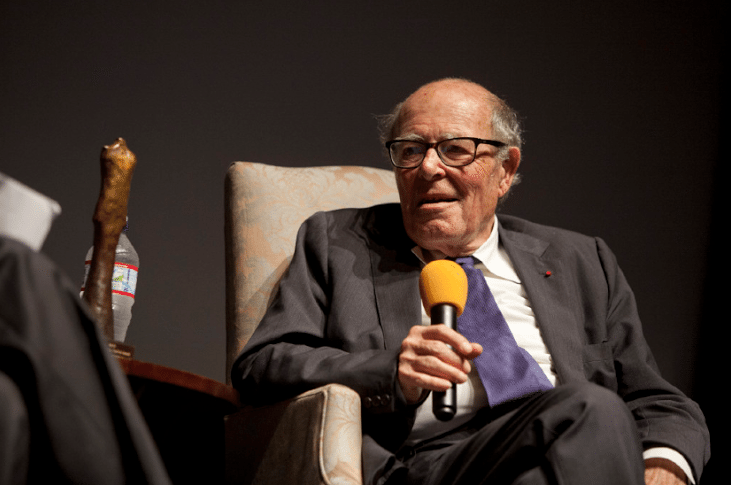
On Thursday, October 15, MVFF paid tribute to documentarian Marcel Ophuls. Born in Germany in 1927, Ophuls is considered one of the most important filmmakers of the world, garnering critical acclaim for his work including, The Sorrow and the Pity (1969), an Oscar-nominated examination of France under Nazi occupation, which was later featured in the story arc of Woody Allen’s Annie Hall; and Hotel Terminus: The Life and Times of Klaus Barbie (1988), which won an Academy Award for Best Documentary Feature.

Before screening ‘Ain’t Misbehavin’ (Un Voyageur), Ophuls explained how he made the 2013 autobiographical film as a precursor to his memoirs, and quipped that it’s “short” at 106 minutes (The Sorrow and the Pity runs 251 minutes; Hotel Terminus is 267 minutes).

Afterwards, Ophuls conversed on stage with Peter Stein, Peabody Award-winning filmmaker and former executive director of the San Francisco Jewish Film Festival. Ophuls discussed how most of his films were journalistic assignments, and that his best movie was The Memory of Justice.

Peter Stein: [The Memory of Justice (1976)] is a brave film because once again, you turn your attention toward the crimes under Nazism, but through the lens of the Vietnam War. And Algeria.

Marcel Ophuls: That’s the Nuremberg principle. It was supposed to bring justice to the world, and of course, it didn’t. Because there is no justice in the world. There can’t ever be. For a while, we felt it could be possible. No, these things are still with us, and the danger is still here.

Stein: Your films set a certain moral bar for what film can do in the way of exposing some deep national truths, starting with The Sorrow and the Pity. You’re revealing something about French activity during the occupation that was kind of an overturning of “an official version,” as Stanley Kauffmann used to call it. Was that intentional or did you discover that in the making of the film?

Ophuls: Both. The time had come for somebody to—in films, in books—put an end to the godless, Communist mythology about a country having all resist the invader. No country ever does that. In no crisis in life is that ever possible.

Stein: One of your great contributions to cinema is allowing a big story to fill a big space of time.

Ophuls: Actors can give you on the screen their personality in three minutes—great actors, even less. But for real people to stop being just talking heads, you have to give them time so that people can judge for themselves. I’m not the one who invented that. To me, documentaries are all about spontaneity.

Arts: Cut!

by Mal Karman

Believe it or not, the 38th Mill Valley Film Festival, which wrapped on Sunday with a closing night bash at Terrapin Crossroads, is now older than the median age in this country. While we predicted that Eddie Redmayne would win the Academy Award for Best Actor and told him so at last year’s festival, we won’t stick our necks out quite that far this time. But do look for Brie Larson to at least get trumpeted for a nomination for her role in Room.  

Not unprecedented, but still a bit of a longshot because of his age, 9-year-old Jacob Tremblay deserves a nom for supporting. To prep for the part as a young woman imprisoned for years with her little boy in a backyard shed, the disarmingly articulate Larson, whose agent told her that she would never get the role, says, “[I] trapped myself in my house for a month, with no TV, no junk food, no Internet, out of the sun, meditating a lot. I worked with trauma specialists, about what would happen to her mind, where survival is the main focus of the brain. I talked with doctors and a nutritionist about the effects of this imprisonment …

“It was complicated,” she continues. “It did seem insurmountable at first. I had to find her, look at who she was up to 17 when she was abducted. I wrote three diaries, for when she was 10, 14, and 15 or 16—my way of delving into an adolescent mind worrying about her body, wishing mom would let her get highlights. I tried to understand the frustration of what this woman would have to go through day after day.” Room won the MVFF Audience Favorite, Gold Award for 2015 U.S. Cinema. Look for it on Oscar night.

You can call us crazy (and you’d probably be right) but on the ninth day of the festival, we walked into Marcel Ophuls’ four-hour and 20-minute The Sorrow and the Pity, then dragged ourselves directly to the wacky Icelandic comedy Rams and, finally, practically crawled into a screening of Truth, a mere eight-plus hours of nonstop viewing. And, yes, we have an eye exam next week. The soon-to-be (on November 1) 88-year-old Ophuls appeared on stage for a tribute and an exchange with the audience, and spontaneously broke into song with “San Francisco, open your Golden Gate.” That was a bit of a curiosity for a man who candidly admitted to us that, on three occasions, he tried to kill himself.  “It’s the only way you can escape from life,” he said. “But as I didn’t succeed, I am here. You learn, as you get older, to become more interested in yourself. And that animals are preferable to people.”

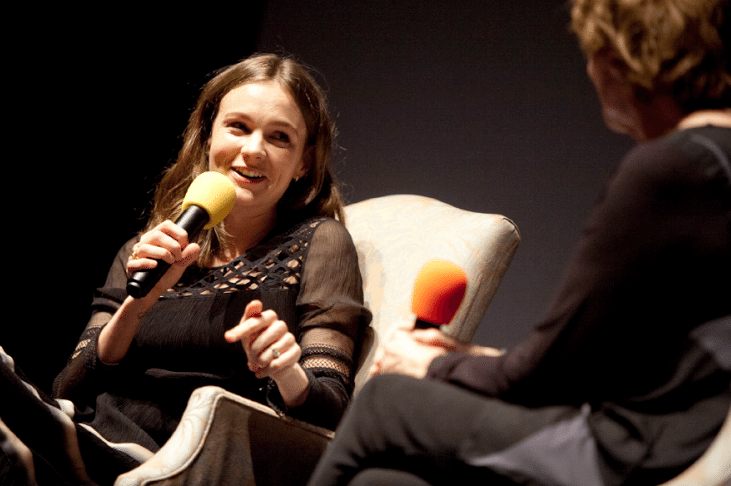
When Carey Mulligan met us on the red carpet she had tears in her eyes. We were about to ask if we were that frightening, but she explained that the California air had sent up alarm bells for her allergies. The British-born actress, who has the lead in Suffragette, about women’s fight for the right to vote in England, surprised us with the news that her career got off to a bumpy start.  First, her parents “were not wild about my going to drama school. I applied secretly to three and snuck away to audition, but I got rejected at all three. My mum and dad busted me and it was awful!” Then, after landing her first role (in Pride and Prejudice), she says, “I didn’t know what I was doing and I was freaked out acting in scenes with [legendary] Judi Dench. [Director] Joe Wright came up to me and said, ‘Carey, you actually need to do something.’ But I had nothing to do except giggle and run around and call room service. I thought all roles would be like this.” 

The hand-me-down clothes and toe-crunching shoes she wore in Suffragette could have easily dispelled that fantasy. Director Sarah Gavron says, “Carey prepped for this by going to work in a laundry and didn’t wash her hair for three weeks. And those clothes are made to be uncomfortable. I’d been trying to get this film done for 10 years and had Carey in mind right from the start.” (Really? Mulligan would have been but 20 a decade ago.) “We were told it would take almost a month to hear whether she would take on the part, so I went off on holiday. Two days later, I got a call she wanted to see us, so I flew back, talking to her for 15 minutes feverishly and without taking a breath until she stopped me and said, ‘I’ll do it.’ We built the cast (including Helena Bonham Carter and Meryl Streep) around her. There has never been a screen version of this issue. It is still relevant, there are still gender gap issues today.”  (Suffragette was the first film to ever receive an OK to film in the UK’s House of Parliament.)

Gandalf the Grey, otherwise known in real life as Sir Ian McKellen, jumped into the vat of estrogen by suggesting that he engage with audiences on the topic of women with whom he has worked, among others Ava Gardner, Judi Dench, Jane Seymour, Bridget Fonda, Greta Scacchi and Annette Bening. The last-minute McKellen Harem program, as we like to call it, proved a risqué success.

There was so much estrogen surging through this 11-day showcase with more than 40 films, exhibits and panels referencing the gender gap, salary gap, power gap and recognition gap that women face in the workplace today, we just have to wonder why Gap (clothing store) did not tear off its underwear to become a sponsor. Had any of us been in doubt about the fest’s focus on the female, we had only to look at a few of the film titles: The Girl in the Book, the Girl King, the Danish Girl, Black Girl, Bunny New Girl and The Satellite Girl and Milk Cow.

Tiburon’s Robin Hauser Reynolds took home a MVFF Audience Favorite Gold

Award in Active Cinema for her Code: Debugging the Gender Gap while San Anselmo’s Eli Adler and San Rafael’s Blair Gershkow captured an Audience Favorite, Gold Award for documentary filmmaking with their Surviving Skokie. Berkeley director Rob Nilsson, who has been landing films in the Mill Valley Film Festival since the festival was in its toddler years and this season premiered his Permission to Touch, jokes that sometimes he feels he is running a pyramid scheme, getting the funding for his next film just in time to use the money to complete his last one. Swiss German director Barbet Schroeder asked his mother to get out of her house in Ibiza for a month so he could shoot Amnesia there. Since the film screened here, she apparently agreed to go.

The 38th edition of the annual autumn event drew more than 68,000 to the festival’s venues in Mill Valley, Larkspur, Corte Madera and San Rafael. That’s a lot of movie-loving people moving through Marin.

Food & Drink: What to eat

by Tanya Henry

Based on author Michael Pollan’s book In Defense of Food, a new documentary (with the same title) offers up plenty of bite-sized nuggets about what we should be doing to improve our health as a nation. The Berkeley-based journalist’s seven-word mantra sums up his philosophy around helping Americans improve their eating habits: “Eat Food. Not too much. Mostly plants.”

The two-hour film, produced for public television, covers quite a bit of territory and includes everything from Pollan lecturing in a packed-to-capacity lecture hall, to historical examinations of how the media has covered food over the last 50 years, to the most current research and interviews with scientific experts studying the American diet.

Along with the vilification of the usual suspects—sugar, fat and salt, the film offers fascinating insight about the way in which microbes play crucial roles in our guts. Interestingly, a study of breast milk reveals how this “perfect food” offers newborns certain bacteria that fill up a portion of their intestines, disallowing harmful bacteria to invade. Likewise, there is ongoing research that explores ways in which we can learn to cultivate healthy microbiomes through diet to improve our health.

“It isn’t often that we find a simple answer for a very complicated problem,” says Pollan, who returns again and again throughout the film to the simple notion that eating real food that isn’t processed, that can be found in the outer aisles of our supermarkets and that our grandmothers would have eaten—is the right way to consume food.

Pollan, for those familiar with his work, is known for popularizing and blaming the notion of “nutritionism” on many of the health problems associated with our diets. He delves deep into this ideology that contends that the key to understanding food begins with the nutrient. He argues that since nutrients are invisible, it is necessary to rely on nutrition experts to make our food choices. He believes that this is where the problems began as certain nutrients became viewed as “good” and others as “evil.” He compares nutritionism to a religion, and blames many fads and misguided information on this religion-like concept that has us “looking for dietary salvation.”

Whether food is of great interest to viewers or not, this film is important for anyone who eats. In Defense of Food is a smorgasbord of fascinating historical perspective, important cultural findings and cutting-edge scientific research, all served up in accessible, right-sized, colorful bites.

Upfront: Renewable revolution

by Joseph Mayton

Editor’s note: This story is under review following reports of challenges to the veracity of Joseph Mayton’s reporting for other publications.

The addition of Belvedere and Mill Valley to the HERO (Home Energy Renovation Opportunity) Program earlier this month gives Marin County more than 126,000 homes under the program, which aims at giving access to financing for water and energy improvements. The goal of the program across the county is to increase energy reliance on local and sustainable efforts.

“It was a really good thing for us to have solar put in because it really reduced our bill and I know the program can help so many people who might not have known where to go first,” says Fairfax resident Ryan Hensin. He believes that those who join the program will see “some savings right away, and that is really nice.”

HERO Property Assessed Clean Energy (PACE) financing enables homeowners to make energy- and water-efficiency improvements and pay for them over time through their property tax bill. Interest is tax-deductible, and homeowners see immediate savings on utility bills.

Marin has quickly become a hub for PACE expansion and the county has approved the option for all residents of ‘unincorporated areas,” or roughly 50,000 homes. The cities of Belvedere, Fairfax, Larkspur, Mill Valley, Novato, San Anselmo, San Rafael and Tiburon have also approved HERO. Corte Madera, Ross and Sausalito have not yet voted on the program, leaving 8 percent of homes in the county unable to access HERO financing.

Across California, HERO serves more than 10.5 million households. The program has “helped fund more than 46,000 residential efficiency projects totaling more than $933 million in financing in California,” a statement issued by a public relations firm representing HERO read. “By stimulating home renovation activity, the HERO Program increases demand for local contractor services. HERO is estimated to have spurred the creation of more than 7,900 jobs in California since beginning in December 2011.”

With the state legislation recently passing new regulations that should see a reduction in urban water consumption by 25 percent, the new financing options should help residents meet and exceed the goals, says Vice President of Community Development for Renovate America Blair McNeill, the company in charge of the HERO Program’s administration.

“We are seeing the rising costs of energy and when I speak with homeowners, they really want to find ways to be environmentally friendly and cost effective,” McNeill says. “I think this program is the best solution right now to help people get their energy costs down, conserve water and at the same time not have it destroy the bank accounts.”

McNeill says that HERO finances the entirety of the improvement project and he believes that the length of time that HERO is involved helps residents understand the process and make it work. “It’s about bringing renewable and efficient technology within reach for a broad range of homeowners.”

Given the State of California’s recently adopted regulations aimed at reducing urban water consumption by 25 percent, PACE financing is a particularly appealing option for homeowners and for municipalities.

Through the HERO Program, residents are able to obtain access to high-efficiency toilets, faucets and showerheads, drip irrigation systems, rainwater catchment systems, artificial turf and drought-tolerant landscaping—all financed through the program and paid back through property taxes. McNeill believes that it is a win-win situation.

“This is just the beginning of the renewable revolution that is happening in California and we are seeing that Marin is very open and receptive to these ideas, so it is exciting to see how many homes will take advantage of this opportunity,” he says.

Some residents are using the HERO Program to install the most popular product, solar power panel installations and heating and cooling systems, as well as energy-saving windows and doors, roofing and insulation.

San Francisco-based contractor Marcus Samuelsen, who regularly works in Marin on housing projects, says that residents should understand that these products are better than the standard options available.

“What we are seeing right now is that people understand that by putting a few bucks forward now, they can save themselves in the long run and help to move California and the country in the direction off fossil fuels,” he says. “I think this project should be mandated for all new structures in order to really have an immediate impact. In today’s world, lagging behind is not good enough anymore.”

And the HERO Program’s success is a direct result of its extensive contractor network.

When a homeowner faces unexpected and inevitable repairs such as a broken water heater or leaking roof, HERO-qualified contractors can steer their customers toward more efficient upgrades.

“Homeowners can select a truly efficient product for their repair since they don’t have to put down large amounts of money upfront; they then enjoy immediate savings on water and/or energy bills,” the statement read.

Marin also hopes that the program will be a benefit through economic stimulus and local job growth, while helping their communities reach state-imposed water- and energy-saving goals.

According to HERO, an estimated “6.2 billion KwHs of energy are already being saved by projects completed to date. This is equivalent to the CO2 emissions from 38,000 homes’ energy use for a year. Water-efficiency projects HERO has helped finance to date will save 1.7 billion gallons of water, or the equivalent of 55 million showers.”

The HERO program has now been adopted by 352 communities in California, in 34 counties.

HERO’s success in California is part of a national trend, with PACE programs now enabled in more than 30 states. The new financing model is quickly becoming a cornerstone of America’s push for cleaner power and energy independence.

Cities and counties need only pass a resolution in order to make PACE programs like HERO available to local property owners. The program has received numerous awards, including the Governor’s Environmental and Economic Leadership Award, the Urban Land Institute Best of the Best and the Southern California Association of Governments President’s Award for Excellence. Taking part in the HERO program is 100 percent voluntary for both jurisdictions and property owners. The program is cost-neutral to participating local governments.

McNeill hopes that this is just the beginning of finding a way to get more California homes into the renewable sector without breaking the bank. “I think we are very aware of the high costs of living in the Bay Area and this translates beyond rents or mortgages, so anything we can do to help remedy these problems will be great for the people and our communities,” he says.

Hensin agrees with McNeill, but goes further in urging other Marin residents to follow up with HERO representatives in order to obtain the information needed to move forward on improvements.

“This is a great project, but I feel too many people still don’t know about it or are apprehensive because they think it is too expensive,” Hensin says. “We need to educate and get the word out to more and more people so this will be in all homes in Marin.”


Feature: The Power of Grace

0

by Joanne Williams

It takes 40 minutes to travel from Mill Valley to Sausalito by battery-operated wheelchair. Last September, Grace Dammann piloted her power chair on the bike path and took the ferry to the city for lunch. It was her first such foray, but she’s planning more independent ventures. This is her story since an accident in 2008 confined her body but not her mind.

Dr. Grace Dammann maneuvers her wheelchair next to the man seated across the room, takes both hands and gently massages his knuckles and joints. He smiles; his shoulders retreat from his ears. “I think you should get more exercise,” she says. “Do you swim in the pool? I know I need more exercise. I got this shiner under my right eye when I tried a new exercise and fell off the treadmill,” Dammann says. He chuckles at the attention as she continues to ask him how he’s doing.

Grace Dammann, MD, a 68-year-old, pixie-sized physician with short dark hair laced with silver, is director, founder (in 2006) and a team member of the first San Francisco in-patient unit for patients with chronic pain, located in a skilled nursing facility at San Francisco’s Laguna Honda Hospital and Rehabilitation Center. Dammann landed there after the near-death head-on collision on the Golden Gate Bridge in 2008 that put her in a wheelchair for life and resulted in a lawsuit against the Bridge District and the eventual installation of a moveable median barrier last year.

Every Thursday in a bright airy room in the new wing of the hospital at the foot of Twin Peaks, she and eight other professionals—acupuncturists, massage therapists, occupational therapists, advanced care nurses, substance abuse workers, pharmacists, physicians and a psychiatrist—attend to disabled residents, one at a time, to tame their pain.

The pain clinic’s mandate of compassionate care is clearing away the underbrush of confusion when it comes to pain management—trying alternative techniques besides medication. Clinic team member Dan Rybold, M.D., an acupuncturist and family practice physician, believes pain is blocked energy. “By releasing blockage the energy can flow again,” he says. The pain clinic uses various techniques, from foot and neck massage, talk therapy and meditation to yoga, Qigong, acupuncture and a vibration acupuncture called acutonics, a method using tuning forks that vibrate and are believed to release blocked energy. Medication, including medical marijuana, can be part of the recommendation, particularly with AIDS patients.

The morning begins at 9am with a staff meeting to discuss patient progress and a new patient, who requires a translator. “There is a family member who wants to direct treatment,” Dr. Dan says. (It’s hard to use their formal title in this relaxed setting). “The patient has multiple system failure. How do we handle this?” The ensuing conversation is off-limits to this reporter. Before the team breaks—they will see 30 patients today—they take time for 10 minutes of meditation together.

At around 10 o’clock, patients arrive, some walking, some in wheelchairs, one lively woman in bed who likes to chat about anything. Dr. Rybold speaks in Spanish to a man from Vera Cruz with a colostomy bag hanging from his waist and places acupuncture needles in his ear and on the top of his head. He makes no sound and accepts the needles while he and Dan converse in Spanish like old friends. “How are you feeling today?” Dan asks. “Where are you hurting?”

On the other side of the room, Alice Wong, an activity specialist, wields the acutonic tuning forks, different colors for various vibrations, smacking them against a small disc strapped to her thigh with the verve of a Taiko drummer, and as the wood and metal forks begin to vibrate she passes them over the painful areas on the patient. “It helps with diabetic pain, arthritis, AIDS inflammation and similar discomfort,” she says. (Alice and Dan met at the pain clinic and were married by Grace at the Zen Center at Green Gulch Farm in Marin.)

Pain is the fifth vital sign, after pulse-rate, respiration, body temperature and blood pressure, and physicians are beginning to pay more attention to it. The pain clinic at Laguna Honda has developed various alternative methods of treatment that have been noticed nationally. “They try to use alternative treatments long enough on a patient to see what works for each patient,” Dammann says. Among them: Mid-morning, the clinic lights are dimmed and the team and the entire group of patients close their eyes for a 10-minute meditation.

If these procedures seem too far out they appear to work. “My own experience after the near-fatal accident on the Golden Gate Bridge that resulted in 15 surgeries and 58 units of blood led me to research pain and palliative care. I was bored being a patient myself,” Dammann says. “When I was cleared to work again and I was offered the pain clinic at Laguna Honda I didn’t want to do it, but as I thought about it, physicians need pain education, and who better to teach it than a disabled physician. I believe in patient-centered care. Pain is under-treated and the medical community realized it needed to be addressed. It is very complicated and has very little to do with physical symptoms but everything to do with how a person experiences it.”

Grace Meigs Dammann grew up in a small town near Winnetka, Illinois, from a long line of physicians—she’s seventh in the chronology, and the oldest of four siblings. Her grandmother was a pediatric physician, a contemporary of Jane Addams who started Hull House, the first Settlement House in Chicago that started the social welfare movement. Grace received her B.A. from Smith College, went on to Yale Divinity School where she graduated as an agnostic but was impressed with the idea of belief.

From there Dammann moved to Wisconsin, where she received her MSW, gravitated further west and asked for guidance from her then deceased grandmother, who advised her in a dream to go to medical school. Dammann enrolled at Mills College for pre-med, and then “all the doors opened,” she says. At 35 she continued her studies, received her M.D. from UCSF in 1986 and in 1990 established the first AIDS inpatient unit in a skilled nursing facility at Laguna Honda.

Before the horrific head-on collision that put her in a wheelchair for life, Dammann had lived for 27 years at the Zen Center at Green Gulch Farm above Muir Beach in Marin with her partner, Nancy “Fu,” Schroeder and their adopted daughter Sabrina. She also maintained an AIDS and family practice in Mill Valley and was directing the first AIDS clinic for poor people at Laguna Honda Hospital.

Both Sabrina and their beloved dog, Mack, survived the accident (Fu was not in the car), but Dammann had so many internal injuries and broken bones she was not expected to survive. But after nearly two months in a coma she woke up. “I was glad to be alive,” she says, even with multiple injuries. Colleagues at Laguna

Grace Dammann gets rehabilitation help from her partner, Nancy "Fu" Schroeder.
Grace Dammann gets rehabilitation help from her partner, Nancy “Fu” Schroeder. Photo by Mark Lipman.

Honda gave up a year of sick days to maintain her salary during rehab. Her arduous rehabilitation is captured in the 2014 documentary States of Grace by her longtime friends, filmmakers Helen S. Cohen and Mark Lipman.

In 2010 Dammann left the hospital and resumed life at Green Gulch, where she had worked in the garden and in the kitchen while maintaining her public health jobs. It was not an easy adjustment. Fu made a five-year commitment to take care of her partner, yet they had always had differences. “I am an extrovert and Fu is an introvert,” Dammann says. “Being a 24/7 caregiver is an impossible job. Fu wanted a more monastic life, and I wanted to go back to work. I gotta get a job, I told Fu. It was a bad joke. Also I wanted to be ordained as a Buddhist priest. I had missed a year and a half of Sabrina’s life as a teenager. I had arm and leg surgery, foot surgery. When I first woke up I was glad to be alive. Then I became frustrated by my limitations. I wanted to dance, to surf.”

The offer in 2011 to create a pain clinic turned out to be a gift. “I hired Dan Rybold and we quickly pulled a team together who wanted to work with us on this alternative approach to pain management,” she says.

Last month, Dammann was invited by Harvard University Medical School to teach compassionate care to third-year medical students. She also taught the medical staff at Brown University, in both instances using her case history in States of Grace, which has become a valuable teaching tool. The National Institutes of Health and other hospitals nationwide are now studying pain management and compassionate care. Dammann herself is now off of pain medications because she believes in her case that they intensify pain if one becomes dependent on them and then tries to stop.

Today, Dammann has a unique vision of her task. “The role of the healer is to help make patients happier,” she says. “I tell my staff if you are depressed don’t come to the office. I learned from being a patient the importance of relationship-centered care, of compassionate care. To me this is not work.”

During the six-year period that marked the AIDS disease’s deadliest era, Dammann signed more than 1,000 death certificates. The Dalai Lama honored her work with an Unsung Heroes of Compassion Award in 2005.

Perhaps Dammann’s capacity for pain is due to her Buddhist philosophy and her ambition to become ordained. Her left hand is still crippled from the accident, and she struggles to use it, but she managed to finish 15,000 tiny stitches on the garment that she will wear if ordained.  

Now living at The Redwoods retirement community in Mill Valley, Dammann starts her day with meditation at 5:30am. A hummingbird feeder hangs above her apartment door facing the marsh and Tibetan prayer flags greet the breezes. Mack’s water dish sits near a smiling Buddha statue. Dammann tried the treadmill again and with a physical therapist makes a strenuous effort to walk. After her trip to Boston she officiated at a wedding in Santa Barbara, then went to Bellingham, Washington to do more professional consultation.

Dammann has learned to accept change. Her Buddhist philosophy helps.

“You can’t argue with what is, that can create more suffering,” she says. “I remember after my accident what pleasure I experienced for my first shower. It was better than sex. You can’t control what happens but you can control how you behave in response. Now I have learned to say yes to everything, to travel, to everything that presents itself.”

Dammann won’t run the Bay to Breakers again, but she anticipates more journeys on her power chair, like her trip to the Ferry Building. She has occasional twinges when crossing the Golden Gate Bridge because of the memory, but for her weekly commute she takes the Whistlestop bus or has a driver with her personal wheelchair-accessible van. To stay engaged at Green Gulch, she spends two days a week in the office, answering the phone and taking reservations for visitors. She’s also a fan of the Golden State Warriors.

As Dammann writes in Lessons from an Accident, published online at Awakin.org, “I realize now that my greatest happiness in life has been in my service to people, particularly the joy that comes from being totally present with my own and their suffering. When I woke up from my coma I had new insight, I understood that I hadn’t completely shown up in life. My new emphasis in service is to remind myself of this motto, ‘Do it now, just do it now.’ Whatever life offers, take it.

*   *   *

The Lawsuit

Written by Grace Dammann’s attorney, John Stein (Boccardo Law Firm of San Jose)  

Grace Dammann sued the Golden Gate Bridge District because she believed head-on collisions could be avoided with a median barrier. After five years of litigation starting in 2009, the Golden Gate Bridge District finally agreed to install a moveable median barrier. From receipt of money to construction, it took another six years to get it done. There is a legal principle called design immunity in the government code that makes it difficult for members of the public to re-engineer public bridges and roadways.

In 1990, the same company that installed a median barrier on the Golden Gate Bridge, installed a moveable barrier on the Auckland Bridge in New Zealand that resulted in a dramatic overall reduction of accidents, and totally eliminated dangerous ‘cross over’ collisions. Caltrans had studied this engineering breakthrough, and in 1998 a moveable median barrier was installed on the Coronado Bridge in Southern California that again resulted in a total elimination of head-on crossover accidents and a 20 percent reduction in overall accidents. The Chief Engineer of the Golden Gate Bridge District, Merv Giacomini, recommended installing the median barrier in 1998 but the report was buried for eight years.

The lawsuit drew the attention of California legislators. Nancy Pelosi and Barbara Boxer earmarked $10 million for the construction of the median barrier. The Metropolitan Transport Commission contributed another $5 million from one of its funds, which finally resulted in the installation of the movable median barrier (January 11, 2015). There hasn’t been a head-on collision since. We lost the battle, but we won the war. It was a painful loss for us but an important victory for Grace and everyone who travels the bridge.

Free Will Astrology

By Rob Brezsny ARIES (March 21-April 19): According to the online etymological dictionary, the verb “fascinate” entered the English language in the 16th century. It was derived from the Middle French fasciner and the Latin fascinatus, which are translated as “bewitch, enchant, put under a spell.” In the 19th century, “fascinate” expanded in meaning to include “delight, attract, hold the...

Advice Goddess

advice goddess
By Amy Alkon Q: Two friends of mine are in “love at first sight” relationships. (One went from chills at seeing the guy to moving in with him weeks later.) Each has said to me, “When it’s right, you just know.” Well, as I get to know this new guy I’m seeing, I like him more and more. It’s just...

This week in the Pacific Sun

This week in the Pacific Sun, you'll find our cover story, by Joanne Williams, on physician Grace Dammann, who survived a 2008 head-on collision on the Golden Gate Bridge, and who now works with chronic pain patients. On top of that, Joseph Mayton writes about Marin homeowners saving energy and water by adopting the HERO Program, Tanya Henry reports...

Music: Melding art

by Steve Heilig Poetry married with jazz enjoyed a brief heyday in the San Francisco Bay Area and elsewhere during the fabled Beatnik era, although legendary poet Kenneth Rexroth reportedly called the melange “a shotgun wedding.” Still, some musicians and poets have soldiered on, melding carefully chosen poetic forms and adventurous music into something, well, cool indeed. Longtime Marin cohorts Peter...

Theater: Tiny fragments

by David Templeton In Mary Shelley’s Frankenstein, as everyone knows, a creature is assembled from dead body parts and granted the spark of life. In Trevor Allen’s The Creature—a daring, artful, but ultimately problematic adaptation, the playwright puts Victor Frankenstein’s creation process in reverse, taking the original story apart and reassembling it into something similar, but entirely different. Like Victor Frankenstein’s...

Arts: Lifetimes of achievement

by Samantha Campos Sir Ian McKellen arrived to a legion of fans who’d gathered on the sidewalk alongside a red carpet leading into the Smith Rafael Film Center on Sunday, October 11. Accompanied by an entourage, McKellen walked, beaming, towards the photographers’ pen, stopping short to ensure that a young girl got “a good shot.” Inside the theater a few minutes...

Arts: Cut!

by Mal Karman Believe it or not, the 38th Mill Valley Film Festival, which wrapped on Sunday with a closing night bash at Terrapin Crossroads, is now older than the median age in this country. While we predicted that Eddie Redmayne would win the Academy Award for Best Actor and told him so at last year’s festival, we won’t stick...

Food & Drink: What to eat

by Tanya Henry Based on author Michael Pollan’s book In Defense of Food, a new documentary (with the same title) offers up plenty of bite-sized nuggets about what we should be doing to improve our health as a nation. The Berkeley-based journalist’s seven-word mantra sums up his philosophy around helping Americans improve their eating habits: “Eat Food. Not too much....

Upfront: Renewable revolution

by Joseph Mayton Editor's note: This story is under review following reports of challenges to the veracity of Joseph Mayton's reporting for other publications. The addition of Belvedere and Mill Valley to the HERO (Home Energy Renovation Opportunity) Program earlier this month gives Marin County more than 126,000 homes under the program, which aims at giving access to financing for water...

Feature: The Power of Grace

by Joanne Williams It takes 40 minutes to travel from Mill Valley to Sausalito by battery-operated wheelchair. Last September, Grace Dammann piloted her power chair on the bike path and took the ferry to the city for lunch. It was her first such foray, but she’s planning more independent ventures. This is her story since an accident in 2008 confined...
3,002FansLike
3,850FollowersFollow