Advice Goddess

Q: I’m a slim woman in my early 40s—successful in my field—and I am always in jeans, a vintage ripped t-shirt, and boots. I mean, always. Granted, I have an extremely expensive handbag and perfectly highlighted blonde hair, and I always wear winged eyeliner. My friends say that going “underdressed” like this is disrespectful and inappropriate for (corporate-type) business meetings. Are they right, or is rocking your own thing no matter what a sign of confidence? (P.S. I’d kill myself before I’d wear a blazer.)—Punk Rock Corporate

A: There’s actually something to be said for a person who goes into an important business meeting dressed like one of their LinkedIn endorsements is “Aggressive Panhandling.”

Sure, to a lot of people, it looks like career suicide in progress. However, research by Harvard Business School’s Francesca Gino suggests that rebelling against norms for business attire can make you come off as higher status than people who dress all junior CEO.

Gino ran a number of experiments that led her to this conclusion, but my favorite is from a seminar on negotiations she taught at Harvard to two different groups of bigwigs in business, government and philanthropy. For each session, she dressed in the requisite “business boring”—a dark blue Hugo Boss suit and a white silk blouse. But then, for her second session, she paired this outfit with a pair of red Converse high-tops. As she made her way to the classroom, a few fellow professors did give her the WTF-eye. However, seminar participants, surveyed after each session, guessed that she was higher in status and had a pricier consulting rate when she was wearing the red sneaks.

Gino explains that a person who is seen to be deliberately violating workplace wardrobe norms sends a message that they are so powerful that they can shrug off the potential costs of not following convention.

Anthropologists and zoologists call this a costly signal: a trait or behavior that’s so wastefully extravagant and/or survival-threatening that only the highest-quality, most mojo-rific people or critters could afford to display it. This, in turn, suggests to observers (whether predators or predatory executives) that it’s more likely to be legit—and not false advertising.

Q: I’ve long been a “Shallow Hal,” attracted to women’s youth and physical beauty and less concerned with integrity. Not surprisingly, I keep getting into relationships with women who aren’t very good people. How can I stop being so superficial?—Man With Eyes

A: It isn’t wrong to initially be looks-driven: “Now, she’s a woman I wanna have sex with!”—as opposed to “Now, she’s a woman I wanna debate on Jeremy Bentham’s views on utilitarianism!”

Also, you should no more feel guilty for being drawn to young women than you would for having your taste buds be more “All aboard, baby!” for chocolate cake than for a “burger” made out of broccolini. This preference evolved to solve the “How do I pass on my genes?” problem for our male ancestors.

However, it helps to understand what psychologist Daniel Kahneman has explained as our two thinking systems—fast and slow. Our fast system is emotion-driven, rising up automatically, and is often home to toddler-like demands: “Gimme cake!” Our slow system, the home of rational thought, needs to be forced to do its job—examining our impulses and assessing whether it’s wise for us to run with them.

In other words, your problem comes from running with your initial impulse without putting it through the Department of Reasoning. Though it’s natural to be led by your eyes, you need to implement a next step—assessing the character of these foxerellas before you turn them into girlfriends.

Visions of Moderation


By Bill Smith

The good old days were the good because you were young. As a rule, wherever you spent your 20s, the memories you made are precious and enduring. I was lucky. I made mine in the Bay Area in the 1990s: affordable rents, barbecued oysters on Drake’s Bay, biking over the bridge to the Marin Headlands or over to Sausalito for the ferry ride back to The City. A super beef-tongue burrito at La Cumbre cost less than $4 and Capp Street Project was on Capp Street. For a time, you could smoke in bars, restaurants and cafes. That was also the last time I took psychedelics—a magical day amidst the undulating redwoods of Muir Woods.

I thought I had left those days far behind me until a crisis loomed and I knew I needed to make some adjustments fast. My son was going off to college, my cannabis-addicted mother was going off the deep end, and I really had to quit smoking cigarettes. I had just finished Michael Pollan’s new book on the healing power of psychedelics, How to Change Your Mind.

I figured that a guided psychedelic experience could provide the quick jolt of therapy I needed, so I contacted a local shaman who worked with ayahuasca. The irony of scrambling my brains with a hallucinogenic DMT concoction from the Amazon to unscramble my comparatively cushy American life is not lost on me. But my insurance deductible puts regular therapy out of reach.

Alan Watts said this of the psychedelic experience: “If you get the message, hang up the phone.” I honestly don’t recall any message from my drug-induced 20s. I’m not sure if I even hung up or just hit “hold.” But I was about to pick up that phone again. Only now I wasn’t a carefree kid with most of his unexplored life ahead; I was a stressed-out 52-year-old single father with most of his unexamined life behind him.

Two weeks before my ayahuasca “sit,” I got instructions for how to prepare: “Rest, reflect on your intention, walk easily and eat whole foods—no red meat, alcohol, marijuana or other drugs. Consider lowering or avoiding coffee, sugar and salt.” The hardest thing for was to cut back to one cup of coffee a day.

I wasn’t surprised that marijuana was on the prohibited list. I started smoking marijuana in high school, but I’d stopped in college. The reason it took me even that long was that I was too intoxicated to notice how dull-witted, unproductively introspective, isolated and boring it made me. What’s surprising, in retrospect, is that I ever started smoking marijuana at all. I was raised by a “stoner,” which is to say, I raised myself. And, after a lifetime of smoking marijuana, my mother was the same emotionally stunted, rage-filled, paranoid narcissist she was when I was a kid.

So, as far as I’m concerned, there’s no message to be gotten from cannabis. There’s nothing on the other end of that line. That the shaman and “Grandma Ayahuasca” frowned on it made sense to me. If you’re looking for clarity, insight and growth from one drug, you should first step out of the paralyzing fog from another.

How my son turned out the way he did is beyond me. I was going to miss him when he left for college, but I was unprepared for exactly how much until I returned home unexpectedly one night recently, and found the aftermath of a teen party.

Popcorn and tortilla chips were scattered on the sofa and floor; two half empty bottles of Coke and ginger ale with their caps off sat on the coffee table, along with a half-eaten pan of brownies. Uh-oh. I took a bite.

It was pure brownie.

Who is this kid? When I was 16 I was climbing out my bedroom window to take LSD and drink and smoke anything and everything I could get my hands on. And now my own son wasn’t even having interesting parties when Dad was away. As I chewed on the brownie, it hit me how integral my son is to my identity. I’m going to miss the boy when he goes off to school in a way I hadn’t missed anyone since my father died.

Well then. After two weeks of minor deprivation and self-reflection, I arrived at the gathering place: a basement rec room in the basement in a subdivision. Most of the 15 other “sitters” seemed to be in their late 30s or early 40s. All were white. As we waited for the shaman we chatted. It seemed like half the group was in tech, the other half was in art. Half had money, but little meaning, and the other half had meaning, but little money. Only three of us seemed to have a profound need for healing: a recovering heroin addict, a man with obvious mental illness, and a woman who just got diagnosed with a death sentence in the form of Huntington’s Disease. The rest of the group was like me: the walking wounded.

When the shaman and his wife arrived they introduced themselves by their actual names and then by their shamanic names. We were in their home. They trusted us, we should trust them. He had taken ayahuasca more than 2,000 times. They explained what to expect with the “medicine,” how the visions were a gift from the plants’ spirit they called “Grandmother.”

The experience was visceral, physical and intellectual. It will connect you to your body in new ways. For the first 20 minutes after drinking the tea, there will be nothing.

Then the visions will begin, as if a switch was flipped. We were told, don’t fight it. Let Grandmother guide you and you will learn what you need to learn, though not necessarily what you thought you needed to learn.

A prayer was sung, sage and herbs were smudged, and the seekers, one by one, went before the shaman. Each sat or kneltkneeled and made some blessing while he stared into their eyes and measured out a portion of the ayahuasca, blew on it rapidly three times and then handed them the cup. When it was my turn I downed it without hesitation. It was viscous, thick and pulpy and tasted like licorice. Not unpleasant. I then returned to my spot and waited and watched.

The Shaman drank a big cup of tea and then his wife turned the overhead lights off. The room was candle-lit and the Shaman went around to each of us with his eagle feather. He touched the feather to our heads and shoulders, and waved them about our bodies. I noticed he spent a little extra time with the Huntington’s woman, the man with mental illness, and the heroin addict. When he returned to his seat, he began beating on a drum and singing. I guessed it was Quichua. It was rhythmic and powerful. His wife then joined in with harmonies, and it became so ethereally beautiful that I almost cried. Someone blew out the candles and we were left with only the moonlight, smoldering sage and the shamanic singing to guide us.

The purging started with the artist to my right. He doubled over, convulsed, and spewed a mighty torrent. I was worried the little bucket would overflow, but as quickly as he started, he stopped. I was surprised the sound didn’t gross me out. It didn’t even make me queasy. And there was no nausea-inducing smell. A benefit of the diet, no doubt. The vomiting then moved around the yurt like the fountains at the Bellagio. I stifled laughter, shut my eyes, and the visions began.

Geometric patterns shot across my eyelids until I was swimming in them. I felt a kindness welling up, some entity entering me. Grandmother! The visions were intense, but my ego, the “I” in my narrative, never completely dissolved. This was fine with me. Grandmother was kind. Her lessons had such a gentle wisdom that I spent much of the night softly laughing.

First she “looked” at me and gave me a quizzical smile: “You are fundamentally a happy person! Deep-down you are happy.”

“Really?” I thought.

And she smiled and shook her head in bemusement: “You seem to feel the need to pay for that happiness with being unhappy? That’s so funny! You don’t pay for happiness with misery! You pay by enjoying it! By sharing it!”

Then she took a tour around my body, racing like a child through a new house who opens up every door to peek inside each room. She would occasionally stop and I would notice—heart and beat; lungs and breath; she opened every door and bounced on every bed and sofa. When she was bouncing around my abdomen, I noticed a pain in my shoulder from my arthritis. She then bounded up to the pain, and as she explored my shoulder, the pain quickly and gently melted away. Same with my tortured knee. I recall wondering if DMT or the other chemicals in my body at the moment had anti-inflammatory properties. But even though I was making a more clinical evaluation than your typical mystic on potent drugs, I still said, “Thank you” to Grandmother. Whatever I chose to call it, this was powerful medicine.

“I am blessed!” was the next lesson from Grandmother. This message was, again, delivered with seeming wide-eyed wonderment and boundless love. This wasn’t guilt over my white, male privilege. It wasn’t nearly so rational or abstract as that. I actually felt these blessings: I had a comfortable home, a remarkable son, good friends, a creative and supportive community. My life was abundant with meaning. And again, gently, she pointed out the absurd calculus I made in paying for these blessings with guilt and self-loathing. Deserving or not deserving was not a part of the equation. You pay for your blessings by honoring them, by sharing them, by tending to them. But what does honoring your blessings look like? Is it as simple as keeping the house tidier? Unclogging the sink in a timely manner? Not chastising the boy when he spaces out and drops his wet towels on the floor eight inches from the laundry basket?

“That’s a start,” came her reply. “I think I could manage that,” I thought.

The final two lessons were simple and quick. They, too, involved reframing a problem that allowed the possibility for, if not resolution, then at least management. I saw my mother as a sad, confused, angry old woman who reflexively drove away the one thing she craved: love. “Have some pity on this old lady. She is powerless,” came the voice. “Yeah,” I agreed. And again, I felt it deeply. Seeing her in this light bypassed all my triggers and defenses and I was able for the first time ever to generate some sympathy for that woman.

Last came the smoking. “You can choose to have a cigarette, or to not have a cigarette. Just be sure it is you who is choosing. Say, ‘I am choosing to smoke this cigarette now, or I am choosing not to have this cigarette now.’” All of a sudden, I felt some agency in my relationship with tobacco. We actually practiced this a few times: “I choose not to smoke right now.” It seemed to work. A lot seemed to work with Grandmother holding your hand.

At some point Grandmother showed me a gate. It was of brown, twisted vines interwoven with hundreds of faces. Behind the gate was the real trial and transformation;, ego death and rebirth. I asked her if we were going through that gate. She smiled a compassionate smile and led me away: apparently not. Although I would have trusted the lesson that lay beyond it, I was relieved.

Throughout the evening the chanting and singing would come and go. It would pull us back, and refocus the visions, and remind us of our intentions, our “work.” At one point I sat up and opened my eyes. Sprawled all about the yurt were bodies; some prone, a few sitting upright, some twisting and heaving, some completely still. It occurred to me that if someone walked in here they would think this no different from a nineteenthan nineteenth century opium den. How would anybody know that this mass of shivering, twitching, writhing humanity was working on healing intentions and not just taking a holiday from the barely tolerable misery of modern life?

It’s hard to say if or when I awoke, because it’s hard to say if I ever slept. It seemed to me that the visions traversed both realms and blurred the distinction between my sleeping and waking self. At last I felt Grandmother had taken her leave of me and I sat up and looked around the yurt. It took me a moment to be sure that it was dawn coming through the opening in the center and not the moonlight. There were only two other bodies left Everybody else had gone back to the heated rec room.It was cold. So I bundled up my blanket and pillow and headed toward some warmth. In the rec room, I found a spot on the floor and promptly fell asleep.

Later when I was driving home, Ihome I felt like I was returning from summer camp. We had all hugged each other goodbye with a warmth that was astonishing considering we spent less than two days together and I couldn’t tell you a single one of their names. During the ride back home I chose to not have three cigarettes. I chose to have one. And I enjoyed the hell out of it.

Later that evening I found the boy reading in bed. He gave me a “Hey Dad,” without looking up from his book.

“You know, we are really fortunate.”

“Yeah.”

“We are, for lack of a better word, ‘blessed.’”

He cocked his head.

“We have a nice home, we have plenty to eat, we have an amazing community. And it’s not a question of whether we deserve these blessings or not, it’s our job to . . . honor them.”

“OK . . .

“Sometimes we feel like we have to pay for them by not acknowledging them or by not taking care of them properly, but that’s silly. We should tend to our blessings.”

Now his book was completely down, and he was looking at me as if there was some joke he wasn’t quite getting.

“We should, you know, tidy up more, do the dishes after dinner, put away our clothes.”

An audible sigh escaped from his lips.

“For a second, I thought you’d joined some Christian cult,” he said. We laughed, each honoring, in our way, the blessing of the other.

It’s been four weeks since my session with Grandmother. I still smoke, but I do it deliberately. I “choose” to have eight to 10 cigarettes a day. I drink one cup of coffee in the morning and I keep the house a bit tidier than before. I am grateful for a son who has not dulled himself with marijuana, and more forgiving toward a mother who has.

Bill Smith is a pseudonym. The author is a public educator and former Bay Area resident.

Henry the Great

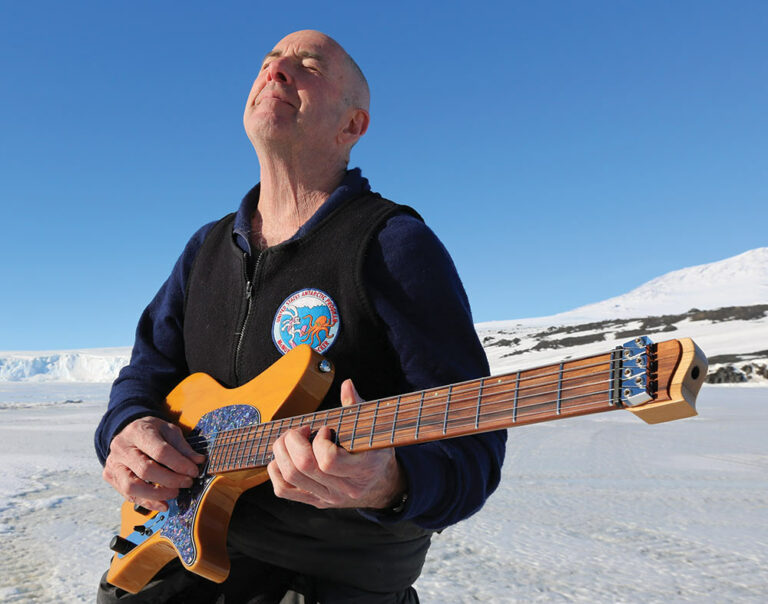
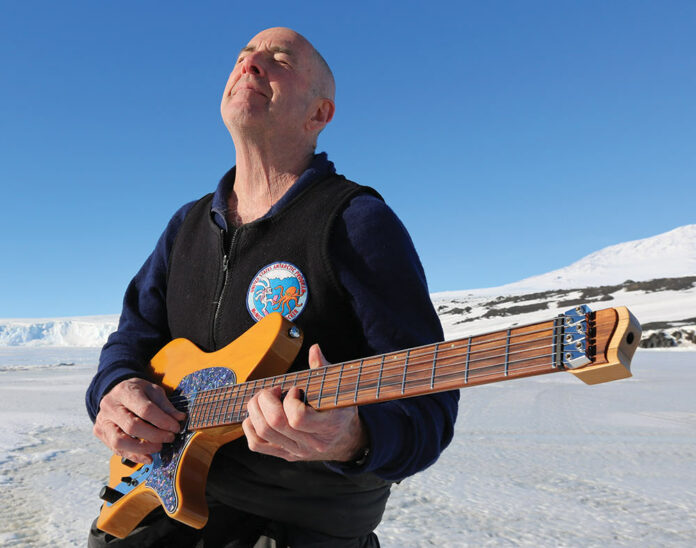
For most mortals, a single major accomplishment can be satisfying enough for one lifetime. Being an Academy Award–nominated producer, say; or a director-composer and cinematographer for multiple television series; or a university professor for nearly two decades; or a research diver with one of the highest numbers of dives under Antarctic sea ice; or creating your own record label still going strong in its fifth decade; or collaborating with an unprecedented array of artists across numerous genres from many different cultures—or, say, being one of the most outstanding guitarists of your generation—would be a laurel quite large enough to rest on.

Not so for Henry Kaiser, whose Promethean achievements encompass all of these and much else.

But let’s focus for the moment on Henry Kaiser, guitarist. Picking up the guitar at the comparatively late age of 20 and emerging as a cutting-edge improviser in the late seventies, Kaiser has continued to record an incomparably broad variety of music very much in keeping with his wide-ranging interests and influences. In a discography now north of 300 releases, one thing that becomes abundantly clear is how much this man loves to play, with an instantly recognizable, invigorating tone and sky (or is that sea?) diver’s fearlessness, and one who equally esteems the process of collaboration with many different kinds of artists.

That love of playing will be on full display during the weekend of April 20 as Kaiser performs in tributes to two major inspirational figures for him. First, on the exalted marijuana holiday itself, Kaiser will join longtime friends and collaborators Rova Saxophone Quartet among many others for “Fly! Fly! Fly! Fly! Fly! A Tribute to Cecil Taylor” at CounterPulse in San Francisco. And the following day finds him once more joining drummer John Hanrahan’s ongoing project, performing the classic suite by the late saxophone titan John Coltrane, A Love Supreme, at Sweetwater Music Hall in Mill Valley.

Reached at his home near the Santa Cruz mountains, Kaiser recalled the memorable first time he heard Coltrane.

“Some girl played A Love Supreme for me in her dorm room while we made out on her bed! So, it made a strong impression,” he says.

Hanrahan has been leading the Coltrane project for several years with the work’s original instrumentation and recently decided to take the work in an electric direction. One of the first people he contacted was Kaiser. He was in, but said to Hanrahan, “Let’s get some more electric players with us—let’s open it up and not do it all reverent.”

On April 21, Hanrahan and Kaiser will be joined at Sweetwater Music Hall by violinist Mads Tolling, keyboardist Scott Looney and bassist Murph Murphy. It’s one of several electric incarnations for this project, which has included such musicians as guitarist Steve Kimock as well as the legendary bassist for the iconic West Coast punk band the Minutemen, Mike Watt.

“Watt’s a super Coltrane freak and he was kinda terrified to do it,” Kaiser says. “And the big surprise about A Love Supreme is that it’s something that’s open. It’s a recipe and it makes different things every time. Like the Grateful Dead’s ‘Dark Star,’ it has a strong identity of its own that takes over and you don’t know what’s going to happen.”

That’s a telling reference both from Kaiser’s influences and his own discography, one that features several instances of him playing the Dead’s psychedelic anthem “Dark Star,” starting with a sidelong rendition on his 1988 album Those Who Know History Are Doomed To Repeat It, recorded for the Minutemen’s label SST Records. Kaiser has been effusive in his praise of the Dead over the years, extolling their pioneering blending of styles and their range of expression from the most familiar to the most avant of gardes, strikingly similar to Kaiser’s own musical journey.

His embrace of widely different musical approaches has resulted in a truly multicultural catalog, with Kaiser exploring music from Africa, India, Japan, Korea, Norway and elsewhere. Perhaps his most popular world music endeavor was his celebrated collaboration with fellow guitarist David Lindley and several musicians from Madagascar on the joyous two-volume A World Out Of Time.

“Lindley and I did not take any money for it,” Kaiser recalls. “All the money went to the Malagasy people. We set up a special publishing deal where they got 90 percent of the publishing and all the proceeds from it. That was sort of a protest against certain first-world artists who badly exploited third-world artists, including stealing their songs and their publishing.”

Alongside all this musical activity has been a parallel career as a research diver and educator. “I taught scientific diving at UC Berkeley since the mid-80s,” says Kaiser. “When our program went away in 2001, I became a diver in the U.S. Antarctic program and I’ve had 13 deployments. And I have the seventh-most dives in the program.”

This experience, in conjunction with his work in film and video, has served him well over the years, not least when he was nominated for an Academy Award as a producer while also serving as soundtrack artist and both land and underwater cinematographer for Encounters at the End of the World, one of several documentaries he has worked on for German director Werner Herzog.

“I met Werner sitting next to him on an airplane years ago,” says Kaiser. “I was a soundtrack advisor to Little Dieter Needs to Fly, I was a cameraman on The Wild Blue Yonder, I was a soundtrack producer on Grizzly Man and then I did the soundtrack and was cameraman on Encounters. And I was the producer, because nobody wanted to be in charge of Werner! So, I got the job and also got to do the soundtrack for it with Lindley. I was lucky.”

Kaiser’s accomplishments seemingly know no bounds in yet another ideal metaphor for his music. One irony, sharper as we approach April 20, is that this self-described “psychedelic” guitarist has famously never taken drugs. When asked what “psychedelic” means for him in this context, Kaiser replies, “It means what Salvador Dalí said: I don’t need drugs, I AM drugs!”

Kaiser expands on this thought in a follow-up email, writing, “I get the feeling that what my guitar has to say is psychedelic, rather than coming from psychedelics.

“When you were a preschool kid, did you–like me–lay in your dark bedroom at night and press on the lids of your eyes to generate phosphene patterns of internal light that danced in your head before going to sleep each night? Even though it may look like I’m smiling at the drummer or the audience, inside my mind, and without the addition of recreational chemicals, I’m drifting through glowing clouds of light; among coruscating fractal and geometric forms that shimmer in and out of existence. Rivers of light, like oceanic streams of phosphorescent plankton inflamed by the wakes of playful sea lions, dance in multi-colored time to the music before it happens; giving me my silent cues, like the clouds a glider pilot watches to catch updrafts.”

James Keepnews is a musician, writer and multimedia artist.

Horoscope

ARIES (March 21-April 19): French writer Simone de Beauvoir sent a letter to her lover, Aries author Nelson Algren. She wrote, “I like so much the way you are so greedy about life and yet so quiet, your eager greediness and your patience, and your way of not asking much of life and yet taking much because you are so human and alive that you find much in everything.” I’d love to see you embody that state in the coming weeks, Aries. In my astrological opinion, you have a mandate to be both utterly relaxed and totally thrilled; both satisfied with what life brings you and skillfully avid to extract the most out of it; both at peace with what you already have and primed to grab for much more.

TAURUS (April 20-May 20): The Beat Generation of American poets arose in the late 1940s as a rebellion against materialistic mainstream culture and academic poetry. It embraced sexual liberation, Eastern spirituality, ecological awareness, political activism, and psychedelic drugs. One of its members, Jack Kerouac, tweaked and ennobled the word “beat” to serve as the code name for their movement. In its old colloquial usage, “beat” meant tired or exhausted. But Kerouac re-consecrated it to mean “upbeat” and “beatific,” borrowing from the Italian word *beato*, translated as “beatific.” I bring this to your attention, Taurus, because you’re on the verge of a similar transition: from the old meaning of “beat” to the new.

GEMINI (May 21-June 20): “Scattered through the ordinary world, there are books and artifacts and perhaps people who are like doorways into impossible realms, of impossible and contradictory truth.” Argentinian author Jorge Luis Borges said that, and now I’m passing it on to you—just in time for your entrance into a phase when such doorways will be far more available than usual. I hope you will use Borges’ counsel as a reminder to be alert for everyday situations and normal people that could lead you to intriguing experiences and extraordinary revelations and life-changing blessings.

CANCER (June 21-July 22): The Free Will Astrology Committee To Boldly Promote Cancerian’s Success is glad to see that you’re not politely waiting for opportunities to come to you. Rather, you’re tracking them down and proactively wrangling them into a form that’s workable for your needs. You seem to have realized that what you had assumed was your fair share isn’t actually fair; that you want and deserve more. Although you’re not being mean and manipulative, neither are you being overly nice and amenable; you’re pushing harder to do things your way. I approve! And I endorse your efforts to take it even further.

LEO (July 23-Aug. 22): Many experts who have studied the art and science of running fast believe that it’s best if a runner’s legs are symmetrical and identical in their mechanics. But that theory is not supported by the success of champion sprinter Usain Bolt. Because he has suffered from scoliosis, his left leg is a half-inch longer than his right. With each stride, his left leg stays on the track longer than his right, and his right hits the track with more force. Some scientists speculate that this unevenness not only doesn’t slow him down, but may in fact enhance his speed. In accordance with current astrological variables, I suspect you will be able to thrive on your asymmetry in the coming weeks, just as your fellow Leo Usain Bolt does.

VIRGO (Aug. 23-Sept. 22): Virgo adventurer Jason Lewis traveled around the world using transportation powered solely by his own body. He walked, bicycled, skated, rowed, pedaled, and swam more than 46,000 miles. I propose that we make him your role model for the next four weeks. You’re primed to accomplish gradual breakthroughs through the use of simple, persistent, incremental actions. Harnessing the power of your physical vitality will be an important factor in your success.

LIBRA (Sept. 23-Oct. 22): Curcumin is a chemical found in the plant turmeric. When ingested by humans, it may diminish inflammation, lower the risk of diabetes, support cardiovascular health, and treat digestive disorders. But there’s a problem: the body is inefficient in absorbing and using curcumin—unless it’s ingested along with piperine, a chemical in black pepper. Then it’s far more available. What would be the metaphorical equivalent to curcumin in your life? An influence that could be good for you, but that would be even better if you synergized it with a certain additional influence? And what would be the metaphorical equivalent of that additional influence? Now is a good time to investigate these questions.

SCORPIO (Oct. 23-Nov. 21): “I have the usual capacity for wanting what may not even exist,” wrote poet Galway Kinnell. How abut you, Scorpio? Do you, too, have an uncanny ability to long for hypothetical, invisible, mythical, and illusory things? If so, I will ask you to downplay that amazing power of yours for a while. It’s crucial for your future development that you focus on yearning for actual experiences, real people, and substantive possibilities. Please understand: I’m not suggesting you’re bad or wrong for having those seemingly impossible desires. I’m simply saying that for now you will thrive on being attracted to things that are genuinely available.

SAGITTARIUS (Nov. 22-Dec. 21): “Sometimes I have kept my feelings to myself, because I could find no language to describe them in,” wrote Sagittarian novelist Jane Austen. I’m guessing you’ve had that experience—maybe more than usual, of late. But I suspect you’ll soon be finding ways to express those embryonic feelings. Congrats in advance! You’ll discover secrets you’ve been concealing from yourself. You’ll receive missing information whose absence has made it hard to understand the whole story. Your unconscious mind will reveal the rest of what it has thus far merely been hinting at.

CAPRICORN (Dec. 22-Jan. 19): All over the world, rivers and lakes are drying up. Sources of water are shrinking. Droughts are becoming more common and prolonged. Why? Mostly because of climate change. The good news is that lots of people are responding to the crisis with alacrity. Among them is an engineer in India named Ramveer Tanwar. Since 2014, he has organized efforts leading to the rejuvenation of 12twelve dead lakes and ponds. I propose we make him your role model for the coming weeks. I hope he will inspire you to engage in idealistic pursuits that benefit other people. And I hope you’ll be motivated to foster fluidity and flow and wetness everywhere you go. The astrological time is ripe for such activities.

AQUARIUS (Jan. 20-Feb. 18): A blogger named Caramelizee offered her definition of elegance: “Bbeing proud of both your feminine and masculine qualities; seeing life as a non-ending university and learning everything you can; caring for yourself with tender precision; respecting and taking advantage of silences; tuning in to your emotions without being oversensitive; owning your personal space and being generous enough to allow other people to own their personal space.” This definition of elegance will be especially apropos and useful for you Aquarians in the coming weeks.

PISCES (Feb. 19-March 20): You Pisceans have been summoning heroic levels of creative intensity. You’ve been working extra hard and extra smart. But it seems that you haven’t been fully recognized or appreciated for your efforts. I’m sorry about that. Please don’t let it discourage you from continuing to express great integrity and authenticity. Keep pushing for your noble cause and offering your best gifts. I’m proud of you! And although you may not yet have reaped all the benefits you will ultimately sow, three months from now I bet you’ll be pleased you pushed so hard to be such a righteous servant of the greater good.

Homework: Imagine your future self sends a message to you back through time. What is it? Freewillastrology.com.

In Trump They Trust

One of the most extraordinary developments of recent political history is the loyal adherence of religious conservatives to Donald Trump. Trump won four-fifths of the votes of white evangelical Christians. This was a higher level of support than either Ronald Reagan or George W. Bush (an outspoken evangelical himself) ever received.

Trump’s background and beliefs could hardly be more incompatible with traditional Christian models of life and leadership. Trump’s past political stances (he once supported the right to partial-birth abortion), his character (he has bragged about sexually assaulting women), and even his language (he introduced the words pussy and shithole into the presidential discourse) would more naturally lead evangelicals toward exorcism than alliance. This is a man who has cruelly publicized his infidelities and made disturbing sexual comments about the size of his penis on the debate stage. Yet religious conservatives who once squirmed at PG-13 public standards now yawn at such NC-17 maneuvers.

Evangelical used to denote people who claimed the high moral ground; now, in popular usage, the word is nearly synonymous with “hypocrite.”

Ron Lowe

Nevada City

Warning Signs

Since our basic human nature is compassionate, why is it that the practice of altruism is viewed by some as non-American? How can people support leadership that thrives on incivility, tribalism and business intentions disguised as government? It seems to me, when people are socially and economically disrupted, they become more vulnerable to being radicalized thus falling between the cracks. Warning signs against partisanship are being offered to us all, and like persons rowing upstream, they must heed the warnings, move forward, or fall helplessly and hopelessly behind.

Dennis Kostecki

Sausalito

Peace Plan

The following plan for world peace is my alternative to the dangerous and provocative atmosphere of anger in the United States that has created the widespread paranoia of Russian interference and collusion with President Trump. The current “balance of terror” with Russia, China, and North Korea demands that our nation abolish all of our nuclear weapons by totally transforming our dangerous and hostile rivalries with our current competitors into peaceful, cooperative and friendly alliances, alliances that will no longer keep the world fragmented into opposing camps of enemies, all of whom must continue to waste trillions of dollars and indispensable human energy in maintaining huge military forces and arsenals of thousands of absolutely destructive and suicidal nuclear weapons. These nuclear arsenals and other war preparations, if not ended, can only eventually result in a nuclear holocaust that will completely destroy the entire human race.

This would be an intolerable tragedy and absolutely must be prevented. And this nuclear holocaust can only be prevented by creating a cooperative and loving international community of harmonious, non-competitive nations that share the same planet through sharing our planet’s land and natural resources for the equal benefit of all people from all nations of the world.

Therefore, we in the United States must see that our patriotism and “making America great again” now mean exactly this change from the present state of international struggle and the continued danger of nuclear war to our becoming friends and allies with all the other nations of the world.

Rama Kumar

Fairfax

Bluesy Virtuosos

0

Raised in San Rafael and now living in Novato, Rebecca Roudman makes her living as a cellist in the Oakland Symphony and the Santa Rosa Symphony. She started playing classical music when she was 7 years old, and after graduating as a music major in college, it was all classical music all the time.

“But classical music has never my first love,” says Roudman. “It’s been everything else; blues and bluegrass and rock.”

Eight years ago, she took a musical detour in that bluesy direction, teaming with her flutist-turned-guitarist husband Jason Eckl to form Dirty Cello a crossover smashup of cello strings and stomping blues rhythms that hit a note with Bay Area audiences almost immediately. “There was interest, people thought it was kind of cool and kind of weird,” says Roudman. “That’s the kind of people we are.”

Musically, Roudman’s biggest hurdle was learning to improvise on the cello during performances, not a skill that’s emphasized in classical training.

“It was an uphill battle at first,” she says. “Now, it feels natural, which feel good.”

Soon after they started, Dirty Cello expanded from a duo to a full four-piece band, and today the group includes bassist Colin Williams, drummer Ben Wallace-Ailsworth and occasionally vocalist and multi-instrumentalist Sandy Lindop.

This year is shaping up to be one of the group’s busiest yet. They’re currently preparing to release Bad Ideas Make Great Stories, their second record of 2019 after Bluesy Grass, which came out in January.

“It’s a pretty unique record because it’s made from personal stories of all our adventure we’ve been on,” says Roudman.

After a record-release concert at the HopMonk Tavern in Sebastopol, Dirty Cello again goes international, performing in England, Israel and Iceland over the summer.

“If people are expecting to see a classically-trained cellist playing mellow, smooth music, it’s not that,” says Roudman. “They’re going to hear something they haven’t heard before.”

Dirty Cello performs on Friday, April 26, at HopMonk Tavern, 230 Petaluma Ave., Sebastopol. 8pm. $13-$20.707.829.7300. dirtycello.com.

Hero & Zero

Hero
A group of jaywalking ducklings and their mama tried to cross busy Sir Francis Drake Boulevard in Kentfield last Saturday afternoon. As cars whizzed by, a good citizen attempted to prevent them from crossing, but they seemed determined to reach the other side. Fortunately, a Marin County Sheriff’s deputy rushed to the scene, blocked traffic and ushered the family to safety. Once on the other side of the street, the deputy and two citizens shepherded the ducks to a nearby pond, where they will live happily ever after.
Zero
It’s one thing to walk by a kid’s lemonade stand without making a purchase; however, it’s quite another to insult the lad running the shop. Shanna’s 9-year-old stepson asked if they could make a lemonade stand during spring break and she gave the go ahead. He felt excited about his first enterprise and Shanna felt thrilled to give him a childhood experience that most kids enjoy. Together they made the lemonade and the son baked brownies. Voila. A lemonade stand.
A customer approached the San Rafael stand and stared at the brownies for a moment. “Are these from a box?” she asked.
“I made them myself,” the boy replied proudly.
The moment began to feel tense. “They’re Ghiradelli chocolate brownies from Costco and he mixed them from a box, yes,” Shanna said.
The demanding customer rolled her eyes. “Well, no, then. I’m a chocolate snob and only eat homemade brownies made with high quality chocolate.”
With that, she turned and walked away, leaving the young fella crestfallen.
“If you can’t say something nice and supportive, don’t say anything at all,” says Shanna.
We say quit acting like a Zero at a kid’s lemonade stand. And, for future reference, most children’s ventures don’t dole out gourmet chocolate, so take your Godiva jones somewhere else.
Email your hero and zero suggestions to ni***************@***oo.com.

Hero & Zero

Hero

A group of jaywalking ducklings and their mama tried to cross busy Sir Francis Drake Boulevard in Kentfield last Saturday afternoon. As cars whizzed by, a good citizen attempted to prevent them from crossing, but they seemed determined to reach the other side. Fortunately, a Marin County Sheriff’s deputy rushed to the scene, blocked traffic and ushered the family to safety. Once on the other side of the street, the deputy and two citizens shepherded the ducks to a nearby pond, where they will live happily ever after.

Zero

It’s one thing to walk by a kid’s lemonade stand without making a purchase; however, it’s quite another to insult the lad running the shop. Shanna’s 9-year-old stepson asked if they could make a lemonade stand during spring break and she gave the go ahead. He felt excited about his first enterprise and Shanna felt thrilled to give him a childhood experience that most kids enjoy. Together they made the lemonade and the son baked brownies. Voila. A lemonade stand.

A customer approached the San Rafael stand and stared at the brownies for a moment. “Are these from a box?” she asked.

“I made them myself,” the boy replied proudly.

The moment began to feel tense. “They’re Ghiradelli chocolate brownies from Costco and he mixed them from a box, yes,” Shanna said.

The demanding customer rolled her eyes. “Well, no, then. I’m a chocolate snob and only eat homemade brownies made with high quality chocolate.”

With that, she turned and walked away, leaving the young fella crestfallen.

“If you can’t say something nice and supportive, don’t say anything at all,” says Shanna.

We say quit acting like a Zero at a kid’s lemonade stand. And, for future reference, most children’s ventures don’t dole out gourmet chocolate, so take your Godiva jones somewhere else.

Email your hero and zero suggestions to ni***************@***oo.com.

Flashback

0

20 Years Ago

This Week

The American Society of [Daily] Newspaper Editors is meeting in San Francisco this week. They’re agonizing over why daily paper circulation has dropped like a rock over the last 50 years. There’s even a national pilot program involving eight daily papers, studying the loss of credibility. Those poor saps. The editors probably haven’t noticed that all eight papers are owned by chains. And newspaper chains have only one true goal: to make as much money as possible. (They aim for a profit of 25 percent or better.) So editors are told to slash costs. The product gets worse, people stop reading and the editors say they can’t figure out why. Duh.

—Steve McNamara, April 14–22, 1999

30 Years Ago

This Week

With one exception, the [animation] festival’s best films are ones seen here in previous collections, including this year’s Oscar winner for animated short, John Lasseter’s Tin Toy (from Marin County’s Pixar) and Cordell Barker’s Oscar-nominated The Cat Came BackTin Toy uses animated models and toys, with computer augmentation (if terms like “procedural animation” and “dynamics techniques” mean anything to you, you’ll understand more about the process than I do) . . . —Renata Polt, April 13–19, 1989

50 Years Ago

This Week

Shock troops for the concrete crew of Army Engineers came to Kentfield Tuesday. There to meet them in full battle regalia (Kentfield style) were hastily assembled guerrilla forces of the conservationists. Leading them was stylish, attractive and determined Mrs. Clinton Jones III, great-granddaughter of A.E.Kent, the man who founded Kentfield, and granddaughter of Congressman William Kent, Marin’s greatest conservationist and the man who donated Muir Woods to the federal government . . .

—Steven McNamara, April 16–23, 1969

Quite Contrary

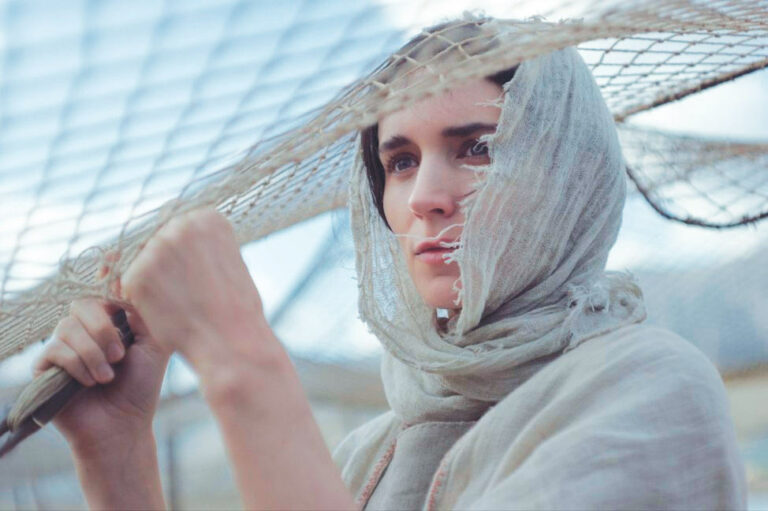
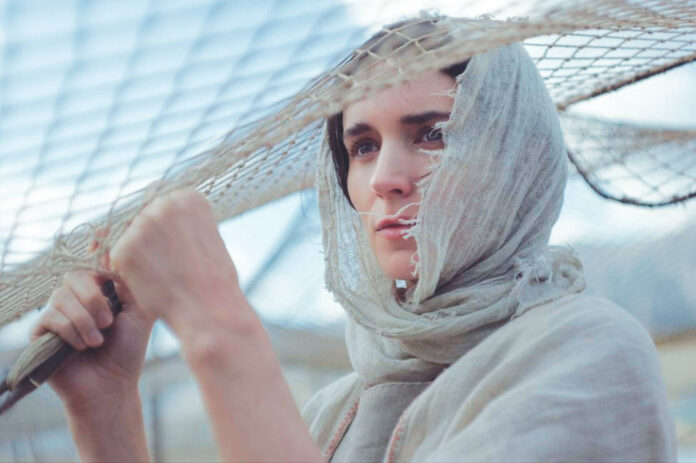
The Eastertide story Mary Magdalene has an underpowered Rooney Mara in the title role as a girl of the lonely fisher-village of Magdala. She isn’t actually a harlot—this was a Dark Ages slander, but she’s the next worst thing; a daughter who disobeyed her parents.

Mary has a part-time career as a midwife. Her father Daniel (Denis Menochet) wants her to marry an established widower. The unwanted marriage causes the girl such torment that the community decides she’s possessed, forcing her into a watery exorcism at night. Alone and despondent, Mary meets a wandering rabbi familiar to us all. He comforts her, telling her he knows she doesn’t harbor demons.

At age 44, Joaquin Phoenix may be one of the oldest actors to play Jesus, and the choice for a sadder, aged Christ may be justifiable in a time and place where working people got old very early on in life. In real life, Phoenix was raised in a religious cult, and he has a deep understanding of both the grounded and the mysterious qualities of the role.

Australian director Garth Davis (Lion) shot this in the rock-strewn parts of southern Italy and Sicily, in a blue-filtered twilight. Johann Johannsson’s looped strings and pianos mirror the melancholiness. Chiwetel Ejiofor’s Peter is a lieutenant who never quite understands what Jesus is getting at. Judas (Tahar Rahim, very good) is the zealot, certain that it’s the time to strike against the Roman occupiers.

As always, one dreads how the story ends. Davis makes it bearable, as opposed to the way it went down in The Passion of the Christ, bypassing the trial of Jesus with the convenient action movie shortcut of knocking a character out and letting them come to later. The sadness of what follows outweighs the disgust. Mary Magdalene’s part is to sit and commune with her rabbi as he dies. In the background we see little clusters of families and friends, seated in their own vigils at the foot of other crosses.

Phoenix’s sensitivity overwhelms the callouses one has against the Greatest Story Ever etc., and the bruises one accumulates in a lifetime of dealing with hateful Christians. Against this mysterious poignancy, Mara seems a bit lost and underpowered. Despite this, there are intelligent and careful moments throughout, such as the suspiciousness with which the elder Mary (Irit Sheleg) looks at this traveling woman, and the way she confides about her son, “He was never really mine.”

‘Mary Magdalene’ is playing in select theaters.

Advice Goddess

Q: I’m a slim woman in my early 40s—successful in my field—and I am always in jeans, a vintage ripped t-shirt, and boots. I mean, always. Granted, I have an extremely expensive handbag and perfectly highlighted blonde hair, and I always wear winged eyeliner. My friends say that going “underdressed” like this is disrespectful and inappropriate for (corporate-type) business...

Visions of Moderation

  By Bill Smith The good old days were the good because you were young. As a rule, wherever you spent your 20s, the memories you made are precious and enduring. I was lucky. I made mine in the Bay Area in the 1990s: affordable rents, barbecued oysters on Drake’s Bay, biking over the bridge to the Marin Headlands or over...

Henry the Great

For most mortals, a single major accomplishment can be satisfying enough for one lifetime. Being an Academy Award–nominated producer, say; or a director-composer and cinematographer for multiple television series; or a university professor for nearly two decades; or a research diver with one of the highest numbers of dives under Antarctic sea ice; or creating your own record label...

Horoscope

All signs look to the 'Sun'
ARIES (March 21-April 19): French writer Simone de Beauvoir sent a letter to her lover, Aries author Nelson Algren. She wrote, "I like so much the way you are so greedy about life and yet so quiet, your eager greediness and your patience, and your way of not asking much of life and yet taking much because you are...

In Trump They Trust

One of the most extraordinary developments of recent political history is the loyal adherence of religious conservatives to Donald Trump. Trump won four-fifths of the votes of white evangelical Christians. This was a higher level of support than either Ronald Reagan or George W. Bush (an outspoken evangelical himself) ever received. Trump’s background and beliefs could hardly be more incompatible...

Bluesy Virtuosos

Raised in San Rafael and now living in Novato, Rebecca Roudman makes her living as a cellist in the Oakland Symphony and the Santa Rosa Symphony. She started playing classical music when she was 7 years old, and after graduating as a music major in college, it was all classical music all the time. “But classical music has never my...

Hero & Zero

Hero A group of jaywalking ducklings and their mama tried to cross busy Sir Francis Drake Boulevard in Kentfield last Saturday afternoon. As cars whizzed by, a good citizen attempted to prevent them from crossing, but they seemed determined to reach the other side. Fortunately, a Marin County Sheriff’s deputy rushed to the scene, blocked traffic and ushered the family...

Hero & Zero

Hero A group of jaywalking ducklings and their mama tried to cross busy Sir Francis Drake Boulevard in Kentfield last Saturday afternoon. As cars whizzed by, a good citizen attempted to prevent them from crossing, but they seemed determined to reach the other side. Fortunately, a Marin County Sheriff’s deputy rushed to the scene, blocked traffic and ushered the family...

Flashback

20 Years Ago This Week The American Society of Newspaper Editors is meeting in San Francisco this week. They're agonizing over why daily paper circulation has dropped like a rock over the last 50 years. There's even a national pilot program involving eight daily papers, studying the loss of credibility. Those poor saps. The editors probably haven't noticed that all...

Quite Contrary

The Eastertide story Mary Magdalene has an underpowered Rooney Mara in the title role as a girl of the lonely fisher-village of Magdala. She isn’t actually a harlot—this was a Dark Ages slander, but she’s the next worst thing; a daughter who disobeyed her parents. Mary has a part-time career as a midwife. Her father Daniel (Denis Menochet) wants her...
3,002FansLike
3,850FollowersFollow