Virtual & Walking Cemetery Tours Share North Bay History This Halloween

Whoever said, “Dead men tell no tales,” never visited a cemetery tour like the ones that pop up in the North Bay every Halloween season. Even with this year’s pandemic making group gatherings difficult in parts of the region, two local groups are telling tales about the historical figures residing at local cemeteries.

First up, Tulocay Cemetery in Napa holds a thousand stories waiting to be told among its grassy hills and century-old tombstones. This week, the Napa County Historical Society launches the first phase of an ambitious three-year project to tell several of these stories through interactive, self-guided and virtual tours of Tulocay and the surrounding community.

The society debuts “Echoes of Napa Valley: The Tulocay Project” on Thursday, Oct. 29, online at 7pm. The creative team at NCHS will be on hand for a discussion about the project before NCHS presents a virtual cemetery tour that is “hosted” by an actual historical figure.

Of course, the dead are not actually rising from the grave, but actors will embody figures like Maria de Jesus Higuera Juarez (1815-1890), who comes to life to host the virtual Oct. 29 tour.

“Echoes of Napa Valley: The Tulocay Project” will cover figures like Juarez and her husband Don Cayetano Juarez, early North Bay settlers who obtained the original land grant from the Mexican government for what is now Napa and gifted Tulocay’s acreage.

Other figures who are coming to life for virtual tours includes Nathan Coombs, founder of the city of Napa. The project will also highlight the First Peoples of the Napa Valley, the Patwin and Wappo, whose stories remain largely untold.

The project is operating in partnership with New Tech High School in Napa, where students are developing dramatic monologues and graphic displays, and Napa Valley College Performing Arts, which is providing opportunities to workshop new performances.

NCHS also hopes to inspire the audience to research their own stories and ask themselves important questions about community, identity and culture.

‘Echoes of Napa Valley: The Tulocay Project’ debuts on Thursday, Oct. 29, at 7pm. $10 donation. Napahistory.org.

In Marin County, Mt. Olivet Catholic Cemetery has stood for 140 years in San Rafael, situated on twenty acres of hilltop property along Los Ranchitos Road. The cemetery currently provides a final resting place for over 14,000 persons. Some of those people are famous; some of them are infamous.

This weekend, Marin History Museum hosts the Halloween-appropriate “Walking Tour: Mt. Olivet Cemetery & Its Famous–and Infamous–Residents,” on the morning of Oct. 31. Historian Marcie Miller will lead the guided tour and will reveal who resides at the cemetery, from some of Marin’s most prominent pioneers to convicts executed at San Quentin State Prison such as Juanita Spinelli, aka “The Duchess,” who was the first woman to be executed by the state of California via San Quentin’s gas chamber in 1941.

The walking tour of Mt Olivet Cemetery, 270 Los Ranchitos Road, San Rafael, begins at 10am on Saturday, Oct. 31. To pre-register, email ma****@**********ry.org or call 415.446.8869.

North Bay Nonprofit Sanctuary Launches ‘Saving Senior Dogs Week’

People love dogs, as evidenced by the estimated 14,000 animal rescue organizations that exist nationwide. Yet, less than 40 of those 14,000 organizations are dedicated to rescuing, rehabilitating and re-homing senior dogs.

One organization that focuses exclusively on senior dogs is Lily’s Legacy Senior Dog Sanctuary in Petaluma. The nonprofit rescue organization saves and re-homes homeless senior large-breed dogs in California.

Now Lily’s Legacy is going national with its second annual ‘Saving Senior Dogs Week,’ an online education and fundraising campaign running October 26 to November 1. The campaign, presented in partnership with senior dog rescue organizations from across the United States, is using social media to raise public awareness of the plight of homeless senior dogs throughout the country.

“There is a perception that senior dogs are harder to adopt, which we have not found to be the case,” says Alice Mayn, founder and Executive Director of Lily’s Legacy. “I wanted to find a way to educate the public, and I also wanted a way to bring the existing rescues together, let people know they’re out there, and maybe encourage other people to start a senior rescue so there are more of us. Because there needs to be more of us.”

‘Saving Senior Dogs Week’ will take to Facebook, Twitter, Instagram and other social media outlets all week to share images, videos and stories about senior dogs. Mayn notes that the awareness campaign is more important than ever this year, as the Covid-19 crisis is increasing the number of surrendered pets due to financial hardships.

“It’s not people that have contracted Covid, it’s people who have lost their homes, their livelihood or both, due to Covid,” Mayn says. “It’s hard for them, they’re giving up a family member.”

In August, the American Society for the Prevention of Cruelty to Animals released data estimating that 4.2 million pets will enter poverty in the next six months as a result of the Covid-19 pandemic, a 21-percent increase from pre-pandemic estimates. The total number of animals living in poverty could rise to more than 24.4 million dogs, cats, horses, and other animals.

For more than a decade, Mayn and the volunteer-run staff at Lily’s Legacy have been giving large-breed senior dogs a second chance through fostering and adoption programs, and they care for senior dogs with hospice care.

“The biggest lesson I’ve learned from these dogs is gratitude and resilience to hard times,” Mayn says. “Senior dogs, who have been through some kind of trauma, they seem to bounce back when they get some love and good nutrition and medical care. It’s an amazing phenomena.”

In addition to sharing stories of senior dogs, Lily’s Legacy is highlighting the network of other senior animal rescues working throughout the nation.

“I get calls from all over the country from people who want senior dogs, and now I have a resource,” Mayn says.

Seventy-five percent of the proceeds from the ‘Saving Senior Dogs Week’ fundraising campaign will be divided equally among the participating senior dog rescue organizations, and the remaining funds will go into a Saving Senior Dogs Grant program to provide startup funding and support for individuals interested in founding a new senior dog rescue.

Two months ago, Lily’s Legacy awarded its first Saving Senior Dogs Grant to Daisy Lu Ranch Senior Dog Sanctuary in Camarillo to provide medical care for their senior dogs.

“Senior dogs make great companions,” Mayn says. “If you’re considering getting a dog, consider getting a senior dog.”

Get more information and donate to ‘Saving Senior Dogs Week’ at Lilyslegacy.com or the event’s page on Donately.com.

Marin Center Offers Drive-Thru Alternative to Trick-or-Treating

While Marin County continues to reopen the economy in a measured and safe way to slow the spread of Covid-19, the Marin County Department of Health and Human Services (HHS) is discouraging the usual Halloween activities like door-to-door trick-or-treating or large multi-household parties.

The bad news is that trick-or-treating will encourage touching surfaces like doorbells, door handles, and candy bowls, and that makes it more difficult to maintain physical distancing. In addition, Halloween parties that require congregating in groups will increase the risk of transmitting Covid-19.

The good news is that families who want to celebrate Halloween this year can dress in costume and visit the Halloween Fair Food Drive-Thru Spooktacular at the Marin Center in San Rafael. Opening October 23, and running daily through November 1, the drive-thru celebration features family-friendly activities that families can enjoy while staying inside their cars.

The doctor-approved Spooktacular, presented by the Marin County Department of Cultural Services and operated by the same team that presents the Marin County Fair each year, first and foremost offers festive treats and county fair food.

Kids will love the Halloween-themed pumpkin and ghost candy apples, black-and-orange cotton candy and more; and the whole family can order from a bevy of delectable delights like funnel cake, churros, kettle corn, caramel corn, and strawberry lemonade.

Also on the menu are county fair staples like giant corndogs, turkey legs, Greek gyros, tri-tip sandwiches, ribs and deep-fried Oreos. A selection of Halloween-themed adult beverages will also be available (to take and drink at home).

Beyond the food, families will be able to drive through a series of spooky attractions, with Halloween-themed “lands” featuring animatronic dinosaurs, skeletons and other seasonal scares. Attendees can also download the Spooktacular Drive-Thru Tunes playlist on Spotify to play in their cars while they cruise through the haunted highlights.

On Halloween, Saturday, Oct. 31, the Spooktacular goes all out with live music by the Las Gallinas Sanitary District Non-Marching Band, aka The Sewer Band, who will perform spooky tunes from 3pm to 6pm. The Marin County Free Library will also get in on the fun and give out free activity books, bookmarks, stickers and pencils  on Oct. 31 and Nov. 1, from 11am to 8pm.

The Marin Center notes that the drive-thru event will prioritize the safety of its guests and vendors. All event staff will wear face coverings and gloves and will sanitize frequently as they deliver the packaged food.

The Spooktacular is the first time the Marin Center or the Fairgrounds has been open to the public since March 13, per the shelter-in-place mandate that went up in the face of the pandemic.

“In our Fair history, this is one of the most challenging times we have encountered,” says Gabriella Calicchio, Director of Cultural Services at Marin County, in a recent statement on the Marin Fair’s website. “Our utmost goal is to support the efforts to flatten the curve of the Covid-19 pandemic and soar into the future with even more resilience. We hope everyone will stay safe and creatively engaged at home and we look forward to serving our community, clients, partners, vendors and Fair family through this crisis.”

The Halloween Fair Food Drive-Thru Spooktacular runs from Friday, Oct. 23, to Sunday, Nov. 1, at Marin Center, 10 Avenue of the Flags, San Rafael. The Spooktacular will be open from 4pm to 9pm on weekdays and 11am to 9pm on weekends. Admission is $10 per car; food is available to purchase. Get details and see menus at Facebook.com/MarinCountyFair.

Scary Movies Invade North Bay Cinemas & Drive-Ins for Halloween

0

“They’re coming to get you, Barbara!” So far, 2020 has felt a bit like a horror movie. Currently, the North Bay is enduring a global pandemic, braving regular attacks from wildfires and preparing to vote in one of the most dramatic elections ever.

So, who wants to go to the movies?

Turns out, a lot of people do, and cinemas in Marin County and Napa County are reopening at limited capacity while Drive-In Theaters continue to pop-up outdoors in Sonoma County. With Halloween around the corner, now’s the time to escape from today’s horrifying reality and enjoy an old-fashioned scare on the silver screen.

In Marin County, the Lark Theater and The Village at Corte Madera are still hosting Lark Drive-In: Movies Under the Stars screenings at the Village’s north parking lot, and the series goes all out for Halloween weekend with several spooky, scary and fun movies Oct. 28–31.

First up, on Oct. 28, the classic story of “Frankenstein” plays out from the National Theatre stage in London in a screening of the stage play, filmed in 2011 and starring Benedict Cumberbatch (Dr. Strange) and Jonny Lee Miller (Trainspotting) in a production directed by Danny Boyle (Trainspotting, Slumdog Millionaire). On Friday, Oct. 29, Lark Drive-In presents a double bill featuring the original Ghostbusters and the recent mockumentary What We Do in the Shadows. The next night, on Oct. 30, the horror-comedies continue with a double bill of Beetlejuice and Shaun of the Dead. Finally, on Halloween night, Oct. 31, Lark Drive-In presents two late-night classics, screening Young Frankenstein and The Rocky Horror Picture Show. Showtimes vary, tickets are $15-$30. Larktheater.net.

In Sonoma County, the horror fiends at CULT Film Series conspire with the Luther Burbank Center for the Arts in Santa Rosa for a drive-in screening of the classic granddaddy of zombie-flicks, Night of the Living Dead, today, Oct. 22.

Writer-director George Romero’s 1968 low-budget film was a groundbreaking achievement in horror, and it spawned the zombie genre as we know it today. The movie was also a major Drive-In hit back in its day, and tonight’s screening offers old-school chills. Gates open at 6pm, and tickets are $25 per car. Lutherburbankcenter.org.

This weekend, the Alexander Valley Film Society screens a friendlier Halloween favorite, when they present the 1993 family-film Hocus Pocus as part of its Carpool Cinema series. While Hocus Pocus did not exactly cast a spell on the box office when it premiered in the early ‘90s, the witchy comedy starring Bette Midler, Sarah Jessica Parker and Kathy Najimy has developed a cult following. On Saturday, Oct. 24, the AV Film Society turns the Cloverdale Citrus Fairgrounds into a Drive-In to screen the film in English, with Spanish subtitles. Gates open at 6:30pm, and tickets are $30 per car. Avfilmsociety.org.

Hocus Pocus is also playing in St. Helena for Halloween, as the Cameo Cinema presents a “BYOB (Bring your own Broom)” screening on Oct. 31. The night before, on Oct. 30, Cameo Cinema is also screening a horror classic from one of wine country’s favorite directors when it presents Bram Stoker’s Dracula. The 1992 film from director Francis Ford Coppola is heralded as a faithful and ambitious adaptation of the 1987 novel that introduced the world to the most infamous vampire of all time. Both movies screen at 7:45pm, and tickets are $10. Cameocinema.com.

Other movie theaters in Marin and Napa County that can reopen at limited capacity include the Century Northgate in San Rafael and the Century Rowland Plaza in Novato, as well as the Century Napa Valley in Napa. All these theaters are offering special Halloween screenings of classics like the North Bay-shot Scream and others. Check with the theaters for times and tickets.

All of these theaters are also practicing CinemaSafe protocols, enforcing social distancing seating and touch-less concessions among other health and safety measures. Get more details on this program at CinemaSafe.org.

Prop the Vote: A Cheat Sheet to California’s Statewide Ballot Measures

Issues proposed in California’s statewide ballot measures can sometimes be as opaque as they are varied, which is why the Pacific Sun’s staff decided to wade through the morass to help make voting easier. Below are breakdowns of the big decisions going to state voters on Nov. 3:

PROP. 14

In 2004, California voters approved Proposition 71, which created and funded the California Institute for Regenerative Medicine (CIRM), a public agency that distributes funds to pay for stem cell research. The $3 billion allotted by Prop. 71 ran out last year and the issue is back in voter’s hands with Prop. 14 on this year’s ballot. If it passes, the state would issue $5.5 billion in bonds to fund additional CIRM research grants for years to come. While the pro-Prop. 14 campaign has spent $9.1 million in support versus $0 in opposition, critics, like the San Francisco Chronicle’s editorial board, argue that the CIRM funding pot contributed to the rise of “opportunistic quacks hawking stem cell snake oil.”

PROP. 15

Today, all property taxes—whether it’s homes, office buildings or golf courses—are capped at the purchase price with a 2 percent annual tax increase. Prop. 15 would mandate commercial properties be assessed every three years and taxed at their current fair market value. The measure would not apply to residential properties. Proponents, including the Chan Zuckerberg Initiative, Working Partnerships USA and California Teachers Association, say the measure will apply primarily to large companies and generate between $6.5 trillion and 11.5 trillion for local governments and schools. Opponents, including the Howard Jarvis Taxpayers Association, California Business Roundtable and California Taxpayers Association, say the tax increases will trickle down to small businesses and customers and push business out of California.

PROP. 16

In 1996, California voters banned the use of affirmative action, but 24 years later a majority of state lawmakers are looking to bring it back. Prop. 16 would reinstate affirmative action, meaning universities and public entities could factor someone’s gender, race or ethnicity into admissions or hiring decisions. Supporters, who include Gov. Gavin Newsom, Sen. Kamala Harris and the state’s NAACP conference, say that it would level the playing field for people of color. Meanwhile, opponents like the California Republican Party, the Asian American Legal Foundation and the Chinese American Alliance say that it would legalize discrimination.

PROP. 17

Prop 17 would restore voting rights for parolees with felony convictions. The current law on the books requires individuals to complete both their prison sentence and parole before being able to reclaim the right to vote. Supporters, which include the ACLU of California, Gov. Gavin Newsom and the Brennan Center for Justice, say that denying parolees the right to vote extends punishment and disproportionately disenfranchises people of color. But opponents, like the California Republican Party, Crime Victims United California and the Election Integrity Project California, say that parolees need to prove they can be rehabilitated before they can vote again.

PROP. 18

If Prop. 18 passes, 17-year-olds will be able to vote in primary and special elections as long as they’re 18 by the time of the next general election. Currently, 18 states and Washington D.C. give 17-year-olds this right. Supporters, like Secretary of State Alex Padilla, the ACLU of Southern California and Assemblyman Evan Low (D-Cupertino), say that it will allow first-time voters to participate in the full election cycle and boost youth voter turnout. However, opponents, like the Election Integrity Project California, the Howard Jarvis Taxpayers Association and the California Republican Party, say that 17-year-olds are still kids who could be easily influenced by teachers or counselors.

PROP. 19

Prop. 19 would allow homeowners who are 55 or older, disabled or wildfire and disaster victims to transfer their primary home’s tax base up to three times, up from the one-time move allowed today. The lower tax base could also still be passed to children, but only if they plan to live in the home, or if the property is a farm. Proponents, including the NAACP, California Democratic Party and California Business Roundtable, say the measure would close “unfair tax loopholes” for out-of-state investors and offer older residents more freedom. Opponents, including Howard Jarvis Taxpayers Association and the ACLU of Southern California, don’t agree with the provision mandating children live in the home to get the tax break.

PROP. 20

California’s prisons were already bursting at the seams before the pandemic hit, and the overcrowding led to a wave of deaths that health experts and civil rights activists called preventable. Prop. 20 would lead to more women and men ending up behind bars by allowing some property crimes of more than $250, such as “serial shoplifting” and car theft, to be charged as felonies instead of misdemeanors. The law would also increase the rate of recidivism and create a DNA database for people convicted of other low-level crimes, such as drug possession, furthering the goals of conservative prosecutors and police unions who would rather see the carceral state flourish than work on other meaningful reforms.

PROP. 21

Rent control is on the ballot for the second time in two years, and advocates hope the pandemic and economic downturn will push Californians to expand renter protections. Prop. 21 would allow cities and counties to pass rent control for more properties than currently allowed, including those built before 2005 and owned by landlords with more than two properties. Single-family homes would be exempt. Proponents, including the AIDS Healthcare Foundation, Sen. Bernie Sanders and California’s public employees union, say the measure is key to tackling homelessness. Opponents, including Gov. Gavin Newsom, the state’s Republican Party and large apartment developers, say Prop. 21 would worsen the housing crisis by disincentivizing landlords from renting and developers from building.

PROP. 22

When tech companies spend a couple hundred million dollars supporting an initiative, it’s an easy answer on who stands to gain the most from its passage. Uber, Lyft and other gig companies want the state to exempt them from treating their workers as employees instead of independent contractors, thereby saving the companies gobs of money. The passage of AB 5 last year threw a wrench in the way numerous industries compensate freelance and part-time workers, and Prop. 22 seeks to limit the amount of pay and benefits gig companies are required to cough up. A few concessions in the prop, such as strengthened rules on driver background checks, appear to be window dressing meant to cover up the fact that Prop. 22 would require a 7/8th supermajority in the state Legislature to amend, which would basically give control of any changes over to the Republican minority.

PROP. 23

We are a nation going through a global health crisis, and access to safe and reliable treatment should be a priority for all of us, right? Prop. 23 would force kidney dialysis clinics to have at least one physician on site during operating hours to better respond during emergencies, and it would require data on infections to be reported to the state. The initiative would also stop clinics from discriminating against patients for their type of insurance. Dialysis companies oppose the effort, saying staffing levels are already adequate and the enhanced regulations would cut into their bottom line and force some clinics to close. California unions and the state Democratic Party support Prop. 23, and they’ve argued that dialysis companies are making serious bank so those profits should coincide with better patient protections.

PROP. 24

The pet project of real estate investor Alastair Mactaggart, Prop. 24 would update California’s consumer privacy laws and create a state Privacy Protection Agency to enforce the rules. The initiative’s supporters, including a handful of elected Democrats, say it would increase user’s control over their personal data. Opponents, including the ACLU, Green Party and Republican Party, warn that the proposition was written behind the scenes and opens up new loopholes which companies can exploit. The Electronic Frontier Foundation (EFF) landed somewhere in-between. Declining to endorse or oppose the proposition, the EFF wrote that Prop. 24 is “a mixed bag of partial steps backwards and forwards.”

PROP. 25

If Prop. 25 passes, it would uphold a 2018 California law that would end cash bail and instead use a risk-based algorithm to decide who gets out of jail while awaiting trial. Supporters, which include the SEIU California State Council, the League of Women Voters of California and Gov. Gavin Newsom, say that Prop. 25 would eliminate an unfair system for those who can’t afford to pay bail. Criminal justice advocates have been trying to get rid of cash bail for years, but many argue that Prop. 25 isn’t the solution. Opponents, like the California Black Chamber of Commerce and the ACLU of Southern California, say that the algorithm could create more biased outcomes for people of color. Bail bond groups, such as the American Bail Coalition, also oppose the measure, but for different reasons. They say that it would eliminate their industry, put public safety at risk and cost taxpayers more money.

A Look at Marin County Ballot Measures

With the presidency and the U.S. House and Senate majorities at stake on Nov. 3, it’s easy to focus on the big races. However, let’s not give short shrift to the five measures on the Marin County ballot. Each measure affects only a portion of the county; consequently, you won’t be voting on every one.

The ballot includes three school-funding measures and two tax proposals. I won’t tell you how to vote, but we’ll chew the fat and you’ll be on your way to figuring it out. 

Measure L – Shoreline Unified School District Parcel Tax

The Shoreline Unified School District in West Marin is asking for approval on Measure L, which will renew the existing parcel tax of $212 for eight more years, with no increases from year to year.

The tax currently generates about $1 million in annual revenue, representing approximately 7 percent  of the district’s budget. The existing tax expires in June 2021.

If approved by two-thirds of the voters, funds from Measure L will enhance science, technology, engineering and math courses; maintain art and music programs; provide specialized reading and writing instruction; and attract and retain teachers. It may also pay for Covid-19-related services.

The elections department received no arguments against the measure.

Bottom line: Measure L asks you to pony up the same amount you’ve been paying each year, with no increases for the next eight years.

Measure M – Tamalpais Union High School District Parcel Tax

The Tamalpais Union High School District (TUHSD) seeks to replace two current parcel taxes with one parcel tax for the next nine years. The new tax of $469 equals the amount of the two existing taxes combined, with the same 3 percent cost-of-living increase each year.  

The estimated tax revenue is approximately $16.8 million annually, equal to about 17 percent of the budget. TUHSD says it already cut $6.7 million annually from the budget due to ongoing deficits over the last three years. In addition, it boosted class size and cut administrative staff and reduced benefits. 

Tax proceeds will provide science, technology, engineering, math, reading and writing instruction; maintain advanced placement classes; support art and music programs; and attract and retain teachers.  

If approved by two-thirds of voters, the new tax will begin on November 4. Otherwise, the two current taxes will continue through June 30, 2022.

Opponent Michael Harnett, founder of the Marin Public Policy Institute, argues Measure M is premature since the two current parcel taxes don’t expire until 2022 and Proposition 15 on this November’s ballot could provide additional funding for schools.

Proponents say failure to pass the measure will result in massive cuts to advanced placement courses, elective programs and athletics, as well as the layoff of up to 100 teachers.

Bottom Line: Funds from Measure M account for a significant portion of the district budget. A “No” vote means you’ll continue to pay the two current parcel taxes through mid-2022 and you’ll likely see a similar measure on the next ballot. A “Yes” vote extends the same $469 tax for the next nine years, with an annual 3 percent cost-of-living increase.

Measure P – Sausalito Marin City School District Bond

A $41.6 million bond measure is on the ballot in the Sausalito Marin City School District. The funds raised by the bond sales, estimated at $2.5 million annually, will finance the renovation and replacement of outdated buildings at Willow Creek Academy in Sausalito and Bayside Martin Luther King Jr. Academy in Marin City. The district expects to unify and integrate the two schools and wants equitable facilities on both campuses.

Some school buildings date back to 1945. Revenue will be spent on constructing new classrooms; repairing plumbing, electrical systems and wiring, restrooms, gas lines and leaky roofs; replacing deteriorating heating, ventilation and air conditioning systems; and ensuring accessibility for disabled students.

The district estimates the bond measure will cost property owners $30 per $100,000 of assessed property value. If approved by 55 percent of voters, it will begin in fiscal year 2021–22.

No arguments against Measure P were submitted to the Elections Department.

Bottom Line: Do the math for your assessed property value (not market value) to calculate your tax payment. (Example: A $500,000 assessed property value equals a $150 annual tax.) 

Measure Q – Novato Hotel Tax Increase

Voters in the City of Novato will decide whether to raise the transient occupancy tax (a.k.a. hotel tax) from 10 percent  to 12 percent. The tax applies to hotel and short-term rental stays of 30 days or less, including Airbnb and Vrbo.

If passed by a majority vote, the increase will account for an estimated $400,000 in revenue that will go into the city’s general fund. It may be used for Covid-19 recovery efforts, street repairs and 911 emergency services.

The Novato city council unanimously supports Measure Q. No arguments against it were filed with the elections department.

Bottom Line: This isn’t a tax on Novato residents unless you stay at a hotel or short-term rental for 30 days or less. On the other hand, if you own a hotel or short-term rental property in Novato, your guests will pay the tax hike.

Measure R – San Rafael Sales Tax

The City of San Rafael proposes the “San Rafael Emergency Preparedness and Essential Services Protection Measure.” Simply put, Measure R raises the local sales tax by one quarter of one percent for the next nine years.

The City foresees an $11.8 million revenue loss over the next 16 months due to the Covid-19 pandemic. Boosting the sales tax from 9 percent to 9.25 percent will generate a projected $3.4 million a year for the general fund. If passed by a majority vote, it will begin on April 1.

The funds may be used for disaster and health emergency preparedness, repairing streets, maintaining 911 emergency response times and preserving local services and programs for youth, families, seniors and the homeless.

Measure R opponents call the sales tax regressive and claim it hurts those least able to afford it. The true issue is pension funding, they say, which accounts for about 25 percent of San Rafael’s budget.

Proponents say the measure will protect essential city services.

Bottom Line: The increase will make San Rafael’s sales tax the highest in Marin, though food and medicine are exempt from Measure R.


Open Mic: Sonoma County Defies State Wildfire Safety Standards

0

While many Sonoma County residents feel wildland fire fatigue, we should embrace some hard facts about the underlying factors that have contributed to the situation. California, our county, the nature of the wildland-urban interface, climate change and human factors have led us to a troubling wake-up call. Decisions about roads and development in high fire-risk areas are being made that will determine our future.

Sonoma County’s fire ordinance does not meet the statewide Fire Safe Regulations for the wildland-urban interface. The Department of Forestry and Fire Protection’s standards went into effect in 1991, and counties have been required to implement them or present an ordinance to the Board of Forestry for certification that either “meets or exceeds” the CalFire regulations. Any ordinance “shall provide for safe access for emergency wildfire equipment and civilian evacuation concurrently.” New development requires 20-foot road widths (two lanes) and dead- end roads are limited to one mile.

The Board of Forestry concluded in May that the county’s 2019 ordinance failed to provide safe and concurrent access of fire apparatus and egress of civilians. In August, the supervisors made the ordinance worse. It now exempts all existing roads from state standards, which is where new development in the wildland-urban interface occurs. It substituted a single lane requirement instead of two lanes, making it impossible for fire apparatus and civilian vehicles to pass one another. The supervisors claim the ordinance exceeds the state standards, but the Board of Forestry at its September board meeting again declined to certify it. One lane exceeds two lanes? Bottlenecks on one-lane roads have the same practical effect as safe passage on two-lane roads?

Traffic jams associated with fire evacuations are common in recent years. Our subpar roads cannot support the existing development in the wildland-urban interface, so why encourage more development there? Sonoma County should meet or exceed the state regulations, lest more people die and more homes are lost to wildfire in the wildland-urban interface. Not only should the supervisors do things right, but they should also do the right thing.

Marylee Guinon lives in West County and is a retired owner of an environmental planning consulting firm. Craig S. Harrison is a retired lawyer living in Bennett Valley. Deborah A. Eppstein, PhD, is a scientist and retired biotech entrepreneur. Her home burned in the Glass Fire when firefighters would not enter Cougar Lane because it is one lane and they didn’t want to hinder evacuation.

Letter to the Editor: Measure P

Measure P, Sonoma County’s proposed ordinance to make IOLERO (Independent Office of Law Enforcement Review and Outreach) more effective, does not take a single penny from the Sheriff’s budget. And there was only one signature-gathering effort, which had to be suspended because of the Covid-19 quarantine and, therefore, the Board of Supervisors stepped in to place the ordinance on the ballot.

On its signs and in its voter-guide counter-arguments, the Sheriff’s Office and the Deputy Sheriff’s Association claim otherwise. Both the Board of Supervisors and the County Counsel can prove the Sheriff’s claims are false. It’s that simple.

Seems to me that, if the truth worked, why would the opposition rely on falsehoods? Might it be that the truth lies on the side of Yes on Measure P?

And it’s sad to see the firefighters damaging their incredible goodwill with the community by signing on to the deception. But they have an excuse. They’ve been very busy lately (thank you!) and may not have adequately researched the issue. I don’t know what the Sheriff’s excuse is. You’d think that with $6.6 million in legal settlements in one year alone, $2 million in legal fees and a $2.7 million increase in insurance premiums, he’d be eager for the changes that will make both his officers and the public safer at a much smaller cost.

$1.9 million for IOLERO or $11.3 million for business-as-usual. An ounce of prevention is worth a pound of cure.

Susan Collier Lamont

Santa Rosa

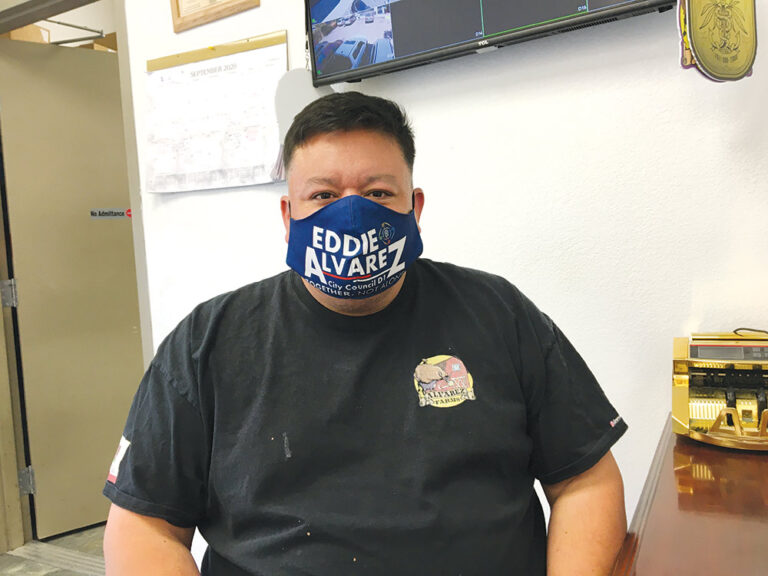
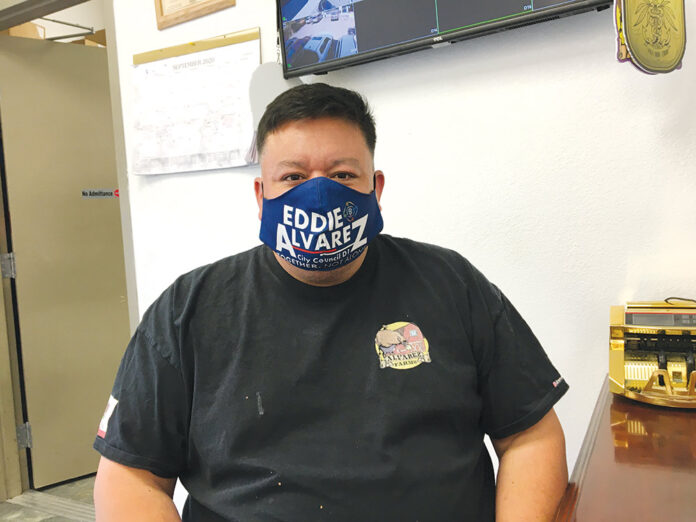
Eddie Alvarez Runs for Council

A local environmental group recently endorsed Eddie Alvarez, though it also called him “rough around the edges.” Alvarez is running for a position on the Santa Rosa City Council, which meets a short distance from 817 Russell Avenue, the location of The Hook, his cannabis dispensary, which serves the Latino community more than any other in the region.

“I’m not an angel,” Eddie tells me, and, while that seems to be true, he also has angelic qualities, including a deep-seated desire to help people who are on the edge and in the margins.

Twelve years ago, he was arrested on bogus charges at 1:30am in Rohnert Park. The black Cadillac he was driving might have caught the eye of cops looking for an easy mark. Also, Eddie might have been a target of racial profiling. All charges have been dropped.

Born and raised on Boyd Street in southwest Santa Rosa, he smoked his first joint, he says, at age 4, and learned about the medicinal benefits of cannabis from a great-grandmother who combined weed with alcohol to make a tincture good for fevers and arthritis.

Eddie’s dad worked as a dishwasher for much of his life, his mom as a waitress in a restaurant. For his first job, Eddie woke at 4am and headed for a vineyard where he carried buckets filled with grapes. For lunch he enjoyed bean tacos and hot chocolate.

He might have gone to one of the big high schools in Santa Rosa, but, as he tells me, “Trouble followed me around.” He went to a “continuation school” where a teacher gave him a copy of Rudolfo Anaya’s Bless me, Ultima, a brilliant coming-of-age novel which traces the life of Antonio Márez y Luna, a Chicano kid, and a wise older woman known as “La Grande.”

It would be an exaggeration to say that the novel totally transformed Eddie, though it certainly helped him refocus. At Heald Business College, he earned an AA in Business Software Applications. “I wanted to make a million dollars and needed to learn the value of a dollar,” he tells me. He adds, “As a community we have to move from survival mode to thrive mode.”

At Hook Dispensary, which hooks up strangers and turns them into friends, and where “the driver is the customer and the people set the tone,” Eddie has exceeded his own expectations. A vote for him Nov. 3 is a vote for District One, which includes South Park and Roseland—the heart of the Latino community. It’s also a vote for Santa Rosa and its future.

Jonah Raskin is the author of “Dark Past, Dark Future: A Tioga Vignetta Murder Mystery.”

Zach Woods’ ‘David’ Delights at SJSFF

0

There comes a time in every reporter’s career when an actor must be interviewed because they’ve directed a short film. These moments are fraught with anxiety because the films are often vanity projects created for the sake of showcasing some nascent talent the actor believes has been overlooked, without ever questioning why. I’m happy to report this is decidedly not the case with Zach Woods’ debut directorial effort, David, a hilarious, humanistic portrait of psychic healing that should be prescribed viewing for the sake of global mental health. 

Seriously. David is one of the 100-plus line-up of shorts that are part of the 12th Annual San Jose International Short Film Festival – Home Edition, playing Oct. 22–25.

Some might recognize Woods for his roles in The Office (“Gabe Lewis”) and Silicon Valley (Donald “Jared” Dunn), but you will not find him onscreen in his film. When asked why, Woods quips, “I auditioned, but I just didn’t get the part.” 

Rather, he was steadfastly behind the camera, directing a stellar trio of talents: William Jackson Harper stars as (one of) the titular characters as a man in crisis, Will Ferrell is his therapist and Fred Hechinger is a surprise third-wheel whose presence catalyzes the story after a cleverly deployed slowburn that results in equal measures of chaos and caring (saying anything more would steal from the true delight of watching the film).

“The thing about directing that’s so nice is that your attention is so monopolized,” says Woods. “There’s so many questions to answer, there are so many things to pay attention to and there are so many people to attend to that it’s like, you really don’t have much bandwidth left to turn on yourself, which I thought was really, really nice. It’s more like hosting a party or something. You’re just trying to create optimal conditions for everybody to do their best work and it feels like you disappear a little bit.”

Woods’ ability to find humor in human frailty (without punching down) is evident in his own turns as an actor. When he brings these sensibilities to bear in David (co-written with Brandon Gardner), the result is an authorial wholeness that adds emotional ballast. This bodes well for his trajectory as a filmmaker, which Woods is continuing with another short film currently in post-production.

San Jose International Short Film Festival – Home Edition runs October 22–25. The film festival features more than 20 themed blocks of films. All films can be screened via Chromecast, Apple TV, computer, tablet, and most smartphones. For more information and festival passes and packages, visit sjsff.com.

Virtual & Walking Cemetery Tours Share North Bay History This Halloween

Whoever said, “Dead men tell no tales,” never visited a cemetery tour like the ones that pop up in the North Bay every Halloween season. Even with this year’s pandemic making group gatherings difficult in parts of the region, two local groups are telling tales about the historical figures residing at local cemeteries. First up, Tulocay Cemetery in Napa holds...

North Bay Nonprofit Sanctuary Launches ‘Saving Senior Dogs Week’

People love dogs, as evidenced by the estimated 14,000 animal rescue organizations that exist nationwide. Yet, less than 40 of those 14,000 organizations are dedicated to rescuing, rehabilitating and re-homing senior dogs. One organization that focuses exclusively on senior dogs is Lily’s Legacy Senior Dog Sanctuary in Petaluma. The nonprofit rescue organization saves and re-homes homeless senior large-breed dogs in...

Marin Center Offers Drive-Thru Alternative to Trick-or-Treating

While Marin County continues to reopen the economy in a measured and safe way to slow the spread of Covid-19, the Marin County Department of Health and Human Services (HHS) is discouraging the usual Halloween activities like door-to-door trick-or-treating or large multi-household parties. The bad news is that trick-or-treating will encourage touching surfaces like doorbells, door handles, and candy bowls,...

Scary Movies Invade North Bay Cinemas & Drive-Ins for Halloween

“They’re coming to get you, Barbara!” So far, 2020 has felt a bit like a horror movie. Currently, the North Bay is enduring a global pandemic, braving regular attacks from wildfires and preparing to vote in one of the most dramatic elections ever. So, who wants to go to the movies? Turns out, a lot of people do, and cinemas in...

Prop the Vote: A Cheat Sheet to California’s Statewide Ballot Measures

Issues proposed in California’s statewide ballot measures can sometimes be as opaque as they are varied, which is why the Pacific Sun’s staff decided to wade through the morass to help make voting easier. Below are breakdowns of the big decisions going to state voters on Nov. 3: PROP. 14 In 2004, California voters approved Proposition 71, which created and funded...

A Look at Marin County Ballot Measures

With the presidency and the U.S. House and Senate majorities at stake on Nov. 3, it’s easy to focus on the big races. However, let’s not give short shrift to the five measures on the Marin County ballot. Each measure affects only a portion of the county; consequently, you won’t be voting on every one. The ballot includes three school-funding...

Open Mic: Sonoma County Defies State Wildfire Safety Standards

While many Sonoma County residents feel wildland fire fatigue, we should embrace some hard facts about the underlying factors that have contributed to the situation. California, our county, the nature of the wildland-urban interface, climate change and human factors have led us to a troubling wake-up call. Decisions about roads and development in high fire-risk areas are being made...

Letter to the Editor: Measure P

Measure P, Sonoma County’s proposed ordinance to make IOLERO (Independent Office of Law Enforcement Review and Outreach) more effective, does not take a single penny from the Sheriff’s budget. And there was only one signature-gathering effort, which had to be suspended because of the Covid-19 quarantine and, therefore, the Board of Supervisors stepped in to place the ordinance on...

Eddie Alvarez Runs for Council

A local environmental group recently endorsed Eddie Alvarez, though it also called him “rough around the edges.” Alvarez is running for a position on the Santa Rosa City Council, which meets a short distance from 817 Russell Avenue, the location of The Hook, his cannabis dispensary, which serves the Latino community more than any other in the region. “I’m not...

Zach Woods’ ‘David’ Delights at SJSFF

There comes a time in every reporter’s career when an actor must be interviewed because they’ve directed a short film. These moments are fraught with anxiety because the films are often vanity projects created for the sake of showcasing some nascent talent the actor believes has been overlooked, without ever questioning why. I’m happy to report this is decidedly...
3,002FansLike
3,850FollowersFollow