Years before the Covid-19 pandemic, award-winning virologist Dr. Nathan Wolfe proposed a plan to protect the economy from pandemics.
Even though Wolfe was named one of the ‘100 Most Influential People in the World’ in TIME for his work tracking Ebola and swine flu, no one took his proposal seriously. Now, Wolfe’s story is told in a new one-man show, The Catastrophist, that was recently written by Wolfe’s wife, acclaimed playwright Lauren Gunderson.
This month, The Catastrophist debuts in a world premiere digital production helmed by Marin Theatre Company in collaboration with Washington, DC–based company Round House Theatre. The online production is available to stream January 26 to February 28.
“You think you know your partner of a decade. And then you attempt to write a play about them,” Gunderson says in a statement. “When (Marin Theatre Company Artistic Director) Jasson Minadakis posed the idea of writing a new play about my husband, I initially rejected it. But the idea started to make more and more sense.”
Gunderson is currently one of America’s most prolific and most produced playwrights. She has worked with Marin Theatre Company since the world premiere of her award-winning play I And You in 2013 and a tenure as MTC’s playwright-in-residence that began in 2016.
“When the reality sunk in that we would not be in theaters in 2020, Lauren and I began discussing projects that could live between the worlds of theatre and film in a virtual space, and ‘The Catastrophist’ went straight into development as a new commission,” Minadakis says in a statement. “‘The Catastrophist’ is like nothing Lauren has attempted before. I’m delighted to be partnering with Ryan and Round House on this unique experience and look forward to the conversations it sparks across our country.”
Akin to Marin Theatre Company, Round House Theatre is one of the leading professional theater companies in the Washington, DC area; producing new plays, modern classics, and musicals each year.
“There really couldn’t be a more timely production in content or presentation,” Round House Artistic Director Ryan Rilette says in a statement. “In the midst of a global pandemic, Lauren Gunderson has created a deeply personal story about the man who has been sounding the alarm on them for years. I had read Dr. Wolfe’s book, ‘The Viral Storm,’ years ago when I was still Producing Director at Marin, and I immediately wanted to see a stage adaptation. I was thrilled when Jasson reached out to say that he and Lauren were finally going to make that happen, and I’m thrilled to work with them to share that story with audiences in the DC metropolitan area, the Bay Area, and everywhere in between.”
Filmed on stage in MTC’s Boyer Theatre, The Catastrophist is directed by Minadakis and stars William DeMeritt (Death of the Last Black Man in the Whole World, HBO’s The Normal Heart) as Wolfe. The digital production’s creative team also includes producer Nakissa Etemad, dramaturg Martine Kei Green-Rogers, costume designer Sarah Smith, lighting designer Wen-Ling Liao, composer and sound designer Chris Houston, director of photography Peter Ruocco, assistant director Christina Hogan and Covid compliance officer Liz Mastos.
“Of course, I told Nathan what I was writing and asked his permission, but I didn’t let him read it or see it until the very first rehearsal,” Gunderson says. “I wanted him to not only be the subject of the play, but its first audience. He laughed. He cried. He gave me several notes on the science. This play has both the hardest play I’ve ever written and the most meaningful. What a joy to share it so widely so soon.”
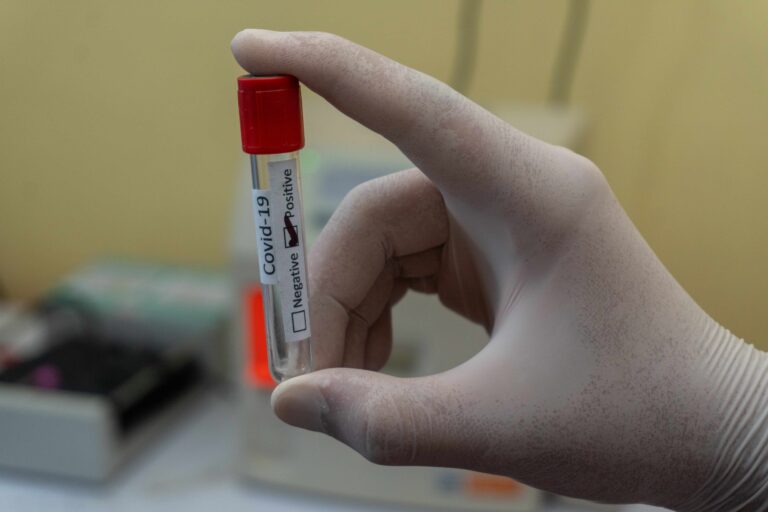
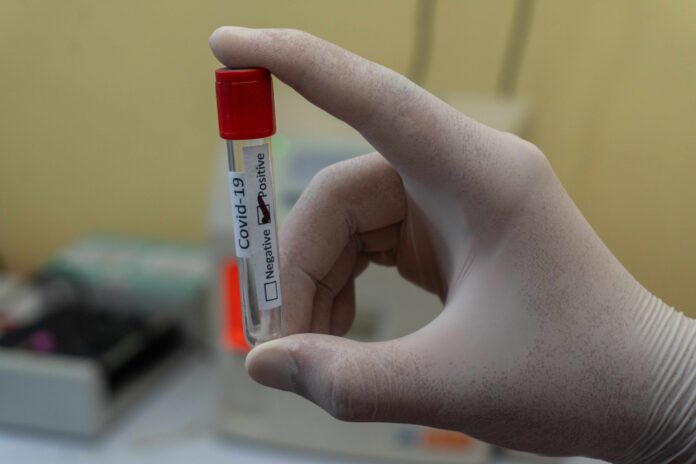
Marin County partnered with the Covid-19 testing company Curative to provide additional self-administered, oral swab testing to community members, County officials announced.
Six testing sites in Larkspur, Bolinas Novato, San Anselmo, San Geronimo, and Sausalito were announced before the New Year with testing that started as early as Dec. 21, and an additional testing site in San Rafael will begin testing Wednesday.
The sites offer free, self-administered Covid-19 swab tests.
In taking the test, patients are required to cough deeply between three and five times and swab multiple sides of the interior of the mouth. The swab is then returned to a Curative employee at the testing site and results are returned within 72 hours by email or text.
The new San Rafael testing site, located at the Armory Parking Lot along Civic Center Drive, will operate Sundays, Tuesday and Thursdays from 11am to 5pm, and Mondays and Wedesdays from 8am to 2pm.
The six previously-announced sites are operating as follows:
– Bolinas: Mondays, 10:00am – 12:30am; Bolinas Fire Station at 100 Mesa Road
– Larkspur: Thursdays from Jan. 7, 10:00am – 4:00pm; Piper Park at 250 Doherty Dr.
– Novato: Fridays from Jan. 8, 10:00am – 4:00pm; Novato Library at 1720 Novato Blvd.
– San Anselmo: Tuesdays, 10:00am – 4:00pm; United Market at 100 Red Hill Ave.
– San Geronimo: Mondays, 10:00am – 4:00pm; San Geronimo Golf Course parking lot at 5800 Sir Francis Drake Blvd.
– Sausalito: Wednesdays starting January 6, 10:00am – 4:00pm; Sausalito City Hall at 420 Litho St.
“Curative is thrilled to partner with Marin County to bring more free, accessible, and convenient Covid-19 testing to the North Bay,” said Shoshana Gould, Curative’s Partnerships Manager for the Bay Area. “We are looking forward to fully-launching this week and keeping everyone safe and healthy with our mobile van unit and drive through in San Rafael. Marin County is the 6th county in the Bay Area with Curative-run testing, following San Mateo, San Francisco, Alameda, Sonoma, and Santa Clara.”
Testing at these sites are free of charge but require an appointment, which can be made through the Curative’s website.
Even though 2020 is officially done and the New Year is here, the Covid-19 pandemic continues to make in-person gatherings a tricky endeavor in the North Bay. To help start 2021 in a positive way, several local events boasting music, art, history, poetry and other timely communal interests are happening online this week. Here’s a round up of what’s worth looking forward to.
Online Reading
The Rivertown Poets regularly meets twice a month at Aqus Café in Petaluma to share poetry readings from guest writers and the community-at-large with a poetry open mic. In 2020, the group went online to continue the series virtually in the wake of the pandemic, and things are staying online in 2021. Rivertown Poets mark the first of it’s “Amuse-ing Mondays” of the year with a digital gathering featuring readings by published poets Patti Trimble and Robert Eastwood followed by an online poetry open mic on Monday, Jan. 4, at 6:15pm. Free. Aqus.com/online.
Online Event
Marin County residents and organizations resolving to get creative for the New Year can learn how to get on local television at the Community Media Center of Marin Orientation, held virtually in place of in-person events due to the pandemic. The CMCM’s first orientation of 2021 offers insight into the center’s low-cost video production workshops, such as basic camera production and video editing, and how Marin residents can receive the necessary certifications for using CMCM equipment and facilities. Take the first step into television on Tuesday, Jan. 5, at 7pm. Free. Cmcm.tv.
Online Forum
Each month, the Marin County Commission on Aging hosts a meeting to discuss timely topics that directly impact the elder community in the region. This month, the commission hosts a virtual gathering that covers “The Intersection of Race and Age in Marin.” The Zoom meeting will feature several Marin residents sharing their personal stories of how systemic racism in the North Bay has affected the older-adult community, along with expert opinions on the matter from Yashica Crawford, Ph.D., of College of Marin’s psychology faculty. The free forum is open to the public and takes place on Thursday, Jan. 7, at 10am. Get details at Marinhhs.org.
Online Concert
Marin-based multi-instrumentalist and music educator Megan Schoenbohm uses her musical gifts to help children express themselves and to help families creatively connect to each other through interactive music classes. In addition to her classes, she makes acclaimed music for kids. Her debut children’s album, “Bubba & Boo,” won a Parents’ Choice Award and a NAPPA Award, and her second album, “You Are Enough,” won the 2020 Parents’ Choice Award. This week, Schoenbohm is the latest North Bay star to shine online as part of the ongoing “Luther Locals” concert series, hosted by Luther Burbank Center for the Arts on Friday, Jan. 8, at 5pm. Lutherburbankcenter.org.
Online Lecture
In July of 1974, Anita Fagiani Andrews was murdered at Fagiani’s Cocktail Lounge in Napa, which she co-owned with her sister. The case went unsolved until 2011, when DNA evidence led to the conviction of Roy Melanson, who has been linked to several murders. Napa County Superior Court Judge Ray Guadagni oversaw that trial; now he writes about the case in the forthcoming book, The Napa Murder of Anita Fagiani Andrews: A Cold Case That Caught a Serial Killer. Before the book’s release, Guadagni shares his story in an online presentation hosted by the Napa County Historical Society on Friday, Jan. 8, at 7pm. Free. Napahistory.org.
Online Exhibit
The last 12 months have been unprecedented and challenging on many levels, with a medical crisis, ecological disasters and social-justice movements all converging in 2020. Throughout all of that upheaval, local artists and creative folks responded with meaningful works that reflect the current state of affairs and offer a glimpse into a hopeful future. This week, MarinMOCA showcases many of those salient pieces of art in the new exhibit, “Here & Now.” Juried by Bay Area gallery owner and curator Kim Eagles-Smith, the contemporary multimedia exhibit opens on Saturday, Jan. 9, at 500 Palm Dr., Novato, and online at Marinmoca.org.
Online Event
The Sonoma County Climate Activist Network kicks off 2021 with a new vision for progressive and transformative change with the online community summit, “It’s Up To Us.” The interactive presentation includes information on how the activist network is helping the community connect to the land through education and action, and the summit boasts a lineup of guest speakers from local organizations such as The Greenbelt Alliance, The Climate Center, Singing Frogs Farm and the Sonoma Sunrise Movement. Join the summit and learn how you can help the North Bay go green on Sunday, Jan. 10, at 2pm. Free. Sonomacountycan.org.
Every year since 1976,Project Censored has performed an invaluable service — shedding light on the most significant news that’s somehow not fit to print. While journalists everyday work hard to expose injustices, they work within a system where some injustices are so deeply baked in that stories exposing them are rarely told and even more rarely expanded upon to give them their proper due.
That’s where Project Censored comes in.
“The primary purpose of Project Censored is to explore and publicize the extent of news censorship in our society by locating stories about significant issues of which the public should be aware, but is not, for a variety of reasons,” wrote its founder Carl Jensen on its 20th anniversary.
Thus, the list of censored stories that’s the centerpiece of its annual book, State of the Free Press | 2021 doesn’t just help us to see individual stories we might otherwise have missed. It helps us see patterns — patterns of censorship, of stories suppressed and patterns of how those stories fit together.
The stories listed below are only part of what Project Censored does, however. State of the Free Press | 2021 has chapters devoted to other forms of obfuscation that help keep censored stories obscured. So, if the Top 10 stories summarized below leave you hungry for more, Project Censored has all that and more waiting for you in State of the Free Press | 2021.
1. Missing and Murdered Indigenous Women and Girls
“In June 2019 the Canadian National Inquiry into Missing and Murdered Indigenous Women and Girls released its final report, which received widespread news coverage in the United States,” Project Censored notes.“U.S. corporate news outlets have provided nearly nothing in the way of reporting on missing and murdered Indigenous women in the United States.”
That’s despite a problem of similar dimensions, and complexity, along with the election of the first two Native American congresswomen, Deb Holland and Sharice Davids, who, Ms.Magazine reported, “are supporting two bills that would address the federal government’s failure to track and respond to violence against indigenous women [and] are supported by a mass movement in the U.S. and Canada raising an alarm about missing and murdered indigenous women and girls (MMIWG).”
Four in five Native women experience violence at some time in their lives, according to a 2016 survey by the National Institute of Justice, cited in an August 2019 Think Progress report.
“About nine in 10 Native American rape or sexual-assault victims had assailants who were white or Black,” according to a 1999 Justice Department report.
“Although the number of Native Americans murdered or missing in 2016 exceeded 3,000 — roughly the number of people who died during the Sept. 11, 2001 terror attack — the Justice Department’s missing persons database logged only 116 cases that year,” Think Progress noted. “The sheer scale of the violence against Native women and the abysmal failure by the government to adequately address it, explains why the issue was given such prominence during this week’s presidential candidates’ forum in Sioux City — the first to focus entirely on Native American issues.”
But even that didn’t grab media attention.
There are multiple complicating factors in reporting, tracking, investigating and prosecuting, which were explored in coverage by The Guardian and Yes! Magazine, as well as Ms. and Think Progress.
“Campaigners, including the Sovereign Bodies Institute, the Brave Heart Society, and the Urban Indian Health Institute, identify aspects of systemic racism — including the indelible legacies of settler colonialism, issues with law enforcement, a lack of reliable and comprehensive data, and flawed policymaking — as deep-rooted sources of the crisis,” Project Censored summed up. “As YES! Magazine reported, tribal communities in the United States often lack jurisdiction to respond to crimes.”
This was partially remedied in the 2013 reauthorization of the Violence Against Women Act, known as VAWA, but “it left sex trafficking and other forms of sexual violence outside tribal jurisdiction, YES! Magazine reported.”
The House voted to expand tribal jurisdiction in such cases in its 2019 VAWA reauthorization, but, Ms. reported, “The bill is now languishing in the Senate, where Republicans have so far blocked a vote.”
Another facet of the problem explored by Yes! is the connection between the extractive fossil fuel industry and violence against Native women. The Canadian report “showed a strong link between extraction zones on the missing and murdered women crisis in Canada,” Yes! noted. “It specifically cited rotational shift work, sexual harassment in the workplace, substance abuse, economic insecurity, and a largely transient workforce as contributing to increased violence against Native women in communities near fossil fuel infrastructure.”
“It creates this culture of using and abuse,” said Annita Lucchesi, executive director of the Sovereign Bodies Institute. “If you can use and abuse the water and land, you can use and abuse the people around you too.”
Project Censored concluded, “As a result of limited news coverage, the United States is far from a national reckoning on its crisis of missing and murdered Indigenous women and girls.”
2. Monsanto “Intelligence Center” Targeted Journalists and Activists
In its fight to avoid liability for causing cancer, the agricultural giant Monsanto (now owned by Bayer) created an “intelligence fusion center” to “monitor and discredit” journalists and activists, Sam Levin reported for The Guardian in August 2019.
“More than 18,000 people have filed suit against Monsanto, alleging that exposure to Roundup [weedkiller] caused non-Hodgkin lymphoma, and that Monsanto covered up the risks by manipulating scientific data and silencing critics,” the Hill summarized. “The company has lost three high-profile cases in the past year, and Bayer is reportedly offering $8 billion to settle all outstanding claims.”
“Monsanto adopted a multi-pronged strategy to target Carey Gillam, a Reuters journalist who investigated the company’s weedkiller,” TheGuardian reported.
The Guardian’s report was based on internal documents (primarily from 2015 to 2017) released during trial. They showed that “Monsanto planned a series of ‘actions’ to attack a book authored by Gillam prior to its release, including writing ‘talking points’ for ‘third parties’ to criticize the book and directing ‘industry and farmer customers’ on how to post negative reviews.”
In addition, Monsanto paid Google to skew search results promoting criticism of Gilliam’s work on Monsanto, and they discussed strategies for pressuring Reuters with the goal of getting her reassigned. The company “had a ‘Carey Gillam Book’ spreadsheet, with more than 20 actions dedicated to opposing her book before its publication.” They also “wrote a lengthy report about singer Neil Young’s anti-Monsanto advocacy, monitoring his impact on social media, and at one point considering ‘legal action.’”
The entire pool of journalists covering the third trial was also targeted in a covert influence operation, Paul Thacker reported for The Huffington Post. A purported “freelancer for the BBC” schmoozed other reporters, trying to steer them toward writing stories critical of the plaintiffs suing Monsanto. Their curiosity aroused, they discovered that “her LinkedIn account said she worked for FTI Consulting, a global business advisory firm that Monsanto and Bayer, Monsanto’s parent company, had engaged for consulting,” and she subsequently went into a digital disappearing act.
Chemical juggernaut Monsanto sought to discredit rocker Neil Young, who released a 2015 record, ‘The Monsanto Years.’ Photo by Ben Houdijk
“FTI staff have previously attempted to obtain information under the guise of journalism,” Thacker added. “In January, two FTI consultants working for Western Wire — a ‘news and analysis’ website backed by the oil and gas trade group Western Energy Alliance — attempted to question an attorney who represents communities suing Exxon over climate change.”
Nor was FTI alone.
“Monsanto has also previously employed shadowy networks of consultants, PR firms, and front groups to spy on and influence reporters,” Thacker wrote. “And all of it appears to be part of a pattern at the company of using a variety of tactics to intimidate, mislead and discredit journalists and critics.”
“Monsanto officials were repeatedly worried about the release of documents on their financial relationships with scientists that could support the allegations they were ‘covering up unflattering research,” TheGuardian noted.
At the same time, they tried to attack critics as “anti-science.”
“The internal communications add fuel to the ongoing claims in court that Monsanto has ‘bullied’ critics and scientists and worked to conceal the dangers of glyphosate, the world’s most widely used herbicide,” it summed up.
“Monsanto’s campaign to monitor and discredit journalists and other critics has received almost no corporate news coverage,” Project Censored notes.
A rare exception was a June 2019, ABC News report which nonetheless “consistently emphasized the perspective of Monsanto and Bayer.”
3. U.S. Military — A Massive, Hidden Contributor to Climate Crisis
It’s said that an army travels on its stomach, but the Army itself has said, “Fuel is the ‘blood of the military,’” as quoted in a study, Hidden carbon costs of the ‘everywhere war by Oliver Belcher, Patrick Bigger, Ben Neimark, and Cara Kennelly, who subsequently summarized their findings for The Conversation in June 2019.
The U.S. military is “one of the largest polluters in history, consuming more liquid fuels and emitting more climate-changing gases than most medium-sized countries,” they wrote.
If it were a country, it would rank as “the 47th largest emitter of greenhouse gases in the world.”
Studies of greenhouse gas emissions usually focus on civilian use, but the US military has a larger carbon footprint than any civilian corporation in the world.
“The U.S. military’s climate policy remains fundamentally contradictory,” their study notes.
Things will only get worse.
“There is no shortage of evidence that the climate is on the brink of irreversible tipping points,” the study notes. “Once past those tipping points, the impacts of climate change will continue to be more intense, prolonged, and widespread, giving cover to even more extensive U.S. military interventions.”
Understanding the military’s climate impact requires a systems approach.
“We argue that to account for the U.S. military as a major climate actor, one must understand the logistical supply chain that makes its acquisition and consumption of hydrocarbon-based fuels possible,” the study states. “We show several ‘path dependencies’—warfighting paradigms, weapons systems, bureaucratic requirements, and waste—that are put in place by military supply chains and undergird a heavy reliance on carbon-based fuels by the U.S. military for years to come.”
Data for their study was difficult to get.
“A loophole in the 1997 Kyoto Protocol exempted the United States from reporting military emissions,” Project Censored explains. “Although the Paris Accord closed this loophole, Neimark, Belcher, and Bigger noted that, ‘with the Trump administration due to withdraw from the accord in 2020, this gap . . . will return.’” They only obtained fuel purchase data through multiple Freedom of Information Act requests.
Finally, by way of conclusions, Project Censored stated:
Noting that “action on climate change demands shuttering vast sections of the military machine,” Neimark, Belcher, and Bigger recommended that “money spent procuring and distributing fuel across the US empire” be reinvested as “a peace dividend, helping to fund a Green New Deal in whatever form it might take.”
Not surprisingly the report had received “little to no corporate news coverage” as of May 2020, beyond scattered republication their Conversation piece.
4. Congressional Investments and Conflicts of Interest
Exposition, political corruption and conflicts of interest are age-old staples of journalism. So, it’s notable that two of the most glaring, far-reaching examples of congressional conflicts of interest in the Trump era have been virtually ignored by corporate media: Republican’s support for the 2017 Tax Cuts and Jobs Act, and bipartisan failure to act on catastrophic climate change.
“The cuts likely saved members of Congress hundreds of thousands of dollars in taxes collectively, while the corporate tax cut hiked the value of their holdings,” Peter Cary of the Center for Public Integrity reported for Vox in January 2020.
It was sold as a middle-class tax cut that would benefit everyone.
“Promises that the tax act would boost investment have not panned out,” he noted. “Corporate investment is now at lower levels than before the act passed, according to the Commerce Department.”
Once again, ‘trickle down tax cuts’ didn’t trickle down.
“The tax law’s centerpiece is its record cut in the corporate tax rate, from 35 percent to 21 percent,” Cary wrote. “At the time of its passage, most of the bill’s Republican supporters said the cut would result in higher wages, factory expansions, and more jobs. Instead, it was mainly exploited by corporations, which bought back stock and raised dividends.”
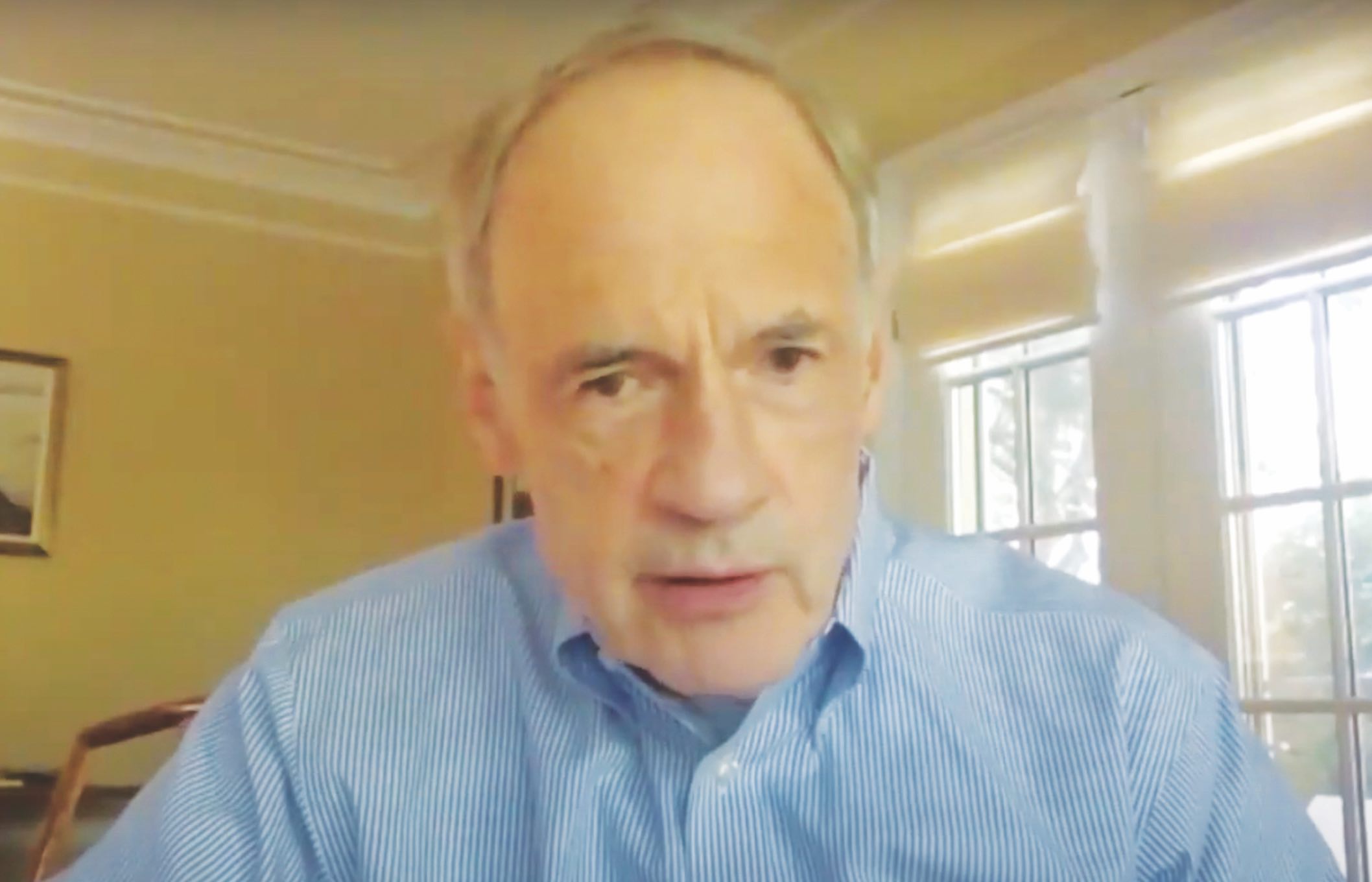
A screenshot of Zoom call with Sen. Tom Carper, the top Democrat on the Environment and Public Works Committee, who has up to $310,000 invested in more than a dozen oil, gas, and utility companies.
Buybacks exceeded $1 trillion for the first time ever, the year after the cuts were passed, and dividends topped a record $1.3 trillion high.
The benefits to Congressional Republicans were enormous.
“The 10 richest Republicans in Congress in 2017 who voted for the tax bill held more than $731 million in assets, almost two-thirds of which were in stocks, bonds, mutual funds, and other instruments,” which benefitted handsomely as a result of their votes that “doled out nearly $150 billion in corporate tax savings in 2018 alone,” Cary noted. “All but one of the 47 Republicans who sat on the three key committees overseeing the drafting of the tax bill own stocks and stock mutual funds.
“Democrats also stood to gain from the tax bill, though not one voted for it,” he wrote. “All but 12 Republicans voted for the tax bill.”
Two special features deserve notice. First is a newly created 20% deduction for income from ‘pass-through’ businesses, or smaller, single-owner corporations.
“At least 22 of the 47 members of the House and Senate tax-writing committees have investments in pass-through businesses,” Project Censored noted.
Second was a provision allowing real estate companies with relatively few employees — like the Trump organization — to take a 20 percent deduction usually reserved for larger businesses with sizable payrolls.
“Out of the 47 Republicans responsible for drafting the bill, at least 29 held real estate interests at the time of its passage,” Project Censored pointed out.
As to the second major conflict, “Members of the U.S. Senate are heavily invested in the fossil fuel companies that drive the current climate crisis, creating a conflict between those senators’ financial interests as investors and their responsibilities as elected representatives,” Project Censored wrote.
“Twenty-nine U.S. senators and their spouses own between $3.5 million and $13.9 million worth of stock in companies that extract, transport, or burn fossil fuels, or provide services to fossil fuel companies,” Donald Shaw reported for Sludge in September 2019.
While unsurprising on the Republican side, this also includes two key Democrats. Sen. Tom Carper, of Delaware, is the top Democrat on the Environment and Public Works Committee. He has “up to $310,000 invested in more than a dozen oil, gas, and utility companies, as well as mutual funds with holdings in the fossil fuel industry,” Shaw reported.
But his record is not nearly as questionable as Sen. Joe Manchin, of West Virginia, the ranking member of the Senate Energy and Natural Resources Committee, who “owns between $1 million and $5 million worth of non-public stock in a family coal business, Enersystems,” and reported earning “between $100,001 and $1 million” in reported dividends and interest in 2018, plus $470,000 in ‘ordinary business income,” Shaw reported.
His support for the industry was significant:
Manchin was the only Democrat to vote against an amendment to protect the Arctic National Wildlife Refuge from oil drilling in 2017, and he was one of just three Democrats to vote against an amendment to phase out taxpayer subsidies for coal, oil, and gas producers in 2016. Manchin has also voted to approve construction of the Keystone XL oil pipeline, expedite the approval process for natural gas pipelines, and override an Obama administration rule requiring coal companies to protect groundwater from toxic coal mining waste.
While there has been critical coverage of 2017 tax cuts, this has not included coverage of lawmakers personal profiting, Project Censored noted.
“In addition, despite the significant conflicts of interest exposed by Donald Shaw’s reporting for Sludge, the alarming facts about U.S. senators’ massive investments in the fossil fuel industry appear to have gone completely unreported in the corporate press.”
5. Inequality Kills: Gap between Richest and Poorest Americans Largest in 50 Years
“In public health, decades of research are coming to a consensus: Inequality kills,” DePaul University sociologist Fernando De Maio wrote for Truthout in December 2019.
Even before COVID-19, his research added fine-grained evidence of broad trends highlighted in three prominent governmental reports: the gap between rich and poor Americans had grown larger than ever in half a century, according to the U.S. Census Bureau’s 2019 annual survey, with dramatic evidence of its lethal impact: people in the poorest quintile die at twice the rate as those in the richest quintile, according to a report by the Congressional General Accounting Office. And, this is partly because job-related deaths are increasingly rooted in the physical and psychological toll of low-wage work, as opposed to on-the-job accidents, as documented by the United Nations’ International Labor Organization.
All these conditions were made worse by COVID-19, but they could have been seen before the pandemic struck — if only the information hadn’t been censored by the corporate media, as Project Censored noted:
As of May 2020, Project Censored has not been able to identify any corporate news coverage on the GAO or Census Bureau reports on inequality and premature mortality, or on the ILO report about work-related illnesses, accidents, and deaths that take place when workers are off-duty.
The August 2019 GAO report was based on health and retirement surveys conducted by the Social Security Administration in 1992 and 2014, looking at those between 51 and 61 years old in 1992, and dividing them into five wealth quintiles.
“[T]he GAO found that nearly half of those (48 percent) in the poorest quintile died before 2014, when they would have been between 73 and 83 years old. Of the wealthiest quintile, only a quarter (26 percent) died,” explained Patrick Martin, writing for the World Socialists Website
Death rates increased for each quintile as the level of wealth declined.
It’s at the level of cities and communities “that the most striking links between inequality and health can be detected,” De Maio wrote. “At the city level, life expectancy varies from a low of 71.4 years in Gary, Indiana, to a high of 84.7 in Newton, Massachusetts — a gap of more than 13 years.”
And at the community level, “In Chicago, there is a nine-year gap between the life expectancy for Black and white people. This gap amounts to more than 3,000 ‘excess deaths’” among black Chicagoans, due to “heart disease, cancer, stroke, diabetes and kidney disease. All of these are conditions that an equitable health care system would address,” he concluded.
“The poorest Americans are also more likely than their rich counterparts to face illness or premature death due to the inherent dangers of low-wage work,” Project Censored noted.
“In 2019, you no longer have to hang from scaffolding to risk your life on the job,” María José Carmona wrote for Inequality.org. “Precariousness, stress, and overwork can also make you sick, and even kill you, at a much higher rate than accidents.”
She reported on an ILO story that found that less than 14 percent of the 7500 people who die “due to unsafe and unhealthy working conditions every day” die from workplace accidents.
The greatest risk comes from “increasing pressure, precarious contracts, and working hours incompatible with life, which, bit by bit, continue to feed the invisible accident rate that does not appear in the news,” Carmona wrote. “The most vulnerable workers are those employed on a temporary or casual basis, those subcontracted through agencies and the false self-employed. ILO data shows the rate of accidents for these employees to be much higher than for any others.”
As of May 2020, Project Censored has not been able to identify any corporate news coverage on the GAO or Census Bureau reports on inequality and premature mortality, or on the ILO report about work-related illnesses, accidents, and deaths that take place when workers are off-duty.
6. Shadow Network of Conservative Outlets Emerges to Exploit Faith in Local News
In late October 2019, Carol Thompson reported in the Lansing State Journal that, “Dozens of websites branded as local news outlets launched throughout Michigan this fall … promising local news but also offering political messaging.” The websites’ ‘About us’ sections “say they are published by Metric Media LLC, a company that aims to fill the ‘growing void in local and community news after years of steady disinvestment in local reporting by legacy media.’” Thompson wrote, but it soon emerged that they weren’t filling that void with locally-generated news, and the 40 or so sites Thompson found in Michigan were just the tip of the iceberg.
A follow-up investigation by TheMichigan Daily reported that “Just this past week, additional statewide networks of these websites have sprung up in Montana and Iowa,” which was followed by a December 2019 report by the Columbia Journalism Review, revealing a network of 450 websites run by five corporate organizations in twelve states that “mimic the appearance and output of traditional news organizations” in order to “manipulate public opinion by exploiting faith in local media.”
All were associated with conservative businessman Brian Timpone.
“In 2012, Timpone’s company Journatic, an outlet known for its low-cost automated story generation, which became known as ‘pink slime journalism,’ attracted national attention and outrage for faking bylines and quotes, and for plagiarism,” CJR’s Priyanjana Bengani reported. Journatic was later rebranded as Locality Labs, whose content ran on the Metric Media websites.
“The different websites are nearly indistinguishable, sharing identical stories and using regional titles,” Michigan Daily reported. “The only articles with named authors contain politically skewed content. The rest of the articles on the sites are primarily composed of press releases from local organizations and articles written by the Local Labs News Service.”
“Despite the different organization and network names, it is evident these sites are connected,” Bengani wrote. “Other than simply sharing network metadata as described above, they also share bylines (including ‘Metric Media News Service’ and ‘Local Labs News Service’ for templated stories), servers, layouts, and templates.”
Using a suite of investigative tools, CJR was able to identify at least 189 sites in 10 states run by Metric Media — all created in 2019 — along with 179 run by Franklin Archer (with Timpone’s brother Michael as CEO).
“We tapped into the RSS feeds of these 189 Metric Media sites,” over a period of two weeks, Bengani wrote, “and found over fifteen thousand unique stories had been published (over fifty thousand when aggregated across the sites), but only about a hundred titles had the bylines of human reporters.” That’s well below 1% with a byline—much less being local. “The rest cited automated services or press releases.”
Although The New York Times did publish an article in October 2019 that credited the Lansing State Journal with breaking the story about pseudo-local news organizations, Project Censored notes that, “Corporate coverage has been lacking…. The Columbia Journalism Review’s piece expands on the breadth and scope of previous coverage, but its findings do not appear to have been reported by any of the major establishment news outlets.”
7. Underreporting of Missing and Victimized Black Women and Girls
Black women and girls go missing in the United States at a higher rate than that of their white counterparts. And, that very fact goes missing, too.
“A 2010 study about the media coverage of missing children in the United States discovered that only 20% of reported stories focused on missing Black children despite it corresponding to 33 % of the overall missing children cases,” Carma Henry reported for the Westside Gazette in February 2019.
But it’s only getting worse.
“A 2015 study discussed in the William & Mary Journal of Race, Gender, and Social Justice found that the disparity listed in the 2010 study between the reportage and the reality of missing Black children had increased substantially,” Project Censored noted: 35% of missing children cases vs. just 7% of media stories.
That discussion appeared in a paper that made two other pertinent points. First, that Black criminal perpetrators are over-represented in the media, while Black victims are underrepresented, and second, that “because racial minorities are identified as criminals more often than not, non-minorities develop limited empathy toward racial minorities who are often perceived as offenders.”
Non-minorities in the media are obviously not exempt.
“Media coverage is often vital in missing person cases because it raises community awareness and can drive funding and search efforts that support finding those missing persons,” Project Censored noted.
While there is some coverage from small independent sources, “this gap in coverage of missing Black women and girls has gone widely underreported,” Project Censored noted.
It cited two exceptions (one from ABC News, another from CNN).
“But, broadly, US corporate media are not willing to discuss their own shortcomings or to acknowledge the responsibilities they neglect by failing to provide coverage on the search for missing and victimized Black women and girls.”
8. The Public Banking Revolution
The year 2019 marked the 100th anniversary of the USA’s first publicly-owned state bank, the Bank of North Dakota (BND), and in October, California Gov. Gavin Newsom signed the Public Banking Act, authorizing up to 10 similar such banks to be created by California’s city and county governments. In response, the cities of San Francisco and Los Angeles both announced plans to do so. It was the culmination of a decade-long effort that began in the wake of the Great Recession that’s also been taken up in nearly two dozen other states. Beyond the benefits North Dakota has reaped in the past, such banks could have greatly assisted in responding to COVID-19’s economic devastation, and could yet help fund a just transition to a decarbonized future, along the lines of a Green New Deal.
Yet, despite California’s agenda-setting reputation, Project Censored notes that, “No major corporate media outlets appear to have devoted recent coverage to this important and timely topic.”
“The Bank of North Dakota was founded in 1919 in response to a farmers’ revolt against out-of-state banks that were foreclosing unfairly on their farms,” Ellen Brown, founder of the Public Banking Institute wrote for Common Dreams. “Since then it has evolved into a $7.4 billion bank that is reported to be even more profitable than JPMorgan Chase and Goldman Sachs, although its mandate is not actually to make a profit but simply to serve the interests of local North Dakota communities.”
“The state of North Dakota has six times as many financial institutions per capita as the rest of the country and it’s because they have the Bank of North Dakota,” Sushil Jacob, an attorney who works with the California Public Banking Alliance told The Guardian. “When the great recession hit, the Bank of North Dakota stepped in and provided loans and allowed local banks to thrive.”
As a result, “North Dakota was the only state that escaped the credit crisis,” Brown told Ananya Garg, reporting for Yes! magazine. “It never went in the red, [had] the lowest unemployment rate in the country, the lowest foreclosure rate at that time.”
In short, “From efforts to divest public employee pension funds from the fossil fuel industry and private prisons, to funding the proposed Green New Deal, and counteracting the massive, rapid shutdown of the economy caused by the COVID-19 pandemic, public banking has never seemed more relevant,” Project Censored wrote.
It’s a time-tested practical solution the corporate media refuses to discuss.
9. Rising Risks of Nuclear Power Due to Climate Change
As early as 2003, 30 nuclear units were either shut down or reduced power output during a deadly European summer heatwave in Europe.
But almost two decades later, the corporate media has yet to grasp that “Nuclear power plants are unprepared for climate change,” as Project Censored notes. “Rising sea levels and warmer waters will impact power plants’ infrastructure, posing increased risks of nuclear disasters, according to reports from the Natural Resources Defense Council (NRDC) and Truthout from September 2019,” they explain. Yet, “Tracking back to 2013, corporate news media have only sporadically addressed the potential for climate change to impact nuclear power plants.”
Sea level rise — combined with storm surges — represents the most serious threat. That was the focus of a 2018 report by John Vidal from Ensia, a solutions-focused media outlet, which found that “at least 100 U.S., European and Asian nuclear power stations built just a few meters above sea level could be threatened by serious flooding caused by accelerating sea-level rise and more frequent storm surges.”
“Nuclear stations are on the front line of climate change impacts both figuratively and quite literally,” leading climate scientist Michael Mann told Vidal. “We are likely profoundly underestimating climate change risk and damages in coastal areas.”
10. Revive Journalism with a Stimulus Package and Public Option
In late March, Congress passed and President Trump signed a $2.2 trillion coronavirus rescue package, including direct payments of $1,200 per adult and more than $500 billion for large corporations. Before passage, Craig Aaron, the president of Free Press, argued that a stimulus package for journalism was also urgently needed. “In the face of this pandemic, the public needs good, economically secure journalists more than ever,” separating fact from fiction, and holding politicians and powerful institutions accountable,” Aaron wrote in the Columbia Journalism Review.
Aaron’s organization, Free Press, placed journalism’s needs at $5 billion in immediate emergency funds, “less than half of one percent of a trillion-dollar recovery package” and asked that “Congress put a foundation in place to help sustain journalism over the long term.”
Arguing that a “resilient and community-centered media system” is necessary to get through the pandemic, Aaron concluded, “Now is the time to act. We need significant public investments in all corners of the economy, and journalism is no exception.”
In an article in Jacobin, Media scholar Victor Pickard advanced a more robust proposal, for $30 billion annually (less than 1.4% of the coronavirus stimulus package, Project Censored noted).
“While corporate news outlets have reported the ongoing demise of newspapers and especially local news sources, they have rarely covered proposals such as Aaron’s and Pickard’s to revitalize journalism through public funding,” Project Censored wrote.
Paul Rosenbergis an activist turned journalist who has written for the Christian Science Monitor, the Los Angeles Times, the Denver Post, Al Jazeera English, Salon.com, and numerous other periodicals. He has also written more than 300 book reviews. He has worked as an editor at Random Lengths News since 2002.
Kudos to the Bohemian/Pacific Sun for a fantastic piece of journalism. Peter Byrne’s “Apocalypse Cow” (Dec. 9) was the most comprehensive story I’ve read about the plight of the elk and of Point Reyes National Seashore in the face of unrelenting misinformation and negligence by agencies in charge and by our local elected representatives.
I applaud your paper for being bold enough to report the truth regarding the Park Service’s failure to follow National Park mandates and National Seashore law which require them to protect and preserve our natural spaces, water quality and wildlife, including threatened and endangered species.
Byrne also points out the hypocrisy of Huffman declaring himself an environmental advocate while he takes campaign money from organizations which make a profit from the destruction of forests and public lands, and contribute to a decline in air quality, and promote unhealthy forms of food and drink. He has been an unapologetic supporter of the dairy industry even with thousands of public comments calling for a look at the obvious destruction of these national parklands which taxpayers continue to subsidize.
Your kind of honest reporting is critical now when businesses and organizations engage in greenwashing to lull the public into complacency, and the voices of corporate media try to obscure science and drown out those who speak up for a just and sustainable world. Keep up the great work!
Proposition 13, passed in 1978, is eating California alive.
Economists argue that property taxes are the only moral tax. Common land and resources are privatized, and in return, neighbors are compensated with alternative value—namely, public services and infrastructure. For industrial properties the relationship is more complex; some jobs are created, but the community faces more noise, pollution and traffic.
While there was merit to stabilizing property taxes, Prop. 13 was poorly crafted and sacrificed our state’s future.
For homeowners, it incentivized something like hoarding. Once upon a time, people downsized and moved away from jobs and schools at retirement, but Prop. 13 broke that cycle. Now renting is more profitable than selling, and only the wealthiest can afford what houses are available.
Young families struggle here, cannot save enough to compete with all cash offers and then move away with nothing to show. Industries rarely move anyways, and Prop. 13 disincentivized improving or expanding for fear of triggering reappraisal.
Even worse, Prop. 13 limited increases to 2 percent annually. In plain dollars, what has that cost us?
One hundred dollars of property taxes assessed in 1978 provides a maximum revenue of $230 now. Over the same years, inflation raised the cost of goods 4x, and average salaries rose 5x. Had taxes risen with comparable sales values each year ($100 up to $995), local budgets would be in the green and California could have afforded to drop either income or sales tax, both of which impact poor more than rich.
In 2019, property taxes only provided an eighth of California county revenues, while half of county budgets came from state and federal sources. Follow the money, find the power. With so few dollars to go around, budgets get squeezed. Service cuts? School closures? Underwhelming infrastructure? All sprang from Prop. 13.
You think this is a progressive state? Prop. 13 drove a wedge into our society, one that favored businesses, the wealthy and homeowners already established pre-1978. Proponents scared you into thinking grandma would be thrown out; instead, it was the grandkids.
Let’s kill Prop. 13 so all of California may thrive.
Iain Burnett lives with his wife and daughter in Forestville.To have your topical essay of 350 words considered for publication, write le*****@********un.com.
DocLands Documentary Film Festival, hosted by the California Film Institute, brings compelling true-life films to Marin each spring, though the festival will look quite different when it returns in 2021.
While 2020’s festival was postponed due to the Covid-19 pandemic, this year’s event is staying on schedule while it adapts to the ongoing health crisis, and the fifth annual DocLands Documentary Film Festival will be held virtually May 7–16.
The festival is also currently accepting submissions from documentary filmmakers via upload through the FilmFreeway submission platform. The festival’s programming emphasizes new works in both documentary features and shorts; and each year, DocLands strives to engage a diverse audience with its films.
When DocLands returns virtually in May, it will build upon the innovative online programming that was introduced during 2020. Those innovations included “DocTalk From Home,” a springtime online showcase featuring the films and filmmakers that were meant to be in the 2020 festival. Following that digital venture, DocLands hosted the online “DocPitch” forum to support filmmakers with documentaries in production this past fall.
The 2020 DocLands Documentary Film Festival finally ran virtually this past October in tandem with the Mill Valley Film Festival, which also adapted to the pandemic with online and outdoor screenings for its 43rd year.
That virtual version of the 2020 DocLands festival boasted three categories of programming. ‘Art of Impact’ included films that tell stories from the global community and its disparate cultures. These stories engage in politics, personal narratives and biographies; and they aim to spark social justice action. ‘The Great Outdoors’ featured films that transport virtual audiences outside to explore and inspire conservation efforts to save the environment. ‘WonderLands’ featured a selection of films full of joy, wonder and possibility.
“It was such a privilege and honor to have my most recent film (Current Sea) at DocLands Documentary Film Festival,” says filmmaker Christopher Smith in a statement. “Despite the difficult situation caused by the coronavirus pandemic, the team at DocLands put together an unforgettable experience, one that I will cherish for a long time.”
Now planning for an accessible and inclusive virtual festival, the organizers are keeping open the possibility of limited in-theater screenings available while offering virtual access to those unable or unwilling to travel.
Submissions for the 2021 DocLands Documentary Film Festival are open for new works in documentary features (60-plus minutes), mid length films, and short films. The early deadline is Feb. 1, 2021; final deadline is Feb. 12. Rules and regulations are available on FilmFreeway and filmmakers can submit a film for consideration via upload there.
With DocLands, the Mill Valley Film Festival and the Christopher B. Smith Rafael Film Center in San Rafael, the nonprofit California Film Institute continues to celebrate and promote local and international films with its online endeavors. The Smith Rafael’s “Rafael @ Home” virtual screening series offers stay-at-home audiences several films available for streaming, including a special presentation of the newly released documentary film A Trusted Space: Redirecting Grief to Growth, featuring leading experts in trauma-informed education, which screens online with an accompanying panel discussion of local educators on the pandemic’s effects on schooling.
West Marin artist Toni Littlejohn is best known in the North Bay as a founding member of Gallery Route One in Point Reyes Station, where she lives. Currently working as GRO’s Board President, Littlejohn is also highly regarded for her ‘Wild Carrots’ art workshops, which are on pause due to the pandemic.
As a mixed-media artist, Littlejohn is not pressing pause on her creative output, and she opens 2021 with a new solo exhibit, “Coalescing Earths: Paintings by Toni Littlejohn.”
The show opens Tuesday, Jan. 5, and runs through Jan. 31 at Toby’s Art Gallery in Point Reyes Station. The gallery is open every day with Covid-19 safety protocols in place.
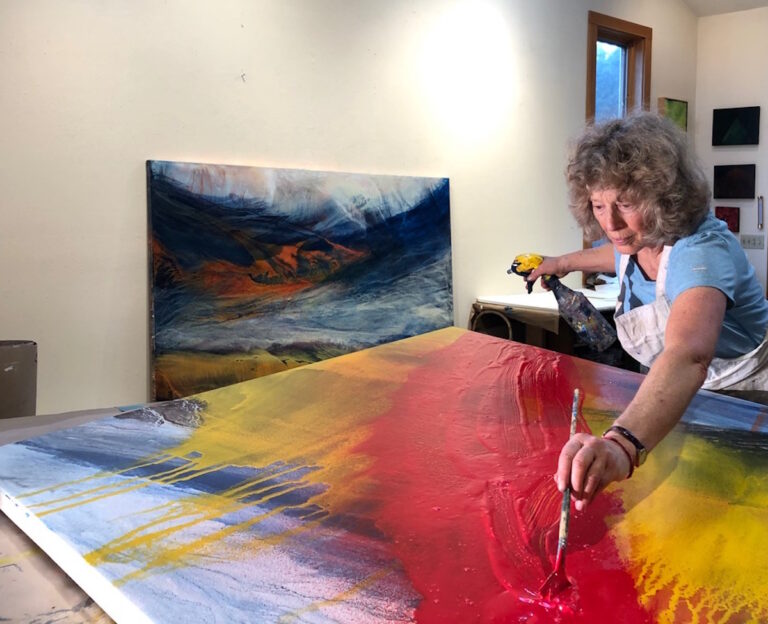
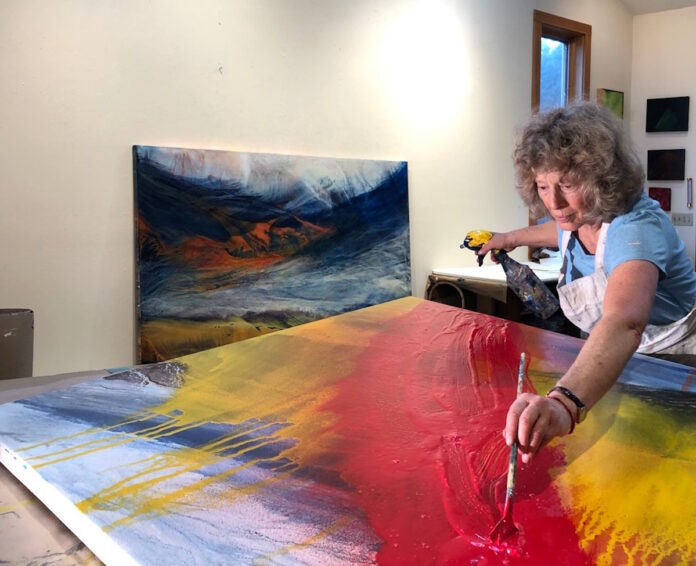
Littlejohn’s latest works visually explore the interaction of paint, water and gravity to form artistic depictions of fantastical Earthscapes.
Littlejohn’s art process begins by pouring paint and water on a large canvas, often four feet by six feet in size, that’s been laid flat. Guiding the paint with a brush and a water bottle, Littlejohn invites the two elements to naturally spread on the surface in swirling patterns.
Before the paint dries, Littlejohn tilts the canvas up to an upright position, and the paint responds to gravity as the swirls turn to flowing rivulets of paint. She then adjusts the angle of of the canvas’s position again, often reversing the paint’s direction. The process is repeated several times with each layer of color.
In this way, Littlejohn’s creative process itself becomes a metaphor of what she calls the “geological alchemy that created the Earth in a sensuous cacophony of fire, water, air and earth.”
Ultimately the colors meld into visual metaphors for ancient geological events that formed the planet as we know it, with works that resemble fiery volcanic explosions and canyons carved by shifting tectonic plates.
“(The paintings are) something beyond language, a stirring in my internal landscape which reminds me that I, too, hold boiling magmas, oceans to infinity, and the gift of sunlight in my own being,” Littlejohn says in a statement.
Littlejohn is also dedicating the upcoming exhibit to “the hope that humans will have the wisdom to realize our collective connection to the planet and the need for us all to participate in its well-being.”
‘Coalescing Earths: Paintings by Toni Littlejohn’ opens Tuesday, Jan. 5, and runs through Jan. 31 at Toby’s Art Gallery, 11250 Highway 1 in Point Reyes Station. Monday–Saturday, 9am to 5pm; Sunday, 10am to 5 pm. Tobysfeedbarn.com.
Two stellar companies, Kikoko and Saka, both owned and operated by women, have made a big splash in the cannabis industry. Their products are perfect for holiday cheer this year.
Kikoko
Kikoko, a Marin County enterprise that emphasizes “wellness,” offers a variety of premium cannabis products, beautifully packaged and accurately labeled. The Emerald Triangle supplies the weed. The founders supply the love.
I recently received a “care package” from Kikoko, opened it immediately and began to test drive the goodies: cannabis mints, cannabis honey and cannabis teas. For three days—a Friday through a Sunday—I imbibed and monitored the effects on my mind and my body. It took effort, but it was worth it.
The organic mint green tea, with THC and CBD, as well as licorice root and safflower petals, got me pleasantly stoned.
The care package came with a nifty booklet about Kikoko’s wellness teas, plus facts about the dangers of opioids and ways to relieve PMS. The booklet’s back cover boasts an image of a woman wearing black gloves and a black hat. I think of her as one of Kikoko’s sophisticated customers, though I know one doesn’t have to be a sophisticate to enjoy the teas, the mints and the cannabis-infused New Zealand Manuka honey.
Two self-defined “middle-aged women,” Jennifer Chapin and Amanda Jones, founded Kikoko in 2014. Headquartered in Sausalito, the products are manufactured in Alameda County, which is friendlier to pot than Marin, where citizens vote “Yes” on cannabis measures, but where the NIMBY attitude prevails.
Marin doesn’t encourage the manufacture of products with THC and CBD, and on the whole, Marinites don’t want dispensaries in their neighborhoods, whether the San Geronimo Valley or around the Point Reyes National Seashore.
The only brick-and-mortar Marin dispensary is located in Fairfax, though the county has several delivery services. While the city of Sausalito recently gave cannabis companies the green light to transport cannabis products to homes and offices, storefront retail is prohibited.
Kikoko co-founder, Amanda Jones, who was born and raised in New Zealand, has lived in Marin for 30-plus years. “We wouldn’t sell anything we wouldn’t put in our own bodies,” she tells me. “We test our products at least four times before they hit the shelves.” Jones’ partner and Kikoko co-founder, Jennifer Chapin, says, “For decades, the cannabis plant has been demonized. We aim to debunk myths and educate the public about cannabis and wellness.”
Seventy-five percent of Kikoko’s employees are women. Half are people of color. At the manufacturing facility, women do much of the heavy lifting. “We’ve created an environment where women can be leaders,” Chapin says. When I mention the stereotype of the “stoner,” she says, “We’re not that!” She adds, “We want our products to help people with health concerns, have fun and look to replacing pharmaceuticals and alcohol with cannabis.”
Saka
House of Sakamakes a beverage from Napa Valley grapes that has zero alcohol content, but that’s infused with THC and CBD. It comes in pink and in white. Rosé de pinot noir grapes for the pink and chardonnay grapes for the white.
“Saka” (not saki) is the name of the beverage. The instructions on the label read: “Pour ten capfuls into a glass, sip, savor and enjoy. Onset may be felt in as little as 5 to 15 minutes. Refrigerate after opening.”
Each serving of Saka has 16 calories, 5 milligrams of THC and 1 milligram of CBD. A 750 ml bottle is $45.
“Saka” is named after a mythical tribe of women. The label features a warrior on horseback armed with bow and arrow.
On a recent Sunday, I sipped about four ounces of the white. Twenty minutes later I began to unwind. Space expanded. Time slowed down. An hour after my first sip, I was pleasantly high.
At a dinner party that evening with friends and neighbors, we paired the beverage with caviar, baked potatoes and crème freche, followed by a brined rotisserie chicken cooked by cabinet maker extraordinaire, Chris Sheppard. Herbalist Karin Larez prepared a salad of greens and tomatoes—the last of the season—from her own garden.
Karin’s mother, Thora, 85 and spry, drank the Saka, started to giggle and remembered the time, 50 years ago, when she came to San Francisco from Seattle.
House of Saka was co-founded by Cynthia Salarizadeh, who has eons of experience in the “cannabis space,” as she calls it, and Tracey Mason, who identifies as “a queer woman.” Mason says that after years in the wine industry she knows how to navigate “a male-dominated world.”
Cannabis Gifts
Salarizahed and Mason want their beverage to be enjoyed most of all by women, but they won’t be miffed if guys get into the act. They suggest that when you enjoy House of Saka “Saka,” you listen to singer-songwriter, Sade Adu, who killed it in 1985 with the hit single, “Is It A Crime,” and also Erykah Badu, who broke out of the pack with the LP Baduizm and followed it with Mama’s Gun.
Chez Panisse founder and cookbook author, Alice Waters, has often called for a “revolution of the senses.” Saka might help revolutionize your taste buds and expand your head. Drink it alone or with a friend, and of course drink sensibly.
Jonah Raskin is the author of “Marijuanaland: Dispatches from an American War.”
Drug overdoses are the leading cause of accidental death in Marin and almost half involve opioids, according to a Marin County Civil Grand Jury report released last week.
The report, Opioid Misuse: Strengthening Marin County’s Response, reveals grim statistics. It estimates 4,400 people in Marin suffer from opioid use disorder. Last year, 43 people died from drug overdoses and opioids contributed to 23 of the deaths. Ambulance crews in Marin respond to three to five opioid-related overdose calls each week.
The United States recorded the most overdose deaths, over 81,000, for the 12-month cycle ending in May 2020, provisional data from the Centers for Disease Control and Prevention shows.
Unfortunately, the number of opioid overdoses in Marin is on the rise. Hospital emergency department visits for opioid overdoses more than tripled from 2006 to 2019. The opioid overdose death count in 2019 topped each of the previous eight years.
Opioids, a class of drugs used to relieve pain, are found naturally in the opium poppy plant. Regular use can cause dependence and long-term use may result in addiction, the most severe condition of opioid use disorder. Prescription opioids include OxyContin, Vicodin, morphine and fentanyl, a synthetic opioid 50 to 100 times stronger than morphine. Heroin and illegally manufactured fentanyl are the most common opioid street drugs.
Though the county has taken measures to prevent and treat opioid misuse, more must be done, the report concluded. The grand jury issued five recommendations.
Marin County Department of Health and Human Services (Marin HHS) should place naloxone, also known by the brand name Narcan, in public spaces, giving bystanders access to the drug to treat people who overdose on opioids. This life-saving medication, which is easily administered, reverses the effects of opioid overdose by restoring breathing.
The report called for Marin HHS to assess whether additional recovery coaches are necessary. Coaches are accredited and have personal experience with substance use. Marin HHS contracts with five coaches for Medi-Cal patients and more are needed, public health officials told members of the grand jury.
Healthcare providers must possess a waiver to prescribe medication for opioid use disorder and a cap exists on the number of patients they can treat. Marin HHS should expand the prescriber base and provide incentives for prescribers to treat the maximum allowed, the grand jury said.
Marin HHS should also pursue funding and opportunities to increase the number of beds in long-term recovery residences. There is a wait list for adults, and adolescent beds aren’t offered in Marin.
Finally, the grand jury proposed that the Marin Healthcare District, through MarinHealth Medical Center (formerly Marin General Hospital), ascertain whether to hire more substance use navigators, who counsel overdose patients in the emergency room.
The report commended the county for programs already implemented to prevent and reduce opioid misuse, such as participation in statewide monitoring of healthcare providers’ prescribing patterns. This database also allows providers to evaluate a patient’s substance use history.
The county has also developed the RxSafe Marin agency. Among its many programs is Safe Schools and Prevention, which aims to decrease drug use by school children.
Additional funding for opioid treatment and prevention programs could possibly come from lawsuits the county has filed against the makers and distributors of opioid drugs, the report said.
The Marin County Board of Supervisors and the Marin Healthcare District must respond to the report by March 14, 2021.
Years before the Covid-19 pandemic, award-winning virologist Dr. Nathan Wolfe proposed a plan to protect the economy from pandemics.
Even though Wolfe was named one of the ‘100 Most Influential People in the World’ in TIME for his work tracking Ebola and swine flu, no one took his proposal seriously. Now, Wolfe’s story is told in a new one-man show,...
Even though 2020 is officially done and the New Year is here, the Covid-19 pandemic continues to make in-person gatherings a tricky endeavor in the North Bay. To help start 2021 in a positive way, several local events boasting music, art, history, poetry and other timely communal interests are happening online this week. Here’s a round up of what’s...
Kudos to the Bohemian/Pacific Sun for a fantastic piece of journalism. Peter Byrne’s “Apocalypse Cow” (Dec. 9) was the most comprehensive story I’ve read about the plight of the elk and of Point Reyes National Seashore in the face of unrelenting misinformation and negligence by agencies in charge and by our local elected representatives.
I applaud your paper for being...
By Iain Burnett
Proposition 13, passed in 1978, is eating California alive.
Economists argue that property taxes are the only moral tax. Common land and resources are privatized, and in return, neighbors are compensated with alternative value—namely, public services and infrastructure. For industrial properties the relationship is more complex; some jobs are created, but the community faces more noise, pollution and...
DocLands Documentary Film Festival, hosted by the California Film Institute, brings compelling true-life films to Marin each spring, though the festival will look quite different when it returns in 2021.
While 2020’s festival was postponed due to the Covid-19 pandemic, this year’s event is staying on schedule while it adapts to the ongoing health crisis, and the fifth annual DocLands...
West Marin artist Toni Littlejohn is best known in the North Bay as a founding member of Gallery Route One in Point Reyes Station, where she lives. Currently working as GRO’s Board President, Littlejohn is also highly regarded for her ‘Wild Carrots’ art workshops, which are on pause due to the pandemic.
As a mixed-media artist, Littlejohn is not pressing...
Two stellar companies, Kikoko and Saka, both owned and operated by women, have made a big splash in the cannabis industry. Their products are perfect for holiday cheer this year.
Kikoko
Kikoko, a Marin County enterprise that emphasizes “wellness,” offers a variety of premium cannabis products, beautifully packaged and accurately labeled. The Emerald Triangle supplies the weed. The founders supply the...
Drug overdoses are the leading cause of accidental death in Marin and almost half involve opioids, according to a Marin County Civil Grand Jury report released last week.
The report, Opioid Misuse: Strengthening Marin County’s Response, reveals grim statistics. It estimates 4,400 people in Marin suffer from opioid use disorder. Last year, 43 people died from drug overdoses and opioids...