Park Concessions: Private enterprise in public spaces

0

One of the oft repeated arguments against having agriculture in a national park is that it is a commercial venture, and private commerce should not be allowed in national parks.

It might surprise people who proffer this argument to know that there are today more than 500 separate private businesses operating inside America’s National Parks and Seashores, many of them chains with multiple outlets scattered about the Park Service. And many produce carbon footprints far larger than that of a ranch or dairy farm.

Included in the long list of private concessions in national parks are bath houses, cruise lines, hotels, marinas, outfitters, parking facilities, service stations and perhaps the most ecologically destructive of them all—golf courses.

These booming enterprises are all linked together by blacktop highways which host millions of fossil fuel burning cars, trucks, snowmobiles and motorcycles, and where thousands of animals, some of them endangered species, become roadkill. Many highway victims are drawn to the roads by tasty vegetation planted on median strips or rotting food tossed by the wayside.

It really has become quite difficult for humans or wildlife to find true peace or a semblance of wilderness in an American national park. But a good meal, comfortable bed, a movie, sleigh ride, souvenir teddy bear, coffee table book or a fine bottle of wine are never far from a National Park Service (NPS) parking lot, all offered to the public by private concessionaires attracted into the parks by the NPS’s active and expanding Commercial Services Program.

If commerce is to continue to be a central purpose of our national parks (a good topic for debate), why not include healthy food production as one of the welcomed concessions in the mix? If, on the other hand, the NPS decides to limit or cut back the number of private concessions in the parks they manage, why not begin by expelling or dismantling the golf courses, fancy lodges, snowmobile rent shops, cruise ships and marinas that allow the use and rental of jet skis?

Mark Dowie is an investigative historian outside Willow Point. He is the author of ‘The Haida Gwaii Lesson: A Strategic Playbook for Indigenous Sovereignty.’

Making Music with San Rafael’s Susan Zelinsky

I was introduced to singer-songwriter Susan Zelinsky through my friend, Rachel Conine, and just in time since I’m hoping to see her perform at the “Sheryl Crow Celebration” at Rancho Nicasio this Friday. The following is an interview with Zelinsky:

What do you do? Lots. I direct musical theater productions at a few schools throughout Marin. I’m also the music teacher at Venetia Valley, through Marin Youth in Arts. I’m also a member of three bands, Urban Outlaws, The Winding Road and Lilith Affair; sing backups with the Jenny Kerr Band; and working on a new album of my original music.

Where do you live? San Rafael’s West End Village.

How long have you lived in Marin? 35 years, 33 in the same house.

Where can we find you when you’re not at work?

I take my dog, Maizy, to San Quentin Beach, or for walks on Sorich Ridge. My family likes Creekside in San Anselmo and Via Piccola Trattoria in Tiburon. The open mics on Wednesday nights are fun at Big Rock Cafe.

If you had to convince someone how awesome Marin was, where would you take them?

Definitely a hike on Mount Tam to see Cushing Memorial Amphitheater, East Peak’s Fire Lookout for a moonrise and Bolinas Ridge for a sunset. Mountain Play for a performance and Rancho Nicasio for a Sunday Summer Concert. Fourth Street in San Rafael for Dining Under the Lights and live music at the Pint Size Lounge.

What is one thing Marin is missing?

When my kids were little, I wished there was a roller or ice rink, in the old Yardbirds building. I’d be so much better at skating.

What’s one bit of advice you’d share with your fellow Marinites?

Attending live performances of music and theater is good for your soul, and your community. Things have opened up again, so get out there and enjoy!

If you could invite anyone to a special dinner, whom would they be? Robin Williams. We have a lot of catching up to do, one on one, heart to heart.

What is some advice you wish you knew 20 years ago?

Let go of perfectionism, go ahead and fail, and acknowledge every step you’ve taken to get where you are today.

What is something that in 20 years from now will seem cringeworthy?

That we didn’t have Universal Healthcare in 2023. Fingers crossed.

Big question. What is one thing you’d do to change the world?

I’d start by making music and theater mandatory for all elementary grades, to nurture compassion, creativity and wonder.

Visit @susanzmusic on Instagram or FB for details on Friday’s show.

Of Galas and Grace Notes

Sebastopol

pianoSonoma

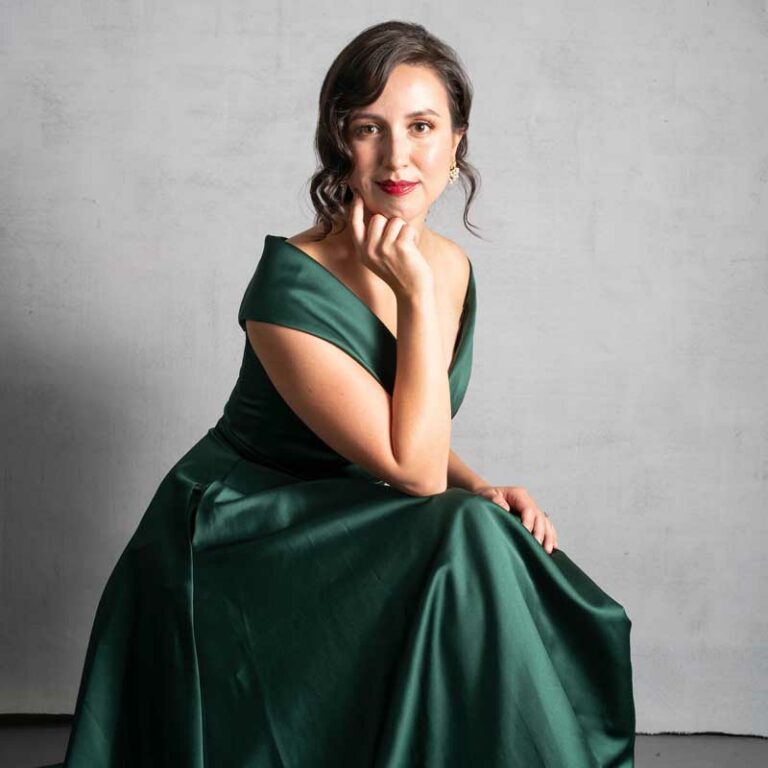
Despite our brand-conscious quibbles about portmanteaus and camel case wordmarks, we remain fans of pianoSonoma, which entreats music fans to experience, first-hand, the talents of their artists-in-residence program. There, “Classical virtuosity meets contemporary improvisation meets ground-breaking innovation in this eclectic and energizing program featuring classical, jazz, and original compositions,” according to their PR. We’re inclined to believe it thanks to its line up of emerging stars. Mezzo-soprano Kara Dugan, violinist Charles Yang, and pianists Peter Dugan, Jessica Shinn and Michael Shinn will showcase their talents at 7pm, Tuesday, May 16, at the Community Church of Sebastopol, 1000 Gravenstein Hwy. North. The performance is free.

Sausalito

Marin Open Studios Gala Fundraiser

Art can open one’s mind, but it’s especially potent when it’s straight from the source—an open studio. This is a phenomenon Marin Open Studios knows well after 30 years of offering a self-guided tour of local artists’ studios. This year kicks off with a gala fundraiser from 6 to 7pm, Saturday, April 29, at the Sausalito Center for the Arts, 750 Bridgeway. During Open Studios weekends, art lovers are invited to visit artists in their studios to meet the artists personally, enjoy a portfolio of artworks and purchase work directly from the artists. The Open Studios Tour takes place from 11am to 6pm, Saturday, May 6 and Sunday, May 7, as well as Saturday, May 13 and Sunday, May 14. Tickets for the Gala Fundraiser are $30. Visit MarinOpenStudios.org for more information.

Napa

Historical Society Turns 75

If one is looking for an alternative to blowing in the wind, the answer, my friend, is “Shouting Down the Wind: Napa’s Pioneering Women,” which explores women’s stories, primarily from the 1830s to today, and the contributions they have made to the Napa Valley. The exhibit is part of the Napa County Historical Society’s 75th Anniversary celebration that opens to the public at 10am, Friday, May 12 at the historic Goodman Library, located at 1219 First St. in downtown Napa. “Shouting Down the Wind” depicts an array of experiences through the lenses of education, health, sciences, arts and leisure, business and politics, as well as touching on the experiences of pre colonial Wappo and Patwin women and the rancho women of the 1830s and 1840s. The exhibit is free. There will be live music and refreshments. For more information, including the specifics of a members-only preview, visit napahistory.org.

Santa Rosa

First Responders Event

First Responders Resiliency, Inc., a science-based approach to the physiological, neurological, psychological and emotional effects of trauma and stress on first responders and their families, hosts its first Responder Resiliency Gala fundraiser from 5:30 to 8:30pm, Saturday, April 29 at Balletto Vineyards, 5700 Occidental Rd., Santa Rosa. The event includes an auction led by Aaron Johnson, live music by Max Vogel and a family-style dinner by celebrity chef Domenica Catelli. The organization’s goal is to eventually raise the $15 million needed to build a first-of-its-kind First Responder Resiliency Center on 17.75 acres recently purchased in Cotati. The future center will not only offer training but will also provide real-time access to wellness and support services. To purchase tickets to the fundraiser, visit resiliency1st.org/gala.

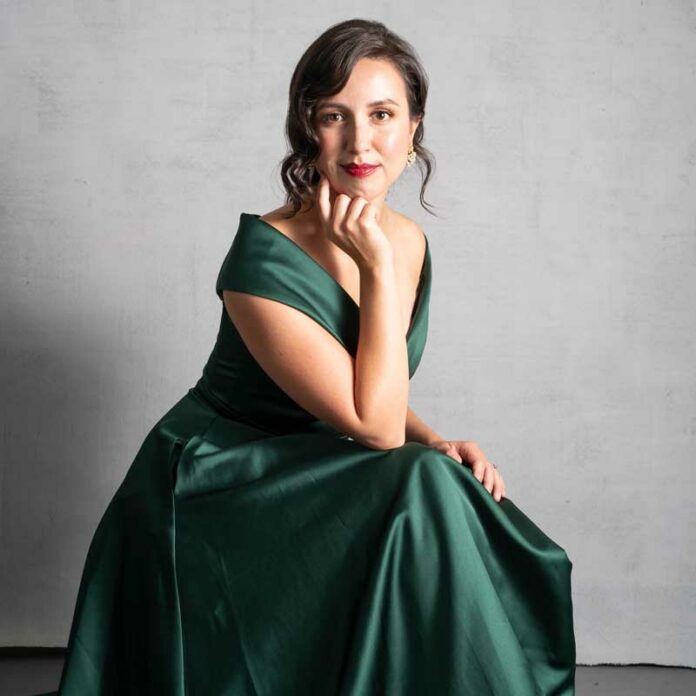
Meet Jodi Roberts, MarinMOCA’s New Executive Director

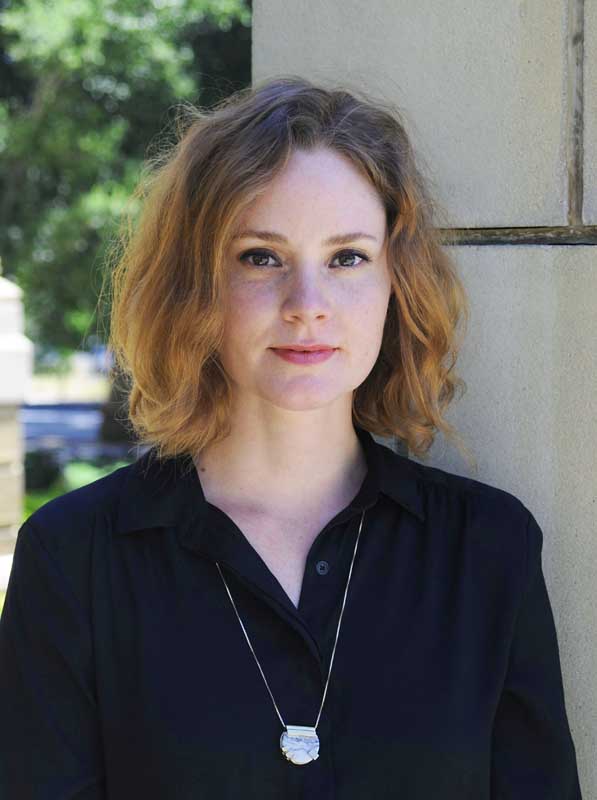
The Marin Museum of Contemporary Art (MarinMOCA) is excited to announce Jodi Roberts as the museum’s new executive director.

As of the first day of May, Roberts will take the reins and begin her new role, succeeding Amy Owen as executive director of MarinMOCA.

“We had a great experience with Amy Owen—she was a very strong leader,” said MarinMOCA board president Daniel Daniloff. “But Jodi is absolutely fabulous! We had 90 applicants for the job, and we whittled it down to six. [Roberts] was head and shoulders above everybody else…and everyone else was extremely qualified as well.” 

Roberts boasts a downright impressive decade full of professional experience in the world of art and art history. She has worked with and for prestigious institutions such as the Museum of Modern Art (MoMA) in New York, as well as Stanford University and the Adrian Rosenfeld Gallery.

“In part, I see my coming to MarinMOCA as a continuation of the incredible growth of its exhibitions, which Amy Owen did a great job with in bringing new types of art, artists and exhibitions to MarinMOCA—it’s my instinct to continue that,” said Roberts.

“I want to keep bringing in new artists, but locally focused,” she continued. “I’m excited for community-centered, smaller and more regional work for building up the community…a museum can be a great place for that.”

Roberts is also the co-founder of Art + Climate Action, a San Francisco Bay Area collective dedicated to creating an environmentally conscientious approach to sustainable art models. She plans to bring this eco-friendly attitude for art to her work at MarinMOCA as well.

“On a very practical side, my past two years working with art in regards to climate action has me focusing on and thinking creatively about how we approach exhibitions,” explained Roberts. “What can the exhibition be, and how can it be put together and how can we improve our energy use and how can we amplify and advance the climate goals of Marin County? And how can we at MarinMOCA become a model of sustainability in the world of art?”

Roberts spent her formative years in Tucson and moved to New York City as soon as she was finished with high school. She took advantage of the gap between high school and higher education to travel, broaden her horizons and explore the world around her through a quintessential coming-of-age backpacking trip through Europe.

“I took three years off between high school and college and did backpacking through Europe,” explained Roberts. “We landed in Madrid, and the trip took us wherever we felt we needed to go—this trip definitely stoked my interest in art and, through the experience, I thought I’d study history.”

After Roberts returned from her travels and while living in New York, she earned her Ph.D. in philosophy, history of art and architecture in 2015. During this time, she also worked for five years as a curatorial assistant for the Museum of Modern Art.

“Studying art history offered me a lens through which I could study history through the creative mind and an artist,” explained Roberts. “It’s how I found a hook to understanding history, and there is, in my opinion, no better way to study the past than through art and artists.”

After finishing her dissertation, Roberts moved again, this time from the East Coast all the way to the western coast of California. And, in 2015, she began working as a curator for Stanford University’s Cantor Arts Center.

“I took the opportunity at the Cantor Arts Center since I love working in universities and I love the dynamism of working in smaller art spaces,” said Roberts. “I understood that I’d have much more one-on-one time there, especially since [the Cantor Arts Center] sits within a larger institution.”

“I was genuinely excited to be in the Bay after so much time in New York,” continued Roberts. “And, of course, the cultural lore and the appeal of the Bay Area was intense, and I was happy to have had the opportunity to make the move out here.”

Roberts eventually settled down in Mill Valley, where she has lived for nearly five years. During this time, Roberts developed a family and currently has two young boys who she describes as “very West Coast.”

“My goal was always to explore the Bay Area in its larger form,” said Roberts. “It’s fascinating how each different city in the Bay Area has its own vibe, its own appeal, and I love that.”

Currently, Roberts plans to continue with the existing lineup for MarinMOCA’s 2023 exhibitions but is excited to implement some of her own ideas for the museum come 2024. Her focus for the moment will be in community building, education and maintaining the quality of work expected from Marin’s fine arts institution.

“Starting the first of May, I will always be present at the museum,” said Roberts. “I will definitely be a public presence for the community. I’m just really excited to be here, and I want to be available to help make MarinMOCA a hub in the larger ecosystem of the Bay Area as well.”

Roberts also hopes to pursue routes for collaboration between MarinMOCA and other local institutions. These interdisciplinary projects, which Roberts has seen through her work with Art + Climate Action, could play a role in paving the way for more combined community efforts toward a greater Marin.

“It’s part of that larger mission and, going back to the idea of art helping to grow the understanding of bigger cultural trends and debates, a museum is the perfect place to interact with and understand that,” said Roberts.

The current exhibition schedule for MarinMOCA will remain unchanged, and guests may attend during regular hours to see the work of Barbara Stauffacher Solomon and Nellie King Solomon in the “Super-Silly-Us” exhibition, as well as the 2023 Artist Member Showcase of “Elena Guryeva: Phenomena.”

“I think a lot of the artists who are working [in Marin] have been working here for quite a while,” concluded Roberts. “There’s a particular attunement to the immediate community and to the world around them that spills into their work and gives a special Bay Area flavor and interest. It’s a really rich and diverse scene, and I think that MarinMOCA can be a big part of that going forward.”

MarinMOCA is located at 500 Palm Dr. in Novato. For more information, call 415.506.0137, send an email to in**@*******ca.org or visit the website at marinmoca.org. The museum is open Wednesday through Friday from 11am to 4pm and on Saturday and Sunday from 11am to 5pm.

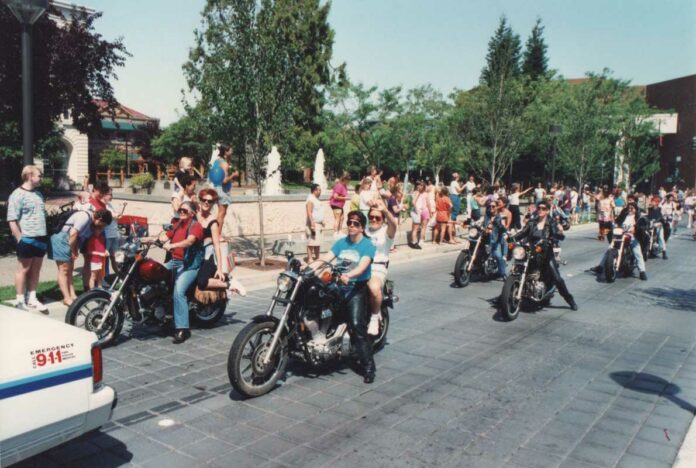
North Bay Lesbians Bond Over Film

In 2021, Pam Adinoff traveled to Provincetown, Massachusetts, and watched a documentary that would change her life remarkably.

The Unlikely Story of the Lesbians of First Friday, produced by Kathryn L Beranich, tells the story of lesbians in the early 1980s who formed a large, tight-knit community called First Friday in Roanoke, Virginia. At a time when same gender relationships were reviled by much of the general population, it was vital for lesbians in this rural area to come together for dances, parties and weekend-long retreats.

Adinoff, who lives in Sonoma County, came out 50 years ago, while studying at Sonoma State University. She found a social life and support system among fellow students in the women’s studies program.

“As I was watching the documentary, it really just rang so true about my own community—how amazing we were, how engaged, how much fun we had,” Adinoff said.

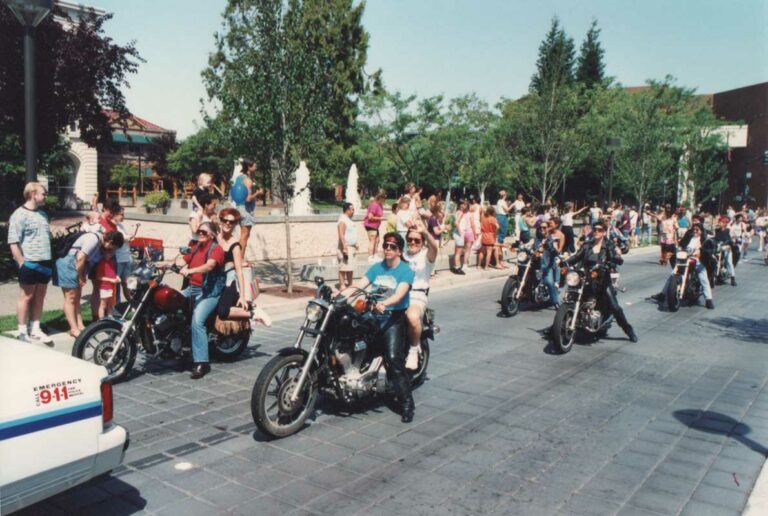
Community gatherings like the ones seen in Beranich’s documentary of Roanoke were happening all over the country in the 1970s and 1980s, said Adinoff, noting that Sonoma County lesbians created a women’s center, bookstore, political organizations, “softball teams galore” and more.

In the film, footage of the Roanoke retreats show women participating in costume contests and mock-Olympic games that opened with someone carrying a torch with tampons for the wick. More than a dozen First Friday participants share their memories of the group.

“We just wanted community, and we had to be very protective of it. It’s not something that we could do out in the open. Although that’s kind of sad in one way, it made it very rich and very fun,” one woman recalls.

After seeing the film, Adinoff was inspired to reconnect with the women she knew decades ago, first reaching out to a few friends she was still in contact with. In December 2021, a group of seven founders launched a Facebook group called Sonoma County Lesbian Reunion (SCLR). Today, the group has close to 300 members, between Facebook and an email list.

Members meet regularly on Zoom and in person. Last year, they held a picnic in Sebastopol with more than 100 people and a fall tea dance with a live band. Online, members find and share old photos.

Like the women of First Friday, Adinoff said although she is relieved it is safer to be out about one’s sexual orientation in 2023 than it was in the past, changes resulted in a loss of close community. SCLR aims to bring people together again for fun times and valuable connections.

“What can we do to continue to get a vibrant, engaged community and continue to be with each other as we age?” Adinoff said.

SCLR will host two screenings of The Unlikely Story of the Lesbians of First Friday on Sunday, April 23 at 1 and 4pm at Rialto Cinemas in Sebastopol. Beranich and associate producer Nancy Kelly will attend for a live Q&A. People of all ages are welcome.

Buddhist Bay Area: Film showings stretch over months at San Rafael festival

Buddhism: What does this word bring to mind?

If the answer is thoughts of meditation, mindfulness, monks and monasteries, then the imagery is correct, though it may be incomplete. The truth is, even in the Bay Area, where diversity, acceptance and cultural curiosity abound, there may still be a shroud of mystery surrounding the topic of Buddhism.

“Buddha means ‘The Awakened One’—that’s all it means,” explained Gaetano Kazuo Maida, founder and executive director of both the International Buddhist Film Festival and the Buddhist Film Foundation. “Very famously, the Buddha was once asked by a king: ‘Are you a god? A saint? What are you?’ And Buddha simply said to the king, ‘I am awake.’”

“That spirit is not limited to Buddhism, but has been identified in gatherings of people in any community,” said Maida.

Through the upcoming International Buddhist Film Festival Spotlight Series, the Marin community is offered an opportunity to gather at San Rafael’s Smith Rafael Film Center where, over the coming months, feature films pertaining to Buddhism, its people and its practices will play for local audiences.

“We use film as a medium because some folks are maybe a little hesitant to knock on the door of a Buddhist temple,” explained Maida. “Maybe it looks intimidating or doesn’t afford a direct integration into their lives. But to go to a movie is very simple. We all know how to arrive at a movie theater with a bag of popcorn in a room full of strangers in the dark to watch something special. That’s why we use film.”

These showings will offer an entertaining and approachable angle to develop a deeper perspective on elements of Buddhism, as seen through the lens of a camera. Showings will also include special guest attendees such as the directors of each film, prominent figures of the Buddhist community and, of course, the festival founder himself, Maida.

Maida grew up in a half-Japanese and half-Sicilian home in what he described as “a progressive activist family and community that had nothing to do with religion and spirituality.” In fact, Maida’s interest in Buddhism did not begin until his father gifted him a book, Zorba the Greek by Nikos Kazantzakis. With that, a lifelong interest was sparked and the journey toward founding the International Buddhist Film Festival began.

“I escaped New York many years ago in the ’60s,” said Maida. “I spent several years in the Bay Area doing the things that you’d expect in the ’60s—worked for Rolling Stone for a bit, had a band… but I was young and uncomfortable with the burgeoning drug culture, so I left back for the East Coast.”

At this juncture of his life, Maida put his passion for film and photography on the back burner to focus instead on the wellbeing and security of his family. Time passed, his daughter grew up and graduated, and he was able to return his attention to the realm of photojournalism and filmmaking.

“While in New York, the circles I participated in included some of the more interesting American Buddhist personalities,” explained Maida. “Around 1990, we concluded there was a missing piece in that arena: a magazine. So, we set out to start a national independent nonprofit Buddhist magazine.”

The magazine, Tricycle, was first published in May of 1991 and is still in production. Following the success of Tricycle, Maida returned to the West Coast and, while living in Berkeley in 2000, redirected his energy toward founding a Buddhist nonprofit for film. Then, in 2003, the opportunity to host the inaugural International Buddhist Film Festival presented itself.

“The first festival was 20 years ago at the Los Angeles County Museum of Art,” said Maida. “It was a wonderful experience and in the middle of the film community—obviously, since we were in LA. We had some very interesting people participate, and it was a wonderful beginning.”

“But we didn’t understand what we had done,” continued Maida. “We had set out to fill a hole in the festival arena. But what we thought was going to be a local event immediately turned into an invitation to Washington, DC, to present at the Smithsonian in 2004…then the invites came from all over the world: Barcelona, Singapore, London, Mexico City (where 50,000 people showed up for the opening celebration) and Vancouver.”

With the Buddhist Film Festival’s immediate, obvious and staggering popularity, Maida made the decision to continue the event and even expand upon it. The Bay Area, he asserted, was the perfect place to operate from, partly due to its historical roots in Buddhism.

“Being here in the Bay Area is, for us, my wife and I and the organization as well—it’s the ideal place to be,” said Maida. “It’s a very vibrant and diverse region in terms of Buddhist activity so, for us, it’s very natural.”

Though the upcoming film festival is centered on concepts of Buddhism, the event is open to any who wish to attend, enjoy the atmosphere and learn a thing or two from the silver screen.

“None of these films are only for Buddhists or only for Tibetans—they’re well-made feature-length films for everyone,” said Maida. “And the [Smith] Rafael Film Center has always been a good supporter of us, and it is in my opinion that they are the finest theater in terms of presentation quality in the Bay Area….it is a pleasure to watch a film there.”

The lineup for the 2023 International Buddhist Film Festival is as follows: Ganden: A Joyful Land on Sunday, April 30; Geshe Wangyal With Blessing of the Three Jewels on Sunday, May 21; Into the Night: Portraits of Life and Death (Part Two) on Sunday, June 18; and Dark Red Forest on Sunday, Sept. 17.

“When we choose our films, what we’re looking for is a good film,” said Maida. “But we’re also looking for a clear passion for seeking the path of compassion.”

Each showing will include an opportunity to interact with special guests, such as the director of each film (including Helen Whitney, an Academy Award-nominated and Emmy Award-winning documentary filmmaker, and Rosemary Rawcliffe, an Emmy Award-winning producer and director). Other notable figures in the Buddhist community will also attend showings, such as the president of Tibet House US, Robert Thurman, and Chodo Robert Campbell Sensei and Koshin Paley Ellison Sensei, founders of the New York Zen Center for Contemplative Care.

All screenings for the International Buddhist Film Festival Spotlight Series will take place at the Smith Rafael Film Center, located at 1118 4th St. in San Rafael. For more information or to pre-purchase tickets, visit rafaelfilm.cafilm.org.


Mr. Bungle, Redux Edition

​​Trevor Dunn of the seminal NorCal metal band on then and now

The Eureka-bred, avante-metal band Mr. Bungle cut its vicious, vampire teeth on the stages of the North Bay. The wacky funk-ska-metal beast that is Mr. Bungle is no longer creating layered and intensely original sounds as they did on their three albums of the ’90s. Nah, these fuckers came to thrash.

Mr. Bungle was started in high school by a trio of friends. When lead singer Mike Patton helped lead Faith No More to commercial success, Bungle was signed to Warner Bros. Not a subsidiary, no; the young freaks were suddenly labelmates of Van Halen and other giants.

The band’s experimental noisecore is my happy place, so I was thrilled, honored and all but moved to tears to interview Mr. Bungle and Fantomas bassist Trevor Dunn in advance of their upcoming show.

Giotis: The set on this tour is drawn from your very first demo, which is much different than the sound that defined Mr. Bungle in the ’90s. It’s an 4-track, almost death metal demo that you are now playing with the finest metal instrumentalists around. What’s it like to return to your origins like that? How did it come about?

Trevor Dunn: “We always thought it would be cool to revisit this with, like, the people it was written for essentially, like Scott Ian of Anthrax and Dave Lombardo of Slayer (also in Fantomas with Dunn and Patton). We were 100% listening to ’80s metal back then, so we thought, hey man, why not go back to the motherland for this?”

Giotis: That demo (the recently re-recorded ‘The Raging Wrath of the Easter Bunny’) was recorded in high school. How did that turn into a career?

Dunn: “[In the] late ’80s, we [got] more serious about the band, and we started making road trips down to San Francisco, opening for Primus. We’d go down to the Phoenix [in Petaluma] and Guerneville to play the River Theater there and small clubs in San Francisco.”

Giotis: When you were playing places like the Phoenix and The River Theater, you were building a sound on the backs of giants like Slayer and Anthrax. Now the most lauded members of those bands play with you. What’s it like playing with your idols?

Dunn: “I remember…that Patton and I were like, man, we haven’t played metal in a while; let’s start a metal band. [He] went home and wrote all these pieces that became Fantomas. Then one day, he was just kind of like staring at his record collection [and was] like, ‘You know what? I’m just going to call Dave Lombardo and Buzz Osborne.’ We didn’t know either of them at the time, and I was like, you know, ‘Good luck with that man.’

“I remember the first rehearsal in the room with Dave Lombardo blasting a double bass drum, just thinking this is insane, what the hell am I doing here, man? Like, that’s the sound of those records that I’ve been listening to, you know?

“By this time, I’ve spent a lot of time with Dave over the years; we’ve become friends. I got over being starstruck; this guy’s a human being like everyone else. No, well, it’s questionable because he’s part animal somewhere.”

Giotis: Like Animal, Muppets Animal.

Dunn: “Yeah, exactly, that kind of animal.”

Giotis: So my wife says that the way she’ll know I’m an imposter is if she comes home and I’m blasting Red Hot Chili Peppers. Then something is terribly wrong.

Dunn: “[Laughing] Hopefully, she’ll put you out of your misery.”

Giotis: Bungle and the Red Hot Chilli Peppers have a long standing beef that is legendary in the alternative funk thrash world. It was kind of one-sided, wasn’t it?

Dunn: “They’re such bullies; they really bullied us bad. They’re this multi-million dollar band that is still annoyed by us. Is Bungle really hurting their sales? I don’t think so. It affected us, personally, financially. They should be happy for spreading their hatred.”

RABBIT Mr. Bungle performing ‘The Raging Wrath of the Easter Bunny.’ Photo by Eric Larsen
Dunn then mentioned the uncompromising Nick Cave, quoted in the ’00s saying, “I’m forever near a stereo saying, ‘What the fuck is this garbage?’ And the answer is always the Red Hot Chili Peppers.”
Giotis: Bungle is known for some pretty shocking shenanigans onstage. Can you just verify for me that I saw Mike Patton drink piss on stage at the New Year’s Eve show opening for Primus in ’92?

Dunn: “Yeah, some kid threw a shoe up on stage and Patton peed into it. And then basically poured it over his head and drank it; it was disgusting.

Giotis: No, [laughing] it was beautiful, man; that meant the world to us. Pretty sure that was my first Bungle show. Somehow at that point, you were already on Warner Bros?

Dunn: “The only reason Warner Bros kept us around was because they had hopes that we were going to write a Faith No More type of hit, which was obviously never going to happen. But the thing is they never paid any attention to us. They weren’t breathing down our necks to put out records; they weren’t checking to see what our music was like; we had total freedom. They’d give us like a hundred grand to make a record, and we’d spend it all, and if we had any left over we’d buy some gear, you know?”

Giotis: The indie-metal label Ipecac out of Oakland is the organizer of this label showcase tour, the “Geek Show.” How is it working with Ipecac, which also releases music for your bands Fantomas and Trevor Dunn’s Trio-Convulsant?

Dunn: “It’s very grassroots. I think there’s three people now, maybe four involved with the label. In the less than 10 years [we were at Warner Bros], so many hands changed. Every time we put out a record, no one at the label knew who we were. Like, ‘What band is this?’ [So in] terms of Ipecac as a label, it’s like if you have questions, you want to know what’s going on, you want to know how many records are selling, you want to know what the figures are, you just call them up. It’s great; it’s a relationship, you know?”

Giotis: A bit like coming home.

Dunn: “Exactly.”

Mr. Bungle plays with Melvins and Spotlights on May 23 (sold out) and 24 in Oakland at the Fox Theater, 1807 Telegraph Ave. Tickets available through Ticketmaster or at thefoxoakland.com/listing.

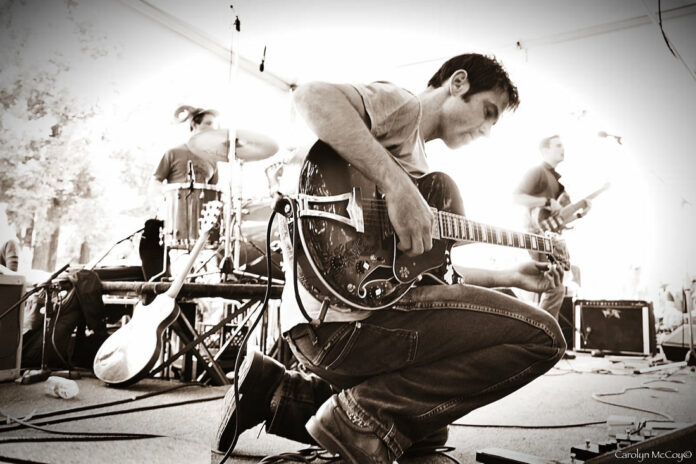
PSDSP, Find Out What it Means to Me

0

Elephant in the Room

177 Healdsburg Ave., Healdsburg. elephantintheroompub.com.

Continuing its valiant fight against fossil fuels is Electric Tumbleweed, 8pm, Friday, April 21. $10.

The Flamingo Resort

2777 4th St., Santa Rosa. vintagespacesr.com.

Get spun right round by ’80s DJs Tecni and Tim Brown. 9pm, Saturday, April 22. 21+. Free with online reservation.

Green Music Center

1801 East Cotati Ave., Rohnert Park. gmc.sonoma.edu.

Ukulele Orchestra of Great Britain proves ukes are no fluke. 7:30pm, Thursday, April 20. Tickets are $25-$85.

Hopmonk Tavern Sebastopol

230 Petaluma Ave., Sebastopol. hopmonk.com.

The Purple Pachyderm Purtentious Fancy Pants Burger Extravaganza. Nuff said. 4pm, Saturday, April 22. $45.

Blue Note Napa

1030 Main St., Napa. bluenotenapa.com.

Woody Allen has nothing on the envy of Jealous Zelig. 8pm, Friday, April 21. Tickets $12-$25.

The Phoenix Theater

201 Washington St., Petaluma. thephoenixtheater.com.

One of these things is not like the other, but can you guess which one? Jellyfish Method, Mordred, Right to Remain, Malpractice. 8pm, Saturday, April 22. $10.

Peri’s Tavern

29 Broadway, Fairfax. peristavern.com.

PSDSP—not sure what it stands for, but we suspect it might be psychedelic. 9pm, Friday, April 21. $10-$13.

—Daedalus Howell

Send your gigs to dh*****@*****ys.com.

Earth Speaks but We Must Listen

At the post office, my neighbor rolled down the window of his pick-up truck to chat. As is typical in Northern Maine this time of year, we praised the sunlight, warmth, bare patches of ground, and eyed the shrinking snowbanks with delight.

“Winter wasn’t so bad, this year,” he weighed in, “not like it used to be.”

At 85, he’s old enough to remember the -20 F temperatures from January onward.

“Gotta give global warming that much,” he joked.

I’m not sure he believes the climate crisis is real, even though he’s lived through the shocking shift in temperatures, seen the impacts on our local farming community and read the headlines of the disasters like the forest fires, droughts, super-storms and flooding.

“It’s not good for the ecosystem,” I venture, cautiously. “Remember the article in the newspaper that said 90% of the moose calves died from tick swarms?”

When mild winters fail to kill off the tick population, the explosion of ticks literally sucks the blood out of the baby calves. Moose dislike the changing climate. The hotter summers force them to spend more time trying to get cool instead of munching the plants that give them enough fat to survive the winter.

A touch of discomfort shifts through him. He taps the steering wheel uneasily. Then he shrugs.

“Nature has a way of correcting itself,” he says.

Yes, nature corrects itself. But that failsafe is crumbling, rapidly. Nature’s way of correcting itself right now is embodied by the students walking out of school on Fridays, pleading with older generations to take action to ensure their future. Nature is correcting itself through climate scientists publishing well-documented facts about this crisis. Or through activists blocking pipelines or pushing universities and retirement funds to divest from fossil fuels. Earth is speaking through city councils declaring climate emergencies, churches switching to solar and wind, businesses cleaning up their act and much more.

If we hope nature will correct itself, we need to wake up to our role in the rebalancing.

Rivera Sun is the author of ‘The Dandelion Insurrection.’

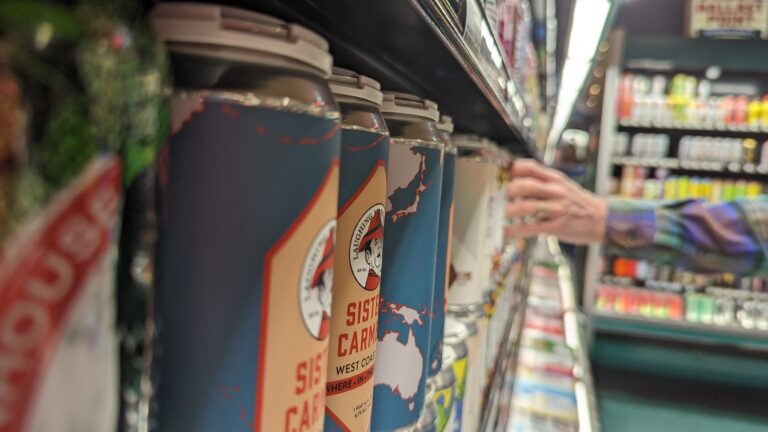
Craft Questions: The Meaning Behind the Marketing

The term “craft” has become so ubiquitous in the beverage industry, it’s hard to know when it means something and when it’s just a marketing term.

As it applies to alcoholic beverages, “craft” made its official entry into the American drinks lexicon with the craft microbrewery movement of the early 2000s (started by independent craft brewers in the ’70s). The Brewers Association first created a definition for the term craft brewers in 2006, describing them as “small, independent brewers,” with the definition of “small” changing over the years. Today the maximum production for craft breweries is six million barrels.

“Craft” made the jump easily over to the craft spirits movement, and has since also become popular in the wine industry. It has remained more of a marketing term than an official category due to the current lack of a widely recognized and approved craft winery designation that provides the opportunity for wineries of different sizes to obtain certification.


For spirits, The American Craft Spirits Association defines a craft distillery as “a distillery who values the importance of transparency in distilling, and remains forthcoming regarding their use of ingredients, their distilling location and process, bottling location and process, and aging process.”

Further tying craft spirit status to the size and production level of the distillery, the American Distilling Institute defines craft spirits as “the products of an independently-owned distillery with maximum annual sales of 52,000 cases where the product is physically distilled and bottled on-site.”

For wine, the existing definition has been curated by the Craft Wine Association, an independently run nonprofit organization (designated a nonprofit in 2022) that offers a Certified Craft Wine designation to qualifying wineries.

CWA defines craft wine as “commercially available, limited-production wine most commonly in production runs of 5,000 cases or fewer. Wines must [also] be authentic and traceable to their roots: producers that buy grapes need to know the source of their fruit to qualify for this designation.”

This craft wine designation may be the one that best attempts to limit the use of “craft” to truly authentic products made with traceable ingredients rather than tying the meaning only to production methods and levels. Under these defined terms, a brand that buys bulk juice and has their wine made by a custom crush facility (not by their own winemaker) wouldn’t qualify. Which is a good thing. It does, however, leave wineries that make more than 5,000 cases of wine, using artisanal or craft methods, out in the cold.

The CWA has been under new management since 2022, when they obtained nonprofit status and launched an advocacy group. The organization is currently looking at how to better promote the opportunity for certification, provide more benefits for certified member wineries, and potentially revise the current prerequisites.

The Future Includes More Craft Products

Whatever way one looks at it, the term “craft” doesn’t seem to be going anywhere anytime soon—and this is because consumers connect with the concept of artisan or craft concepts, as well as the terms used to describe them.

International craft food manufacturing company FONA International collected consumer data from millions of their customers, showing that “more than 50% of Millennials associate the term ‘craft’ with high-quality, along with 45% of Gen-Xers and 40% of Baby Boomers.”

In the beverage world, the numbers prove the popularity of craft products. With craft spirits, the number of craft distilleries increased 17.3% between 2021 and 2022, while export sales jumped 58% in 2021, and domestic sales continue to see more than 10% growth each year. For craft beer, sales (in dollars) increased 21% in 2021 over previous years, while craft beer volume sales increased 8% in 2021 (compared to just 1% growth in overall beer volume sales).

The numbers aren’t clear when it comes to wine, since the craft wine category isn’t currently measured like it is in beer and spirits.


However one slices it, it’s clear that consumers are buying into the craft alcohol movement in a big way. Yet, the number of businesses claiming to make “craft” products or to be “craft” producers is greater than the number of businesses that have actually applied for and earned a certification or designation, especially within the wine industry.

The Numbers

There are over 9,000 certified craft breweries and over 2,000 certified craft distilleries in the U.S., while there are currently only between 60-70 certified craft wine producers.


The much smaller number of certified craft wineries is completely understandable, as the option to become a certified craft winery is relatively recent, and the organization that awards this designation hasn’t had the same recognition, power, size or scope as the associations that award certifications in the spirits and beer industries.

It’s also become so important in the wine industry to show certifications related to organic farming or organic winemaking that proving a winery’s artisanal production methods, authenticity, ingredient sources and production size hasn’t been as much of a focus. Despite the fact, these are all things that are now agreed to be very important to consumers.

Certification Needs

The ability for a small business to differentiate themselves by the quality of ingredients, the production methods they use, their size and the fact that their products are made by a person who can be identified as the maker could give many small artisan producers a leg up over faceless brands, which are created by huge companies to appear like real wineries with real people behind them.

I’d personally love to see a craft winery certification that considers the quality of the ingredients, the production methods and how much the business deals directly with consumers (i.e., what percent they sell wholesale and what percent they sell directly to their customers) above the number of cases they produce. I also agree with setting a reasonable cap on allowed annual production levels, but do not feel that 5,000 cases is an appropriate number.

Firstly, this is because it’s extremely difficult for a winery to make a living in California if they are making only 5,000 cases (unless they are charging an obscene amount per bottle). Secondly, because making more than 5,000 cases does not correlate to making lower quality wines. After all, the objective of any business is to grow and become more profitable over time. There are plenty of independently owned craft wineries in Sonoma County that make anywhere between 3,000 and 15,000 cases of wine, using natural and traditional methods and locally sourced, traceable ingredients that prove this.


What do you think?

Do you perceive a food or beverage product to be higher quality when the term ‘craft’ is used?

What do you want to know about the wine businesses that you support, and be sure is 100% true?


Would a certification proving that a third-party association verified a business’ production methods, quality of ingredients, ingredient sources and traceability, and production size make you feel even better about purchasing from that business?

Would you actively seek out businesses with this kind of certification?

Let us know in the comments online or write dh*****@*****ys.com. We’d love to hear from you.

Park Concessions: Private enterprise in public spaces

One of the oft repeated arguments against having agriculture in a national park is that it is a commercial venture, and private commerce should not be allowed in national parks. It might surprise people who proffer this argument to know that there are today more than 500 separate private businesses operating inside America’s National Parks and Seashores, many of them...

Making Music with San Rafael’s Susan Zelinsky

I was introduced to singer-songwriter Susan Zelinsky through my friend, Rachel Conine, and just in time since I’m hoping to see her perform at the “Sheryl Crow Celebration” at Rancho Nicasio this Friday. The following is an interview with Zelinsky: What do you do? Lots. I direct musical theater productions at a few schools throughout Marin. I’m also the music...

Of Galas and Grace Notes

Sebastopol pianoSonoma Despite our brand-conscious quibbles about portmanteaus and camel case wordmarks, we remain fans of pianoSonoma, which entreats music fans to experience, first-hand, the talents of their artists-in-residence program. There, “Classical virtuosity meets contemporary improvisation meets ground-breaking innovation in this eclectic and energizing program featuring classical, jazz, and original compositions,” according to their PR. We’re inclined to believe it thanks...

Meet Jodi Roberts, MarinMOCA’s New Executive Director

The Marin Museum of Contemporary Art (MarinMOCA) is excited to announce Jodi Roberts as the museum’s new executive director. As of the first day of May, Roberts will take the reins and begin her new role, succeeding Amy Owen as executive director of MarinMOCA. “We had a great experience with Amy Owen—she was a very strong leader,” said MarinMOCA board president...

North Bay Lesbians Bond Over Film

FILM NBB MPS 2316
In 2021, Pam Adinoff traveled to Provincetown, Massachusetts, and watched a documentary that would change her life remarkably. The Unlikely Story of the Lesbians of First Friday, produced by Kathryn L Beranich, tells the story of lesbians in the early 1980s who formed a large, tight-knit community called First Friday in Roanoke, Virginia. At a time when same gender relationships...

Buddhist Bay Area: Film showings stretch over months at San Rafael festival

Buddhism: What does this word bring to mind? If the answer is thoughts of meditation, mindfulness, monks and monasteries, then the imagery is correct, though it may be incomplete. The truth is, even in the Bay Area, where diversity, acceptance and cultural curiosity abound, there may still be a shroud of mystery surrounding the topic of Buddhism. “Buddha means ‘The Awakened...

Mr. Bungle, Redux Edition

​​Trevor Dunn of the seminal NorCal metal band on then and now The Eureka-bred, avante-metal band Mr. Bungle cut its vicious, vampire teeth on the stages of the North Bay. The wacky funk-ska-metal beast that is Mr. Bungle is no longer creating layered and intensely original sounds as they did on their three albums of the ’90s. Nah, these fuckers...

PSDSP, Find Out What it Means to Me

Elephant in the Room 177 Healdsburg Ave., Healdsburg. elephantintheroompub.com. Continuing its valiant fight against fossil fuels is Electric Tumbleweed, 8pm, Friday, April 21. $10. The Flamingo Resort 2777 4th St., Santa Rosa. vintagespacesr.com. Get spun right round by ’80s DJs Tecni and Tim Brown. 9pm, Saturday, April 22. 21+. Free with online reservation. Green Music Center 1801 East Cotati Ave., Rohnert Park. gmc.sonoma.edu. Ukulele Orchestra of Great...

Earth Speaks but We Must Listen

At the post office, my neighbor rolled down the window of his pick-up truck to chat. As is typical in Northern Maine this time of year, we praised the sunlight, warmth, bare patches of ground, and eyed the shrinking snowbanks with delight. “Winter wasn’t so bad, this year,” he weighed in, “not like it used to be.” At 85, he’s old...

Craft Questions: The Meaning Behind the Marketing

The term “craft” has become so ubiquitous in the beverage industry, it’s hard to know when it means something and when it’s just a marketing term. As it applies to alcoholic beverages, “craft” made its official entry into the American drinks lexicon with the craft microbrewery movement of the early 2000s (started by independent craft brewers in the ’70s). The...
3,002FansLike
3,850FollowersFollow