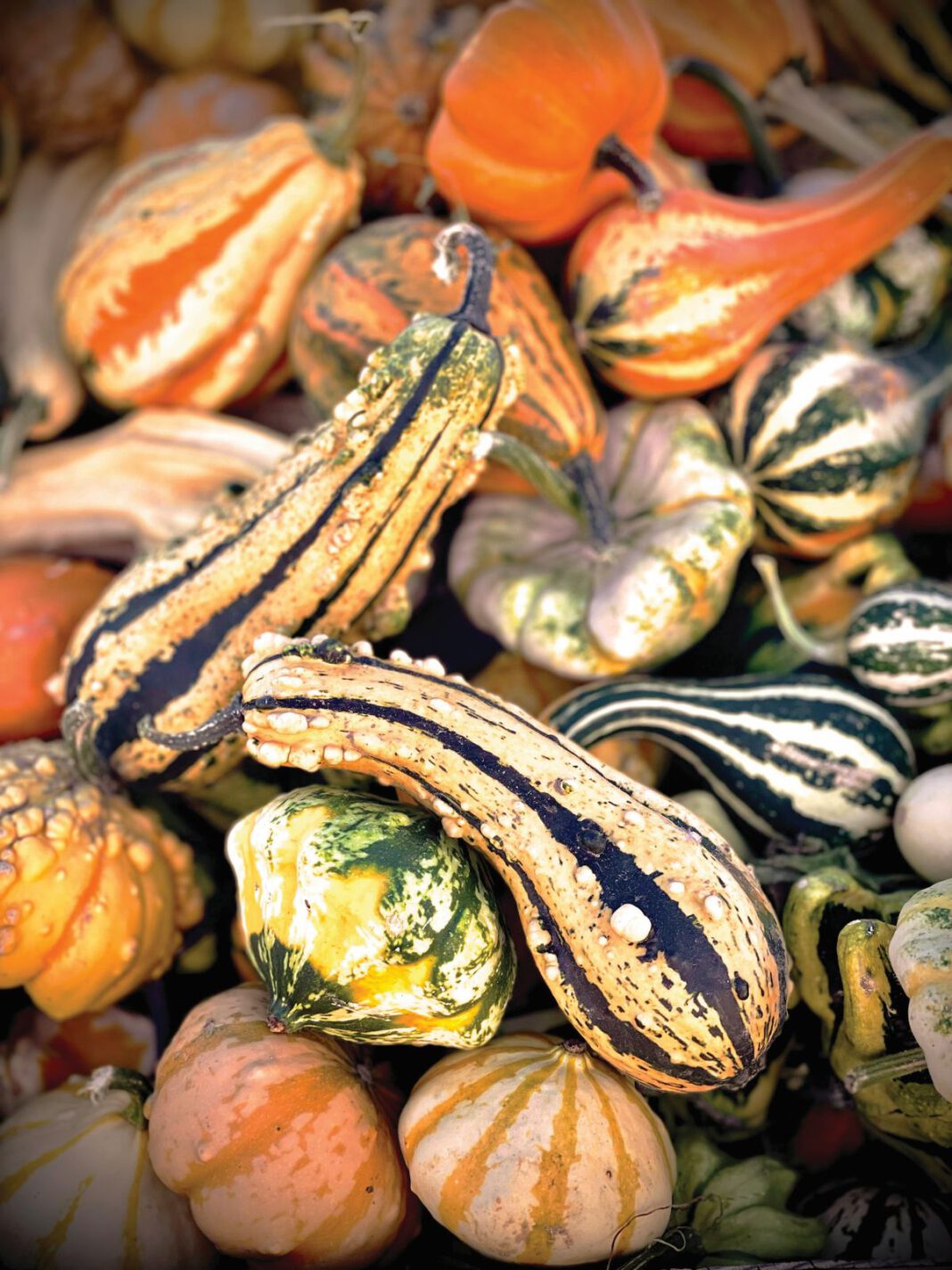
Ornamental gourds are like the semicolons of autumn. No one knows what to do with them, but when one sees them they kind of make sense.
This is the gourd’s contemporary office: sitting in a tasteful heap on a farmhouse table, looking seasonal. It may be striped, speckled, warted or shaped like a swan with scoliosis. It is rarely eaten. It has no obvious function. Yet remove one from an autumnal tableau and the whole arrangement loses its, ahem, gourd.
For much of human history, gourds were indispensable objects. The bottle gourd, Lagenaria siceraria, was among the earliest domesticated plants, cultivated in Asia at least 8,000 years ago and present in the Americas during pre-Columbian times. Harvested young, it could be eaten; left to mature, its hard shell could be dried and fashioned into bottles, bowls, ladles, floats, pipes, birdhouses and musical instruments.
Across West Africa, calabashes became water vessels and resonators for instruments including the kora and balafon. In China, the bottle-shaped hulu came to symbolize health and longevity, partly because physicians once carried medicine in gourds. Indigenous peoples throughout the Americas cultivated members of the genus Cucurbita thousands of years before European contact, eating their flesh and seeds while turning the dried shells into cups, storage vessels and ceremonial rattles.
The family name, Cucurbitaceae, encompasses an unruly Thanksgiving dinner of cucumbers, melons, pumpkins, squash and gourds. “Gourd” itself is more household term than precise botanical rank. Many of the small ornamental varieties belong to Cucurbita pepo, the same astonishingly elastic species that gives us zucchini, acorn squash and jack-o’-lantern pumpkins.
Whether one should eat one is another matter. Some decorative gourds contain high concentrations of bitter compounds called cucurbitacins, which can cause serious gastrointestinal distress. If a squash or gourd tastes unnaturally bitter, one should consider that a botanical cease-and-desist letter and stop eating it.
Our habit of treating gourds strictly as décor is comparatively recent, although decorating with the harvest is ancient. Abundance has always had allure as interior decor. European harvest festivals featured produce, grain and greenery; in North America, pumpkins and squash accumulated associations with Indigenous agriculture, Thanksgiving and Halloween. Irish and British immigrants brought traditions of carving lanterns from turnips and other roots; in the United States, the larger, more obliging pumpkin eventually took over the role. The term “jack-o’-lantern” was being applied to carved pumpkins by the 19th century.
Here in the North Bay, we remain blessedly close to local sources. In Sonoma County, the Petaluma Pumpkin Patch sells pumpkins and other gourds at 450 Stony Point Rd., while Pronzini Farms presents gourds amid its elaborate autumn vignettes at 3795 Adobe Rd. Muelrath Ranches near Santa Rosa grows pumpkins, winter squash and gourds without synthetic pesticides.
In Marin, Nicasio Valley Pumpkin Patch offers a 12-acre field and a persuasive reminder that agricultural shopping should occasionally involve hay. In Napa, the venerable Stanly Lane Pumpkin Patch, at 3100 Golden Gate Dr., has traditionally assembled thousands of pumpkins, gourds, cornstalks and other autumnal necessities. Because seasonal inventories and operating days vary, one should check with each farm before setting forth.
Gourds are best chosen by instinct. In fact, some say that a gourd chooses its person. Whether one’s gourd has knobs, stripes or necks that twist on themselves like a Klein bottle, they should treat it like an heirloom and place it somewhere prominent to signal their affinity with the season.
After several millennia spent carrying our water, medicine, soup and music, the gourd has earned the right to just sit around looking as cool as an autumnal breeze.