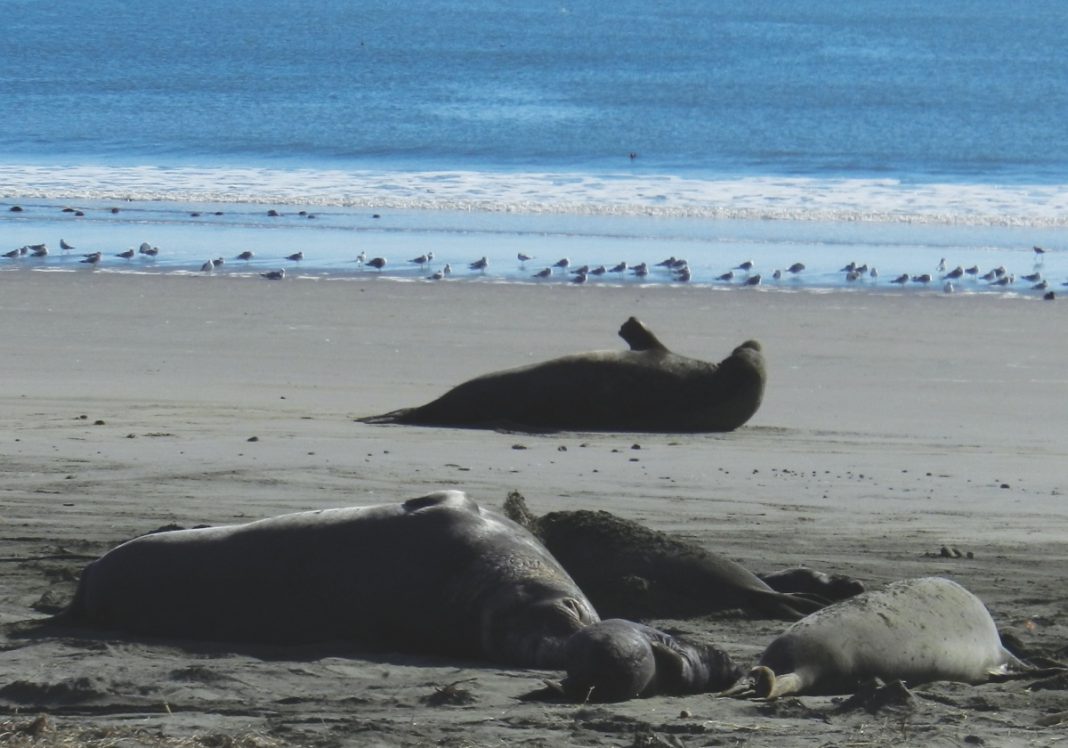
I was at Drakes Beach in Point Reyes National Seashore on a day in late December. The day was notably warm for the coast, with a soft breeze and not a cloud in the sky. The water moved calmly, softly, as small waves crashed on the shore.
I looked onto the sand, trying to make out the movement of the mounds I saw resting there, camouflaged. The mounds themselves were northern elephant seals. These lumbering animals, ranging from 10 to 13 feet and weighing from half a ton to more than two tons, will call Drakes Beach home until the winter fades into March.
Before their arrival to Drakes Beach, they would only stop by for a day or two but not, as now, stay around to breed, as they are likely to do this very month. However, a combination of the pandemic, and calmer waters along the shore, brought with them these beasts of the Pacific.
“In 2019, that’s when they decided to move right in front of the visitor center,” Sarah Codde, marine ecologist for Point Reyes National Seashore, said. “And there was a media blitz, because that was during the government shutdown at the time.”
This shutdown, and therefore the park employees’ inability to intervene, meant they couldn’t do the work of deterring the seals, usually by waving a giant tarp at them, from moving in front of the main visitor center.
Then, the pandemic hit, also thwarting more work to prevent the seals from getting too close to the more populated areas of Drakes Beach. This essentially, in the seals’ eyes, solidified this stretch of sand as their new home.
Since this occurred, the park has now raised a small fence to deter the seals from lumbering onto the parking lot and destroying the pavement with their weight. This, along with a robust docent program of around 140 volunteers, has kept Drakes Beach accessible to visitors, still as there are hundreds of seals on its shores. It has become, according Codde, one of the best places to see elephant seals up close in the wild.
“If we didn’t have those docents, we would have to close the entire parking lot and not have people go down there at all for the whole winter,” said Codde.
It’s important to remember that, while this population of seals is increasing, some other beaches, like the smaller one near Chimney Rock at the head of Point Reyes, have a population that is at times decreasing. This means that overall it is hard to determine just what the growth of the population at Drakes Beach means for the growth of elephant seal populations broadly. Although, scientists we spoke with did indicate that the population is, currently, fairly healthy.
But why are they here? To answer this question, we need to understand how we almost lost this species well before the Point Reyes National Seashore was considered a park.
After decades of thoughtless hunting for their blubber to be used as an oil, in the 1880s elephant seals had been so thoroughly killed off that most believed the animal to be extinct.
“Their population was decimated,” Milagros Rivera, elephant seal researcher at UC Santa Cruz, said. “The species had completely died out, but there was this very small subset hiding off the coast of Mexico.”
It wasn’t until 1892 when a team of scientists with the Smithsonian discovered a grouping of elephant seals living on Isle de Guadalupe off the coast of Mexico. Promptly, the team from the Smithsonian decided to kill seven of the eight seals they discovered. The government of Mexico, later in 1922, decided to protect the elephant seals, under law, initially stationing troops on the island to protect the last living 264 beasts of the Pacific.
As time passed, this population grew, eventually expanding their numbers to other islands off the coast of Mexico and beyond. And while the population did well, eventually ballooning to the tens of thousands in the 1950s, it wasn’t until decades later, in 1972, when the United States passed the Marine Mammal Protection Act, that elephant seals began to really bounce back, expanding their populations across the entirety of their historical regions.
As a reminder, it is only due to humans ceasing to hunt the elephant seals that these remarkable creatures have bounced back in numbers. There has been, unlike with other endangered creatures, no robust breeding program—just a touch of restraint from humanity was all it really took.
What makes the story of this rebound quite odd to scientists is that elephant seals have not historically ever lived on the coastline of Point Reyes.
“We do know that they were seen in Point Reyes, but that was likely the Point Reyes Headlands,” Codde said, noting that we don’t know if they spent long periods of time there.
This is why, if one visits Drakes Beach, they may hear some docents say that there has never been evidence of elephant seals on the coastline.
Not only have they historically been absent from the coastline, but they were seldom if ever seen on any mainland continent at all, preferring, it seems, living and breeding on offshore islands. And while this is incredibly difficult to prove with fossil evidence—as elephant seals more often die in the open ocean, where they feed and are preyed on by great white sharks—it’s generally accepted as probable.
One potential reason why elephant seals may not have lived on Point Reyes, and instead lived on islands—such as Ano Nuevo, where they have one of the largest breeding populations in California, with more than 10,000 individuals—is that perhaps they were prey to a once large predator that is now nearly wiped out across North America: the grizzly bear.
And though this is only a hypothesis, and is not at all close to scientific consensus, it does seem to add up to seeing these animals, who are not particularly agile on land and are full of fat, and therefore would have been easy pickings on land. But, once again, this is only a best guess at this point, with no proof historically to call it true.
While these hulking creatures are not the most agile on land, this does not mean they are to be treated as unthreatening if one happens upon an elephant seal at Drakes Beach, or anywhere on the coast, for that matter.
Because of the potential danger that elephant seals pose to people, and tragically the danger that humans still pose to elephant seals by our own prodding of them, Point Reyes National Seashore enlists a large group of volunteers to monitor the parking lot during the winter to ensure everyone’s safety when going to Drakes Beach.
“With this docent program we have, we might just have one of the best views of elephant seals in the country,” Codde said. “It’s just so easy to see them. You just drive to that parking lot, and they’re right there.”
Growing up in Marin County, all this open wilderness was what made childhood full of wonder and curiosity for me. This included my early years wandering around the small trails near my childhood home in San Anselmo, to heading into Point Reyes via the bus to hike at Bear Valley, to high school spending long nights out at Limantour and, yes, Drakes Beach.
At Drakes, sometimes kids would try to have bonfire parties, which were always quickly broken up by the rangers. Today, and likely for the best, those late night long drives out in the darkness to the quiet coast have ended. Instead, the Drakes Beach of my high school days has already vanished, but not to be lamented.
Instead, at night, with fog or clear skies, northern elephant seals take their rest from the turbid waters of the Pacific, safe on the shore from human hunters and the jaws of white sharks, where we residents of the North Bay may, in the morning, stare at these beasts and admire them, in awe.