It was hours before sunrise as 110 participants fanned out across Marin during the biennial point-in-time count to document the number of homeless people in the county. The 2024 survey identified 1,090 unhoused individuals.
Those conducting the count included elected officials and employees from cities and towns in Marin, staff from the county and community organizations and people with lived homelessness experience. All received training and area maps in the days leading up to the event. Their assignment was to capture quantitative data by observation only—no outreach.
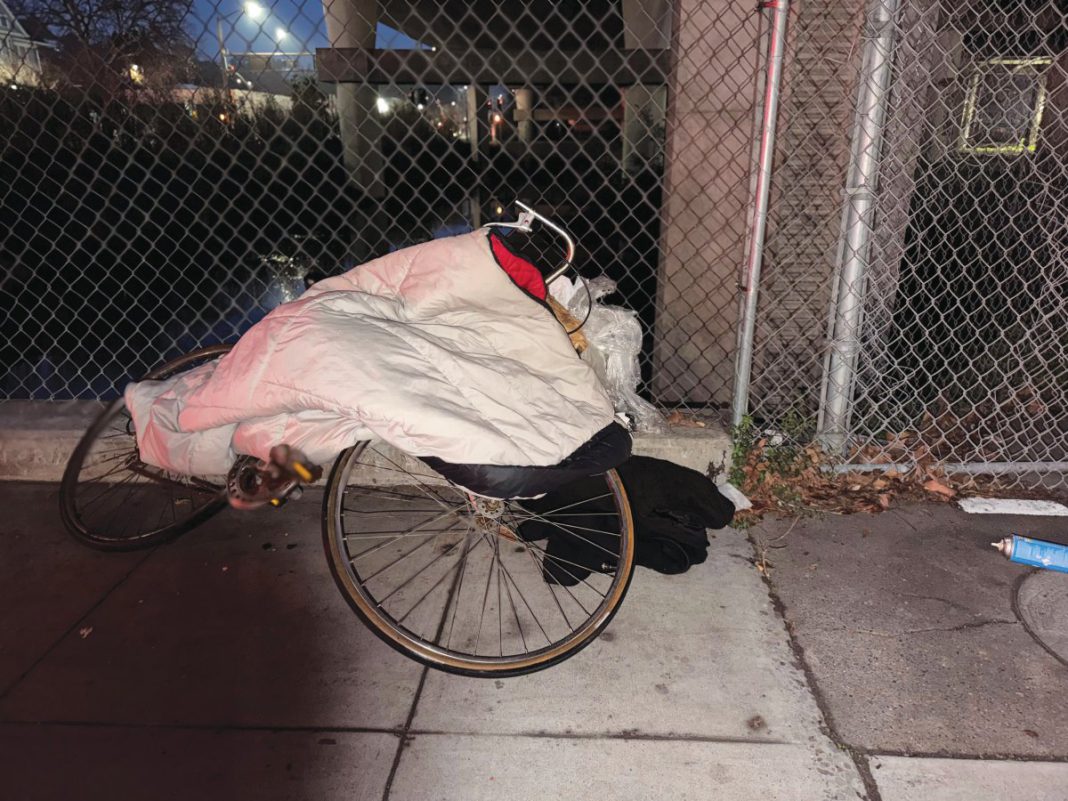
On Jan. 28, beginning at 5am, teams of two to four people searched each of Marin’s 62 census tracts for vehicles, tents, abandoned buildings and isolated sites that may provide a place for an unhoused person to lay their head. The early start was by design, with the counting concluded by about 10am.
“Morning hours are typically when individuals are likely to be in their usual spot,” said Nikolas Brady, senior program coordinator with the Marin County Homelessness & Coordinated Care Division, which is conducting the “point-in-time” or “PIT” count. “The PIT is an imperfect system, but doing it during that time is a more accurate way of counting folks—non-duplicated.”
Required by the U.S. Department of Housing and Urban Development, communities conduct the point-in-time count every two years, and the federal government bases local funding decisions on the results. California also uses the statistics to allocate funds for homelessness services.
In the coming weeks, an in-depth survey will take place to gather more data about Marin’s homeless residents, incorporating questions about demographics and qualitative information, including how a person became homeless, place of residence prior to homelessness and employment status. The county will combine the survey with the point-in-time count to generate a comprehensive report on homelessness.
Marin officials rely on the data to understand homelessness in the county and develop effective strategies to reduce it, said Gary Naja-Riese, the Homelessness & Coordinated Care Division director. The results from count to count help determine trends.
For the first time, Marin embedded a reporter into one of its teams to help demystify the point-in-time count process for the public. I was invited to join two Corte Madera city council members to chronicle their morning activities and later review the operation with the county organizers, Naja-Riese and Brady.
Armed with a map and a phone app to enter data, Corte Madera Vice Mayor Fred Casissa and Councilmember Eli Beckman, with me in tow, traversed three census tracts encompassing large swaths of Corte Madera and Larkspur. Casissa and Beckman had both volunteered for the 2024 point-in-time count and were familiar with the territory. They had also contacted the Central Marin Police Department for a list of areas where homeless people might be staying.
With Beckman at the wheel, Casissa navigated. Driving slowly on residential streets and in commercial areas, they scanned each parked car for foggy or covered windows. The pair had learned in training that condensation from a person’s breath could cloud the windows, while coverings might indicate someone wanting privacy.
Drizzly weather made it difficult to determine if anyone was sleeping in the hundreds of vehicles we passed in Corte Madera. Crossing into Larkspur, we left the car to explore areas under the 101 overpass.
We found no one. Ditto for a commercial area in Larkspur.
Next, we combed the marsh behind Trader Joe’s and Cost Plus. A maze of trails and overflowing brush offer seclusion, while the proximity to a grocery store and public transit deliver convenience. However, large puddles took over the trails, and the shore was mucky, making it inhospitable for habitation.
“We had the floods three weeks ago,” Casissa said. “The levee out here breached.”
As dawn broke, we drove back to Corte Madera and stopped in a neighborhood. Beckman climbed a steep hill behind the library to scan an isolated trail. Although he found a deteriorated tarp and tent, it was clear that people weren’t currently camping at the site.
Two-and-a-half hours later, the council members had traveled through all the assigned areas, yet they did not observe anyone experiencing homelessness. The 2024 point-in-time count had documented three people in Corte Madera and four in Larkspur.
According to Naja-Riese, our outcome wasn’t unusual. Other teams, too, had zero sightings. However, it doesn’t mean that Corte Madera and Larkspur are without a homeless population. The weather could have skewed results. Or volunteers in adjacent tracts with portions of Corte Madera and Larkspur may have counted people.
A San Rafael participant, Ben Stein, encountered a much different scenario. Each of the six teams he coordinated for the point-in-time count saw unhoused folks.
“Every team except one had about 12 to 15 people counted,” Stein said. “There was one team that counted, I believe, 40 people.”
Most of the individuals they observed were in parking lots behind businesses and commercial office buildings, predominantly near Highway 101. That’s why Stein wasn’t surprised when I told him about my experience in Central Marin.
“It’s less of an industrial area,” he said. “I think that people stand out a little bit more, and they get run off.”
But Stein also had the advantage of knowing where to look for folks experiencing homelessness. He oversees the case management team at the Ritter Center, a nonprofit serving homeless people in Marin, and he regularly performs community outreach.
The county recruited staff from its nonprofit partners because of their expertise. It’s also why the teams were composed of people who were formerly homeless, county workers, and officials and staff from Marin’s cities and towns. Each of these people is knowledgeable about their neck of the woods.
“That’s what partially helps us to assure that we are looking comprehensively and in the right places,” said Brady of the county’s homelessness division.
Still, critics of the count maintain that the methodology significantly undercounts the homeless population.
“Point-in-time counts fail to account for the transitory nature of homelessness and thus present a misleading picture of the crisis,” the National Law Center on Homelessness & Poverty stated in a 2017 report.
Agreeing that undercounting occurs, Naja-Riese says it’s not just in Marin but in jurisdictions nationwide. The county states it every time they use the point-in-time data in a report or presentation, he explained.
“It is just designed as a one-day snapshot,” Brady said. The benefit of looking at the analysis historically, though, is it is consistent. The methodology is the same.”
Brady noted the undercounting discrepancy in the point-in-time numbers when comparing them to the actual number of homeless people who move through the county’s coordinated entry system. However, the trends identified through the biennial counts are essential to developing effective county programs and services addressing homelessness.
For example, in the past several years, Marin has greatly reduced the number of homeless veterans. Naja-Riese believes they can soon approach zero. Now, the county is using the same approach with homeless families, hoping to repeat the success it had with reducing veteran homelessness.
Preliminary results from the point-in-time count will be available in spring, with the full report out in the fall.
Editor’s note: This article has been revised to reflect that funds are not being redirected from homeless veterans to homeless families.